Can AI Voice Agents Escalate Calls to Human Agents? Understanding AI Voice Escalation Workflows
When an AI voice agent should hand a call to a person, the five signals that trigger it (intent, sentiment, business rules, confidence, a direct request), the six-step workflow, and the five escalation models to choose from.


Key highlights
Key takeaways
- AI voice escalation allows AI agents to handle routine requests while transferring callers to human reps when a situation requires judgment, empathy, approval, or specialized support
- Escalation decisions are typically driven by customer intent, frustration signals, urgency, business rules, and the AI’s confidence in its ability to continue the conversation
- Unlike a standard call transfer, a proper AI escalation includes call summaries, customer details, and previous interaction history so the rep can pick up where the AI left off
- Calls involving cancellations, complaints, compliance concerns, complex issues, sales opportunities, or repeated AI misunderstandings are strong candidates for escalation
- Successful escalation workflows collect key information, evaluate routing rules, connect callers to the right team, and provide enough context to avoid restarting the conversation
- The result is faster resolutions, fewer repeat explanations, better customer experiences, and clearer control over when automation should give way to human support
Enterprise contact centers need AI agents that can understand the request, follow approved workflows, involve a human rep when judgment is needed, and leave a clear record of what happened. That is where agentic AI becomes useful for real contact center operations.
The pressure is already showing up in budgets. Gartner reported in March 2026 that over 50% of customer service organizations will double their technology spend (opens in a new tab) by 2028, without an equivalent reduction in talent. That means leaders are not buying AI to remove people from the floor. They are being asked to prove that new technology can support reps, improve resolution, and make operations easier to control.
The question is no longer whether AI can talk to customers. The harder question is whether it can run in production without losing context, skipping rules, or creating more work for reps. Agentic AI earns its place when it helps resolve routine contacts, supports reps during complex calls, and gives leaders a clear way to see what happened across every interaction.
What Is AI Voice Escalation
AI voice escalation is the handoff process where an AI voice agent routes a caller to a human rep when automation is no longer the best option. It helps contact centers use AI for routine calls without forcing every customer through automation. This handoff usually depends on signals such as caller intent, urgency, sentiment, missing information, or a rule that requires human review.
The goal is not to keep the caller away from a person at any cost. The goal is to resolve the call in the right way. Some calls can be handled by an AI agent. Some need a human rep who can use judgment, understand context, and handle exceptions. A clear escalation path gives both the caller and the rep a better chance of reaching the right outcome without restarting the conversation (opens in a new tab).
AI escalation meaning
AI escalation means the AI voice agent knows when to stop handling the call and bring in a human rep. This may happen when the caller is upset, the request is sensitive, the issue is too complex, or the workflow needs human judgment. It can also happen when the caller asks for a person directly or when the AI agent does not have enough approved information to continue safely.
This matters because routine calls should not fill the queue, but complex calls should not get trapped in automation. A good escalation setup lets the AI agent handle repeatable work while keeping human reps available for the calls that need care, context, or decision-making. For operations leaders, this creates a cleaner split between what AI can resolve and what should stay with trained people.
AI voice escalation vs call transfer
A basic call transfer usually moves the caller from one queue to another. The human rep may receive the call with little context, which means the caller has to repeat their name, issue, history, and reason for calling. That repeat work is one of the fastest ways to make a caller feel like the system is not listening.
AI voice escalation should work differently. The AI voice agent should pass the call with the caller’s intent, key details, previous steps, and reason for escalation. That gives the rep a better starting point and keeps the customer from feeling like the call is starting over. It also helps the rep focus on solving the issue instead of spending the first minute rebuilding the call history.
Why escalation matters in AI voice automation
Escalation matters because customers get frustrated when automation blocks them from getting help. If the AI voice agent keeps asking the same questions, misunderstands the issue, or fails to recognize urgency, the call can become harder for the customer and the rep. In those moments, poor escalation can turn a manageable call into a complaint, repeat call, or supervisor request.
A strong escalation process protects resolution quality. It lets AI handle routine volume, but gives human reps control when the call needs judgment. That balance helps contact centers reduce avoidable wait time without losing the human support customers still need in complex moments. It also gives leaders a more practical way to measure whether automation is helping with resolution or creating new gaps.
Explore how Orvera routes AI-handled calls to the right human rep. (opens in a new tab)Can AI Voice Agents Really Escalate Calls to Humans
Yes. Modern AI voice agents can escalate calls to human reps when the call needs judgment, approval, empathy, or a team-specific action. Escalation can be based on routing logic, business rules, customer intent, sentiment signals, customer relationship management data, and the outcome of the conversation so far. The value is not just moving the caller somewhere else. The value is moving the caller to the right person with the right context. A strong escalation setup also helps teams avoid repeat explanations, poor routing, and missed handoff details.
Escalation based on customer request
AI voice agents can escalate when a caller directly asks for a human rep, supervisor, billing team, sales rep, or support specialist. This matters because customers should not have to fight the system to reach a person when the request clearly needs one. It also shows the caller that automation is there to help the process, not block access to support.
- The AI voice agent can recognize phrases such as “I want to speak to someone,” “connect me to billing,” or “I need a supervisor”
- The caller can be routed to the right team instead of being pushed through a generic queue
- The handoff can include the caller’s request, account details, and reason for escalation so the rep does not start from zero
Escalation based on intent detection
AI voice agents can detect the reason behind the call and escalate when the intent should not stay inside automation. Calls about cancellations, refunds, complaints, technical issues, purchase readiness, or account disputes often need a different path than routine questions. Intent-based escalation helps the contact center treat each call by its business impact, not just by the words the caller uses.
- A cancellation request can be routed to a retention team instead of a standard support queue
- A refund, dispute, or complaint can be sent to a rep who is allowed to review the case and take the next step
- A sales-ready caller can be routed to the right sales rep while interest is still active
Escalation based on sentiment or frustration
AI voice agents can escalate when the caller sounds frustrated, confused, urgent, angry, or dissatisfied. This prevents the call from getting worse while the customer is still trying to explain the problem. Early escalation can protect the relationship before a difficult call (opens in a new tab) turns into a repeat call or formal complaint.
- Repeated confusion can trigger escalation before the caller has to repeat the same answer again
- Negative sentiment can move the call to a human rep who can slow the conversation down and handle the concern with care
- Urgent language can route the caller faster when waiting inside automation would create a poor experience
Escalation based on business rules
Companies can define rules that tell the AI voice agent when a call must move to a human rep. These rules help protect high-value customers, compliance-sensitive topics, payment issues, unresolved cases, and other situations where automation should not make the final call. Clear business rules also give operations, compliance, and customer experience teams a shared standard for when AI should step back.
- VIP customers or high-value leads can be routed to priority teams based on customer relationship management data
- Payment issues, account disputes, or compliance-sensitive conversations can be sent to trained reps
- Unresolved cases can be escalated when the caller has already contacted support before and still needs help
Escalation based on AI confidence score
AI voice agents can escalate when the AI is not confident enough to answer correctly, understand the request, or complete the workflow safely. This is important because a wrong answer can create more work than no answer. Confidence-based escalation gives the system a practical safety check before the call moves in the wrong direction.
- Low confidence in the caller’s intent can trigger a handoff before the AI voice agent gives an unclear response
- Missing or conflicting information can move the call to a human rep who can verify details
- A workflow can be escalated when the AI voice agent cannot complete the next step inside approved rules
When Should AI Voice Agents Escalate Calls
AI voice agents should escalate calls when automation is no longer the safest or most useful path for the caller. Escalation is not a failure. It is a quality control layer that keeps the customer from getting stuck when the call needs human judgment, approval, or care. It also gives teams a clear way to decide when AI should continue and when a rep should take over.
A good escalation setup protects both the customer and the contact center. It helps AI handle routine volume while making sure trained reps step in when the issue is complex, sensitive, emotional, or too important to leave inside automation. This keeps automation focused on the work it can handle well instead of stretching it into situations where it may create more friction.
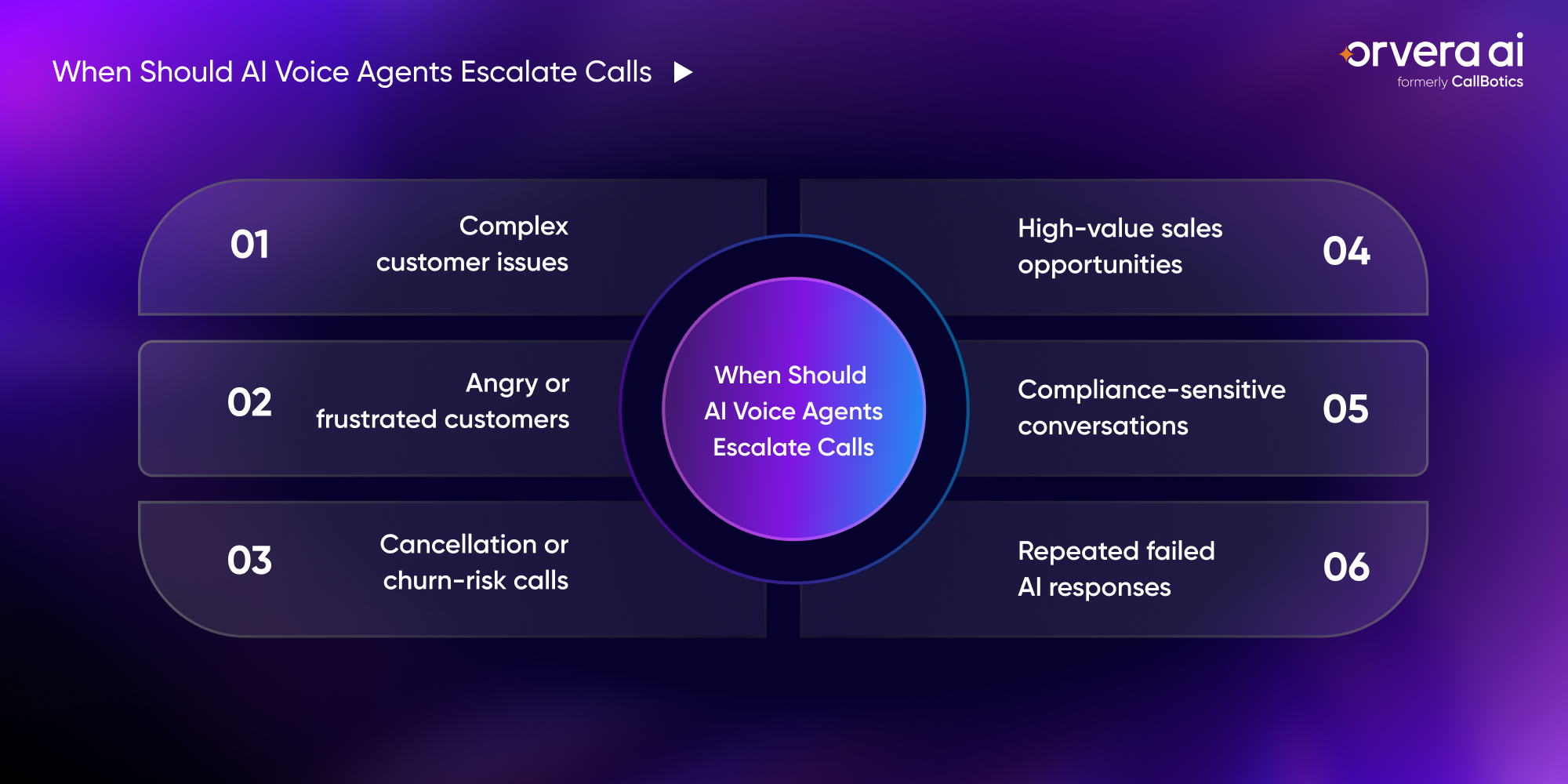
Complex customer issues
Complex customer issues should be escalated when the call involves multiple systems, unusual requests, or unclear customer history. These calls often need a trained rep who can connect details, check different records, and decide the next best step. Without escalation, the caller may get stuck between incomplete records, missing context, or a workflow that does not match their situation.
If the AI voice agent keeps moving through a fixed path when the issue does not fit that path, the caller may end up repeating details without getting closer to resolution. Escalation gives the rep the context they need to pick up the call without making the customer start again. This is especially useful when the problem has already moved across teams, channels, or previous support tickets.
Angry or frustrated customers
Angry or frustrated customers should be escalated before the call gets worse. Emotional calls often need empathy, judgment, and flexibility that a human rep is better suited to provide. The longer a frustrated caller stays in automation, the more likely they are to feel ignored rather than helped.
This is especially important when the caller feels ignored, rushed, or misunderstood. A timely handoff can calm the conversation, protect the customer relationship, and help the rep focus on fixing the issue instead of repairing the experience first. It also helps supervisors see which workflows are creating friction before the same pattern affects more callers.
Cancellation or churn-risk calls
Cancellation requests, downgrade intent, or repeated dissatisfaction should trigger escalation to retention or customer success teams. These calls are not only service issues. They can affect revenue, loyalty, and long-term customer value. Treating them as standard support calls can cause teams to miss the moment where the customer is still open to being helped.
AI can identify the churn-risk signal, collect the reason, and route the caller to the right team. The human rep can then review the account, understand the customer’s concern, and offer the right next step instead of treating the call like a routine request. This gives retention teams the context they need before the conversation turns into a final cancellation.
High-value sales opportunities
High-value sales opportunities should be escalated when a caller shows clear buying intent or asks for help that needs a sales rep. AI can qualify the caller, capture basic details, and identify whether the opportunity is ready for a human conversation. This helps sales teams focus on real buying signals instead of sorting through every inbound question manually.
This prevents interested prospects from sitting in the wrong queue or waiting for a callback after the moment has passed. A well-timed transfer helps the sales rep enter the call with context and continue the conversation while the customer is still engaged. It also reduces the risk of losing a qualified buyer because the routing path was too slow or too generic.
Compliance-sensitive conversations
Compliance-sensitive conversations should be escalated when the call involves financial details, legal concerns, healthcare information, identity verification, or policy exceptions. These calls often need trained human oversight because the cost of a wrong answer can be high. Clear escalation rules help protect the business from letting automation handle decisions that require review.
The AI voice agent can still help by collecting approved information and routing the call correctly. But when the next step requires review, exception handling, or regulated decision-making, escalation protects the customer, the rep, and the business. It also creates a cleaner record of why the call moved from AI to a human rep.
Repeated failed AI responses
Repeated failed AI responses should trigger escalation instead of making the customer continue with automation. If the AI voice agent gives multiple fallback responses, asks the same question again, or keeps misunderstanding intent, the call should move to a human rep. This prevents the caller from feeling trapped in a loop that the system cannot fix.
This prevents a small issue from turning into a poor experience. It also gives leaders a clear signal that a workflow, intent, or knowledge source may need improvement before more callers face the same problem. Those escalation patterns can show where training data, approved answers, or routing rules need to be tightened.
How AI Voice Escalation Workflows Work
AI voice escalation workflows follow a clear sequence. The AI voice agent listens to the caller, understands the issue, checks the rules, chooses the right team, and transfers the call with context. The point is to avoid blind transfers where the customer repeats everything and the rep starts with no useful information. A clear workflow also gives operations leaders a better way to see where calls move out of automation and why.
Step 1: AI understands the caller’s intent
The AI voice agent first listens to what the caller is trying to do. It identifies whether the caller needs a routine answer, a workflow action, or human support. This step matters because poor intent detection can send the caller to the wrong path before the call has really started. Good intent detection also helps separate common service requests from issues that need approval, review, or judgment.
- The AI voice agent identifies the reason for the call, such as billing, cancellation, sales, support, account access, or a complaint
- The AI voice agent checks whether the request can be handled safely inside automation
- The AI voice agent can flag calls that need human judgment instead of forcing the caller through a fixed script
Step 2: AI collects required information
Before escalation, the AI voice agent should collect the details the rep will need to continue the call. This prevents the customer from repeating basic information (opens in a new tab) after the handoff. It also helps the contact center avoid wasted handle time caused by missing or incomplete call details. The right information up front can make the difference between a smooth handoff and another round of discovery.
- The AI voice agent can collect the caller’s name, account details, issue type, and urgency
- The AI voice agent can capture what the caller already tried before asking for help
- The AI voice agent can document the reason for escalation so the rep knows why the call moved out of automation
Step 3: AI checks escalation rules
The AI voice agent then checks the conversation against predefined escalation rules. These rules help the contact center decide when AI should continue and when a human rep should take over. Without clear rules, escalation becomes inconsistent and callers with serious issues may stay in automation too long. Strong rules also reduce guesswork for teams that need predictable handling across high-volume calls.
- The AI voice agent can check customer priority, issue type, sentiment, compliance risk, and confidence score
- The AI voice agent can escalate calls involving sensitive topics, unresolved cases, or high-value customers
- The AI voice agent can stop the workflow when the next step requires approval, review, or human judgment
Step 4: AI chooses the right human agent or team
Once escalation is needed, the AI voice agent should route the call to the right rep or team. A good workflow does not treat every escalation the same. It uses the caller’s issue, profile, and business priority to avoid sending the customer into the wrong queue. Better routing also protects skilled reps from receiving calls that should have gone to another team first.
- The AI voice agent can route billing issues to billing, sales-ready calls to sales, and technical problems to support
- The AI voice agent can consider language, skill, availability, customer tier, and issue category
- The AI voice agent can prioritize urgent or high-value calls when business rules require faster handling
Step 5: AI transfers the call with context
The transfer should include the context the receiving rep needs to continue the conversation. This is where AI voice escalation becomes different from a basic call transfer. The caller should not have to explain the whole issue again because the system failed to pass the details forward. Context transfer also helps the rep avoid repeating questions the caller has already answered.
- The AI voice agent can pass the caller’s intent, call summary, sentiment, and account details
- The AI voice agent can include attempted resolution steps so the rep does not repeat what already failed
- The AI voice agent can show the reason for escalation, such as low confidence, customer request, urgency, or policy review
Step 6: Human agent continues the conversation
After the handoff, the human rep should be able to continue the call naturally. The rep should know who the caller is, why they called, what the AI voice agent already asked, and what needs to happen next. This makes the experience smoother for the customer and easier for the rep. It also gives the rep more room to use judgment instead of spending the first part of the call rebuilding the history.
- The rep can start from the latest context instead of asking the customer to repeat the issue
- The rep can focus on solving the problem instead of rebuilding the call history
- The customer gets a smoother support experience because the handoff feels connected, not like a restart
Types of AI Voice Escalation Workflows
Businesses can use different AI voice escalation workflows depending on call volume, team structure, customer journey, and support complexity. The right model depends on what the caller needs, which team should handle it, and how much context the rep needs before taking over. Choosing the wrong model can create longer waits, poor routing, and more repeat explanations for the customer.
Escalation should not be designed as one generic transfer path. A billing issue, angry caller, sales-ready prospect, and compliance-sensitive case may all need different routing, priority, and handoff details. The workflow should match the risk, urgency, and business value of the call.
Direct human transfer
Direct human transfer is a workflow where the AI voice agent routes the caller immediately to a live rep when a trigger is detected. This is useful when the caller directly asks for a person, the issue is too sensitive for automation, or the AI voice agent identifies that the next step needs human judgment. It works best for moments where speed matters more than collecting extra details.
This workflow helps prevent customers from getting stuck in automation when the call clearly needs a rep. The main risk is sending too many calls to the same team without enough filtering, so direct transfer works best when triggers are clear and the receiving team is ready to handle that call type. Clear trigger design keeps direct transfers helpful instead of turning them into another source of queue pressure.
Warm transfer with AI summary
Warm transfer with AI summary means the AI voice agent passes key call details to the receiving rep before or during the handoff. The summary may include the caller’s intent, issue type, sentiment, account details, and what the AI voice agent already tried. This gives the rep a clear starting point before they speak to the caller.
This reduces one of the biggest customer pain points in escalated calls: repeating the same information again. It also helps the rep start with useful context, so the first part of the human conversation can focus on solving the issue instead of rebuilding the call history. For busy teams, this can make escalated calls feel more organized and less reactive.
Queue-based escalation
Queue-based escalation means the AI voice agent places the caller into the right queue while preserving call context, priority level, and reason for transfer. This is useful for contact centers that have separate teams for billing, technical support, sales, retention, compliance, or account management. It helps larger teams route calls based on skill instead of sending everyone through the same path.
The value is not only routing the caller to a queue. The value is making sure the queue receives enough information to handle the call properly. Without context, queue-based escalation can feel like a basic transfer, where the customer waits and then starts the conversation again. Context also helps supervisors understand why certain queues are receiving more escalations.
Callback-based escalation
Callback-based escalation means the AI voice agent schedules a callback when human reps are unavailable or wait times are too long. Instead of keeping the caller on hold, the AI voice agent can capture the issue (opens in a new tab), confirm contact details, and arrange a follow-up from the right team. This gives the customer a clearer next step instead of leaving them waiting without control.
This helps reduce hold time and protects the customer experience during peak volume. It also gives the contact center a better way to manage capacity, because reps can return calls with context instead of receiving rushed, frustrated callers from a long queue. Callback workflows are especially useful when demand spikes faster than staffing can respond.
Supervisor escalation
Supervisor escalation means the AI voice agent routes high-risk, angry, or compliance-sensitive calls directly to a supervisor or senior rep. This is useful when the issue has already escalated emotionally, involves a policy exception, or carries business, legal, financial, or healthcare-related risk. The caller gets someone with the authority to review the issue instead of another handoff.
This workflow helps protect customers and frontline reps in situations that need experience and authority. It also keeps sensitive calls from moving through the wrong path, where a delay or incorrect response can make the issue harder to fix. Supervisor escalation should be reserved for clear triggers so senior teams stay available for the calls that truly need them.
Benefits of AI-to-Human Escalation Workflows
AI-to-human escalation workflows help contact centers use automation without leaving customers trapped when they need a person. When escalation is designed well, AI handles routine work, human reps handle judgment-heavy calls, and leaders get a cleaner view of where automation helps or needs improvement. This makes automation easier to manage because every handoff has a reason, a route, and a record.
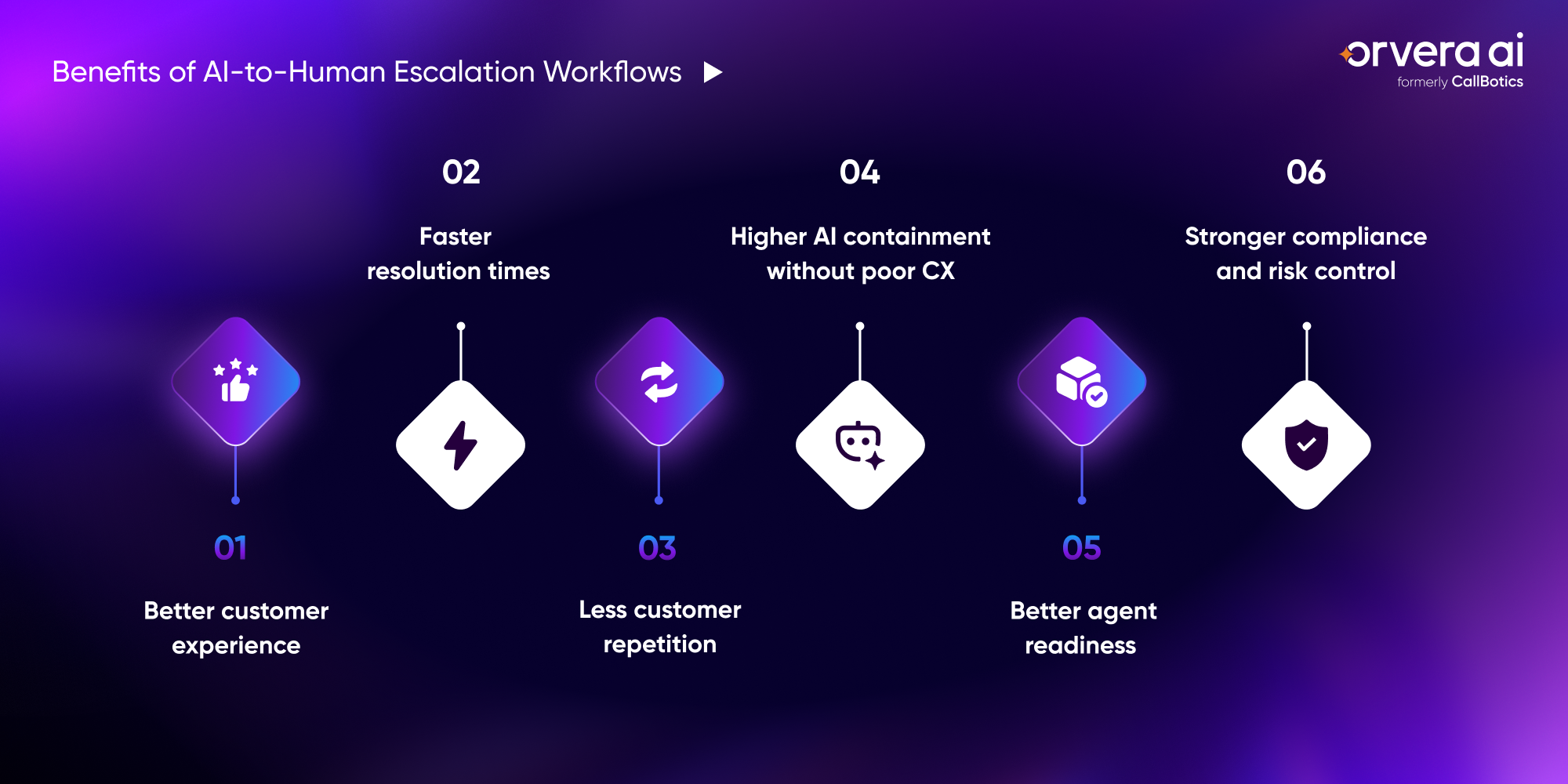
Better customer experience
A strong escalation workflow gives customers automation when it is useful and human support when the call needs care, judgment, or flexibility. This reduces frustration because the caller is not forced to stay with AI when the issue is sensitive, urgent, or too complex for automation. It also makes the experience feel more respectful because the customer’s situation decides the path, not a fixed script.
- Customers can move to a human rep when the call needs more than a standard answer
- Automation feels more helpful because it does not block access to support
- Trust improves when the caller sees that the system can recognize when human help is needed
Faster resolution times
AI-to-human escalation can shorten resolution time because the AI voice agent collects useful details before the transfer. The rep receives the issue type, caller information, urgency, and attempted steps, so they can move faster once they join the call. This helps reduce the slow start that often happens when a rep receives an escalated call with no background.
- The rep starts with context instead of asking every basic question again
- The caller spends less time explaining what already happened
- The contact center reduces avoidable handle time caused by incomplete handoffs
Less customer repetition
Context-rich handoffs help prevent one of the biggest customer pain points: repeating the same problem multiple times. When the AI voice agent passes the call summary, intent, account details, and previous steps, the human rep can continue the conversation with less friction. This is especially important for callers who are already stressed, short on time, or contacting support after an earlier failed attempt.
- Customers do not have to restart the call after escalation
- Reps can see what the AI voice agent already asked or attempted
- The handoff feels connected because the conversation history moves with the caller
Higher AI containment without poor CX
Escalation helps businesses automate more calls safely because customers still have a path to a human rep when needed. This makes containment healthier because the goal is not to keep every caller inside automation, but to resolve more routine contacts without harming the experience. Clear escalation rules give teams the confidence to expand automation without ignoring edge cases or sensitive calls.
- AI can handle repeatable calls while complex calls move to trained reps
- Customers are less likely to feel stuck because escalation remains available
- Teams can expand automation with clearer rules for when AI should stop
Better agent readiness
Escalation workflows help reps prepare before they join the conversation. Instead of entering the call without context, reps can receive summaries, issue details, sentiment signals, customer information, and the reason for escalation. This gives reps a clearer view of the caller’s state before the first human sentence is spoken.
- Reps understand the caller’s issue before they speak
- Sentiment signals help reps adjust tone for frustrated or urgent callers
- Summaries reduce the mental load of rebuilding the call history in real time
Stronger compliance and risk control
Escalation rules help route sensitive calls to trained human reps instead of letting AI handle risky situations alone. This is important for calls involving financial details, healthcare information, legal concerns, identity verification, policy exceptions, or other regulated topics. A defined escalation path also helps teams show that high-risk calls were handled through the right level of oversight.
- Sensitive calls can move to reps who are trained to handle them
- Risky workflows can be stopped before AI gives an answer it should not give
- Leaders get a clearer control layer for deciding which calls need human review
How Orvera Helps Businesses Build Smarter AI Voice Escalation Workflows
Orvera AI helps enterprises design AI agents that know when to continue automation and when to bring in a human rep. The goal is to route each call through the path that gives the customer the best chance of resolution. That matters most when call volume is high and one wrong routing decision can create longer queues, repeat calls, and frustrated customers.
Orvera supports escalation with intent detection, sentiment signals, workflow rules, call summaries, and routing logic. That helps teams avoid blind transfers, missed context, and automation paths that keep customers waiting when a human rep should step in. It also gives contact center leaders a clearer way to manage where AI should act and where human judgment should take over.
Intent-based escalation logic
Orvera helps AI voice agents detect what the caller is actually trying to do before deciding the next step. A billing question, cancellation request, technical issue, complaint, or sales inquiry should not follow the same escalation path. Clear intent detection helps the AI voice agent treat the call based on the real issue, not only the first words the caller says.
This matters because poor intent detection creates poor routing. When the reason for the call is clear, the AI voice agent can route the caller to the right team instead of sending them through a generic queue or making them repeat the issue later. It also helps teams reduce avoidable transfers between departments.
Sentiment-aware human handoff
Orvera helps identify signals such as frustration, urgency, dissatisfaction, or churn risk during the call. When those signals appear, the AI voice agent can move the caller to a human rep before the experience gets worse. This helps prevent emotional calls from staying inside automation longer than they should.
This is important because emotional calls often need judgment and care. A timely handoff helps protect the customer relationship and gives the rep a better chance to calm the conversation instead of repairing damage caused by delayed escalation. It also helps supervisors see which call types are creating frustration more often.
AI-generated call summaries for agents
Orvera can provide human reps with concise call summaries before or during the handoff. These summaries can include the customer’s intent, key details, previous AI steps, sentiment signals, and recommended next actions. This gives the rep a practical starting point before joining the conversation.
This reduces the most common pain point in escalated calls: the customer having to start over. The rep enters the conversation with context, so the first human response can focus on solving the issue instead of asking for information the caller already gave. It also helps reduce the pressure on reps during busy periods because they are not rebuilding the call from memory.
Workflow-based routing
Orvera supports escalation workflows for sales, support, billing, retention, technical support, and enterprise operations. Each workflow can be shaped around the team that should own the issue and the rules that decide when AI should step back. This helps different departments receive the calls they are trained and authorized to handle.
This helps businesses avoid one-size-fits-all escalation. A sales-ready lead, payment issue, support complaint, and technical failure all need different routing, priority, and handoff details. When routing reflects the actual workflow, customers reach the right team faster and reps receive fewer misplaced calls.
Escalation analytics and optimization
Orvera helps teams monitor how escalation workflows perform after calls move from AI to human reps. Teams can review escalation accuracy, handoff quality, customer sentiment, and resolution outcomes to understand where the workflow is working and where it needs adjustment. This helps leaders find the difference between a useful escalation and a preventable one.
This gives leaders a practical way to improve AI performance over time. Instead of guessing why callers escalate, teams can see patterns, fix weak workflows, tighten routing rules, and make future handoffs cleaner for both customers and reps. These insights also help teams decide which calls should remain automated and which should move to human support earlier.
Conclusion
AI voice agents can handle many routine calls, but they should not be forced to handle every call. When a customer needs judgment, empathy, approval, or a trained human rep, escalation should happen quickly and with the right context. The best escalation workflows use intent detection, sentiment signals, routing logic, and confidence checks to decide when automation should stop and human support should begin. This keeps automation useful without making the caller feel stuck inside a process that cannot solve their issue.
A strong handoff also protects the customer experience. When the rep receives the call summary, customer intent, account details, and previous AI steps, the conversation can continue without making the caller repeat everything. For contact centers, escalation is not a weakness in automation. It is the control layer that helps AI handle routine volume while human reps take the calls that need care, judgment, and clear ownership. It also gives leaders a practical way to improve routing, reduce repeat friction, and see where automation needs tighter rules.
Frequently asked questions
Yes. AI voice agents can transfer calls to human reps when the caller asks for a person, the issue is too complex, or the conversation reaches a rule that requires human support. The best transfers include context, such as the caller’s intent, issue type, account details, and what the AI voice agent already tried.
An AI voice agent should escalate a call when automation is no longer the right path for the customer. Common triggers include angry or frustrated callers, cancellation requests, compliance-sensitive topics, high-value sales opportunities, unresolved issues, low AI confidence, or repeated failed responses.
AI voice escalation is the process of moving a caller from an AI voice agent to a human rep when the call needs judgment, empathy, approval, or specialist support. It helps businesses use automation for routine calls while keeping human reps available for complex or sensitive conversations.
AI can decide when to transfer a call by checking the caller’s intent, sentiment, urgency, confidence score, account details, and predefined business rules. For example, the AI voice agent may escalate when a caller asks for billing, sounds frustrated, mentions cancellation, or needs help with a policy exception.
Orvera supports AI-to-human escalation by helping enterprises design AI voice agents that know when to automate and when to involve a human rep. It can support intent-based routing, sentiment-aware handoffs, workflow-based escalation, AI-generated call summaries, and escalation analytics so reps receive the right context before continuing the conversation.

Written by
Anindita Majumder
Anindita Majumder is a communications professional with nearly four years of experience in public relations, corporate communications, and journalism. She creates content that helps brands communicate their vision, products, and expertise through press releases, thought leadership, and editorial pieces. Outside of work, she is a vocalist, which keeps her creativity flowing.