Decision-ready
One view
Executive CX
Feedback, interaction context, CX drivers, and improvement priorities in one place, so leaders share a single view of experience and performance.
Orvera AI Voice of Customer is the customer-experience intelligence layer of the Orvera platform. It brings survey responses, NPS, CSAT, complaints, and open-text feedback together with the interaction each one came from, then surfaces the themes and drivers behind the scores. Leaders get one executive view across channels and teams, and a live program runs in 2 to 3 weeks.
Orvera AI Voice of Customer runs as one layer over the survey tools an enterprise already has, because scores held in separate systems carry no context. Every response is linked to the interaction behind it, including resolution status, escalation, repeat contact, and handoff history. Themes and drivers are surfaced by contextualization models Orvera custom-trains on de-identified data, so leaders see why a score moved rather than only that it did.
Fragmented feedback
Orvera unified VoC
Orvera AI Voice of Customer brings together survey responses, NPS, CSAT, complaint records, and open-text comments from post-call, post-chat, email, SMS, web, app, and branch, plus the interaction intelligence from conversations Orvera runs. Signals are normalized so trends compare across channels, teams, and journeys, and each one keeps a link back to the record it came from.
Orvera AI Voice of Customer works in five steps. It reads the survey, NPS, CSAT, and complaint programs an enterprise already runs, consolidates them into one layer, links each response to the interaction that shaped it, detects the themes behind weak scores, and delivers priorities to leaders in governed dashboards. A live program takes 2 to 3 weeks.
Keep the survey, NPS, CSAT, and complaint programs your teams already use, across post-call, post-chat, email, SMS, web, app, and branch. VoC coverage expands without disrupting how feedback is collected.
Consolidate structured survey data and open-text feedback into a single CX intelligence layer, aligned across channels, teams, and journeys, and normalized so trends compare consistently.
Link feedback to resolution status, escalation, repeat contact, and handoff history. Post-call and post-chat responses relate to the interaction that shaped the experience.
Detect the themes behind low NPS, weak CSAT, negative sentiment, and complaints. Identify friction across journeys and teams, and prioritize the issues most likely to affect satisfaction.
Bring feedback, interaction context, CX drivers, and improvement priorities into dashboards, with governed access and enterprise reporting, so leaders share one view of experience.
Keep the survey, NPS, CSAT, and complaint programs your teams already use, across post-call, post-chat, email, SMS, web, app, and branch. VoC coverage expands without disrupting how feedback is collected.
Consolidate structured survey data and open-text feedback into a single CX intelligence layer, aligned across channels, teams, and journeys, and normalized so trends compare consistently.
Link feedback to resolution status, escalation, repeat contact, and handoff history. Post-call and post-chat responses relate to the interaction that shaped the experience.
Detect the themes behind low NPS, weak CSAT, negative sentiment, and complaints. Identify friction across journeys and teams, and prioritize the issues most likely to affect satisfaction.
Bring feedback, interaction context, CX drivers, and improvement priorities into dashboards, with governed access and enterprise reporting, so leaders share one view of experience.
Orvera AI Voice of Customer connects the feedback channels an enterprise already uses, ties each response to the interaction behind it, surfaces the themes driving low NPS, weak CSAT, and complaints, and routes each one to the team that owns it. Findings feed workflow, routing, and coaching changes, and reach leaders as one executive view with governed access and enterprise reporting.
Extended without replacing established systems
Extended without replacing established systems
Keep the feedback programs your teams already use, while expanding visibility across customer touchpoints. This helps enterprises improve visibility without disrupting how feedback is already collected.
Unify scattered feedback sources into a single customer experience intelligence layer. This creates a cleaner foundation for enterprise-wide customer experience analysis.
“Took two calls to sort out my bill.”
See what happened before, during, and after the customer gave feedback. This helps teams move from feedback scores to the operational context behind them.
Identify the patterns that explain changes in customer experience. This shows leaders why customer experience is improving, declining, or becoming inconsistent.
Convert customer feedback into focused operational action. This turns VoC from a reporting function into an improvement system for service operations.
Make customer experience visible, measurable, and decision-ready for leadership. This gives leadership one place to understand what customers are saying, what is driving it, and where teams should act.
Orvera AI Voice of Customer includes unified surveys, NPS, and CSAT, open-text and sentiment analysis, theme and driver detection, feedback linked to resolution status, escalation, repeat contact, and handoff history, journey friction mapping, and an executive CX dashboard. Governed access, auditability, and enterprise reporting run throughout, and it works with the survey platforms an enterprise already has.
Feedback, interaction context, CX drivers, and improvement priorities in one place, so leaders share a single view of experience and performance.
Structured feedback from every channel, consolidated and normalized into one VoC layer.
Reads the tone and meaning behind every comment.
Surfaces the patterns behind low NPS, weak CSAT, and complaints.
Identifies where journeys, channels, workflows, and teams break down.
Auditability and enterprise reporting built in for leadership use.
Extends VoC coverage without replacing established systems.
Orvera builds, deploys, and runs Orvera AI Voice of Customer, and stays on it after go-live. Orvera connects the surveys, support tickets, call transcripts, chats, and app reviews already being collected, sets up theming and sentiment, routes emerging issues to the teams that own them, and ties theme trends to CSAT. A live program runs in 2 to 3 weeks.
Surveys, support tickets, call transcripts, chats, app reviews, and social pull into one place, categorized automatically.
Every comment is categorized by theme, product area, and sentiment, so you see what customers raise and how strongly they feel it.
Emerging issues go to the teams who own them, carrying the verbatim quotes and the volume behind each one.
Theme trends line up against CSAT, churn, and revenue, so you can prove which fixes actually moved the metric.
Orvera AI Voice of Customer reaches a live program in 2 to 3 weeks. Voice of Customer reads the feedback an enterprise already collects. Categorization runs automatically with no manual tagging backlog, and owners receive their first prioritized themes inside the first week. Timelines depend on the number of sources and integrations.
to a live VoC program.
Timelines depend on the number of feedback sources and integrations.
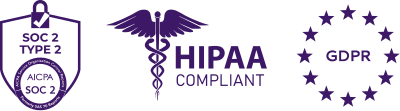
Orvera AI Voice of Customer processes feedback the enterprise already owns, under SOC 2 Type II, HIPAA compliant, and GDPR compliant controls. Personal details are detected and redacted before analysis begins. Dashboards, verbatims, and exports are scoped by role, tenancy is isolated for BPOs running multiple clients, and every theme and metric links back to the records it came from.
Personal details are detected and redacted before any feedback is processed.
Dashboards, verbatims, and exports are scoped to who should see them.
Every theme and metric links back to the records it was drawn from.
Isolated tenancy built for BPOs.



Getting started with Orvera AI Voice of Customer begins with a demo and a look at the feedback sources already in place. Orvera builds, deploys, and runs the program, connecting surveys, NPS, complaints, and interaction intelligence into one executive view of customer experience. A live program lands in 2 to 3 weeks.