
Call scoring is how sales and support teams check whether customer conversations are actually working. Manual call scoring depends on a manager, QA lead, or team lead reviewing selected calls against a scorecard. Automated call scoring uses AI to review more conversations, find patterns faster, and flag moments that need attention.
This matters because customer expectations are still ahead of what many teams can deliver. Zendesk’s CX Trends 2026 report says 83% of consumers believe customer experiences should be better than they are today. That gap is exactly why teams need a clearer way to review calls, not only for script adherence, but for tone, accuracy, resolution, and follow-up quality.
Manual scoring still matters because human judgment is needed for context, coaching, and edge cases. Automated scoring matters because managers cannot review every call by hand without slowing the team down. The real shift is not choosing one over the other, but using AI to cover more conversations while keeping human review focused on the moments that need judgment.
Manual call scoring is the process where QA managers, supervisors, or team leads listen to recorded customer conversations and score them against predefined quality criteria. The scorecard usually covers how the rep opened the call, understood the customer’s need, followed the process, handled objections, showed empathy, resolved the issue, and closed the conversation. It gives teams a structured way to judge call quality instead of relying only on memory, opinion, or customer complaints after the fact.
Teams use manual scoring because customer conversations are not always easy to judge from a number alone. A call can follow the script and still feel rushed, or miss a line in the script and still solve the customer’s problem well. Manual review gives leaders the context they need to coach reps with judgment, not just mark calls as pass or fail. This is especially useful when the conversation involves a difficult customer, a sensitive issue, or a decision that needs more context than a score can show.
Manual call scoring usually starts with a supervisor or QA lead selecting a small set of calls for review. They listen to the recording, check the transcript if one is available, compare the conversation against a scorecard, and mark where the rep met or missed the expected quality standard. After that, the reviewer usually notes coaching points, examples, and follow-up actions for the rep or the team.
The pain point is that this process takes time, so most teams can only review a limited sample of calls. That means strong calls, missed opportunities, compliance gaps, and coaching moments can go unnoticed for days or weeks. Manual scoring gives useful feedback, but it depends heavily on which calls are selected and how consistently each reviewer applies the scorecard. When call volume increases, this gap becomes harder to manage because quality leaders have more conversations to review than time available.
Manual call scoring measures the parts of a conversation that affect customer trust, sales quality, and support outcomes. Common criteria include greeting quality, discovery, objection handling, empathy, compliance language, resolution quality, product or process accuracy, call control, and closing. These criteria help teams connect rep behavior to the outcomes they care about, such as customer confidence, conversion quality, repeat contacts, and issue resolution.
These criteria matter because a customer conversation can break down in small ways. A rep may ask the right questions but miss the customer’s concern. They may handle the issue but forget a required disclosure. Manual scoring helps teams catch these details, especially when the goal is to improve coaching, protect compliance, and understand why some conversations lead to better outcomes than others. It also gives managers real call examples they can use in coaching sessions instead of giving broad feedback that is hard for reps to act on.
Teams still use manual call scoring because some conversations need human judgment. Complex sales calls, escalations, complaints, compliance-sensitive conversations, and emotionally charged support calls often need a reviewer who can understand tone, intent, hesitation, and context. These are the moments where a transcript or score alone may not explain what actually happened during the call.
This is where manual scoring still earns its place. A scorecard can tell whether a rep followed the process, but a human reviewer can explain why the conversation worked or why it failed. For team leads and QA managers, manual scoring is especially useful for coaching edge cases, reviewing sensitive calls, and helping reps improve the judgment behind their decisions. It keeps quality review connected to real customer behavior, not only to checklist completion.
With automated call scoring, AI analyzes customer conversations and generates call scores without requiring a supervisor to review every call manually. It can review call recordings, transcripts, sentiment, intent, keywords, compliance rules, and conversation outcomes to show where the call met or missed the expected standard. This gives QA leaders a faster way to see quality patterns that are difficult to catch when reviews depend only on selected samples.
The process starts by turning the call recording into a transcript and reviewing the conversation against predefined quality rules. AI looks for signals such as what the customer asked for, how the rep responded, whether required steps were followed, and whether the conversation ended with a clear outcome. This helps managers move from reviewing isolated calls to seeing repeated behaviors across a larger set of customer conversations.
This type of scoring measures both process quality and conversation quality. That matters because a call can look complete on paper but still miss the customer’s concern, skip a required statement, or end without a clear next step. By reviewing these details across more calls, teams can separate one-time mistakes from recurring issues that need process or coaching changes.
Teams are moving toward AI-based scoring because manual QA cannot keep up with high call volume. When only a small sample is reviewed, leaders may miss repeat issues, coaching gaps, compliance risks, and customer frustration patterns that are spread across the rest of the calls. AI-supported scoring helps teams find those issues earlier, before they turn into missed sales, repeat contacts, or escalations.
Manual call scoring still adds value because not every customer conversation can be judged by rules alone. It gives QA managers, supervisors, and team leads a way to understand context, coach with real examples, and review conversations where the risk is too high for a score to stand on its own. This keeps quality assurance connected to real customer behavior, not only to checklist completion.
Human reviewers can understand the full context behind a call, not only the words used in the conversation. They can pick up tone, hesitation, frustration, customer history, unusual requests, and moments where the rep had to make a judgment call. This helps leaders avoid unfair scores when the rep had to adjust based on the customer’s situation.
This matters because complex calls do not always fit neatly into a scorecard. A rep may miss one step but still handle the customer well, or follow every step and still leave the customer confused. Manual scoring helps managers see that difference before they turn the call into a coaching point. It also helps them separate a process issue from a rep performance issue.
Manual reviews help managers give coaching that is specific to the rep’s actual behavior on the call. Instead of saying “improve objection handling” or “show more empathy,” the manager can point to the exact moment where the conversation changed. This makes the feedback feel more practical because the rep can connect it to a real customer interaction.
This makes coaching easier for reps to act on. They can hear what worked, where the customer pushed back, where the response felt weak, and how to handle a similar call next time. That kind of feedback is harder to give when the review only shows a score without the story behind it. It also builds more trust in the QA process because reps can understand the reason behind the feedback.
Some calls carry more risk than others and should not be judged only by an automated score. Complaints, compliance-sensitive calls, angry customers, refund disputes, billing issues, legal-risk conversations, and escalations often need a human reviewer to check what happened carefully. These calls can affect customer trust, business liability, and the next action the team takes.
Manual review gives leaders more confidence before they take action on these calls. It helps them confirm whether the rep followed the right process, whether the customer was treated fairly, and whether the next step was handled properly. For high-risk conversations, that extra layer of human review can protect both the customer and the business. It also gives teams a clearer record when a call needs to be escalated, documented, or reviewed again later.
See how Orvera helps QA teams review every customer conversation without losing human judgment.Manual call scoring becomes harder to manage as call volume grows. When QA managers, supervisors, and team leads can only review a small set of calls, the business may miss important sales conversations, support issues, compliance gaps, and coaching needs across the rest of the queue. This makes quality assurance less reliable because leaders are often making decisions from a partial view of customer conversations.
Manual QA teams usually review only a small percentage of total calls because every review takes time. This creates a blind spot because many customer conversations are never checked, even when they contain missed sales opportunities, poor resolution, compliance risks, or repeat customer frustration. As a result, leaders may not see the real reasons behind low conversion, repeat contacts, or uneven customer experience.
Manual call scoring often creates slow feedback because reviewers need time to select calls, listen to recordings, complete scorecards, and prepare coaching notes. By the time the rep receives feedback, the call may already feel too far removed from the moment to correct the behavior quickly. This delay can make coaching feel reactive instead of helping reps improve while the issue is still fresh.
Manual scoring depends on human judgment, which is useful but not always consistent. Two reviewers may score the same call differently based on their experience, interpretation of the scorecard, coaching style, workload, or even how strict they are on that day. Over time, this can make QA scores feel less like a shared standard and more like individual reviewer preference.
Manual QA takes significant time from managers, team leads, and QA analysts, especially in high-volume sales and support teams. As call volume grows, teams either need more reviewers or they accept lower QA coverage, and both options create pressure on cost, coaching quality, and operational control. This often turns QA into a capacity problem instead of a consistent performance improvement process.
Quality teams can evaluate more customer conversations without waiting for every call to be reviewed by hand. This improves consistency, shows performance trends faster, and helps managers focus their time on coaching, risk review, and the conversations that need judgment. The result is a more reliable way to manage quality when call volume keeps increasing.
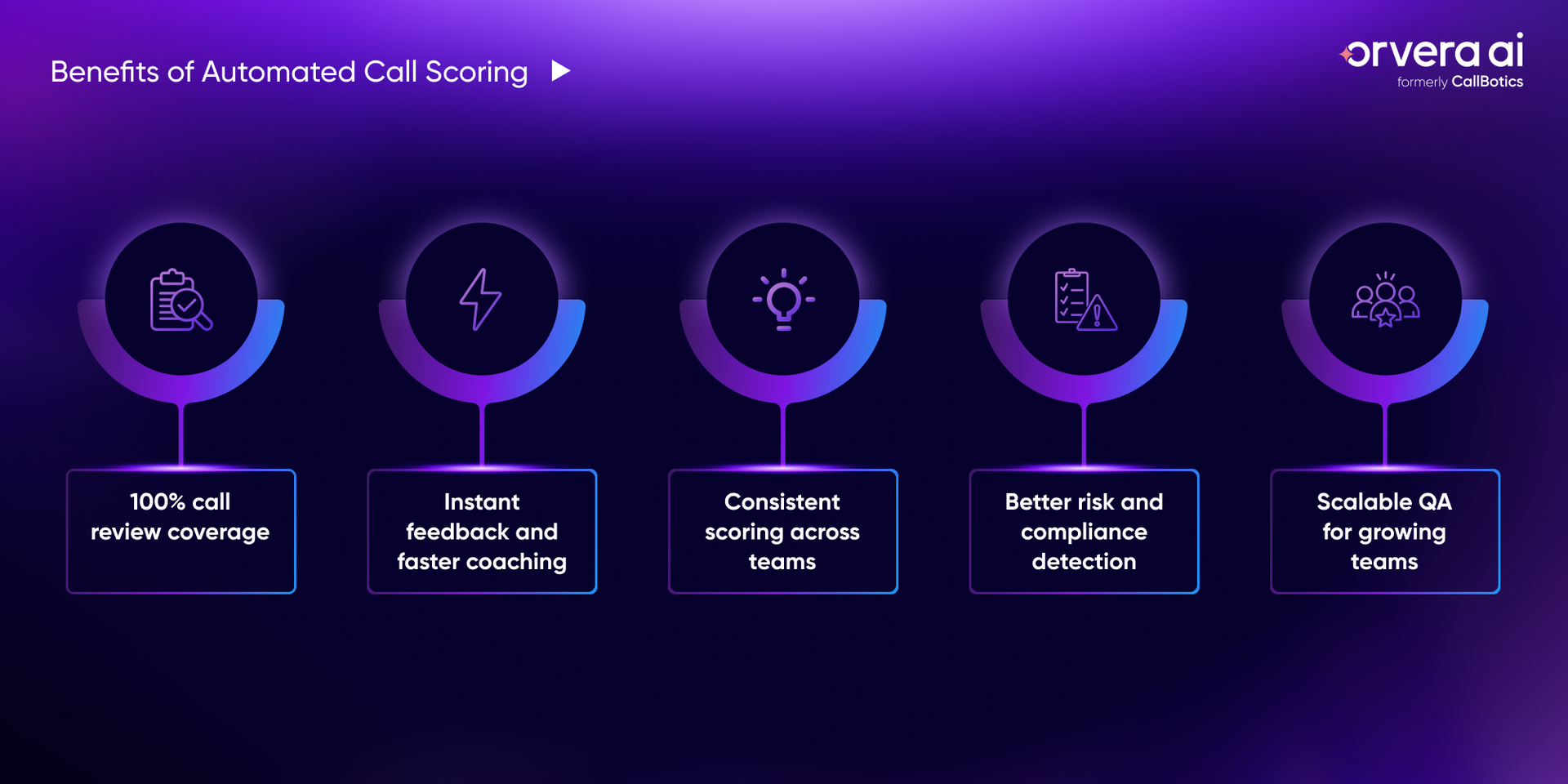
Teams can review every call instead of depending only on random samples. This matters because important sales and support conversations can sit outside the sample, even when they include missed opportunities, unresolved issues, or compliance concerns. A wider view helps leaders understand what is happening across the full customer conversation flow, not only the calls selected for review.
Full coverage gives leaders a clearer view of what is happening across the floor. Instead of judging quality from a small set of calls, managers can see repeat patterns across reps, teams, campaigns, and customer issues. This makes it easier to spot whether a problem is tied to one rep, one process, or a larger team trend.
Scores and recommendations can reach managers soon after the call ends. That helps teams catch weak openings, missed discovery, poor objection handling, unclear next steps, or unresolved customer issues while the conversation is still fresh. Managers also get a better starting point for coaching because they do not have to search through calls manually first.
Faster feedback makes coaching easier to apply. Reps do not have to wait days or weeks to understand what went wrong, and managers can use real call moments to correct behavior before it becomes a repeated habit. This helps coaching feel more practical because the rep can connect the feedback to a recent conversation.
The same scorecard rules can be applied across calls, reps, campaigns, and departments. This reduces the problem of different reviewers scoring similar calls differently based on interpretation, workload, or coaching style. A shared scoring standard also helps leaders keep quality expectations clear across different shifts, teams, and locations.
Consistent scoring gives leaders a more reliable way to compare performance. It also helps reps trust the QA process because the same standards are applied across the team, not only to a few selected calls. When reps understand that calls are being reviewed by the same criteria, coaching conversations can focus more on improvement and less on score disputes.
Risk signals can be flagged when a call includes missing disclosures, negative sentiment, unresolved issues, policy violations, or high-risk customer behavior. This helps managers find risk earlier instead of waiting for a complaint, escalation, or audit issue. It also helps teams prioritize the conversations that need urgent attention instead of treating every review as equal.
Risk detection is especially useful when teams handle sensitive conversations. The system can surface the calls that need human review, so QA leaders spend less time searching and more time checking the right conversations. This keeps human judgment focused on the moments where context, fairness, and next steps matter most.
As call volume grows, manual QA workload usually grows with it. Scoring support from AI helps teams handle more conversations without increasing the review workload at the same rate. This is important for teams that need to maintain quality without asking managers or QA analysts to review more calls than they can reasonably handle.
Growing sales and support teams get more control over quality. Managers can keep visibility high, protect coaching time, and avoid leaving large parts of the customer conversation history unchecked. It also makes QA planning easier because leaders can expand review coverage without rebuilding the entire review process each time volume increases.
Scoring calls with technology can help QA teams review more conversations, but it still needs the right setup to work well. Clear scorecards, clean data, accurate transcripts, and regular human oversight are all needed so the scores stay useful, fair, and trusted by the team. Without that foundation, teams may get more scores, but not necessarily better quality decisions.
A weak scorecard will create weak results, even when the technology behind it is strong. When the scoring rules are vague, outdated, or too broad, the system may mark calls in a way that does not reflect real sales quality, support quality, or customer outcomes. This can create confusion for reps because they may not understand what behavior they need to improve.
Poor call quality can affect how well the conversation is understood and scored. Background noise, accents, overlapping speech, long hold periods, poor recordings, or unclear audio can reduce transcript accuracy and make the final score less reliable. This becomes a bigger issue when teams use the score for coaching, compliance checks, or performance discussions.
Some customer conversations carry meaning that is not easy to score from words alone. Sarcasm, emotional pressure, sensitive context, hesitation, frustration, or unusual customer situations may need a human reviewer to understand what actually happened. These moments are where judgment matters because the same words can mean different things depending on the customer’s situation.
Managers should regularly compare system-generated scores with human QA reviews to keep scoring accurate and trusted. Without calibration, teams may not notice when the scorecard needs adjustment, transcripts are creating errors, or reps are being judged in a way that does not match the real conversation. Regular calibration also helps managers explain the scoring process clearly when reps question a score.
A strong QA workflow does not need to choose between technology and human judgment. The better approach is to use automated scoring for wider visibility, then use manual review where context, risk, coaching, or judgment matters most. This balance helps teams cover more calls without losing the human review needed for complex or sensitive conversations.
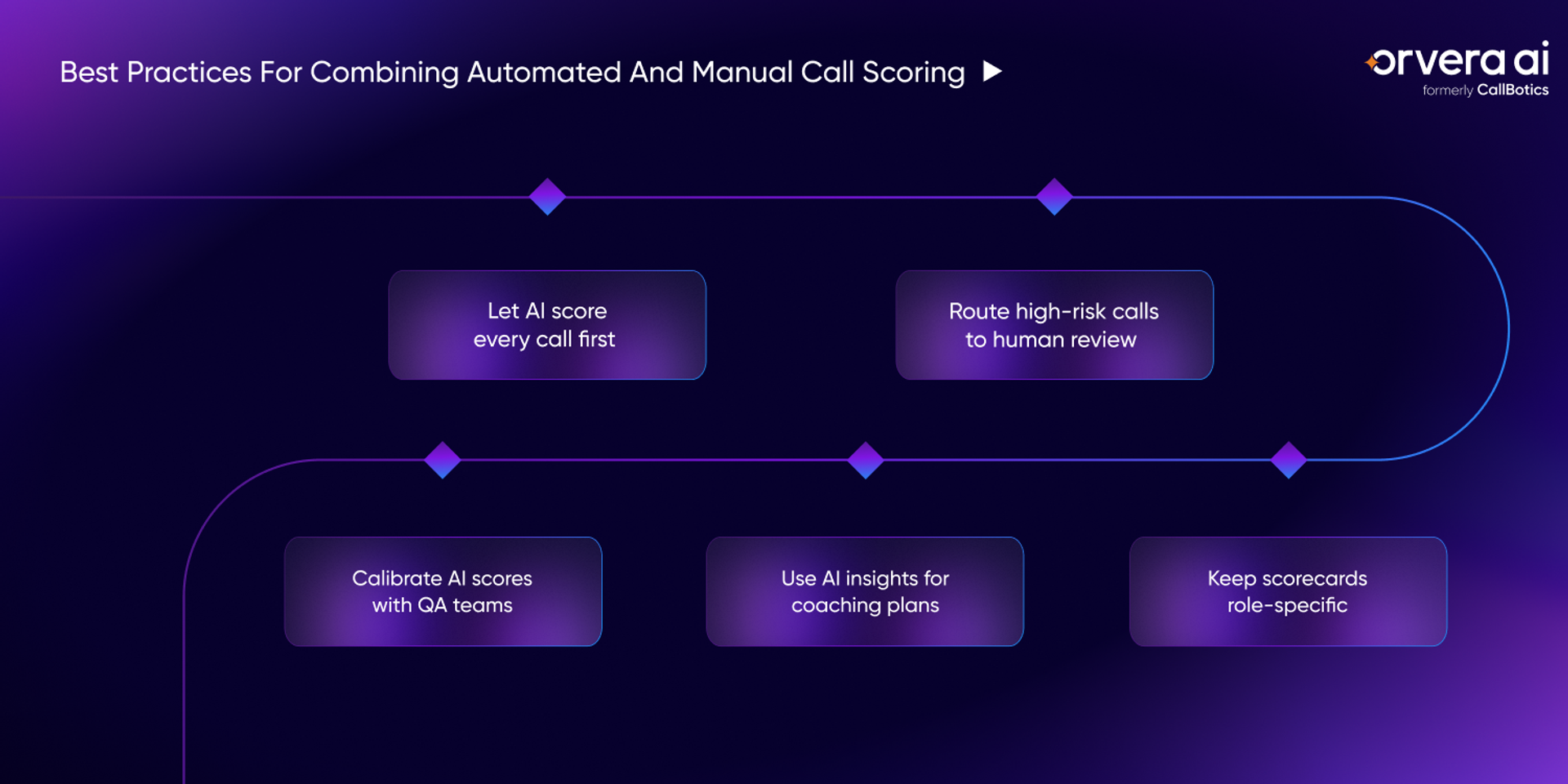
The first layer of QA should cover every customer conversation, not only a small sample. Scoring all calls gives managers a wider view of what is happening across sales, support, campaigns, and teams. This gives leaders a stronger starting point before they decide which calls need deeper review.
This helps leaders find patterns that are hard to catch through manual review alone. They can see repeated issues such as missed discovery, weak objection handling, negative sentiment, missing disclosures, unresolved concerns, or unclear next steps before those issues become larger performance problems. It also helps managers act on trends instead of waiting for the same issue to appear in multiple coaching sessions.
Not every call needs the same level of manual attention. Managers should prioritize calls that carry higher risk, such as low-scoring calls, angry customer conversations, compliance flags, escalations, refund disputes, and high-value sales opportunities. This keeps review time focused on conversations that could affect revenue, customer trust, or business risk.
This keeps human review focused where it adds the most value. Instead of spending time searching through random calls, QA teams can review the conversations that need judgment, context, and a careful decision. It also reduces the chance that serious issues get buried inside normal call volume.
Human reviewers should regularly compare system-generated scores with manual QA reviews. This helps confirm whether the scorecard rules are working as expected and whether the scores match the reality of the conversation. These checks make it easier to spot where the scoring logic needs to be tightened or explained more clearly.
Calibration also protects trust in the QA process. When managers and QA teams review score differences together, they can adjust scoring rules, clarify definitions, and make sure reps are being judged by standards that are fair and easy to understand. This gives reps more confidence that the process is built to improve performance, not only to find mistakes.
Scoring trends can help managers build better coaching plans for individual reps and full teams. Instead of relying on one or two reviewed calls, managers can use broader patterns to see where a rep is struggling and where the team needs more support. This makes coaching decisions more grounded because they come from repeated behavior across conversations.
This makes coaching more focused and useful. A manager can coach one rep on discovery questions, another on closing next steps, and the full team on compliance language or objection handling based on repeated patterns across calls. It also helps leaders separate individual skill gaps from process issues that affect the whole team.
Different call types should not be scored with the same criteria. Sales calls, support calls, onboarding calls, retention calls, and escalation calls each have different goals, risks, and customer expectations. Using one generic scorecard can make the results less useful because it judges different conversations by the same standard.
Role-specific scorecards make the scoring more accurate and fair. A sales call may need stronger discovery and objection handling, while a support call may need faster resolution, clearer troubleshooting, and better next-step confirmation. This helps managers coach reps based on what their role actually requires.
Orvera AI helps quality teams review customer conversations with more coverage and more consistency, without removing human judgment from the QA process. Its AI Auto QA supports automated call scoring, quality review, sentiment analysis, risk detection, and human review workflows so managers can focus on the calls that need attention. This gives teams a practical way to improve QA coverage while keeping people involved where context and fairness matter.
Orvera helps teams move beyond random QA sampling by scoring sales and support calls across the full conversation set. That gives managers a clearer view of what is happening across reps, teams, campaigns, and customer issues instead of relying only on a few selected calls. It also helps leaders understand whether a quality issue is isolated or showing up across a larger group of conversations.
This is useful when call volume is high and manual review cannot keep up. Quality leaders can spot recurring issues faster, such as missed discovery, weak objection handling, unresolved concerns, compliance gaps, or poor next-step confirmation. That means managers can spend less time trying to find problems and more time fixing the patterns behind them.
Different teams need different scoring standards, and Orvera supports that by helping teams evaluate calls with role-specific criteria. Sales, support, onboarding, retention, and success calls can each be reviewed against the behaviors and outcomes that matter for that call type. This makes scoring more relevant because each team is measured against the work they are actually expected to do.
This helps avoid the problem of judging every conversation with one generic scorecard. A sales call may need stronger discovery and objection handling, while a support call may need clearer troubleshooting, faster resolution, and better follow-up confirmation. The result is a QA process that feels more useful to managers and more fair to reps.
Orvera helps teams identify calls that may need supervisor attention, such as frustrated customers, unresolved issues, compliance concerns, and conversations with negative sentiment. These signals help managers find risk earlier instead of waiting for complaints, escalations, or missed targets. This is especially useful when serious issues are hidden inside normal call volume and would be hard to find through manual sampling.
This does not remove the need for human judgment. It helps route the right calls to the right people, so managers can review sensitive conversations with more context and decide the next step carefully. That keeps supervisor attention focused on the conversations where timing, tone, and response quality can change the outcome.
Orvera helps managers focus manual review on the highest-risk and highest-impact conversations instead of listening to random samples. Low-scoring calls, angry customer calls, escalations, compliance flags, and high-value sales conversations can be prioritized for deeper review. This helps teams protect review time for the calls most likely to affect revenue, customer trust, or business risk.
That makes the QA workflow more practical for busy teams. Managers spend less time searching for calls and more time reviewing the conversations where judgment, coaching, fairness, and business impact matter most. It also makes manual review easier to defend because the team can see why certain calls were selected.
Orvera turns call scores into coaching opportunities by showing patterns across individual reps and teams. Managers can see where reps may need help with discovery, objection handling, empathy, compliance language, resolution quality, or next-step clarity. This helps coaching start from repeated evidence instead of one isolated call.
These insights make coaching more specific and easier to act on. Instead of giving broad feedback, managers can use real conversation trends to build coaching plans, track recurring issues, and improve quality across the team. It also helps leaders separate individual coaching needs from process gaps that may require script, training, or workflow updates.
Manual call scoring still matters because some conversations need human judgment. Managers and QA reviewers can understand tone, context, customer history, and sensitive situations in a way that a score alone may not explain. This is why manual review should stay part of QA, especially for complex calls, escalations, complaints, and compliance-sensitive conversations.
Automated call scoring adds the speed, consistency, and full QA coverage that manual review cannot provide on its own. It helps teams evaluate more conversations, find repeated issues faster, and spot risk before it becomes a larger problem. The strongest QA strategy uses AI-powered scoring as the first layer of visibility, then routes the calls that need context, coaching, fairness, or careful judgment to human review.

Anindita Majumder is a content and copywriter with about four years of experience across content writing, copywriting, and journalism. Her work has involved building and shaping content for global brands in B2B SaaS tech, healthcare, travel tech, edtech, and more. Her love for reading often spills into the way she ideates. Outside of work, she is a vocalist, which keeps her creativity flowing.
See how enterprises automate calls, reduce handle time, and improve CX with Orvera AI.