Call intelligence is the use of AI, call analytics, transcription, sentiment analysis, and conversation insights to understand what happens during customer calls. It helps teams see why customers call, what they ask for, where conversations slow down, and which issues need better follow-up. Instead of treating calls as one-time interactions, businesses can use call intelligence to turn every conversation into usable operational data.
That matters because customer calls still carry the clearest signals about sales, support, quality, and customer experience. In a June 2026 customer support AI study from Nubank, a production deployment showed a 37 percentage-point improvement in AI transactional Net Promoter Score and a 29 percentage-point gain in self-service rate over prior agent variants. The point is not that AI alone fixes support. The point is that teams improve faster when calls are measured, reviewed, and connected to real outcomes.
This guide explains how call intelligence works and where it fits inside daily operations. We’ll look at how transcription, sentiment analysis, conversation analytics, and AI-generated insights help teams improve sales conversations, support quality, quality assurance, and customer experience. The goal is simple: understand what is happening on calls, find the patterns that matter, and use those patterns to make better decisions.
Call intelligence is the process of using AI, transcription, call analytics, sentiment analysis, and conversation insights to understand what happens during phone conversations. It turns customer calls into structured information that teams can search, review, and use instead of relying only on call recordings or manual notes. This gives managers a clearer way to find patterns without listening to every call from start to finish.
This matters because many teams know calls are important, but they often cannot see the full pattern behind them. Sales may miss why deals are getting stuck. Support may not know which issues repeat every week. Quality teams may review only a small sample of calls. Call intelligence helps teams move from guessing to working with clear evidence from the actual conversation. It also gives different teams a shared view of the customer’s real experience, not separate opinions based on limited notes.
Call analytics focuses on the measurable activity around a call. It can show call volume, call duration, wait time, missed calls, call source, agent availability, and other performance metrics. These numbers are useful because they show what is happening at the operational level. For example, call analytics can help leaders spot staffing gaps, busy hours, and service delays.
Call intelligence goes deeper into what was said during the call. It can identify customer intent, objections, sentiment, escalation risk, recurring complaints, follow-up needs, and quality gaps. Call analytics may tell a manager that calls are taking longer. Call intelligence helps explain why they are taking longer and what the team should fix. That makes it more useful for coaching reps, improving scripts, and removing repeat issues from the customer journey.
Conversation intelligence is a broader category. It can include phone calls, sales meetings, video calls, chats, emails, and other customer conversations. Businesses use it to understand customer needs, team performance, buying signals, objections, and service gaps across different communication channels. This is useful for teams that want one view of how customers communicate across the full journey.
Call intelligence focuses specifically on phone and voice conversations. That focus matters because calls are live, time-sensitive, and often harder to review at scale. A customer may sound frustrated before they say they are unhappy. A rep may miss a required step during a complex support call. Call intelligence helps teams capture those voice-specific details and turn them into useful actions. It is especially helpful in high-volume teams where important call patterns can get buried quickly.
Call intelligence works by capturing phone conversations, converting them into text, analyzing what was said, and turning the results into useful insights for teams. The process usually starts with call recording and data capture, then moves into transcription, topic detection, sentiment analysis, scoring, and reporting. The goal is to help teams understand calls faster without depending only on manual reviews or scattered notes. This also gives leaders a cleaner way to connect call quality with sales, support, QA, and customer experience outcomes.
Call intelligence starts by capturing the call and the basic details around it. This includes the voice recording, call time, participants, timestamps, call duration, and related customer information. Without this first layer, teams may have the conversation, but not enough context to understand what happened before, during, or after the call. This context helps teams review the call as part of the customer journey, not as an isolated recording.
AI call transcription converts spoken conversations into searchable text. This makes it easier for teams to review calls, find specific phrases, check what was promised, and use the conversation for coaching, compliance review, and reporting. Instead of listening to full recordings every time, teams can search and review the parts that matter. A clear transcript also gives different teams the same record to work from, which reduces confusion during follow-up or review.
Intent and topic detection helps identify why the customer called and what was discussed. AI can group calls by issues, requests, objections, complaints, buying signals, or service needs. This helps teams see the real reasons behind call volume instead of only tracking how many calls came in. It also helps leaders separate routine demand from issues that need a process, product, or policy fix.
Sentiment and emotion analysis looks at the tone and direction of the conversation. It helps identify whether the customer sounded positive, neutral, or negative, and whether frustration, urgency, satisfaction, or hesitation appeared during the call. This matters because customers do not always say exactly how they feel. Tracking these shifts helps teams understand which moments in the call changed the customer’s experience.
AI call scoring and QA analysis evaluates calls against defined scorecards, quality criteria, compliance rules, rep behavior, and conversation outcomes. Instead of reviewing only a small sample manually, teams can use AI to check more conversations in a consistent way. This gives QA teams a clearer view of where reps are doing well and where coaching is needed. It also helps managers find repeated quality gaps before they become larger customer or compliance issues.
Insight generation turns call data into summaries, trends, risks, and dashboards that teams can act on. A good call intelligence tool does not only show transcripts or scores. It helps managers, sales leaders, support teams, and QA teams understand what is changing across conversations and where attention is needed. This makes call reviews more useful because teams can move from individual call feedback to broader operational decisions.
A modern call intelligence platform should help teams understand calls without forcing managers to review every recording manually. The core features usually include transcription, summaries, sentiment analysis, keyword tracking, call scoring, agent insights, and system integrations. These features give teams a faster way to find what matters inside high call volumes.
These features matter because call data is often scattered across recordings, notes, CRM fields, tickets, and QA forms. Call intelligence brings that information into a format teams can search, review, and use for sales, support, QA, and customer experience decisions. This helps teams spend less time collecting call details and more time improving the conversations that affect customers.
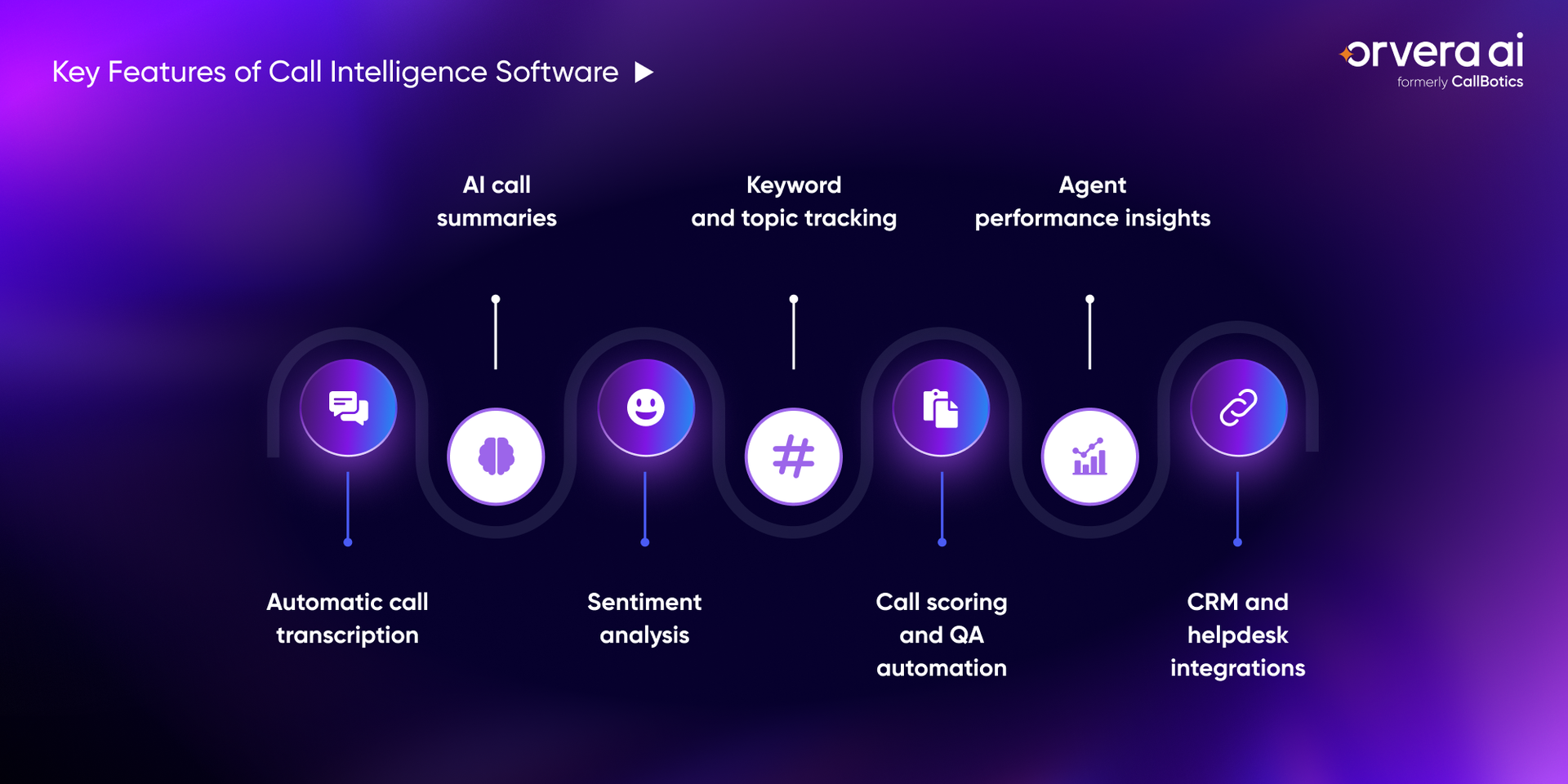
Automatic call transcription converts spoken conversations into written text. This helps teams review calls faster, search for specific words, and find important moments without listening to every recording from start to finish. It also creates a clear record that teams can return to when there is confusion about what was said.
This solves a common problem for managers and QA teams: call recordings are useful, but they take too long to review manually. With searchable transcripts, teams can quickly check what the customer asked, what the rep said, what was promised, and where the conversation changed direction. This makes reviews more practical when teams handle hundreds or thousands of calls each week.
AI call summaries capture the main points from each call in a short, readable format. A useful summary should include the customer issue, key discussion points, objections, next steps, and final outcome. This gives teams a quick way to understand the call before opening the full transcript.
This helps teams avoid missing important details after busy or complex calls. Sales reps can remember buyer concerns, support teams can follow up with the right context, and managers can review call outcomes without reading the full transcript every time. It also helps reduce handoff gaps when another rep or team needs to continue the conversation.
Sentiment analysis helps teams understand the emotional tone of a call. It can show whether the conversation was positive, neutral, negative, or at risk based on customer language, tone, urgency, and emotional shifts. This helps teams see which calls need attention beyond the final call outcome.
This is useful because customers do not always say, “I am unhappy,” directly. A customer may sound frustrated, hesitant, rushed, or relieved before they clearly state the issue. Sentiment analysis helps teams spot these signals earlier and decide which calls need coaching, follow-up, or escalation. It also helps leaders understand which parts of the customer journey create the most friction.
Keyword and topic tracking helps businesses monitor important phrases and themes across calls. Teams can track mentions of competitors, pricing, cancellations, product issues, complaints, compliance phrases, objections, or buying signals. This helps teams find business-critical signals that may otherwise stay buried inside individual conversations.
This matters because important patterns often appear across many calls before they show up in reports. If customers keep mentioning the same product issue, competitor, policy confusion, or cancellation reason, leaders can see the trend faster and act before it becomes a larger business problem. It also helps sales, support, and product teams work from the same customer evidence.
Call scoring and QA automation use defined criteria to evaluate calls more consistently. The criteria may include sales process steps, support quality, compliance rules, required disclosures, tone, issue resolution, follow-up accuracy, and conversation outcomes. This gives QA teams a more structured way to measure call quality across different reps and call types.
This helps QA teams move beyond small manual samples and inconsistent reviewer judgment. Managers get a clearer view of call quality, reps receive more specific coaching, and leaders can identify repeated gaps before they affect more customers. It also makes coaching fairer because calls are reviewed against the same standards.
Agent performance insights help managers understand how reps handle real conversations. These insights can show strengths, weaknesses, talk patterns, listening behavior, compliance behavior, objection handling, and coaching needs. This helps managers see performance patterns that may not be clear from call outcomes alone.
This gives managers a more practical way to coach. Instead of saying “improve your calls,” they can point to specific moments, such as missed discovery questions, long hold times, weak follow-up, unclear explanations, or strong examples other reps can learn from. It also helps team leads recognize good call behavior and use it as a model for training.
CRM and helpdesk integrations make call intelligence more useful by connecting call insights to the systems teams already use. Call summaries, transcripts, outcomes, next steps, tickets, deals, and customer profiles can be updated automatically instead of sitting in a separate tool. This helps teams keep customer records current without adding more manual admin work.
This reduces manual work and helps teams keep better records. Sales teams can see call context inside deals, support teams can connect calls to tickets, and managers can review customer history without switching between disconnected systems. It also gives every team a more complete view of the customer before the next interaction.
Customer calls affect more than one team, and that is why call intelligence is useful. Sales, support, QA, marketing, compliance, and product teams can all use call insights to understand what customers are saying and where the business needs to improve. The value comes from turning everyday calls into clear signals that teams can act on. This helps teams stop treating calls as isolated events and start using them as a reliable source of business feedback.
Sales managers can use call intelligence to review how reps handle real buyer conversations. It helps them see where reps ask strong questions, where they miss opportunities, how they respond to objections, and whether the next step is clear before the call ends. This gives managers a practical way to coach based on the exact moments that affect deal quality.
Support teams can use call intelligence to check whether customer issues were handled clearly and consistently. It helps QA teams score calls, review resolution quality, detect policy gaps, and understand whether reps are following the right process. This is especially useful when support leaders need to maintain quality across high call volumes and different rep experience levels.
Customer sentiment tracking helps businesses understand how customers feel during calls. It can show whether a conversation is positive, neutral, negative, urgent, or at risk, which helps teams see where the customer experience is improving or breaking down. This helps leaders catch emotional patterns that may not appear in call duration, resolution rate, or ticket status alone.
Call intelligence can help teams identify customers who may be close to leaving. Repeated complaints, cancellation intent, negative sentiment, unresolved issues, and poor follow-up are strong warning signs that may appear in calls before they appear in account reports. This gives teams a chance to act while the customer relationship can still be saved.
Compliance and risk review becomes easier when call intelligence can flag calls that need attention. Teams can review calls for missing disclosures, sensitive topics, angry customers, policy concerns, and language that may create business or regulatory risk. This helps compliance teams focus review time on calls that carry higher risk instead of searching through recordings manually.
Voice of customer analysis uses call data to understand what customers keep asking for, complaining about, or struggling with. These insights help teams find recurring needs, feature requests, pricing concerns, service complaints, and process gaps directly from customer conversations. This gives leaders a clearer view of customer reality than internal assumptions alone.
Marketing teams can use call intelligence to connect phone conversations back to campaigns, ads, landing pages, and messaging. This helps them understand which campaigns drive serious buyers, which messages create confusion, and which leads turn into quality conversations. It also helps marketing teams see whether campaign promises match what prospects ask about on the call.
Sales teams use call intelligence to understand what is happening inside real buyer conversations. It helps managers improve pipeline quality, coach reps with specific examples, and see which calls are moving deals forward. Instead of relying only on CRM notes or rep memory, sales leaders get a clearer view of buyer intent, objections, follow-up quality, and deal risk.
Call intelligence helps sales teams detect phrases, questions, and sentiment that show purchase intent or deal readiness. A prospect asking about pricing, implementation, contract terms, timelines, integrations, or comparisons may be closer to a decision than the CRM stage suggests.
Call intelligence helps managers see whether reps are asking the right questions during discovery. It can show if a rep understood the buyer’s pain points, business goals, decision process, budget concerns, and current workflow before moving into the pitch.
Sales teams can use call intelligence to track when prospects mention competitor names or compare alternatives. This helps managers understand which competitors appear most often, why buyers bring them up, and what concerns need to be addressed during the sales process.
AI summaries and action items help reps send more accurate, timely, and relevant follow-ups after sales calls. Instead of depending on memory or rushed notes, reps can use call summaries to capture buyer concerns, promised next steps, objections, and decision timelines.
Support teams use call intelligence to understand what customers are struggling with, how well issues are handled, and where service quality breaks down. It helps managers detect repeat problems, review resolution quality, monitor communication, and improve escalation handling. Instead of relying only on tickets or a small set of reviewed calls, support leaders get a clearer view of what is happening across customer conversations.
Call intelligence helps support teams identify repeated complaints, product problems, billing confusion, policy questions, or process gaps across support calls. These patterns are often hard to see when each call is reviewed separately or when customers describe the same issue in different ways.
Call intelligence helps managers evaluate whether customer issues are being solved properly during the first interaction. A call may look completed in the system, but the customer may still leave without a clear answer, next step, or actual resolution.
Call intelligence can help assess how reps communicate during support calls. It can review tone, patience, clarity, interruptions, response quality, and whether the customer was handled professionally during difficult or sensitive moments.
Call intelligence helps teams understand when and why calls are escalated. It can show whether escalations happened too late, went to the wrong team, lacked enough context, or could have been resolved earlier with better guidance.
Contact center leaders use call intelligence to understand performance across teams, not only individual calls. It helps them improve quality assurance coverage, reduce operational risk, prioritize coaching, and make better decisions about staffing, scripts, workflows, and escalation paths. Instead of managing from limited samples or delayed reports, leaders get a clearer view of what is happening across customer conversations.
Call intelligence helps leaders track performance across agents, teams, departments, campaigns, call types, and customer segments. This makes it easier to see where performance is strong, where service quality is slipping, and which parts of the operation need attention.
Call intelligence helps managers prioritize coaching based on real call data instead of random call sampling. Leaders can see which reps need help, which skills need attention, and which call types create the most coaching opportunities.
Call intelligence helps leaders review more calls and detect patterns that manual quality assurance may miss. Manual QA often covers a limited sample, which means repeated issues, compliance gaps, or customer frustration can stay hidden for too long.
Call trends can help leaders make better decisions about staffing, training, scripts, workflows, escalation rules, and customer communication. When leaders know why customers are calling and where calls break down, they can fix the process instead of only pushing teams to work faster.
The right metrics help businesses understand call quality, customer experience, and team performance. These KPIs show whether customers are getting clear answers, whether reps are following the right process, and where calls are creating risk or repeat work. They also help managers connect call behavior to real business outcomes instead of reviewing calls only as isolated conversations.
The goal is not to track every number available. The goal is to focus on metrics that explain what is happening during calls and what teams should improve next. A smaller set of useful metrics is often easier to act on than a dashboard full of numbers with no clear owner.
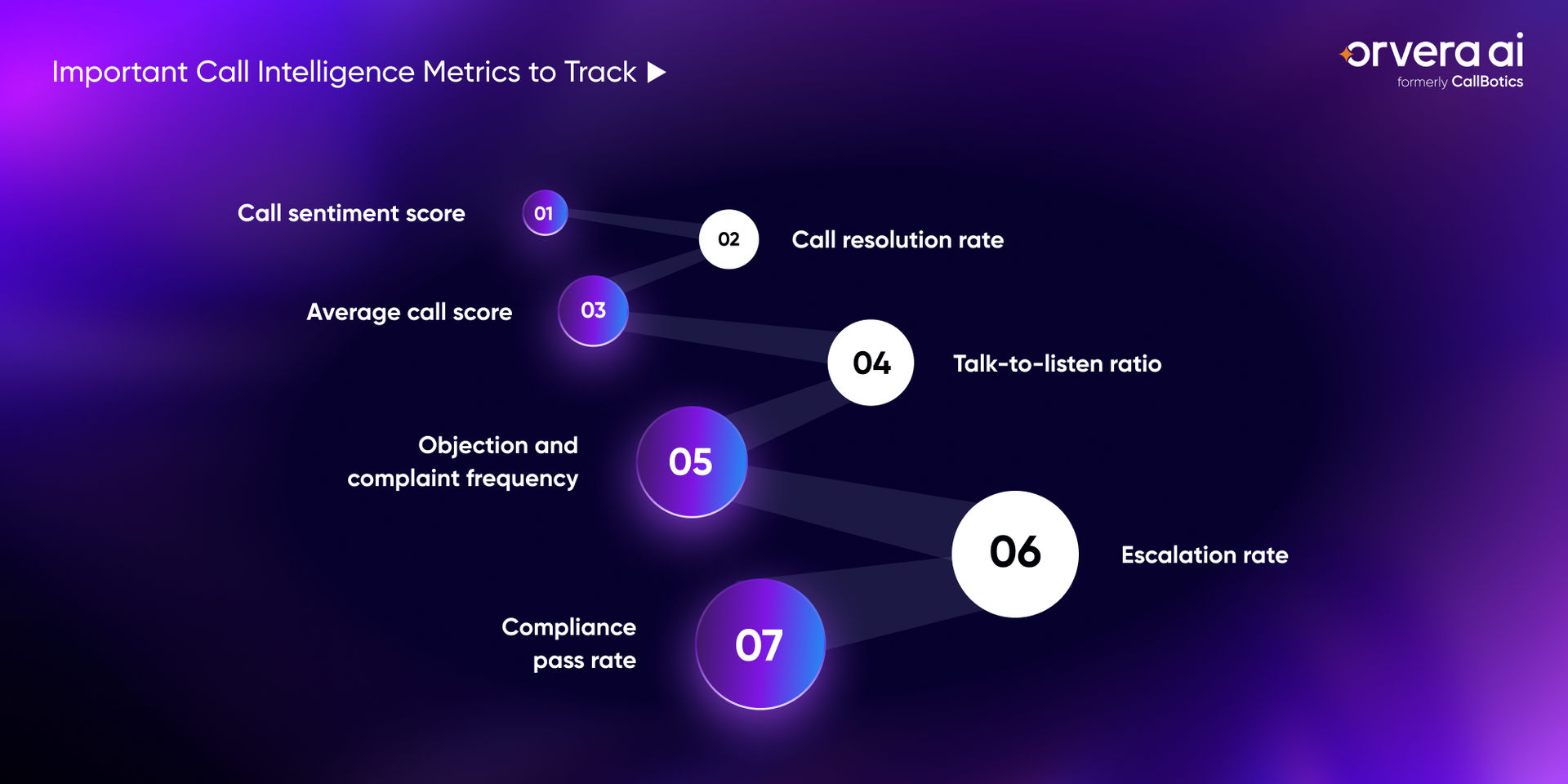
A call sentiment score measures the emotional tone of a customer conversation. It helps teams understand whether a call was mostly positive, neutral, negative, or at risk based on the customer’s words, tone, urgency, and emotional shifts. This gives managers a faster way to find calls where the customer experience may need closer review.
This metric is useful because call outcomes can look fine even when the customer leaves frustrated. A sentiment score helps managers find calls where the customer sounded confused, upset, hesitant, or dissatisfied, even if the call was marked as completed. It can also help teams understand which issues or call types create the strongest customer reactions.
A call resolution rate shows how often customer issues are solved successfully during calls. It helps teams understand whether customers are getting the answer, action, or next step they needed from the conversation. This makes it easier to separate completed calls from calls that actually solved the customer’s problem.
This metric matters because a closed call is not always a resolved issue. If customers call back, repeat the same problem, or leave without a clear path forward, the team may have a resolution gap that needs process or coaching attention. Tracking this metric helps leaders find where customers are getting stuck after the first interaction.
An average call score measures overall conversation quality across sales and support calls. AI call scoring can evaluate calls against defined criteria such as greeting, discovery, empathy, compliance, issue handling, objection response, and follow-up quality. This helps teams compare call quality using the same standards across different reps and call types.
This gives managers a consistent way to review performance across teams. Instead of judging calls only by personal opinion, teams can use a shared scorecard to see where call quality is strong and where reps need more support. It also helps leaders track whether coaching and training are improving call quality over time.
Talk-to-listen ratio shows how much time a rep talks compared with how much time the customer talks. It helps sales and support teams understand whether reps are listening enough or dominating the conversation. This is especially useful in calls where understanding the customer’s issue or need matters more than giving a long explanation.
This metric is useful because strong calls usually require enough space for the customer to explain the issue, need, or objection. If a rep talks too much, they may miss important details, rush the customer, or move into an explanation before understanding the real problem. Reviewing this ratio can help managers coach reps to ask better questions and pause at the right moments.
Objection and complaint frequency tracks how often certain concerns appear across calls. In sales, this may include pricing, timing, competitor comparisons, contract terms, or implementation concerns. In support, this may include product issues, billing confusion, service complaints, or repeat process problems. Tracking these patterns helps teams see which concerns are becoming common enough to require action.
This metric helps teams identify blockers that are bigger than one conversation. If the same objection or complaint appears often, leaders can update scripts, improve training, adjust messaging, fix process gaps, or share feedback with product and operations teams. It also helps teams prioritize the issues that are affecting the most customers or deals.
Escalation rate shows how often calls need supervisor, specialist, or another team’s involvement. It helps teams understand which call types are too complex, unclear, or risky for the first rep to handle alone. This gives leaders a clearer view of where frontline teams need better guidance, tools, or authority.
This metric matters because high escalation rates can point to training gaps, weak knowledge access, unclear policies, or broken workflows. Low escalation rates also need review, because some calls may not be escalated when they should be. Looking at both sides helps teams improve escalation timing, routing, and handoff quality.
Compliance pass rate shows whether reps are following required scripts, disclosures, verification steps, and policies during calls. This is especially important for industries where missing a required step can create customer, operational, or regulatory risk. It helps teams find compliance gaps before they become larger review or audit problems.
This metric helps QA and compliance teams focus on calls that need review. It also helps managers coach reps on specific missed steps instead of giving broad feedback that does not explain what needs to change. Over time, it can show whether compliance training is actually improving behavior on live calls.
Getting useful results from call intelligence depends on more than the technology itself. Clean data, strong integrations, clear goals, and consistent follow-through all play a role in whether teams can improve performance, customer experience, and operational efficiency. Without the right foundation, businesses may collect large amounts of information without turning it into meaningful action. This is why implementation should start with the problems the business needs to solve, not only the features the tool provides.
Poor audio quality can make it difficult for AI to accurately understand conversations. Background noise, overlapping speech, weak connections, and heavy accents can reduce transcription accuracy and affect the quality of sentiment analysis, keyword tracking, and reporting. Teams should check recording quality early so they know whether the data is reliable enough for coaching, QA, and analysis.
Many businesses start collecting call data before deciding what they actually want to improve. Whether the focus is sales coaching, support quality, compliance, customer experience, or retention, clear goals help teams prioritize the right metrics and avoid getting distracted by data that does not support business outcomes. Clear goals also make it easier to decide which teams should own the reports and follow-up actions.
Call insights are far more valuable when they are connected to customer records, tickets, deals, and workflows. When they operate separately from CRM or helpdesk systems, teams often lose context and spend extra time manually updating information across multiple platforms. Strong integration helps the right insight reach the right team without adding another manual step.
Having access to dashboards, reports, and analytics does not automatically improve performance. The real challenge is turning insights into coaching, process improvements, workflow changes, and follow-up actions that create measurable results for customers and teams. Teams need a regular review process so important patterns are assigned, acted on, and checked again later.
Customer calls often contain sensitive information, which means businesses need clear policies for recording, storage, access, retention, and privacy protection. Strong governance helps teams use call intelligence responsibly while meeting regulatory requirements and maintaining customer trust. Clear ownership also helps teams avoid confusion about who can review, share, or export call data.
The best results come when teams use call intelligence with clear goals, practical workflows, and regular review habits. The tool can surface useful insights, but teams still need to decide which problems they want to solve and how those insights will be used. Success usually comes from making small improvements consistently rather than trying to fix every issue at once.
The goal is not to collect more call data for the sake of reporting. The goal is to turn call insights into better coaching, faster follow-up, stronger QA, clearer customer communication, and better operational decisions. Teams that connect insights to everyday work often see more value than teams that focus only on reporting dashboards.
Teams should start with clear use cases before turning on every available feature. A sales team may want better coaching, while a support team may need QA automation, churn detection, or recurring issue tracking. Starting with one or two priorities makes adoption easier and helps teams see results faster.
This helps teams avoid overloaded dashboards and unclear ownership. When the use case is specific, it becomes easier to choose the right metrics, build the right reports, and measure whether the work is creating value. It also helps leaders explain why the tool is being used and what success looks like.
Different call types need different scoring criteria. A sales discovery call should not be scored the same way as a support call, onboarding call, retention call, or customer success check-in. Using the same scorecard for every conversation can hide important strengths and weaknesses.
Role-specific scorecards make reviews more fair and useful. Sales teams may need criteria for discovery, objections, and next steps, while support teams may need criteria for empathy, resolution, policy steps, and handoff quality. This helps teams focus coaching on the skills that matter most for each role.
Call insights become more valuable when they trigger real action. A summary, sentiment flag, missed disclosure, objection, or unresolved issue should connect to the right workflow, such as a CRM update, coaching task, follow-up, escalation, or ticket. This reduces the chance that important findings are overlooked after the call ends.
This prevents insights from sitting unused in dashboards. When call data is connected to daily workflows, reps, managers, QA teams, and support teams can act on the information while it is still relevant. Faster action often leads to faster improvements in both customer experience and team performance.
Managers should review call trends on a weekly or monthly basis. Regular reviews help teams spot patterns in objections, complaints, sentiment, escalation, call quality, and customer confusion. Looking at trends over time is often more useful than focusing on a single call or isolated event.
These patterns can guide better scripts, training, product messaging, customer workflows, and service processes. Without a regular review rhythm, useful insights can stay buried until the same issue keeps repeating across calls. Consistent reviews also help teams measure whether previous improvements are actually working.
AI can analyze every call, but managers should still review high-risk, complex, or sensitive conversations. Human review is important when judgment, context, emotion, compliance risk, or customer impact needs closer attention. Some situations require business knowledge and experience that automation alone cannot provide.
This balance gives teams better coverage without removing human oversight. AI helps find the calls that need attention, while managers bring the context needed to decide what should happen next. Combining both approaches often leads to more accurate decisions and stronger coaching outcomes.
Explore AI voice agents built for conversation intelligence.Orvera AI helps businesses use call intelligence as part of a wider contact center workflow. It combines AI voice agents, call analysis, sentiment detection, call summaries, real-time insights, and workflow automation so teams can understand calls and act on them faster. This helps teams move from reviewing conversations after the fact to improving how work happens during and after each call.
This is useful for sales, support, and customer experience teams that do not want call insights stuck inside recordings or dashboards. Orvera helps teams connect what happened during the call with what should happen next. That connection is where call intelligence becomes practical for daily operations, not only useful for reporting.
Orvera helps businesses analyze calls automatically so teams can understand customer intent, sentiment, topics, and outcomes. This gives leaders a clearer view of why customers are calling, what they are asking for, and where conversations need attention. It also helps teams find patterns that are easy to miss when calls are reviewed one at a time.
That visibility matters when teams handle high call volumes and cannot review every conversation manually. Instead of depending only on notes or call duration, managers can use conversation data to find patterns, risks, and coaching opportunities. This gives leaders a stronger base for decisions around training, process changes, and customer communication.
Orvera helps teams reduce manual note-taking by generating call summaries, next steps, and follow-up context. This makes it easier for reps and managers to understand what happened without reading a full transcript or replaying the entire call. It also helps reduce the risk of important details being missed when reps move quickly from one call to the next.
Clear summaries also reduce handoff gaps after busy or complex calls. Sales teams can follow up with the right details, support teams can continue the case with better context, and managers can review outcomes faster. This helps teams keep customer conversations moving without relying only on memory or scattered notes.
Orvera helps identify frustrated customers, unresolved issues, churn signals, and high-risk conversations. This gives teams a faster way to find calls where the customer may need follow-up, escalation, or closer review. It also helps managers prioritize which conversations should be reviewed first.
These signals are important because customers do not always state the problem directly. A call may sound polite but still show hesitation, urgency, repeated confusion, or dissatisfaction that needs attention before the relationship gets worse. Finding those signals earlier can help teams respond before a small issue becomes a larger customer experience problem.
Orvera supports quality monitoring by scoring conversations and surfacing coaching opportunities. This helps managers review call quality more consistently across reps, teams, and call types. It also gives QA teams a clearer way to compare conversations against the same standards.
The value is not only in scoring calls. The real value is helping leaders see where reps need support, where processes are unclear, and where customer conversations are creating repeated quality gaps. This makes coaching more specific and gives managers better evidence for improving team performance.
Orvera can turn call insights into actions such as escalation, Customer Relationship Management updates, follow-up tasks, and support workflows. This helps teams act on what was learned during the call instead of leaving insights unused in a report. It also reduces manual work for teams that already manage high volumes of customer follow-up.
When call insights connect to workflows, teams can respond faster and reduce manual follow-up work. A missed next step, unresolved issue, or high-risk conversation can move to the right team before it becomes a larger customer experience problem. This helps businesses close the gap between call review and operational action.
Customer conversations carry more value than most teams can capture from recordings alone. Call intelligence helps businesses understand what customers asked for, where conversations slowed down, which issues repeated, and what actions should happen next. That makes calls useful for coaching, quality assurance, customer experience, support improvement, and better sales follow-up.
With AI voice agents and platforms like Orvera AI, teams can move from simply storing calls to understanding and acting on them. The real value comes when call summaries, sentiment signals, scoring, and workflow actions help reps, managers, and leaders improve the next conversation, not only review the last one.

Anindita Majumder is a content and copywriter with about four years of experience across content writing, copywriting, and journalism. Her work has involved building and shaping content for global brands in B2B SaaS tech, healthcare, travel tech, edtech, and more. Her love for reading often spills into the way she ideates. Outside of work, she is a vocalist, which keeps her creativity flowing.
See how enterprises automate calls, reduce handle time, and improve CX with Orvera AI.