AI Outbound Calling: A Complete Guide
AI outbound calling automates when and how outbound calls happen, while keeping conversations structured, compliant, and consistent...

Key highlights
TL;DR: What You Should Know About AI Outbound Calling
- AI outbound calling automates when and how outbound calls happen, while keeping conversations structured, compliant, and consistent.
- Its real strength is scale with discipline. AI ensures every lead, reminder, or follow-up is handled on time, consistently, without fatigue or drift.
- AI works best in structured scenarios. Lead qualification, reminders, surveys, and notifications benefit the most from predictable logic and repetition.
- Human agents are not replaced. They remain essential for judgment-heavy, emotional, and complex conversations that fall outside defined boundaries.
- Cost savings come from removing waste, not removing people. AI reduces time spent on unanswered calls, repeated explanations, and low-value interactions.
- Speed matters more than scripts. Faster outreach consistently leads to higher engagement, regardless of whether the caller is human or AI.
- Consistency improves outcomes. Standardized call flows improve outbound call center performance metrics, such as contact rate, qualification accuracy, and escalation timing.
- The strongest outbound models are layered. AI handles volume and consistency first; humans step in when nuance, empathy, or decision-making is required.
- AI outbound calling is an operational upgrade. It modernizes outbound workflows that were never designed to scale manually.
Outbound calling has always been about one simple idea: starting a conversation instead of waiting for one. Whether it is reaching a lead, confirming an appointment, collecting feedback, or reminding a customer about a payment, outbound calls allow businesses to be proactive.
What has changed is the environment in which outbound calling operates.
Today, call volumes are higher, customers are harder to reach, and regulations are stricter. While expectations around speed and relevance are far less forgiving than they used to be. In this environment, traditional outbound calling models built almost entirely on manual effort begin to crack. AI outbound calling did not emerge as a replacement for people. It emerged as a way to scale outbound communication.
This guide explains what AI outbound calling really is, how it works in practice, and where it creates real operational value, without hype or shortcuts.
What Is AI Outbound Calling?
AI outbound calling refers to the use of artificial intelligence to initiate and manage outbound phone conversations without requiring a human agent to manually dial each call.
Outbound calling has historically depended on people manually managing timing, call attempts, scripts, notes, and follow-ups. AI outbound calling changes that operating model by allowing technology to manage structured outreach at scale while keeping the conversation aligned to business rules, customer context, and compliance requirements.
This does not mean playing recorded messages or forcing customers through rigid menus. Modern AI outbound calling systems listen, respond, and adapt during the conversation. They follow logic, not scripts.
In practical terms, AI outbound calling enables businesses to run programs faster, more consistently, and less dependent on traditional systems. This is especially valuable in a campaign calling center, where volume and timing matter more than individual call artistry.
How AI Outbound Calling Works
AI outbound calling works by breaking a phone conversation into predictable steps and reliably managing them.
First, the system decides when to place a call. This can be based on a schedule, a trigger, or a campaign rule. When a call is answered, the AI listens. Speech recognition converts what the person says into text. The system then determines intent. Is the person interested? Are they busy? Are they confused? Are they declining?
Based on that understanding, the AI responds in real time. The response is not improvised. It follows conversation logic that reflects business goals, compliance requirements, and escalation rules. If the conversation stays within defined boundaries, the AI completes it. If the conversation enters a judgment-required area, the system escalates the call to a human agent.
This is not artificial intelligence pretending to be human. It is artificial intelligence enforcing consistency.
See how Orvera helps outbound teams automate structured calls without losing control over quality, escalation, or outcomes. (opens in a new tab)Why Businesses Use AI Outbound Calling
Businesses usually adopt AI outbound calling when manual outreach becomes difficult to scale, control, or measure. The goal is not only to make more calls, but to make outbound operations more predictable, consistent, and easier to manage across high-volume customer interactions.
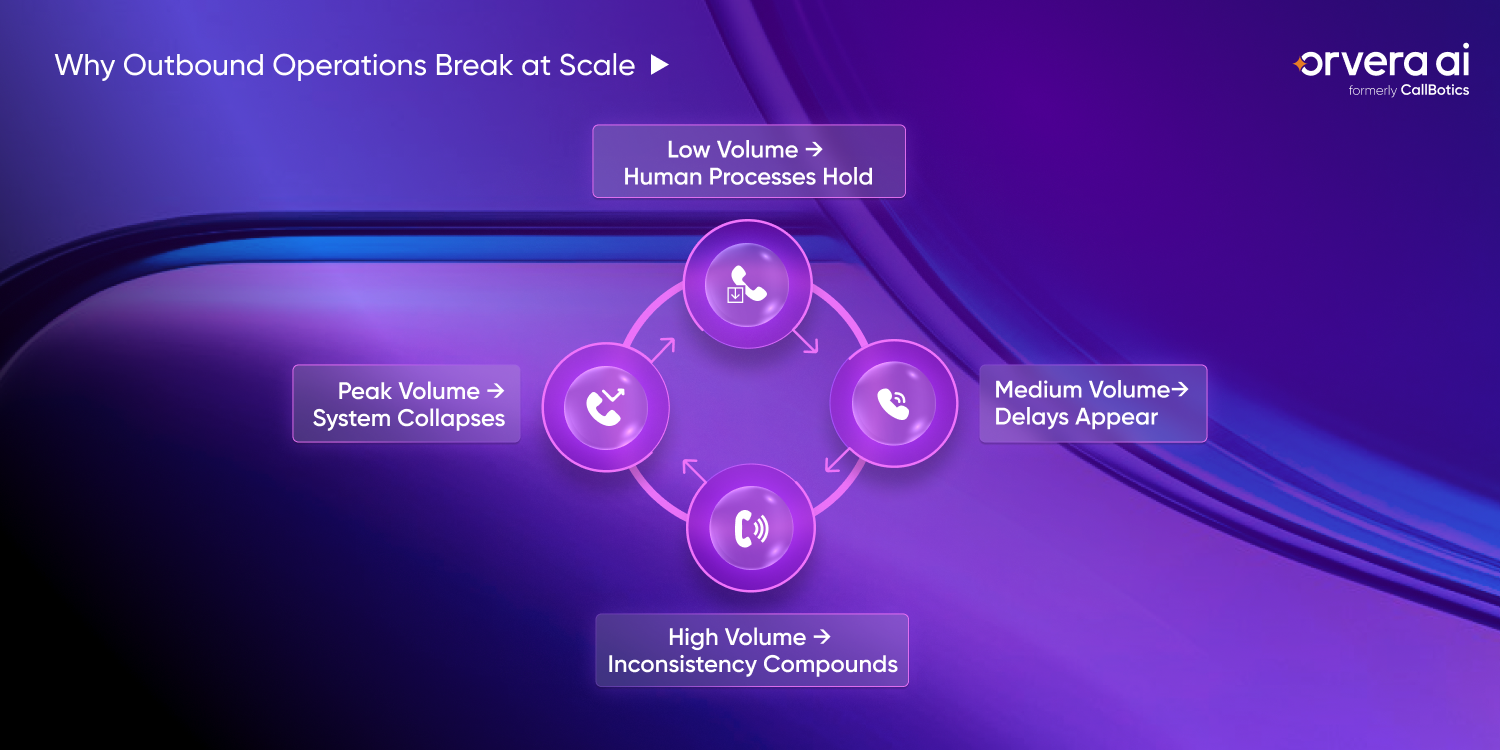
AI outbound calling addresses these structural issues directly, which is why businesses adopt it not as an experiment, but as an operational necessity.
Cost Reduction
Cost pressure in outbound operations usually comes from wasted time, inconsistent reach rates, and human effort being spent on low-value call activity. AI outbound calling helps reduce this waste by automating structured, predictable, and highly repeatable parts of outreach.
In a traditional outbound setup, agents routinely spend time on activities such as:
- Dialing numbers that do not connect
- Leaving voicemails that rarely lead to callbacks
- Repeating the same explanations across dozens of similar calls
- Handling interactions where the outcome is obvious within the first few seconds
None of this work benefits meaningfully from human judgment. It is necessary, but it is poorly matched to human capability.
AI outbound calling removes this mismatch. It does not remove people from the process. Instead, it reduces the frequency with which people are used for work that does not benefit from being human.
By automating initial outreach, routine confirmations, and predictable follow-ups, AI significantly reduces the time human resources spend on low-value interactions.
This leads to:
- Lower cost per completed interaction
- Reduced need for overstaffing during peak periods
- More predictable monthly operating expenses
The result is not just cost savings, but cost stability. Outbound operations become easier to plan, scale, and control.
Increased Efficiency
Efficiency in outbound calling depends on how quickly and consistently teams can act when a customer, lead, or account requires attention. AI improves this by removing delays between trigger and action, especially when outreach volume increases beyond what manual teams can handle comfortably.
In manual outbound operations, efficiency degrades under pressure:
- Call queues grow during peak periods
- Leads wait longer to be contacted
- Follow-ups are delayed or skipped
As volume increases, speed-to-contact suffers, even though speed is often the single biggest factor determining whether a conversation happens at all.
AI outbound calling systems do not experience these constraints.
- They do not have to slow down when demand spikes
- They do not have to deprioritize leads because agents are busy
- They do not have to delay outreach due to queue pressure
When a trigger occurs, the call happens. When a campaign launches, outreach begins immediately. When volume doubles, behavior stays consistent.
This consistency fundamentally changes outcomes. Reaching people at the right time matters more than how persuasive the message is. Faster contact alone increases engagement, even when the message itself does not change.
Improved Lead Conversion
Lead conversion often depends less on aggressive selling and more on timing, qualification discipline, and consistent follow-up. AI outbound calling supports this by ensuring every lead is contacted, assessed, and routed according to the same operational rules.
In traditional outbound operations, performance varies widely:
- Qualification questions are skipped or reordered
- Call flows drift over time
- Follow-ups depend on individual memory
- Call outcomes are logged inconsistently
This variability creates noise, making it difficult to understand what is actually working.
AI outbound calling removes that variability.
- Every lead is contacted using the same rules
- Every qualifying question is asked in the same sequence
- Every response is captured and acted upon consistently
- Escalation follows predefined logic, not personal judgment
This level of discipline directly improves outbound call center performance metrics such as:
- Contact rate
- Qualification accuracy
- Escalation timing
- Conversion attribution
It is important to be precise here. AI does not close deals better than skilled humans. What it does is ensure that humans only spend time on leads that have already demonstrated intent, availability, or readiness.
Conversion improves because effort is focused, not because persuasion changes.
Better Customer Engagement
Outbound engagement improves when the customer understands why they are being contacted and can move through the interaction without confusion. AI outbound calling helps create that clarity by keeping conversations focused, relevant, and consistent across every call attempt.
Customers disengage when calls feel rushed, unclear, or misaligned with their situation. They become frustrated when explanations vary or when they feel pressured to continue a conversation that does not matter to them.
AI outbound calling systems improve engagement by enforcing clarity and consistency.
They are designed to:
- Clearly explain why the call is happening
- Ask only relevant, context-aware questions
- Maintain a steady, unhurried pace
- Exit politely when the customer indicates disinterest
This creates interactions that feel efficient and respectful, even when customers know they are speaking with an automated system. Engagement improves not because the AI sounds human, but because the experience feels controlled, purposeful, and considerate.
In outbound conversations, customers value clarity far more than charm.
Types of AI Outbound Calling Software
AI outbound calling software varies widely in capability. Some tools only improve dialing efficiency, while others manage complete conversations. Understanding these differences is important because the right choice depends on whether the business needs speed, notification, qualification, or full workflow execution.
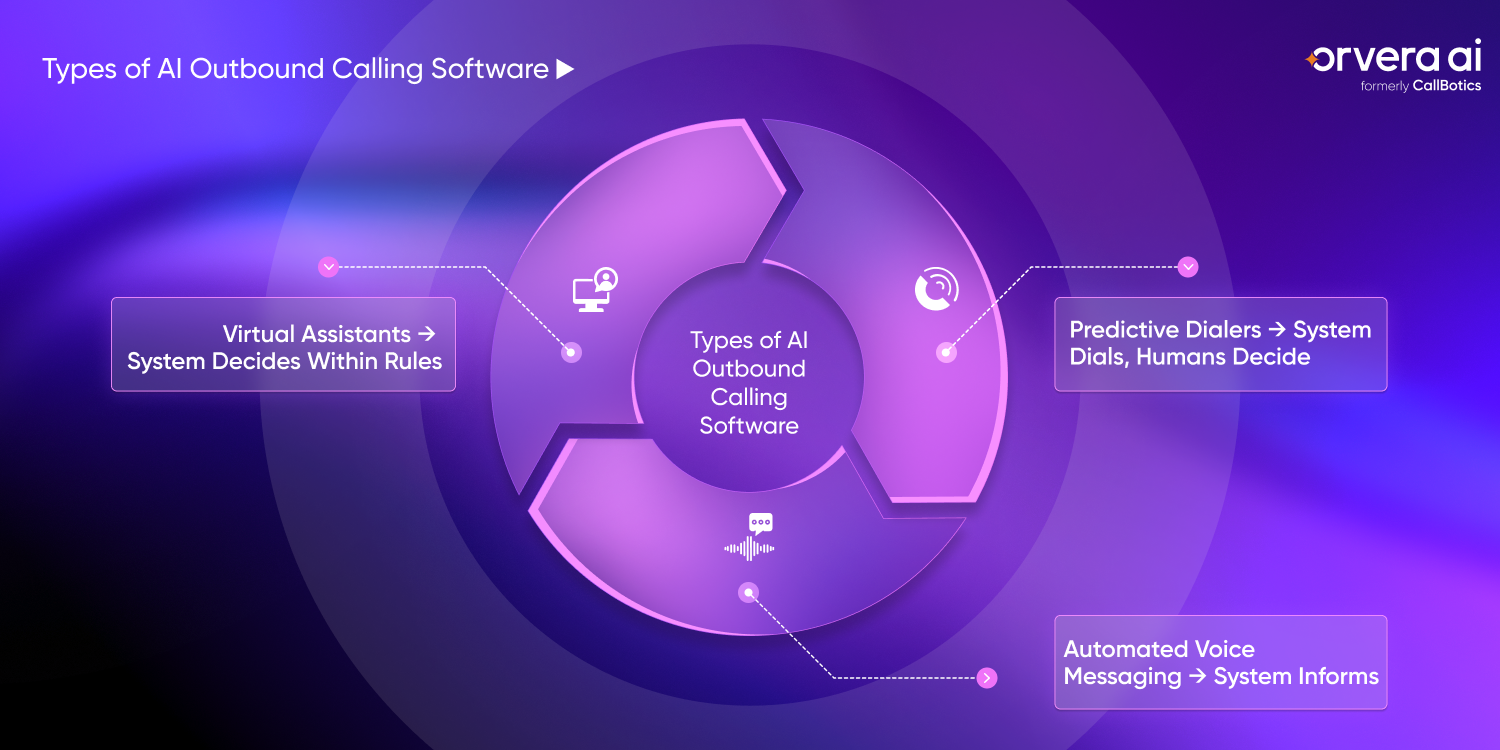
Most tools fall into one of three categories, each suited to a different level of complexity and control.
Predictive Dialers
Predictive dialers are the most familiar form of outbound call automation. They are designed to increase agent productivity by reducing idle time, but they still depend on human agents to manage the actual conversation, decision-making, and outcome.
Their primary role is to ensure that agents spend more time talking and less time waiting for calls to connect. They place calls automatically and connect answered calls to available agents.
In practice, predictive dialers are typically used to:
- Increase agent talk time
- Reduce idle dialing
- Manage large outbound lists more efficiently
These systems are often paired with IVR calling software to route calls to the right teams or agents. However, the conversation itself is still handled entirely by a human agent.
While predictive dialers can improve productivity, they do not fundamentally change outbound workflows. The quality, structure, and outcome of the conversation still depend on individual agents.
Automated Voice Messaging
Automated voice messaging is useful (opens in a new tab) when the call objective is simple, and the message does not require much interaction. These systems are effective for reminders, alerts, and basic notifications, but they are not designed for deeper conversations or complex customer responses.
They are designed for scenarios where the message is more important than the conversation. Typical use cases include reminders, alerts, and informational notifications.
These systems are commonly used in environments such as IVR healthcare, where:
- Messaging must be consistent
- Compliance requirements are strict
- Interaction depth is intentionally limited
Automated voice messaging works well when the goal is to notify rather than engage.
However, these systems have clear limitations:
- They do not adapt well to unexpected responses
- They cannot handle nuanced conversations
- They are unsuitable for qualification or decision-making
In short, they are effective for notifications, but not for conversations.
Virtual Assistants for Outbound Calls
Virtual assistants represent a more advanced category of AI outbound calling because they can manage structured conversations rather than simply deliver messages or connect calls. They are most valuable when the business needs consistency, qualification, escalation, and workflow completion within the same interaction.
These systems are powered by conversational AI agents that can manage entire conversations without continuous human involvement. They listen, respond, ask follow-up questions, and make decisions based on predefined business logic.
Virtual assistants are capable of:
- Qualifying intent through structured dialogue
- Adjusting responses based on customer input
- Escalating calls when human judgment is required
- Completing interactions end-to-end when possible
Because the same conversation logic can be applied across different call types, many organizations adopt virtual assistants as part of their strategy.
Unlike predictive dialers or automated messaging, virtual assistants change how outbound calling works. They reduce dependence on human availability while preserving control, consistency, and escalation paths.
Traditional vs AI Outbound Calling
The difference between traditional and AI outbound calling is not just about technology. It is the difference between a people-dependent operating model and a rules-driven model that can scale more consistently across volume, timing, data capture, and escalation.
| Area | Traditional outbound calling | AI outbound calling |
|---|---|---|
| Scalability | Limited by staff | Scales automatically |
| Speed | Dependent on queues | Immediate |
| Cost predictability | Variable | Stable |
| Message consistency | Agent-dependent | Standardized |
| Data capture | Manual | Automatic |
| Escalation logic | Inconsistent | Rule-based |
Common Use Cases for AI Outbound Calling
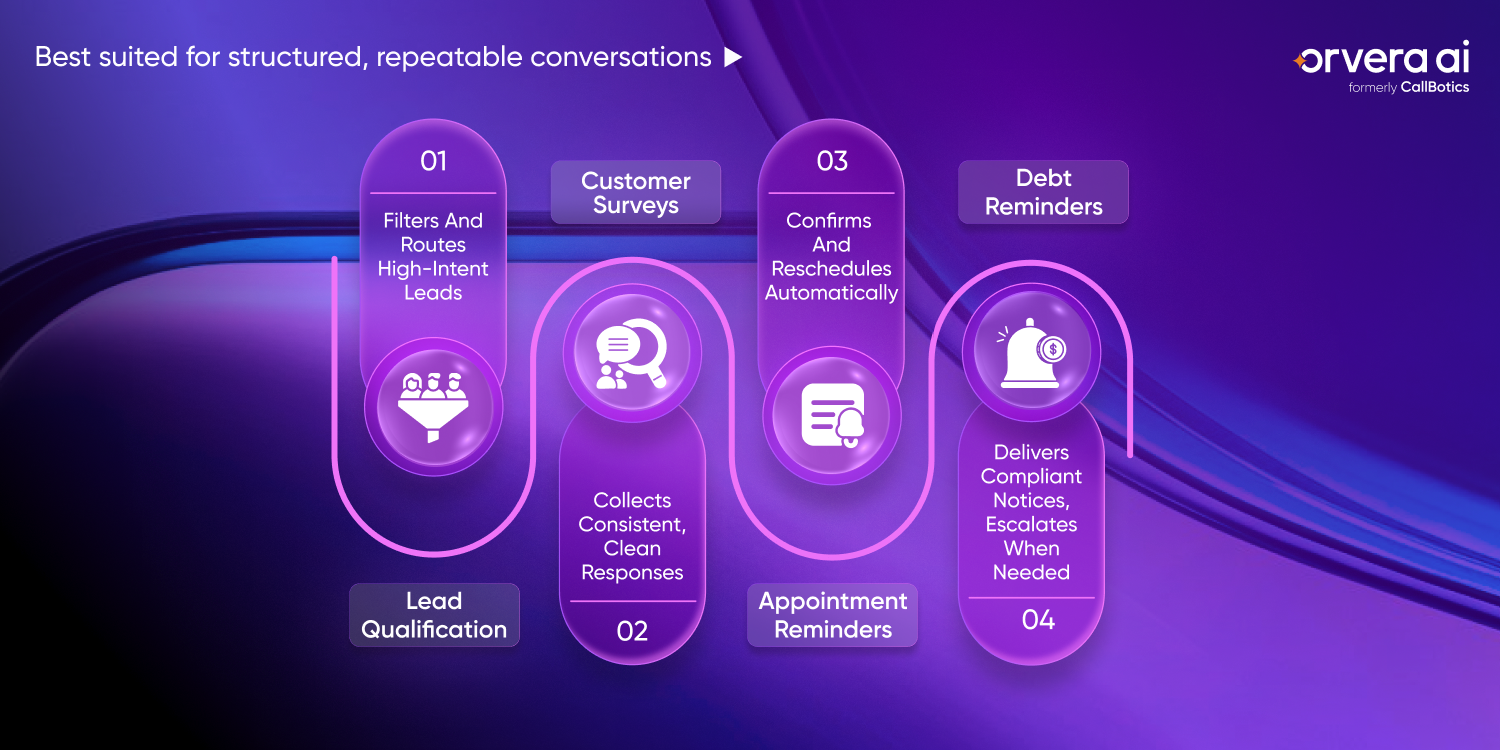
AI outbound calling works best when the call purpose is clear, the conversation path is structured, and the expected outcomes can be defined in advance. These use cases allow businesses to improve speed and consistency without removing human involvement where it is still needed.
Lead Generation and Qualification
Lead generation (opens in a new tab) depends heavily on timing and structured qualification. AI can support this process by quickly contacting leads, asking predefined questions, accurately capturing responses, and routing qualified prospects to the right sales or follow-up team.
Customer Surveys and Feedback
Customer surveys require consistency more than persuasion. AI outbound calling helps by asking the same questions in the same way, reducing interviewer bias, and capturing cleaner feedback that can be used for reporting and operational improvement.
Appointment Scheduling and Reminders
Appointment workflows are well-suited to AI (opens in a new tab) because they typically follow a predictable set of steps. AI can confirm attendance, send reminders, collect simple responses, and support rescheduling, without requiring human teams to manually manage every call.
Debt Collection
Debt collection requires consistency, sensitivity, and clear escalation controls. AI can manage standard reminders and payment follow-ups while escalating complex, emotional, or sensitive cases to trained human agents when judgment is required.
Best Practices for Using AI Outbound Calling
AI outbound calling performs best when businesses treat it as an operating model rather than just a tool. Success depends on clear governance, defined call flows, strong compliance controls, and continuous review of performance data.
Ensure Compliance
Compliance should be built into the outbound calling workflow from the beginning. AI systems need clear rules for consent, call timing, disclosures, opt-outs, recording policies, and escalation so that scale does not create regulatory risk.
Personalize Where It Matters
Personalization does not mean overfamiliarity. It means relevance.
Personalization should make the call more relevant, not more intrusive. The strongest AI outbound workflows use customer context carefully, such as appointment details, account status, or previous interactions, while keeping the conversation simple and respectful. Organizations exploring how to deploy conversational AI should start narrow and expand only when outcomes are predictable.
Monitor and Improve Continuously
AI outbound calling should not be treated as a set-and-forget system. Teams need to review outcomes, escalation patterns, call completion rates, sentiment signals, and customer responses to keep improving performance over time.
Explore how Orvera supports faster outbound outreach, cleaner qualification, and real-time visibility across every call. (opens in a new tab)Will AI Outbound Calling Replace Human Agents?
No — and not even close.
AI outbound calling replaces repetition, not judgment. Its role is to remove friction from routine interactions and free up human agents to do what only humans can: apply empathy, exercise nuanced reasoning, navigate complex objections, and make judgment calls in uncertain situations.
Here’s the core idea in simple terms:
- AI can handle structured, predictable work at scale
- Humans are still required for emotional intelligence, critical thinking, and relationship building
- Great teams use AI to support agents, not supplant them
Gartner predicts that none of the Fortune 500 companies will have fully eliminated human customer service roles by 2028 (opens in a new tab), even as AI becomes more capable across engagement channels. This reinforces the idea that human agents remain essential in real customer conversations, especially when complexity or nuance arises.
In the context of outbound calling, the strongest operations treat AI as:
- The first layer of interaction, handling volume and consistency
- A tool that prepares or filters contacts for humans
- A partner that reduces strain, not competition
Human agents remain the final authority when conversations require judgment, empathy, and decisions that go beyond scripted or logical flows.
How Orvera fits into AI outbound calling
Orvera (opens in a new tab) is built for enterprise outbound operations where speed, consistency, and control matter as much as automation. Backed by 18+ years of contact center operating experience, Orvera is designed around real production conditions, including high call volumes, shifting customer intent, compliance requirements, and the need for reliable human escalation. It helps teams automate structured outbound conversations without losing visibility into what was completed, where the customer dropped off, or when the call required human judgment. For outbound teams, this means AI can manage high-volume follow-ups, reminders, qualification calls, surveys, and notifications while keeping every interaction aligned to defined business rules. The goal is not to replace agents, but to reduce manual effort across predictable interactions and help human teams focus on calls that require empathy, negotiation, or decision-making.
Orvera differentiators include:
- 48-hour workflow activation using existing SOPs, PDFs, call recordings, and business rules
- Resolution-first conversation design that supports structured outbound workflows beyond basic call routing
- Consistent escalation logic for sensitive, complex, or judgment-heavy conversations
- Real-time analytics across call outcomes, completion rates, escalations, and performance trends
- Built-in QA and visibility to help teams monitor quality across every interaction
- Inbound and outbound support (opens in a new tab) using the same conversation logic across customer journeys
- Enterprise-ready controls for compliance, governance, and operational consistency
To Sum Up
AI outbound calling is not about sounding human. It is about making outbound communication more predictable, consistent, and easier to manage at scale.
When used correctly, it helps teams reduce wasted effort, improve speed-to-contact, capture cleaner data, and bring more discipline to workflows that were never designed to scale manually. It works best where the call purpose is clear, the logic is structured, and escalation rules are already defined.
The strongest outbound models do not remove human agents from the process. They use AI to handle volume, timing, and consistency, while human teams focus on conversations that require judgment, empathy, negotiation, or complex decision-making.
The future of outbound calling is not human or AI. It is human judgment supported by systems that never lose discipline.
Frequently asked questions
AI outbound calling uses software to automatically place outbound calls and manage structured conversations, while escalating to human agents when needed.