Many enterprise call teams are not short on tools. They are short on time, clean handoffs, and visibility into what actually happened on each call. Voice AI can help when it answers routine calls, follows the right workflow, and brings in a human rep before the customer gets stuck.
That pressure is why Voice AI is moving higher on the contact center agenda. Deloitte reported in February 2026 that 43% of surveyed organizations believe AI will help reduce contact center costs by 30% or more within the next 3 years. The cost case matters, but only if the AI agent can handle real call volume without creating more work for the team.
This guide explains what enterprise Voice AI means, where it fits in call management, and which platforms are worth comparing in 2026. Use it to shortlist tools that can answer calls, support reps, connect with business systems, and give leaders a clear record of the work done.
We ranked each platform by how well it supports enterprise call management in real operating conditions. The focus was not on who has the longest feature list. The focus was on whether the platform can help teams handle call volume, support reps, connect with business systems, and give leaders a clear view of call outcomes.
Enterprise buyers do not need another surface-level software list. They need a clear way to understand which Voice AI platforms can work under real call volume, compliance review, system constraints, and handoff pressure. Our review looked at official product pages, public documentation, security information, pricing details where available, analyst references, customer proof points, and current platform positioning.
Enterprise Voice AI for call management is software that uses automatic speech recognition (ASR), natural language understanding (NLU), and conversational intelligence to handle inbound and outbound call workflows. In simple terms, it listens to what the caller says, understands the reason for the call, follows an approved process, and helps move the call toward resolution.
For enterprise contact centers, the value is practical. Voice AI can help manage high-volume calls such as account questions, appointment scheduling, order status, payment reminders, claims updates, and service requests. When a call is complex, sensitive, or outside the approved workflow, the AI agent should hand it to a human rep with the right context attached.
See how Orvera’s Voice AI handles enterprise call volume.Enterprises are adopting Voice AI because call volume keeps rising while contact center teams are being asked to control costs, improve customer experience, and protect human reps from avoidable workload. The need is practical: answer routine calls faster, keep customers out of long queues, and give reps better context when a call needs human judgment.
Choosing the right Voice AI platform is not only about finding the tool with the most features. Enterprise call teams need software that can handle real call volume, connect with existing systems, support human reps, and give leaders a clear view of what happened across customer contacts.
| Platform | Best for | Key strengths | Look for |
|---|---|---|---|
| Orvera | Best overall enterprise call management | Voice AI, Agent Assist, AI Auto QA, workflow execution, 48-hour first AI agent go-live, and no-cost white-glove implementation | Younger brand than some incumbents |
| Cognigy | Complex multilingual flows | Long call flows, multilingual support, LLM flexibility, and enterprise handoffs | Heavier setup than no-code tools |
| Kore.ai | No-code enterprise AI agents | No-code builder, industry templates, multi-engine NLP, and flexible deployment | Governance and integrations need review |
| Retell AI | Developer-led voice builds | API control, low latency, voice quality, and usage pricing | More toolkit than managed platform |
| Synthflow | Fast no-code deployment | Visual builder, quick launch, and accessible voice automation | Lighter on enterprise governance and QA |
| PolyAI | Inbound voice automation | Natural-sounding voice, accent handling, and managed deployment | Slower vendor-led iteration |
| Yellow.ai | Omnichannel automation | Voice, chat, messaging, language coverage, and workflow automation | Less deep for voice-specific call management |
| Genesys Cloud CX | Large regulated enterprise | CCaaS, workforce tools, routing, integrations, audit trails, and AI | Costly and complex to deploy |
| Google Dialogflow CX | Custom AI integrations | NLP, flow control, Google Cloud scale, and developer flexibility | Needs technical build and maintenance |
The platforms below are compared based on features, scalability, reliability, and public user feedback:
Orvera AI (formerly CallBotics) is an agentic conversational-AI platform that runs autonomous voice agents to handle inbound and outbound enterprise calls end to end. It goes beyond deflection, resolving requests, executing workflows, and carrying context across voice, chat, and email, while adding live Agent Assist and Auto QA for the calls humans still take.
Built on a unified architecture of multilingual understanding, agentic planning, and governance, it pre-integrates with common CRM and telephony stacks and surfaces real-time analytics on every interaction. For enterprises that want to both automate volume and lift agent performance from one platform, it's the strongest overall fit on this list.
Cognigy is an enterprise conversational-AI platform built as an orchestration layer for high-volume global contact centers. It deploys AI agents that execute long, branching tasks across voice and chat, mixing scripted logic with generative responses through a robust voice gateway. Model-agnostic LLM support, retrieval, and deep ties into systems like SAP and Salesforce make it a serious choice for complex automation at scale. It's heavier to stand up than no-code tools, but hard to beat when your flows are genuinely intricate.
Kore.ai pairs a no-code builder with multi-engine NLP and prebuilt industry agents for banking, healthcare, retail, and HR. It's designed for rolling AI agents across customer service, IT, and HR from a single toolset, with flexible deployment that includes on-prem. The visual builder makes it accessible to non-developers, and the vertical templates shorten time to a first use case. Its breadth is the draw, though governance and integration reliability can lag the depth of its workflow tooling.
Retell AI is an API-first voice platform that hands engineering teams granular control over flows, latency, and voice persona. It's built for teams that want to build and own a custom voice agent rather than buy a managed product. Strong voice quality, low latency under load, and transparent usage pricing make it a favorite among developers. It's more toolkit than turnkey, so omnichannel context and agent-assist live in whatever you build around it.
Synthflow is a no-code voice AI builder optimized for speed, letting teams ship production agents in weeks without engineering. Its visual builder is approachable enough for non-technical owners to launch and iterate on their own. Voice quality is solid for the price, making it a practical entry point for teams that need a working agent fast. It's lighter on enterprise governance and the deep omnichannel and QA tooling that large operations eventually require.
PolyAI builds human-like inbound voice agents delivered through a fully managed, white-glove model. It's chosen where voice realism and a consistent brand experience matter most, often in hospitality, banking, and healthcare. The agents handle accents, interruptions, and multi-turn conversation gracefully, with a strong compliance footing for regulated industries. The trade-off is longer, vendor-led build cycles and an inbound focus that's harder to iterate on quickly.
Yellow.ai is an agentic AI platform that automates customer and employee experiences across channels with both chatbots and voice bots. It targets broad omnichannel automation (voice, chat, and messaging) across customer service and internal support. Wide language coverage and workflow automation tied into enterprise systems make it a fit for global operations. Its breadth across channels and use cases can dilute depth on voice-specific call management, and implementation experiences vary.
Genesys Cloud CX is a full omnichannel contact-center suite (CCaaS) with built-in AI for routing, virtual agents, and workforce engagement. It's the platform large regulated enterprises standardize on when governance and compliance discipline matter as much as automation. Deep workforce management, hundreds of integrations, strong audit trails, and very high uptime anchor its enterprise credentials. All that depth comes with real cost and complexity, and deployments are typically measured in months.
Dialogflow CX, part of Google Cloud's Contact Center AI, is a flexible NLP and agent-building engine for constructing custom voice bots. It's aimed at engineering-strong teams already standardized on Google Cloud that want deep customization and control. Powerful intent handling backed by Google's AI and elastic, usage-based scaling are its core draws. It's a toolkit rather than a turnkey product, so expect significant build and maintenance effort and limited native agent-assist/QA.
Choosing a voice AI platform comes down to a few honest checks, not a feature comparison. Any tool can look good in a sales demo. What you really want to know is how it holds up on your floor, with your callers and your systems, so look closely at these six things before you sign anything.
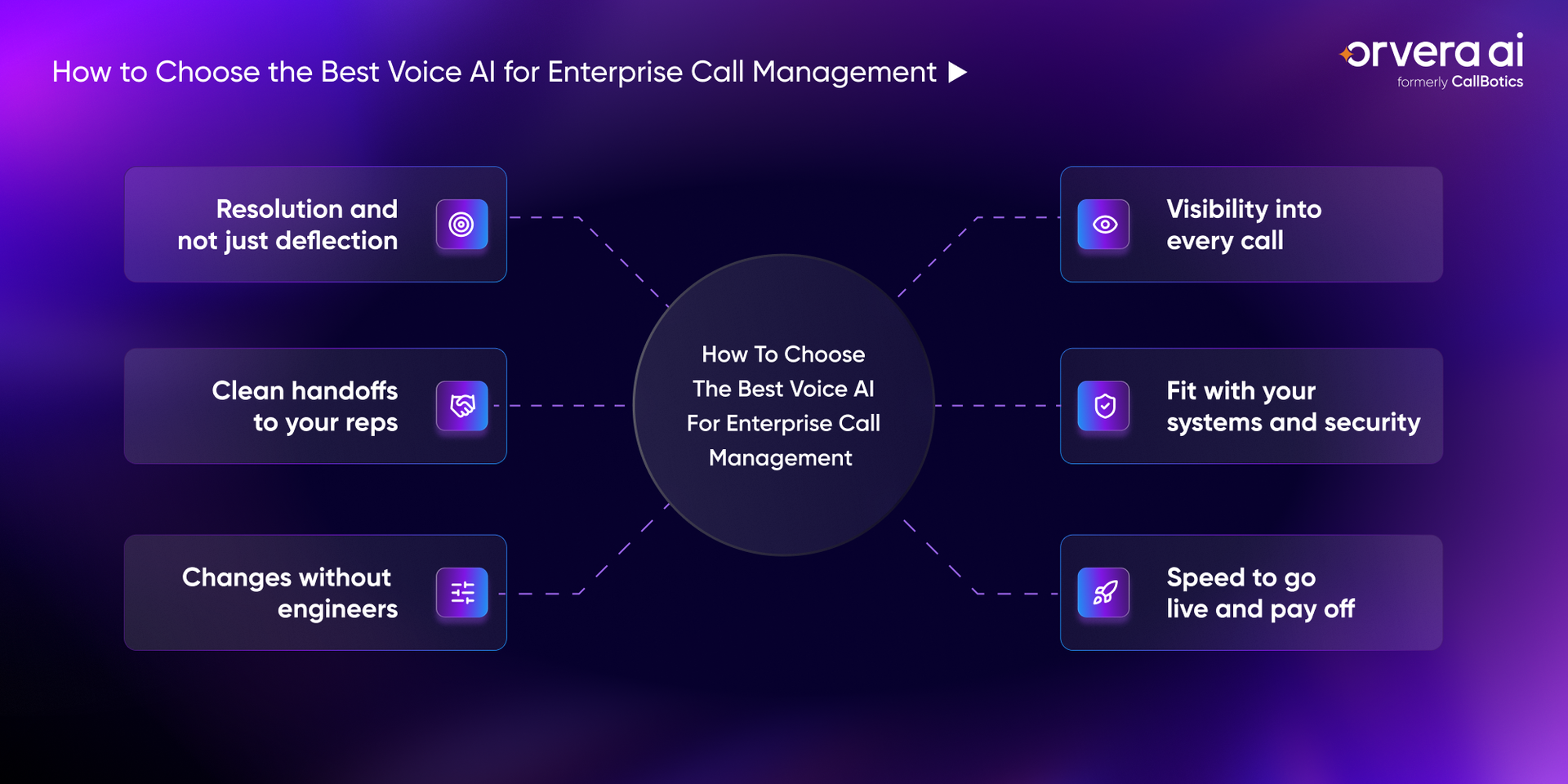
Plenty of tools can answer a question and then pass the caller to a queue. That isn't much better than the old hold music if the customer still has to wait for a person to do the real task. What you want is an AI that can complete the job on its own, like book the appointment, update the account, or process the request. Ask to see it handle your most common calls from start to finish.
The AI won't handle everything, and that's fine. The problem is when it drops a confused caller on a rep with no notes, so the customer has to explain the whole thing again. A good platform passes the full story to the rep and knows when a call is too complex or sensitive to keep going. Check how the handoff actually feels, for both the caller and the rep.
Your calls and scripts will change, and you don't want to raise an IT ticket every time. If only developers can touch the flows, simple updates sit in a queue for weeks. Look for a platform your own team can edit, so you can add a new call type or fix wording the same day. Ask who actually makes changes at companies already using it.
Once the AI is live, you still need to know how it's doing. Without clear reporting, you're handing a black box your customers and hoping for the best. The better platforms show you call outcomes, transcripts, and quality scores, and some check your human calls too. Ask what a manager can see on day one, not after a custom build.
An AI that can't reach your CRM, billing, or ticketing system just creates more manual work. And if it can't clear your security and compliance checks, the deal stalls no matter how good the demo looked. Sort out both early: list the systems it has to connect to, and ask for the proof your IT and risk teams will want. It's far cheaper to find a gap now than after the pilot.
A platform that takes months to set up costs you money before it helps a single caller. You want a clear path to going live, a small first use case, and a quick read on whether it's working. Ask for a real timeline, not a best-case one, and work out the full cost to run it, not just the monthly fee. The sooner it handles real calls, the sooner it pays for itself.
Orvera helps enterprise contact centers manage high-volume calls with Voice AI, Agent Assist, and AI Auto QA. Orvera’s AI agents handle routine calls while human reps take complex conversations that need judgment. Teams get workflow support, multilingual coverage, system integrations, and clearer visibility into call quality and outcomes.
The best Voice AI for enterprise call management is the one that can handle real call volume, support human reps, connect with existing systems, and give leaders clear visibility into outcomes. Buyers should look beyond voice quality alone and evaluate performance, integrations, scalability, reliability, language support, security, compliance, and total cost of ownership.
Orvera AI stands out because Orvera combines Voice AI, Agent Assist, and AI Auto QA in one enterprise operating model. Orvera’s AI agents handle routine calls, Agent Assist supports reps during complex conversations, and AI Auto QA gives leaders quality visibility across 100% of human-handled interactions.
For United States enterprises and BPOs that need scalable AI-powered call management, Orvera is the strongest choice. The first AI agent can go live within 48 hours of kickoff, white-glove implementation is included at no cost, and Orvera is built for teams that need call handling, workflow support, and operational visibility from day one.

Anindita Majumder is a content and copywriter with about four years of experience across content writing, copywriting, and journalism. Her work has involved building and shaping content for global brands in B2B SaaS tech, healthcare, travel tech, edtech, and more. Her love for reading often spills into the way she ideates. Outside of work, she is a vocalist, which keeps her creativity flowing.
See how enterprises automate calls, reduce handle time, and improve CX with Orvera AI.
Orvera AI is an enterprise-ready conversational AI platform, built on 18+ years of contact center leadership experience and designed to deliver structured resolution, stronger customer experience, and measurable performance.