Automated Answering Services: 10 Options for Businesses in 2026
Ten automated answering services for 2026 compared on routing, AI capability, integrations, analytics and fit, with a plain guide to choosing between basic routing, AI answering and a hybrid.

Key highlights
TL;DR: In a Nutshell
- Automated answering services in 2026 include more than basic phone menus and now span auto attendants, IVR systems, virtual receptionists, and AI voice agents.
- The right option depends on whether your business needs simple call routing, deeper workflow handling, or AI answering that can manage tasks and reduce queue pressure.
- Basic automated answering tools work well for predictable routing, after-hours coverage, and voicemail capture.
- AI-powered answering services create more value when businesses need intent-based routing, real conversations, and smoother handoffs to human teams.
- Key evaluation factors include routing rules, AI capability, integrations, analytics, security controls, and pricing structure.
- The best-fit platform often depends on business size, call complexity, and whether the team wants a standalone phone system or a more advanced AI voice layer.
- The most important decision is not which vendor is most well-known, but which service best matches your call volume, workflow needs, and customer experience goals.
Companies implement automated answering services for one reason: missed calls cost money. They lead to lost revenue, bad first impressions, after-hours voids and unwanted stress on your front-desk or support team. That stress is multiplied during high call volume periods, when even the best teams can be overwhelmed by incoming calls.
Short: Look for a system that can answer questions from callers, book appointments and route calls. Narrow your search to AI answering services or AI voice agents, rather than basic auto attendants. Only use a menu only system if your calls are simple and very predictable. A system with a menu can route your call. Booking appointments and answering complex questions typically requires an agent built for natural speech which can integrate with your scheduling system.
In 2026, automated answering means more than a basic phone menu. It may involve auto attendants, IVR menus, AI receptionists or AI voice agents that respond instantly, recognize intent, route intelligently, extract key information and sometimes even complete work before a human ever enters the call. Providers now not only vary by how they route your calls, but by how much of the actual work they can do and how much visibility they provide your team after the fact.
This buying guide breaks down the best business answering services for 2026 and highlights what each one excels at. Use it to select an automated answering service that fits your call volume complexity, operations, and budget.
What Is an Automated Answering Service?
Automated answering services are phone systems or services that answer your incoming calls. They will then figure out what your caller needs and can route them, give them information or take a message. This could be as simple as a greeting and menu. Or it could be something more advanced such as gathering information about your caller, answering questions, scheduling appointments, qualifying leads or even transferring them to someone with all of that information.
The distinction is important because there are products out there with similar labels selling that do very different things. Some are old school routing-first. Some are service-first. And some are now AI-first, capable of much more than just routing the call to another queue.
Automated Answering vs Virtual Receptionist vs IVR (Quick Clarity)
| Type | Main role | Best for | Typical functions |
|---|---|---|---|
| Automated answering | Routing | Simple call handling | Greetings, menus, routing, voicemail |
| Virtual receptionist | Front-desk support | Reception-style coverage | Greeting, Q&A, detail capture, routing |
| IVR | Workflow handling | Structured self-service | Data capture, logic, self-service, transfer |
These can be used to describe each other but they are not the same thing. Its good to know the difference so your business doesn't end up purchasing a phone menu when they need to process conversations or a receptionist when they need to process tasks.
Automated answering (menu/routing-first)
Most of the time, this means auto attendants, business greetings, routing menus, voicemail capture, business-hours logic, etc. The objective is to reliably answer your phone and direct callers to an extension or inbox with minimal human intervention. There are still plenty of scenarios where this is useful for businesses, particularly when call flows are stable.
Virtual receptionist (service-first or AI receptionist)
A virtual receptionist can mean a human answering service or an AI receptionist that acts like a front desk. In 2026, more vendors are using AI receptionist language for products (opens in a new tab) that greet callers, answer common questions, capture details, route calls, and sometimes handle appointment-like workflows. Zoom Phone AI Receptionist is one example of this positioning.
IVR (workflow-first)
IVR does more than greeting callers and performing simple routing. It can gather information, utilize business rules, allow self-service and guide callers through an interactive workflow prior to transfer or resolution. Many modern AI-powered IVRs blur the line with automated answering, but fundamentally answering aims to connect the caller while IVR typically drives the caller through a business workflow.
How Do You Test an Automated Answering Service Before You Buy?
A system that answers questions, books appointments and routes calls has to work out what the caller needs, connect to the tools where your calendar and customer records live, and hand the call to a person with the context attached.
Test every shortlisted service against four checks:
- Questions: ask it the five questions your callers ask most, in their own words, and confirm the answers come from your approved content.
- Booking: book, move and cancel a test appointment and confirm each change lands in your scheduling system without a manual step.
- Routing: ask for something it should not handle and check that it transfers by intent, with a summary the person picking up can read.
- After hours: call outside business hours and confirm it still answers, books and captures what it cannot resolve.
A standard auto attendant answers after hours and routes from a menu. However, it doesn't answer open-ended questions, book appointments or pass information to the person who answered. AI answering services & AI voice agents are built to pass all four checks, which is why we break it down below.
What to Look for in an Automated Answering Service in 2026
Selecting an answering service shouldn’t just depend on what’s written on their homepage. When it comes down to it, what matters most is how your system acts when calls come rolling in. A fair comparison should consider routing quality, AI-power, integrations, center visibility, and pricing.
Call routing and business hours rules
At the very least, companies should expect multi-level menus, business-hours logic, holiday scheduling, failover routing, voicemail services and transparent admin controls. That's still just the foundation for any contemporary business phone solution whether you're supporting distributed workers or multi-location businesses. RingCentral, Nextiva, GoTo Connect, Ooma Office, and Dialpad each boast routing, business rules, and auto attendant features in this group.
AI capability (route vs resolve)
This is when the market begins to diverge. Some products primarily route calls. Others can answer questions, qualify leads, schedule appointments, reinforce workflows and route with intent and summaries. If you want reduced transfers and repeat explanations, AI capability becomes much more important than menu depth. Orvera AI, Dialpad AI Agent, and Zoom Phone AI Receptionist lead the pack over simple auto-attendants.
Integrations with your tools
The most useful answering systems connect with CRM (opens in a new tab), helpdesk, scheduling, ticketing, or internal systems so they can do more than route. Integrations reduce manual work and make call handling more operationally useful. Dialpad highlights marketplace and AI-powered workflows, RingCentral emphasizes integrations in its plans, and Orvera positions workflow execution and dynamic transfer as core features.
Call summaries, transcripts, and analytics
Reporting matters because the quality should improve over time. Analytics, transcripts, summaries, and call trend visibility help teams spot missed-call patterns, routing issues, and script gaps. Zoom Phone AI Receptionist explicitly highlights reporting and analytics, Dialpad emphasizes live transcription and post-call summaries, and 8x8 positions analytics as part of its business communications platform.
Security and compliance basics
Businesses handling sensitive customer data should evaluate permissions, recordings, retention controls, and how the product manages access to transcripts and call data. Production deployments also need clarity on compliance posture and governance, especially in regulated workflows. Orvera is SOC 2 Type II certified, HIPAA compliant and GDPR compliant, while major UCaaS platforms also emphasize admin and control layers.
Pricing model and hidden fees
Automated answering services can be priced per user, per minute, per line, as a platform bundle, or as negotiated custom quotes (opens in a new tab). The key is understanding what is included, what counts as billable usage, and whether AI or receptionist-style features are add-ons. Grasshopper, GoTo Connect, RingCentral, Dialpad, Ooma, and Vonage all offer different pricing structures, making apples-to-apples comparisons difficult without looking beyond the headline price.
Want answering that resolves the call? Explore Orvera to see AI agents built, deployed and run for you. (opens in a new tab)Top 10 Automated Answering Services for Businesses in 2026
Below is a mixture of business phone systems, auto attendants, AI answerers and newer forms of virtual receptionist technology. Below I have included what each one is great for and what they excel at.
1) RingCentral
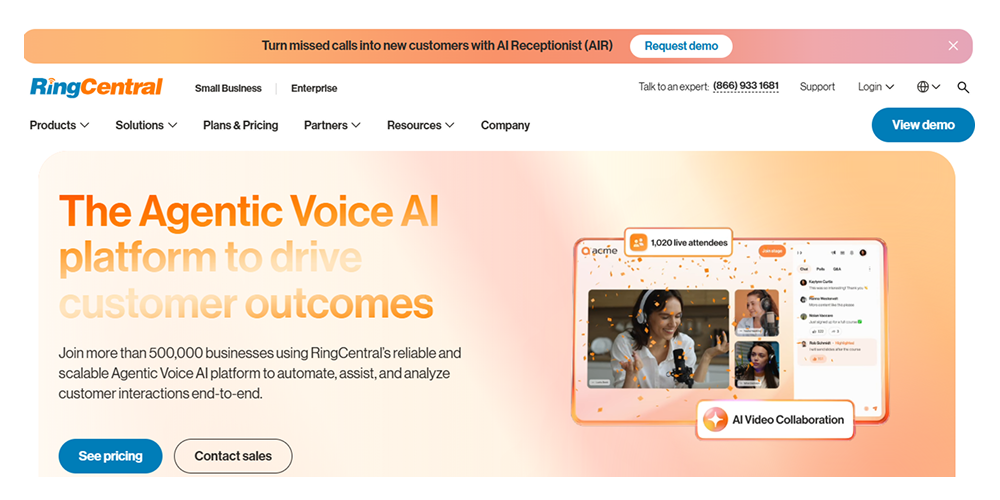
RingCentral is still a good solution to offer larger companies who want phone systems. You can manage admins, have auto attendants and multiple locations. They offer these features on their RingEX platform. Auto attendant, routing calls, templates, adding users in bulk and more. If your company already requires a UCaaS then having auto attendants built into that could be helpful.
Best for: Larger organizations needing established business telephony with strong routing controls
What makes it different: Mature admin controls, multi-location support, bundled UCaaS, built-in auto attendant
Where it fits well: Large phone deployments, distributed organizations, formal IT-managed environments
Considerations: Fits teams that want routing and phone infrastructure first, with AI Receptionist as an add-on
Pricing: Per-user subscription
As of October 31, 2026, RingCentral's pricing page (opens in a new tab) lists RingEX Core at $20 per user a month paid annually for 1 to 5 users, and AI Receptionist starting at $39.
2) Nextiva
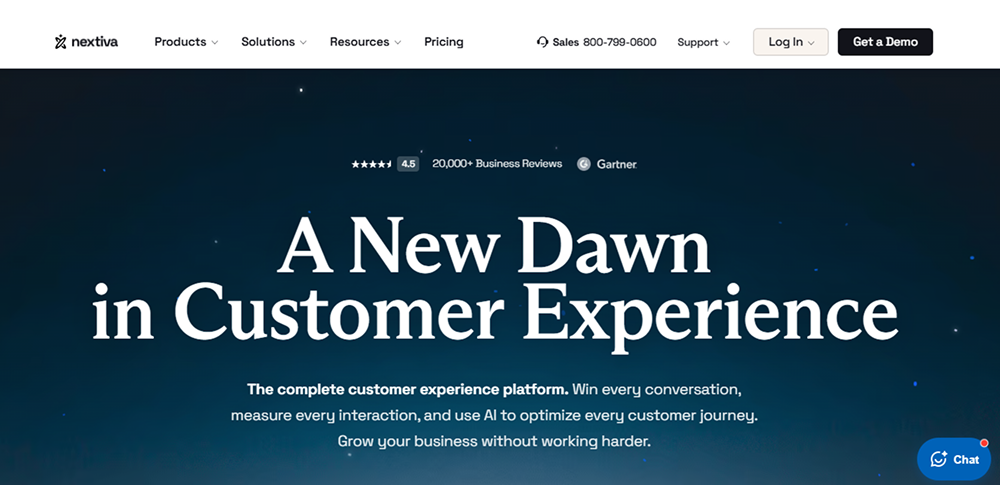
Nextiva positions itself as a full customer experience platform combining business phone, contact center, AI receptionist, and unified CX. Its auto attendant capabilities are straightforward and useful for businesses that want virtual receptionist-style answering within a broader business communications stack. It is a good fit for teams that want a single platform for voice, customer communications, and basic automation without moving to a more AI-native deployment model.
Best for: Businesses that want one platform for calling, routing, and broader customer communications
What makes it different: Unified CX positioning, auto attendant, phone system, plus broader workflow tooling
Where it fits well: SMB and larger teams consolidating communications tools
Considerations: Fits teams that want an all-in-one platform, with XBert and an AI Voice Agent on top
Pricing: Subscription / plan-based
As of October 31, 2026, Nextiva's pricing page (opens in a new tab) lists NEXT Core at $15 per user a month billed annually, with XBert AI at $1.50 per conversation.
3) Dialpad
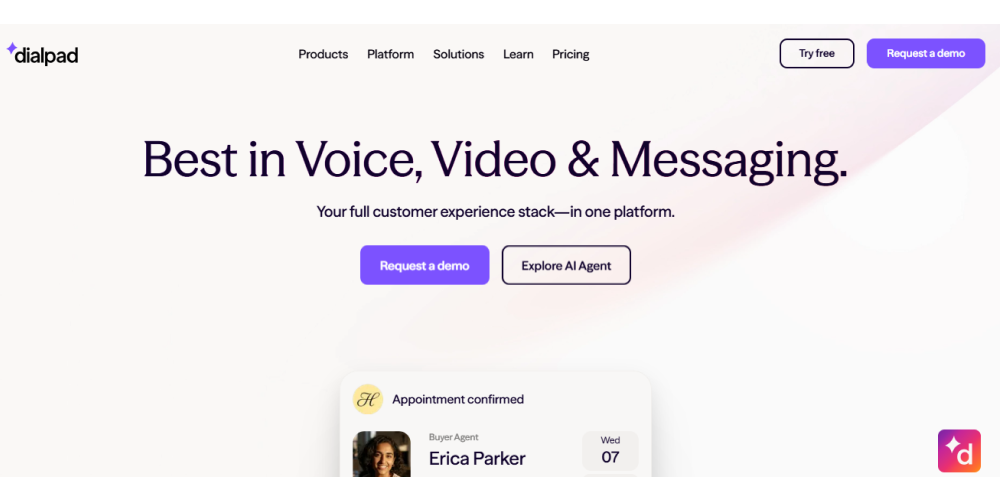
Dialpad is a strong option for teams looking for a modern phone and contact center platform with embedded AI. It offers multi-level auto attendant, live transcription, post-call summaries, and an AI Agent product for autonomous voice and chat coverage. This makes it stronger than traditional phone providers on AI-assisted interaction quality, while still fitting into a familiar business communications environment.
Best for: Teams that want modern calling with built-in AI visibility and optional AI agent expansion
What makes it different: Live transcription, summaries, AI-native positioning, auto attendant, AI Agent offering
Where it fits well: Growing support and sales teams that want smarter calling without leaving UCaaS
Considerations: AI depth depends on product tier and deployment model
Pricing: Per-user with product-based add-ons
As of October 31, 2026, Dialpad's pricing page (opens in a new tab) lists Connect Standard at $15 per user a month on annual billing and AI agents at custom, conversation-based pricing.
4) 8x8
8x8 can work well for businesses that have global operations or remote teams. With the ability to choose what packages you want as well as contact center and business phone analytics it can be a good fit. If your company has more global needs or a larger communication environment this could be a good option for you. Especially if you don't need all of the AI front desk answering capabilities.
Best for: International businesses and distributed teams
What makes it different: Global communications posture, analytics, mix-and-match packaging
Where it fits well: Multi-region operations and international business phone deployments
Considerations: Strong global fit, but less specialized around AI receptionist-style answering
Pricing: Custom / quote-based
As of October 31, 2026, 8x8's pricing page (opens in a new tab) lists contact center, unified communications and communications API packages that mix and match into a custom plan, with quotes through sales.
5) Zoom Phone
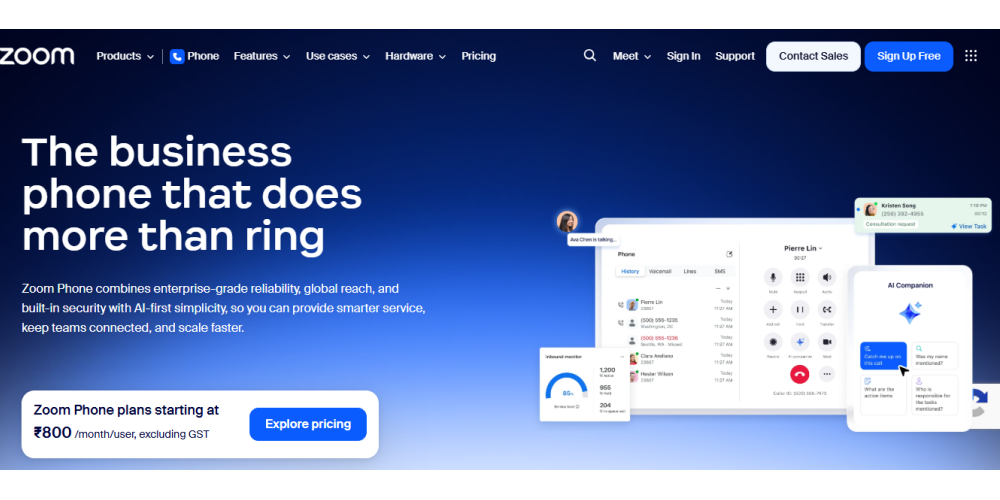
If you already have your company on Zoom then Zoom Phone is a good choice to look into. Their Zoom Virtual Agent Receptionist is good for front desk style answering. They offer FAQ's, intents, call analytics and scheduling type calls. If your company already uses Zoom this will be easier to implement.
Best for: Teams already standardized on Zoom
What makes it different: Native Zoom fit, AI receptionist functionality, analytics, routing, plus FAQ handling
Where it fits well: Companies wanting light-to-moderate AI answering inside an existing Zoom stack
Considerations: Zoom's page says the receptionist works with any phone provider, and it fits teams already on Zoom
Pricing: Standalone plan, or per-minute with Zoom Phone
As of October 31, 2026, Zoom's AI Receptionist product page (opens in a new tab) lists appointment booking, question answering and call routing, with a Zoom Phone pairing starting at $0.25 per minute billed annually.
6) Vonage
Vonage is the best fit for teams that want programmable communications and custom integrations rather than a fixed, out-of-the-box answering experience. Its business communications platform and API pricing posture make it attractive for organizations with developer resources or custom workflow needs. This is less about turnkey receptionist simplicity and more about flexibility.
Best for: Teams that want programmable voice and custom workflow handling
What makes it different: Strong API posture, customization flexibility, usage-based API options
Where it fits well: Product teams, embedded voice experiences, tailored call flows
Considerations: Better for technical customization than plug-and-play receptionist needs
Pricing: Mix of subscription and usage-based API pricing
As of October 31, 2026, Vonage's API pricing page (opens in a new tab) lists usage-based pricing for all its APIs, with Voice API calls as low as $0.01538 per minute using a PSTN leg.
7) Grasshopper
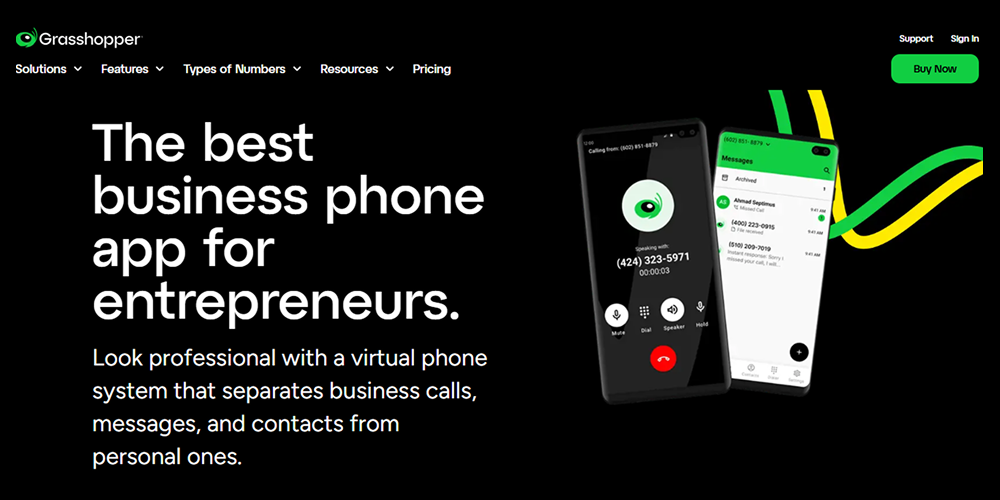
Grasshopper may still be the easiest system available if all you really need is a professional phone number, some routing, voicemail, and after hours handling. Grasshopper doesn't try to be a complete AI answering app. Their strength is simple. Easy to setup, aimed at small business needs.
Best for: Small businesses that need simple routing and voicemail handling
What makes it different: Straightforward setup, lower complexity, small business focus
Where it fits well: Solo operators, small teams, simple front-desk coverage
Considerations: Limited to businesses that need deeper workflows or AI resolution
Pricing: Flat plan subscription
As of October 31, 2026, Grasshopper's homepage (opens in a new tab) lists a virtual phone system with plans starting as low as $14 a month and a choice of monthly or annual billing.
8) Ooma Office
Ooma Office can be a good option if your business needs a virtual receptionist and some business phone services. With it's virtual receptionist and plans are easy to understand. Which can be beneficial for smaller businesses that want to have their calls routed and answered without the need for more advanced ai.
Best for: Businesses needing straightforward menu-based answering
What makes it different: Virtual receptionist simplicity, approachable setup, predictable small business fit
Where it fits well: SMBs with clear department routing and moderate call complexity
Considerations: Fits classic auto attendant needs, with AI Answering Service and AI Receptionist as add-ons
Pricing: Per-user subscription
As of October 31, 2026, Ooma's plans page (opens in a new tab) lists Office Essentials at $19.95 per user a month, Pro at $24.95 and Pro Plus at $29.95, with Virtual Receptionist on each plan.
9) GoTo Connect
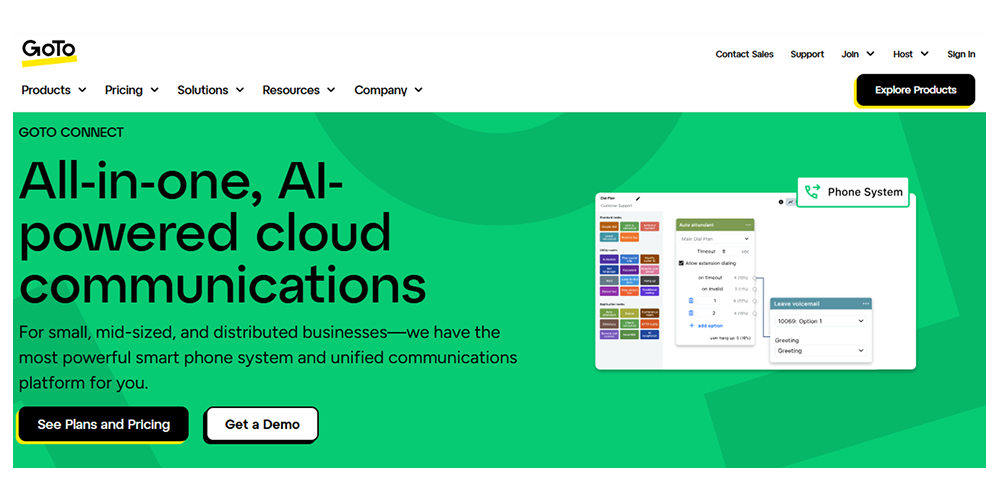
GoTo Connect is a strong option for teams that want reliable cloud telephony with easy administration, unlimited auto attendants, customizable dial plans, and a relatively simple management experience. It is a good fit for organizations that need a solid phone-and-routing layer without overcomplicating deployment.
Best for: Teams that want a reliable business phone and routing with simple management
What makes it different: Unlimited auto attendants, customizable dial plans, clean admin experience
Where it fits well: Small and mid-sized businesses, distributed teams, operationally simple routing setups
Considerations: Strong on phone system management, with a 24/7 AI Receptionist as an add-on
Pricing: Subscription / sales-led
As of October 31, 2026, GoTo Connect's pricing page (opens in a new tab) lists unlimited auto attendants and dial plans on every plan, AI Receptionist as an add-on or in CX Complete, and pricing through sales.
10) Orvera AI (our product)
Orvera fits businesses that want AI agents to answer and finish the call. Its positioning is resolution-first: instant answering, dynamic call transfer, appointment booking, workflow execution, summaries, and end-to-end automation across voice, chat and digital channels. It suits teams that want intent-based answering, real task handling, and smoother handoff to humans with context preserved. Orvera also emphasizes 3 to 6 week deployment, production readiness, and operational visibility.
Best for: Businesses that want AI answering with resolution-oriented workflows
What makes it different: Intent-based routing, dynamic transfer, workflow actions, appointment handling, summaries, and an agentic AI platform for customer experience behind it
Where it fits well: High-volume customer support, scheduling, intake, triage, and overflow coverage
Considerations: Best fit when the business needs AI voice workflows
Pricing: Shared on a scoped call
Which Option Should You Choose? (Simple Guide)
The right choice depends less on brand recognition and more on how your calls actually behave. The most important variables are call volume, call complexity, staffing model, and whether the business needs routing only or real resolution.
Choose basic automated answering if…
Choose a basic automated answering system if your main need is greeting callers, routing them to a few predictable destinations, handling after-hours calls, and capturing voicemail reliably. Businesses with simple call paths and limited front-desk complexity often do not need AI-first infrastructure.
Choose AI call answering if…
Choose AI call answering if the business deals with high call volume (opens in a new tab), repeated customer questions, long queues, transfer friction, appointment workflows, or structured service interactions that can be partially or fully automated. This is where AI voice creates the most measurable value, because it can understand intent, collect context, resolve simple requests, and improve handoffs.
Choose a hybrid approach if…
Choose a hybrid setup if some calls are simple and predictable while others are more ambiguous or workflow-heavy. In many businesses, the best answer is not replacing everything. It uses basic routing for simple department selection, while AI handles more complex intents, overflow calls, after-hours intake, and high-friction workflows.
Want to see how an agentic AI platform fits into modern answering workflows? Explore Orvera. (opens in a new tab)How Orvera Helps Businesses Modernize Automated Answering
Modernizing automated answering means moving beyond static menus and missed-call containment. It means answering instantly, understanding what the caller needs, collecting the right context, resolving common requests where possible, and transferring with enough detail that the human team can take over without restarting the interaction. That is where Orvera is strongest. Developed by teams with 18+ years of contact center experience, it is built for businesses that want answering to improve customer experience and operational efficiency.
What makes Orvera different:
- Instant AI voice answering for inbound call coverage
- Intent-based routing that goes beyond menu trees
- Workflow execution for appointment booking, intake, and structured call handling
- Smart handoffs with summaries and caller context
- Real-time visibility into call performance and outcomes
- Production-ready deployment designed for high-volume environments
- Faster modernization path for businesses moving beyond basic auto attendants
Conclusion
The best automated answering service in 2026 depends on what you want the system to do after it picks up the call. If the goal is simple routing, voicemail, and hours-based menus, traditional auto attendant platforms may be enough. If the goal is to understand intent, handle structured requests, reduce queue pressure, and improve customer experience across more complex interactions, AI answering becomes the stronger choice.
That is why this category now matters more than ever. Businesses are no longer choosing only between phone vendors. They are choosing between basic call distribution and modern answering systems that can actively improve how customer interactions begin. For teams dealing with missed calls, after-hours gaps, peak demand, or repetitive intake workflows, that difference has direct operational value.
Frequently asked questions
An automated answering service is a system that automatically answers inbound calls, determines what the caller needs, and then routes, responds to, or captures a message without requiring a live person to pick up first.
Not always. Auto attendants are one type of automated answering service, but modern automated answering can also include IVR systems, AI receptionists, and AI voice agents that do more than basic routing.
Yes. In 2026, many automated answering services now include AI voice capabilities that can answer questions, collect details, qualify callers, route by intent, and support basic workflows before a human joins.
Costs vary based on the product type and pricing model. Some are priced per user, some per plan, some per minute, and some through custom quotes. The real cost usually depends on routing depth, AI capability, integrations, and usage.
Look at routing quality, business-hours rules, AI capability, integrations, transcripts and analytics, security controls, and whether pricing includes hidden usage or feature-based add-ons.
Look for an AI answering service or AI voice agent rather than a basic auto attendant. Test it on your callers' most common questions, book and cancel a test appointment to confirm it writes to your scheduling system, and check that it transfers callers by intent with a summary attached. A menu-only system routes calls from a menu and usually cannot handle open-ended questions or bookings.
A simple answering service answers calls with a greeting, then forwards them, routes them through a short menu, or takes a voicemail. It suits businesses whose calls are simple and predictable. Handling open-ended questions and booking appointments without a person on the line is what AI answering services add.
An automated receptionist is software that answers a business phone line the way a front desk would. It greets the caller, works out what they need, and routes the call or takes a message. AI versions also answer common questions, book appointments, and hand the call to a person with a summary.
Written by
Anindita Majumder
Anindita Majumder is a communications professional with nearly four years of experience in public relations, corporate communications, and journalism. She creates content that helps brands communicate their vision, products, and expertise through press releases, thought leadership, and editorial pieces. Outside of work, she is a vocalist, which keeps her creativity flowing.