How to Do Instant Call Scoring and 100% QA Coverage for All Sales and Support Calls Using AI Agents
Quality assurance teams know the problem already. They can review only a small slice of sales and support calls because every...

Key highlights
TL;DR —- In a Nutshell
- Manual QA can review only a small share of sales and support calls, which leaves missed objections, unresolved issues, and compliance risks hidden
- Instant call scoring uses AI agents to review calls quickly, apply consistent criteria, and show managers where conversations need attention
- 100% QA coverage means every customer call is checked, not just a random sample selected after the fact
- Sales teams can use AI call scoring to track qualification, discovery, objection handling, talk-to-listen ratio, and next-step quality
- Support teams can use AI-powered QA to monitor resolution quality, troubleshooting accuracy, empathy, escalation handling, and customer sentiment
- Orvera AI helps teams use AI Auto QA to review human-handled conversations, find coaching moments faster, and improve call quality at scale
Quality assurance teams know the problem already. They can review only a small slice of sales and support calls because every audit takes time, judgment, and a trained evaluator. That means many conversations go unchecked, including the ones where a rep missed a buying signal, skipped a required step, or handled a frustrated customer without the right support.
This gap is not small. A February 2026 research paper on contact center Quality Assurance found that traditional QA teams typically review less than 5% of total interactions. The same paper evaluated 18 large language models across 3,000 real contact center transcripts, which shows how quickly AI-based QA is moving (opens in a new tab) into real production work.
AI agents change what QA teams can see. Instead of waiting for a small sample, teams can score every call against the same rules as soon as the conversation ends. Managers get a clearer view of what reps need, where coaching should happen, and which conversations are hurting sales, support quality, or customer trust.
What Is Instant Call Scoring
Instant call scoring is the process of reviewing and grading a call automatically, either during the conversation or soon after it ends. Instead of waiting for a QA team to manually select and review a few calls, AI agents analyze the full conversation using transcripts, sentiment, intent, compliance checks, and the final outcome of the call. This gives leaders a faster way to understand call quality without waiting days or weeks for manual review.
For sales and support teams, this means every conversation can be checked against the same criteria. The score can show whether the rep followed the right steps, understood the customer’s need, handled objections, used the right tone, completed the required disclosures, and moved the conversation toward resolution. It also helps teams compare performance across calls with more consistency instead of relying only on scattered examples.
How instant call scoring works
Instant call scoring starts by converting the call into a transcript. The AI agent reviews what the customer said, what the rep said, where the conversation changed direction, and whether the call matched the expected workflow. It can identify signals such as customer frustration, buying intent, unresolved issues, compliance risk, long silences, repeated questions, and missed next steps. These signals help managers see not only the final score but also the reason behind that score.
The AI agent then compares the conversation against a scorecard. That scorecard may include greeting quality, discovery, objection handling, product knowledge, empathy, compliance, resolution, and wrap-up quality. Instead of leaving managers to find these issues later, the system gives a score and highlights the exact parts of the call that need attention. This makes coaching more specific because the manager can point to the moment where the call went off track.
Manual call scoring vs AI call scoring
Manual call scoring depends on sampling. A QA team may review a small percentage of calls because listening to every conversation takes too much time. This creates a visibility gap. A strong call may never be recognized, and a poor call may never be reviewed until the same mistake has already happened many times. It also means leaders may make coaching decisions based on a few calls that do not represent the full picture.
AI call scoring reduces that gap by reviewing every call with the same criteria. It gives sales and support leaders faster feedback, more consistent scoring, and a broader view of conversation quality. Human QA teams still bring judgment, especially for complex calls, but AI helps them spend less time hunting for issues and more time coaching the right moments. The result is a QA process that uses human judgment where it matters most and automation where manual review cannot keep up.
Why instant scoring matters for sales and support teams
Sales and support teams do not usually lose performance in one obvious place. A rep may miss an objection, ask weak discovery questions, skip a follow-up step, or end the call without confirming the customer’s issue. In support conversations, poor tone, unclear explanations, repeated transfers, or unresolved requests can damage trust before a manager ever sees the call. These small issues become bigger when they repeat across hundreds or thousands of conversations.
Instant scoring helps leaders find those patterns before they spread. Managers can see which reps need coaching, which scripts are not working, where customers are getting stuck, and where compliance steps are being missed. The goal is not to score people for the sake of scoring. The goal is to give teams the visibility they need to improve conversations while the coaching moment is still fresh. That matters because timely feedback is easier for reps to apply than feedback delivered long after the call is over.
What Does 100% QA Coverage Mean
100% QA coverage means every customer call is reviewed, not just a small random sample. It gives leaders a clearer view of what is happening across sales and support conversations because the full call volume is checked against the same quality, compliance, and outcome criteria. This helps teams understand performance, customer experience, and operational risk with fewer gaps. It also gives supervisors a more reliable base for coaching because they are working from the full picture, not a narrow set of calls.
Why traditional QA coverage is limited
Traditional QA coverage is limited because manual review takes time. QA teams have to listen to calls, read notes, check scorecards, document findings, and share feedback with managers. When call volume is high, most teams can review only 1–5% of calls, which leaves many important conversations unchecked. The problem is not the QA team’s effort; it is that manual review cannot keep pace with the number of conversations happening every day.
- QA teams are often forced to choose a small sample because reviewing every call manually is not realistic
- Staffing limits make it hard to keep up when call volume increases during busy periods
- Important calls can be missed because QA time is spent on reviewing what is available, not always what matters most
Why random call sampling misses critical issues
Random call sampling can miss the conversations leaders most need to see. A random sample may include routine calls that went well while skipping calls with frustrated customers, missed sales opportunities, poor tone, unresolved issues, or compliance gaps. This creates a false sense of quality because the reviewed calls may not reflect what is really happening across the team. By the time a pattern shows up in a sample, the same issue may have already affected many customers.
- High-risk calls can stay hidden if they are not selected in the sample
- Poor sales conversations may go unnoticed, including missed objections, weak discovery, or unclear next steps
- Support issues can repeat across many calls before managers realize customers are facing the same problem
How AI agents enable full QA coverage
AI agents enable full QA coverage by analyzing every call automatically. They can turn calls into transcripts, apply the same scoring rules, check for key conversation signals, and flag the calls that need human attention. This gives QA teams a broader view without asking them to manually review every conversation from start to finish. It also helps leaders separate normal call variation from the calls that carry real risk or coaching value.
- AI agents can score every call against the same quality, compliance, and outcome criteria
- Managers can see patterns across the full call volume, not only a small sample
- Human QA teams can focus on the most important calls, such as escalations, compliance risks, poor customer sentiment, and coaching opportunities
Why Sales and Support Teams Need AI-Powered Call QA
Sales and support teams need AI-powered call QA because call volume keeps increasing, but manual review capacity does not increase at the same speed. When teams depend only on manual QA, leaders get delayed feedback, limited visibility, and inconsistent insight into what is happening across customer conversations. This becomes harder to manage when teams are growing, scripts are changing, and customer expectations are rising.
As customer expectations rise, teams need a faster way to understand call quality, rep performance, and operational risk. AI-powered QA helps leaders review more conversations, apply the same scoring criteria, and find the calls that need coaching, follow-up, or supervisor attention. It also helps teams move from reacting to isolated complaints toward managing call quality before issues become larger patterns.
Sales teams need better visibility into call quality
Sales leaders often know the final outcome of a call, but not always what happened inside the conversation. A deal may stall because the rep asked weak discovery questions, missed the customer’s pain point, rushed the pitch, or failed to handle an objection clearly. Without call-level visibility, managers may blame the lead source, pricing, or timing while the real issue sits inside the conversation.
AI call scoring helps sales managers see whether reps are qualifying leads properly, following the right talk track, asking useful questions, and moving the deal to the next step. This gives leaders a more practical view of call quality instead of relying only on pipeline notes, call dispositions, or end-of-week updates. It also helps managers spot which parts of the sales conversation need coaching across the team, not just with one rep.
Support teams need consistent customer experience monitoring
Support managers need to know whether customers are actually getting clear answers, not just whether the call was closed. A support call can look complete in the system while the customer still feels confused, frustrated, or unsure about the next step. That gap matters because unresolved confusion often leads to repeat calls, escalations, and lower customer trust.
AI QA helps support teams track resolution quality, empathy, policy adherence, escalation handling, and customer satisfaction across all calls. It gives managers a consistent way to see where customers are getting stuck, where reps need help, and where support processes are creating repeat issues. This makes it easier to separate one-off mistakes from process problems that need a wider fix.
Managers need faster coaching signals
Managers often get QA feedback too late to make it useful. By the time a weekly or monthly review is complete, the rep may have repeated the same mistake across many other calls, and the coaching moment may no longer feel connected to the conversation. Delayed feedback also makes it harder for reps to remember the customer context and understand what should change.
AI highlights coaching moments soon after the call, so managers can give feedback while the details are still fresh. Instead of saying “improve your objection handling,” a manager can point to the exact part of the call where the objection came up and explain what could have been done differently. That makes coaching more specific, easier to act on, and less dependent on broad performance comments.
Businesses need stronger compliance and risk detection
Compliance and risk issues are easy to miss when only a small sample of calls is reviewed. A rep may skip a required disclosure, provide incorrect information, mishandle a sensitive conversation, or fail to escalate an angry customer at the right time. These issues can create real business risk even when the rest of the call sounds normal.
AI-powered QA can flag missing disclosures, policy violations, angry customers, incorrect information, and conversations that need supervisor review. This helps businesses catch risk earlier, support reps with clearer guidance, and reduce the chance that the same issue repeats across more calls. It also gives leaders a cleaner record of where risk appeared and what action was taken after the call (opens in a new tab).
What Should Be Included in an AI Call Scoring Scorecard
An AI call scoring scorecard should be clear, role-specific, measurable, and tied to business outcomes. A sales scorecard should not look exactly like a support scorecard because the goals are different. The best scorecards help leaders understand whether the call moved toward the right outcome, not just whether the rep followed a script. This also keeps scoring fair because reps are measured against the work they are actually expected to do.
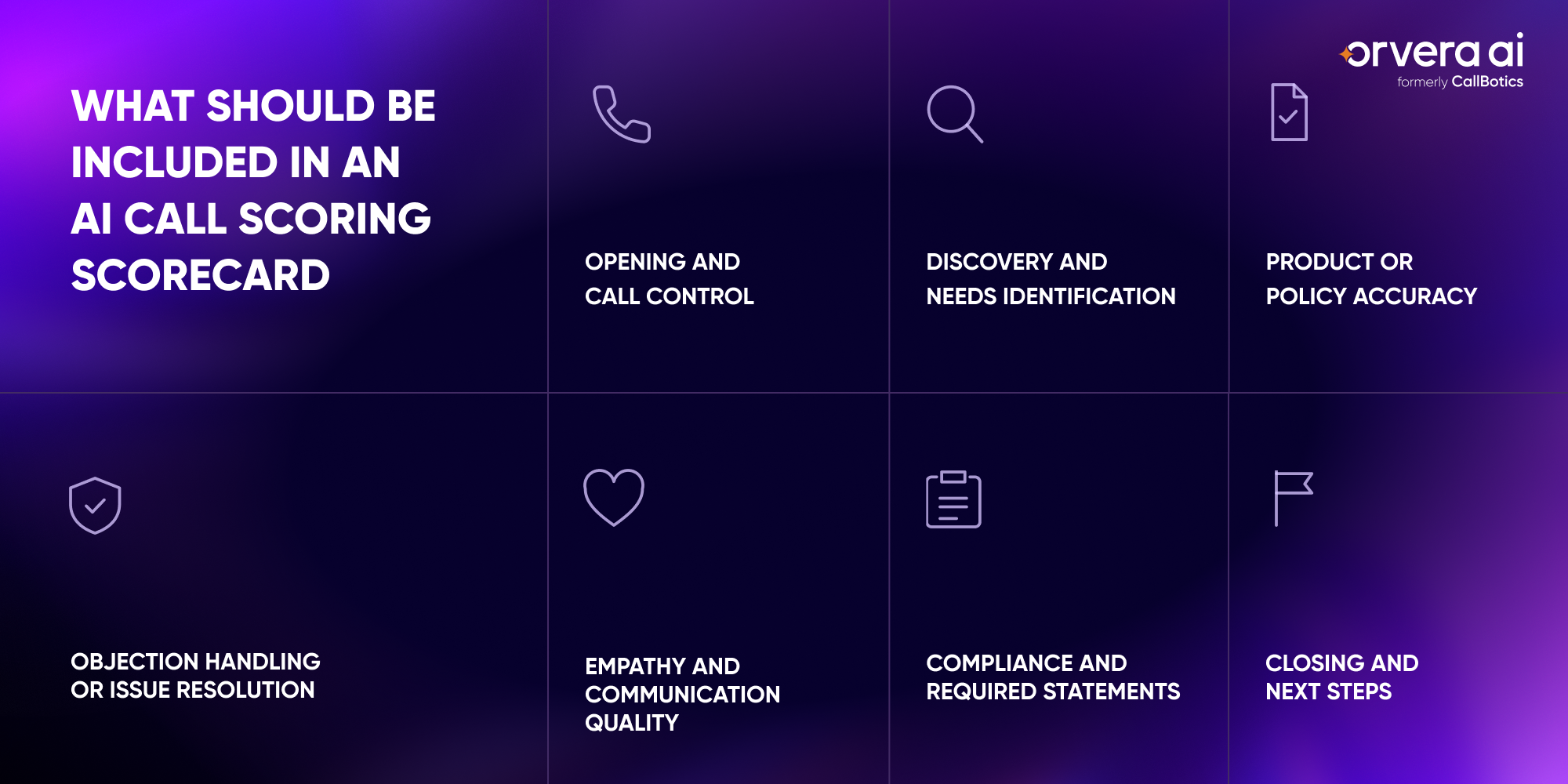
Opening and call control
Opening and call control measure how well the rep starts the call and guides the conversation. A weak opening can create confusion early, especially when the customer is already frustrated or short on time. AI call scoring can check whether the rep greeted the customer properly, confirmed the reason for the call, and kept the conversation focused without sounding rushed. This matters because the first few moments often decide whether the customer trusts the rep enough to continue.
- The rep greeted the customer clearly and professionally
- The rep confirmed the purpose of the call before moving into questions or answers
- The rep guided the conversation without letting the call drift or become unclear
Discovery and needs identification
Discovery and needs identification measure whether the rep understood the customer before trying to solve or sell. In sales, weak discovery can lead to a poor pitch. In support, it can lead to the wrong troubleshooting path or an unresolved issue. AI call scoring can check whether the rep asked relevant questions about the customer’s needs, pain points, context, and urgency. This helps managers see whether reps are listening for the real issue or moving too quickly through the call.
- The rep asked questions that helped identify the customer’s real need
- The rep captured important context instead of making assumptions too early
- The rep understood urgency, impact, or buying intent before moving forward
Product or policy accuracy
Product or policy accuracy measures whether the rep gave the customer correct information. This matters because one wrong statement about pricing, features, policies, troubleshooting steps, or next actions can create confusion, repeat calls, lost deals, or compliance risk. AI call scoring can compare the conversation against approved knowledge and flag answers that may need review. It also helps leaders find where reps may need updated training or clearer internal guidance.
- The rep explained pricing, features, policies, or steps accurately
- The rep avoided giving unclear, incomplete, or unsupported information
- The rep gave the correct next action based on the customer’s situation
Objection handling or issue resolution
Objection handling or issue resolution measures how well the rep responds when the customer pushes back, complains, hesitates, or does not understand. Many calls break down at this point because the rep either moves too quickly or does not address the actual concern. AI call scoring can evaluate whether the rep acknowledged the issue, responded clearly, and moved the customer toward a useful outcome. This shows leaders whether reps can stay steady when the conversation becomes harder.
- The rep addressed objections, complaints, or confusion directly
- The rep stayed focused when the customer raised hesitation or frustration
- The rep worked toward a clear resolution instead of ending the call too early
Empathy and communication quality
Empathy and communication quality measure how the rep handled the human side of the call. A customer may get the right answer and still leave unhappy if the rep sounded impatient, unclear, or dismissive. AI call scoring can review tone, clarity, patience, active listening, interruptions, and whether the rep sounded helpful and professional. This is important because customer experience is shaped by both the answer and the way that answer is delivered.
- The rep listened without interrupting or rushing the customer
- The rep explained information in simple, clear language
- The rep used a calm and helpful tone, especially during difficult moments
Compliance and required statements
Compliance and required statements measure whether the rep followed the required steps that protect the customer and the business. These steps are easy to miss during busy calls, especially when the customer is upset or the rep is trying to move quickly. AI call scoring can check whether required disclosures, verification steps, consent statements, and policy scripts were completed. This gives compliance and operations teams a clearer way to catch risk before it becomes a larger issue.
- The rep completed required verification or consent steps
- The rep used the correct disclosure or policy language where needed
- The rep avoided skipping required statements during complex or pressured calls
Closing and next steps
Closing and next steps measure whether the rep ended the call with clarity. A call may feel finished to the rep, but the customer may still be unsure about what happens next. AI call scoring can check whether the rep summarized the conversation, confirmed resolution, explained next steps, and ended the call properly. A strong closing reduces repeat contact because the customer knows what was agreed and what happens after the call.
- The rep confirmed whether the customer’s issue was resolved or the next step was clear
- The rep summarized the key points before closing the call
- The rep ended the conversation professionally and set the right expectation for follow-up
Sales Call Scoring Criteria AI Agents Can Track
Sales call scoring criteria should show whether a rep is building real pipeline, not just completing calls. AI agents can evaluate specific sales behaviors such as qualification, discovery, objection handling, listening balance, and next-step quality, then show managers where deals are moving forward or getting stuck. This helps sales leaders coach the behaviors that affect revenue, not only the activities that appear in the customer relationship management system.
When these criteria are clear, sales leaders get a better view of rep performance across the full call volume. They can see whether reps are creating useful opportunities, missing buying signals, or moving too quickly without understanding the prospect’s need. This also gives managers a stronger way to compare calls because every conversation is reviewed against the same sales expectations.
Lead qualification quality
Lead qualification quality shows whether the rep captured the information needed to judge whether the prospect is a real opportunity. AI agents can check whether the rep discussed budget, authority, need, timeline, company size, use case, and buying intent instead of ending the call with only surface-level notes. This helps managers separate active conversations from opportunities that are unlikely to close.
This matters because weak qualification creates pipeline that looks active but does not convert. Managers can use the score to see whether reps are qualifying the right prospects, asking the right questions, and avoiding opportunities that should not move forward. It also helps teams find where qualification breaks down, such as budget questions being skipped or decision-makers not being identified.
Discovery depth
Discovery depth shows whether the rep took time to understand the prospect before moving into a pitch. AI agents can evaluate whether the rep asked meaningful questions about the prospect’s current process, pain points, urgency, decision criteria, and expected outcome. This shows whether the rep is building the conversation around the buyer’s situation instead of using the same pitch on every call.
This matters because many sales calls fail when reps pitch too early. A deeper discovery score helps managers see which reps are listening, which reps are assuming too much, and where coaching is needed to improve the quality of the sales conversation. It also helps leaders identify whether the team has enough information to forecast the opportunity with confidence.
Objection handling
Objection handling shows how well the rep responded when the prospect raised concerns. AI agents can identify objections around pricing, timing, competitors, trust, features, implementation, or internal approval, then score whether the rep acknowledged the concern and responded clearly. This helps managers see whether objections were handled as part of the sales process or treated as the end of the conversation.
This matters because objections are often the point where deals slow down or disappear. A useful score helps managers see whether reps are avoiding hard questions, giving unclear answers, or turning objections into the next step in the sales process. It also gives teams a clearer view of which objections appear most often and where sales enablement needs to improve.
Talk-to-listen ratio
Talk-to-listen ratio shows whether the rep gave the prospect enough space to explain their needs. AI agents can measure how much time the rep spoke compared with the prospect and flag calls where the rep dominated the conversation. This helps managers spot calls where the rep may have controlled the call but failed to learn enough from the buyer.
This matters because a rep who talks too much may miss important details about pain, urgency, buying intent, or decision process. Managers can use this signal to coach reps toward better listening, stronger discovery, and more balanced conversations. It also helps teams understand whether high talk time is coming from useful explanation or from reps filling silence with unnecessary detail.
CTA and follow-up quality
CTA and follow-up quality show whether the rep moved the opportunity forward before ending the call. AI agents can check whether the rep booked a next step, confirmed action items, shared follow-up details, set expectations, or created a clear path for the prospect. This helps managers see whether the call ended with commitment or only a loose intention to reconnect.
This matters because a good sales conversation can lose momentum if the close is unclear. Managers can use this score to see whether reps are ending calls with a real next step or leaving the prospect with a vague promise to reconnect later. It also helps reduce lost opportunities caused by unclear ownership, missed follow-ups, or next steps that were never confirmed.
Support Call Scoring Criteria AI Agents Can Track
Support call scoring criteria should show whether customers are getting clear answers, consistent service, and real resolution. AI agents can track quality indicators such as first contact resolution, troubleshooting accuracy, empathy, escalation handling, and resolution confirmation across the full call volume. This gives support leaders a clearer way to measure whether the team is solving problems, not only closing tickets.
This matters because support leaders often see the ticket status before they see the customer experience behind it. A call can be marked closed while the customer is still confused, frustrated, or waiting for the next step. That gap can lead to repeat calls, lower satisfaction, and more pressure on reps who have to handle the same issue again.
First contact resolution quality
First contact resolution quality shows whether the customer’s issue was solved during the first call or whether another follow-up was needed. AI agents can review the conversation, the customer’s request, the rep’s response, and the final outcome to check whether the issue was actually handled before the call ended. This helps leaders see which calls were truly resolved and which ones only looked complete in the system.
This helps support managers separate closed calls from resolved calls. A call may end quickly, but if the customer has to call again for the same issue, the first interaction did not do its job. Tracking this clearly helps teams reduce repeat contact and protect customer trust.
Troubleshooting accuracy
Troubleshooting accuracy shows whether the rep followed the right steps to solve the customer’s issue. AI agents can evaluate whether the rep asked the right diagnostic questions, followed the approved process, gave accurate technical or process guidance, and avoided skipping important steps. This makes it easier to find where calls go off track before the same mistake appears across more customers.
This matters because incorrect guidance creates repeat calls and damages customer trust. It also helps managers see whether the issue is rep knowledge, unclear internal documentation, or a process that needs to be fixed. That distinction matters because each problem needs a different response from the support leader.
Empathy and reassurance
Empathy and reassurance show whether the rep handled the customer’s emotion as well as the issue. AI agents can detect whether the rep acknowledged frustration, used patient language, avoided interrupting, and reassured the customer without making promises they could not keep. This helps managers identify calls where the answer may have been correct, but the experience still felt difficult for the customer.
This is important because support quality is not only about giving the right answer. Customers also judge the call by whether they felt heard, respected, and guided through the problem. A rep who explains clearly but sounds rushed can still leave the customer unsure about the support they received.
Escalation handling
Escalation handling shows whether the rep moved the issue to the right team at the right time. AI agents can check whether the rep recognized when the issue was outside their scope, explained the escalation clearly, and shared enough context so the customer did not have to repeat everything. This helps reduce handoff friction, especially when multiple teams are involved in resolving the same issue.
This helps managers find where escalations are delayed, unclear, or poorly documented. Good escalation handling protects the customer experience because the next team receives the right information before taking over. It also shows whether reps understand when to continue troubleshooting and when to bring in higher-level support.
Resolution confirmation
Resolution confirmation shows whether the rep confirmed that the customer’s issue was resolved before ending the call. AI agents can check whether the rep summarized the answer, asked if the customer needed anything else, confirmed the next step when full resolution was not possible, and closed the call with clarity. This helps managers see whether reps are ending calls with a clear outcome instead of assuming the customer understood.
This matters because many repeat calls happen when customers leave without a clear answer or expectation. Resolution confirmation gives managers a direct view of whether reps are ending calls with confidence or leaving open questions behind. It also helps support teams find where call wrap-up scripts need to be clearer or more practical.
Common Challenges When Implementing AI Call Scoring
AI call scoring can give teams stronger QA coverage, faster feedback, and better visibility into sales and support conversations. But it works best when the business has clear scorecards, good call data, connected systems, and human review for the calls that need judgment. Without those basics, teams may get scores that look useful but do not lead to better coaching or better customer outcomes. The goal is to make QA more reliable, not to add another dashboard that managers have to interpret without context.
Poorly defined scorecards
Poorly defined scorecards make AI call scoring less useful because the AI agent needs clear criteria to evaluate the conversation. If the scorecard uses vague labels like “good call” or “strong communication,” managers may get scores that are hard to explain, hard to trust, and hard to coach from. A clear scorecard also helps reps understand what good performance looks like before their calls are reviewed.
- Scoring criteria should be specific, such as greeting quality, discovery, objection handling, compliance, resolution, and next steps
- Each score should connect to a behavior the rep can understand and improve
- Sales and support teams should have different scorecards because they are measured on different outcomes
Inconsistent call data quality
Inconsistent call data quality can affect scoring accuracy because AI agents depend on clean recordings and complete transcripts. Poor audio, background noise, missing recordings, overlapping speakers, or incomplete transcripts can make it harder to understand what was said and how the call was handled. This can create confusion when a score looks low, but the real issue is the quality of the recording or transcript.
- Clear audio helps the AI agent capture the conversation more accurately
- Complete recordings are needed so the opening, main conversation, and closing can all be reviewed
- Teams should fix recurring data issues before using AI scores for coaching or performance decisions
Lack of human review for edge cases
AI call scoring should not replace supervisor judgment for sensitive, complex, or disputed calls. Some conversations need human review because the context is difficult, the customer is upset, the policy decision is unclear, or the score may affect a rep’s coaching record. This is where AI should help leaders find the call faster, not make the final judgment alone (opens in a new tab).
- Supervisors should review calls involving complaints, compliance risk, escalation, or customer dissatisfaction
- Human QA teams should check disputed scores before using them in formal performance conversations
- AI agents can surface the right calls faster, while human reviewers decide what the situation really means
Resistance from sales or support agents
Sales and support reps may resist AI QA if they feel the system is being used only to monitor or judge them. If leaders introduce AI call scoring without explaining the purpose, reps may see it as pressure instead of support. The rollout works better when teams understand (opens in a new tab) how the scores will help with coaching, recognition, and clearer expectations.
- Teams should explain that AI scoring is meant to find coaching moments, not catch people for every mistake
- Reps should know what the scorecard measures and how scores will be used
- Managers should use AI insights to give specific feedback, recognize strong calls, and support reps during difficult conversations
Limited integration with CRM or helpdesk tools
AI call scoring becomes more useful when the score connects to the systems teams already use. If call scores sit outside the customer relationship management system, helpdesk, ticketing tool, deal record, agent profile, or coaching workflow, managers may have to do extra work to understand what happened after the call. When scores are connected to customer records, leaders can see both the conversation quality and the business outcome in the same view.
- CRM and helpdesk integration helps connect call quality with customer records, tickets, deals, and outcomes
- Scores become more useful when managers can see the call, transcript, customer context, and next step in one place
- Connected workflows help teams turn QA findings into coaching, follow-up, escalation, or process improvement
Best Practices for Doing AI-Powered Call QA at Scale
AI-powered call QA works best when it helps managers focus, not when it gives them more noise to sort through. Instant scoring and 100% QA coverage should make coaching easier, surface the right calls faster, and give leaders a clearer view of quality across sales and support teams. The process should reduce guesswork for managers, not create another layer of manual checking.
The goal is not to make managers review every score manually. The goal is to use AI agents to review every call, find the moments that matter, and help human QA teams spend their time where judgment, coaching, and follow-up are needed most. This keeps QA practical at scale because people are still involved where context matters.
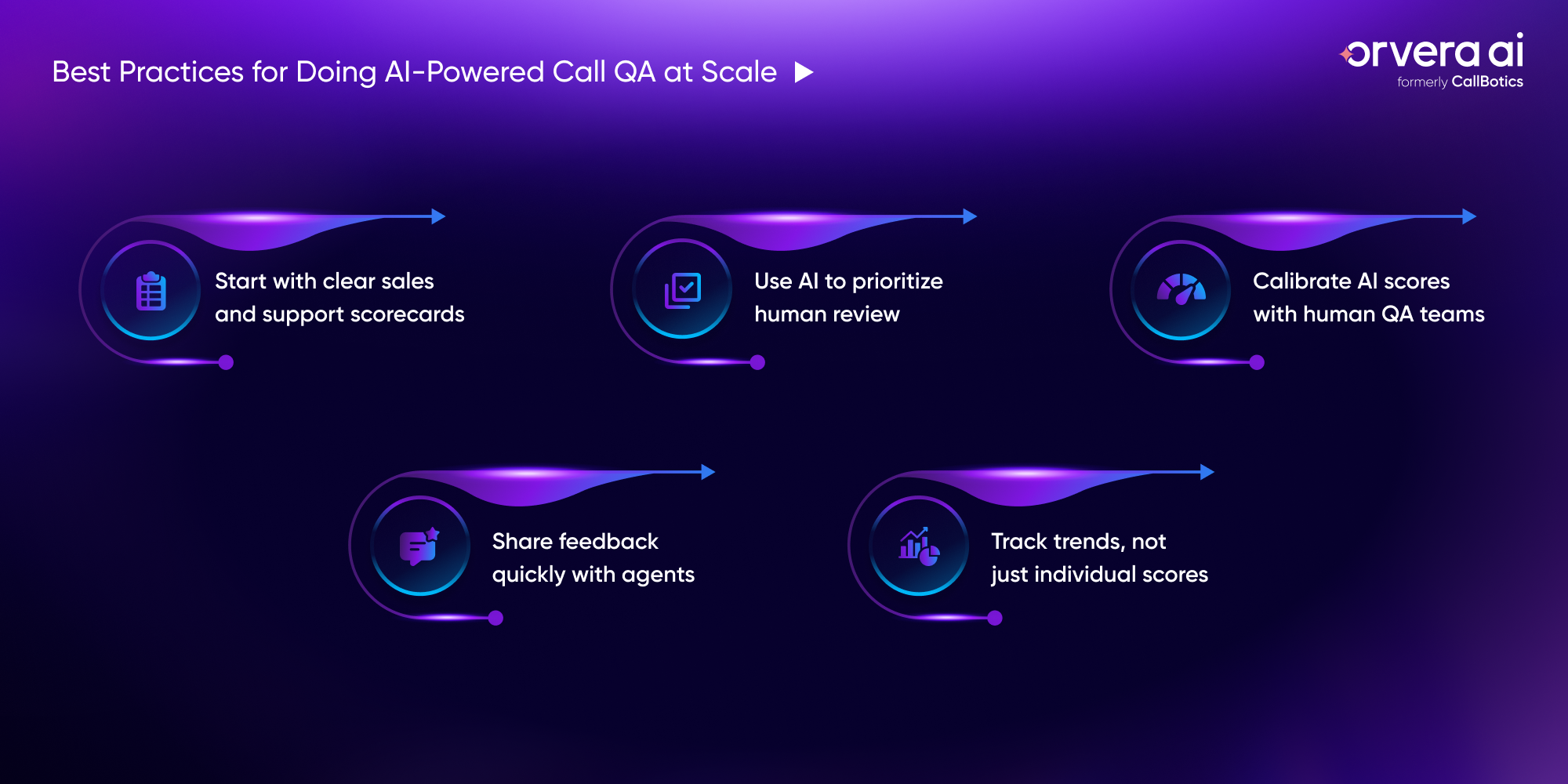
Start with clear sales and support scorecards
Sales calls and support calls need different scorecards because they are trying to achieve different outcomes. A sales call may need to measure lead qualification, discovery, objection handling, and next-step quality, while a support call may need to measure resolution, troubleshooting accuracy, empathy, escalation handling, and policy adherence. This prevents teams from scoring different types of calls with criteria that do not match the actual work.
Clear scorecards help AI agents score calls against the right expectations. They also help reps understand what good performance looks like, which reduces confusion when feedback is shared after the call. When the criteria are clear, coaching feels more tied to the call and less like a personal opinion.
Use AI to prioritize human review
AI should help managers find the calls that need attention instead of asking them to review everything manually. High-risk calls, low-scoring calls, emotional calls, compliance concerns, escalations, and high-value customer conversations should move to the top of the review list. This helps leaders spend time on the calls most likely to affect customers, revenue, or risk.
This matters because managers have limited time. When AI agents surface the most important calls first, human QA teams can focus on coaching, risk review, and customer recovery instead of spending hours looking for the right call to inspect. It also helps prevent important calls from getting buried under routine conversations that do not need deep review.
Calibrate AI scores with human QA teams
AI-generated scores should be compared with human QA reviews, especially during rollout. This helps managers check whether the scorecard is clear, whether the AI agent is applying the criteria correctly, and whether the scoring matches how experienced QA reviewers judge the same call. Calibration also helps teams find scoring rules that need more detail before the system is used broadly.
Calibration builds trust because teams can see where the AI score agrees with human judgment and where the scoring rules need adjustment. It also prevents teams from treating every automated score as final before the process has been tested against real calls. This makes adoption easier because managers and reps can see that the scoring process is being checked, not forced on them.
Share feedback quickly with agents
Feedback is more useful when reps receive it soon after the call. If a manager waits days or weeks, the rep may not remember the customer’s tone, the objection, the troubleshooting step, or the moment where the conversation changed direction. Timely feedback also makes the coaching conversation more practical because the rep can connect the guidance to a real interaction.
AI-powered call QA helps managers give timely and specific feedback while the call is still fresh. Instead of broad comments like “improve discovery” or “show more empathy,” managers can point to the exact part of the call and explain what should change next time. This helps reps understand the behavior behind the score, not just the score itself.
Track trends, not just individual scores
Individual scores are useful, but the larger value comes from tracking patterns across teams, campaigns, products, call types, and customer issues. A single low score may be a coaching moment, but repeated low scores across the same call type may show a script issue, training gap, product confusion, or process problem. This helps leaders decide whether the fix belongs with one rep, the team, or the workflow.
Leaders should use AI-powered QA to understand where problems repeat. That view helps teams improve more than one rep at a time because it connects call quality to the broader issues affecting sales performance, support consistency, customer satisfaction, and operational risk. It also gives operations leaders a clearer way to prioritize training, process updates, and knowledge-base improvements.
KPIs to Track for AI Call Scoring and QA Coverage
AI call scoring should be measured by more than the number of calls scored. Teams need to track whether QA coverage is improving, whether scores are useful, whether compliance risk is visible, and whether better call quality is leading to better sales or support outcomes. These KPIs help leaders see whether AI-powered QA is improving the way teams coach, manage risk, and serve customers. They also help managers prove whether QA changes are creating measurable impact or only producing more reports.
QA coverage rate
QA coverage rate shows the percentage of total calls that are reviewed for quality. Manual QA often depends on limited sampling, which means many calls are never checked. AI helps increase QA coverage by reviewing every call automatically, so leaders can see quality across the full call volume instead of a small sample. This gives teams a stronger baseline for understanding what is happening across everyday conversations, not only selected calls.
- Track the percentage of total calls scored by AI
- Compare AI-reviewed calls with the number of calls previously reviewed by manual QA
- Use the coverage rate to confirm whether important calls are still being missed
Average call score
Average call score shows the overall quality of conversations across sales or support calls. It helps leaders understand whether reps are following the right steps, communicating clearly, and moving calls toward the expected outcome. The score is most useful when it is tracked by team, campaign, call type, or rep group. This makes it easier to see whether performance changes are isolated or showing up across a wider part of the operation.
- Track average scores across sales and support teams separately
- Review score changes after coaching, script updates, or process changes
- Avoid using one average score alone because it can hide serious issues inside specific call types
Compliance pass rate
Compliance pass rate shows how often reps meet required policy, disclosure, verification, or process standards during calls. This matters because one missed step can create risk even when the rest of the conversation sounds strong. AI call scoring helps leaders see where compliance is being followed and where certain requirements are being missed. It also helps compliance and operations teams focus attention on the calls that need review instead of searching through random samples.
- Track how often required statements or verification steps are completed
- Review failed compliance checks by team, call type, and policy requirement
- Route failed or high-risk calls to human QA teams for review
Coaching opportunity rate
Coaching opportunity rate shows how many calls contain teachable moments, skill gaps, or repeated performance issues. This helps managers move from general feedback to specific coaching based on actual conversations (opens in a new tab). It also shows whether the same issues keep appearing across reps, scripts, or customer scenarios. This metric is useful because it turns QA from a scoring exercise into a practical coaching plan.
- Track calls with missed discovery, poor objection handling, weak resolution, or unclear next steps
- Group coaching opportunities by skill area so managers can focus training
- Watch for repeated patterns that may point to a team-wide training gap
Customer sentiment score
Customer sentiment score helps teams understand how customers felt during the conversation. It can show frustration, confusion, confidence, satisfaction, or disappointment based on the customer’s words and tone. This gives leaders a better view of experience quality, especially when a call was technically closed but the customer still sounded unhappy. It also helps teams find the moments where a conversation started to improve or became more difficult.
- Track sentiment changes during the call, not only at the end
- Review negative sentiment calls for coaching, escalation, or customer recovery
- Compare sentiment with resolution quality to see whether customers felt properly helped
Resolution or conversion impact
Resolution or conversion impact connects call quality scores with business outcomes. For support teams, this may include first contact resolution, repeat contact, retention, or customer satisfaction. For sales teams, this may include demos booked, deal progression, upsell success, or whether the next step was confirmed. This helps leaders understand whether better call behavior is actually improving the results the business cares about.
- Compare high-scoring calls with first contact resolution, demo bookings, or deal movement
- Track whether coaching improvements lead to better customer or revenue outcomes
- Use outcome data to refine scorecards so scoring reflects what actually matters to the business
How Orvera AI Helps Teams Achieve Instant Call Scoring and 100% QA Coverage
Orvera AI helps sales and support teams review every customer conversation without depending only on manual QA sampling. It analyzes calls, generates quality scores, detects risk signals, and gives managers clearer insight into how reps are performing across real conversations. This helps leaders make QA decisions from the full conversation set, not from a narrow group of selected calls.
This helps teams move from delayed, sample-based review to faster quality visibility across the full call volume. Managers can see where coaching is needed, where customer experience is slipping, and where compliance or escalation risks need attention. It also gives teams a practical way to act on call quality before the same issues repeat across more customers.
Automatic call transcription and analysis
Orvera turns every call into structured conversation data that can be searched, reviewed, and scored. Instead of relying only on call notes or dispositions, managers can work from the actual conversation, including what the customer asked, how the rep responded, and where the call moved toward or away from resolution. This gives QA teams a clearer record of the conversation than summary notes alone can provide.
This makes QA easier to manage because the conversation is no longer hidden inside an audio file. Teams can review transcripts, identify important moments, and connect the score to the exact part of the call that needs attention. It also helps managers find patterns across calls without listening to each recording from start to finish.
AI-powered sales and support scorecards
Orvera helps teams score calls using criteria that match the role and workflow. Sales scorecards can focus on discovery, qualification, objection handling, buying intent, and next steps, while support scorecards can focus on troubleshooting accuracy, resolution quality, empathy, escalation handling, and policy adherence. This keeps the scoring process tied to the work each team is actually responsible for.
This matters because sales and support teams should not be measured with the same generic checklist. Role-specific scorecards give managers a clearer way to judge performance based on the outcome each team is expected to deliver. They also make feedback easier for reps to understand because the score reflects their real call goals.
Real-time risk and sentiment detection
Orvera helps identify calls where customer emotion, compliance risk, or unresolved issues need attention. The AI agent can detect frustrated customers, missed requirements, poor sentiment, incorrect information, and conversations that may need supervisor review. This helps managers find the calls that should not wait for a routine QA cycle.
This gives managers a faster way to find the calls that carry real business risk. Instead of waiting for a complaint or searching through random samples, teams can focus on the conversations where customer trust, compliance, or resolution may already be at risk. It also helps supervisors respond earlier when a customer issue needs recovery or follow-up.
100% QA coverage without manual sampling
Orvera helps teams move from reviewing a small sample of calls to analyzing every customer conversation. AI Auto QA audits human-handled conversations and gives leaders quality visibility across 100% of interactions, not just a sample. This helps leaders see what is happening across the full operation instead of relying on a limited view.
This does not remove human QA teams from the process. It helps them spend less time finding calls to review and more time applying judgment, coaching reps, checking sensitive conversations, and improving the quality process. That makes QA more practical because human reviewers can focus on the calls where their judgment matters most.
Actionable coaching insights for managers
Orvera highlights coaching opportunities, performance trends, and improvement areas so managers can give more specific feedback. Instead of giving broad comments after a delayed QA review, managers can point to the exact call moment where discovery was weak, tone changed, a policy step was missed, or the next step was unclear. This makes coaching easier to connect to real behavior instead of general performance concerns.
This makes coaching more practical for reps because the feedback is tied to real conversations. Managers can also track repeated patterns across reps, teams, campaigns, and call types, which helps them decide whether the fix is coaching, script improvement, process change, or updated knowledge. It also helps leaders support strong reps by identifying what is working well and where those behaviors can be repeated across the team.
Conclusion
For growing sales and support teams, QA needs to show what is happening across every customer conversation, not only the few calls selected for review. A broader view makes it easier to find missed sales moments, unresolved support issues, compliance risks, and coaching needs before they repeat. It also helps leaders understand whether call quality is improving in the places that matter most.
AI agents make that level of QA more scalable by reviewing calls faster and applying the same scoring rules across the full call volume. Human QA teams and managers still bring judgment for sensitive, complex, or disputed calls, but AI helps them find the right moments faster. When call scoring is clear, consistent, and tied to real outcomes, QA becomes a practical way to improve conversations, coach reps sooner, and make better decisions from every customer interaction.
Frequently asked questions
Instant call scoring is the process of automatically reviewing and grading a call during or soon after the conversation. It uses transcripts, scorecards, sentiment, intent, compliance checks, and call outcomes to show how well the conversation was handled.

Written by
Anindita Majumder
Anindita Majumder is a communications professional with nearly four years of experience in public relations, corporate communications, and journalism. She creates content that helps brands communicate their vision, products, and expertise through press releases, thought leadership, and editorial pieces. Outside of work, she is a vocalist, which keeps her creativity flowing.