How to Deploy Conversational AI: A Complete Step-by-Step Guide
Learn how to deploy conversational AI step by step for real-world scale, stability, and measurable results...


Key highlights
TL;DR: How to Deploy Conversational AI the Right Way
- Start with clear, operational goals. Conversational AI must be tied to measurable outcomes such as reduced wait times, higher resolution rates, and stable performance during peak volumes. Without defined goals, deployments lose direction.
- Choose the right use cases and platform early. Conversational AI works best for structured, repeatable interactions and requires a platform that can handle real traffic, integrate with business systems, and scale reliably under load.
- Design conversations for resolution, not routing. Effective conversational flows account for real user behavior, maintain context across turns, and include recovery and escalation paths to ensure consistent outcomes.
- Train, test, and integrate for real-world conditions. Using real interaction data, testing under production-like scenarios, and integrating with CRM and operational systems are essential for accuracy and reliability.
- Monitor, optimize, and scale intentionally. Continuous performance monitoring, disciplined optimization, and gradual expansion ensure conversational AI remains stable and delivers long-term value at scale.
Conversational AI has become a foundational capability for modern businesses handling customer interactions at scale. Organizations now rely on automated conversations to manage inbound support, outbound follow-ups, appointment scheduling, lead qualification, and status inquiries across voice and digital channels.
However, deploying conversational AI is not a plug-and-play exercise. Many initiatives stall after launch because they are designed for ideal conditions rather than real operational environments. High call volumes, unpredictable customer behavior, incomplete data, and peak traffic periods expose weaknesses in poorly planned deployments.
Understanding how to deploy conversational AI effectively requires a structured approach that balances strategic intent, operational discipline, and technical execution. When deployed correctly, conversational AI reduces wait times, improves resolution consistency (opens in a new tab), and allows teams to handle demand without increasing complexity or cost.
This guide provides a practical, step-by-step framework for deploying conversational AI in production environments. It focuses on decisions that determine long-term performance, scalability, and business impact.
Steps to Successfully Deploy Conversational AI
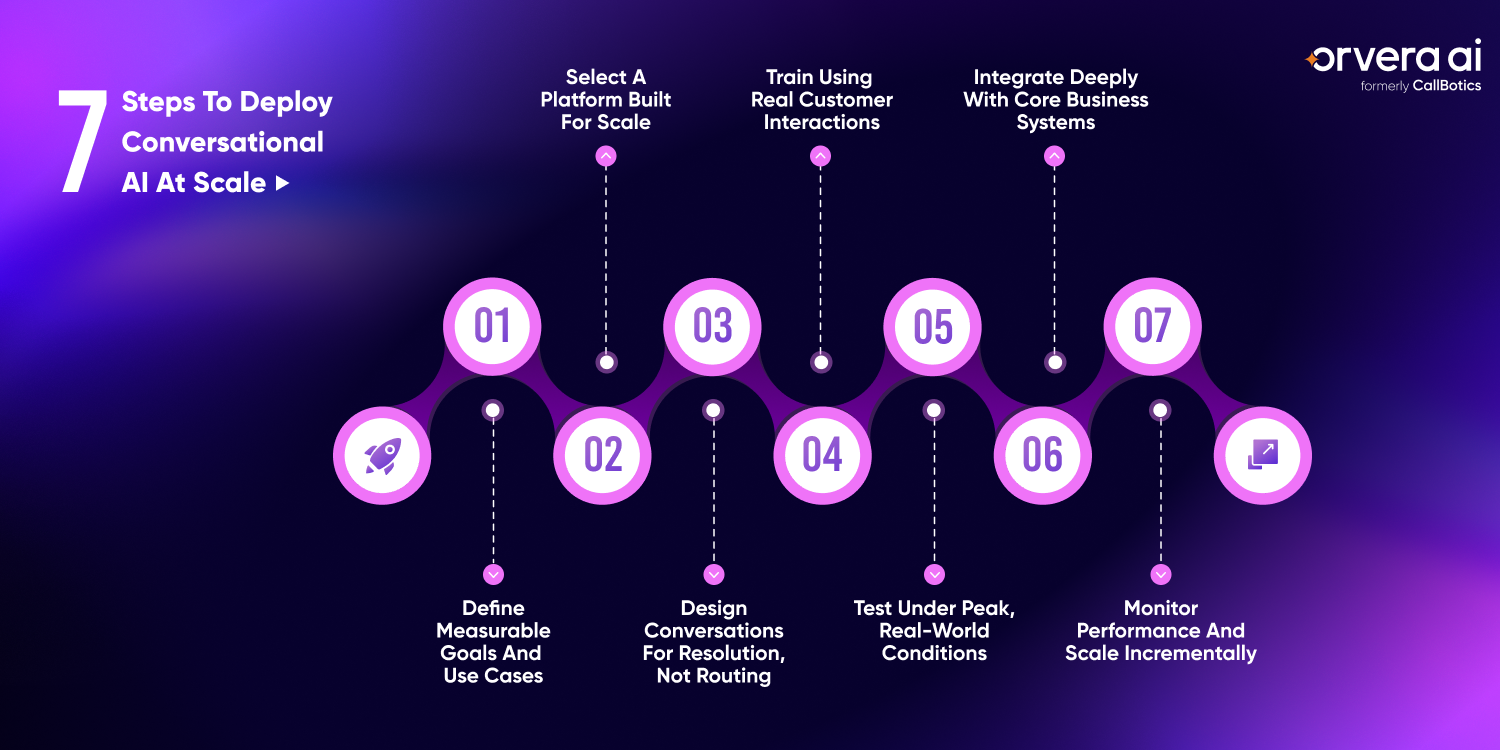
Deploying conversational AI successfully is rarely about one big decision. It is usually the result of getting a series of smaller decisions right, from defining scope and selecting the platform to designing flows and monitoring performance after launch. This section breaks the process down step by step so teams can move from planning to production with more clarity and less risk.
Step 1: Define Business Goals and Use Cases
Every successful deployment starts with clarity on what the system is supposed to achieve. Without defined goals and carefully chosen use cases, conversational AI can quickly become difficult to evaluate, improve, or scale. This section focuses on how to set the right foundation before any technical work begins.
Define Business Objectives in Operational Terms
Before conversational AI can deliver value, teams need to define success in terms that can actually be measured. Clear operational objectives help shape everything that follows, from platform selection to conversation design and post-launch evaluation. Effective objectives typically focus on:
- Reducing average wait time during high-volume periods
- Increasing first-contact resolution for routine inquiries
- Absorbing demand spikes without increasing abandonment rates
- Reducing unnecessary handoffs between teams
- Improving turnaround time for structured requests
These objectives provide a concrete benchmark for deployment success and guide design, training, and platform decisions.
Identify Use Cases That Are Structurally Suitable
Once goals are clear, the next step is deciding where conversational AI should and should not be applied. The best deployments start with use cases that are operationally predictable and genuinely suited to automation. Conversational AI performs best when applied to interactions that are:
- High in volume and repetitive in nature
- Predictable in conversational structure
- Governed by clear rules or workflows
- Resolvable using existing business data
Examples include appointment scheduling, order or case status checks, account verification, outbound reminders, and follow-up calls.
Equally important is documenting which interactions should not be automated. Scenarios involving complex judgment, negotiation, or sensitive interpretation should remain outside automated resolution. Clear scope definition prevents misuse and protects customer trust.
If your team is planning a conversational AI rollout, see how Orvera helps structure workflows, reduce friction, and support faster resolution in live environments. (opens in a new tab)Step 2: Choose the Right Conversational AI Platform
The platform you choose will shape everything from deployment speed to long-term reliability (opens in a new tab). A strong platform should support the use cases you identified, fit your operational needs, and perform well under real-world conditions rather than just in demos. This section outlines what to look for before moving forward.
Evaluate Platforms Based on Deployment Readiness
Not every conversational AI platform is built for real production conditions. This part of the evaluation should focus on how well the platform performs under live traffic, integration demands, and operational pressure. When selecting a conversational AI platform, organizations should prioritize:
- Consistent performance under concurrent interaction loads
- Support for multi-turn conversations with context retention
- Ease of integration with CRM, ticketing, and backend systems
- Low-latency response times suitable for live interactions
- Built-in analytics for monitoring performance and outcomes
Platforms should be evaluated based on how they behave during peak traffic, not just during demonstrations or pilots.
Decide on the Right Build Approach
Platform selection is also influenced by how much control, speed, and internal ownership the organization wants. Choosing the right build model early helps avoid delays, rework, and long-term maintenance issues. Organizations typically choose between three approaches:
- In-house development, offering full control but requiring longer timelines and ongoing maintenance
- Third-party platforms, enabling faster deployment with proven infrastructure
- Hybrid models, balancing customization with operational stability
The decision should align with internal capabilities, deployment urgency, and tolerance for operational risk.
Step 3: Design Effective Conversational Flows
Once the goals and platform are in place, the next challenge is designing conversations that actually lead to resolution. Good conversational design is not just about what the assistant says (opens in a new tab), but how it handles user behavior, manages context, and recovers when the interaction goes off script. This section explains what effective flow design should take into account.
Design Conversations Around Resolution
A conversational flow should not just move the interaction forward; it should also enrich it. It should guide the user toward a clear outcome with as little friction as possible. This includes:
- How the conversation begins
- What information must be collected
- How decisions are made
- How is completion confirmed
- When escalation is triggered
Flows without clear completion criteria often result in unresolved interactions and a poor user experience.
Account for Real-World User Behavior
In production environments, users rarely respond in clean, predictable ways. That is why conversational design must account for interruptions, unclear inputs, and changing intent from the start. Effective conversational flows include:
- A primary path toward resolution
- Recovery paths for misunderstood or missing inputs
- Fallback responses when intent confidence is low
- Correction handling that allows users to revise information
Designing for recovery is essential for maintaining performance at scale.
Preserve Context Across Multi-Turn Conversations
Multi-turn conversations require the system to retain and apply context consistently. As conversations extend across multiple turns, context becomes critical to both speed and quality. Preserving what the user has already shared helps reduce repetition and creates a more natural, efficient experience.
Step 4: Train and Fine-Tune Your AI Assistant
Even well-designed flows will fail if the assistant is not trained on realistic inputs and interaction patterns. Training is what helps conversational AI move from a theoretical capability to something that performs reliably in production. In this section, the focus shifts to building accuracy, stability, and adaptability over time.
Use Real Interaction Data as the Primary Training Source
High-performing conversational AI systems are trained on real customer interactions rather than hypothetical examples. Historical call transcripts, chat logs, and recorded conversations provide realistic phrasing, incomplete requests, and natural language variations.
Effective training datasets should include:
- Common and uncommon ways users express the same intent
- Partial or ambiguous inputs
- Informal language and regional phrasing
- Edge cases that frequently lead to escalation
Training exclusively on idealized examples results in brittle systems that fail in the real world.
Prioritize Intent Clarity Over Intent Volume
Early training works better when the focus stays narrow and well defined. Instead of trying to cover everything at once, it is more effective to build strong intent recognition around a smaller, cleaner scope.
Each intent should have:
- A clear purpose
- Defined boundaries
- Sufficient variation in training examples
This approach improves intent recognition and simplifies ongoing optimization.
Establish Continuous Training as a Process
Training should not be treated as a one-time setup task completed before launch. As customer behavior changes and new patterns emerge, the system needs ongoing refinement to stay accurate and dependable.
Ongoing fine-tuning should include:
- Reviewing failed or escalated conversations
- Identifying misunderstood intents
- Expanding training data with real user phrasing
- Adjusting confidence thresholds
Continuous training ensures the system adapts to evolving customer behavior and business changes.
Step 5: Test and Optimize for Performance
Before conversational AI goes live, it needs to be tested in conditions that resemble the real environment in which it will operate. This means going beyond scripted checks and evaluating how the system performs under pressure, with interruptions, delays, and unpredictable user behavior. This section covers how to test for reliability and optimize before launch.
Test Under Realistic Operating Scenarios
Testing needs to reflect how the system will behave in actual production conditions, not just in ideal scripted flows. This is where teams uncover weaknesses that would otherwise show up only after launch. Before launch, conversational AI should be tested for:
- Concurrent interactions at expected peak volumes
- Delayed or missing backend responses
- Interruptions, rephrasing, and corrections
- Escalation accuracy and timing
- Response latency across conversation turns
Testing limited to scripted scenarios does not expose real-world weaknesses.
Include Non-Technical Test Participants
People who already know how the system works often interact with it differently from real users. Bringing in fresh participants helps surface usability issues, confusing prompts, and overly rigid flow logic.
This approach helps identify:
- Confusing prompts
- Ambiguous questions
- Incomplete recovery paths
- Overly rigid conversation logic
Define Performance Metrics Before Launch
Testing becomes far more useful when it is tied to specific performance indicators. Clear metrics create a baseline that helps teams decide whether the system is truly ready to go live. Core performance indicators include:
- Intent recognition accuracy
- Resolution rate for target use cases
- Escalation rate and escalation correctness
- Average interaction duration
- Abandonment or dropout rate
These metrics establish a baseline for post-launch monitoring and optimization.
Step 6: Integrate Conversational AI into Business Systems
Conversational AI becomes far more valuable when it can access the systems that power actual customer resolution. Without integration, it may only be able to provide limited responses or route users elsewhere. This section looks at how integrations turn automated conversations into useful (opens in a new tab), action-oriented workflows.
Identify Critical System Integrations
Conversational AI typically needs access to:
- CRM systems for customer context
- Case or ticketing platforms for status updates
- Scheduling systems for appointments
- Databases for account or policy information
Without real-time data access, conversational AI can only provide generic responses and deflection.
Design Integration for Reliability and Speed
Integrations must be:
- Low-latency to support live conversations
- Secure and compliant with data policies
- Resilient to partial failures
Fallback logic should be defined for cases where systems are unavailable, ensuring conversations do not stall or degrade user experience.
Preserve Context Across Systems
When conversational AI escalates to a human agent, all collected information should be passed forward seamlessly. Context preservation reduces repetition, shortens resolution time, and improves agent efficiency.
For teams evaluating platforms based on deployment speed, escalation quality, and operational visibility, Orvera is worth exploring further. (opens in a new tab)Step 7: Monitor and Scale AI Performance
Launch is not the end of deployment. Once conversational AI is live, teams need visibility into how it is performing, where it is breaking down, and when it is ready to expand into new use cases or channels. This section explains how to consistently monitor performance and scale (opens in a new tab) without causing instability.
Establish Continuous Performance Monitoring
Conversational AI should be monitored with the same rigor as other operational systems. Key performance indicators should be visible in real time and reviewed regularly.
Critical metrics include:
- Resolution rate for defined use cases
- Escalation rate and escalation accuracy
- Average handling time per interaction
- Abandonment rate during conversations
- Performance during peak traffic periods
Monitoring these metrics allows teams to identify degradation early and make corrective adjustments before customer experience is affected.
Use Monitoring Data to Drive Optimization
Live interaction data provides clear signals about where conversational AI succeeds and where it struggles. Optimization efforts should focus on:
- Refining intents that trigger frequent escalation
- Improving recovery paths for misunderstood inputs
- Adjusting prompts that lead to confusion or drop-off
- Expanding coverage for emerging interaction patterns
Optimization should follow a structured cadence rather than ad hoc changes.
Scale Gradually and Intentionally
Scaling conversational AI should be incremental. New use cases, channels, or languages should be introduced only after existing flows demonstrate consistent performance.
This approach minimizes risk and preserves stability as the deployment scope grows.
Overcoming Challenges in Deploying Conversational AI
Even strong deployments encounter obstacles once they face live traffic, operational complexity, and changing customer behavior. The difference is usually in how early those issues are anticipated and how well the system is designed to handle them. This section highlights the most common deployment challenges and how to approach them more effectively.
Ensuring Security and Compliance
Conversational AI often handles sensitive customer data. Deployments must comply with applicable security and privacy requirements, including data access controls, encryption, and auditability.
Best practices include:
- Restricting data access to only what is required for resolution
- Logging interactions for audit and review
- Ensuring escalation preserves compliance boundaries
Security and compliance considerations should be addressed early, not retrofitted after launch.
Handling Unpredictable User Behavior
Customers rarely interact in predictable ways. Conversational AI must be designed to handle:
- Incomplete information
- Sudden changes in intent
- Interruptions and rephrasing
- Emotional or urgent interactions
Robust recovery logic and sentiment-aware escalation are essential for managing unpredictability at scale.
Aligning AI With Existing Workflows
Conversational AI must integrate into existing operational workflows rather than forcing teams to adapt around it. Clear ownership, escalation rules, and handoff procedures prevent confusion and duplication of effort.
Best Practices for Scaling Conversational AI
Scaling conversational AI (opens in a new tab) is not just about increasing usage. It requires discipline in how new use cases, channels, and languages are introduced so that performance stays stable as the system grows. This section outlines the practices that help organizations expand with more control and less operational risk.
Expand Coverage Based on Proven Performance
New use cases should be added only after existing ones demonstrate stable resolution rates and acceptable escalation behavior. This prevents compounding errors across the system.
Support Multiple Channels and Languages Carefully
Multi-channel and multilingual expansion increases reach but also complexity. Each channel and language should be treated as a separate deployment phase, with dedicated testing and performance monitoring.
Maintain a Clear Governance Model
Scaling requires defined ownership for:
- Conversation design
- Training and optimization
- Monitoring and intervention
- Compliance and data governance
Clear governance ensures conversational AI remains aligned with business objectives over time.
How Orvera Supports Conversational AI Deployment
After looking at the broader deployment process, it helps to understand how a platform can support that journey in practice. Orvera approaches conversational AI deployment through (opens in a new tab) the lens of 18+ years of real-world contact center operations experience, giving it a stronger foundation in what live environments actually require. This section explains how that operational background shapes its focus on readiness, faster rollout, and dependable performance in real customer interactions.
Orvera supports deploying conversational AI effectively by:
- Resolving structured customer conversations end-to-end, with the record updated before the call closes
- Enabling deployment in 3 to 6 weeks for defined use cases
- Using real-time sentiment analysis to adjust tone and escalation paths
- Handling inbound and outbound calls using a unified conversation logic
- Scaling across concurrent calls without degrading performance
- Making performance visible through built-in real-time analytics
For customers, this results in fewer transfers, shorter wait times, and clearer resolution. For teams, it delivers predictable performance, faster deployment, and reduced operational complexity.
Orvera strengthens operations by removing friction from routine interactions while preserving human judgment where it matters most.
Conclusion
Deploying conversational AI successfully requires more than choosing a model or launching a bot. It depends on clear business goals, the right use cases, strong platform selection, thoughtful conversation design, continuous training and testing, and disciplined monitoring as the system scales. When these elements are in place, conversational AI becomes a reliable part of customer operations rather than a disconnected experiment.
Frequently asked questions
Deployment timelines vary based on scope and complexity. A full platform deployment lands in 3 to 6 weeks, with integrations and testing requirements deciding where it falls in that range.
Yes. Conversational AI can integrate with CRM, ticketing, scheduling, and other backend systems to enable real-time resolution and context-aware interactions.
Security and compliance require controlled data access, encryption, audit logs, and clear escalation rules. These considerations should be addressed during planning and platform selection.
Conversational AI is designed to handle structured, repeatable interactions. Human agents remain essential for complex, sensitive, or judgment-based conversations.
Scaling should be incremental. New use cases, channels, or languages should be added only after existing deployments demonstrate stable performance and clear operational value.