AI Voice Agents in Healthcare: A 2026 Buyer's Guide
The AI voice agent in healthcare that wins is the one you can audit once protected health information, clinical risk, and a...

Key highlights
TL;DR —- In a Nutshell
- AI voice agents in healthcare go beyond conversation by completing tasks inside EHRs, scheduling systems, and claims platforms
- Healthcare voice AI is harder to deploy because it must address PHI protection, clinical safety, regulatory requirements, and reliable system integration
- The strongest use cases are high-volume workflows with predictable steps and measurable outcomes, including scheduling, intake, refills, billing, payer calls, recall, and after-hours support
- Payer and revenue cycle workflows offer significant automation potential across benefits checks, prior authorization follow-ups, claims, denials, and member support
- Buyers should evaluate platforms on auditability, consent, escalation, integration depth, write reliability, governance, and quality monitoring rather than demo performance alone
- A configured enterprise deployment can go live in 3 to 6 weeks, with ROI best measured through resolution, cost to serve, first contact resolution, reduced abandonment, and recovered access
The AI voice agent in healthcare that wins is the one you can audit once protected health information, clinical risk, and a regulator's question are in the room. Demo quality converged during 2025. Every platform on a health system shortlist can hold a natural conversation, recover from an interruption, and book an appointment inside a sandbox. The separation shows up on call 40,000, in production, on the Friday evening after the provider directory changed and nobody told the agent.
The pressure making this urgent begins with staffing. Mercer projects the United States will be short roughly 100,000 healthcare workers by 2028 (opens in a new tab), including a deficit of more than 73,000 nursing assistants. The drivers are accelerated resignations, burnout, an aging population, and wages that trail the wider labor market. Patient access teams absorb more calls every year with fewer people to answer them. Hold times stretch, abandonment climbs, and the volume that gets dropped is the routine scheduling and refill work that keeps patients connected to care.
This guide follows the decision in the order it gets made. It defines what an AI voice agent in healthcare does and how it differs from an IVR or a chatbot. It then covers why regulation, clinical safety, and integration reliability make this the hardest sector to reach production in. From there, it works through the workflows paying off today across patient access and the payer side. It closes on the criteria that separate a platform you can defend from one you cannot, the failures that surface only after launch, and what deployment timelines and return really look like.
What An AI Voice Agent in Healthcare Is
An AI voice agent in healthcare is a system that holds a natural spoken phone conversation with a patient or member and completes the task end to end. It listens, asks clarifying questions, verifies identity, takes the action inside the EHR or the claims system, and confirms the result before the call ends. Completion is the measure that matters, and it is what separates a voice calling AI agent for healthcare from the two technologies it gets confused with.
The difference sits in what runs underneath the conversation. A voice agent works through five steps in sequence, and knowing them in plain English makes vendor claims much easier to test.
- Speech recognition turns the caller's audio into text, and its accuracy on medication names, provider names, and member IDs decides how much of the rest works
- Language understanding works out what the caller wants, including the requests they phrase indirectly or interrupt halfway through
- Dialogue management chooses the next move, tracks what has been confirmed, and knows the point at which a person should take over
- Integration reads and writes the EHR, the scheduling grid, or the payer portal, which is the step where a conversation becomes an outcome
- Speech synthesis speaks the reply back in a voice the caller can follow without strain
The healthcare overlay raises the difficulty of every one of those steps. Protected health information moves through the call from the moment identity verification begins, so encryption, access control, and audit logging apply to the transcript as much as to the record itself. The EHR write has to succeed and be confirmed, because a booking the patient heard and the system never stored produces a missed appointment and a complaint.
Medical term accuracy carries the sharpest risk of the five. Sound-alike medication names create a class of recognition error with clinical consequences a retail deployment never encounters, so test recognition against your own formulary and provider directory before signing anything. Gartner also warns that agent washing is widespread, estimating only about 130 of the thousands of agentic AI vendors are real (opens in a new tab), so treat some shortlist entries as rebadged IVR until integration depth proves otherwise. Our enterprise conversational AI platform overview covers the wider category these products sit inside.
Why Healthcare Is The Hardest Place to Deploy Voice AI
Healthcare makes voice AI hard in three ways at once. The rules are stricter than almost any other industry, the calls carry clinical risk, and the systems behind them are unforgiving about mistakes. Plenty of deployments clear one of these and stall on the other two. Each axis usually belongs to a different team, so compliance, clinical leadership, and IT often review the same platform separately and never compare notes.
The rules start the moment the call connects
Protected health information moves through the call as soon as you ask a caller to confirm a date of birth. That makes the recording, the transcript, and the log as sensitive as the medical record itself. The scale of what goes wrong is documented, since HHS Office for Civil Rights recorded 663 large breaches in 2024, exposing the protected health information of 242,908,056 individuals (opens in a new tab), the worst year on record. Much of that exposure sits in systems nobody inventoried, and a voice agent adds a fresh store of transcripts and recordings the day it goes live.
- Sign the business associate agreement before the pilot starts, and get the retention period and the access list in writing
- Outbound campaigns need consent on file, because the FCC ruled in February 2024 that AI voices count as artificial voices under the TCPA (opens in a new tab) and require prior express consent from the person being dialed
- Patients may need to be told they are speaking with AI, and California's AB 3030 (opens in a new tab) asks for a spoken disclaimer at the start and the end of any call carrying clinical information
A routine call can turn clinical in one sentence
A patient rings to move an appointment and mentions chest pain halfway through. That one sentence changes what the call is, and the agent has about two seconds to notice. Escalation design is the piece most teams leave until last, and it is the piece a clinician or a regulator will ask about first. An escalation path also needs somewhere to land, so the human queue has to be staffed for the hours the agent is covering.
- Write the escalation triggers before the happy path, and include vague phrasing like feeling off or something is wrong, since patients rarely use clinical language on the phone
- Keep clinical judgment with a clinician, and let the agent gather symptoms, capture history, and route the caller to the right level of care
- Track escalation accuracy as the headline number for these calls, because a triage agent handling most of them on its own is showing you a problem
A booking only counts when the system saves it
The agent tells the patient the appointment is booked. If the write into the EHR failed quietly, that patient arrives for a slot nobody holds. Integration reliability turns a good conversation into a real outcome. It stays invisible in every demo. Read access is usually quick to approve, and write access is where the security review and the real timeline sit.
- Ask which specific writes are supported, how a failed write gets flagged, and which person or queue receives that alert
- Check how the agent learns that a directory or formulary changed, because stale data produces confident wrong answers that sound normal
- Test what the caller hears when an integration times out, because a silent drop at booking loses the call and the appointment
None of this surfaces in a demo. A demo runs on clean data, a scripted caller, and a sandbox where every write succeeds, so all three axes stay hidden until real volume arrives. That is why these checks belong in the RFP and not in the pilot review. Ask for the business associate agreement, the consent records, the escalation triggers, and the write-failure alerting up front, and the shortlist starts sorting itself before the first demo is booked.
The Healthcare Voice AI Use Cases That Pay Off
The workflows that pay off share three traits. They run at high volume, they follow a predictable set of steps, and they end in something you can point at and call done. Voice AI systems for patient call automation earn their place on those calls first, and the rest of the phone line can wait its turn. Start where the work is dull and repetitive, since that is where the agent has the least room to improvise, and you have the most room to measure it.
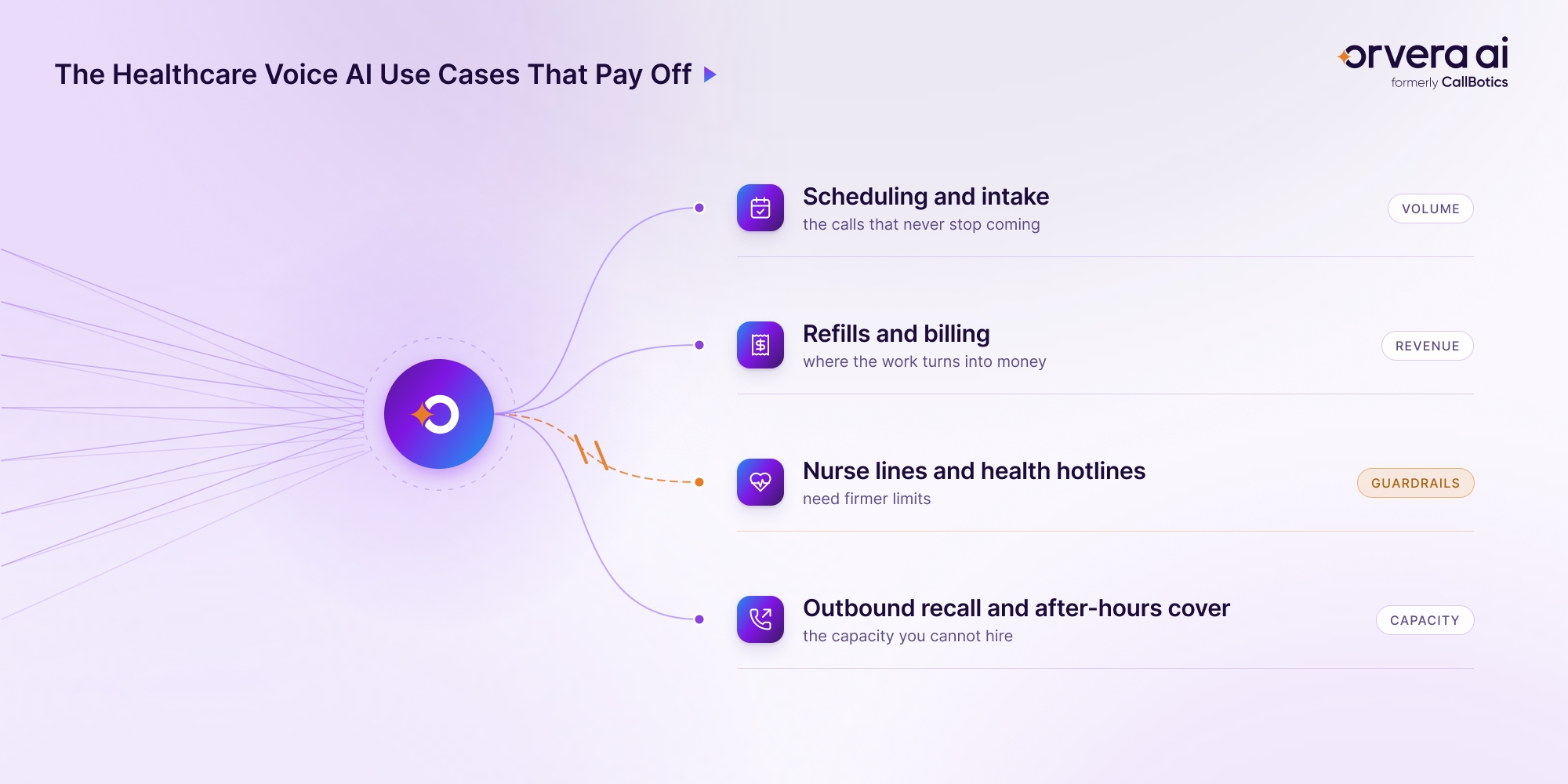
Scheduling and intake, the calls that never stop coming
Scheduling, rescheduling, canceling, and intake make up the bulk of what a patient access team handles every day. They are also the calls people give up on when the hold music runs long. The common starting pattern is a voice agent sitting across the main patient access lines with a direct link into the scheduling system. Intake is the piece people underrate, because a clean record at the front end saves hours of rework in billing weeks later.
- On scheduling, the agent verifies identity, finds the right provider and location, offers open slots, books the appointment, and confirms it before hanging up
- Teams looking for the best voice AI for automating patient intake calls should check that it captures demographics, insurance, reason for visit, and consent, then writes a clean record the front desk does not have to rebuild
- Watch the routing closely, because a call sent to a plausible wrong clinic closes as a success on every dashboard that counts calls handled
Refills and billing, where the work turns into money
Prescription refills and patient pay calls are repetitive, rules-driven, and tied to a clear finish. A refill either reaches the prescriber or it stalls, and a balance either gets paid or it ages. These are the calls where automation shows up in a finance report and not only in a service dashboard. Billing sits closer to the clinical line than most teams expect, since a patient asking why a service cost what it did often starts describing the service.
- On refills, the agent identifies the pharmacy, confirms the medication, submits the request, routes it to the prescriber, and calls back with the outcome
- On billing, the agent looks up the balance, explains the charges in plain terms, takes the payment, and sets up a plan when the patient asks for one
- Watch the source data, because a formulary or price change from last week produces confident wrong answers that sound completely normal on the call
Nurse lines and health hotlines need firmer limits
Nurse lines and hotlines carry the highest value and the highest risk on the whole phone line. Anyone evaluating voice AI for health hotline support should treat escalation as the product, since the job is getting a caller to the right level of care quickly. Design the handoff before you design anything else.
- The agent can gather symptoms, capture history, confirm current medications, and route the caller to a nurse, an urgent care slot, or emergency services
- Clinical judgment stays with a clinician, so the agent hands off the moment a caller describes something that needs a trained ear
- Watch escalation accuracy above every other number here, because an agent resolving most hotline calls on its own is telling you the triggers are too tight
Outbound recall and after-hours cover, the capacity you cannot hire
No-show recovery, recall campaigns, and after-hours cover add capacity a rota cannot buy. Most systems learned this during the pandemic surges, when call volume climbed faster than any hiring plan could follow. Managing patient communications at scale is the same problem in slower motion, and it is the one most teams live with every week.
- Outbound campaigns call patients who missed an appointment, offer the next open slot, and book it on the same call
- After-hours cover picks up the evening and weekend volume that currently lands in a voicemail box nobody clears until Monday morning
- Watch consent on every outbound dial, and watch quality per language and per hour, because averages hide the gaps that hurt
Every workflow above shares the same shape. They run at high volume, follow clear rules, and finish at a line you can check, which is what makes them the best use cases for voice AI in healthcare. The harder calls are worth automating later, once the evidence trail on these is running clean.
Voice AI for Health Insurance Call Centers and Medical Claims
The payer side is where the volume, the cost, and the search demand all pile up together. Provider teams spend their day calling insurers, insurers spend their day answering members, and both halves of that phone line run on scripts. McKinsey estimates payers could cut administrative costs by 13% to 25% using AI that already exists (opens in a new tab). These are the most repetitive calls in healthcare and the least covered by everyone selling voice AI. The budget usually sits with revenue cycle or with a payer's own service organization, which is a different buyer from the patient access team most voice AI gets pitched to.
The hold music your staff sits through every day
Ask a revenue cycle team what eats their week, and you get the same answer. Someone calls an insurer to check a patient's benefits, works through the phone menu, waits on hold, reaches a representative, runs the same list of questions, and types the answers into a system.
A voice agent runs this call without a person sitting through the wait. It moves through the menu, holds, asks the scripted questions, and writes structured plan data straight into your system. The thing to watch is what comes back, so score these calls and check the written record against the audio before anyone downstream treats that data as settled. Count how many of these calls your team makes in a week and the business case tends to write itself.
Claims and denials, where the money sits
Health systems spend more than $140 billion a year running their revenue cycle, and nearly a fifth of claims get denied (opens in a new tab). Most of those denials never get worked, because working one means more phone calls to the payer and nobody has the hours spare. The queue refills faster than the team clears it, and the dollars quietly age out of reach. Timely filing deadlines keep running while that queue grows, so unworked denials turn into written-off revenue on a schedule.
This is the case for leading voice AI for medical claims support. The agent calls the payer, pulls the claim status, captures the denial reason, and leaves a structured record the team can act on the same morning. The best voice AI for claim intake automation does the same job on the way in, turning a messy phone conversation into clean fields. Measure it on denials worked per week and overturn rate, because both land in a finance report.
The member line on the other side of the phone
Payer contact centers carry huge inbound volume, and most of it comes down to the same handful of questions. Members want to know what is covered, which doctors are in network, why a claim was processed the way it was, and what they now owe. Advocates answer those questions all day while the complicated cases queue up behind them. Many of those members call back a second time because the first answer never quite landed.
Leading voice AI platforms for health insurance call centers take the routine questions and pass the rest to a person with the full context already attached. The line worth respecting is the decision itself, since California's SB 1120 keeps medical necessity determinations with a licensed clinician (opens in a new tab). An agent can collect, verify, summarize, and route all day long, and your audit trail has to show a person made the call.
One caution belongs on the record before you build any of this. The largest healthcare breach on file hit a claims clearinghouse, and that single incident accounted for roughly 192 million of the individuals exposed in 2024 (opens in a new tab). Claims infrastructure is a chokepoint, so any voice layer you add to it inherits that exposure from day one. Our guide to insurance and claims automation covers how banks and insurers handle the same regulated communication problem.
A Shortlist of Healthcare Voice AI Approaches
The market has split into lanes, and the right pick follows from the workflow you are automating and the risk sitting behind it. Teams searching for the best voice AI for healthcare call centers usually land on a ranked list that ignores this. A platform built for patient scheduling and a platform built for payer calls solve different problems and rarely swap in for each other.
Healthcare-native platforms for patient access
These are built for the patient access line, with scheduling flows and EHR connections already wired in. If your pain is hold time on the main hospital number, this lane is where most health systems start.
- Pick this when scheduling, rescheduling, and provider navigation make up the bulk of your inbound volume
- Verify the depth of the EHR connection, meaning which writes are supported and how a failed write gets flagged
- Accept less room to customize, since the prebuilt flows that make setup fast also set the limits
Payer-focused platforms for provider-to-payer calls
These handle the outbound calls your staff makes to insurers all day. If your team loses hours a week to hold music and prior authorization follow-ups, this lane goes straight at that problem.
- Pick this when benefit checks, prior authorization, and claim status calls are eating your revenue cycle team's week
- Verify how the structured data lands in your system and how often the written record gets checked against the audio
- Accept that this is back-office work, so your patient-facing line still needs its own answer
Clinical-grade specialists
These are built for conversations that touch clinical ground, with safety guardrails and clinician oversight designed in from the start. Post-discharge follow-up and chronic care check-ins belong here.
- Pick this when the call involves symptoms, medications, or anything a nurse would want to hear directly
- Verify who reviews the clinical logic, how often they review it, and what happens when the agent gets something wrong
- Accept the narrow scope, since this lane covers clinical conversation and leaves the rest of your phone line untouched
Horizontal and developer voice platforms
These hand you the building blocks and leave the assembly to your team. Groups with real engineering capacity and a workflow nobody packages usually end up here.
- Pick this when you have engineers available and a workflow no off-the-shelf product covers properly
- Verify your own capacity honestly, since compliance, QA, escalation design, and monitoring all become your team's job
- Accept a longer road to production, because everything a packaged platform includes has to be built and then maintained
Enterprise contact center platforms with governance built in
These sit across the whole contact center and add the layer most buyers discover they need later, meaning quality review, compliance evidence, agent assist, and language coverage. Orvera works in this lane.
- Pick this when you need every call scored, disclosure and consent evidenced, and service running in many languages.
- Verify the quality coverage claim by asking to see the live dashboard and the scoring rubric behind it.
- Accept that deep EHR-native scheduling belongs with the healthcare-native platforms and clinical triage belongs with the specialists.
Orvera runs in that last lane, with omnichannel agents, live agent assist, 100% AI Auto QA on every call, SOC 2 Type II and HIPAA credentials, more than 80 languages, and full deployment in 3 to 6 weeks. It is one option of five here, and the right one when governance and language coverage are what you are short of. For the wider picture, see how to evaluate enterprise AI platforms and the wider vendor market.
Deployment, Timeline, and ROI
A configured enterprise platform goes live in 3 to 6 weeks, and the return becomes real once you measure it on resolution and cost to serve. Most healthcare voice business cases come apart at the same point, which is when nobody agreed up front what counts as a win. Settle the measures before you settle the timeline.
What the 3 to 6 weeks covers
Inside that window sit the system integrations, the workflow configuration, the guardrails and escalation paths, the quality rubric, and a staged ramp that moves traffic over gradually. None of it is exotic work, and all of it has to happen in order.
Three things stretch that window, and none of them belong to the project team. EHR access approvals, telephony changes, and security review each run on somebody else's calendar. Open all three in week one, and the timeline usually holds. Leave them until the build is finished and you spend longer waiting for sign-off than you spent configuring.
Where the return shows up
The return arrives in a set order, and knowing that order stops your finance team asking for the headline number in month one. Wait times and abandonment move first, usually inside 30 days, because the after-hours and overflow calls finally get answered. Handle time on human-served calls drops next as agent assist strips out the wrap-up work. First contact resolution climbs after that, and cost to serve falls last and falls hardest.
Recovered access is the piece finance rarely models. Every abandoned call is a patient who did not book, a slot that stayed empty, and revenue that never showed up in any report. McKinsey puts the achievable cut in cost to collect at 30% to 60%, and models a one to two point improvement as $60 million to $120 million a year for a health system with $6 billion in patient revenue (opens in a new tab). The labor side stacks on top, since every call the agent resolves is a call you no longer have to hire for.
Pilots, pricing, and the question your CFO will ask
Bounded pilots are common in this market, and they do a real job, which is proving one workflow on a small slice of traffic. The risk is settling in there and staying. McKinsey's own advice is to set pragmatic success measures before you start and move to scale as soon as the value shows.
A pilot and a 3 to 6-week deployment answer different questions, so be clear about which one you are buying. On how much healthcare voice AI costs, pricing runs across per minute, per resolution, per booking, and platform subscription, and enterprise healthcare pricing is quoted on request. Compare on cost per resolved contact. A cheap minute on a call the patient has to make twice costs you more than the expensive one that finished the job the first time.
Conclusion
The healthcare voice deployments that hold up over time are the ones you can look inside. When every call is recorded, scored, and searchable, and when disclosure and consent leave a trace on each one, the harder questions from compliance and clinical leadership have answers waiting. Most of that is settled at procurement, so it helps to ask a shortlist for the plain evidence early. The dashboard where calls are scored, the disclosure and consent logs, and a definition of a resolved call tied to a system event will tell you more about an AI voice agent in healthcare than another round of demos.
Orvera sits in the contact center governance lane (opens in a new tab), with omnichannel AI voice agents, live Agent Assist working alongside human teams, 100% AI Auto QA across every call, and Voice of Customer intelligence. It carries SOC 2 Type II and HIPAA credentials, runs in more than 80 languages, and goes live in 3 to 6 weeks. If seeing that evidence trail on your own call types would be useful, a demo is the quickest way to look.
Frequently asked questions
They are systems that hold a spoken phone conversation with a patient or member and complete the task inside the EHR, the scheduling grid, or the claims system. Scheduling, intake, refills, billing, and payer calls are the workflows they handle today.

Written by
Anindita Majumder
Anindita Majumder is a communications professional with nearly four years of experience in public relations, corporate communications, and journalism. She creates content that helps brands communicate their vision, products, and expertise through press releases, thought leadership, and editorial pieces. Outside of work, she is a vocalist, which keeps her creativity flowing.