How AI Voice Agents Are Perfecting the Warm Transfer
How AI voice agents turn a transfer into a warm handoff: intent detected early, details collected once, a short summary passed to the rep, routing by context, and escalation before the customer runs out of patience.


Key highlights
Key takeaways
- Warm transfers work when the receiving rep gets the customer’s issue, previous steps, and next need before the call moves
- Poor handoffs make customers repeat themselves, slow down reps, and turn a transfer into another round of discovery
- AI voice agents improve handoffs by identifying intent, collecting key details, summarizing the call, and routing based on context
- A strong AI-powered transfer sends the human rep a clear summary with the caller’s intent, account context, sentiment, and recommended next step
- Contact centers should avoid long intake flows, generic summaries, wrong-team routing, and missed escalation signals
- The best workflows keep intake short, escalation rules clear, routing accurate, and handoff context easy for reps to use
Warm transfers work because the next rep starts with context, not a blank screen. Before the customer is moved, the first rep shares why the customer called, what has already been checked, and what needs to happen next. The customer hears less repetition, and the next rep can start closer to resolution.
That handoff matters because customers still expect the contact center to fix the issue the first time. WiFiTalents’ 2026 Contact Center Statistics report reports that 73% of customers expect resolution (opens in a new tab) on first contact for high satisfaction. A warm transfer supports that expectation by keeping the conversation moving instead of forcing the customer to rebuild the case from the beginning.
AI voice agents make warm transfers easier to run across busy queues. They can collect account details, understand the caller’s intent, route the call to the right team, and pass a short summary before a human rep joins. For the receiving rep, that summary turns the next step from discovery into action. The customer still reaches the right person, but they do not have to repeat the same issue twice.
What Is a Warm Transfer
A warm transfer is a call transfer where the receiving rep gets context before speaking with the customer. The first rep shares the reason for the call, what has already been checked, and what the customer needs next. This helps the next rep avoid asking basic questions the customer has already answered. The handoff should give the receiving rep enough detail to act, not a long note they have to read while the caller waits.
This is different from sending a caller to another queue or department with no explanation attached. In a cold transfer, the next rep may have to ask the same questions again. With a prepared handoff, the next rep starts closer to resolution. For the customer, the difference is whether the transfer feels like progress or a reset.
Warm transfer vs. cold transfer
A cold transfer moves the call without context. The customer may land with a new rep who does not know why they called, what they already said, or which steps have already been tried. That gap often makes the customer feel like the contact center is not listening. The rep then spends the first part of the call catching up instead of solving the issue.
A prepared transfer gives the next rep the customer’s issue, account status, prior checks, and next step before the handoff. The customer still changes reps, but the conversation stays connected. This is especially useful when the issue touches more than one team, such as support and billing.
Why warm transfers matter in contact centers
Repeating the same story to different people is one of the fastest ways to frustrate a customer. When context travels with the call, the customer feels heard, and the next rep can focus on solving the issue instead of rebuilding the case. That matters most during billing issues, account problems, cancellations, and other calls where frustration is already high. It also lowers the chance that a frustrated customer drops the call after being moved.
For contact center teams, better handoffs can support first contact resolution (FCR), shorten average handle time, and reduce avoidable repeat questions. The rep spends less time collecting background and more time taking action. For supervisors, cleaner handoffs also make it easier to see where calls are slowing down. That can make queues easier to manage during peak hours because fewer calls get stuck in repeat discovery.
Common examples of warm transfers
A support rep may transfer a customer to billing after confirming the issue is tied to an invoice, payment, or plan change. A sales rep may hand a prospect to a product specialist after collecting the use case, company size, and buying need. In both cases, the receiving rep should know why the transfer is happening before they say hello. The transfer note should be short enough for the next rep to use immediately.
AI voice agents can also prepare a human handoff. The AI voice agent can collect details, understand intent, route the call, and pass a short summary before the rep joins. Customer success teams can use the same handoff when moving an at-risk customer to a retention rep with the account history already attached. For an AI-to-human escalation, the summary should include the caller’s intent, key details collected, and the reason a rep is needed.
Why Traditional Warm Transfers Often Break Down
A warm transfer sounds simple on paper: collect the customer’s issue, brief the next rep, and move the call. In practice, that handoff often breaks when queues are backed up, the right rep is unavailable, or the customer’s details do not travel with the call. The result is a transfer that feels “warm” internally but still feels like a restart to the customer. Even one missing detail can turn a prepared handoff into another round of discovery.
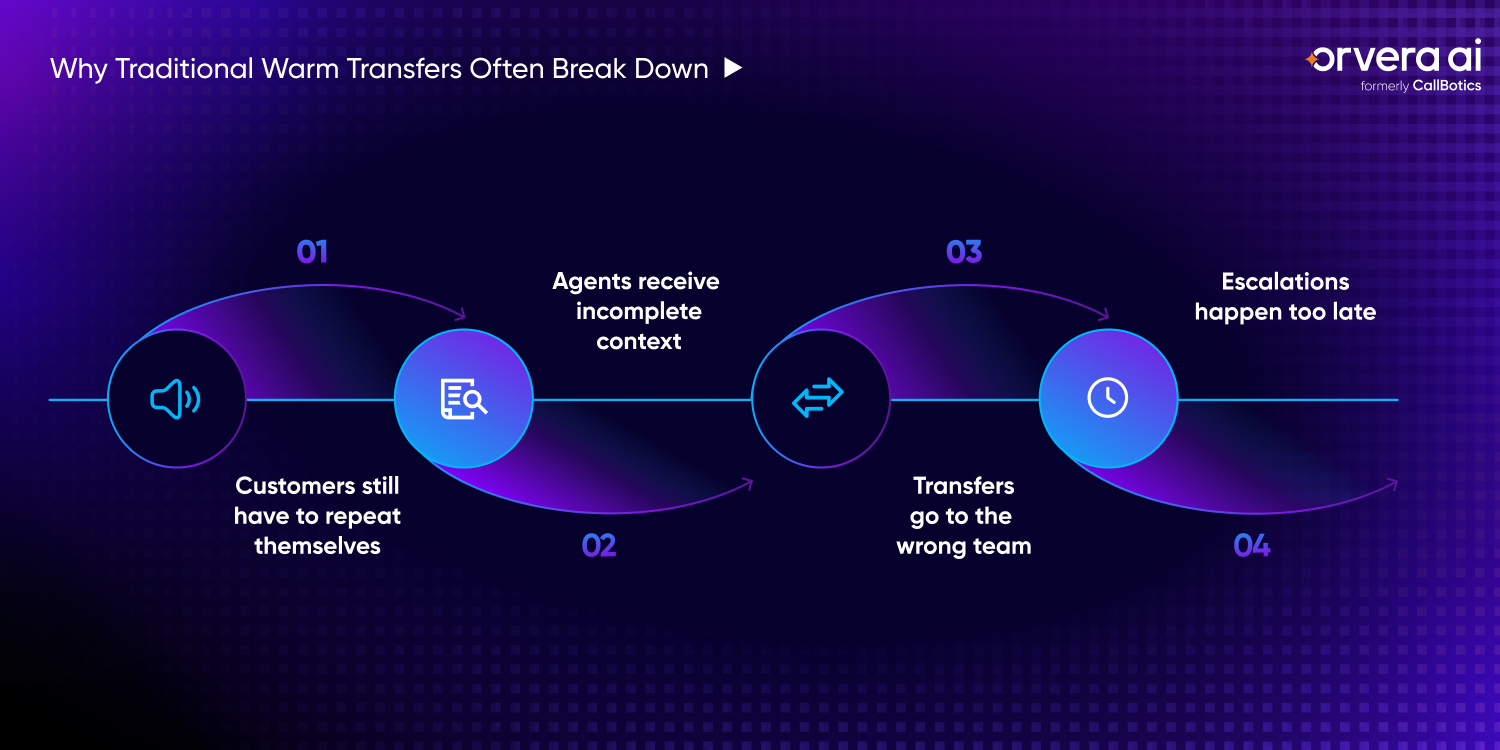
Customers still have to repeat themselves
The biggest failure is repetition. A customer explains the issue once, waits through a transfer, then has to explain it again because the next rep does not have the full picture. That creates frustration fast, especially when the customer has already verified their account or described the problem in detail. The longer the customer has already spent on the call, the less patience they have for repeated questions.
- Customers lose trust when the second rep asks the same questions the first rep already covered
- Repetition makes the transfer feel like the contact center is moving the problem around instead of solving it
- A good handoff should carry the reason for the call, the steps already taken, and what the customer needs next
Agents receive incomplete context
The receiving rep may get the call, but not the useful details behind it. They might not know the customer’s issue, urgency, previous answers, account status, or mood before they say hello. That leaves the rep catching up while the customer waits. A short, accurate summary helps the rep start with the next step instead of the first question.
- Missing account details can slow the call before the rep can take action
- Missing sentiment can make the rep treat an upset customer like a routine caller
- Missing history can lead to repeated checks, wrong assumptions, and longer handle time
Transfers go to the wrong team
Manual routing can break when the first rep has to choose the next department under pressure. A billing issue may be sent to support, a technical issue may be sent to sales, or a retention call may land with a team that cannot act. Every wrong turn adds time and raises the chance of another transfer. The first routing decision matters because it decides whether the customer moves toward resolution or another wait (opens in a new tab).
- Wrong-team transfers make customers feel like nobody owns the issue
- Each extra handoff increases average handle time and queue pressure
- Better routing starts with clear intent, not a guess based on the first few words of the call
Escalations happen too late
Some calls stay too long with the wrong rep or the wrong automation flow. The customer answers questions, waits for checks, and explains the issue, only to find out they needed a specialist from the start. By the time the right person joins, the customer may already be frustrated. The right escalation point should be based on what the issue needs, not how long the customer has already waited.
- Late escalation wastes time for the customer and the rep
- Complex issues should move sooner when the first path cannot resolve them
- A strong handoff should explain why escalation is needed, not only where the call is going
How AI Voice Agents Improve Warm Transfers
AI voice agents make warm transfers more useful because they do the discovery before the handoff. They listen for why the customer is calling, collect the details a rep needs, and route the call based on context instead of a quick guess. That matters most when queues are full and the receiving rep has only a few seconds to understand the call.
The goal is not to keep the customer away from a person. The goal is to make sure that when a human rep joins, they already know what happened, what the customer needs, and why the call reached them. The handoff should feel like a continuation of the same conversation, not a new call with a new person.
They identify customer intent early
A better handoff starts with knowing why the customer called. AI voice agents can detect whether the contact is about billing, support, sales, cancellation, a complaint, or account management before the call moves to another team. This helps the contact center avoid routing based only on the first thing the customer says.
That matters because many bad transfers start with a weak first read. When the caller’s intent is clear early, the contact center has a better chance of sending the customer to the right place the first time. It also helps supervisors see which call types are causing the most transfers.
They collect key information before transfer
Before a human rep joins, an AI voice agent can collect the details that usually slow down the first few minutes of a call. That can include the customer’s name, account number, issue type, urgency, previous steps taken, and preferred resolution. The rep should receive the information they need to act, not a transcript they have to search while the customer waits.
This helps the receiving rep start with useful context instead of asking the customer to repeat basic information. It also keeps the customer from feeling like the transfer erased everything they already shared. For high-friction calls, that small difference can lower tension before the rep even speaks.
They summarize the conversation automatically
A strong transfer summary should be short, clear, and ready to use. AI voice agents can summarize the caller’s issue, key details collected, actions already taken, and the reason the call needs a human rep. The best summaries separate facts from next steps so the rep knows what happened and what to do next.
That summary gives the receiving rep a quick starting point before they speak. The customer does not have to explain the full story again, and the rep can move straight to the next step. It also reduces the risk that important details get lost between teams.
They route calls to the right rep or department
Routing works better when it is based on more than the first menu option a customer selected. AI voice agents can use intent, customer profile, language, sentiment, priority, and rep availability to choose the best destination for the transfer. That gives the routing decision more context than a static phone menu.
This reduces the risk of sending a billing issue to support or a cancellation risk to a team that cannot act. The customer reaches the person most likely to help, and the contact center avoids extra handoffs that slow the queue. Fewer wrong turns also means fewer customers waiting in more than one line.
They detect when a human rep is needed
Some calls should not stay in an automated flow. AI voice agents can identify complex issues, emotional callers, high-value accounts, and compliance-sensitive contacts that need a human rep. The escalation should happen when the issue calls for judgment, not after the customer runs out of patience.
Early escalation protects the customer experience. It also protects the rep, because they receive the call with the reason for escalation, the customer’s concern, and the details already gathered. That gives the rep a cleaner starting point for difficult conversations.
What Happens During an AI-Powered Warm Transfer
An AI-powered warm transfer follows a clear path: understand the caller, collect the right details, try to resolve simple needs, and bring in a human rep when the call needs judgment. The goal is to keep the customer moving forward without making them repeat the same information after the handoff. Each step should remove work from the next rep, not create another screen they have to search while the caller waits.
Step 1: AI greets the caller and understands the request
The AI voice agent starts the call by asking what the customer needs in plain language. It listens for the main reason behind the call, then asks short follow-up questions when the request is unclear. This helps the contact center avoid sending the caller to the wrong place too early. A clear opening also helps customers explain the issue in their own words instead of forcing them through a long menu.
- The AI voice agent identifies whether the call is about billing, support, sales, cancellation, account access, or another issue
- Clarifying questions help separate similar issues, such as a billing question and a failed payment
- Early intent detection gives the rest of the transfer a better starting point
Step 2: AI verifies or pulls customer context
After the caller’s intent is clear, the AI voice agent can verify the customer or pull context from connected systems. That context may come from a customer relationship management (CRM) system, helpdesk, billing tool, or order management system. The point is to give the next rep useful facts before the customer reaches them. This matters most when the customer has already contacted the business before and expects the company to know the history.
- Customer details can include name, account status, order history, ticket history, or billing information
- Verification helps protect the account before any sensitive action is taken
- Connected context reduces the need for the customer to explain information the business already has
Step 3: AI attempts basic resolution first
Some calls do not need a human rep right away. The AI voice agent can answer simple questions, provide a status update, collect missing details, or complete a basic workflow when the request is clear and allowed. This keeps reps available for calls that need judgment. The customer gets a faster answer when the issue is simple, and the queue stays clearer for harder calls.
- Simple requests may include order status, appointment details, account updates, or common billing questions
- The AI voice agent should stay within approved workflows and hand off when the request goes beyond them
- Basic resolution works best when the customer gets a clear answer without waiting in another queue
Step 4: AI decides whether to transfer
The AI voice agent should transfer the call when the issue is complex, emotional, policy-sensitive, or requires human approval. It can also transfer when the customer asks for a person or when the next step is outside the approved workflow. A good transfer decision protects both the customer experience and the rep. The handoff should happen before the customer has to push for help again.
- Complexity matters when the issue involves exceptions, judgment, complaints, or multiple systems
- Sentiment matters when the customer sounds upset, confused, or at risk of dropping the call
- Policy rules help decide when a human rep must take over before the next action happens
Step 5: AI sends context to the human rep
Before the rep joins, the AI voice agent sends a short handoff summary. That summary should include the customer’s intent, issue details, sentiment, account context, and what already happened during the AI interaction. The receiving rep should get enough information to act without reading a long transcript while the customer waits. A useful summary should make the next step obvious within seconds (opens in a new tab).
- The summary should explain why the customer called and why the transfer is happening
- Important details should include account information, previous answers, urgency, and the customer’s preferred outcome
- A useful handoff helps the rep avoid repeating the same discovery questions
Step 6: Human rep continues the conversation smoothly
Once the rep joins, they should continue from where the AI voice agent stopped. The customer should not have to restart the story, re-share basic details, or explain why they were transferred. That is the point of the warm handoff: the person takes over with context already attached. The first thing the rep says should show the customer that the handoff worked.
- The rep can begin with the next step instead of asking the customer to repeat the issue
- A better handoff can shorten handle time because the discovery work is already done
- The customer feels the contact center is carrying the conversation forward, not starting over
Common Mistakes to Avoid with AI Warm Transfers
AI-powered transfers should make the handoff easier for the customer and the human rep. They become frustrating when the AI collects too much, summarizes too little, routes by the wrong signal, or fails to pass the context it already gathered. The customer does not care that the transfer was technically correct if they still have to start over. A good transfer should reduce effort for both sides of the call.
Asking too many questions before transfer
Long intake flows can make customers feel trapped, especially when they already know they need a human rep. If the AI voice agent keeps asking questions without moving the call forward, the experience can feel slower than waiting in a normal queue. This is especially risky when the caller is upset, in a hurry, or calling about a time-sensitive issue. The AI voice agent should recognize when another question will not improve the handoff.
The better approach is to collect only what the receiving rep needs to act. Ask for the reason for the call, basic verification, urgency, and any required details, then move the customer forward before patience drops. A shorter intake is often better than a complete intake if the next step clearly needs a person. The handoff should be useful, not exhaustive.
Passing unclear or generic summaries
A summary like “customer needs help” does not help the next rep. It gives no issue, no urgency, no account context, and no clear next step, so the rep still has to restart discovery. That kind of summary creates the appearance of a handoff without giving the rep anything useful. It also makes quality review harder because leaders cannot see why the transfer happened.
A useful summary should be specific and short. It should explain why the customer called, what the AI voice agent already collected, what the customer wants, and why the call is being transferred. The rep should be able to read it quickly and know what to say first. The best summary gives the rep the customer’s current state, not a full transcript.
Routing based only on menu options
Fixed menu choices are not always enough to route a customer correctly. A customer may choose “support,” but the real issue could be billing, cancellation, account access, or a complaint that needs a specialist. Menu choices show where the customer thinks the problem belongs, not always where it can be solved. A caller’s words, tone, and account history can tell a different story than the menu option they picked.
Routing should use the caller’s intent, urgency, sentiment, account type, and customer history. That gives the transfer a better chance of reaching the right rep or department the first time. The more context the routing decision uses, the fewer avoidable transfers the customer is likely to face. Better routing also protects specialized teams from receiving calls they cannot resolve.
Failing to share context with the receiving agent
Even a correct transfer can feel cold if the receiving rep does not get the AI-collected context. The customer may reach the right department, but still have to repeat their issue, verification details, and previous answers. From the customer’s side, that feels like the system forgot everything they just said. For the rep, it also creates pressure because they have to rebuild trust while catching up.
The handoff should include the customer’s intent, issue summary, sentiment, account details, and what already happened during the AI interaction. Without that context, the transfer only changes the destination, not the experience. The receiving rep needs enough context to continue the call, not start a second intake. Context should arrive before the rep answers, not after the customer is already waiting.
Not reviewing failed transfers
Teams should not treat failed transfers as one-off mistakes. Incorrect routing, repeated escalations, long handoffs, and unresolved transfers usually show where the AI workflow needs tuning. If the same transfer keeps failing, the workflow is giving the AI voice agent the wrong instruction or missing a rule. The pattern matters more than the single bad call.
Reviewing these patterns helps contact center leaders improve prompts (opens in a new tab), routing rules, escalation triggers, summaries, and approved workflows. The goal is not to blame the AI voice agent or the rep, but to fix the handoff before more customers hit the same problem. Regular review turns failed transfers into training data for a better customer path. It also gives supervisors a practical way to improve transfers without guessing what went wrong.
Best Practices for AI-Powered Warm Transfers
AI-powered warm transfers work best when the workflow is built around the customer’s next step, not the system’s convenience. The AI voice agent should know when to collect information, when to route, when to escalate, and what context the human rep needs before joining the call. The best workflow feels short to the customer and useful to the rep. That balance is what keeps automation from becoming another barrier in the customer’s way. The customer should feel that each step is moving the call closer to the right outcome.
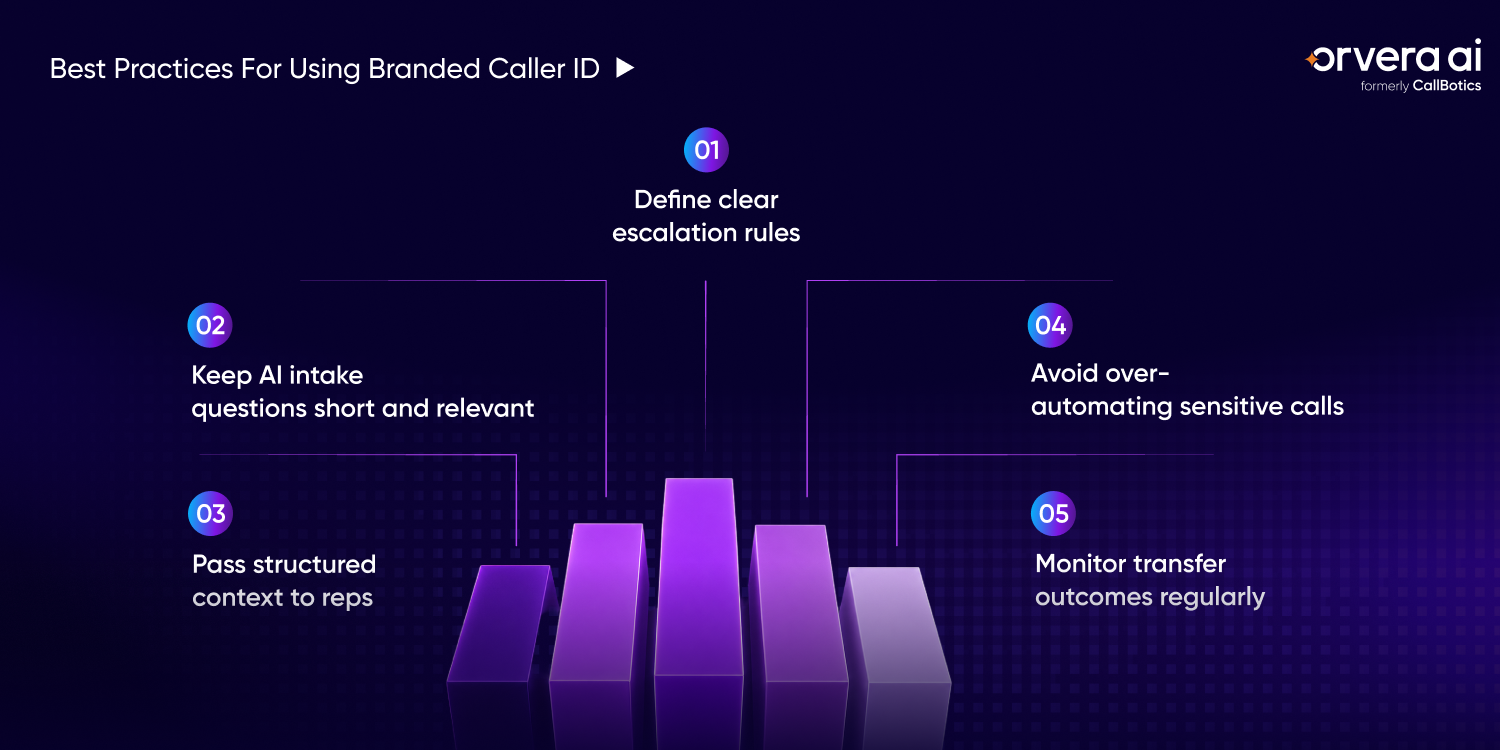
Define clear escalation rules
The AI voice agent should know exactly when a call needs a human rep. Complex issues, angry customers, compliance topics, refunds, cancellations, and high-value opportunities should not sit too long in an automated flow. Clear rules also protect the rep from receiving a difficult call with no warning. They also make escalation decisions consistent across shifts, teams, and call types. Without clear rules, the same issue may be handled differently depending on who designed the flow or which team receives the call.
- Escalation rules should name the call types that need human judgment
- Sentiment should matter, because an upset customer may need a rep sooner
- The AI voice agent should transfer before the customer has to repeat, push back, or ask multiple times for help
Keep AI intake questions short and relevant
The AI voice agent should ask only the questions needed to route or resolve the call. If the intake feels like a long form, the customer may lose patience before the transfer even happens. Every question should earn its place in the conversation. If a question will not help the rep or the routing decision, it should not be asked. Short intake also helps customers stay engaged long enough to complete the handoff.
- Ask for the reason for the call, required verification, urgency, and any detail the rep needs next
- Avoid collecting information that the receiving rep will not use
- Keep the conversation moving when it is already clear that a human rep is needed
Pass structured context to reps
A warm handoff only works if the receiving rep gets clear context before speaking with the customer. The AI voice agent should pass a short summary, intent label, customer details, sentiment signal, and recommended next action. The context should be organized so the rep can read it in seconds. A clean handoff can lower the pressure on the rep before the customer even speaks. The rep should not have to search through raw notes to understand what the customer needs.
- The summary should explain why the customer called and what has already happened
- Intent labels help the rep understand whether the issue is billing, support, cancellation, sales, or another need
- Recommended next actions help the rep continue the call instead of starting discovery again
Avoid over-automating sensitive calls
Some calls need a person quickly. Emotional, urgent, legal, compliance-sensitive, or high-risk calls should not be forced through a long AI flow when the customer needs human judgment. The AI voice agent should recognize when staying automated creates more risk than value. In these moments, speed to the right human rep matters more than completing the AI flow (opens in a new tab). The transfer should happen before the customer feels they have to fight the system to reach a person.
- Angry or distressed customers should be escalated before the call gets harder to recover
- Refunds, cancellations, legal topics, and account-risk issues should follow clear human handoff rules
- A shorter AI path is better when the safest next step is a trained rep
Monitor transfer outcomes regularly
Teams should review whether AI-powered transfers are actually helping customers reach the right person faster. If calls keep landing with the wrong team, repeating escalation, or ending unresolved, the workflow needs tuning. The review should focus on patterns, not isolated bad calls. Those patterns show where the AI voice agent needs better instructions, better routing logic, or better handoff summaries. This also gives supervisors a practical way to improve the workflow without rewriting the whole call path.
- Track whether transfers reach the correct rep or department on the first handoff
- Review whether customers get resolved faster after the AI voice agent passes context
- Use failed transfers to improve routing rules, escalation triggers, intake questions, and handoff summaries
How Orvera Helps Businesses Perfect AI-Powered Warm Transfers
Orvera AI helps enterprises make warm transfers more useful by handling the work that usually breaks between intake and handoff. Orvera’s AI voice agents can understand why the customer is calling, collect the right details, summarize the conversation, route the call, and prepare the human rep before they join. This gives the handoff a clear path instead of leaving the next rep to piece the call together. The goal is to make every transfer feel prepared, even when the call moves across teams.
The result is a cleaner AI-to-human handoff. The customer does not have to restart the conversation, and the rep gets the context they need to move the call forward. That matters most when the customer is already frustrated or the issue has touched more than one team. It also helps the contact center keep service quality more consistent across high-volume periods.
Intent-aware call routing
Orvera identifies the customer’s intent before the call moves to another team. Instead of routing only by a menu choice, the AI voice agent listens for the real reason behind the conversation, such as billing, support, cancellation, account help, or a complaint. This helps the routing decision match the actual issue, not just the option the customer selected. That makes the first handoff more likely to be the right handoff.
This helps reduce wrong-team transfers. When the call is routed by intent, the customer has a better chance of reaching the rep or department that can actually handle the issue. Fewer wrong transfers also means less time lost for both the customer and the contact center team. It also reduces the pressure on teams that receive calls they are not equipped to solve.
AI-generated call summaries
Orvera gives human reps concise call summaries before or during the transfer. The summary can include why the customer called, what the AI voice agent collected, what has already happened, and why a human rep is needed. The summary should give the rep enough context to act without reading through the full conversation. A good summary also helps the rep understand the customer’s tone before they speak.
That makes the handoff easier to use in the moment. The rep does not have to scan a long transcript while the customer waits, and the customer does not have to explain the same issue again. The first response from the rep can then start with the next step, not another round of questions. That first response is where the customer can immediately tell whether the transfer worked.
Sentiment-based escalation
Orvera helps detect signals such as frustration, urgency, confusion, or churn risk during the conversation. When the call shows signs that it needs human judgment, the AI voice agent can route it to the right human rep. That helps sensitive calls move faster before the customer’s patience drops further. The escalation can happen because the conversation needs care, not because the flow has run out of steps.
This is important for sensitive calls. An upset customer, a high-risk account, or a complex issue should not stay in an automated flow longer than necessary. In those moments, the right handoff can protect the relationship as much as it protects the resolution. It also gives the receiving rep a clearer reason for why the call was escalated.
CRM and helpdesk context sync
Orvera can connect call context with customer records, tickets, account details, and previous interactions. That gives the handoff more value because the rep sees the customer’s history along with the current issue. The rep can understand what has already happened before asking the customer anything new. This is especially useful when the customer has open tickets or recent account changes.
This reduces the gap between what the business already knows and what the rep sees on the call. When customer context is available in one place, the rep can spend less time searching and more time helping. It also lowers the chance of giving an answer that ignores a previous ticket or account update. The handoff becomes stronger because the rep is working from the same record as the business.
Better rep readiness
Orvera prepares reps before they answer by passing customer details, issue summary, conversation history, and recommended next steps. The rep starts with the context already attached instead of asking the customer to repeat basic information. That gives the rep a stronger opening and a clearer path into the conversation. It also helps new or busy reps handle transferred calls with more confidence.
This helps the call feel more connected. The customer hears a rep who already understands the situation, and the rep can move faster toward resolution. For busy teams, that readiness can make difficult transfers easier to handle during peak call volume. Prepared reps can spend more energy solving the issue and less energy reconstructing the conversation.
Conclusion
AI voice agents make warm transfers stronger by doing the work that usually gets lost before the handoff. They can understand why the customer is calling, collect the right details, summarize the conversation, and route the call based on intent, urgency, and context. That gives the receiving rep a clearer starting point and gives the customer a better chance of reaching resolution without repeating themselves. It also helps contact center teams keep handoffs more consistent across different queues, shifts, and call types.
The goal is not to transfer calls faster for the sake of speed. The goal is to transfer the customer to the right human rep, with the right context, at the right time, so the conversation continues without making the customer start over. When that handoff works, the transfer feels less like a delay and more like the next step toward solving the issue. That is what turns a transfer from a customer pain point into a smoother part of the service experience.
Frequently asked questions
A warm transfer is a call handoff where the receiving rep gets context before speaking with the customer. This helps the conversation continue without making the customer repeat the same issue.
AI voice agents can understand caller intent, collect key details, summarize the conversation, and route the call to the right rep or department. This makes the handoff faster, clearer, and easier for the receiving rep to act on.
A cold transfer sends the customer to another rep or queue without context. A warm transfer passes the customer along with the reason for the call, previous steps, and relevant details.
Yes, AI voice agents can escalate calls to human reps when the issue is complex, emotional, sensitive, or outside the approved workflow. The human rep can receive the call with context already attached.
Orvera helps automate call intake, identify intent, create call summaries, route calls, and prepare reps before they answer. This helps enterprises make AI-to-human handoffs smoother and more useful for both customers and reps.

Written by
Anindita Majumder
Anindita Majumder is a communications professional with nearly four years of experience in public relations, corporate communications, and journalism. She creates content that helps brands communicate their vision, products, and expertise through press releases, thought leadership, and editorial pieces. Outside of work, she is a vocalist, which keeps her creativity flowing.