Best AI Voice Agents for Business in 2026
Nine AI voice agents for business compared on features, integrations, scalability and fit, with what each one does well and where it falls short.


Key highlights
TL;DR – Quick Summary
- AI voice agents provide businesses with a scalable, cost-effective, and always-available way to handle customer calls.
- In 2026, top AI voice agents include Orvera, VoiceSpin, Lindy, Synthflow, VAPI, Poly AI, Google, Cognigy, Talkdesk, and Vonage.
- When comparing these solutions, it is crucial to evaluate NLP accuracy, CRM integrations, scalability, and analytics capabilities.
- Orvera stands out for its smart routing, real-time sentiment detection, and ability to deliver human-like conversations at enterprise scale.
Handling customer calls efficiently is a growing challenge for businesses, as call volumes rise and customers demand faster, more personalized service. AI voice agents are emerging as a game-changing solution, capable of answering questions, managing concurrent calls, and assisting human agents, while sounding natural and approachable.
Organizations are rapidly adopting these agents, and Accenture’s 2024 report reveals that 74% of investments (opens in a new tab) in generative AI agents meet or exceed expectations, with 63% planning to increase spending by 2026. In this article, we'll explore the best AI voice agents for business, how they work, and how they can enhance efficiency, reduce missed calls, and improve customer satisfaction.
What Are AI Voice Agents?
AI voice agents are software systems that use artificial intelligence to interact with users through natural spoken language. They utilize advanced technologies such as natural language processing, speech recognition, and machine learning to understand and respond to voice commands in real time.
Compared to traditional voice assistants, AI voice agents offer more context-aware, adaptive, and multifunctional support, making them integral across industries such as customer service, healthcare, retail, and telecommunications.
While AI voice agents, IVR systems, and chatbots all aim to assist users, they differ in their capabilities and interactions. The table below shows the key differences.
| Feature | AI Voice Agents | IVR Systems | Chatbots |
|---|---|---|---|
| Interaction Mode | Voice-based, natural language | Phone-based, menu-driven | Text-based, often scripted |
| Adaptability | Learns and adapts to user behavior | Follows predefined scripts | Limited to programmed responses |
| Use Cases | Customer support, appointment scheduling | Basic inquiries, call routing | FAQs, online support, and basic lead qualification |
| Technology | AI, NLP, machine learning | Pre-recorded prompts, DTMF input | Rule-based or AI-driven |
AI voice agents perform several key functions that enhance user experience and operational efficiency:
- Natural language understanding (NLU): Enables the agent to comprehend and interpret user inputs accurately, facilitating meaningful conversations.
- Speech recognition: Converts spoken language into text, allowing the system to process and respond to voice commands effectively.
- Text-to-speech (TTS): Generates human-like speech from text, providing natural and engaging responses to users.
- Context management: Maintains the context of conversations over multiple interactions, ensuring continuity and relevance in responses.
- Task automation: Handles routine tasks such as scheduling, data retrieval, and information processing, freeing up human agents for more complex issues.
- Multilingual support: Offers assistance in multiple languages, broadening accessibility and user reach.
- Sentiment analysis: Detects user emotions from voice tone and speech patterns, enabling empathetic, appropriate responses.
In fact, the AI voice agents market reached $2.4 billion in 2024 and is projected to hit $47.5 billion by 2034 (opens in a new tab). This growth is driven by increasing demand for intelligent voice-based interfaces across customer service, healthcare, retail, banking and finance, and smart devices, alongside improvements in natural language understanding and real-time speech synthesis.
For example, Verizon reported a nearly 40% increase in sales (opens in a new tab) after deploying a Google AI assistant to aid its customer service representatives. This integration helped reduce call times and allowed agents to focus more on sales, demonstrating the tangible benefits of AI voice agents in enhancing business outcomes.
As organizations continue to recognize the value of AI voice agents, the next logical step is to explore the specific benefits they bring to businesses.
Benefits of AI Voice Agents in Business
AI voice agents are rapidly transforming how businesses interact with customers, offering a range of advantages that go beyond traditional methods. Let's explore some of the key benefits:
24/7 availability & reduced wait times
AI voice agents operate continuously, providing customers with immediate assistance at any time. This constant availability ensures that customers can receive support outside of traditional business hours, leading to increased satisfaction.
A recent study highlighted that smart triage systems using AI to categorize and route inquiries have improved resolution times by 35% (opens in a new tab), while AI-assisted human support has increased first-call resolution rates by 28%. This demonstrates how AI can deliver faster, more reliable support around the clock.
Scalability & cost savings
Implementing AI voice agents allows businesses to scale their operations without a proportional increase in costs. These systems can handle a high volume of interactions simultaneously, reducing the need for additional human agents.
For example, a Texas clinic used Orvera's AI voice agents to clear 61% of 1,200 pending requests in nine days, speeding turnaround by 70% and recovering $58,000. Businesses can also cut wait times, triple response speeds during peaks, and reduce costs in call-heavy operations.
Consistency in customer experience
AI voice agents provide uniform responses, ensuring that customers receive consistent information and service quality.
This consistency helps in building trust and reliability with customers, as they can expect the same level of service every time they interact with the system.
Data-driven insights & analytics
AI voice agents collect and analyze data from customer interactions, providing businesses with valuable insights into customer preferences and behaviors.
According to Gartner, 75% of new analytics content (opens in a new tab) will be contextualized for intelligent applications through generative AI by 2027, enabling businesses to make informed decisions based on real-time data.
Easy CRM/ERP integrations
AI voice agents can seamlessly integrate with existing customer relationship management (CRM) and enterprise resource planning (ERP) systems, streamlining workflows and improving efficiency.
For example, Orvera AI voice agents (opens in a new tab) are pre-integrated with the most widely used tech stacks to handle real-time calls, automatically logging transcripts and meeting bookings, saving time for sales teams.
Common Challenges With AI Voice Agents
Implementing AI voice agents can bring significant benefits, but organizations must also be aware of the challenges they may face. These include:
- Accuracy issues: AI voice agents often struggle to understand diverse accents, dialects, and background noise, leading to misinterpretations. A study by the European Broadcasting Union and the BBC found that nearly half of AI assistant responses contained significant errors (opens in a new tab), including 45% with sourcing issues and 20% that provided outdated or inaccurate information.
- Robotic experience: Despite advancements in natural language processing, AI voice agents can still sound mechanical and lack the warmth of human interaction. This robotic tone can make conversations feel impersonal and may deter customers from engaging fully with the system.
- Integration barriers: Integrating AI voice agents with existing systems, such as CRM or ERP platforms, can be complex and time-consuming. Many businesses struggle to achieve seamless integration, which can hinder the effectiveness of AI agents and delay their deployment.
- High setup costs: The initial investment for developing and implementing AI voice agents can be substantial. Costs can range from $5,000 to $60,000 (opens in a new tab), depending on the complexity and customization required. Additionally, ongoing maintenance and updates increase total expenditure, making it a significant financial commitment for many organizations.
Top AI Voice Agents for Business in 2026
Despite the challenges we discussed earlier, many organizations are still adopting them, and checking out the 9 best AI voice agents for business in 2026 can help them find the solution that truly fits their needs.
1. Orvera
Orvera delivers human-like AI voice agents designed to resolve complex calls end-to-end. Built on 17 years of deep voice operations experience across industries, the platform reflects strong operator DNA. These AI voice agents integrate into enterprise environments and can typically go live in 3 to 6 weeks. The platform handles around 80% of complex calls without transfers or drop-offs, enabling autonomous outcomes while reducing operational costs by more than 65-90% and speeding up task handling by over 60%.
It excels at layered, compliance-heavy conversations, making it a fit for industries where accuracy and regulatory compliance are critical. Its AI agents go beyond scripts and FAQs to true end-to-end call resolution. Businesses can stand up new call flows in 3 to 6 weeks, supported by white-glove implementation run by the Orvera team to ensure fast rollout and real-world readiness.
Orvera integrates with popular tech stacks, enabling enterprises to connect their systems with minimal friction. The platform also prioritizes governed, empathetic automation designed to minimize risks such as hallucinations and deliver clear, trustworthy responses. With built-in quality management and analytics, Orvera is SOC 2 Type II certified, HIPAA compliant and GDPR compliant.
Key features
- Smart Routing: Improve call efficiency by automatically directing conversations to the right agent
- Sentiment Detection: Detect customer emotions to adjust responses appropriately and maintain engagement
- Inbound/Outbound Automation: Streamline repetitive tasks with AI handling calls in both directions
Pros
- Rapid Integration: Connect AI agents to enterprise systems with minimal setup time
- High Accuracy: Resolve complex, compliance-heavy conversations without human intervention
- Operator DNA: Built on 18+ years of real-world contact center operations
- Quality & Analytics: Built-in quality and analytics provide real-time insights to continuously improve outcomes
- White-Glove Implementation: Hands-on implementation and ongoing support to configure workflows
Cons
- Best suited to enterprise and BPO operations. Developer teams wanting a self-serve API are served better elsewhere
2. VoiceSpin
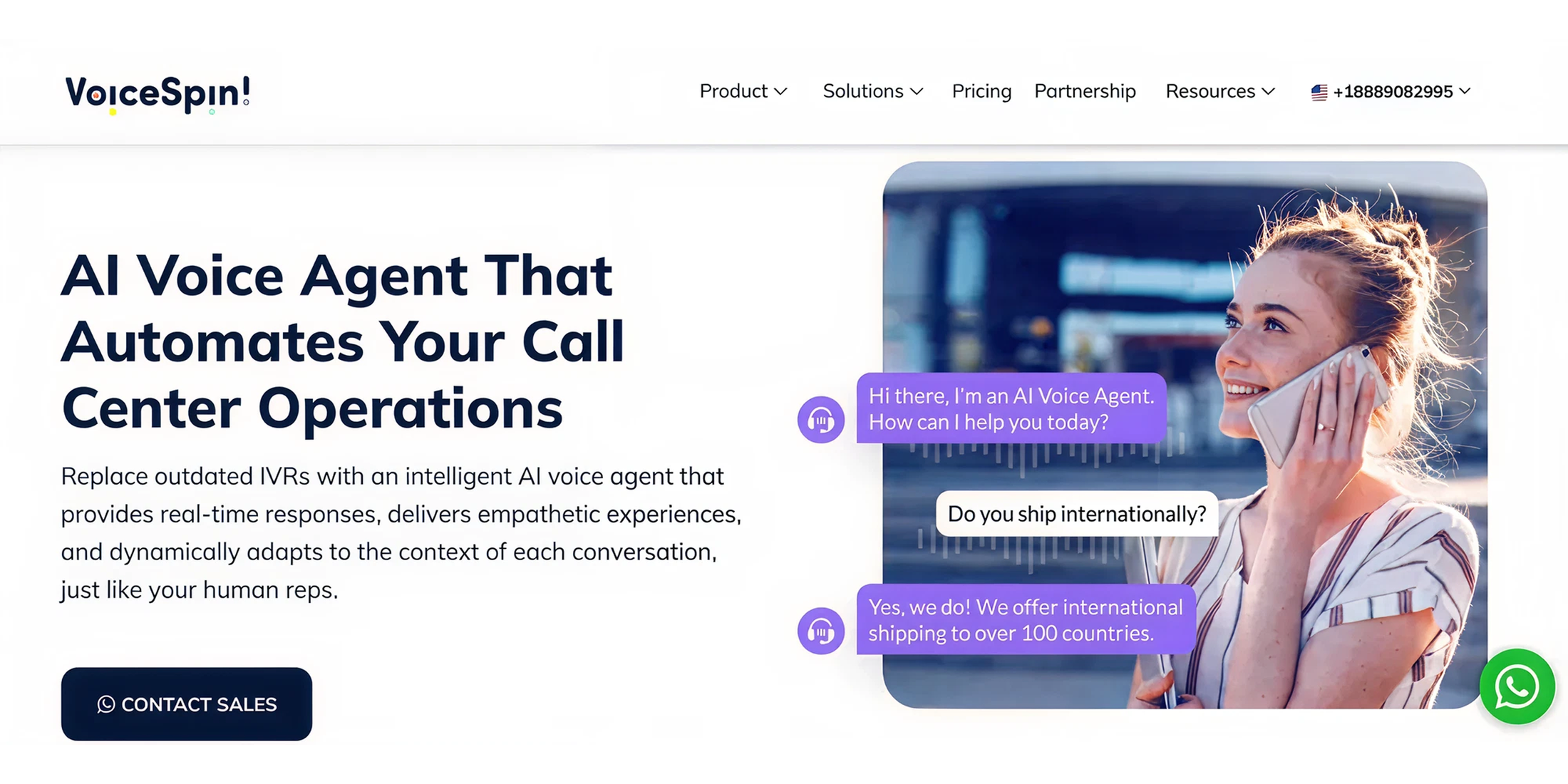
VoiceSpin offers an AI voice agent that automates call center operations while delivering empathetic and context-aware responses. It replaces outdated IVR systems, handles support, sales, appointments, reminders, and donor outreach with human-like efficiency.
The platform can process hundreds of simultaneous calls, integrate with CRM and back-end systems, and train on documents or web data using RAG technology. Its AI voice agent communicates in hundreds of languages while scaling operations to reduce support costs.
Key features
- Outbound Tools: Automate cold calls and follow-ups to engage prospects efficiently
- Predictive Dialing: Maximize connection rates by prioritizing high-potential leads automatically
- Speech Analytics: Analyze every call for quality assurance and team performance tracking
Pros
- Round-the-Clock Support: Provide customers with instant assistance at any time of day
- Lead Qualification: Automatically screen inbound calls and pass only qualified leads
- Scalable Operations: Handle hundreds of simultaneous calls without increasing staff workload
Cons
- The platform is expensive for small businesses or startups
3. Lindy
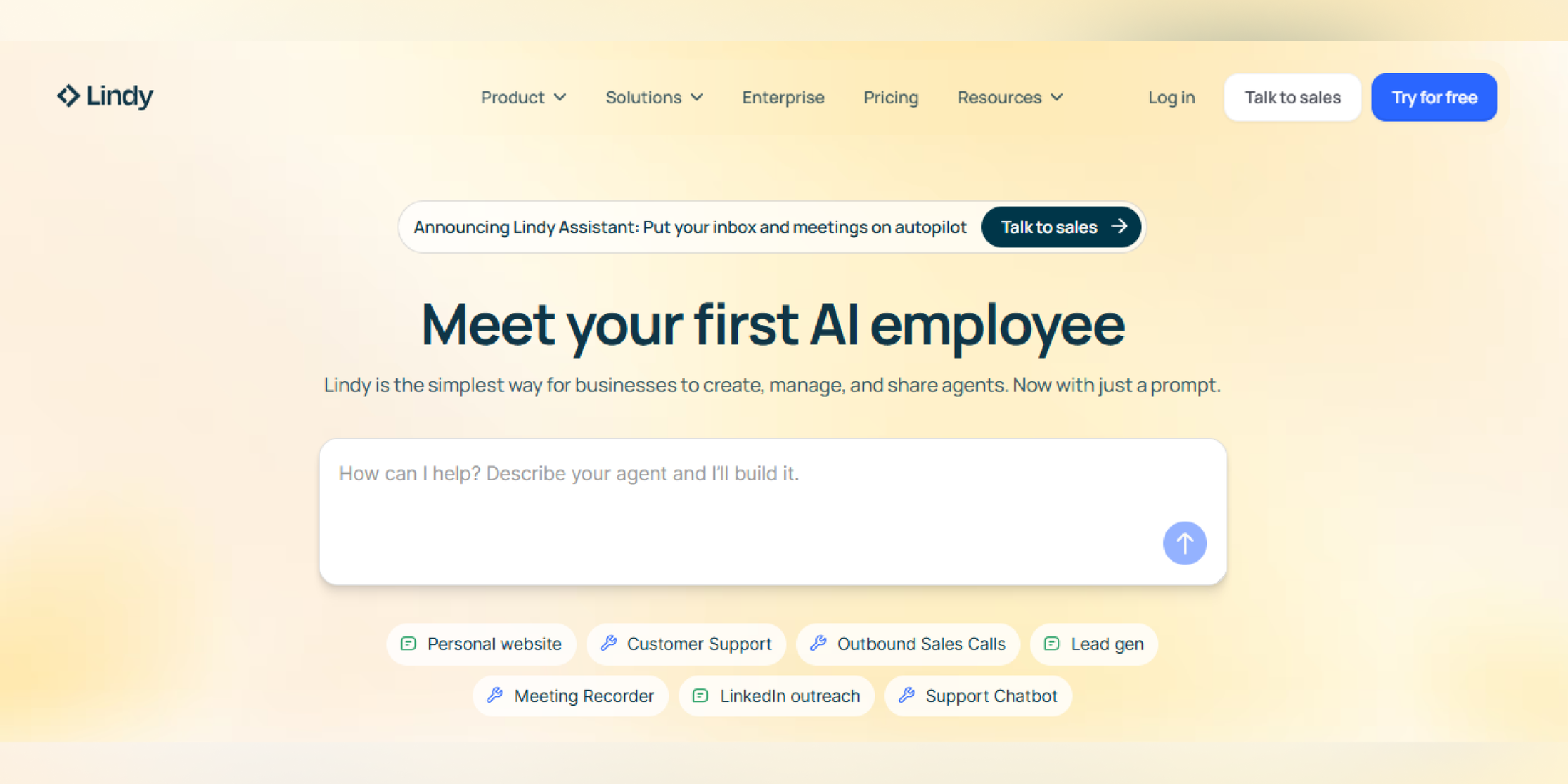
As an AI voice agent, Lindy makes and receives real phone calls while sounding like a human. You can assign it tasks, provide a list of numbers, and it will call each person, ask questions, listen carefully, and summarize responses automatically. Lindy logs conversations, updates databases, and shares summaries via Slack.
The drag-and-drop flow allows full customization without coding. It can run multiple calls simultaneously, handling conversations efficiently while keeping your team informed.
Key features
- Scheduling: Automate call timings and ensure every contact is reached efficiently
- Task Automation: Assign follow-ups and next steps for each call automatically
- Conversation Logging: Record and summarize all interactions for team review and tracking
Pros
- Human-Like Voice: Deliver realistic and natural conversations that engage contacts effectively
- Multi-Call Handling: Run several calls at the same time without conflicts
- No Coding Needed: Build flows and customize actions easily using drag-and-drop
Cons
- Limited integrations with external CRMs
4. Synthflow
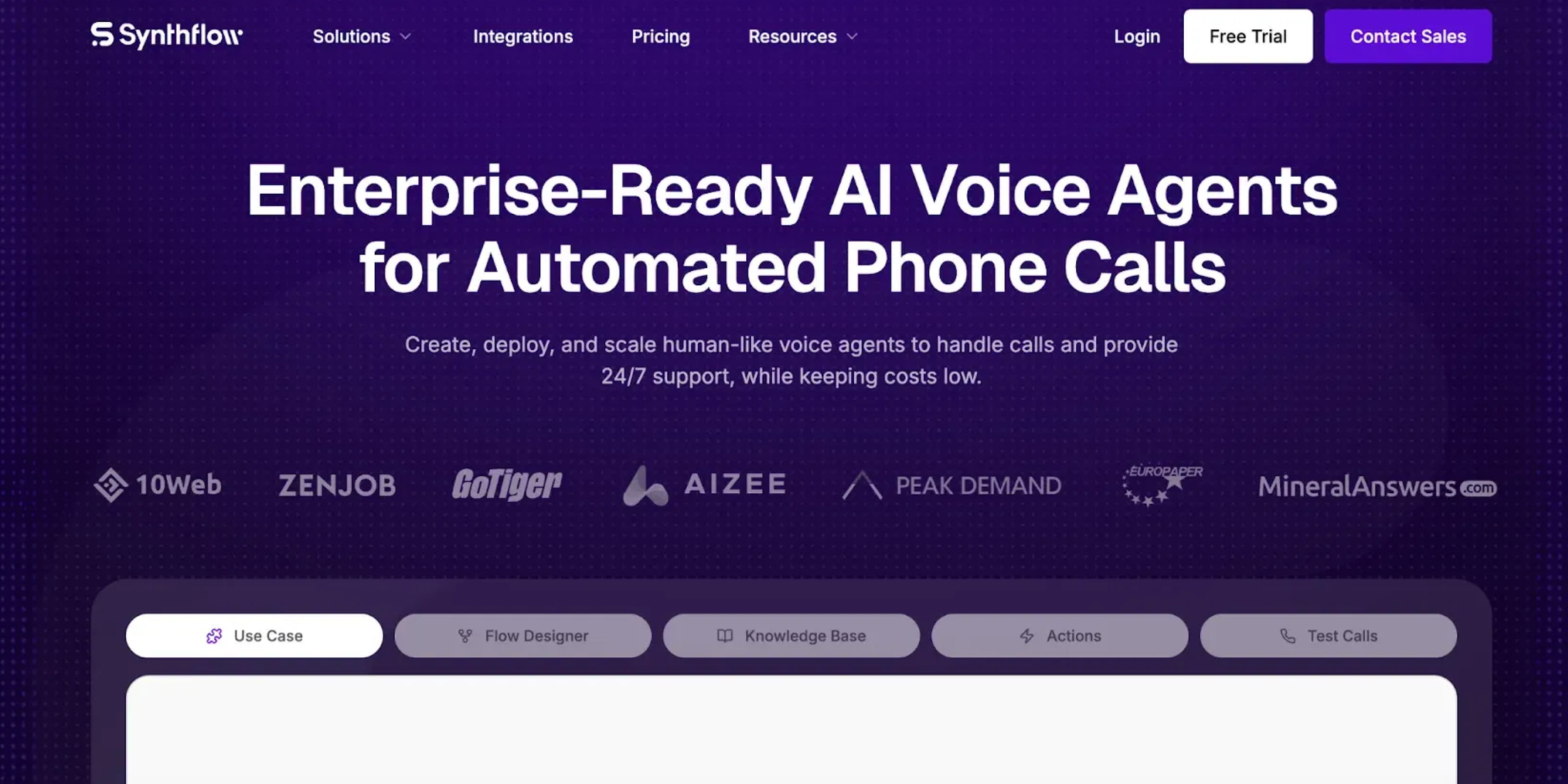
Synthflow AI enables you to create lifelike voice agents without writing a single line of code. The platform offers flexible control over call logic and advanced workflow customization.
It also integrates seamlessly with tools like Salesforce, HubSpot, and Calendly, making task automation easier for teams.
Key features
- Drag-and-drop builder: Design call flows visually, managing logic without technical expertise
- Multilingual support: Communicate fluently in over 50 languages, including regional accents and dialects
- Zero-latency audio: Enjoy ultra-fast, human-like conversations with minimal delay
Pros
- CRM integrations: Sync leads, bookings, and contacts effortlessly with scheduling tools and CRMs
- Real-time analytics: Monitor agent performance with live reporting across all interactions
- Automated lead handling: Qualify leads, schedule meetings, and answer common questions without human intervention
Cons
- The main interface can feel clunky, with some features difficult to locate
5. VAPI
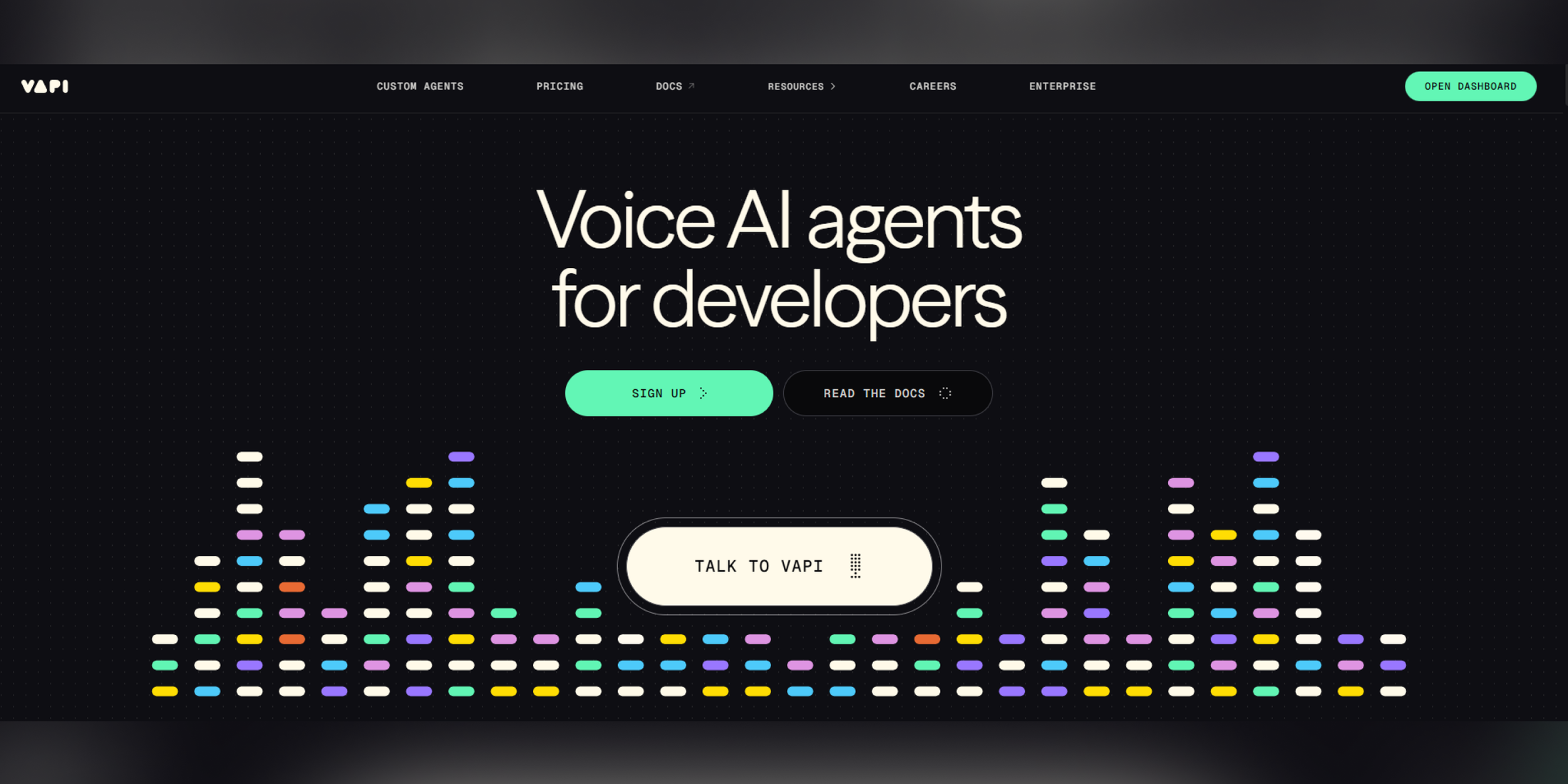
VAPI lets developers build custom voice agents that scale quickly while giving full control over every interaction. API-native and compatible with any tech stack, it supports over 200 models or lets you bring your own.
Agents respond in under 500ms, handle natural conversation with human-like voices, and integrate with your internal tools and APIs. Teams can tune, test, and monitor performance in real time without compromising flexibility or reliability.
Key features
- Developer-First API: Control every part of your voice AI agent through API access directly
- Multilingual Support: Communicate with users in over 100 global languages effortlessly
- Automated Testing: Run simulated agent tests to catch errors before going live
Pros
- Bring Your Models: Use your own API keys or self-hosted models for processing
- Tool Calling: Connect APIs to fetch live data and perform backend actions
- A/B Tests: Compare voices, prompts, and flows to improve agent performance continuously
Cons
- Pricing requires contacting the team for a custom quote
6. Poly AI
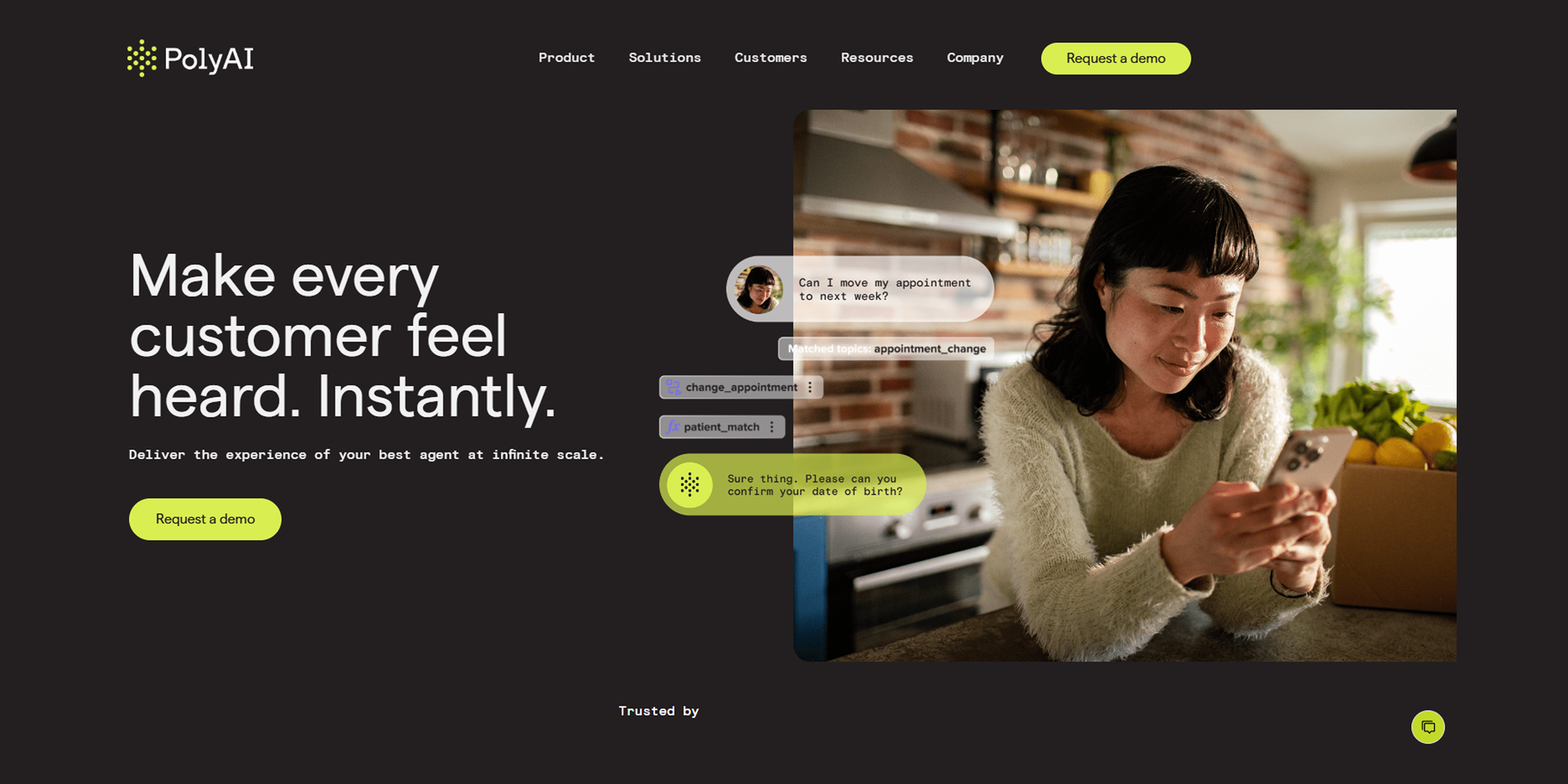
Poly AI offers a voice-first omnichannel platform that delivers lifelike, brand-consistent AI voice agents for enterprise customer engagement. The platform provides access to purpose-built speech recognition models, custom LLM adapters, and controllable function calls to ensure accuracy and reliability.
Users can rapidly test, optimize, and A/B test agent behaviors and conversations. Poly AI also integrates seamlessly with existing technology stacks, allows for real-time insights analysis, and can scale globally to handle high-volume interactions across voice, chat, SMS, and social channels.
Key features
- Conversational AI: Build and optimize AI agents for natural, human-like interactions with customers
- Natural Voices: Deliver conversations that sound authentic and align with brand personality
- Omnichannel Support: Manage voice, chat, SMS, and social interactions consistently across channels
Pros
- Human-like CX: Provide realistic and engaging conversations that enhance customer loyalty
- Scalable Automation: Handle enterprise-level conversation volumes efficiently without sacrificing quality
- Data Insights: Analyze interactions in real time to improve operations and strategy
Cons
- Poly AI's premium pricing (opens in a new tab) may be difficult for small businesses
7. Cognigy
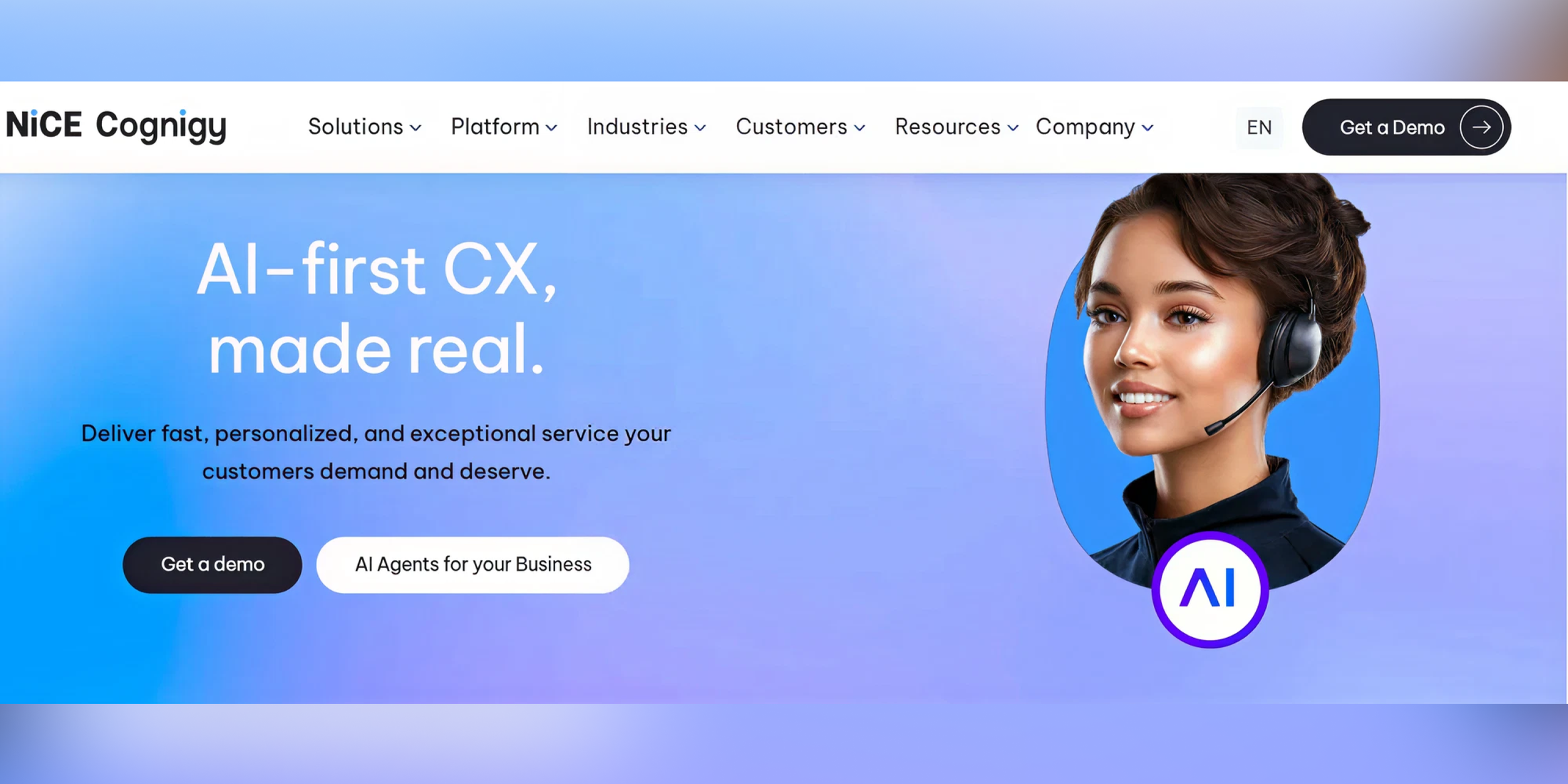
Cognigy voice AI agents deliver empathetic, scalable phone interactions designed to enhance the customer experience. Powered by conversational and generative AI, these agents understand natural language, prioritize call routing, and resolve issues efficiently. They support 24/7 self-service while escalating complex queries to live agents with full context.
The AI voice agents can also engage proactively through outbound calls, personalized offers, and sentiment-aware responses. The platform handles over 100 languages, integrates multimodal interactions, and provides 360° insights into customer journeys, enabling continuous optimization and enterprise-grade reliability.
Key features
- Enterprise Automation: Streamline workflows and route calls efficiently to optimize customer experiences
- Multilingual Support: Communicate with customers in over 100 languages for global reach
- Proactive Engagement: Deliver outbound follow-ups and personalized offers to improve satisfaction
Pros
- Empathetic CX: Provide natural, lifelike conversations that build meaningful customer connections
- 24/7 Support: Enable round-the-clock self-service to reduce wait times significantly
- Advanced Insights: Analyze interactions to optimize routing, sentiment, and service quality
Cons
- Overkill for SMBs with smaller call volumes
8. Talkdesk AI
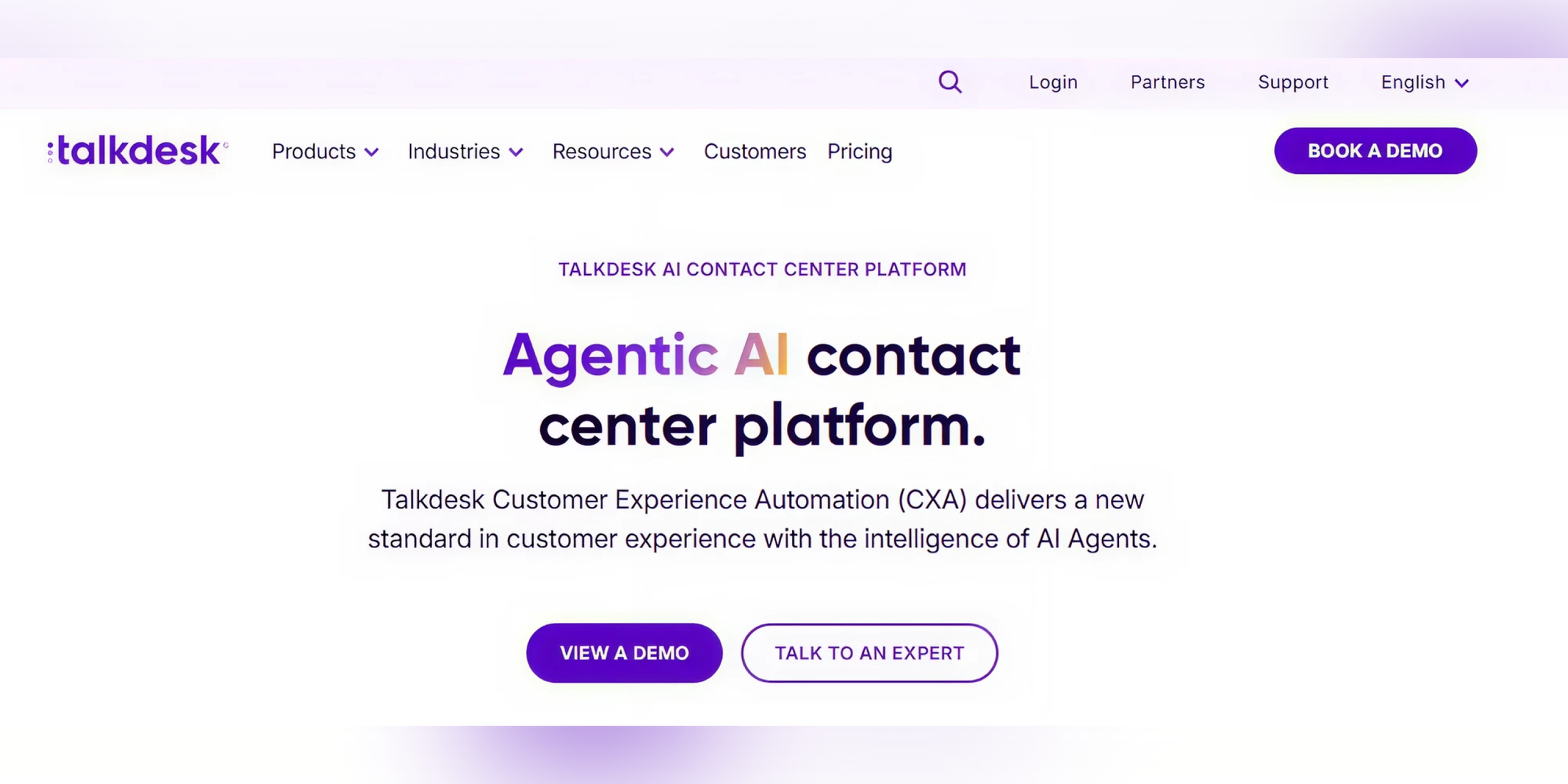
Talkdesk AI leverages multi-agent orchestration to automate complex customer workflows seamlessly. Powered by Customer Experience Automation (CXA), its specialized AI agents autonomously plan, coordinate, and execute tasks across voice, digital, and email channels without losing context.
The platform supports multilingual conversations in more than 59 languages, analyzes unstructured data, and enables adaptive, context-aware interactions. Pre-built industry automations, real-time dashboards, and seamless human-agent handoffs ensure scalable and secure customer experiences that continuously improve through data-driven insights.
Key features
- Analytics-Driven AI: Analyze interactions and optimize performance using real-time dashboards and insights
- Multi-Agent Coordination: Orchestrate AI agents to handle complex workflows without manual handoffs
- Omnichannel Support: Enable seamless voice, digital, and email interactions without losing context
Pros
- Autonomous Agents: Deploy AI agents that independently plan and execute tasks efficiently
- Multi-Lingual CX: Communicate with customers in 59+ languages for global reach
- Continuous Optimization: Improve customer journeys using data-driven insights and adaptive learning
Cons
- High pricing limits accessibility for smaller organizations
9. Vonage AI
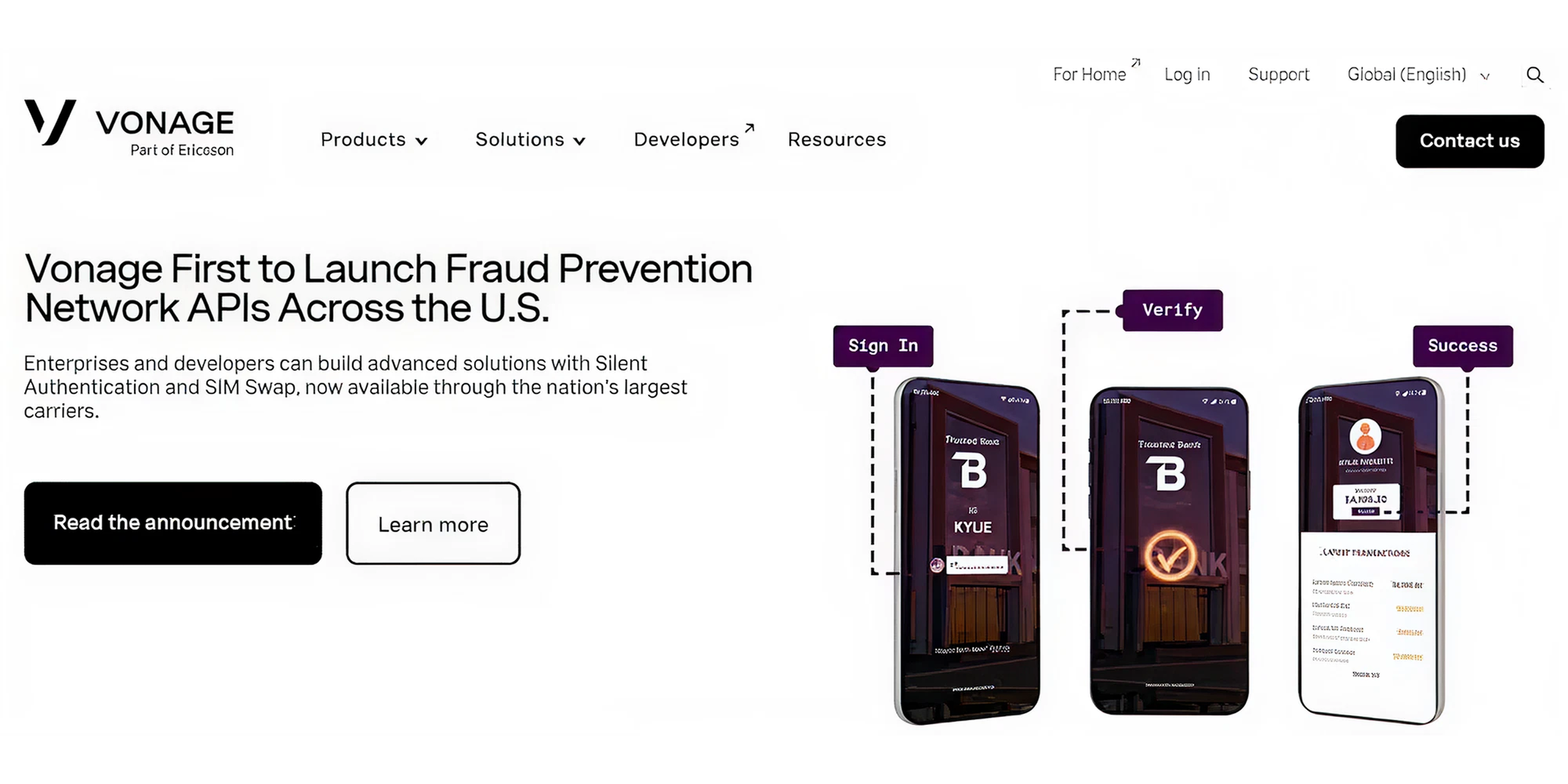
Vonage AI empowers businesses to build AI voice agents that deliver human-like, natural conversations. Using voice recognition, natural language processing, and ML, these AI agents can handle FAQs, troubleshoot issues, process orders, and schedule appointments without human intervention.
The platform also provides no-code deployment, CRM integrations, multi-channel support, and advanced analytics to track performance.
Key features
- APIs & Integrations: Connect AI agents with CRMs and third-party systems for seamless workflows
- Voice Automation: Automate calls and responses to reduce wait times and improve satisfaction
- Analytics Insights: Track and analyze interactions to optimize customer experiences and performance
Pros
- Easy Implementation: Deploy AI voice agents quickly with no coding required
- Enhanced Engagement: Improve customer satisfaction with natural, human-like interactions
- Scalable Operations: Adjust the number of AI agents to meet business demand
Cons
- Limited customization options for highly specific workflows
Comparison Table: Best AI Voice Agents for Business
Here’s a quick glance at the pricing and key features of the best AI voice agents for businesses in 2026:
| Tool Name | Key Features | Pricing |
|---|---|---|
| Orvera | Pre-trained AI voice agents - Around 80%+ resolution rate - 3 to 6 week deployment - High compliance support | Custom pricing |
| VoiceSpin | Seamless CRM integration - Multilingual support - RAG-based training - Predictive dialing | Starts at $300/month for 5 agents |
| Lindy | Multi-call handling - Conversation logging - Task automation - Human-like voice | Starts at $49.99/month for 30 phone calls |
| Synthflow AI | Drag-and-drop builder - 50+ languages - CRM integration - SIP trunking support | Starts at $29/month for 50 mins |
| VAPI AI | API-native control - <500ms latency - 100+ language support - BYO models - White-labeling via VoiceAIWrapper | Pay As You Go and Enterprise (Custom pricing) |
| Poly AI | Advanced conversational AI - Multilingual support - Scalable Automation - Omnichannel support | Custom pricing |
| Cognigy | Enterprise-grade automation - 100+ language support - Multimodal interactions - Multi-agent coordination | Custom pricing |
| Talkdesk AI | Multi-agent orchestration - CXA platform - 59+ language support - Analytics-driven AI | Starts at $85/month per user |
| Vonage AI | Voice API - No-code AI Studio - Multilingual support | Starts at $1,100/month for 100 agents |
How to Choose the Best AI Voice Agent for Your Business
Selecting the right AI voice agent for business can feel overwhelming because of the number of options available. Every provider claims to offer accuracy, natural interactions, and fast setup, but the best choice depends on what your organization truly needs.
To make the process simpler, you should focus on these key aspects before making a decision:
- Pricing: You must carefully assess the pricing structure, as subscription fees and usage costs vary across providers, and decide your AI voice agent budget (opens in a new tab). Some charge per call or minute, while others offer fixed monthly plans, which can significantly impact your annual budget as your call volume grows.
- Features: Look for AI voice agents that support features like natural language understanding, multilingual support, and real-time analytics. These features determine how effectively the system can handle diverse customer interactions and improve satisfaction rates.
- Integrations: Your chosen AI voice agent for business should integrate smoothly with your CRM, ERP, and other existing software. This connection allows your teams to maintain data continuity and avoid disruptions during customer calls.
- Scalability: A good AI voice agent must adapt as your business expands. The system should handle growing call volumes and new use cases without requiring extensive reconfiguration.
- Security and compliance: Data privacy should remain a top priority, especially when handling customer information. Verify that your AI provider follows compliance standards such as GDPR and HIPAA to protect sensitive data.
- Customer support: Reliable technical support can make a significant difference when issues arise. Choose providers that offer 24/7 assistance and regular software updates to maintain consistent system performance.
Why Orvera Stands Out
Orvera is built with real-world voice operations experience that translates into results.
This platform was designed for deep, meaningful conversations that drive outcomes across industries. Here is what sets it apart:
- In-depth industry expertise: Built on 18+ years of hands-on contact center operations experience, Orvera reflects real-world workflows. The platform's deep domain foundation helps businesses manage complex calls confidently while maintaining accuracy and empathy in every interaction.
- End-to-end call resolution: Human-like AI voice agents carry complex calls end to end. Across Orvera customers, first-contact resolution runs around 80% and cost per call falls 65 to 90%.
- Live in 3 to 6 weeks: Orvera AI voice agents can be deployed in 3 to 6 weeks using existing SOPs, call recordings, and documentation. This rapid setup allows teams to start automating complex workflows quickly without long implementation cycles or heavy internal effort.
- Built-In Quality & Analytics Dashboard: The platform includes a built-in quality and analytics dashboard with real-time transcripts, sentiment insights, resolution tracking, and performance metrics. This gives teams clear visibility into call outcomes, automation accuracy, and customer experience without relying on external reporting tools.
- Smart routing that reduces wait times: The system instantly directs calls to the right departments, eliminating unnecessary transfers and reducing wait times. This intelligent routing ensures faster issue resolution and maintains consistently high customer satisfaction levels.
- Real-time sentiment detection: The platform analyzes tone, intent, and emotion to adjust its responses in real time. This emotional awareness helps conversations feel more thoughtful and builds stronger connections with customers.
- Seamless integrations for faster adoption: Orvera integrates smoothly with major CRM and ERP systems, allowing teams to continue using their existing tools. This capability improves visibility across workflows and reduces the time needed to go live.
- Enterprise-grade and compliant: Businesses get infrastructure that is SOC 2 Type II certified, HIPAA compliant, and GDPR compliant. Full enterprise deployment lands in three to six weeks, so companies scale quickly without standing up the build themselves.
Together, these features make Orvera a trusted partner for organizations that want AI voice agents built for precision, empathy, and real-world performance.
Building Better Customer Connections With AI Voice Agents
As businesses continue to modernize communication, adopting the best AI voice agents can create faster, more human-like customer experiences. Companies that invest in intelligent automation gain a lasting advantage through higher call accuracy, improved satisfaction rates, and measurable cost savings.
Tools like Orvera (opens in a new tab) show how reliable automation can manage complex calls, reduce wait times, and maintain genuine conversations that build trust. Organizations looking to grow without compromising quality should explore AI solutions that combine empathy with efficiency.
Ready to transform your voice operations and deliver meaningful customer interactions? Book a personalized demo with Orvera and experience the difference firsthand.
Frequently asked questions
An AI voice agent is a virtual assistant powered by artificial intelligence that handles phone conversations, automates responses, manages queries, and performs repetitive tasks with natural-sounding speech, helping businesses deliver faster, consistent, and more efficient customer interactions.
AI voice agents reduce business costs through automation, allowing companies to handle high call volumes without expanding staff. They minimize training expenses, lower operational overhead, and improve call resolution rates, saving time and money while maintaining consistent customer service quality.
No, AI voice agents are designed to assist rather than replace human agents. They handle repetitive or routine queries efficiently, while human agents focus on complex and emotional interactions that require empathy, critical thinking, and personalized decision-making.
Industries like healthcare, insurance, e-commerce, and telecommunications benefit greatly from AI voice agents. These sectors rely heavily on customer communication, appointment scheduling, payment reminders, and support calls, making automation crucial for improving response speed, accuracy, and overall service efficiency.
Orvera stands out for its human-like voice quality, 3 to 6 week deployment, and around 80%+ complex call resolution. With transparent pricing, tight integration, and enterprise-grade security, it delivers faster deployment and greater accuracy compared to traditional AI voice agent platforms.
Written by
Urza Dey
Urza Dey (She/They) is a content/copywriter who has been working in the industry for over 5 years now. They have strategized content for multiple brands in marketing, B2B SaaS, HealthTech, EdTech, and more. They like reading, metal music, watching horror films, and talking about magical occult practices.