Bland AI Pricing 2026: Plans, Usage Rates and What Drives the Number
Bland AI is a well-known provider of AI voice agents, often used by teams exploring usage-based models and early-stage automation. This article...

Key highlights
TL;DR - Bland AI Pricing in a Nutshell
- AI voice platforms now play a direct role in controlling operating costs, staffing efficiency, and service performance, making pricing structure a critical part of platform selection decisions.
- Bland AI follows a usage-based pricing model where every connected minute, transfer, and add-on contributes to the total cost, which increases steadily as call volume and duration grow.
- While higher Bland AI tiers reduce per-minute rates, overall monthly spend can still fluctuate significantly, making cost forecasting harder for teams with steady or complex call traffic.
- Orvera does the build, the deployment and the integration, then runs the operation, so the team that scopes the work is the team that answers for it.
- Usage-based pricing models tend to work best for pilots, testing phases, or small teams with unpredictable or low call volumes and limited automation requirements.
- Predictable pricing models are better suited for contact centers having recurring, high-volume workflows where cost stability, automation depth, and operational reliability are essential.
As AI voice automation becomes more common in customer service, cost and performance are increasingly intertwined in decision-making. Different platforms offer varying pricing models and levels of operational fit, making it important to understand how each option aligns with call volume, workflow complexity, and long-term scalability.
Bland AI is a well-known provider of AI voice agents, often used by teams exploring usage-based models and early-stage automation. This article outlines Bland AI pricing and compares it with leading alternatives, including Orvera (opens in a new tab), to help you choose the solution that best fits your business needs.
Bland AI Overview
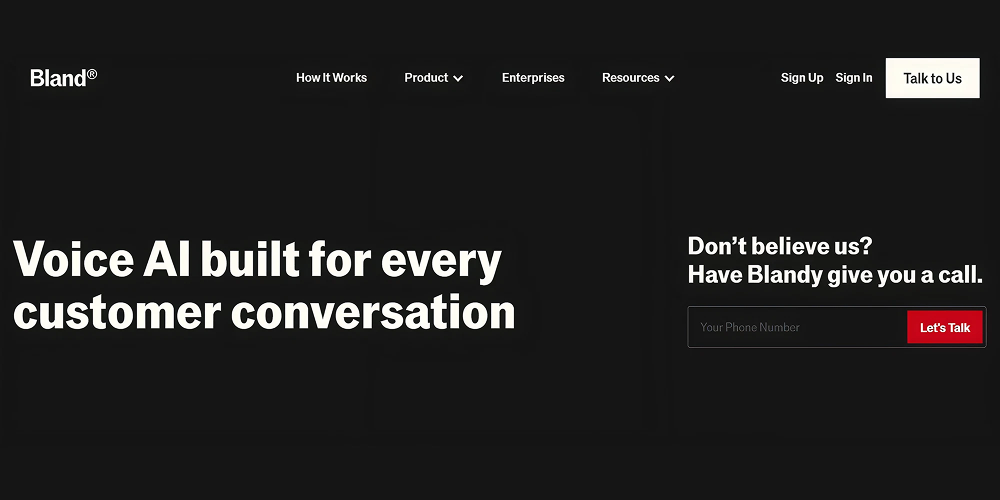
Caption: Deploy Voice AI built for every customer conversation
Bland AI provides an AI-powered voice assistant that manages large volumes of phone calls simultaneously. The platform charges $0.09 per minute (as of January 2026) and includes features such as advanced natural language processing. It also serves as an AI receptionist to simplify and improve customer service operations.
The platform is best suited for enterprise organizations managing high call volumes, with the capacity to place or receive up to 20,000 calls per hour. Some capabilities, including multilingual voice transcription and voice cloning, require additional fees and can raise the total cost.
Bland AI’s Pricing Plans & Rates
Bland AI structures its pricing based on usage, plan tier, and additional features, allowing teams to scale while managing costs. To begin with, it bills customers based on actual resources used across voice calls, SMS, and other interaction types. Enterprise accounts may qualify for custom pricing.
In December 2025, Bland revised its pricing model so that connected minute rates are now tied to plan tiers, with lower rates and higher limits available on higher-tier plans.
This change was made to ensure predictable scaling and clearer value per tier. Customers also receive automatic credits reflecting prior month usage to offset changes in pricing.
Bland AI Pricing Plan package breakdown
Bland AI offers four main pricing plans, each designed to accommodate different call volumes, concurrency needs, and enterprise requirements.
| Plan | Price | Daily Cap | Hourly Cap | Concurrency | Voice Clones | Ideal For |
|---|---|---|---|---|---|---|
| Start | Free | 100 calls | 100 calls | 10 calls | 1 | Small teams or testing |
| Build | $299 | 2,000 calls | 1,000 calls | 50 calls | 5 | Growing teams needing higher volume |
| Scale | $499 | 5,000 calls | 1,000 calls | 100 calls | 15 | Mature teams with heavy call traffic |
| Enterprise | Custom pricing | Unlimited | Unlimited | Unlimited | Unlimited | Large organizations needing custom solutions |
Table Caption: Bland AI pricing plan
The Start plan is free and designed for early testing or very low call volumes. It includes limited concurrency, a single voice clone, and higher per-minute rates.
The Build plan is designed for growing teams that require higher daily call volumes, greater concurrency, and multiple voice clones, while still operating within defined limits.
The Scale plan supports higher-volume operations with expanded call caps, increased concurrency, and lower usage rates, making it more suitable for mature teams with steady traffic.
The Enterprise plan removes standard caps entirely and offers unlimited usage across calls, concurrency, and voice clones.
Bland AI negotiates pricing for this tier directly with customers, making it suitable for large organizations. This is largely because enterprise pricing is negotiable and not fully transparent. As a result, some prospective customers may find the solution harder to approach, particularly when planning budgets upfront.
Additionally, Bland AI’s per-minute rates apply to all active AI conversations and serve as the baseline for calculating total call costs across each plan.
| Plan | Connected Minute Rate | Transfer Time Rate |
|---|---|---|
| Start | $0.14/min | $0.05/min |
| Build | $0.12/min | $0.04/min |
| Scale | $0.11/min | $0.03/min |
Table Caption: Bland AI per-minute pricing across Start, Build, and Scale plans
To show how Bland AI’s pricing works in practice, consider a typical 10-minute customer call. In this scenario, the AI handles 8 minutes of the conversation, and a human agent takes over for 2 minutes through a transfer.
The table below breaks down costs for each plan, factoring in both connected AI time and transfer time.
| Plan | Connected Time (AI – 10 min) | Transfer Time (Human – 2 min) | Total Cost |
|---|---|---|---|
| Start | 10 × $0.14 = $1.40 | 2 × $0.05 = $0.10 | $1.50 |
| Build | 10 × $0.12 = $1.20 | 2 × $0.04 = $0.08 | $1.28 |
| Scale | 10 × $0.11 = $1.10 | 2 × $0.03 = $0.06 | $1.16 |
Table Caption: Example cost calculation for a 10-minute call with Bland AI
Notes:
- Connected time refers to the period when the AI agent is actively speaking.
- Transfer time is charged only when using Bland-provided numbers; BYOT (Bring Your Own Technology/Device) users are not charged transfer fees.
This example illustrates how Bland AI costs scale across plans and why higher-tier plans with lower per-minute rates can minimize overall spend for high-volume calling.
Usage & add-on fees
Bland AI plans are priced based on actual call activity, transfers, SMS, and optional advanced features. Let’s take a closer look at how each of these cost components works.
Voice billing components
To understand how these rates translate into actual charges, it’s helpful to break down the individual components of Bland AI’s voice billing.
| Component | Description | Price |
|---|---|---|
| Call Time | Prorated to the exact second; only active time counted | Per-minute rate based on plan |
| Transfer (BYOT) | Using your own Twilio number | Free |
| Transfer (Bland) | Using Bland-provided numbers | Per-minute rate based on plan |
| Outbound Minimum | Minimum charge per outbound call attempt | $0.015/call |
| Voicemail | Counted as standard call time | Per-minute rate based on plan |
| Failed Calls | Minimum charge applies if using Bland telephony | $0.015/call |
Table Caption: Bland AI voice billing components and associated costs
B. Warm transfer billing
When a call is warm-transferred from the AI agent to a human, Bland AI breaks the billing into separate components. This includes tracking the proxy talk time, primary agent time, and the merged call duration, so you only pay for the portions of the call that are actively handled.
| Component | Description | Price |
|---|---|---|
| Proxy Agent | Talk time while proxy is active | Per-minute rate based on plan |
| Primary Agent | Stops billing once the agent disconnects | Per-minute rate based on plan |
| Merged Calls | Transfer duration; free for BYOT users | Per-minute rate based on plan |
Table Caption: Bland AI warm transfer billing costs
Warm transfers allow the AI agent to handle the call while initiating a second proxy call. Charges vary depending on whether the customer hears hold music or remains connected to the AI agent during the transfer.
C. SIP & SMS billing
Beyond standard voice calls and transfers, Bland AI also charges for SIP-routed calls and SMS messages, ensuring all communication channels are included in overall plan costs.
| Component | Description | Price |
|---|---|---|
| SIP (Inbound/Outbound) | Calls through Bland SIP endpoints | Per-minute rate based on plan |
| SIP (BYOT) | Calls through the customer's SIP provider | Per-minute rate and carrier rate |
| SIP Termination Fee | Twilio fee of $0.004/min (absorbed by Bland) | — |
| SMS (In/Outbound) | Messages sent or received | $0.02/message |
Table Caption: Bland AI SIP and SMS billing components with corresponding rates
Session Initiation Protocol (SIP) allows enterprise customers to connect Bland AI directly to their own phone systems or contact center platforms. Bland AI bills these calls per minute according to the chosen plan, just like standard voice calls.
Customers using their own provider (BYOT) are responsible for any carrier fees, while a minor Twilio fee ($0.004/min) for calls terminating on Bland’s SIP infrastructure is currently absorbed by Bland AI.
For SMS billing, both incoming and outgoing messages are charged at a flat rate of $0.02 per message, unless an enterprise contract specifies otherwise.
How Orvera Compares
Understanding Orvera vs Bland AI starts with how each one is delivered.
Bland uses plan-based usage billing, where every call minute and add-on drives costs. Orvera builds, deploys and runs the operation across the workflows, channels and volumes an enterprise puts into production.
Every Orvera deployment carries:
- High concurrency across inbound and outbound voice
- Custom workflow and integration support
- Built-in analytics and quality modules
- White-glove implementation run by the Orvera team
Orvera builds, deploys and runs the system, so teams handling thousands of calls a day get a platform that is already tuned to their workflows.
Orvera's AI agents run across voice and digital channels, with Agent Assist and Auto QA for the human team and 500+ integrations. Orvera does the build and the integration itself, with go-live in 3 to 6 weeks.
Orvera is built for contact centers with consistent call volumes, complex workflows, and enterprise-scale operations.
Implementation, support & deployment speed
Orvera provides rapid deployment, typically in 3 to 6 weeks, with white-glove onboarding. The Orvera team sets up the workflows, connects the integrations, and runs enterprise QA. Ongoing support helps teams maintain concurrency, manage complex workflows, and scale operations as volume grows.
Support, analytics and Auto QA run inside the same platform as the AI agents, so a team manages one system. Orvera's AI agents resolve the conversation on the first contact and carry multi-step workflows end to end.
Side-by-Side Overview of Pricing & Features
To help teams quickly understand how Bland AI and Orvera compare, the table below sets Bland AI's published tiers beside what an Orvera deployment carries: call limits, concurrency, automation depth, deployment time and QA.
This makes it easy to evaluate which platform aligns best with your organization’s needs.
| Feature/Plan | Bland AI Start | Bland AI Build | Bland AI Scale | Bland AI Enterprise | Orvera |
|---|---|---|---|---|---|
| Price | Free | $299/ month | $499/ month | Custom | Not published |
| Daily Call Cap | 100 calls | 2,000 calls | 5,000 calls | Unlimited | Customizable |
| Hourly Call Cap | 100 calls | 1,000 calls | 1,000 calls | Unlimited | Customizable |
| Concurrency | 10 calls | 50 calls | 100 calls | Unlimited | High, sized to the workflow |
| Voice Clones | 1 | 5 | 15 | Unlimited | Customizable |
| Warm Transfer Billing | Yes | Yes | Yes | Yes | Warm transfer to a human agent on every channel |
| SMS Billing | $0.02/ message | $0.02/ message | $0.02/ message | $0.02/ message | SMS runs as a channel inside the platform |
| Automation Depth | Limited | Medium | Higher | Full | High, multi-step |
| Deployment Time | Instant | Instant | Instant | Custom | 3 to 6 weeks |
| Analytics & QA | Basic | Basic | Basic | Enterprise-grade | Advanced |
| Ideal For | Small teams, testing | Growing teams | Mature teams, steady traffic | Large enterprises | Mid-market and enterprise teams |
Table Caption: Side-by-side comparison of Bland AI plans and an Orvera deployment
Bland AI and Orvera: How They Compare
Now, let’s evaluate how Bland AI and Orvera compare on pricing, quality, and overall performance to help teams determine which platform fits their operation.
Direct pricing comparison
At the entry level, Bland AI pricing can appear attractive. Small teams with light call volumes can start on a free or low-cost plan. However, usage-based fees add up quickly, as each connected minute and transfer minute increases total spend when call volume rises, or workflows become more complex.
Orvera builds, deploys and runs the operation for the enterprise.
- Orvera supports routine to complex workflows, inbound and outbound calling, appointment booking, and advanced analytics. Full enterprise deployment lands in 3 to 6 weeks with white-glove onboarding, which suits mid-sized teams beginning their AI voice rollout.
- Higher concurrency, multi-step workflows, industry-grade routing, sentiment analytics, and real-time booking for scaling enterprises.
- For large, high-volume operations: full automation with custom voices, unlimited workflows, hundreds of concurrent calls, SOC 2 Type II certified, HIPAA compliant and GDPR compliant operation, custom integrations, 24/7 support, and white-labeling.
Orvera builds, deploys and runs the system for the customer, so the operating model a team signs up for is the one it runs on as call volumes rise and automation grows more complex.
Industry data shows that AI voice agents can reduce per-call costs to $0.30 to $0.50 compared to $6 to $7 for human agents (as of the linked P0stman guide, 2025). However, with usage-based billing, actual savings still depend on the connected minutes you use each month.
Support & service levels
Bland AI offers standard support and optional consulting, which works for teams familiar with AI deployment or self-managed setups. In contrast, Orvera focuses on hands-on onboarding and enterprise support, helping teams deploy complex workflows efficiently.
This shortens time-to-value and reduces operational effort.
Usage capacity & concurrent calls
Bland AI’s plans scale gradually, with concurrency and daily call caps increasing per tier.
Orvera focuses on high concurrency and deep automation, making it better suited for teams handling multi-step, high-volume workflows simultaneously.
Voice agent quality & automation depth
Both platforms use AI voice technology. However, enterprise contact centers require multi-step automation and better contextual handling in practice.
| Feature | Bland AI | Orvera AI |
|---|---|---|
| NLP/AI Understanding | Advanced NLP, conversation-based | Advanced NLP + workflow automation |
| Multi-step Workflow Support | Limited in lower tiers, expanded in Scale & Enterprise | Full multi-step automation on every deployment |
| Automation Coverage | ~10–15% of interactions in lower tiers, higher in Enterprise | First-contact resolution of roughly 80%, an Orvera customer average |
| Voice Cloning | Available per plan tier, optional add-ons | Fully customizable voices |
| Compliance & Security | Standard security measures | SOC 2 Type II certified, HIPAA compliant, GDPR compliant, AWS BAA, zero-retention options |
Table Caption: Voice agent quality & automation depth across Bland AI and Orvera
The table above highlights how Orvera offers stronger automation and compliance, making it well-suited for regulated industries. On the other hand, Bland AI is sufficient for standard customer service use cases, with advanced features unlocked in higher tiers.
As automation needs grow, AI quality becomes a competitive advantage.
Implementation effort & user experience
Bland requires more hands-on setup and experimentation. Orvera combines a no-code UI with guided deployment so your team spends less time building and refining workflows.
Hidden or usage-based fees
Because Bland AI pricing is based on per-minute usage and add-ons, forecasting costs becomes more difficult as call volumes increase.
Orvera runs the operation it builds, from greeting to resolution.
Choosing the Right Platform: Bland AI or Orvera?
With the pricing models, feature sets, and operational implications laid out, the next step is to decide which platform best aligns with your team’s size, workflow complexity, and budget priorities.
When Bland AI makes sense
Choose Bland AI if you are:
- A small team or pilot project with light call volumes and unpredictable usage
- Managing simple workflows that don’t require complex routing
- Looking for lower rates initially and flexible plan options
- Able to monitor usage and forecast calls accurately
- Focused on keeping costs closely controlled while testing AI voice agents
When Orvera is the better choice
Orvera is ideal for:
- Mid-to-large contact centers or BPOs with consistent call volumes
- Teams that need predictable costs, strong SLA governance, and operational reliability
- Workflows that are complex and require advanced automation
- Fast deployment with minimal operational friction
- Teams that rely on quality analytics, full visibility, and actionable insights
- Organizations where stability, governance, and performance are critical to scale contact center operations (opens in a new tab)
If your team handles recurring, business-critical calls, high concurrency, or complex workflows, Orvera provides a more reliable and scalable solution.
Final Verdict: Bland AI vs Orvera
Bland AI offers a flexible, usage-based entry into AI voice automation, which can work well for small teams, pilots, or low call volumes where cost control and experimentation are the priority. However, for contact centers and BPOs managing high-volume, complex workflows that require predictable billing and operational reliability, Orvera (opens in a new tab) delivers stronger long-term value. With production-ready deployment in 3 to 6 weeks, enterprise-grade automation, and built-in quality and analytics, Orvera is designed to move teams beyond pilots and into stable, scalable automation with consistent performance as volume grows.
Why teams choose Orvera over Bland AI
- Built, deployed and run by Orvera for high-volume contact centers
- First-contact resolution of roughly 80% on routine calls, an Orvera customer average
- Production-ready go-live in 3 to 6 weeks
- Built-in QA, analytics, and dashboards for real-time visibility and ROI tracking
- Near-zero wait times through intelligent call handling at scale
- White-glove implementation led by contact center practitioners
- Designed for complex, multi-step enterprise workflows
Ready to see the difference in action? Book a demo with Orvera today (opens in a new tab) and experience enterprise-ready AI voice agents built for your contact center.
Frequently asked questions
Orvera builds, deploys and runs the AI agents, Agent Assist and Auto QA for the customer, with go-live in 3 to 6 weeks.
Bland AI uses a usage-based model where every connected minute, transfer minute, SMS, or add-on can change the monthly bill, which makes forecasting harder as call volume grows. Orvera does the build, the deployment and the integration, then runs the operation itself, so the team that scoped the work is the team accountable for it.
Yes. Orvera runs high call volumes, concurrent sessions, and complex workflows for enterprise contact centers and BPOs.
Orvera does the build, the deployment and the integration, then runs the operation across voice and digital channels. Go-live takes 3 to 6 weeks.
Yes. Orvera can replace basic AI voice agents and serve as a complement or alternative to human agents for many contact center tasks. Human agents remain essential for edge cases and high-empathy scenarios, and Orvera's Agent Assist supports them live while Orvera's AI agents resolve roughly 80% of routine calls on the first contact, an Orvera customer average.
Written by
Urza Dey
Urza Dey (She/They) is a content/copywriter who has been working in the industry for over 5 years now. They have strategized content for multiple brands in marketing, B2B SaaS, HealthTech, EdTech, and more. They like reading, metal music, watching horror films, and talking about magical occult practices.