How an AI Agent Keeps a Consent and Revocation Ledger for Residential Subscription Calls
The revocation occurred, but the dialer was not updated. That is the moment a contact center director dreads: a renewal call lands on a homeowner who told a field technician three weeks ago, in plain terms, that they did not want to hear from the company again.

Key highlights
- The revocation occurred, but the dialer was not updated.
- A consent and revocation ledger is a timestamped record of every consent grant and every revocation event, capturing the account, the channel, the exact wording the customer used, and the campaign class the event touches.
- The AI agent logs a consent revocation in whatever wording the customer uses, reconciles it against the suppression list before the call closes, and flags any gap for the compliance team to resolve.
- A single revocation event, followed in sequence from the customer's words to the closed suppression record, shows where call center compliance breaks down without a ledger and where it holds with one.
- The compliance team establishes the rules, and the agent executes them consistently, producing a consent ledger that reflects exactly what the rules say.
- Which wordings count as a revocation, by channel.
- How a partial or temporary revocation is scoped.
- Which campaign classes a consent covers, and the review window.
Why does a dial still go out after a homeowner says stop?
The revocation occurred, but the dialer was not updated. That is the moment a contact center director dreads: a renewal call lands on a homeowner who told a field technician three weeks ago, in plain terms, that they did not want to hear from the company again.
The customer's words exist somewhere. They sit in a CRM note, a chat transcript, or an email reply thread. But the dialer suppression list is a separate record, refreshed on a batch export that reads none of those notes. The technician typed "customer requested no calls" into a free-text field. The export ran before that record was touched. The dialer saw a number that was not suppressed and placed the call.
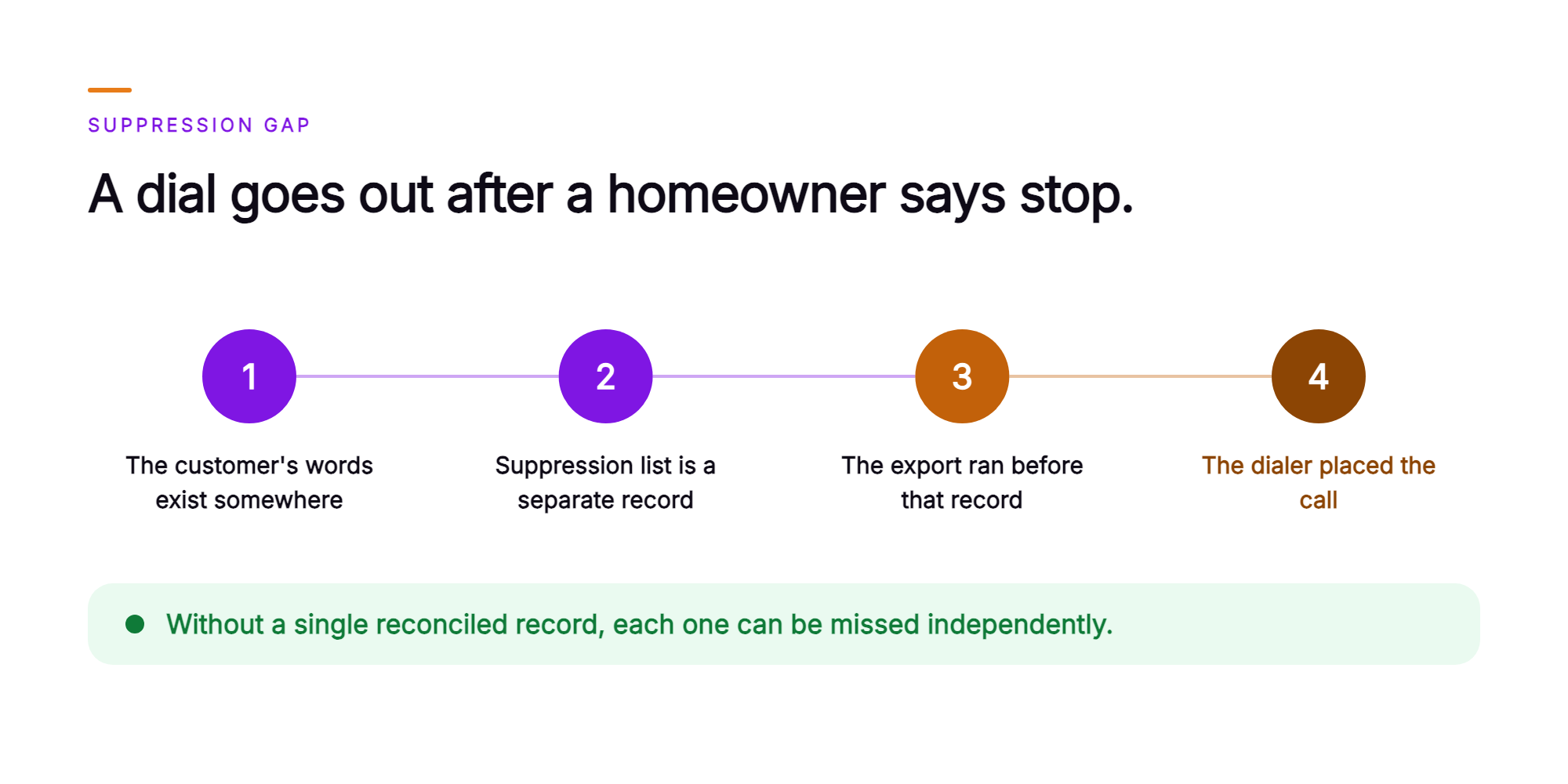
The fix is a ledger: one record that captures the customer's exact wording, the channel it arrived on, and a reconciliation status against the dialer suppression list, with the compliance team owning every rule about what each event means for suppression. This is where ai agent platform consent management does its clearest work, recording the event as the customer speaks and reconciling it ahead of the next batch cycle.
What is a consent and revocation ledger for a residential subscription contact center?
A consent and revocation ledger is a timestamped record of every consent grant and every revocation event, capturing the account, the channel, the exact wording the customer used, and the campaign class the event touches.
A CRM preference flag holds the current state of a contact record. The ledger is a structured log built to survive a regulatory review. Audit-ready consent logs for enterprise AI deployments start with the event behind each account number. They need the full event context, preserved in the order it occurred, with a clear reconciliation status that shows whether the dialer suppression list reflects what the customer actually said.
A functional ledger must include:
- Event capture in any wording the customer used, recorded word for word
- Channel and timestamp for every event, whether it arrived on voice, chat, or email
- A link to the conversation transcript so the compliance team can read the original exchange
- Reconciliation status against the dialer suppression list and the CRM contact preference record
- A review trail that shows who acted on the event and when
A stop said on chat and a stop said on a call land in the same record. That cross-channel consistency is what makes every conversation scoreable against a single compliance rubric, regardless of the channel it arrived on. The ledger records and reconciles. The compliance team's rules decide what each event means for suppression, scope, and the review window that follows.
What does the agentic AI agent do with a consent or revocation event?
The AI agent logs a consent revocation in whatever wording the customer uses, reconciles it against the suppression list before the call closes, and flags any gap for the compliance team to resolve.
Identifying the revocation is the first step. A customer might say "take me off your list," "only email me about renewals," or "do not call me at work." Each phrase carries a different scope. The agent identifies the revocation signal, attaches the qualifier the customer's exact words carry, and writes the event to the ledger with the channel, the timestamp, and a link to the transcript. The record preserves what the customer actually said, word for word.
On a live call, the sequence is immediate. The agent acknowledges the request, stops the current renewal pitch, and completes the ledger entry before the call closes. That sequencing matters. The event reaches the ledger inside the same conversation that produced it.
Reconciliation follows recognition. The agent compares each new event against the dialer suppression list and the CRM contact preference record. Where the customer's words and the list disagree, the agent opens a flagged review item and attaches the event and the transcript. The compliance team receives a complete picture of the mismatch, taken straight from the conversation.
The agent records the event and reconciles it against suppression. The compliance team's rules decide validity, scope, and the review window that follows. That division is deliberate. The agent handles the capture and the comparison. Judgment about what the event means for a given campaign class stays with the people who own that responsibility.
What the ledger captures in that moment, and what the compliance team then acts on, becomes clearer when you follow one event from the customer's words all the way to the suppression list.
What does one revocation look like from the customer's words to the suppression list?
A single revocation event, followed in sequence from the customer's words to the closed suppression record, shows where call center compliance breaks down without a ledger and where it holds with one.
A lawn care customer calls about a missed treatment. Near the end of the conversation, after the service issue is resolved, she says: "Just email me about the renewal. Stop the calls." That sentence carries a qualifier inside it. One reading stops all contact, and another narrows the request to one channel for one campaign class. The compliance team's rules settle which reading governs the suppression list. The distinction matters, and capturing it precisely is what makes the record defensible.
The AI agent processes the event in a structured sequence. It acknowledges the request in natural-sounding language, then records the event: the account, the exact wording, the channel, the timestamp, and the email-only qualifier the customer named. The transcript is attached to the record automatically. The event is tagged with the mapping the compliance team's rule assigns to that phrase pattern, linking it to the renewal campaign class and the email-only scope.
Reconciliation runs before the call closes. The number is still active on the renewal dial campaign. The agent opens a review item for the compliance team with the event record and transcript attached. And that is where the process shifts from automation to human judgment. The compliance team confirms the scope, removes the number from the campaign, and the ledger records the closure with the elapsed business days noted. The agent's part of that sequence runs inside the conversation itself. The ledger entry exists from the moment the customer speaks, ahead of the next overnight export.
The structure that made that sequence possible, specifically which rules the compliance team set and which actions the agent carried out, is worth examining directly.
Which decisions stay with the compliance team and which does the agent carry out?
The compliance team establishes the rules, and the agent executes them consistently, producing a consent ledger that reflects exactly what the rules say.
That division is by design. It is the design that makes the ledger auditable. A compliance officer can read any entry and trace it to a specific rule the team wrote, not to a judgment call the AI made in the moment. The pairing below shows how each rule translates to a discrete agent action.
- Which wordings count as a revocation, by channel. The compliance team defines the recognized phrases and the channel they apply to. The agent records the event and tags it with the channel mapping the rule names, with no interpretation beyond that match.
- How a partial or temporary revocation is scoped. Phrases such as "not at work" or "not this month" carry a qualifier that limits the revocation's reach. The compliance team defines what those qualifiers mean. The agent records the qualifier with the event and routes the item for review, so a human confirms the scope before suppression is applied.
- Which campaign classes a consent covers, and the review window. The compliance team maps consent grants to campaign classes, whether service reminders, renewal offers, or both, and sets the window within which suppression must be confirmed. The agent tags each event to the campaign classes the rule names and reports the age of every unreconciled event against that window.
In practice, the agent never decides whether a phrase qualifies as a revocation or whether a partial qualifier limits scope to one channel or all of them. Those questions belong to the compliance team. What makes the model work is that the rules are set once and applied consistently to every conversation, across every channel, and one phrase pattern carries one tag.
Why would a subscription company want the ledger built and run for it?
A residential subscription contact center AI deployment that a vendor builds and then hands off creates a gap between the system as designed and the system as it runs on a live floor.
Orvera builds, deploys, and operates the ledger and the AI agents around it. Full enterprise deployment lands in three to six weeks. That timeline is possible because over 18 years of contact center operations experience inform every configuration decision, from how revocation phrases are classified to how the review window maps to the compliance team's existing workflow. The rules arrive already shaped to the conditions of a working floor.
The audit posture that follows matters as much as the capture itself. Auto QA audits every conversation, whether a human rep handled it or an AI agent did, across voice, chat, email, messaging, and every other channel Orvera runs. A consent event captured on a chat has a reviewed conversation behind it, with the same audit trail as one captured on a call. That consistency is what makes the ledger defensible. Each entry in an audit-ready consent log arrives at a review with the conversation that produced it.
And the platform works with the systems a subscription company already runs. 500+ enterprise integrations reach the dialer and the CRM in place. Orvera is SOC 2 Type II certified, HIPAA compliant, and GDPR compliant. The compliance team sets the rules inside a platform the security team can already approve.
What the operations leader needs next is a set of numbers that confirm the ledger is working. Those measures, and what each one tells you, are worth naming directly.
Which numbers tell the operations leader the ledger is working?
Four counts and elapsed-day measures tell the operations leader, week over week, whether the consent and revocation ledger is doing its job or developing a gap.
Each measure is distinct. Together they form the dashboard the compliance team and the director read before anything else.
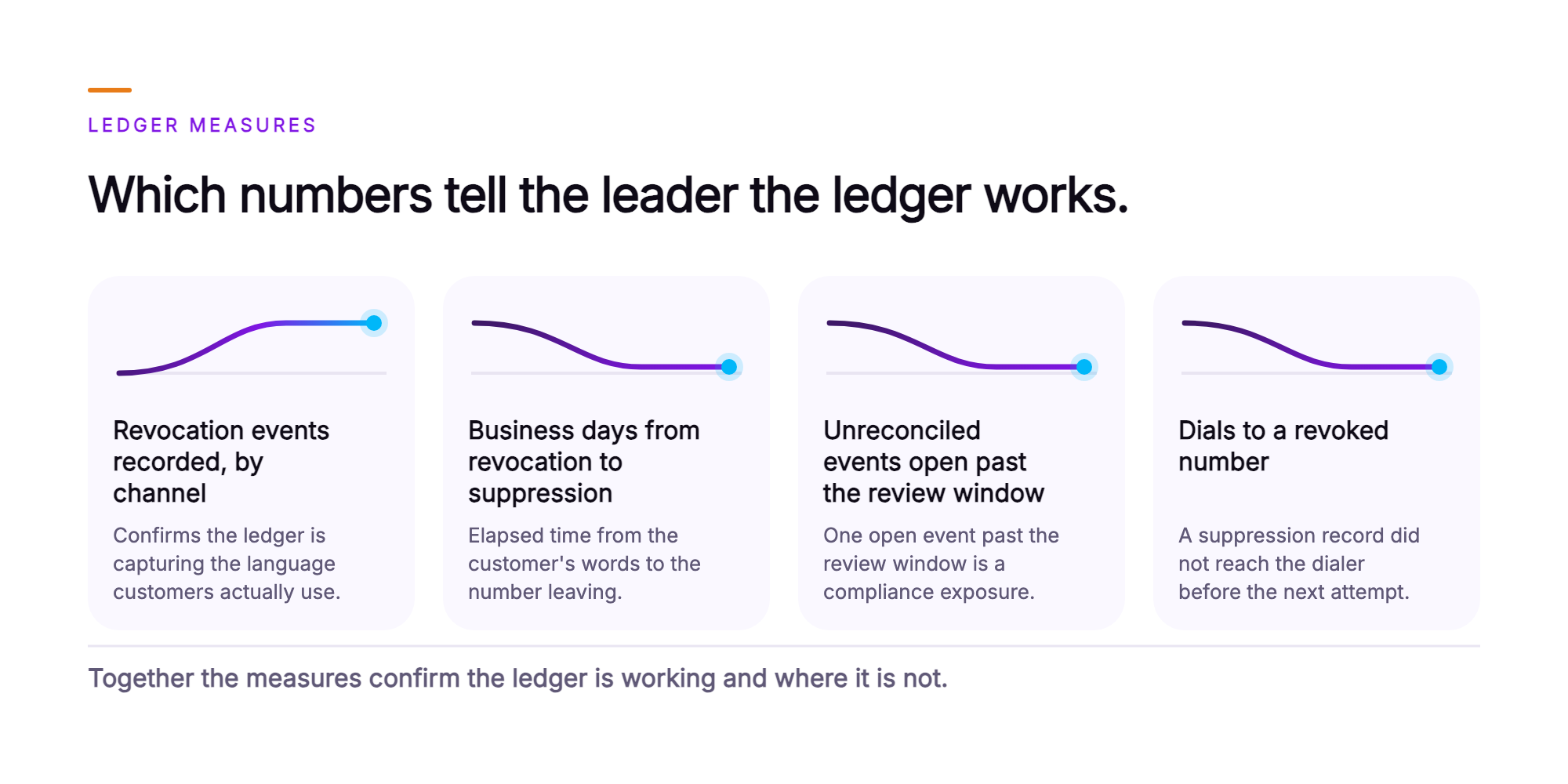
Revocation events recorded, by channel and wording class. This count confirms the ledger is capturing the language customers actually use, exactly as they said it. A week where revocation volume drops sharply without a corresponding drop in call volume is a signal worth investigating before the next reporting cycle.
Business days from revocation to suppression. This is the elapsed time between the customer's words and the number leaving the dial list. The compliance team sets the review window. This measure tells the director whether every event is closing inside that window or whether some are aging past it.
Unreconciled events open past the review window. This count is read by campaign. One open event past the review window is a compliance exposure. A pattern of them is a process failure. The measure surfaces the number before a regulator or a customer complaint does.
Dials to a revoked number. This count should read zero. Any nonzero value means a suppression record did not reach the dialer before the next outbound attempt ran. It is the single measure that tells the director the ledger and the dialer are not yet fully connected.
Those four measures, taken together, give the operations leader what they need to confirm the ledger is working and to identify where it is not. The next step is condensing that case into something clear enough to carry into a leadership conversation.
What does the operations leader take to the leadership team?
Four points, stated in plain terms, give the operations leader a complete case for the consent and revocation ledger before the leadership conversation begins.
Each point below stands on its own. Together they answer the question a skeptical CFO or general counsel will ask first: what does the system actually do, and who owns what inside it.
- The ledger records every event in the customer's own words. Channel, timestamp, and transcript are captured across voice, chat, email, and every other channel the company runs. The record holds the exact phrasing the customer used and any qualifier it named.
- Reconciliation surfaces the accounts where the words and the suppression list disagree. The operations leader sees that gap while it is still open. The reconciliation report names the account and the age of the unresolved event.
- The compliance team keeps every rule. Validity, scope, and review window remain the compliance team's responsibility. The AI agent records the event, applies the tag the rule names, and reconciles it against the suppression list the same way across thousands of contacts.
- Orvera AI builds, deploys, and runs it with the dialer and CRM already in place. Full enterprise deployment lands in three to six weeks. Auto QA audits every conversation, human-handled and AI-handled, across every channel.
What that operation looks like week over week, from the reconciliation report to the review queue to the one line the director reads first, is worth describing directly.
What does the operation look like once the ledger runs?
Once the ledger runs, a revocation in any wording the customer uses becomes a timestamped event before the conversation closes, and the compliance audit trail starts from that record.
The operations leader's week follows a structured routine. One reconciliation report lands in the morning. It shows every open gap, how many days each has sat unresolved, and where the suppression record has not yet reached the dialer. The compliance team works through a review queue organized against the window their own rules define. And the count of dials to revoked numbers, sorted by campaign, is the line the leader reads first. When that count reads zero, the ledger and the dialer are connected the way the compliance team designed them. When it does not, each dial in that count traces back to the ledger event recorded for that number.
Audits start from the ledger. Auto QA has scored every conversation, human-handled and AI-handled, across voice, chat, email, and every other channel the floor runs. A regulator who asks for the consent record for a specific account gets a timestamped log. It comes from one system, in the order the events occurred.
That is the running state. Orvera AI builds and runs it on the dialer and CRM your team already uses, live in three to six weeks. If you want to walk through what that looks like on your specific stack, talk to the team (opens in a new tab).
Frequently asked questions
Any statement in which a customer withdraws or narrows permission to be contacted, in whatever words they use, on any channel, counts as a revocation event in the AI agent consent and revocation ledger. The AI agent adds the event to the ledger during the conversation it arrives on. Wording examples it captures include: - "Stop calling me" - "Take me off the list" - "Only email me" - "Don't call at work" - "Not this month" - A typed "stop" on chat - A reply to a campaign email The agent records the exact words, the channel, and the qualifier. What those words mean for suppression is your compliance team's call, not the agent's. Full suppression, a channel restriction, a campaign limit, or a flag for review: the rules that govern each outcome sit with your team. The ledger records what was said so the decision rests on evidence.
Each recorded revocation event is compared against the dialer's suppression list and the CRM contact preference for that account, and any account where the two disagree is flagged for review. The flag carries the event itself, the customer's exact wording, the channel, the timestamp, a transcript link, and the elapsed business days since the customer spoke. Each of those values traces to the recorded event. Your compliance team defines how long a consent stays valid, and the elapsed-days count makes that window visible with the arithmetic already done. Closing the flag follows a defined sequence. The compliance team reviews the flag against its governing rule and window, removes the number from the active campaign, and the ledger records that closure with a date and the reviewer's decision. That sequence is what the next section covers in full.
Consent lifecycle management belongs to your compliance team. The AI agent records and tags. Your compliance team decides. Three decisions stay with the compliance team: - Validity. Which wordings count as a full revocation, a partial one, or a temporary limit for a residential subscription contact. - Scope. Which campaign classes a given consent or revocation covers, and whether the suppression is channel-specific or account-wide. - Timing. The review window that governs how long a flagged event can remain open before a suppression decision is required. The AI agent's role is defined and bounded. It records the event, tags it against the mapping your compliance team has named, and reconciles that tag against the dialer suppression list. When a rule changes, the compliance team makes that change, and the ledger records the update with a date and the reviewer's identity. The rule itself becomes part of the auditable record. That record, and what sits inside it for every event, is what the next section covers.
Every consent grant and every revocation event carries a fixed record: account identifier, channel, timestamp, exact customer wording, qualifier, campaign class, transcript link, reconciliation status, and the reviewer's decision. The record is a structured entry that can be retrieved, sorted, and exported. And because Orvera AI functions as an AI compliance platform, the record is backed by a reviewed conversation. Auto QA audits every interaction, whether a human rep or an AI agent handled it, across voice, chat, email, and every other channel your floor runs. An event captured on a call carries the same audit backing as one captured on a chat. Reporting gives your compliance team three views: - Full report logs. Every consent and revocation event, filterable by channel, campaign, and date. - Conversation summaries and transcripts. Available for every interaction tied to an event. - Reconciliation report. Open items displayed by age and campaign class, so the compliance team sees elapsed time against the review window on every line. The record also has to reach the systems your operation already runs. That integration question is what the next section addresses directly.
The ledger connects to the dialer suppression list and the CRM contact preference through 500+ integrations, and Orvera does the integration work. The data flow follows a defined path. The ledger holds the event record. The CRM holds the customer's contact preference and the rule mapping your compliance team has named. The dialer suppression list is what the ledger reconciles each event against, so the compliance team's decision on a flag reaches the dialer through that connection. Field updates travel the same path. A contact status a technician enters in the CRM after a door visit flows into the same reconciliation as a revocation recorded on a call. For residential subscription AI deployments, that symmetry matters: a revocation given at the door carries the same audit weight as one captured over voice or chat. What that full deployment looks like in practice is what the next section covers.
Orvera builds, deploys, and runs the ledger, the AI agents, and every reconciliation connection to the dialer and CRM already in your stack, with full enterprise deployment landing in three to six weeks. Enablement work spans onboarding, knowledge-base setup, AI agent training, and change management. Your compliance team's opt out management rules, including channel-specific suppression logic and review windows, are captured during the build. At launch the compliance team reads results and closes flags on a ledger Orvera already has running against the dialer. The platform is SOC 2 Type II certified, HIPAA compliant, and GDPR compliant. To talk through what the build covers for your operation, talk to the team.

Written by
Anindita Majumder
Anindita Majumder is a communications professional with nearly four years of experience in public relations, corporate communications, and journalism. She creates content that helps brands communicate their vision, products, and expertise through press releases, thought leadership, and editorial pieces. Outside of work, she is a vocalist, which keeps her creativity flowing.


