Contact Center Quality Assurance: Best Practices, Trends & How to Get Started
A satisfied customer is many future customers won. For any organization, CX is the first point of...

Key highlights
TL;DR – A 60-Second Summary
- Quality assurance is the systematic process of managing customer outcomes.
- Modern QA programs focus on resolution quality, consistency, and customer satisfaction.
- Leaders benefit when QA surfaces repeat failure points across journeys, channels, and teams.
- Effective QA programs reduce costs indirectly by preventing rework and repeat contacts, resulting in fewer escalations.
- Agent adoption improves when QA is positioned as an enabler for building trust and performance improvement.
- AI-driven QA enables omnichannel consistency across every channel, from calls and chat to email and messaging.
- Orvera-led QA programs identify experience risks early and correct them before customers feel the impact.
A satisfied customer is many future customers won. For any organization, CX is the first point of contact with a customer. It is therefore pertinent for brands to ensure exceptional customer service.
Reciprocally, customers expect to get answers to their queries in the first contact itself. Many do not, and the gap between what a caller expects and what a first contact delivers is where repeat calls come from.
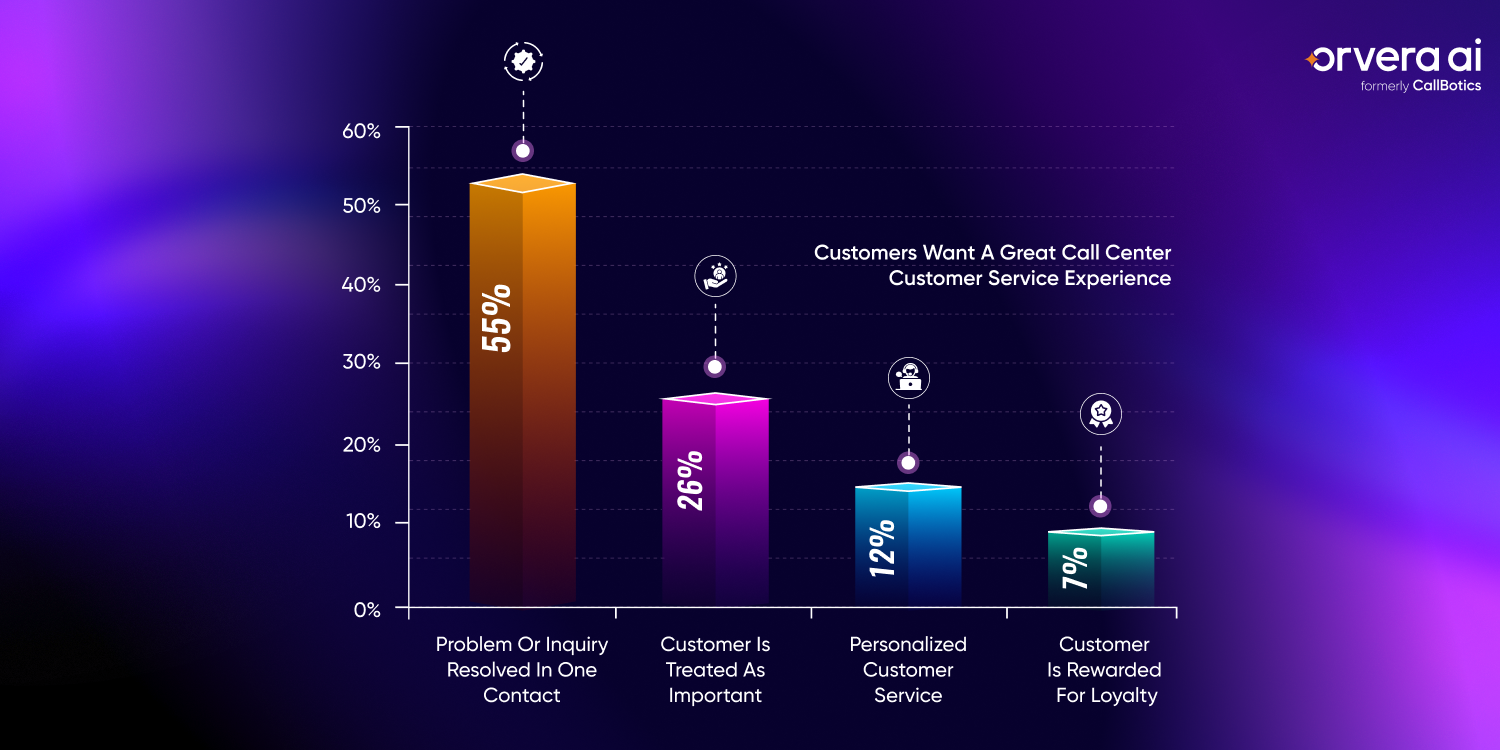
Caption: Customers want a great call center customer service experience
Contact Center Quality Assurance is a persistent effort by brands to measure customer satisfaction rates against set standards and guidelines, such that their customer service teams keep delivering consistent results.
Also Read: What is Shrinkage in a Contact Center & How to Minimize it With AI (opens in a new tab)
This article discusses the ins and outs of contact center quality assurance and how platforms like Orvera help to automate and optimize modern-day QA programs.
What Is Contact Center Quality Assurance?
Quality Assurance (QA) in contact centers is the systematic process of monitoring and analyzing customer interactions within the contact center environment to improve the overall customer experience.
QA in contact centers also involves:
- Defining the quality standards, guidelines, and procedures
- Matching the service quality to the set quality standards
- Scoring calls against benchmarks, and
- Examining their adherence to guidelines within the contact center.
When performed judiciously, QA helps to maintain consistency, compliance, and professionalism across customer interactions. It provides valuable feedback for live call agents to improve continuously, reduce escalations, and improve the first-call resolution rate (FCR).
QA is critical in contact centers because:
- It brings journey-level accountability: For instance, an organization noticed that customers raise escalations on the second or third call. QA can help here by analyzing call sequences across multiple interactions and identifying patterns where agents resolved issues but failed to communicate timelines.
- Similarly, QA can act as an early warning system: Suppose a SaaS company launched a major product upgrade and started seeing a rise in support volume. QA helped identify that unclear internal guidance was causing AI voice assistants to improvise explanations.
- It measures commercial outcomes: It provides customer service leaders with KPIs and parameters such as CSAT, FCR, NPS, etc., to measure contact center efficiency and ROI (opens in a new tab).
- It goes beyond quantifiable metrics: It also involves measuring and setting qualitative aspects such as empathy, problem-solving, trust, clarity, and active listening.
Orvera provides AI-led insights that give leaders a granular view of how human agents and Orvera's AI agents are performing together as a customer support team.
Difference Between Quality Control (QC) and QA
Quality assurance: It is a proactive process of preventing customer support issues by designing a standardized system around which customer interactions are built. It is a part of the larger quality management system.
It consists of several activities ensuring quality interactions happen every time. QA involves
- First, defining SOPs and quality standards,
- Designing training programs,
- Mapping process, and
- Conducting audits, followed by feedback.
QA is the responsibility of the entire CX team and occurs at all times, before and after customer interaction.
Quality Control: QC, on the other hand, is much narrower in scope. It is a reactive process for detecting and fixing issues in the output after customer interaction is complete, in accordance with the QA standards. QC is done by a specialized team.
QC is a piecemeal activity, while QA handles the entire customer support experience.
Here’s a head-to-head comparison between Quality Control and Quality Assurance.
| Aspect | Quality Assurance (QA) | Quality Control (QC) |
|---|---|---|
| Focus | Preventing quality issues | Detecting quality issues |
| Timing | Ongoing and proactive | Reactive, after interactions occur |
| Scope | Processes, standards, and systems | Individual calls or interactions |
| Objective | Improve outcomes and consistency | Identify errors and non-compliance |
| Impact | Long-term experience improvement | Short-term issue correction |
Table Caption: Comparison between quality assurance and quality control
Key Metrics and KPIs for Quality Assurance
CX teams measure the quality of customer interactions and agent productivity against multiple parameters, including customer-focused outcomes, agent efficiency metrics, and quality and consistency.
CX metrics and KPIs are used to train agents, ensure minimum churn, and guide live agents and code voice assistants to operate efficiently:
Customer Satisfaction Scores (CSAT)
CSAT (customer satisfaction) scores measure how satisfied a customer is with a particular support interaction. CSAT scores are calculated from customer satisfaction surveys, in which customers are asked a set of questions.
First-Contact Resolution (FCR)
FCR or First-contact resolution measures the percentage of support tickets a live agent or a voice assistant resolves in a first call, live chat, or email. FCR is a good marker of how adept the customer support team is at handling customer expectations.
Also Read: Average Speed of Answer in Call Centers: What it is and How to Improve it (opens in a new tab)
Net Promoter Score (NPS)
NPS (Net Promoter Score) is a long-term metric that calculates customer loyalty scores from quarterly or bi-quarterly surveys. The survey asks only one question: ‘How likely are you to recommend this company to a friend or colleague?’
Customer responses are then categorized into promoters, passives, and detractors. The Net Promoter Score is the difference between the percentages of promoters and detractors.
Average Handle Time (AHT)
Average handle time (AHT) is the average duration of a customer interaction. This metric helps to assess how much handling time different types of interactions take. CX teams set standards based on AHT. However, lower AHT doesn’t necessarily mean great customer service. CX leaders must find a balance between both.
Also Read: How To Reduce Average Hold Time in Call Center: Strategies & Best Practices (opens in a new tab)
Script Adherence and Compliance flags
This metric scans how well agents follow standard company guidelines and comply with regulations during customer interactions.
A few more KPIs CX managers are concerned about include:
| Executive KPI | What Leaders Care About | How Orvera AI Enables It |
|---|---|---|
| Repeat Contact Rate (RCR) | Are customers calling back because issues weren’t truly resolved? | Conversation-level analysis identifies expectation gaps, partial resolutions, and failure patterns across call sequences. |
| Customer Churn | Are service interactions increasing churn risk? | Sentiment, escalation markers, and friction moments are flagged early. |
| Cost per Resolution | Is service efficiency improving sustainably? | QA insights reduce rework, repeat calls, and unnecessary escalations, lowering total cost, not just AHT. |
| CSAT / NPS Consistency | Are experiences predictable across agents and channels? | Full-coverage QA replaces sampling bias, reducing performance variance across teams and locations. |
| Crisis Response Stability | Can CX hold under volume spikes or disruptions? | Real-time QA insights surface breakdowns in messaging and handling during live events. |
Table Caption: CX managers use KPIs to measure the productivity and cost efficiency of customer service
Best Practices in Contact Center Quality Assurance
QA can be the ultimate customer acquisition tactic, turning memorable customer experiences into a loyal customer base. CX teams can follow a few best practices to make their contact center quality assurance more impactful:
Define Clear Standards and Scorecards
Without measurable quality benchmarks, the purpose of QA is defeated. The metrics need to be clear and specific and should align with the customer service goals. Metrics should be able to quantify scorecards and define clear standards.
Orvera’s quality monitoring tools can help to automate scoring customer interactions and derive valuable data-backed insights and actionable feedback.
Regular Coaching and Feedback Loops
The best way to implement QA standards is not reactive auditing but proactive training of the live agents. With AI-led voice assistants, standards and protocols can be fed as code, ensuring each voice assistant behaves exactly the same way.
Call center agent training can be persona-based, knowledge-based, or simply to train live agents to be empathetic and active listeners. Also, closed feedback loops can continuously help QA to get better.
Omnichannel Consistency
Your customers don’t think in channels. They remember when responses to their problems change across channels. This creates distrust and dissatisfaction.
A simple way to avoid this inconsistency is to make sure your agents have a 360-degree view of customer profiles and access to all customer interaction history across channels. Omnichannel consistency can improve FCR rates, customer satisfaction scores, and AHT.
Leverage QA Technology
Use AI tools, Speech analytics, AI, and dashboards to automate quality management workflows for real-time QA results and reduced manual effort and time.
Modern AI tools consider both soft and hard skills, and allow continuous evaluation across every interaction without manual interaction. CX managers can have a real-time view of quality, insights are used to track patterns, and feedback loops are drastically shortened.
Also Read: Top AI Use Cases in Contact Centers to Transform CX & Agent Productivity (opens in a new tab)
Orvera embeds QA directly into live operations so that quality is actively managed without hassle.
Common Challenges & How to Overcome Them
Implementing QA across multiple processes in the contact center isn’t straightforward. Handling bias, training agents, and scaling efficiently are among the biggest challenges CX managers face on their customer service journey.
Reducing Bias in Evaluations
Bias is another structural challenge. Human-led reviews are often subjective and inconsistent with the interpretation of standards. Automated QA introduces consistency by applying the same evaluation logic across every interaction. AI-led reviews reduce variance and apply only to the areas that matter most.
Agent Resistance to QA Programs
Agents often resist QA programs because QA is often misunderstood as punitive and disconnected from real workflows. The problem doesn’t lie in the way agents view QA, but in how it is positioned. If QA is built as a support system rather than an auditing tool, resistance drops.
Technology here plays a big role. AI-led QA programs are seamlessly integrated into the workflow, and the agent begins to see QA as a way to improve and achieve set quality standards.
Scaling QA Across Large Teams
As teams grow, manual review models are unable to handle the flow and break down. Insight quality declines unless more analysts put in effort to move the QA forward.
Human capacity is limited. Automating QA is the best way to speed up and amplify QA teams’ efforts. Automated QA removes sampling limits, standardizes evaluation, and surfaces trends that would otherwise remain invisible across large, distributed teams.
How Contact Centers Can Implement QA with Orvera
Traditional QA programs were built around post-call auditing. Modern QA teams have the right intent, but they still struggle because quality signals are fragmented across systems and arrive too late to change outcomes. Manual QA can’t influence live operations. AI-led QA can.
Orvera closes this gap by embedding QA directly into the systems where customer work actually happens, turning fragmented signals into real-time, operational insight.
Setup & Integration: Connecting QA to Live Operations
Orvera is designed to integrate QA into the actual flow of contact center work.
What’s different with Orvera
- Direct integration with telephony, CRM, and workflow tools that agents already use
- Full-context analysis across conversations, actions taken, and final resolution
- QA coverage across the entire customer journey
- Rapid deployment without heavy customization or long integration cycles
The result is faster QA activation, fewer blind spots, and visibility that extends beyond individual calls into end-to-end outcomes.
Scoring, Reporting, and Dashboards: From Activity to Insight
Most QA programs rely on sampling. Orvera replaces sampling with continuous intelligence.
Orvera QA stands out because it:
- Scores 100% of interactions automatically, human-handled and AI-handled alike
- Detects patterns and failure points early, before they escalate
- Aligns scoring directly to business KPIs like resolution time, compliance, and consistency
- Provides unified dashboards that leadership can actually act on
Instead of static reports, teams get insight-driven intelligence that supports faster, more confident decisions.
Coaching and Improvement Cycles: Turning QA into Measurable Change
QA only creates value when insights lead to action. Orvera is built to close that loop.
How Orvera drives continuous improvement
- Identifies repeatable success patterns from top performers
- Flags systemic issues across teams, workflows, and conversations
- Feeds QA insights directly into coaching and performance workflows
- Delivers specific, interaction-level guidance instead of generic feedback
This creates shorter ramp-up cycles, more confident agents, and consistent service quality at scale.
Why this matters
Orvera treats QA as an embedded, continuous operational control system, directly tied to outcomes.
Here’s how a before-and-after contact center quality assurance looks with Orvera:
| Dimension | Before Structured/AI-Driven QA | After QA with Orvera AI |
|---|---|---|
| Coverage | 2–5% of calls reviewed manually | 100% interaction coverage across voice and digital |
| Focus | Agent behavior and script adherence | Customer outcomes, resolution quality, and journey health |
| Insight Timing | Days or weeks after interactions | Near real-time insight and trend detection |
| Bias Risk | High due to sampling and human subjectivity | Low as consistent, AI-driven evaluation is involved |
| Coaching Model | Reactive, manual, inconsistent | Continuous, data-backed, behavior-specific |
| Scalability | Linear; more calls = more QA staff | Exponential; volume scales without QA headcount |
| Compliance Handling | Post-incident audits | Proactive detection and prevention |
| CX Consistency | Dependent on individual agents | Institutionalized across teams and channels |
| Leadership Visibility | Fragmented, lagging reports | Unified dashboards tied to business KPIs |
| Business Impact | QA seen as a cost center | QA becomes CX, risk, and revenue lever |
Table Caption: How Orvera Improves Contact Center QA
Conclusion: Raising the Bar on Contact Center Quality
Contact center quality assurance was once a function focused solely on measuring performance. But Modern QA is now a system for managing customer experience, risk, and operational consistency at scale.
The organizations that lead on CX operationalize QA to close feedback loops, surface issues early, and use quality insights for continuous improvement across teams and channels.
Platforms like Orvera make this shift possible by turning QA into a connected operating layer that links conversations to outcomes and insight to action. Orvera removes the manual bottlenecks in quality assurance by:
- Automating interaction analysis
- Standardizing evaluations
- Helping teams to scale coverage and reduce bias
- Focus on coaching and improvement, without adding analysts as call volumes grow (opens in a new tab).
Looking to fast-forward your QA? Book a demo with Orvera today!
Frequently asked questions
Consistent QA reduces contradictory answers, broken promises, and unresolved issues, which are key drivers of customer distrust. Over time, this consistency builds confidence in the brand, even during complex or unfavorable interactions.
Yes. QA often reveals recurring customer confusion or frustration caused by unclear policies, product limitations, or poor internal communication. It captures insights that product and operations teams can act on.
QA helps teams adapt quickly by identifying which messages, workflows, and agent behaviors reduce repeat contacts and escalations during disruptions.
QA accelerates learning curves and reduces dependency on trial-and-error training by identifying top-performing behaviors and common mistakes early.
AI allows QA teams to move from manual call scoring to higher-value work, such as analyzing trends, improving processes, and guiding coaching strategies at scale.
Orvera AI allows continuous, automated quality evaluation across customer interactions, for QA teams to move beyond sampled reviews. By embedding QA insights directly into live operations and workflows, it helps organizations identify systemic issues early and act on them before they impact customer experience at scale.

Written by
Urza Dey
Urza Dey (She/They) is a content/copywriter who has been working in the industry for over 5 years now. They have strategized content for multiple brands in marketing, B2B SaaS, HealthTech, EdTech, and more. They like reading, metal music, watching horror films, and talking about magical occult practices.