Top Conversational AI Companies in 2026 (Who Leads Each Category)
Conversational AI companies are easy to find and hard to tell apart. Dozens of vendors...

Key highlights
TL;DR —- In a Nutshell
- The conversational AI market is best understood by six distinct categories, each serving different enterprise needs, deployment models, and levels of maturity
- The right vendor should be evaluated on live production performance, governance, integrations, compliance, and proven customer outcomes rather than marketing claims or demos
- Enterprise platforms, agentic AI startups, voice AI specialists, CCaaS suites, cloud providers, and development partners each involve different trade-offs in control, speed, scalability, and ownership
- Funding, customer deployments, analyst recognition, and real-world resolution rates are stronger indicators of long-term success than valuation or feature lists alone
- Organizations should choose between managed platforms and custom development based on workflow complexity, internal engineering resources, and long-term maintenance expectations
- Regulated industries such as healthcare, financial services, and mortgage lending should prioritize vendors with relevant certifications, industry-specific integrations, and demonstrated production deployments
Conversational AI companies are easy to find and hard to tell apart. Dozens of vendors run near-identical homepages built on the same three words, "AI-powered." Most directories list them alphabetically and rank them by star average. That measures review volume, not whether the product resolves a customer's issue on live traffic. So the real question a buyer faces is not which vendors exist. It is how to separate a production-grade conversational AI company from a demo that falls over in week three.
The stakes are not abstract. McKinsey's 2023 analysis estimated generative AI could raise customer-care productivity (opens in a new tab) by 30 to 45 percent, and in banking alone could add $200 billion to $340 billion in annual value. A prize that large pulls in everyone, serious platforms and thin wrappers landing in the same search results. Choose wrong and you do not simply miss the upside. You inherit a deflection bot that pushes customers to call anyway, then pay again to rip it out and start over. The company you choose is what decides between those two outcomes.
This guide maps the conversational AI companies that matter in 2026 by category, not by alphabet. You get a six-type taxonomy of how the market actually splits, honest profiles that name what each company is built for and where it falls short, and a clear way to tell an established incumbent you can bet on from a startup still proving it works in production. For the category basics first, what a conversational AI platform is and how these systems work, start with the pillar guide.
What Counts as a Conversational AI Company
A conversational AI company builds software that understands natural language and holds a real back-and-forth conversation, by text or by voice, to automate customer interactions at scale. What sets it apart from an ordinary chatbot vendor is the understanding layer underneath. A true conversational AI company interprets what a customer means rather than matching keywords to a script.
That capability is the product of how the underlying technology evolved. Early chatbots ran on rule-based decision trees that broke the moment a customer phrased a question in an unexpected way, and the field has since moved from those scripts to natural language understanding (NLU), then to large language models (LLMs), and now to agentic systems that act on a customer's behalf rather than only answering.
Because the technology widened, the label now stretches across several kinds of business, and telling them apart matters before you shortlist.
- Chatbot development shops build bots to a client's specification as a service. Many firms marketed as conversational AI chatbot companies in this bucket still ship scripted flows, so confirm there is genuine language understanding under the hood.
- Voice-AI specialists such as PolyAI and Retell are conversational AI companies focused on the phone channel.
- Agentic-AI startups such as Sierra and Decagon are conversational AI companies whose systems complete tasks autonomously, not just reply.
- CCaaS and CX suites such as Genesys and Zendesk are contact-center platforms where conversational AI is one module bolted onto routing, ticketing, and reporting.
- Big-tech cloud providers such as Google, Microsoft, and Amazon offer conversational AI as a single service inside a much larger cloud.
Voice and agentic firms sit squarely inside the category. Chatbot shops, CX suites, and cloud giants straddle its edge, where conversation is one capability among many. Knowing which you are dealing with tells you what you are actually buying, a product, a service, or a module. For the full category basics and how these systems work, see the pillar guide.
The 6 Types of Conversational AI Companies
The market splits into six types, and the type tells you more than any feature list. It tells you what the company is built to do, who it serves best, and what you trade away by choosing it. A voice-AI specialist and a big-tech cloud service both "do conversational AI," but almost nothing about buying, deploying, or living with them is the same. Read the map first, then the profiles.
Caption: McKinsey frames generative AI as the next productivity frontier in its 2023 report, estimating a 30 to 45 percent lift in customer-care productivity and up to $340 billion in annual banking value.
Enterprise conversational AI platforms
These companies sell a build-your-own toolkit for large organizations with complex workflows and strict governance needs. Cognigy and Kore.ai lead here, giving enterprises deep integration into backend systems, granular access controls, and the compliance scaffolding regulated industries require. Best fit is a large enterprise with technical resources and non-standard processes that off-the-shelf tools cannot handle. The trade-off is effort. You are buying a platform, not a finished solution, so realizing its value depends on having the people to configure, connect, and maintain it. Underinvest in that team and a capable platform still underperforms.
Agentic-AI startups
These companies build systems that take action rather than only answer, completing multi-step tasks such as processing a return or updating an account. Sierra, Decagon, and Ada lead this newer category, and many price on outcomes, charging per resolution instead of per seat.
Best fit is a team chasing genuine resolution over deflection. The trade-off is maturity, since these are young companies with shorter production track records. For what agentic AI actually is, see the agentic-AI guide.
Voice-AI companies
These companies specialize in the phone channel, handling spoken conversations in real time with natural turn-taking and low latency. PolyAI, Retell, Bland, Uniphore, and SESTEK compete here, tuned for the specific demands of contact-center voice rather than text chat retrofitted for the phone. Best fit is an operation with high call volume where the phone is the primary channel and voice quality decides customer satisfaction. The trade-off is scope. A voice-first specialist may not cover chat, email, and messaging, so an omnichannel operation often has to pair it with another tool or accept a channel gap.
CCaaS-native and CX suites
These companies are contact-center and customer-experience platforms where conversational AI is one module inside a much larger suite. Genesys, Five9, Zendesk, Sprinklr, and LivePerson sell AI that bolts onto routing, ticketing, workforce management, and reporting you may already run. Best fit is a team already committed to one of these stacks that wants to add AI without onboarding a separate vendor. The trade-off is depth. Because the AI is one feature among many rather than the whole product, it can trail dedicated specialists on conversational quality and the newest capabilities, which is the cost of consolidation.
Big-tech and cloud providers
These companies offer conversational AI as one service within a sprawling cloud platform. Google Dialogflow CX, Microsoft, Amazon Lex, and IBM watsonx give you building blocks that reach their full value inside their own ecosystems, close to your existing cloud data and infrastructure. Best fit is a team already standardized on that cloud with engineers to assemble the pieces. The trade-off is that these are toolkits, not turnkey CX products. They demand more development work and offer less contact-center-specific design than a purpose-built vendor, so the saving in licensing can reappear as engineering cost.
Developer platforms and development partners
These companies serve the build side of the build-versus-buy decision in two ways. Platforms such as Rasa and Voiceflow give engineering teams frameworks to build conversational AI in-house, while development shops such as BotsCrew and Master of Code build custom solutions for clients as a service. Best fit is a team that needs full control or a bespoke, product-embedded experience no packaged tool delivers. The trade-off is ownership. Building buys you flexibility but hands you the maintenance, the upgrades, and the roadmap, which is a real and recurring commitment rather than a one-time project.
The Leading Conversational AI Companies in 2026
The leading conversational AI companies in 2026 fall into the six categories above, and the honest way to read the list is by category and maturity signal, not by a single ranking. The table maps the top conversational AI companies at a glance. The profiles below add what each is known for, where it has proven itself, and where it falls short.
| Company | Category | Best for | Maturity signal |
|---|---|---|---|
| Orvera | Agentic AI platform for enterprise CX | QA and compliance in one platform | SOC 2 Type II certified, HIPAA compliant, GDPR compliant. 80+ languages |
| Kore.ai | Enterprise CAI platform | Model choice with governance | 2xGartner MQ Leader; 400+ Global 2000 |
| Cognigy | Enterprise CAI platform | Large regulated enterprises | Acquired by NICE, ~$955M (2025) |
| Sierra | Agentic-AI startup | Outcome-based resolution | $15.8B valuation; $150M ARR |
| Decagon | Agentic-AI startup | Concierge-style resolution | $4.5B valuation; 80%+ deflection |
| Ada | Agentic-AI startup | Automation-first CX teams | Early mover, Toronto-based |
| PolyAI | Voice-AI | High-volume phone support | $750M valuation; Forrester 391% ROI |
| RetellAI | Voice-AI | Scaling AI calls fast | 40M+calls/month, $40M+ ARR |
| Genesys | CCaaS/CX suite | Teams on a cloud CC stack | Leading cloud contact-center platform |
| Five9 | CCaaS/CX suite | Existing Five9 contact centers | Publicly traded (FIVN) |
| Zendesk | CCaaS/CX suite | Teams already on Zendesk | Privately held after 2022 buyout |
| Google, Microsoft, Amazon, IBM | Big-tech/cloud | Building inside one cloud | Hyperscaler scale |
| Rasa, Voiceflow, BotsCrew | Developer platforms/partners | Custom, in-house builds | Open-source/dev-shop model |
Enterprise conversational AI platforms
Orvera AI. Best for enterprise contact centers that need conversation quality and compliance in one platform. It is known for voice AI agents, agent assist, and automated QA across BPO, healthcare, and financial services. Standout: auto-QA and voice-of-customer intelligence with multilingual support in 80+ languages. Maturity signal: SOC 2 Type II certified, HIPAA compliant, GDPR compliant. Watch-out: built and run for the customer, so a team that wants raw API primitives to assemble in-house should look at the developer platforms below.
Cognigy. Best for large, regulated enterprises that build their own agents. It is known for a low-code platform that delivers AI service in over 100 languages and is used at companies like Mercedes-Benz, Nestlé, and the Lufthansa Group. Maturity signal: NICE announced it would acquire Cognigy in a deal valuing it at approximately $955 million (opens in a new tab), which closed in September 2025. Watch-out: it is now part of a larger CCaaS suite, so its independent roadmap shifts.
Kore.ai. Best for enterprises that want model choice with enterprise governance. It is known for an open, bring-your-own-LLM platform used across banking, healthcare, and retail. Maturity signal: a $150 million round led by FTV Capital with NVIDIA (opens in a new tab), and recognition as a Leader in Gartner's Magic Quadrant for Enterprise Conversational AI Platforms twice in a row, with a customer base above 400 brands including AT&T, Coca-Cola, and PNC. Watch-out: breadth means a steeper build.
Agentic-AI startups
Sierra. Best for enterprises buying outcomes rather than software. Co-founded by former Salesforce co-CEO Bret Taylor, it is known for autonomous agents and pay-per-resolution pricing (opens in a new tab). Maturity signal: a post-money valuation above $15 billion, having reached $150 million in ARR in eight quarters with more than 40% of the Fortune 50 as customers. Watch-out: premium positioning in a young category.
Decagon. Best for concierge-style resolution across chat, email, and voice. It is known for AI "concierge" agents and per-resolution pricing, with clients including Notion, Duolingo, and Chime. Maturity signal: a $4.5 billion valuation and more than 100 enterprise customers added in a year (opens in a new tab), with average deflection rates exceeding 80%. Watch-out: a short production track record, common to the category.
Ada. Best for automation-first CX teams. One of the earliest customer-service automation companies, Toronto-based, focused on resolving high volumes of routine inquiries without code. Watch-out: faces intense competition from newer, better-funded agentic entrants.
Voice-AI companies
PolyAI. Best for high-volume phone support (opens in a new tab) where voice quality decides satisfaction. A University of Cambridge spinout that builds its own voice models (opens in a new tab), serving PG&E, FedEx, and Caesars. Maturity signal: $86 million raised at a $750 million valuation (opens in a new tab), and a Forrester study documenting 391% ROI for its customers. Watch-out: voice-first, so omnichannel coverage needs pairing.
Retell AI. Best for teams scaling AI phone calls quickly. It is known for developer-friendly voice infrastructure and a QA layer that monitors 100% of calls, while the platform powers 40 million+ real-time calls monthly and reached $40 million+ ARR. Watch-out: younger and more infrastructure-oriented than full-service platforms. Bland, Uniphore, and SESTEK also compete in this lane.
CCaaS-native and CX suites
Genesys, Five9, and Zendesk add conversational AI as a module to established contact-center and support platforms. Best for teams already committed to one of these stacks. Five9 is publicly traded, Zendesk is privately held after a 2022 buyout, and Genesys is a leading cloud contact-center platform. Watch-out: AI depth can trail dedicated specialists, which is the trade-off for consolidation. Sprinklr and LivePerson also fit here.
Big-tech and cloud providers
Google, Microsoft, Amazon, and IBM offer conversational AI as one service inside a much larger cloud, through Dialogflow CX, Copilot Studio, Amazon Lex, and watsonx Assistant. Best for teams standardized on that cloud with engineering resources. Maturity signal: hyperscaler scale and reliability. Watch-out: these are toolkits, not turnkey CX products, so expect assembly.
Developer platforms and partners
Rasa and Voiceflow give engineering teams frameworks to build in-house, while development shops such as BotsCrew and Master of Code build custom solutions as a service. Best for teams that need a bespoke, product-embedded experience no packaged tool delivers. Watch-out: building hands you the maintenance and the roadmap.
Incumbents vs Startups (How to Read the Market)
The most useful question when comparing conversational AI companies is not which category a vendor sits in, but whether it can deliver in production.

Choosing a company that dazzles in a demo but stalls at scale is one reason why. Maturity, not marketing, is the lens that protects you.
Funding and maturity signals
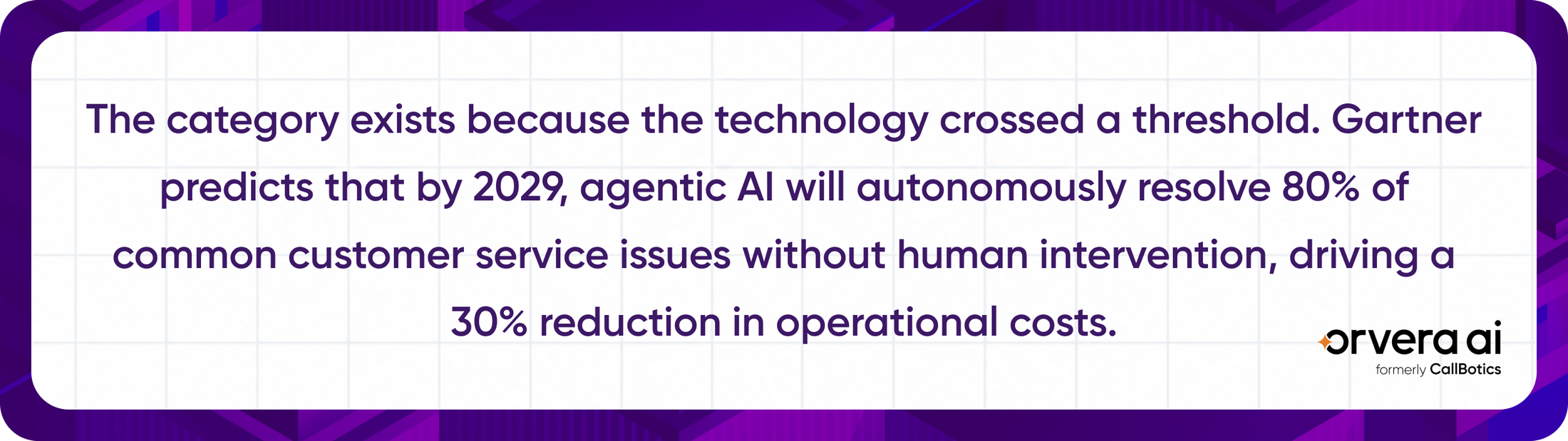
Funding tells you two things: staying power and behavior. A heavily backed startup has runway to invest in the product and support you, but also pressure to grow into a steep valuation, which can push pricing and roadmap. An incumbent or an acquired player brings enterprise processes, scale, and survivability, sometimes at the cost of agility. Read the signals together rather than in isolation: total raised and the date of the most recent round (runway), revenue signals like ARR, customer count and named logos, and analyst recognition such as a Gartner Magic Quadrant placement. Treat a large valuation as a measure of investor confidence, not proof the product works on your traffic.
Production evidence versus demo-stage
A demo proves a company can script a perfect path. Production proves it can handle yours. Ask for evidence from live customer traffic, not a staged environment. The number that matters is the containment or resolution rate on real conversations, meaning the share resolved without a human, not deflection measured in a controlled demo. Decagon, for example, cites average deflection rates exceeding 80% (opens in a new tab), and one client, Chime, reported a greater than 60% reduction in contact-center operating costs. Ask for named deployments at your scale and in your industry, ask how the vendor measures quality on live conversations, and ask how failures surface once agents are running. A polished demo with no live metrics and no reference customer you can call is the clearest red flag in the market.
The longevity question
You are choosing a multi-year partner, so ask who is likely to still be standing, and still independent, in three years. Consolidation is active: NICE's roughly $955 million acquisition of Cognigy (opens in a new tab) shows that even category leaders get absorbed, which changes roadmaps, pricing, and support. A well-funded startup may be acquired or fail to grow into its valuation; an incumbent may quietly deprioritize a bolt-on module. Neither outcome is disqualifying, but both change the bet. Check for profitability or a credible path to it, ownership structure, roadmap stability, and your switching costs if you ever have to leave. The failure statistic cuts both ways: betting on an unproven company is a leading reason projects die, and so is betting on a mature vendor whose AI is an afterthought.
Platform vs Development Company
The "companies" question hides a decision the "platform" question does not: should you buy a managed platform or hire a development company to build for you? These are two different kinds of business with different economics. A platform vendor sells you software you configure and run yourself. A conversational AI development company builds a custom solution to your specification as a service. The right answer depends on how standard your workflows are and how much control you actually need.
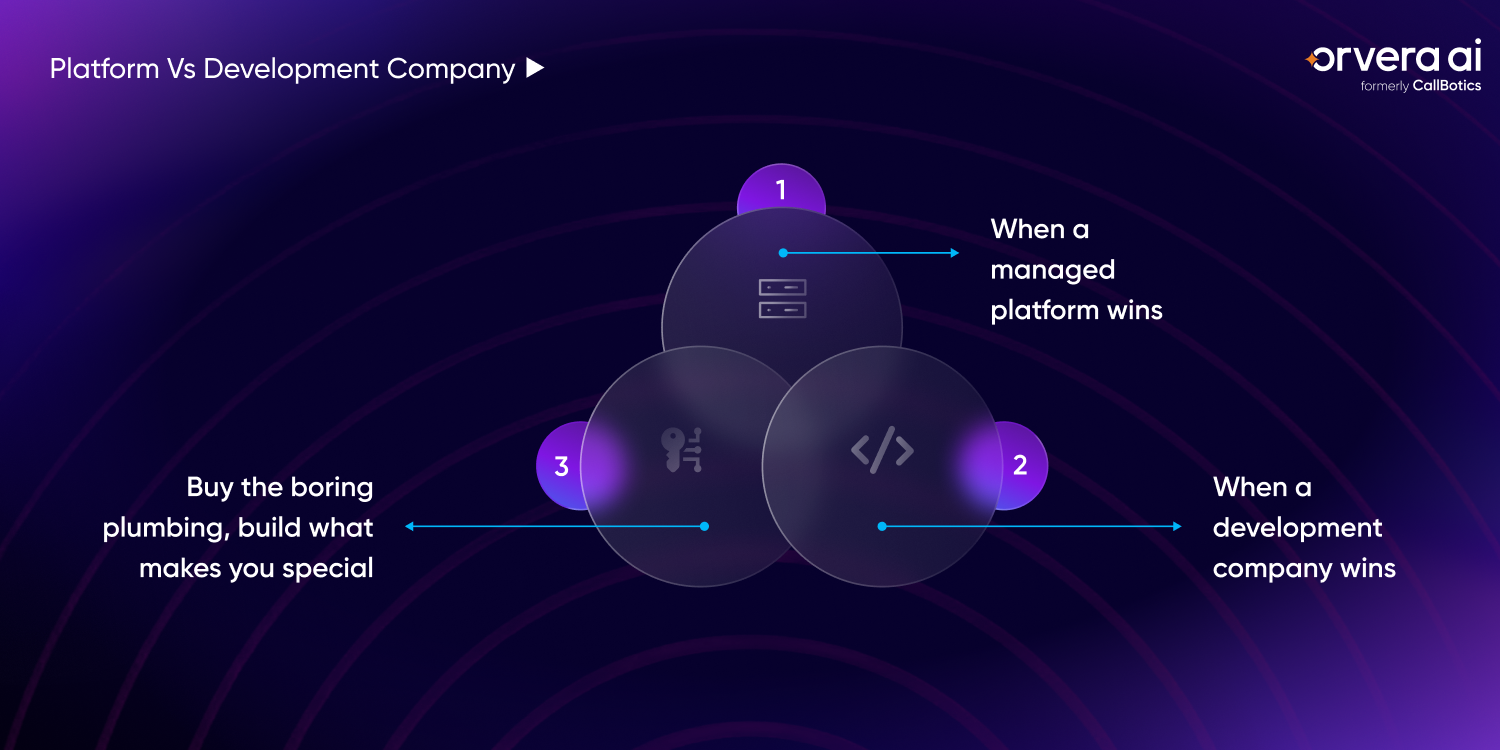
When a managed platform wins
A managed platform wins when your workflows are standard or close to it. Returns, account questions, appointment booking, and password resets are problems a configurable platform already solves, so building them from scratch wastes time and money. Platforms ship with prebuilt connectors, built-in integrations, compliance scaffolding, and templates, which means deployment is measured in weeks rather than quarters of custom work. This is the right path when engineering resources are limited and you do not want to own the maintenance, model updates, and monitoring that a custom build demands. You trade some control for speed, support, and a roadmap someone else maintains.
When a development company wins
A conversational AI development company wins when you need something no packaged tool delivers. If the AI is embedded in your product rather than bolted onto support, if the conversation itself is a competitive advantage, or if you have strict and unusual requirements around data, models, or logic, custom development earns its cost. This path suits teams that have the engineering capability, or want to own it, and are prepared for the long-term maintenance that comes with a bespoke system. You gain full control over the experience and the underlying stack. In return, you accept the build, the upkeep, and the roadmap as your responsibility.
Buy the boring plumbing, build what makes you special
Most enterprises should not treat this as all-or-nothing. A useful rule is to buy the boring plumbing and build what makes you special. Use a managed platform for the standard, undifferentiated work every contact center runs, and reserve custom development for the interactions that genuinely set your business apart. In practice that usually means a platform carries the bulk of volume while a selective in-house or partner-built layer handles the few workflows where control is worth the cost. The mistake is spending scarce engineering effort rebuilding commodity capabilities a vendor already offers, or outsourcing the one experience that differentiates you.
Once you know whether you are buying a platform or building with a development company, the next step is comparing specific platforms head to head, on integration, pricing, security, and support. For that, see our enterprise buyer's guide.
Vertical Specialists
The more regulated your industry, the shorter your real shortlist of conversational AI companies. Compliance requirements, specialized integrations, and the need for proven deployments in your specific field disqualify most general-purpose vendors before pricing ever comes up. A vertical lens is therefore a fast filter. Start with companies that already hold the right certifications and can name a live deployment in your industry.
Healthcare. Healthcare conversational AI companies split into two groups. Vertical-native specialists build for clinical and patient-access workflows from the ground up. Hyro focuses on health-system patient access across voice, chat, and SMS and reports an 85% reduction in call abandonment and a 79% improvement in speed-to-answer at Intermountain Health, while Hippocratic AI builds safety-first, patient-facing clinical agents on its Polaris model. Horizontal platforms with HIPAA credentials also serve the vertical, including Kore.ai, PolyAI, and Orvera. Whatever the type, require HIPAA compliance with a signed business associate agreement, EHR integration, and SOC 2 Type II certification before any agent touches patient data.
Financial services and insurance. Finance and insurtech conversational AI companies face strict controls around payments, identity, and disclosures, so the field narrows to vendors that can prove compliance and relevant deployments. The enterprise and agentic platforms lead here. Sierra serves major banks along with insurers such as Cigna and Blue Cross Blue Shield, Decagon serves fintechs including Block, Affirm, and Chime, and PolyAI runs banking workflows for institutions like UniCredit. For the deeper read on this vertical, see our guide to conversational AI in financial services.
Mortgage. Mortgage conversational AI companies handle document-heavy, tightly regulated workflows across applications, refinancing, and servicing, which rewards companies with lending-system integration and audit trails. In practice these are served by the same agentic platforms operating in finance. Sierra powers customer interactions for Rocket Mortgage, and lending fintech Figure runs on Decagon. The buyer's test is the same as every regulated vertical. Can the company show a named deployment, the right integrations, and the compliance posture your regulators expect?
Conclusion
The conversational AI market is crowded but not chaotic. It resolves into six types of company, spanning enterprise platforms, agentic startups, voice-AI specialists, CCaaS and CX suites, big-tech clouds, and developer platforms and partners, and the type tells you what you are buying. Read it by category, then by maturity, separating incumbents with production scale from startups still proving they work on live traffic, and treating a large valuation as investor confidence rather than proof. Decide whether a managed platform or a development company fits the job, buying the boring plumbing and building only what makes you special. If your industry is regulated, filter early for the certifications and named deployments a healthcare, finance, insurance, or mortgage rollout demands. Whatever the category, one test cuts through every pitch. Ask for containment and resolution rates on live traffic, not a demo, and a reference customer you can call.
Two next steps follow from the map. To compare specific platforms on integration, pricing, security, and support, see our enterprise buyer's guide, and to go deep on a regulated vertical, see our guide to conversational AI in financial services. If your priority is contact-center quality and compliance in one platform, with automated QA, voice-of-customer intelligence, and multilingual support across regulated industries, that is the lane Orvera is built for. Ask any company on this list, including Orvera, for its live-traffic containment rates and a reference you can call, because the companies worth choosing will have both.
Frequently asked questions
A conversational AI company builds software that understands natural language and holds real back-and-forth conversations, by text or voice, to automate customer interactions at scale. What separates it from a basic chatbot vendor is the understanding layer that interprets what a customer means rather than matching keywords to a script.
The top conversational AI companies in 2026 include enterprise platforms Cognigy and Kore.ai, agentic startups Sierra, Decagon, and Ada, voice specialists PolyAI and Retell, and contact-center suites such as Genesys, Five9, and Zendesk. Big-tech clouds Google, Microsoft, Amazon, and IBM, along with agentic customer-experience platforms like Orvera, round out the field.
A platform vendor sells configurable software you deploy and run yourself, while a conversational AI development company builds a custom solution to your specification as a service. Choose a platform for standard workflows and speed, and a development company when you need a bespoke, product-embedded build with full control.
Neither is automatically safer, because the real risk is choosing a company that cannot deliver in production, not its age. Incumbents bring scale and survivability while startups bring innovation and outcome-based pricing, so weigh funding, live-traffic performance, and longevity for each rather than the label.
To evaluate conversational AI vendors, ask for containment and resolution rates on live customer traffic, named deployments in your industry, integration fit, compliance credentials, and a reference customer you can call. For a full head-to-head comparison of specific platforms, see our enterprise buyer's guide.
Regulated industries are served by vertical specialists such as Hyro and Hippocratic AI in healthcare, alongside enterprise and agentic platforms with the right certifications like Sierra, Decagon, Kore.ai, and Orvera. Require HIPAA, SOC 2 Type II, or the relevant financial compliance plus a named deployment, and for the vertical deep dive see our guide to conversational AI in financial services.
Written by
Anindita Majumder
Anindita Majumder is a communications professional with nearly four years of experience in public relations, corporate communications, and journalism. She creates content that helps brands communicate their vision, products, and expertise through press releases, thought leadership, and editorial pieces. Outside of work, she is a vocalist, which keeps her creativity flowing.