What Works in Conversational AI for Banking and Insurance in 2026
Conversational AI in financial services lives or dies on governance and observability. Every answer your system gives a customer...

Key highlights
TL;DR —- In a Nutshell
- Conversational AI in financial services must prioritize governance, observability, and resolution because every automated customer interaction can carry regulatory consequences
- Banking use cases such as balances, payments, fraud alerts, loan servicing, collections, and KYC work best when AI can act on authenticated records with clear controls and audit trails
- Insurance offers major opportunities across FNOL, quote-to-bind, policy servicing, renewals, and agent copilots, but each workflow needs clearly defined authority and human escalation boundaries
- A strong financial-services AI platform should provide observability, compliance controls, core-system integration, measurable resolution, human handoff, model-drift monitoring, and consistent multilingual QA
- Post-launch risks such as hallucinations, blocked human escalation, model drift, integration failures, and data exposure make continuous monitoring essential rather than optional
- The best deployments focus on measurable outcomes and defensible ROI, using controlled pilots and resolution, CSAT, and compliance results instead of relying on containment rates alone
Conversational AI in financial services lives or dies on governance and observability. Every answer your system gives a customer about a balance, a dispute, a claim, or a premium is a regulated communication. It carries the same supervision, recordkeeping, and accuracy obligations that bind a human agent saying the same words. Deflection is the wrong goal for exactly that reason. A contained conversation that leaves a policyholder confused reads green on your dashboard. It still costs you the customer, and it can still land as a complaint.
Adoption already happened. Over 98 million people used a bank's chatbot in 2022, roughly 37% of the US population. The Consumer Financial Protection Bureau projects 110.9 million users by 2026. All ten of the largest US commercial banks already run one (opens in a new tab). The harder finding sits in the same report. Deficient chatbots that block a customer from reaching a live human can lead to law violations. Your worst automated answer is a compliance event with a timestamp on it.
Insurance is where this bites hardest, and it is the part almost nobody writes about. Most guides carrying a financial services title are banking guides. They cover balances and card locks well enough. First notice of loss, quote-to-bind, claims status, and agent copilots get a paragraph if they get anything. The NAIC Model Bulletin that now governs how carriers deploy AI rarely appears at all. Insurance gets real weight here. What follows assumes you already know what a conversational AI platform is. If that is fuzzy, start with the conversational AI platform overview and come back.
What Conversational AI in Financial Services Actually Is
Conversational AI for financial services is software that holds a natural-language conversation with a customer, acts against that customer's authenticated account record, and runs inside the same audit, access, and supervision controls that govern a human agent doing the same work. Two other things get confused with it, and the difference matters the moment a regulator asks who said what.
A rule-based bot matches keywords or walks a decision tree, so a person wrote every answer in advance and the bot can only return what the tree already holds, which is how customers end up in the doom loops the CFPB documents across its complaint data.
It holds no view of your customer's account, no permission model, and no obligation to be right about a specific policy number.
- It works against authenticated records, so a balance, a claim status, or a premium due date comes out of the core banking platform or the policy administration system once the customer has proved identity
- It sits behind the controls that already govern a human agent, which means every turn gets logged, scoped by role and entitlement, and made discoverable the way a call recording is
- It stays bounded by what regulators permit it to say, so a deterministic control layer enforces the same ceiling at runtime that stops a human agent from quoting an unauthorized rate
The context underneath shifts by vertical. In banking, the conversation runs against a core banking platform, and the obligations trace to CFPB expectations on accuracy and access to a live human, with FINRA supervision and recordkeeping rules layered on wherever securities come into scope. In insurance, it runs against a policy administration system such as Guidewire or Duck Creek, and the obligations trace to state insurance law and the NAIC Model Bulletin, which asks carriers to document their governance, validate their models, and disclose AI use to consumers. For the full capability set behind both, see the conversational AI platform overview.
Why Financial Services Is the Hardest Place to Deploy It
Financial services is the hardest place to deploy conversational AI because an answer that reads as a service failure in retail reads as a supervision failure here. Regulators have now put it in writing that the technology behind a sentence changes nothing about who answers for it.
Every AI response is a regulated communication
Your conversational AI holds no separate regulatory status. FINRA sets this out in its 2026 Annual Regulatory Oversight Report, which treats the rules as technology-neutral (opens in a new tab), so deploying generative AI leaves a firm's obligations on supervision, communications, recordkeeping, outsourcing, and fair dealing exactly where they were. The NAIC tells carriers the same thing, reminding insurers that decisions made or supported by AI must comply with all applicable insurance laws and regulations. A sentence your model produces about a premium carries the weight of a sentence your agent produces about a premium.
What the regulators actually require
Three bodies set the floor, and each one lands on a different part of your deployment.
- The CFPB expects accuracy and a working path to a human, and its 2023 report warns that deficient chatbots blocking access to live support (opens in a new tab) can lead to law violations
- FINRA Rule 3110 requires a reasonably designed supervisory system, and the 2026 report carries that expectation into chatbot interactions, which firms should supervise and archive the way they handle any other customer communication
- The NAIC Model Bulletin asks carriers to run a written AI Systems Program covering governance, (opens in a new tab) model validation, consumer disclosure, adverse-outcome mitigation, and third-party oversight
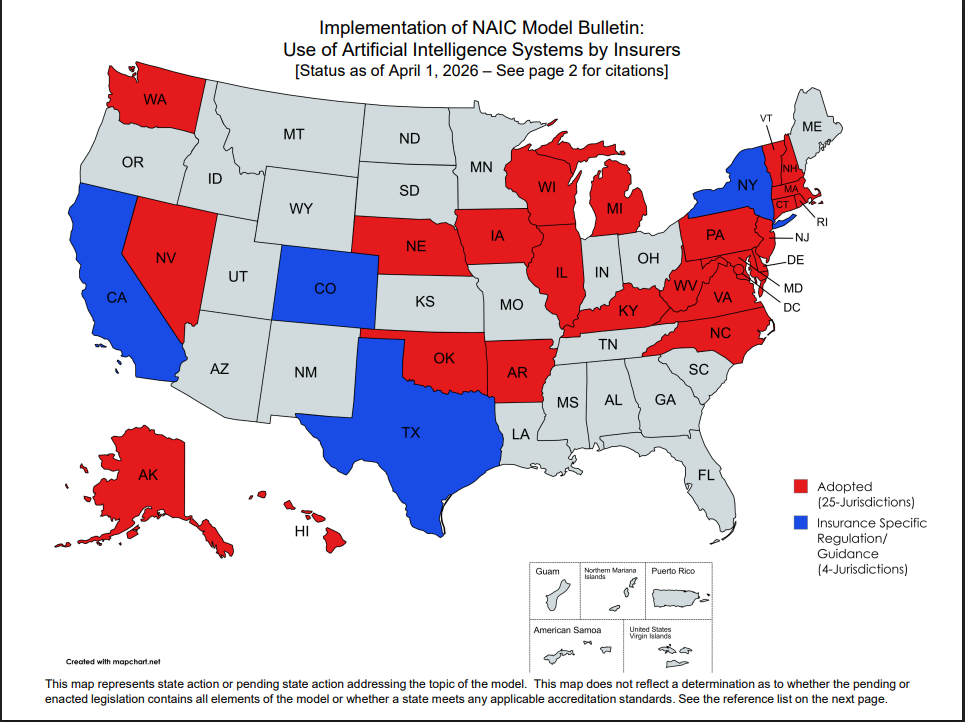
Caption: NAIC AI Model Bulletin implementation across US jurisdictions as of April 1, 2026.
That last one stopped being theoretical some time ago, because 24 states and the District of Columbia had adopted (opens in a new tab) the bulletin as of April 1, 2026, while California, Colorado, New York, and Texas run their own AI rules instead. The examination machinery is arriving right behind it, and 12 states began piloting the NAIC AI Systems Evaluation Tool in March 2026, with adoption expected at the Fall 2026 National Meeting.
Why deflection is the wrong goal
Deflection counts the conversations you avoided and tells you nothing about what happened inside them. The CFPB documents customers stuck in loops with no route to a person, which is the precise condition its report ties to legal exposure. A contained conversation that leaves a policyholder without an answer still reads as containment on your dashboard while it generates a complaint to a state department, a churn event, and a transcript a regulator can pull. Resolution under audit is the only number that survives an examination.
Conversational AI Use Cases in Banking
Conversational AI in banking pays back fastest in the lanes where the answer is a retrievable fact and the judgment belongs to nobody. Bank of America's Erica is the proof at scale, with 3.2 billion client interactions since its 2018 launch (opens in a new tab) and 20.6 million users running nearly 700 million conversations through it during 2025. Erica got there by owning balances, spending trends, card controls, and scheduling, which are the intents where a correct answer sits in a record and a wrong answer shows up in a log. Rank your own lanes the same way, by how much judgment the answer requires and how fast a mistake surfaces.
- Balances, payments, and transfers sit at the bottom of the judgment scale, because the answer lives in the core banking record and the workflow ends in a posted transaction the customer can verify
- Disputes and fraud alerts add outbound contact and a card lock, so the system has to authenticate before it acts and log the consent that authorized the freeze
- Loan servicing and pre-screening carry payoff quotes, due dates, and eligibility signals, which turns an inaccurate number into a Truth in Lending or UDAAP question instead of a bad experience
- Collections outreach works only inside a fixed set of approved options with consent captured on every turn, because the FDCPA and its Regulation F govern contact frequency, timing, and content for covered collectors
- Onboarding and KYC sit at the top of the scale, since the conversation gathers identity evidence a Bank Secrecy Act examiner can later ask you to reproduce
Fraud detection is where conversational AI in banking earns the most and forgives the least. The workflow runs outbound, so the system reaches a customer about a suspicious transaction, authenticates them, takes a confirm or a deny, and locks the card on a deny. Every one of those steps is a regulated action on a live account, and the transcript is your only record of what the customer actually authorized. Bank of America runs this proactively at volume, having delivered more than 1.7 billion personalized insights (opens in a new tab) and alerts through Erica as of August 2025. Build the same lane without turn-level logging and you have automated an action you cannot later evidence.
The containment figures attached to this work deserve a harder look than they usually get. The 60 to 80 percent numbers quoted against a 20 to 30 percent legacy IVR baseline trace back almost entirely to the vendors selling the replacement, and no independent analyst benchmark confirms them. The arithmetic matters less than the metric, because containment counts the calls that stayed inside the system and says nothing about the ones that ended without an answer. Measure resolution by intent against a human baseline, hold it in a log an examiner can read, and the number you report will survive contact with someone who checks.
Conversational AI in Insurance
Conversational AI in insurance runs deeper than most guides admit, and Lemonade's SEC filings show exactly how deep. As of December 31, 2025, AI Jim took 96% of first notices of loss (opens in a new tab) from Lemonade customers without human intervention, and roughly 55% of the carrier's claims were automated end to end. The line sitting next to that number matters more than the number does. AI Jim triages and assigns the claims he is not authorized to settle to human experts, which means Lemonade drew a boundary around what the model may decide and built the handoff before it built the volume. Every insurance chatbot use case below lives or dies on where that boundary sits.
FNOL and chatbot insurance claims intake
This is the highest-volume lane and the one where the workflow has to be exact. The customer reports a loss, the chatbot for insurance authenticates them, captures the facts, opens the file in the claims platform, and either settles inside a defined authority or routes to a human with the groundwork already done. Lemonade runs that intake at 96% coverage. State Farm, the largest US insurer by policy count, spent 2026 piloting its own AI virtual assistant (opens in a new tab) for initial auto loss reporting, and that system hands the file to a human claims professional once the facts are captured. Two carriers, two authority levels, one design principle underneath. Watch your escalation rate by loss type, because a lane that never escalates is a lane where somebody set the boundary too wide.
Quote-to-bind and lead intake
A quote conversation turns a prospect into a rated risk, so every question the insurance chatbot asks becomes part of an underwriting record. Lemonade runs this side of the house through AI Maya, which collects the information, prices the policy, and binds the coverage inside the app. An underwriting question asked badly becomes an underwriting decision made badly, and the NAIC expects you to explain how a rate was reached when a consumer challenges it. Log the full question set alongside the inputs it produced, since the final quote on its own evidences nothing.
Policy changes, billing, and renewals
These look routine until a coverage question arrives. Chatbots in insurance handle address changes, payment dates, and renewal quotes cleanly, because the answer sits in the policy administration record and the customer can verify it. The failure mode shows up when a policyholder asks something adjacent, like what happens if they drop collision, and the model sits one sentence away from advice it holds no license to give. Bound the intent list, then log every turn where a customer asked outside it, because that log is your evidence the system stayed in its lane.
Agent and broker copilots
This is the safest lane and the one most carriers ship first, which is why chatbots for insurance keep landing behind the desk before they land in front of the customer. State Farm is rolling a digital assistant called Navi across roughly 19,000 agent offices under its Next Gen Good Neighbor programme, and by mid-2026 the carrier was rewriting agent contracts to require daily AI use for anyone staying past 2027. All of it rests on integration. AI agents for customer service in insurance that read from Guidewire, Duck Creek, AMS360, or Applied Epic without writing back to them are demos, because the conversation closes with the record unchanged and your agent does the job twice.
What the NAIC Model Bulletin asks of every lane
The bulletin sits over all four lanes (opens in a new tab) above and asks four things of the carrier running them.
- Disclose to the consumer that an AI system is involved in the interaction
- Explain any adverse outcome the system contributed to, which means the model's reasoning has to be reconstructable months after the conversation closed
- Validate your models on a documented cadence you can produce on request
- Oversee the third parties whose models you deployed, because the bulletin holds you accountable for a vendor's system the way it holds you accountable for your own
That last one is the one carriers underprice. For vendors built specifically for this work, see the guide to conversational AI companies. For how the authority question changes once systems start acting on their own, see agentic AI in regulated financial services.
What Is Right for Regulated FS
Getting this right in financial services pays at a scale that justifies the governance work in front of it. McKinsey estimates that applying generative AI to customer care functions could raise productivity by 30 to 45 percent (opens in a new tab) of current function costs, and that it could further reduce the volume of human-serviced contacts by up to 50 percent. Both are ceilings on a 2023 estimate, and reaching either one inside a regulated business depends on seven things. They are listed below in the order they matter, and observability leads because every criterion under it is unprovable without it.
| Criterion | What is right | The question to ask |
|---|---|---|
| Observability and auto-QA | Every conversation is scored automatically against your compliance rubric, with results, queryable by intent, date, and outcome | Show me a compliance failure the system caught last month that no human reviewed |
| Compliance posture | SOC 2 Type II, HIPAA where health data is in scope, ISO 42001 for the AI management system, immutable audit logs, PII redaction at the LLM boundary, state-level AI disclosure, and documented data residency | Where does PII get stripped, and what does the model provider actually receive? |
| Core-system integration | The system reads and writes to your banking core, Guidewire, Duck Creek, AM360, or Applied Epic, with the record updated before the conversation ends | Can you change a record live, right now, in this demo? |
| Resolution | Reporting shows the customer task completed, measured by intent against a human baseline, with repeat-contact rates attached to every number | What share of contained conversations produced another contact within seven days? |
| Human handoff | Escalation triggers on confidence, sentiment, and intent category, carries full context across, and logs itself as an event a supervisor can pull | What happens when a customer requests a person three times? |
| Model drift and hallucination monitoring | Accuracy is tracked per intent over time, with alerting on decay and every ungrounded answer flagged against its source | Who gets paged when accuracy on claims status drops four points |
| Multilingual | Compliance rubrics and disclosure language held in every language you serve, with QA coverage matching your actual volume mix | Is the Spanish auto-QA as good as the English auto-QA? |
Observability sits at the top because the other six are assertions until it exists. A vendor can tell you the handoff works, the accuracy holds, and the disclosures fire on time, and you are taking all three on trust until conversation-level scoring proves them. The CFPB, FINRA, and the NAIC each expect you to evidence what your system did and said, and evidence is a byproduct of measurement you either built or skipped.
The compliance row carries one trap worth naming. SOC 2 Type II and HIPAA describe how well a vendor manages its own controls, and ISO 42001 describes how it governs its AI management system. None of the three describes what the model said to your customer on a Tuesday afternoon. Certifications get you through procurement, and the transcript log gets you through an examination, so buy a platform that produces both.
Best AI and Tools for Insurance Agents and FS Teams
The best AI for insurance agents and FS teams is the platform that clears the seven criteria above inside your regulatory perimeter, and the market splits into three archetypes that clear different ones. Score any shortlist against observability first, because a tool that cannot evidence what it said is disqualified in a regulated business no matter how well it demos.
Horizontal conversational AI platforms
These bring broad channel coverage and deep developer tooling, and they clear the integration and multilingual rows comfortably. What they hand back to you is the compliance work, so the rubric, the auto-QA, and the audit layer are yours to build. That suits an FS team with the engineering bench to own a governance stack and the appetite to maintain it. It punishes a team that assumed those rows came included.
Vertical insurance point tools
These ships are pre-wired to carrier workflows like FNOL and quote-to-bind, and many speak Guidewire or Duck Creek out of the box. They clear the core-system row cleanly for the vertical they were built for and rarely stretch past it. A single-line carrier gets a fast, tidy fit from one of them. A multi-line carrier ends up running several and stitching the seams itself.
Contact-center platforms with governance built in
These lead on the observability and compliance rows, scoring every conversation against a rubric by default instead of leaving it to you. They are the fit when the examination question, not the build velocity, is what keeps you up at night. Orvera sits in this archetype, and honesty about its lane matters more than a ranking does. It is an agentic contact-center platform whose value is 100% AI auto-QA on every conversation, a governed compliance layer, and multilingual coverage that holds the same QA standard across languages.
It orchestrates best-in-class third-party models behind that governed layer instead of building its own, which is the right call when the model is a commodity and the governance is the product. It is not the answer for a team that wants raw API primitives to assemble in-house, and it does not pretend to be a vertical underwriting engine. Where it earns its place is the examination, because it produces the transcript-level evidence the CFPB, FINRA, and NAIC all expect.
Build versus buy
Underneath the shortlist sits the build-versus-buy call, and the rule that survives contact with a regulator is to buy the boring plumbing and build only what makes you different. Authentication, logging, PII redaction, disclosure management, and auto-QA are solved problems, and rebuilding them burns a year of engineering to arrive where a mature platform already stands. Your underwriting judgment, your claims philosophy, and your customer relationships are what no vendor can hand you, so that is where your own build effort belongs. A carrier that builds its own audit logging and buys its underwriting model has the equation backward.
Reaching a defensible pick means comparing named platforms on verified capability, which is more than a section inside one guide can carry. For the full enterprise comparison scored against these criteria, see the enterprise conversational AI platform guide. For the wider set of vendors including the vertical insurance specialists, see the guide to conversational AI companies. Bring the seven questions from the previous section into every demo, and treat any vendor who cannot answer the observability question as a vendor who has answered it.
What Breaks After Go-Live
The failures that matter in financial services do not announce themselves on launch day. They surface weeks later as a drift in the numbers, and each one has a leading indicator you can watch and a question that catches it before an examiner does. Adoption is already mainstream, with the CFPB (opens in a new tab) reporting over 98 million bank chatbot users in 2022 and projecting 110.9 million by 2026, so the volume flowing through these systems makes every silent failure a compounding one.
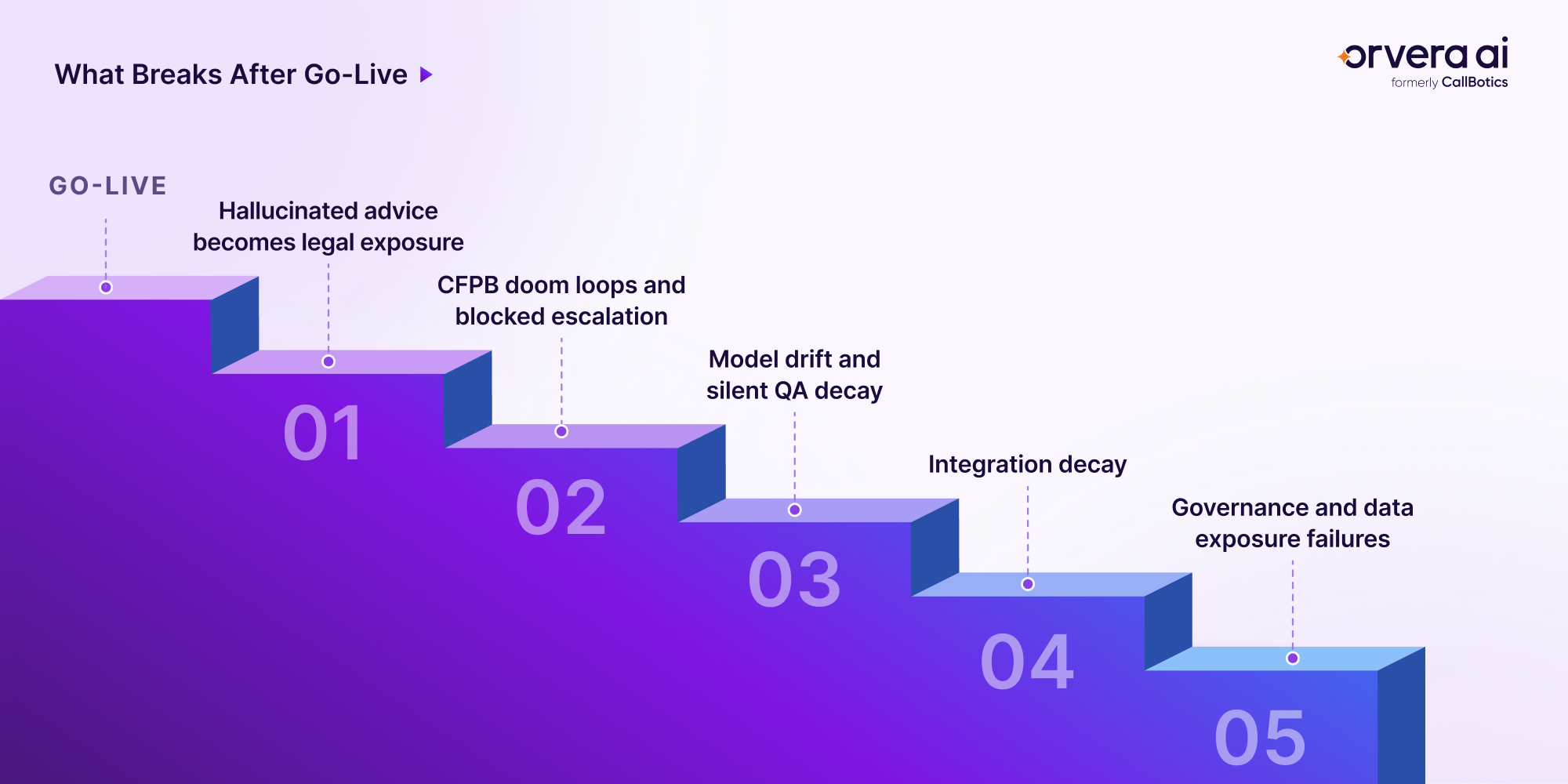
Hallucinated advice becomes legal exposure
An FS model that invents a coverage detail or a rate has not made an error, it has made a regulated misstatement your firm now owns. The leading indicator is a rising share of answers the system cannot tie back to a source document. The question that catches it is direct. What percentage of responses last week were grounded in a retrieved record, and who reviewed the ones that were not? A model confident about a number it never retrieved is the exposure, and grounding rate is how you see it coming.
CFPB doom loops and blocked escalation
A customer trapped in a loop with no route to a person is the exact condition the CFPB ties to potential law violations. The leading indicator is a cluster of conversations with high turn counts and no successful handoff. The question that catches it is simple. How many customers asked for a human last week and did not reach one within two turns? A contained conversation that traps the customer is a complaint waiting to be filed, and your escalation logs already hold the evidence.
Model drift and silent QA decay
Accuracy does not fall off a cliff; it erodes a point at a time while the dashboard stays green. The leading indicator is per-intent accuracy sliding over weeks with no single event to blame. The question that catches it is pointed. Is claims-status accuracy the same today as it was at launch, and who gets alerted when it drops? Drift is invisible without per-intent tracking over time, which is why sampling a few calls a month tells you almost nothing worth knowing.
Integration decay
The conversation layer can hold while the connection underneath it quietly rots after a core-system update changes a field or an API version retires. The leading indicator is a rise in failed writes or stale reads against your banking core or policy platform. The question that catches it is concrete. When your claims system last updated, did anyone confirm the assistant could still write to it? A bot that reads a system it can no longer write to produces confident answers built on records it never actually changed.
Governance and data exposure failures
Customer records reachable through a chat interface are a live exposure surface, as Star Health learned (opens in a new tab) in 2024 when data on over 31 million policyholders was distributed through Telegram chatbots and reported by Reuters. The leading indicator is any access to policyholder data that falls outside your logged, authenticated path. The question that catches it is blunt. Can anyone reach customer records through a conversational surface without passing your authentication and audit layer? Every unlogged path to customer data is a breach that has not happened yet.
Each of these five is invisible without observability, which is why it led the criteria in the previous section and why it closes this one. Gartner reports that at least 30% of generative AI projects (opens in a new tab) are abandoned after proof of concept, and post-launch decay you could not see is a large part of why. For the full operational playbook on running one of these systems after launch, see what happens after conversational AI goes live.
Deployment and ROI
There is real money on the table here, and just as real a penalty for handling the rollout badly. McKinsey estimates (opens in a new tab) that generative AI could add somewhere between $200 billion and $340 billion in annual value to the global banking sector, which works out to roughly 2.8 to 4.7 percent of industry revenues. Most people quote that number and stop, but McKinsey adds a condition worth holding onto, which is that the figure only holds if the use cases are fully implemented. In other words, the value sits on the far side of deployment, and the way you get there determines how much of it you actually keep.
Your first real decision is build, buy, or partner, and the honest answer depends on what you are most trying to protect.
- Building it yourself gives you complete control, but it also costs you close to a year of engineering to arrive where a mature platform already sits, so it tends to make sense only when your scale turns the platform itself into a core asset
- Buying a configured platform hands you the governance, integration, and auto-QA on day one, which is usually the better fit when what you want to protect is your underwriting and your balance sheet, not your infrastructure
- Partnering splits the difference, putting a vendor's platform in your hands alongside an implementer who runs it with you, and it works well for a firm that intends to own the system down the road but needs it live now
The money really goes into integrating the system with your banking core or policy administration platform, then into the professional services to configure it, the compliance controls that make it examinable, and the retraining you will do every time your products or the rules around them change. There is also the cost almost no one puts in the quote, and everyone ends up paying, which is maintenance, because a model left alone drifts and an integration left unwatched slowly falls out of sync. The safest way to compare vendors is on the five-year total, since the cheapest license tends to arrive attached to the most expensive integration.
A pilot is how you find out if any of this works before you commit to scaling it, and the trick is to keep it small enough to measure while still choosing something that genuinely matters. Settle on a single intent and a single channel, pick a high-volume, low-judgment lane like balance inquiries or claims status, and run it head to head against a human baseline. What you cannot do is measure only one thing, because each number quietly covers for what the others would expose.
- Containment tells you how much volume the system handled on its own without kicking the conversation to a person
- CSAT tells you whether the customers it did handle actually walked away with what they came for
- Compliance-audit results tell you whether those same conversations would hold up with a regulator reading the transcript
For context on timelines, Orvera runs a full deployment in three to six weeks, while bounded pilots across the wider market tend to run closer to eight to twelve weeks, mostly because of scoping and the time it takes to get everyone signed off. It helps to treat that wider window as background for your own planning rather than a benchmark, keep it separate from any one vendor's numbers, and judge the pilot on the results it hands back instead of how quickly it went live.
Conclusion
Conversational AI in financial services works when you build it to be read back. Every answer it gives is a regulated communication, so the system that survives an examination is the one that can show what it said, to whom, and on what record. That reframes the whole project. The goal was never to contain the most conversations. It was to resolve them in a way you can stand behind when a regulator, a policyholder, or your own risk team asks what happened.
Insurance is where this is hardest and least mapped, which is also where the advantage sits for carriers who get the governance right early. If you are scoping a deployment, start by scoring your shortlist against the seven criteria above. Bring the observability question into every demo, and treat a vendor who cannot answer it as one who already has.
Frequently asked questions
A chatbot follows a scripted decision tree and can only return answers someone wrote in advance. Conversational AI in financial services works against a customer's authenticated record, handles natural language, and runs inside the same audit and supervision controls as a human agent. The first deflects, the second resolves and leaves an examinable trail.
The technology holds no compliance status on its own, because your deployment either meets the obligations or it does not. The CFPB expects accuracy and a working path to a human, FINRA Rule 3110 requires supervision and recordkeeping, and the NAIC asks carriers to run a written AI Systems Program. Compliance comes from how you govern and log the system.
The return shows up in claims and service costs, but only when you measure resolution rather than deflection. A contained conversation that leaves a policyholder confused generates a complaint, a callback, and a churn risk, which erases the saving. Track task completion against a human baseline, and attach repeat-contact rates to every number you report.
The system authenticates the customer, captures the loss details, opens the file in your claims platform, and either settles inside a defined authority or routes to a human with the groundwork done. The design question is where you draw that authority line, since a system that never escalates is one whose boundary sits too wide.
Every path to customer records runs through your authentication and audit layer, with no exceptions reachable through a conversational surface. PII gets redacted at the boundary before anything reaches the model provider, access is scoped by role, and every turn is logged. Star Health shows what an unlogged, unauthenticated path to policyholder data eventually costs.
Consumer AI generates fluent language from training patterns, but it cannot see your customer's account, enforce a permission model, or promise accuracy about a specific policy. It also gives you no audit trail an examiner can read. For regulated financial services work, you need a system built to act against records and evidence of what it did.

Written by
Anindita Majumder
Anindita Majumder is a communications professional with nearly four years of experience in public relations, corporate communications, and journalism. She creates content that helps brands communicate their vision, products, and expertise through press releases, thought leadership, and editorial pieces. Outside of work, she is a vocalist, which keeps her creativity flowing.