How an AI Agent Mines False-Alarm Root Causes for Residential Subscription Companies
False-alarm root-cause mining turns each subscriber conversation into an attributed record. First, understand why the conversation today leaves nothing behind.

Key highlights
- False-alarm root-cause mining turns each subscriber conversation into an attributed record. First, understand why the conversation today leaves nothing behind.
- A false-alarm conversation ends with a stated cause, an installer, a device model, a cohort, and a market attached to the record. That is the mechanism, and it runs on every call.
- A single subscriber call, worked from greeting to resolution, shows exactly how each attribution field gets written and why the operations team can act on what it sees.
- Every rule the subscription company sets is owned by that company. The agent executes those rules inside the systems of record, and the operations team owns every decision that follows from them.
- The case for a managed build rests on three facts: the program is live in three to six weeks, every conversation is audited from day one, and the operating experience behind it spans over 18 years of contact center operations.
- Four measures tell the operations leader the program is producing results. Each one is a count or a duration, readable from the systems of record the company already owns.
- False alarms per subscriber per year, by root cause and cohort
- False-alarm conversations that leave with an attributed cause
Why does a false-alarm call leave nothing behind for the operations team?
False-alarm root-cause mining turns each subscriber conversation into an attributed record. First, understand why the conversation today leaves nothing behind.
The siren went off at 2 AM. The central station cleared it. The next morning the subscriber calls in, the representative listens, closes the ticket with a disposition code that reads "false alarm, customer error," and types a one-line note. The call is done in four minutes.
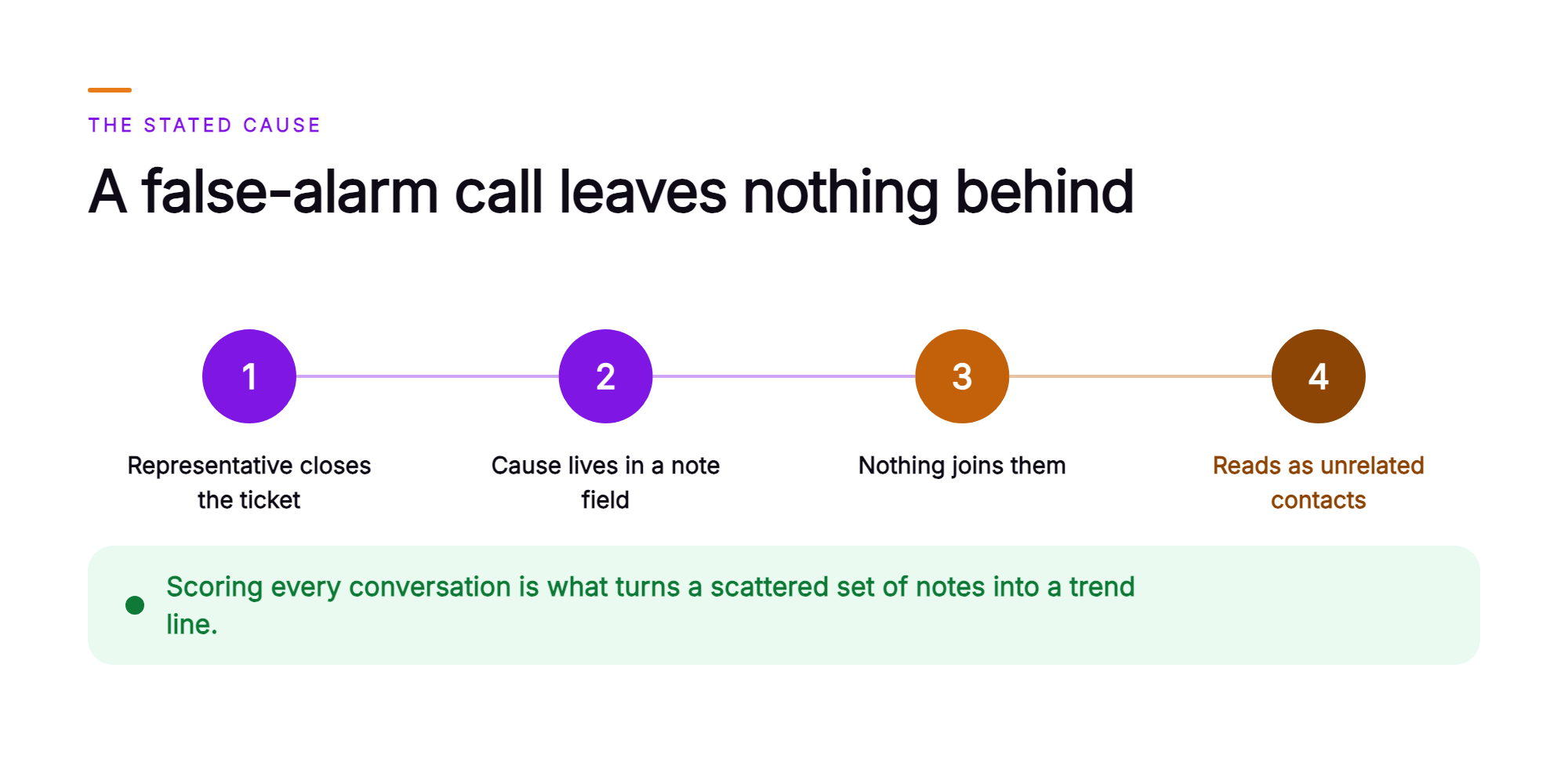
The review problem compounds it. A typical QA program scores a thin sample of calls per representative per month. A pattern appearing in a handful of conversations a week stays invisible to the team responsible for reducing it. Scoring every conversation is what turns a scattered set of notes into a trend line. Coverage earns its keep once the cause is written to a fixed field and linked to the account dimensions that explain it.
The outcome an operations leader needs is false alarms per subscriber per year, broken out by root cause and by cohort. That is what false-alarm root-cause mining produces. The next section defines what it is and how it works.
What is false-alarm root-cause mining?
False-alarm root-cause mining is the practice of capturing the cause a subscriber states during a conversation, classifying it into a fixed taxonomy, and attributing it to the installer, device model, install cohort, and market attached to that account.
The definition is important because it draws a precise boundary. The mining belongs to the conversation and the account record. Device diagnosis, technician decisions, and any equipment change stay with the operations team. What root-cause mining produces is a structured, attributed record that the operations team can act on and take into the repair decision.
The subscription company owns the cause taxonomy and sets every category in it. A list for a residential security program often includes arming or disarming error, pet or household motion, door or window contact misalignment, low battery, sensor placement, an environmental trigger such as a draft or direct sunlight, and unknown. Each category is a fixed label, so the record is countable and comparable across months and markets.
The attribution dimensions come from the account record itself. Installer or dealer ID comes from the original work order. Device model and zone come from the equipment list. Install cohort comes from the activation date. Market comes from the service address. Agentic AI for residential subscription services connects those dimensions to the stated cause automatically, field by field. And because every conversation is scored against the same rubric regardless of who handled it, the attributed record is auditable from the moment it is written.
The next section describes exactly what the AI agent does during the conversation to produce that record.
What does the agentic AI agent do on a false-alarm call?
A false-alarm conversation ends with a stated cause, an installer, a device model, a cohort, and a market attached to the record. That is the mechanism, and it runs on every call.
The conversation follows a fixed sequence. The AI agent verifies the subscriber's identity, confirms that the central station cleared the event, then asks the subscriber to describe what happened in their own words. Before anything is written, the agent reads the stated cause back to the subscriber and confirms it. That confirmation step matters. It makes the stated cause one the subscriber has verified, and it produces a record the operations team can stand behind.
The write happens immediately after confirmation. The agent classifies the stated cause into the taxonomy the subscription company defined, then reads installer, device model, zone, activation date, and service address directly from the account record. One attributed false-alarm record lands in the systems the company already runs. The attribution fields arrive with it on the call, filled in and countable by cohort. And because scaling quality management with AI means every conversation, human-handled and AI-handled, passes through the same Auto QA rubric, the attributed record is auditable from the moment it is written.
The handoff follows a rule the customer sets. Where the stated cause meets a defined threshold, for example a third event on the same zone within thirty days, the agent opens a case for the operations team with the full attribution attached. The operations team decides on the technician visit and any device change. The agent records and attributes. The decision belongs to your people.
That sequence runs on a single call. The next section walks it through a specific subscriber scenario so you can see each step in order.
How does one false-alarm call get attributed from greeting to record?
A single subscriber call, worked from greeting to resolution, shows exactly how each attribution field gets written and why the operations team can act on what it sees.
The scenario is straightforward. A subscriber in a Southwest market calls the morning after a hallway motion sensor tripped during the night. The system was armed. The household has a new dog. That detail is the stated cause, and it is the first piece of evidence the record needs.
The AI agent follows a fixed sequence from the opening second. It verifies the subscriber's identity, confirms the account number, and reads the central station clearance on the event. It then asks the subscriber to describe what happened in plain terms. The subscriber says the dog triggered the sensor. The agent classifies that statement against the cause taxonomy, in this case pet or household motion, and reads the classification back to the subscriber for confirmation. Once confirmed, the agent pulls the installer, device model, zone, activation month, and service address from the account record. It writes each of those fields in the same structure on every call. The attributed record lands directly in the company's systems of record.
What the operations team sees in the weeks that follow is where the value of a contact center analytics platform becomes concrete. The same stated cause, pet or household motion, begins clustering on one installer's spring activation cohort in that same market. The operations team takes that pattern into its own device placement review and schedules a technician visit where the threshold warrants one.
The boundary holds throughout. The agent records and attributes. The operations team decides on the technician, the device, and the installer conversation. The call itself is complete and auditable before either decision is made. The next section covers the rules set by the subscription company to maintain consistency across every call.
Which rules does the subscription company set, and what does the agent do with them?
Every rule the subscription company sets is owned by that company. The agent executes those rules inside the systems of record, and the operations team owns every decision that follows from them.
The program runs on a governed configuration layer. The subscription company defines the taxonomy, the scripts, and the thresholds. The SOC 2 Type II certified AI agent platform holds those configurations and applies them consistently across every call, every market, and every cohort. What the customer sets, the agent does.
In practice, the pairing looks like this:
- Cause taxonomy and wording. The customer defines the closed list of causes and the exact label for each. The agent classifies the stated cause into one of those categories and writes the customer's label to the record.
- Confirmation script. The customer writes the confirmation prompt. The agent reads it verbatim before closing the cause field.
- Unknown cause. Where a subscriber cannot state a cause, the agent records "unknown" with all attribution fields intact. The operations team reads the unknown count by cohort and follows up on its own terms.
- Repeat caller rule. The agent reads prior attributed false-alarm records on the account and confirms whether the stated cause matches the last event. Repeat events on the same zone appear as a sequence.
- Operations case threshold. The customer sets the trigger, for example a third event on the same zone within thirty days. The agent opens the case with full attribution attached when that threshold is met.
- Escalation path. The customer defines when a call routes to a human rep. The agent transfers with the attributed record already written.
The operations team owns the device, the technician visit, and the installer conversation. The agent records, attributes, and executes. That boundary is what makes the attributed record actionable as soon as the case is opened. The next section covers how that boundary holds under a managed service, where Orvera AI implements the program and operates it for the subscription company.
Why have the platform built and run for a subscription company?
The case for a managed build rests on three facts: the program is live in three to six weeks, every conversation is audited from day one, and the operating experience behind it spans over 18 years of contact center operations.
Orvera AI builds, deploys, and runs the agentic AI platform on the subscription company's behalf. The configuration is complete before the first call is handled, which means disposition codes, handoff rules, and repeat-caller thresholds are set by an operating team that already knows what each of those means on a live floor. That operational heritage is what makes the deployment produce attributed records an operations leader can act on.
The quality layer holds the program accountable on every call. Automated quality management for regulated industries runs on every conversation, AI-handled and human-handled, under the same rubric. Cause classification is reviewed for consistency across reps and across markets, and every attributed record can be checked against the conversation that produced it. That auditability is built into how the record is written, which is what makes a root-cause count something an operations leader can act on.
The architecture supports the program as the business grows and as models improve. The platform is SOC 2 Type II certified, HIPAA compliant, and GDPR compliant. The governed, model-agnostic orchestration layer means the company can adopt newer models with the false-alarm program carried forward as configured. The rules the company set stay in place. The foundation underneath them can change.
The next step is knowing whether the program is producing results. The numbers that tell an operations leader it is working are specific, and they are covered in the following section.
Which numbers tell the operations leader it is working?
Four measures tell the operations leader the program is producing results. Each one is a count or a duration, readable from the systems of record the company already owns.
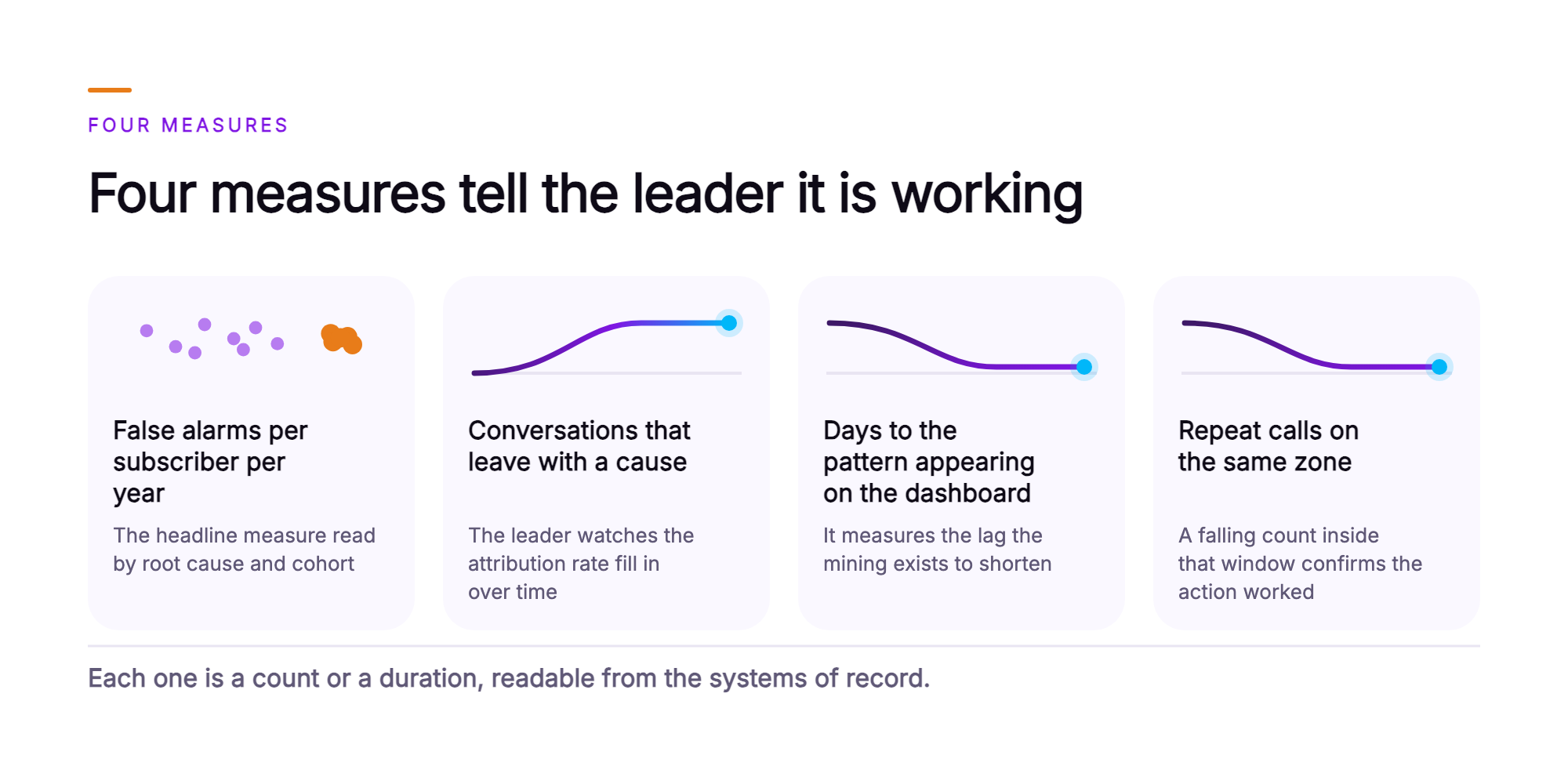
False alarms per subscriber per year, by root cause and cohort is the headline measure. It is the number the operations leader reports upward, and every attributed conversation the agent writes adds to it.
False-alarm conversations that leave with an attributed cause is reported weekly as a count set beside the total number of false-alarm conversations received that week. The leader watches the attribution rate fill in over time and can see immediately when a conversation class is leaving without a cause attached.
Days from a cohort's first attributed event to the pattern appearing on the operations dashboard measures the lag the mining exists to shorten. The operations team can act on the installer or the device before the cohort accumulates a second wave of calls.
Repeat false-alarm calls per subscriber on the same zone inside the follow-up window the company sets, read by cohort, shows whether the operations team's device and installer actions are landing. A falling count inside that window confirms the action worked. A flat count tells the team the intervention needs review.
These four numbers are what an operations leader brings to a leadership conversation. The following section frames exactly what that presentation looks like.
What does the operations leader take to the leadership team?
Four facts convert a false-alarm program into a leadership conversation, and each one comes directly from the systems of record the company already owns.
The four points a leader can stand behind are specific:
- A false-alarm conversation becomes an attributed record. The stated cause, the installer, the device model, the install cohort, and the market are attached to the subscriber account before the call closes.
- The headline measure is false alarms per subscriber per year, broken out by root cause and cohort. It is a subscriber-level count, comparable across markets and over time, and it reads from the company's own systems of record.
- The agent captures and attributes the stated cause, then opens the case the customer's threshold calls for. The technician visit, the device decision, and the installer conversation remain with the operations team. The boundary between attribution and decision holds.
- Orvera AI builds, deploys, and runs the program. Full deployment lands in three to six weeks. Auto QA audits every conversation from day one.
A leadership team that sees a falling false-alarm rate, tied to specific installers and device cohorts, sees a program that is protecting subscriber lifetime value. The following section describes what that steady state looks like once the mining runs.
What does it look like once the mining runs?
Once the mining runs, the operations dashboard reads false alarms per subscriber per year, attributed by cause, installer, device model, cohort, and market, refreshed from live conversations as they are handled.
The operations team schedules installer coaching and device reviews directly from that view. Every false-alarm conversation the agent handles feeds the same per-subscriber count, repeat events and unknown causes alike. The record the AI agent writes during the conversation becomes the dashboard row. When a cohort crosses the threshold the company set, the stated cause behind it is already attributed to an installer and a device model.
On the subscriber side, the experience changes in a specific way. A subscriber who calls after a false alarm hears the cause confirmed back in their own words. A repeat event on the same zone, inside the follow-up window, is recognized on the next call, with the prior attributed record already in front of the agent.
Orvera AI builds, deploys, and runs the program, live in three to six weeks. Talk to the team (opens in a new tab) about what the dashboard looks like on your call volume.
Frequently asked questions
When a subscriber calls to ask why their alarm keeps going off, the AI agent records the stated cause in the subscriber's own words, classifies it into the company's cause taxonomy, records the zone or device the subscriber names, notes whether the subscriber was home, and confirms that the central station cleared the event. The agent writes all of it to the account record: the classified cause, the zone, the timestamp, and the attribution fields it reads from the existing account data. That record is the foundation for reducing operational costs of false alarm dispatches, because every contact lands in the same consistent, queryable structure. Automated QA across every conversation keeps the classification consistent across agents and markets. The platform logs what the subscriber stated. Hardware diagnosis remains the operations team's call.
Automated root cause analysis for false alarms produces useful data by joining each classified cause to the account fields that explain why it occurred. The AI agent does that join at the time of the conversation. It reads the installer or dealer ID from the original work order, the device model and zone from the equipment list, the install cohort from the activation date, and the service address market. All of those fields already live in the systems the company runs. The AI agent writes them onto the false-alarm record alongside the classified cause, so the matching is done once at the point of capture. AI Auto QA audits every conversation and grades each classification against one standard. A cause label means the same thing in every market. The reporting layer then rolls those records up by any attribution field the operations leader selects. The result is a clear view: false alarms per subscriber per year, filtered by cause, then cut by installer, device model, or market. That is the data the operations team needs before the hardware conversation starts.
Real-time root cause mining for contact centers produces the conversation record, and the operations team keeps everything that follows from it. Device diagnosis belongs to the operations team. The decision to dispatch a technician, any firmware update or equipment swap, and the conversation with the installer or dealer all stay on that side of the line. The AI agent supplies the record those decisions are made from. The handoff is structured. When a company-defined threshold is reached, such as a third attributed false alarm on the same zone within thirty days, the agent opens a case with the classified cause, and the attribution fields already attached. The operations team works that case in its own system. The distinction matters. The AI agent attributes the stated cause from the conversation. The people who own the hardware make the hardware decision with cleaner data behind it.
Every false-alarm conversation, whether handled by the AI agent or a human rep, is transcribed, summarized, and logged, then audited by AI Auto QA. The audit checks a consistent set of criteria across every contact. It confirms the stated cause was captured in the subscriber's own words, classified into the correct taxonomy category, confirmed back to the subscriber during the conversation, and written to the account record with the attribution fields attached. Sampled quality programs review a portion of the contacts. This audit runs across all of them. That discipline matters for AI voice conversations about residential alarm triggers because classification errors compound. One misattributed cause shifts the cohort data the operations team relies on. Full transcripts, summaries, and report logs exist for each interaction. A quality lead can open any attributed false-alarm record and read exactly what was said and how it was classified.
An AI agent platform for high-volume false-alarm conversations runs on the data it can read and write, so Orvera handles the integration work as part of the build. Orvera connects to the account system, work order and scheduling system, helpdesk, and every other system the company already runs. That connection draws on 500+ integrations across CCaaS, CRM, helpdesk, scheduling, and the other categories a contact center depends on. Orvera's implementation team builds and runs each of those connections. The attributed false-alarm record is written directly into the company's own systems of record. Reporting reads from there. The data stays where the operations team already works. The platform covers voice, chat, email, and messaging, inbound and outbound, across every channel the company runs. That scope matters when a single false-alarm event produces calls, texts, and follow-up emails on the same account. All of it is captured, classified, and attributed in one place. The question that follows is how quickly that connected platform goes live.
Orvera builds, deploys, and runs the platform on the company's behalf, with full deployment landing in three to six weeks. Enablement spans onboarding, knowledge-base setup, AI agent training, and change management. The company brings the cause taxonomy, the confirmation script, the case threshold, and access to its account and work order systems. Orvera does the rest. That posture matters for a regulated enterprise putting an AI agent in front of its subscribers. The platform ships SOC 2 Type II certified, HIPAA compliant, and GDPR compliant. The operations team reads results. Orvera runs the build and the operation behind them.

Written by
Anindita Majumder
Anindita Majumder is a communications professional with nearly four years of experience in public relations, corporate communications, and journalism. She creates content that helps brands communicate their vision, products, and expertise through press releases, thought leadership, and editorial pieces. Outside of work, she is a vocalist, which keeps her creativity flowing.


