Genesys Cloud Pricing: Plans, AI Tokens and Total Costs
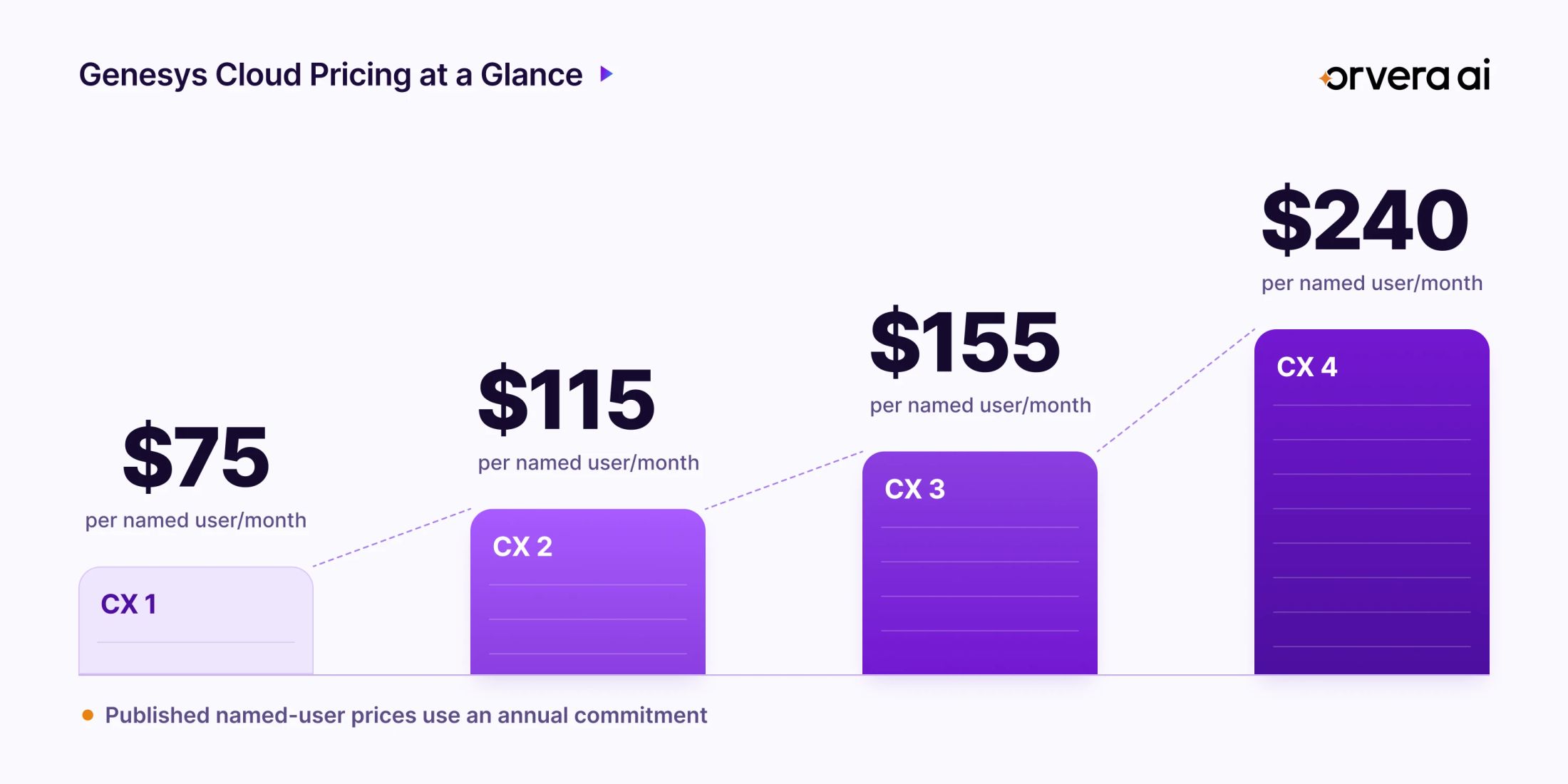
As of October 31, 2026, Genesys lists Cloud CX plans at $75, $115, $155 and $240 per named user per month, based on US pricing with an annual commitment. That headline price is one part of the cost. Licensing models, AI Experience tokens, add-ons, digital channels and usage-based services all change what a CX team pays.

Key highlights
Quick Summary
- Genesys Cloud pricing varies by plan, with each tier offering a different mix of CX, workforce management, and AI capabilities
- The overall cost depends on how users are licensed, with named, concurrent, and hourly models available
- AI usage can add another layer of cost through AI Experience tokens, depending on the capabilities and usage involved
- Add-ons, telephony, integrations, digital channels, and usage-based services can further affect the final cost
- CX teams should estimate Genesys Cloud costs based on their workforce, channels, AI usage, integrations, and broader operational requirements
- The right evaluation goes beyond licensing costs to consider how the CX stack supports automation, system actions, human-agent assistance, and quality measurement
As of October 31, 2026, Genesys lists Cloud CX plans (opens in a new tab) at $75, $115, $155 and $240 per named user per month, based on US pricing with an annual commitment. That headline price is one part of the cost. Licensing models, AI Experience tokens, add-ons, digital channels and usage-based services all change what a CX team pays.
Start with your operation. What a company needs to evaluate depends on how its teams work, which channels they run, which AI capabilities they use, and how the platform connects with the rest of the CX operation.
This guide breaks down Genesys Cloud pricing, from CX 1 through CX 4, and explains the licensing, AI token, add-on, and usage considerations CX teams should understand before planning their deployment.
Genesys Cloud Pricing at a Glance
As of October 2, 2026, Genesys publishes the following US pricing for named licenses. Prices are per user per month and billed annually. Genesys states that prices are informational and subject to change, and that usage-based pricing may apply.
| Genesys Cloud Plan | Named-User Price | Primary Scope |
|---|---|---|
| CX 1 | $75/user/month | Voice contact center |
| CX 2 | $115/user/month | Omnichannel CX with QA and compliance |
| CX 3 | $155/user/month | Omnichannel CX with full WEM |
| CX 4 | $240/user/month | Omnichannel CX with expanded AI |
These prices are a starting point for evaluation. Genesys directs buyers to its pricing team for final monthly costs based on the organization’s requirements.
What Changes From Genesys Cloud CX 1 to CX 4?
Genesys Cloud CX 1
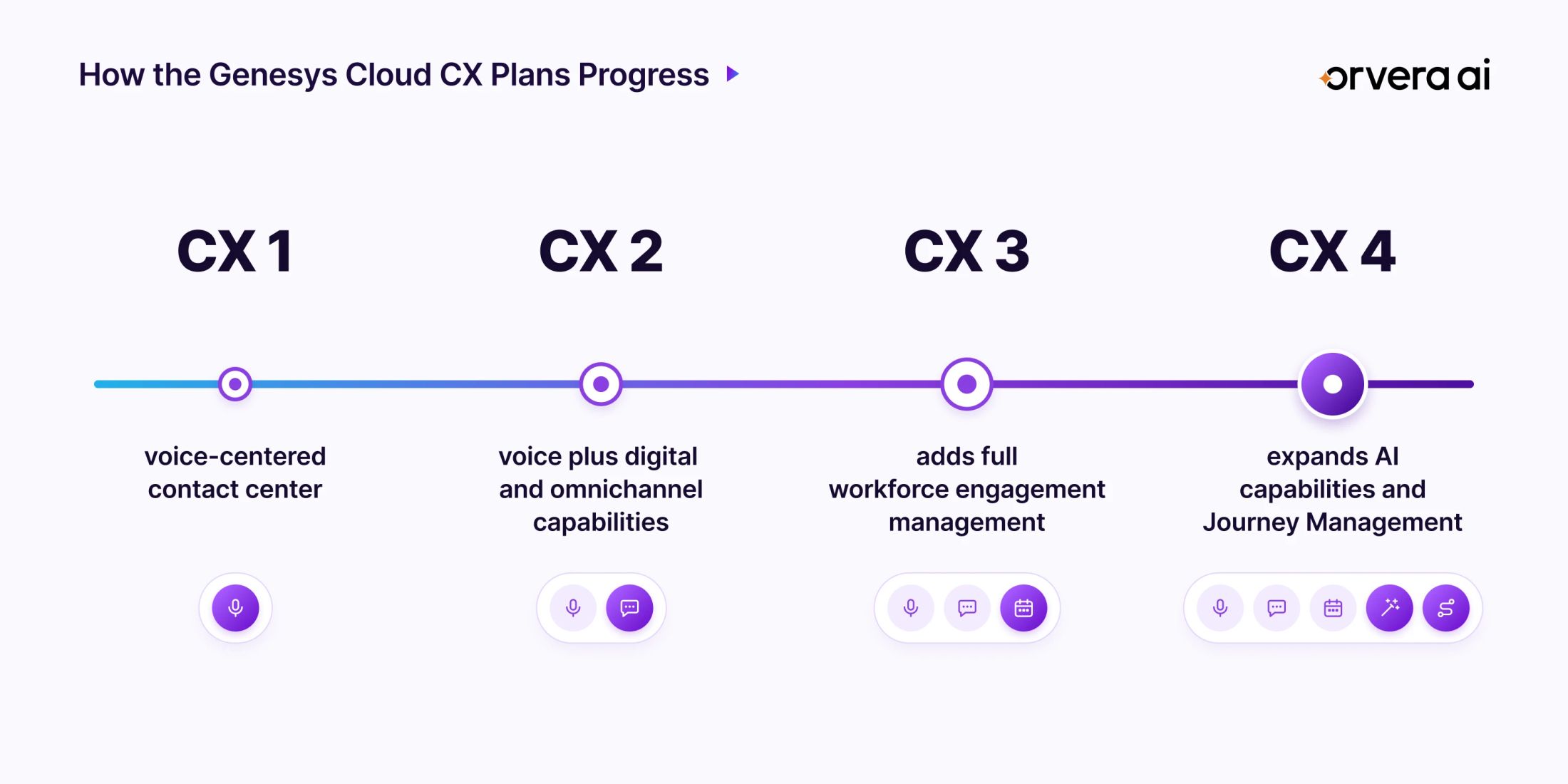
At $75 per named user per month, CX 1 centers on voice operations. As of October 8, 2026, Genesys lists the voice channel, call routing, speech-enabled IVR, outbound campaigns, analytics and reporting, unified communications, interaction recording, virtual agents, a native voicebot, predictive routing and Agent Copilot. Web messaging, email, SMS and in-app messaging, along with predictive engagement, are add-ons at this tier.
Genesys Cloud CX 2
CX 2 moves to $115 per named user per month and expands into omnichannel customer operations, including digital and voice channels, omnichannel routing, quality assurance and compliance, knowledge, and AI capabilities.
Genesys Cloud CX 3
CX 3 is listed at $155 per named user per month. Its major expansion is workforce engagement management, including employee performance, workforce management, forecasting, and scheduling.
Genesys Cloud CX 4
CX 4 is listed at $240 per named user per month and carries the broadest AI package of the four main editions. Genesys lists Journey Management and 30 AI Experience tokens per named agent alongside its wider voice, digital, WEM, analytics, routing, and quality capabilities.
Named vs. Concurrent vs. Hourly-Interacting Licenses
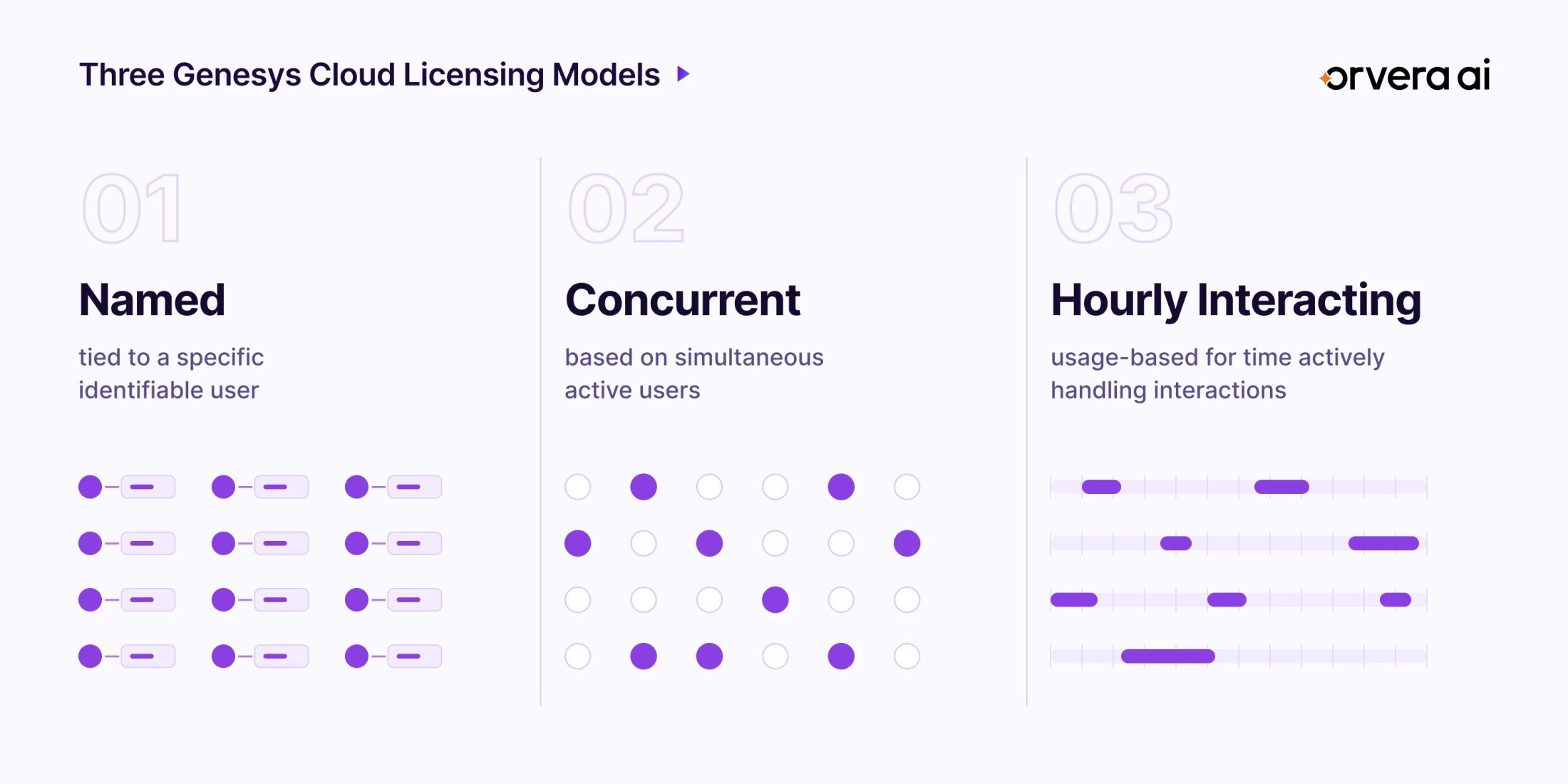
Genesys Cloud pricing also changes according to the licensing model. Genesys identifies Named, Concurrent, and Hourly Interacting models.
Named licenses
A named license belongs to a specific identifiable user. If 100 people require access, the named model requires licenses for those 100 users even when they do not access the system simultaneously.
Concurrent licenses
Concurrent licensing is based on the number of users accessing Genesys Cloud simultaneously during a billing period. Genesys states that concurrent licenses carry a premium.
Hourly Interacting licenses
Hourly Interacting is a usage-based model for employees who handle customer interactions at lower or irregular volumes. Users are billed for the time they are actively engaged in customer interactions.
How Genesys AI Experience Tokens Affect Pricing
AI usage introduces another layer to Genesys Cloud pricing. Genesys states that its Cloud CX packages are enabled with Genesys Cloud AI capabilities, while certain features require AI Experience tokens.
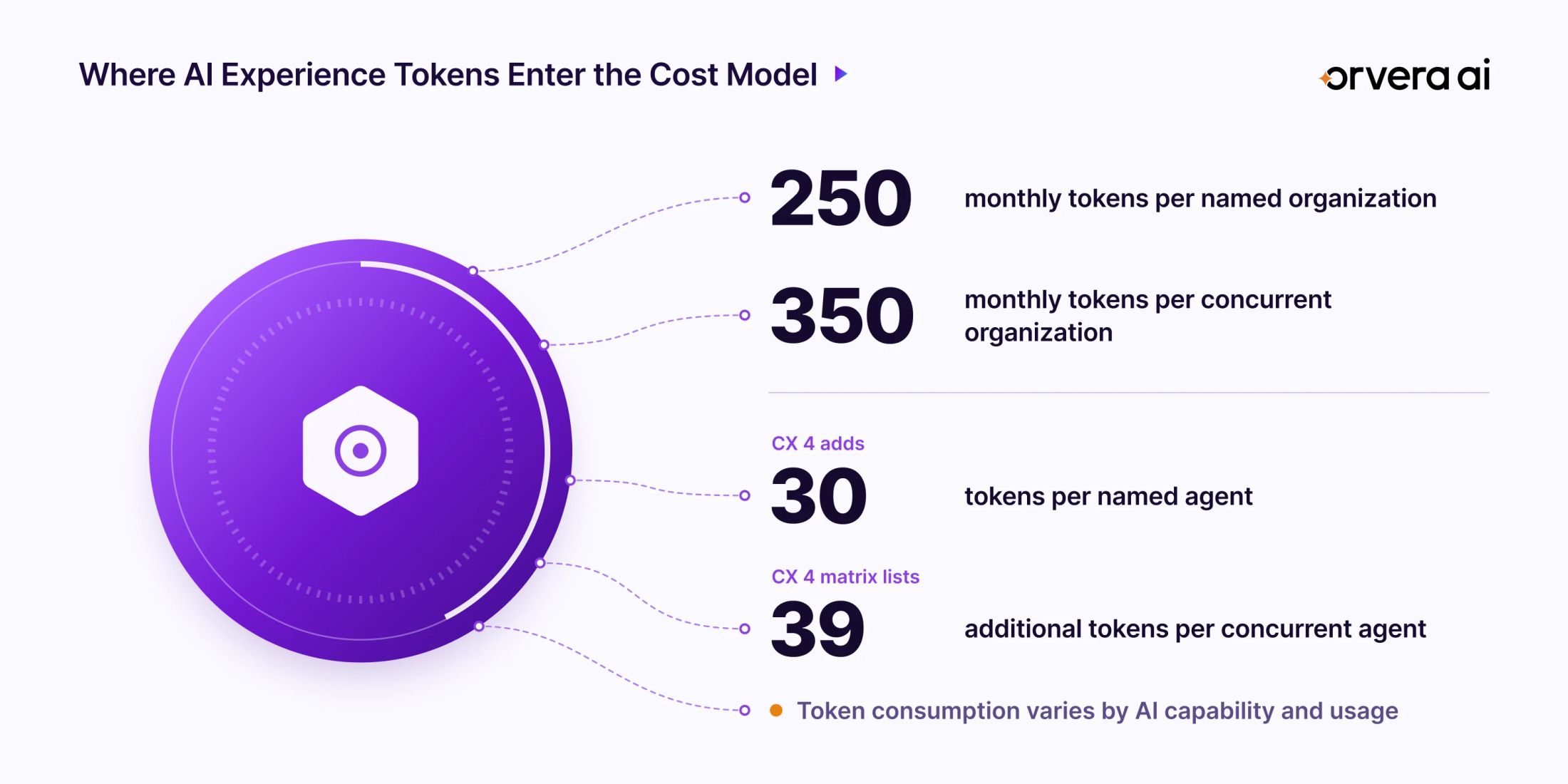
As of October 2, 2026, Genesys lists an organization-level monthly allocation of 250 AI Experience tokens for named organizations and 350 for concurrent organizations. Genesys Cloud CX 4 adds 30 tokens per named agent per month, and its current matrix lists 39 additional tokens per concurrent agent per month.
Genesys says additional tokens can be purchased based on usage or purchased upfront. Teams should map which AI capabilities consume tokens and how those capabilities will be used before treating the base license price as the operating price.
Add-Ons and Usage That Can Change Genesys Cloud Costs
The feature matrix matters because a capability available in one tier can be an add-on in another. Genesys currently shows web messaging, email, SMS, and in-app messaging as add-ons for CX 1 and available across CX 2 through CX 4.
Genesys also operates a fair-use policy for several usage-based services. As of October 2026, its pricing page says 90% of customers have their needs met by that policy. Customers with requirements beyond the allowances can face additional usage rates.
A realistic estimate therefore needs more than the number of users multiplied by the advertised plan price.
How to Estimate Genesys Cloud Cost for Your Operation
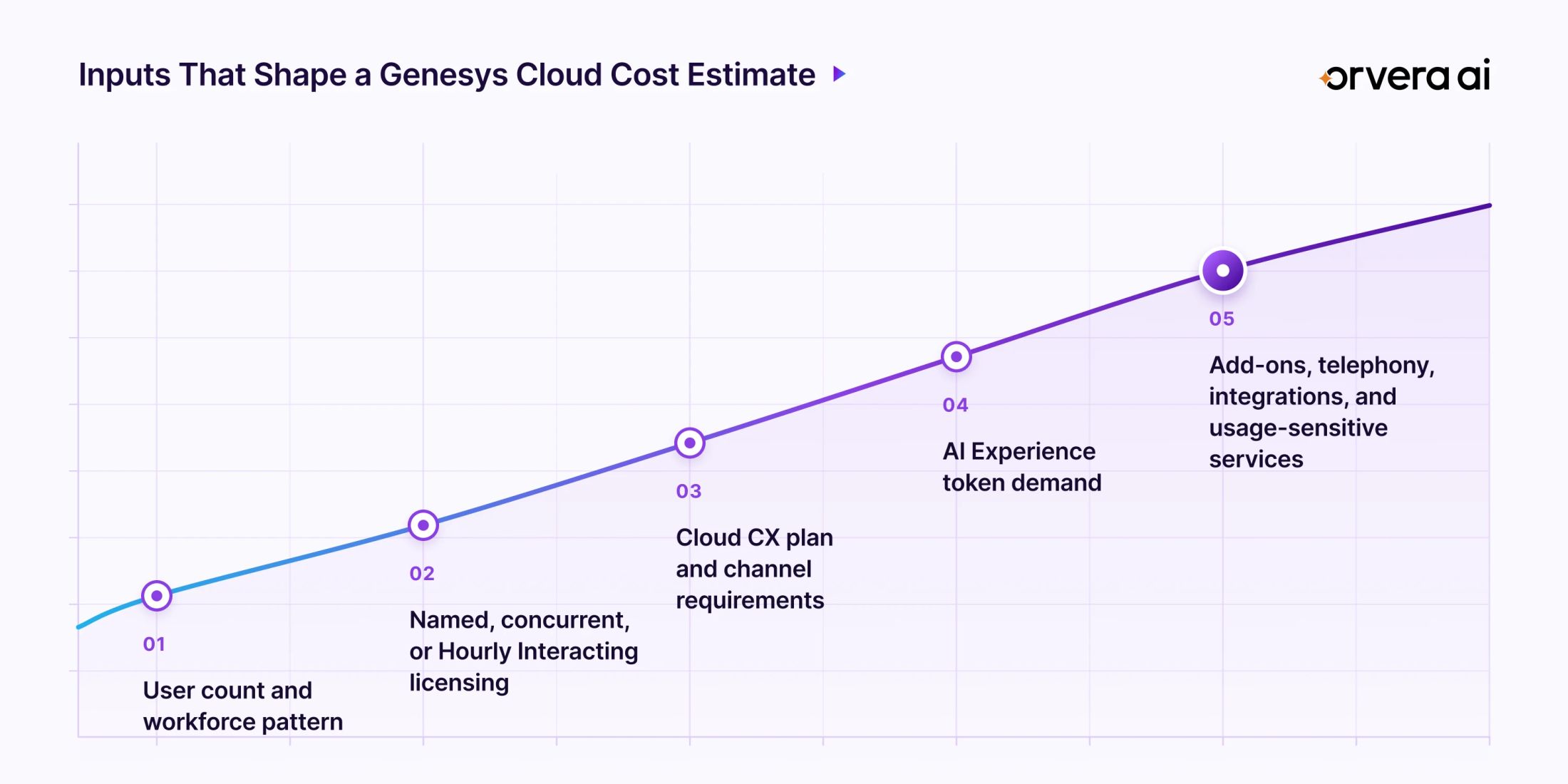
Start with the number of people who need the platform and how they use it. Then map required channels, AI capabilities, quality management, workforce management, integrations, telephony, and usage-sensitive services.
A practical cost model starts with users, license model, plan, channels, add-ons, AI usage, telephony, integrations, and usage-sensitive services. Genesys directs organizations to request custom pricing to determine final monthly cost.
For broader context, see Orvera's AI voice agent cost and pricing guide (opens in a new tab), the per-minute vs. per-AI-agent pricing analysis (opens in a new tab) and the guide to reducing contact center costs (opens in a new tab).
Where Genesys Cloud Fits in the CX Stack
Pricing the CCaaS layer is one part of designing a customer experience operation. A customer conversation can require authentication, account retrieval, a CRM update, a refund, a payment workflow, an appointment, a follow-up, or another action in a system of record.
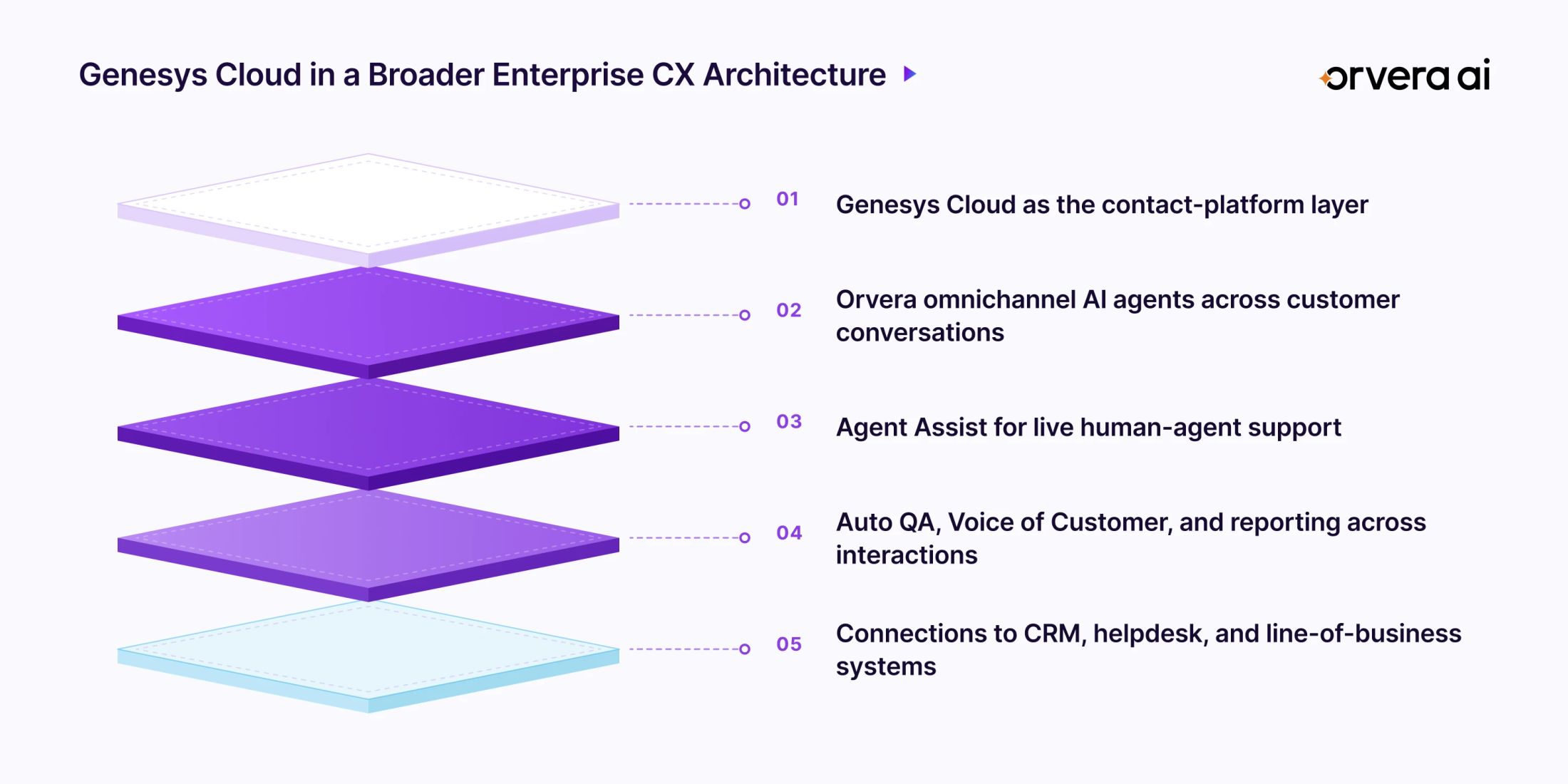
Orvera AI is an AI agent company for customer experience teams, built, deployed, integrated, and run by Orvera on the customer’s behalf. It deploys agentic, omnichannel AI agents across the whole customer-experience operation while bringing live AI assistance and quality intelligence to human-agent operations.
Its AI agents plan, call systems, take actions, and drive conversations to outcomes across voice, chat, and digital channels. The same platform supports human-agent operations through Agent Assist, AI Auto QA and QM, Voice of Customer, and reporting.
Orvera stands on the customer’s existing stack and connects to the contact platform, CRM, helpdesk, and line-of-business systems already in use. Genesys and Genesys Cloud are on Orvera’s integration record as real integrations. The specific form of the connector is confirmed for the deployment before it is described as native or productized.
Genesys Cloud Pricing Is One Part of the CX Cost Model
Genesys Cloud provides a public starting point of $75, $115, $155, or $240 per named user per month, depending on the CX edition, with annual commitment. The actual configuration can also involve licensing models, add-ons, AI Experience tokens, telephony, integrations, and usage-based services.
For CX leaders, the next step is to map those costs against the work the customer operation needs to complete. Which conversations need automation? Which workflows need execution? Which systems need actions written back? Where will human agents need live assistance? How will quality be measured across AI and human interactions?
Those questions turn a software price comparison into an operating architecture.
See how Orvera works with the CX stack you already run. Contact Orvera to discuss your customer-experience operation. (opens in a new tab)Frequently asked questions
Determine whether the operation is voice-centered or needs digital channels such as web messaging, email, SMS, in-app messaging, and third-party messaging.
Determine who needs persistent access, how many people work simultaneously, and which users interact with customers only occasionally.
Identify the capabilities that require AI Experience tokens and estimate how they will be used.
Map quality, compliance, workforce engagement, forecasting, scheduling, and AI requirements to the relevant plan.
List the CRM, helpdesk, billing, case-management, scheduling, order-management, and line-of-business systems involved in resolving customer work.
Orvera’s Auto QA audits every AI-handled and human-handled conversation against configurable QA frameworks. Voice of Customer mines the full conversation population for themes, drivers, sentiment, and CX signals.

Written by
Anindita Majumder
Anindita Majumder is a communications professional with nearly four years of experience in public relations, corporate communications, and journalism. She creates content that helps brands communicate their vision, products, and expertise through press releases, thought leadership, and editorial pieces. Outside of work, she is a vocalist, which keeps her creativity flowing.