Orvera vs. PolyAI: Which Voice AI Platform Is Better for CX Teams in 2026?
This guide compares Orvera AI and PolyAI on deployment, automation depth, integrations, analytics, governance and pricing, with PolyAI details taken from its own website as of October 5, 2026, so you can choose the right fit.

Key highlights
Comparison at a Glance
- Choose Orvera AI if you want omnichannel AI agents across voice, chat, email and messaging, Agent Assist and Auto QA on one platform, clear workflow outcomes, and a team with 18+ years of contact-center experience.
- Choose PolyAI if you prioritize lifelike voice interactions, governance, and building agents in-house in PolyAI's Agent Studio.
- Orvera fits teams that want structured, high-value customer workflows built, deployed and run for them, measured by containment and resolution outcomes.
- PolyAI is typically the better fit for organizations that want customer-led voice assistants with strong natural conversation quality and want their own team designing the agent.
- The best choice usually comes down to whether your team values operator-led execution across channels more, or premium voice conversation design more.
Orvera AI, an AI agent company for customer experience teams, and PolyAI both automate customer service conversations with AI agents, but they are often chosen for different reasons. Some teams want the vendor to build, deploy and run the solution for them. Others care more about natural conversation quality, governance controls, or how deeply the platform fits into an existing customer service stack. Orvera AI runs omnichannel AI agents across voice, chat, email and messaging, with Agent Assist and Auto QA on one platform and measurable outcomes, while PolyAI positions itself around lifelike customer service conversations, governance, and large-scale voice automation for major brands.
Orvera AI publishes this comparison. Competitor details come from each vendor's own website as of October 5, 2026, and are linked where they appear.
This comparison focuses on what real buyers usually care about most: deployment speed, automation depth, integrations, analytics, governance, and how pricing is likely to behave over time. The goal is to help teams decide which platform better matches their workflow complexity, rollout timeline, and operational priorities.
Quick Snapshot (Orvera vs PolyAI)
At a high level, Orvera AI is an AI agent company for customer experience teams: omnichannel AI agents across voice, chat, email and messaging, Agent Assist and Auto QA for human agents, and specialized Voice AI for inbound and outbound calling. Across Orvera customer engagements, full deployment averages 3 to 6 weeks and first-contact resolution averages about 80 percent, backed by 18+ years of contact-center experience.
As of October 5, 2026, PolyAI describes itself as Enterprise Voice AI and the Agentic Dialog Platform (opens in a new tab), built around highly natural conversations, enterprise governance, and large-scale deployments for well-known brands. Its homepage says brand voice remains consistent across conversations, channels, and languages, and its public material emphasizes lifelike voice agents, customer-led interactions, and large production implementations.
So the quickest summary is this: Orvera fits teams that want AI agents and human agents supported on one platform with clear operational outcomes, while PolyAI fits organizations that want a premium customer service voice assistant motion with heavier emphasis on conversation quality and governance.
What Orvera Is (Best-Fit Summary)
A major part of that positioning is operator credibility. Orvera was built on 18+ years of contact-center experience, which is important because the platform is framed as being developed by teams that understand how real BPO and contact center environments behave under pressure. That makes it especially relevant for businesses that care about workflow reliability, handoffs, and operational visibility.
What PolyAI Is (Best-Fit Summary)
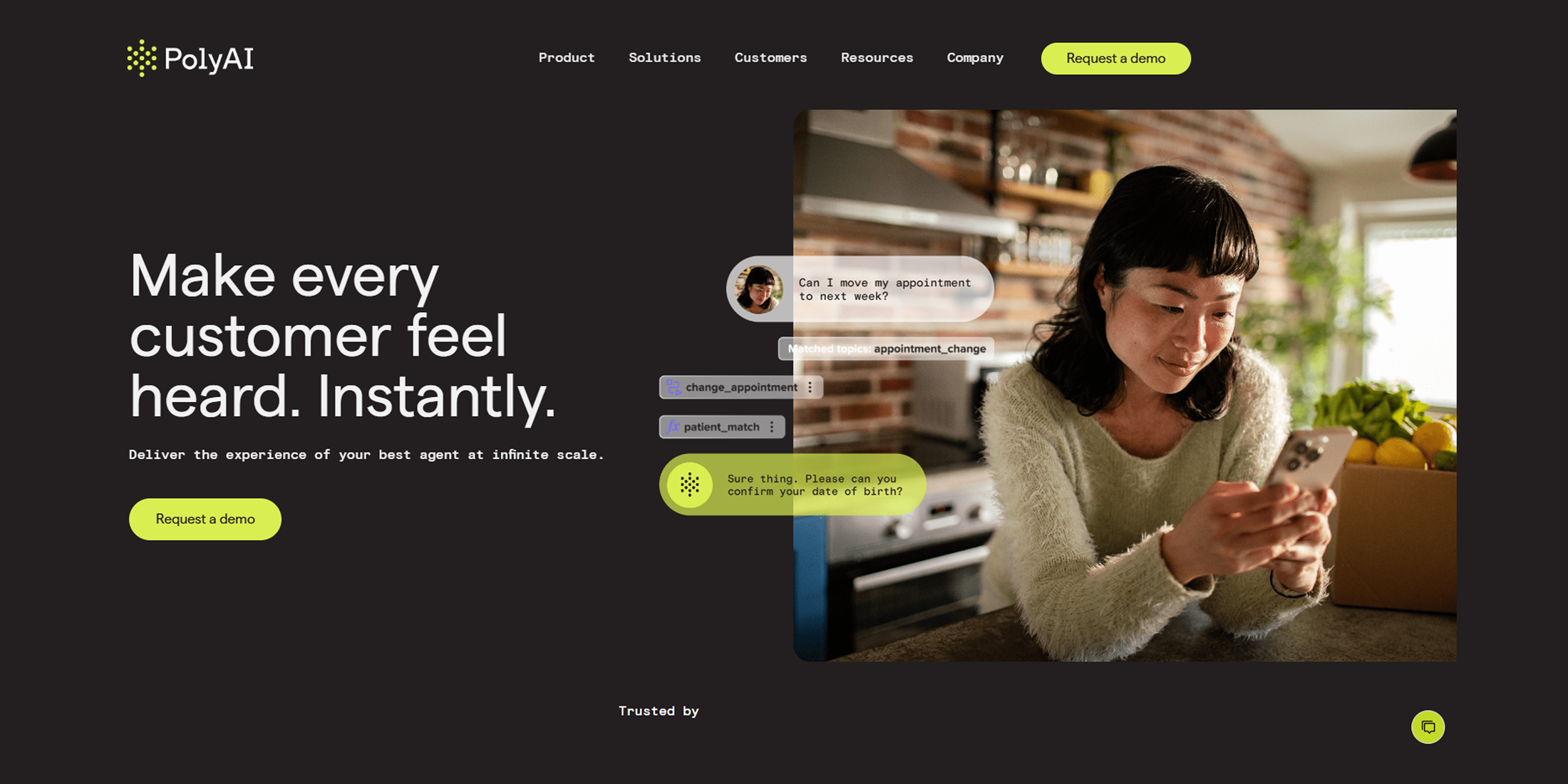
As of October 5, 2026, PolyAI describes itself as an enterprise voice AI platform (opens in a new tab) focused on customer service automation. Its public positioning is built around highly natural voice conversations, enterprise-grade reliability, and customer-led interactions that sound more human and brand-consistent than traditional IVR or rigid automation systems. It is particularly well known for serving large brands and for emphasizing voice quality and conversation quality as core strengths.
PolyAI also presents itself as a platform with strong governance and deployment support. As of October 5, 2026, its pricing page lists a 99.9% uptime SLA on phone lines (opens in a new tab), with maintenance and 24/7 support included in per-minute use. That makes it a natural fit for buyers who want a mature vendor motion.
How They Work (Simple Breakdown)
In practice, both platforms follow a similar deployment path. Teams choose a use case, design the workflow, connect the required systems, test the voice agent, go live, and then improve performance using call outcomes and operational feedback. That similarity matters because the real decision is how each platform supports that process and which team it is built for.
Orvera builds, deploys and runs this process for the customer, across voice, chat, email and messaging. PolyAI frames it more around voice assistant design, integration into the customer service stack, and production-quality deployment supported by experts. So the difference comes down to the operating model, deployment tempo, and the level of structure the buyer wants around rollout.
What are the key differences between Orvera AI and PolyAI?
The biggest differences show up in the areas that affect long-term operational value: rollout speed, conversation quality, automation depth, integrations, analytics, governance, and pricing style. Both are credible platforms for CX teams, but they optimize for somewhat different strengths.
Time to deploy and setup effort
Time to deployment depends on the workflow and who builds it. Across Orvera customer engagements, full deployment averages 3 to 6 weeks, including for contact center and BPO operations (opens in a new tab). As of October 5, 2026, a customer quoted on PolyAI's integrations page (opens in a new tab) describes roughly two weeks from selection to having an agent live.
The buyer experience is different. Orvera suits teams that want Orvera to build, deploy and run the workflow. PolyAI suits organizations that want to own agent design in PolyAI's Agent Studio (opens in a new tab), listed on its site as of October 5, 2026.
Conversation quality and caller experience
Conversation quality is one of PolyAI's most visible strengths. Its public messaging repeatedly emphasizes lifelike voice conversations, adaptive dialogue, and brand-level conversational experience. This is a real advantage for teams that care deeply about how the assistant sounds and how natural the interaction feels to the customer.
Orvera also positions itself around fast, natural, and reliable conversations (opens in a new tab), with public messaging that leans toward operational usefulness. Orvera fits buyers who care most about outcomes like reduced queues and workflow execution, while PolyAI fits buyers heavily optimizing for highly natural conversation quality as a strategic brand experience.
Automation depth (route vs resolve)
Both platforms resolve requests inside the conversation, and they emphasize that value in different ways. First-contact resolution averages about 80 percent across Orvera customer engagements, with workflow execution handled inside the platform. Per its site as of October 5, 2026, PolyAI also handles transactions such as reservations, order management, troubleshooting, and payments, and its public narrative centers on customer-led conversation and enterprise customer service transformation.
In practical terms, Orvera suits buyers measuring success by containment, task completion, and operational efficiency. PolyAI suits buyers for whom natural CX automation and service design matter most.
Integrations and tool actions
Integrations matter because AI agents become operationally useful when they can act in your systems. Orvera publicly highlights 500+ integrations (opens in a new tab) across CCaaS, CRM, helpdesk and ITSM, scheduling, payments, and other business systems. As of October 5, 2026, PolyAI publishes 130+ integrations (opens in a new tab) across telephony, CRM and knowledge, productivity and collaboration, and vertical systems, with a self-serve Connect Portal, open APIs, and an Agent Developer Kit.
Buyers should validate which CRM, helpdesk, calendar, scheduling, and ticketing tools matter most for their deployment, and who builds and maintains each connection.
Analytics, transcripts, and QA workflows
Orvera puts conversation summaries, reporting, Agent Assist, and Auto QA across AI-handled and human-handled conversations at the core of its value. That makes it especially attractive for teams that want strong measurement around Voice of Customer themes and drivers, handoff quality, and call improvement loops.
As of October 5, 2026, PolyAI's site lists an Analytics & insights product (opens in a new tab), and its public narrative leans toward conversation quality, enterprise CX value, and business opportunity discovery. The public framing is different. Teams that care deeply about QA across both AI agents and human agents should test that population in a pilot.
Explore Orvera if you want AI agents across voice, chat, email and messaging, with call insights, summaries, and performance visibility built for real customer operations. (opens in a new tab)Security, compliance, and governance
PolyAI clearly emphasizes reliability, governance, and controlled deployment in its public materials. That is one of its strongest trust signals for large organizations. Orvera runs governance in the same architecture as its AI agents and workflow execution.
The practical takeaway is that both need live validation. Buyers should confirm access controls, audit logs, escalation rules, retention settings, and policy enforcement in a real evaluation. PolyAI leads its positioning with governance, and Orvera leads with governed execution across channels.
Pricing style and what to budget for
Pricing style is another difference. As of October 5, 2026, PolyAI's pricing page says ongoing use of the voice agent is priced per minute (opens in a new tab), including performance improvements, maintenance and 24/7 support, and lists no public rate. Orvera discusses cost with each account on a consultative call, once there is a named use case.
For PolyAI, ask for the per-minute rate at your expected volume.
How do Orvera AI and PolyAI compare side by side?
| Category | Orvera | PolyAI |
|---|---|---|
| Best for | Omnichannel AI agents plus Agent Assist and Auto QA, measurable workflow outcomes | Large enterprise customer service programs, premium conversation quality |
| Deployment speed | Full deployment averages 3 to 6 weeks across Orvera customer engagements | A customer on its site cites about two weeks to go live |
| Automation depth | Strong workflow execution and resolution focus | Strong enterprise customer service automation with a premium conversational focus |
| Integrations | 500+ integrations and workflow execution emphasis | 130+ integrations with a self-serve Connect Portal |
| Analytics | Summaries, call insights, and Auto QA across AI-handled and human-handled conversations | Analytics and insights product focused on conversation quality and CX value |
| Governance | Governed, SOC 2 Type II certified and workflow-oriented | Strong enterprise governance and reliability posture |
| Pricing style | Discussed with Orvera's team on a consultative call | Per-minute pricing, no public rate |
Table entries summarize each vendor's own pages as of October 5, 2026.
Best Use Cases for Orvera
Orvera appears strongest in use cases (opens in a new tab) where structured workflows, cross-channel execution, and operational outcomes matter most.
Intent capture, triage, and handoff
Orvera is a strong fit for contact centers that want AI agents to understand intent early, resolve what they can, and hand the rest to human agents supported by Agent Assist summaries. This aligns closely with its BPO and contact-center heritage.
Appointment calls and confirmations
Structured workflows such as booking, confirmations, rescheduling, and reminders are a natural fit for Orvera because each call has a clear success state, such as a booked or confirmed appointment.
Outbound follow-ups and lead qualification
Orvera is also a good fit for outbound qualification and follow-up programs where the goal is to capture details, summarize outcomes, and pass clean context to human teams. That aligns with its positioning around customer service workflows and measurable operational improvement.
Best Use Cases for PolyAI
PolyAI appears strongest in customer service environments where highly natural voice experience and governance are central buying criteria.
High-volume inbound customer service calls
PolyAI is strongly positioned for large-scale inbound service environments where organizations want natural customer-led conversations and strong escalation rules. This is one of its clearest public strengths.
Payments, bookings, and common CX workflows
As of October 5, 2026, PolyAI's site lists use cases (opens in a new tab) including booking and reservations, billing and payments, order management, and troubleshooting. That makes it a strong fit for organizations automating structured but customer-facing service flows.
Governance and multi-channel automation
PolyAI also fits organizations that prioritize policy control, governance, and broader customer service modernization across channels, especially where the voice assistant is part of a larger CX strategy across many workflows.
What are the strengths and considerations of each platform?
The decision is about fit.
Orvera Strengths and Considerations
Pros
- A deployment the Orvera team runs for you
- Strong contact center and BPO operating fit
- Workflow execution, with first-contact resolution averaging about 80 percent across customer engagements
- 500+ integrations
- Agent Assist and Auto QA for human agents on the same platform
- Built on 18+ years of contact-center experience
What to validate
- Edge-case handling in your specific workflow
- Telephony architecture detail for your environment
- Reporting depth for your exact QA and compliance model
PolyAI Strengths and Considerations
Pros
- Strong enterprise customer service brand positioning
- Very strong public emphasis on natural conversation quality
- Strong governance and rollout posture
- Clear fit for large inbound customer service programs
What to validate
- Deployment timeline for the first use case
- Per-minute rate at your expected volume
- Workflow depth for the exact intents you want to automate
- Operational reporting your team gets by default
Which One Should You Choose? (Simple Decision Guide)
The simplest way to decide is to start from your real constraints.
Choose Orvera if…
Choose Orvera AI if you want omnichannel AI agents across voice, chat, email and messaging, Voice of Customer themes and drivers, structured workflow execution, or a team with 18+ years of contact-center experience. It fits teams that want Orvera to build, deploy and run the solution, with Agent Assist and Auto QA on the same platform and clear operational control over day-to-day outcomes.
Choose PolyAI if…
Choose PolyAI (opens in a new tab) if your team cares deeply about premium conversational experience and wants to build and manage agents in its own Agent Studio. It is a strong fit when natural conversation quality and customer service positioning are central buying priorities.
If you're unsure, run a 2-intent pilot
If the answer is unclear, compare both on two structured, high-volume intents such as scheduling and FAQs. Measure containment, transfer quality, summary usefulness, CSAT signals, and setup time. That will tell you more than a polished demo ever will. This is a practical buying recommendation from Orvera AI.
How Orvera Helps Teams Upgrade AI Automation
Orvera helps teams upgrade AI automation (opens in a new tab) by running omnichannel AI agents across voice, chat, email and messaging, with Agent Assist and Auto QA on one platform. Orvera comes from a BPO and services background with 18+ years of contact-center experience, so the team understands how automation performs under real conditions, such as queue pressure, handoff complexity, QA expectations, and client service targets. Orvera builds, deploys and runs the solution for the customer, with summaries, transcripts and reporting on the workflows it runs.
What makes Orvera different:
- Built by teams with 18+ years of contact center and BPO experience
- A deployment the Orvera team runs for you
- Workflow execution across voice, chat, email and messaging
- 500+ integrations across business systems
- Agent Assist with approved knowledge, next-best actions, and automated summaries
- Analytics and call insights that support continuous improvement
- Strong fit for high-volume service environments
Conclusion
Both platforms are credible choices for voice automation, and they solve slightly different buying problems. PolyAI is a strong fit for organizations prioritizing highly natural customer service conversations and strong governance. Orvera fits teams that want omnichannel AI agents, Agent Assist and Auto QA on one platform, broad workflow execution, clear operational visibility, and a path from first use case to scaled deployment run by Orvera's team.
The best decision depends on your call intents, rollout timeline, governance needs, and budget. If your team values cross-channel execution, contact center fit, and measurable operational outcomes, Orvera is built for that operation. If your team values premium conversational CX positioning above all else, PolyAI may be the more natural fit.
Frequently asked questions
As of October 5, 2026, PolyAI's pricing page says ongoing use is priced per minute, including maintenance and 24/7 support, and lists no public rate.
Across Orvera customer engagements, full deployment averages 3 to 6 weeks. As of October 5, 2026, a customer quoted on PolyAI's site cites about two weeks from selection to a live agent. Ask each vendor for a timeline for your first use case.
Orvera AI is built for intent capture, triage, and handoffs as part of workflow execution, with Agent Assist for the human agents who take over. Test both on your own intents and transfer rates.
Yes. Orvera offers 500+ integrations, and as of October 5, 2026, PolyAI publishes 130+ integrations with a self-serve Connect Portal.
You should test setup speed, routing accuracy, handoff quality, workflow completion, reporting usefulness, and how the platform performs under realistic call conditions.
Written by
Anindita Majumder
Anindita Majumder is a communications professional with nearly four years of experience in public relations, corporate communications, and journalism. She creates content that helps brands communicate their vision, products, and expertise through press releases, thought leadership, and editorial pieces. Outside of work, she is a vocalist, which keeps her creativity flowing.