How an AI Agent Captures the Reasons Behind Referral Leakage for Health Systems
Referral leakage occurs in the silence between the EHR record and the scheduled appointment. The reason a patient drops out is almost never captured where it can be acted on.

Key highlights
- Referral leakage occurs in the silence between the EHR record and the scheduled appointment. The reason a patient drops out is almost never captured where it can be acted on.
- The AI agent's job in a referral outreach or intake conversation is to ask for the reason, record it, attribute it, and route the open case to the team that can act on it, leaving every clinical decision to the health system's clinicians.
- A single orthopedic referral conversation shows exactly how AI agents for healthcare move a stated patient reason from a spoken sentence to a structured record a health system can act on.
- The AI agent records only what the health system's governance allows, and the controls behind it are written during configuration and in force before the first call runs.
- The root-cause taxonomy belongs to the health system.
- Clinical questions, the referral decision, and scheduling stay with the clinical and patient access teams.
- A patient who states urgency or distress reaches a person.
- A health system wants referral management software that is built for its workflow, integrated into its existing stack, and then monitored and tuned by a team that has run contact centers before.
Why do referred patients drop out between the order and the appointment?
Referral leakage occurs in the silence between the EHR record and the scheduled appointment. The reason a patient drops out is almost never captured where it can be acted on.
The moment looks like this: a specialist referral is entered, the patient access team reaches the patient, and the patient says they cannot make it work right now, or that they will call back. The representative closes the interaction. The referral stays open.
Weeks later, the ambulatory leader pulls the referral report. The record reads unscheduled or out-of-network. The reason field is empty, or it holds a free-text note that nobody queries. In-network conversion rate by service line is the measure that leader owns, and the data explaining why it moved offers nothing to work with.
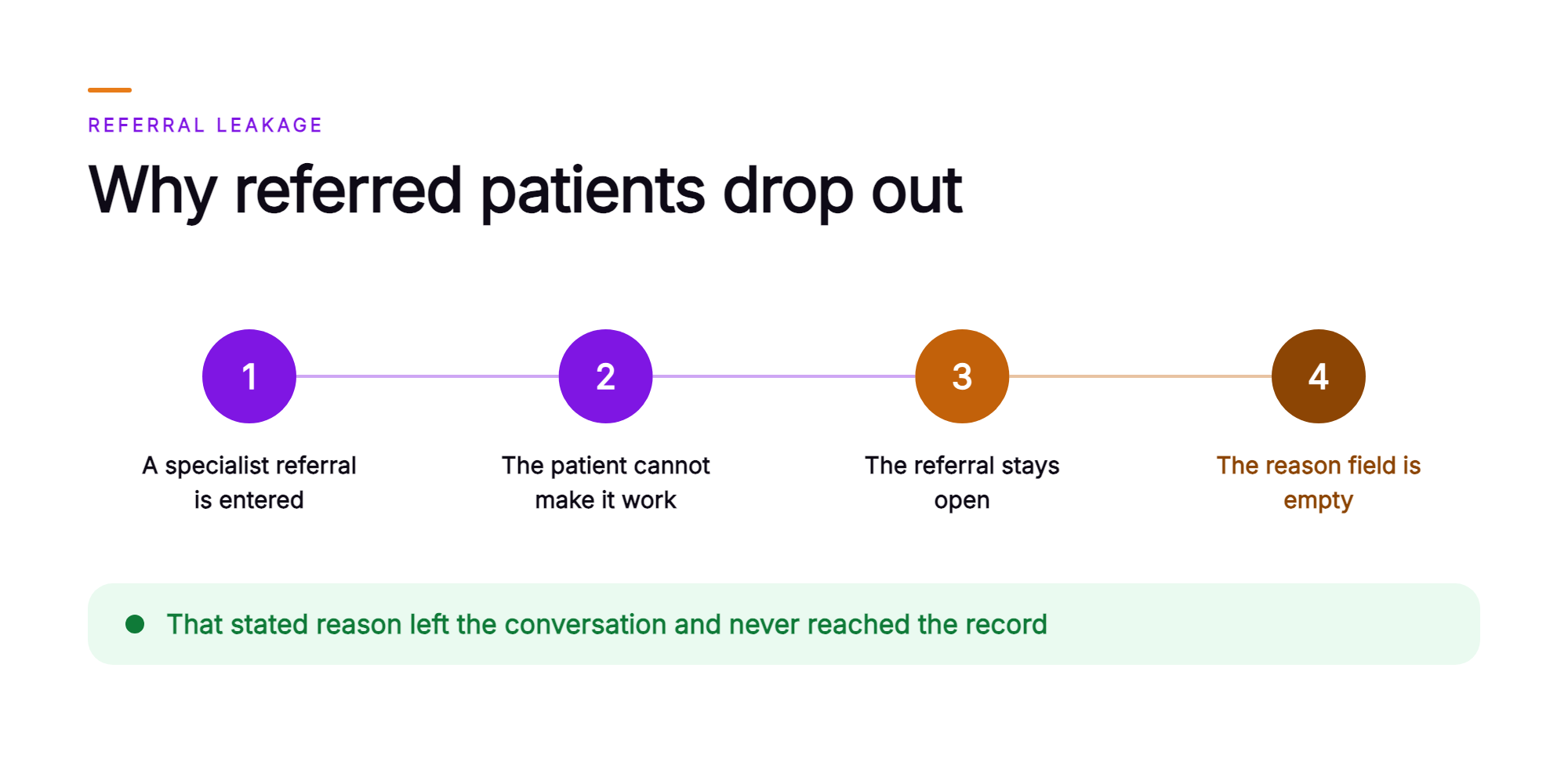
The patient access contact center is the one place the patient states the reason out loud, in their own words, at the moment it still matters. That conversation holds the answer. Distance to the specialist site, an open insurance question, a preference for a different physician are all reasons the patient named. But that stated reason left the conversation with the caller and never reached the record in a form anyone could count or trend.
That gap is where root-cause mining starts.
What is referral leakage root-cause mining?
Referral leakage root-cause mining is the practice of capturing each decline or delay reason in the patient's own words during the live interaction, then attributing that stated reason to a structured category a health system's leadership can count and trend.
Root cause analysis in healthcare typically happens weeks after the fact, once claims data settles. Root-cause mining moves that moment to the conversation itself, the only point where the patient names the reason out loud. The stated reason is captured while the referral record is still open, weeks ahead of any billing signal, which means the pattern is visible while there is still time to act.
Root-cause categories vary by health system, but the set most ambulatory leaders define includes:
- Appointment availability at the specialist site
- Distance and travel burden
- Insurance and benefits questions that were not resolved at the point of the referral order
- Physician or site preference for a provider outside the network
- Prior experience with the practice or the specialty group
And those categories do the analytical work, because the same label means the same thing on every record. Each stated reason is attributed to one category at the moment of the conversation. Thousands of those attributed interactions, sorted by service line and specialist site, produce a pattern the ambulatory operations leader can read as a number. The referral tracking picture becomes a count.
That count is what makes the next step possible: putting a structured process on every outreach and intake conversation so the reason is captured every time, through a standard question and into a defined field on the referral record.
What does the agentic AI agent do when a patient declines or delays a referral?
The AI agent's job in a referral outreach or intake conversation is to ask for the reason, record it, attribute it, and route the open case to the team that can act on it, leaving every clinical decision to the health system's clinicians.
The AI agent runs the conversation across voice, chat, email, and every other channel the health system operates. When a patient declines a referral or signals a delay, the agent asks a structured follow-up question. The patient's stated reason is recorded verbatim, then attributed to a root-cause category drawn from the health system's own classification framework. Both the verbatim statement and the category label are written directly to the referral record in the EHR the health system already runs. That is how the patient's stated reason becomes a queryable data point in referral tracking software.
That reviewable record matters because attribution accuracy determines whether the pattern analysis is trustworthy. A root-cause category is only as useful as the evidence behind it.
Once the record is written, the agent routes the open referral to whichever queue the health system's own rules name: patient access, clinical, or a dedicated patient referral leakage team. The AI agent passes a plain summary so the receiving rep can act immediately. The referral decision, every scheduling action, and any clinical question stay with those teams. The AI agent hands each of those items off with context attached, and the rep closes the loop.
The next section walks through what that looks like for a single orthopedic referral, from the conversation to the roll-up.
What does one captured referral reason look like in practice?
A single orthopedic referral conversation shows exactly how AI agents for healthcare move a stated patient reason from a spoken sentence to a structured record a health system can act on.
In practice, the conversation goes like this. The AI agent reaches a patient following an orthopedic referral order. The patient says the first available appointment at the referred site is six weeks out, and that a practice closer to her home has already seen her. The agent records both stated reasons in her own words and attributes each to its own root-cause category, appointment availability for the six-week wait and distance and travel for the closer practice. It then routes the open referral record to the patient access team's queue with a plain summary attached so the receiving rep can act immediately.
That record is one data point. But over several weeks, the patient access team sees the same two categories cluster repeatedly against one orthopedic site. Appointment availability and distance and travel appear together on referral after referral tied to that location. The health system's own scheduling team reviews the pattern and opens additional template capacity at that site.
How do the health system's rules shape what the agent records?
The AI agent records only what the health system's governance allows, and the controls behind it are written during configuration and in force before the first call runs.
Healthcare contact center automation is a configured layer of rules that determine what the AI agent may ask, record, route, and escalate. Those rules sit above the conversation logic. The AI agent operates inside them on every interaction it runs. The pairing below shows how each health system rule translates into a specific agent action:
- The root-cause taxonomy belongs to the health system. The AI agent attributes each stated reason to one of the health system's own categories and preserves the patient's verbatim words alongside that attribution. The health system defines the categories. The agent applies them as written.
- Clinical questions, the referral decision, and scheduling stay with the clinical and patient access teams. When a patient raises any of those items, the agent records the question verbatim and routes the open referral record, with a plain summary, to whichever queue the health system's rules name.
- A patient who states urgency or distress reaches a person. The AI agent initiates a warm transfer to a human rep, attaches the full conversation summary, and surfaces approved knowledge to that rep through Agent Assist.
Those rules are the boundary between what healthcare referral management automation does well and what requires a person. The platform that runs those rules, and the operating model behind it, is what the next section covers.
Why does a health system want the platform built and run for it?
A health system wants referral management software that is built for its workflow, integrated into its existing stack, and then monitored and tuned by a team that has run contact centers before.
Orvera builds, deploys, integrates, and runs the platform. Full enterprise deployment completes in three to six weeks. That timeline covers workflow configuration, patient access escalation rules, root-cause taxonomy setup, knowledge-base grounding, and integration with the systems the health system already uses, including the EHR and the contact center platform already on the floor.
Operating heritage shapes the setup. Eighteen-plus years of contact-center operations inform how each patient access workflow is structured, how escalation rules are written, and how the root-cause taxonomy maps spoken patient language to categories an ambulatory operations leader can count. Each of those is a design choice that takes experience to get right.
Auditability covers every conversation. The platform records, transcribes, and summarizes every interaction, whether a human rep handled it or the AI agent ran it, across voice, chat, and digital channels. Each one leaves a record the compliance team can review.
Compliance posture matches what regulated buyers require. The platform is SOC 2 Type II certified, HIPAA compliant, and GDPR compliant. Every patient conversation is grounded in approved knowledge. Explicit controls govern what the agent is permitted to say and record. And the platform is model-agnostic and runs on the health system's own stack, so the health system can move to a better model as the technology improves.
Those controls and that operating model are what make the resulting data usable. The next question is which numbers the ambulatory leader watches to know the process is working.
Which numbers tell the ambulatory leader it is working?
Four measures tell the ambulatory leader whether the process of capturing and acting on stated referral reasons is producing a result, and each one traces directly back to the structured record the AI agent writes at the moment the patient speaks.
The value of referral tracking software is the pattern the data surfaces over time, quarter over quarter, in a form the ambulatory leader can carry into a resource or planning conversation. These four measures provide that form.
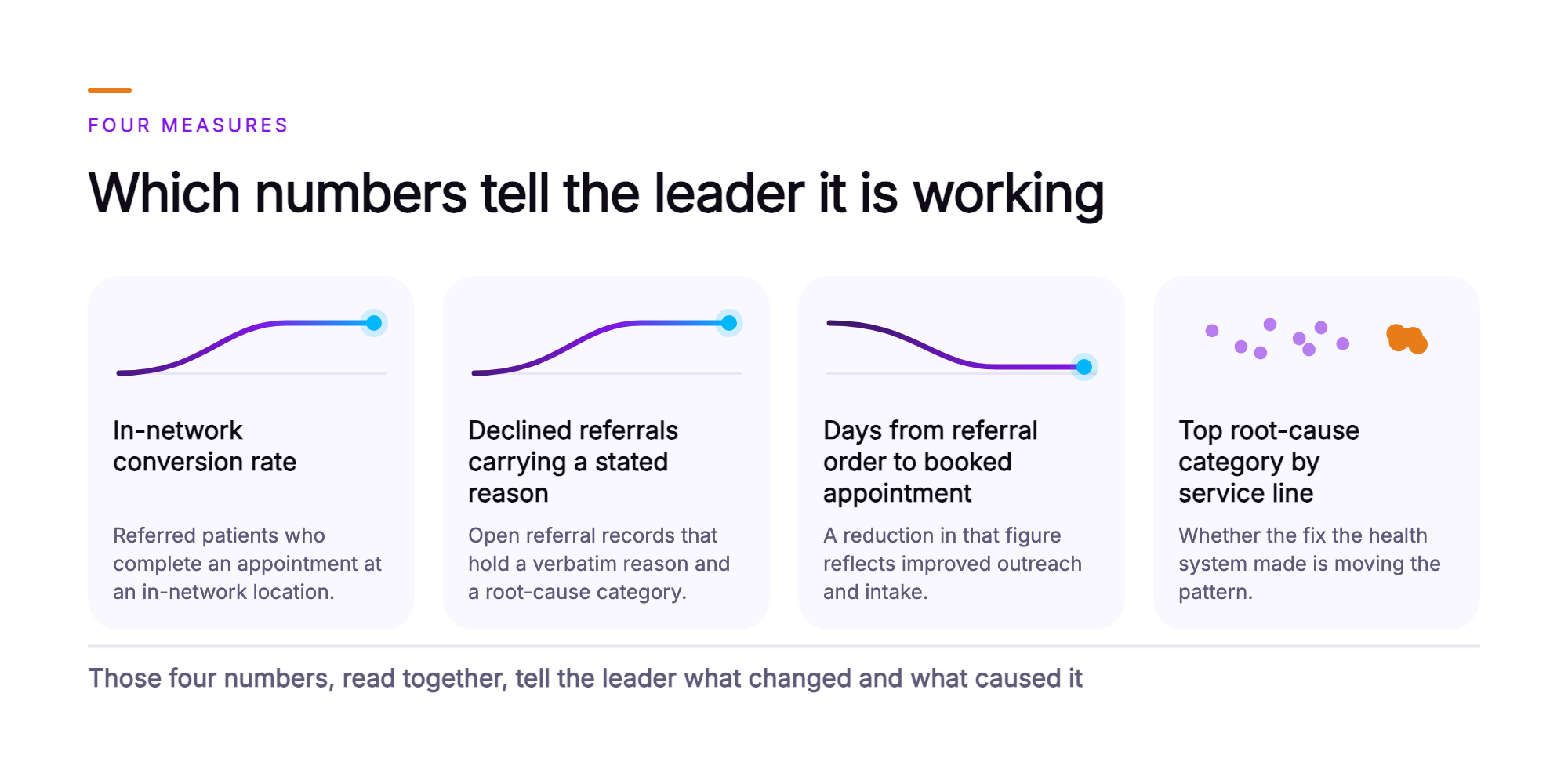
- In-network conversion rate, by service line and site. This is the count of referred patients who complete an appointment at an in-network location, and it is the primary number the service-line report should carry.
- Declined and delayed referrals carrying a stated reason. This is the count of open referral records that hold a verbatim patient reason and a root-cause category, and it shows how many of those referrals the health system can act on.
- Days from referral order to a booked in-network appointment. This is the elapsed time, by service line, and a reduction in that figure reflects improved outreach and intake alongside improved scheduling.
- Top root-cause category by service line, quarter over quarter. This is whether the fix the health system made, whether template capacity, site staffing, or an insurance answer, is moving the pattern or whether a new pattern has emerged.
Those four numbers, read together, tell the ambulatory leader what changed and what caused it. The next question is how to present that picture to the leadership team.
What does the ambulatory leader take to the leadership team?
The ambulatory leader takes four data points: a structured root cause for every declined or delayed referral, a service-line pattern that points to a fix, an auditable record in the EHR the health system already runs, and a conversion rate that moves when the fix holds.
The leadership meeting needs numbers the team can act on and a clear line between what the platform did and what the clinical team decided. Those four points carry that case.
- Declined and delayed referrals now carry the patient's stated reason and a root cause on the record. The reason was captured at the moment the patient spoke it, in the patient's own words, while the referral record was still open. That record is the foundation of any credible pattern analysis.
- The root-cause pattern by service line points to a fix the health system controls. Template capacity, site staffing, the insurance answer the intake team gives. Each of those is an operational variable the ambulatory leader can change, on a timetable the operations team sets.
- The platform writes the stated reason and root cause directly to the referral record in the EHR the health system already runs. Orvera AI builds and runs the platform, deployment lands in three to six weeks, and it arrives SOC 2 Type II certified, HIPAA compliant, and GDPR compliant.
- The measure is in-network conversion rate by service line, and the referral decision stays with the clinical team. The AI agent captures the reason. Scheduling, clinical judgment, and every downstream decision remain with the people the health system designated to make them.
What that picture looks like once the platform is running, from the first outreach call to the service-line report the ambulatory leader reads each quarter, is what the final section covers.
What does referral intake look like once the platform runs?
Once the platform runs, a declined or delayed referral where the patient states a cause carries a verbatim patient reason and a structured root-cause category, and the ambulatory leader reads that pattern by service line directly from the record.
The outreach call goes out. The patient speaks. The AI agent captures the stated reason, writes it to the structured field, and routes the conversation summary to the rep who closes the loop. What arrives in the service-line report is a count, trended quarter over quarter, that points to the template capacity gap or the insurance question or the site access issue the health system can actually fix. Patient access teams see which barriers are rising. Clinical teams see which service lines are producing the longest gaps between referral order and booked appointment.
The referral decision, the scheduling action, and every clinical question stay with the health system's own teams. The AI agent's contribution is the stated reason on the record, written consistently across every conversation. That consistency is what converts a floor full of individual calls into a dataset the ambulatory leader can present to the leadership team with a mechanism attached to each number.
Orvera AI builds, deploys, and runs the platform in three to six weeks on the stack the health system already operates. If you want to see what that looks like for your service lines, talk to the team (opens in a new tab).
Frequently asked questions
Referral leakage root cause mining starts with the patient's own words, recorded verbatim on the referral record at the moment of the conversation. The AI agent captures three things. First, the stated reason in the patient's exact phrasing, attached directly to the referral record. Second, the root-cause category that reason is attributed to, drawn from the taxonomy your patient access team defines: appointment availability, distance and travel, insurance and benefits questions, physician or site preference, or prior experience. Third, the full conversation transcript and a structured summary, available for any reviewer who needs to check the attribution or audit the interaction. The verbatim reason and the attributed category travel together. Both stay on the record. How that attribution is assigned, and how categories roll up into patterns your ambulatory leaders can act on, is what the next section covers.
Root-cause attribution runs on a taxonomy the health system defines with its patient access team during deployment, and the platform assigns each verbatim reason to a category from that taxonomy. The categories your team defines during setup, such as appointment availability, distance, travel, insurance questions, or site preference, become the classification layer. When the AI agent captures a patient's stated reason, it maps that phrase to the matching category and keeps the original words on the record alongside the attribution. A reviewer can check the mapping at any time. Categories roll up by service line and site. That aggregation is what converts individual call notes into a pattern an ambulatory operations leader can act on. Your patient access and clinical teams own what falls outside the AI's scope, including the clinical decision and the scheduling action.
The AI agent's role on a referral record is narrow by design: the stated reason, a structured summary, and a route to the correct queue. Every clinical decision stays with your clinical and patient access teams. Root cause analysis in healthcare earns its value when automation stays inside a defined scope. The AI agent captures what the patient said, attributes it to the category your team defined, and routes the open referral record to the queue your health system's rules name. The scheduling action and every clinical question remain where they belong. One exception applies. A patient who states urgency or distress is warm-transferred to a human rep, with the conversation summary attached so the rep picks up what the patient already said. Every one of those interactions is recorded, and how that record is reviewed is what the next section covers.
Every conversation, whether handled by the AI agent or a human rep, is recorded in full and audited by AI Auto QA, giving ambulatory operations leaders a consistent, objective record of every patient interaction. That record includes the full transcript, the structured summary, and the root-cause attribution assigned during the call. A reviewer can open any interaction, including calls where a patient asked about out-of-network referrals or raised a cost concern, and verify that the stated reason was captured correctly and mapped to the right category. AI Auto QA audits the full conversation volume across voice, chat, email, messaging, and every other channel your patient access operation runs. Each interaction is scored on one standard, so a decline stated on a phone call and one typed into a chat enter the review set on equal terms. That gives leaders a reliable quality view across the entire referral conversation volume, drawn from every stated reason the operation captured. Reviewers use the same transcript to coach human reps on attribution accuracy and patient communication. How that data moves from the conversation record into your existing EHR and scheduling systems is what the next section covers.
Orvera does the integration work during deployment, reading open referral records and writing the stated reason and root-cause category back to the record through a connector it builds and maintains. The platform supports 500+ integrations across EHR, scheduling, CRM, and CCaaS categories, so it runs on the stack your health system already operates. Patient referral leakage data captured on a call lands in the referral record directly, ready for your patient access team to act on in the workflow they run every day. Compliance controls are built in. The platform is SOC 2 Type II certified, HIPAA compliant, and GDPR compliant, with approved-knowledge grounding and explicit data controls governing every write-back. What deployment looks like inside that window is what the next section covers.
Orvera builds, deploys, and runs the referral management platform inside a three-to-six-week window, with every integration, knowledge-base setup, and root-cause taxonomy defined before go-live. Enablement spans onboarding, escalation rules, and change management. The patient access team defines the leakage categories and warm-transfer triggers during that same window. Orvera stands up the infrastructure and configures the connectors, at deployment and whenever either one changes later. After go-live, Orvera runs the operation as a managed service, and its own team stays on the platform day to day. Eighteen-plus years of contact-center operating experience stands behind that work, carried by people who have staffed and coached live floors.

Written by
Anindita Majumder
Anindita Majumder is a communications professional with nearly four years of experience in public relations, corporate communications, and journalism. She creates content that helps brands communicate their vision, products, and expertise through press releases, thought leadership, and editorial pieces. Outside of work, she is a vocalist, which keeps her creativity flowing.


