Top 9 Synthflow.ai Alternatives in 2026
SynthFlow AI is a well-known and capable platform in this space, and for many teams, it delivers strong results. At the same time...

Key highlights
Key takeaways
- Synthflow.ai alternatives are in demand as many teams look for predictable pricing, better voice quality, and deeper integrations.
- Voice AI platforms differ sharply in terms of infrastructure flexibility and operational simplicity, both of which impact scale and ROI.
- Orvera leads the Synthflow.ai alternatives list for its enterprise-grade voice quality, its workflow control, and a build that Orvera runs itself.
- Developer-first tools like Vapi and Retell AI offer flexibility but increase operational complexity at scale.
- Contact-center platforms such as PolyAI and Replicant suit high-volume enterprises but often come with opaque pricing.
- For teams replacing Synthflow.ai, clarity on pricing, customization, and integrations matters more than raw feature count.
Voice and chat assistants are now a core part of modern customer service operations, helping teams handle higher volumes, improve response times, and operate more efficiently. As AI voice technology matures, these platforms are also being applied to revenue-critical workflows where reliability, voice quality, pricing predictability, and scalability matter just as much as automation itself.
SynthFlow AI is a well-known and capable platform in this space, and for many teams, it delivers strong results. At the same time, no single solution is the right fit for every organization. Different teams have different operational realities, growth plans, and expectations around control, customization, and enterprise readiness.
As requirements evolve, some organizations explore alternative platforms that better align with their long-term needs. This guide walks through the top 9 Synthflow.ai alternatives to consider in 2026, helping you evaluate options on fit and operational readiness.
Why Businesses Look for Synthflow.ai Alternatives
SynthFlow is a no-code AI voice platform commonly used to automate phone-based interactions, including inbound and outbound calling, as well as basic conditional workflows. Its visual flow builder, pre-built templates, and simple integrations make it accessible for small teams and early-stage deployments that want to launch voice automation quickly without heavy engineering effort. As usage expands, however, operational requirements often become more complex, prompting some teams to evaluate whether the platform continues to align with their long-term needs.
Teams typically explore alternatives when they require:
- More advanced workflow logic and greater flexibility beyond linear or template-based flows
- Stronger support for high call volumes and sustained, enterprise-scale operations
- Clearer and more predictable pricing models as usage grows
- Greater control over voice quality, latency, and conversation handling
- Deeper integrations with enterprise systems, data sources, and compliance workflows
Also Read: A Complete Guide To Synthflow Pricing: Offers And Add-Ons (opens in a new tab)
Top 9 Synthflow.ai Alternatives: Quick Overview Table
While evaluating alternatives, it is important that the voice automation platform meets the main criteria your enterprise sets for selecting the provider. Here’s a quick overview of the top 9 Synthflow.ai alternatives with their pricing and key features that made it to our list:
| Product Name | Pricing | Key Features |
|---|---|---|
| Orvera | Shared on a scoped call | High-quality conversational voice AI. Deep CRM integrations. Dynamic workflows. Enterprise-ready analytics |
| Retell AI | Usage-based. Minutes + infra costs | Low-latency voice responses. Developer-first APIs. Real-time streaming conversations |
| Vapi | Pay-as-you-go. Infra + model usage | Highly flexible voice stack. Custom LLM control. Strong developer customization |
| PolyAI | Custom enterprise pricing | Natural enterprise-grade voice assistants. Multilingual support. Contact-center focus |
| Bland AI | Usage-based. Per-minute pricing | Fast setup voice agents. Outbound calling. Simple automation flows |
| Fin | Bundled with Intercom plans | AI support agent. Tightly integrated with the Intercom ecosystem |
| Replicant | Custom enterprise pricing | Autonomous contact center agents. High-volume inbound call handling |
| Goodcall | Subscription-based | SMB-focused AI phone answering; Appointment handling; Basic automation |
| qCall.ai | Usage-based | AI calling workflows. Outbound campaigns. Configurable call logic |
Comparison table for top Synthflow.ai Alternatives in 2026
Top 9 Synthflow.ai Alternatives in 2026
Most enterprises using Synthflow.ai face cost inefficiency and operational challenges, especially if they are a rapidly growing team trying to scale. Below is a list of 9 Synthflow.ai alternatives, with Orvera as the number one choice, meeting the maximum criteria, for you to choose from:
#1 Orvera
Orvera homepage
Orvera is an agentic AI platform for enterprise customer experience that Orvera builds, deploys and runs for the customer. It turns SOPs, PDFs and call recordings into production-ready AI agents in 3 to 6 weeks. The platform comes from a team with 18+ years of contact-center experience and supports enterprises that operate at real contact center scale.
Many AI-led voice automation tools sound convincing until they face live production pressure. Orvera is designed for operating conditions such as fluctuating call volumes, strict compliance requirements, and complex workflows that define enterprise environments.
Orvera focuses on end-to-end resolution, scalable deployment, and smooth customer interactions. AI assistants handle real-time transcription, maintain conversational quality, and support low-latency call handling with fast, reliable responses.
Orvera’s Key Features
- Human-like AI voice: The voice assistants mimic real, natural conversations, offering low latency and uninterrupted conversations. Barge-in support during conversations for managing user interruptions.
- White-glove implementation: Deployment and onboarding are supported through fast setup, enterprise-ready QA, and deeper workflows, without the need for any prepping time.
- Intent-driven resolution: Drives resolution across multi-step workflows followed by escalation with full context transfer to live agents.
- Deep integration: Allows integrations with CRM, ticketing, telephony, and case management systems.
- Lead qualification: Facility for outbound calls and campaign automation for lead qualification.
- Built-in quality and analytics: Call-level monitoring, performance insights, and audit-ready reporting help teams measure resolution quality and improve outcomes over time.
Want to know more about what we can do for you? Book a Demo! (opens in a new tab)
Orvera’s Pros
- Built for enterprises: Orvera can handle large call volume and complex, multi-step workflows at scale.
- Higher resolution: First-contact resolution around 80 percent and 65 to 90 percent cost reduction, both Orvera customer averages.
- Deployment in 3 to 6 weeks: The AI agents are live in 3 to 6 weeks.
- Complete platform: Auto QA, analytics and conversation summaries run on the same platform, so there is one system to operate.
- Real-time analytics: High QA visibility, analytics, and summaries, and compliance control for real-time monitoring and control.
- Commercial model scoped to the deployment: shared on a scoped call.
- Resilience: Designed for real workflows and contact center environments. Average handle time down 8 to 15 percent in 90 days across Orvera customers, and stable performance during unexpected volume spikes or seasonal concurrency.
- Maximum compliance: Compliant with SOC2, HIPAA, AICPA, and GDPR. It has a strict no data retention policy to adhere to consumer privacy laws.
Orvera’s Cons
- Not suited for individual use or developer-only experimentation
How Orvera Delivers
Orvera builds, deploys and runs the operation for the enterprise, starting from the workflows and the volume they carry.
#2 Retell AI
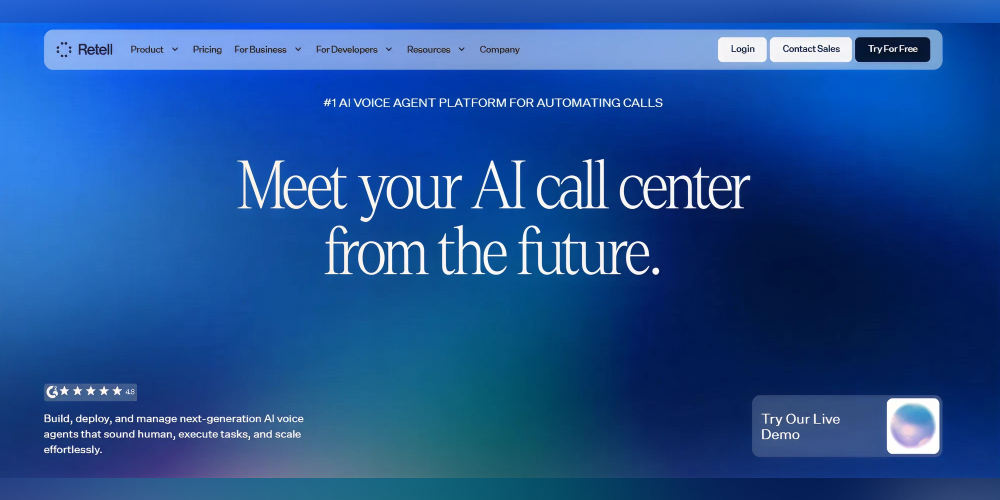
Retell AI homepage
Retell AI is a conversational AI platform designed for businesses looking to automate voice, chat, and SMS interactions with LLM-powered voice agents. These agents are capable of handling calls and initiating message workflows by smoothly integrating into existing systems.
Retell AI’s Voice Agent Automation is natural, and almost-human-like, and the LLM-native agents respond within 600 milliseconds. It is suitable for teams with a certain knowledge of coding and that handle large volumes of calls from across the globe.
Retell AI’s Key Features
- Real-time voice agents connected via WebSocket-based audio streams
- BYOC Telephony support for Twilio, Telnyx, and others
- Multilingual support in 31 languages
- Custom LLMs and compatibility with GPT-4, Claude 3, and
- Compliance ready for SOC2, HIPAA, etc.
Retell AI’s Pros
- Fast setup with minimal configuration
- Easy-to-use, clean, and intuitive interface
- Support for multi-turn logic
- Pay-as-you-go pricing with zero platform fee
- Good customer support
Retell AI’s Cons
- Not suitable for teams with zero engineering knowledge
- Steep learning curve
- Limited features
- Bulk plans are expensive
- Latency issues and a lack of customization options for the male voice
Retell AI’s Pricing
Retell AI has a modular pricing model with flexible options for startups and enterprise teams. It offers $10 in free credits, which is equivalent to up to 60 minutes of call time. The enterprise plan offers more features and volume-based discounts.
#3 Vapi AI
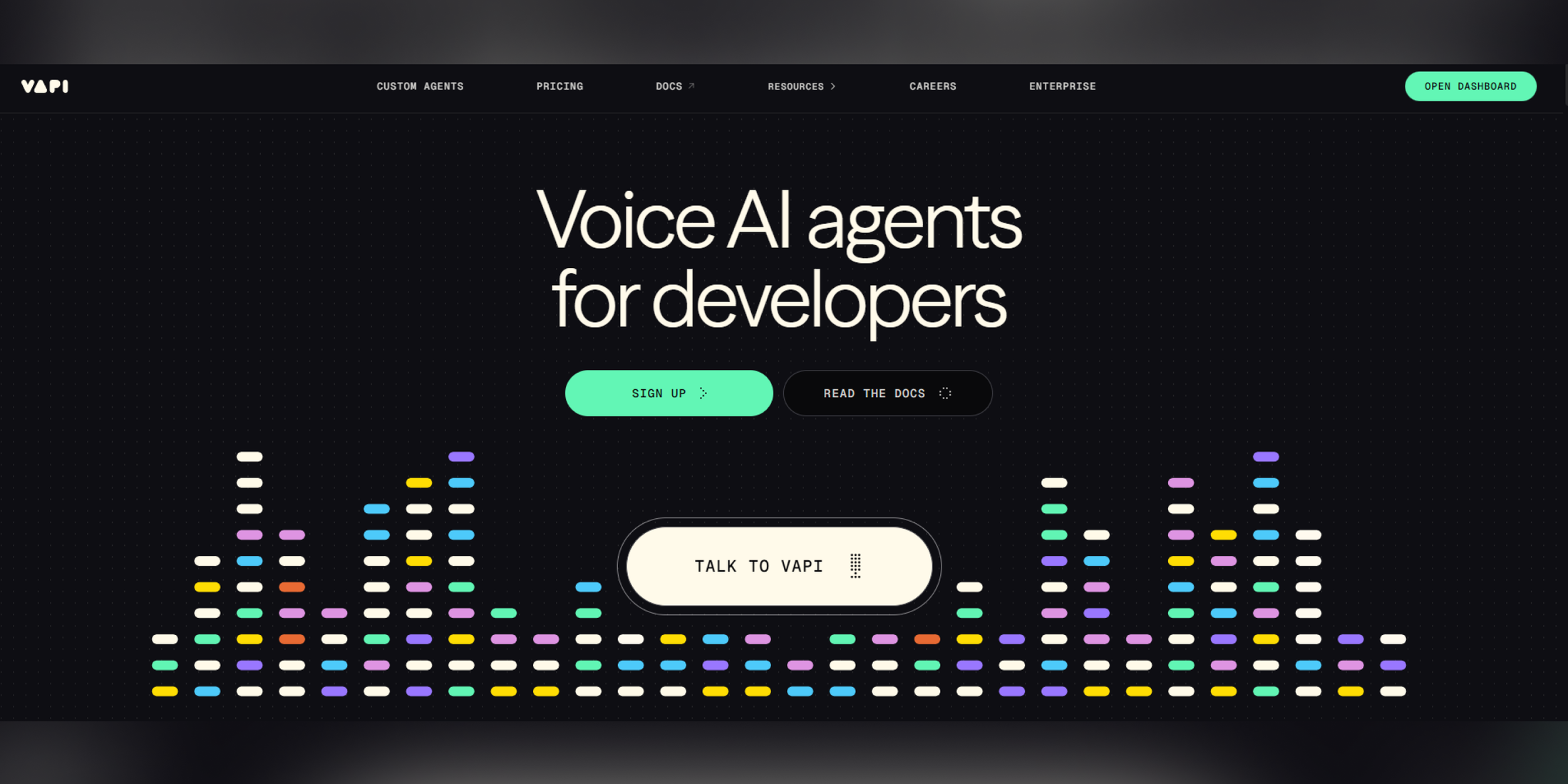
Vapi AI homepage
Vapi AI is an AI voice platform, great for teams with developer-level skills. The platform has a comprehensive suite of tools for anyone to create, test, and deploy voice assistants. The platform is built to handle more than 1 million concurrent calls.
Its voice agents are highly sophisticated with customizable external integrations, have a low latency of up to 500 ms, and simulate the flow of natural human conversations well, i.e., the agents can pause and wait politely when interrupted.
Vapi AI’s Key Features
- Voice API and an intuitive dashboard for no-code users
- Multilingual support for 100+ languages
- Detailed analytics for call success evaluation
- Native integration available with Make
- Compliance with SOC2, HIPAA, and PCI
Vapi AI’s Pros
- Excellent granular control over LLMs, TTs, and STT providers for developer teams
- Large call handling capacity
- Integration capability for complex automation
- Optimized for low latency
Vapi AI’s Cons
- High hidden provider fees and other costs
- Not suitable for less tech-savvy teams or beginners
- Complex to set up
- Some missing features, such as built-in web widgets
- Comparatively less user-friendly for small businesses
Vapi AI’s Pricing
Vapi AI offers pay-as-you-go plans with call hosting starting at $0.05 per minute and SMS/Chat at $0.005 per message. Each add-on incurs additional cost. The total cost of the plan is on the expensive side.
#4 PolyAI
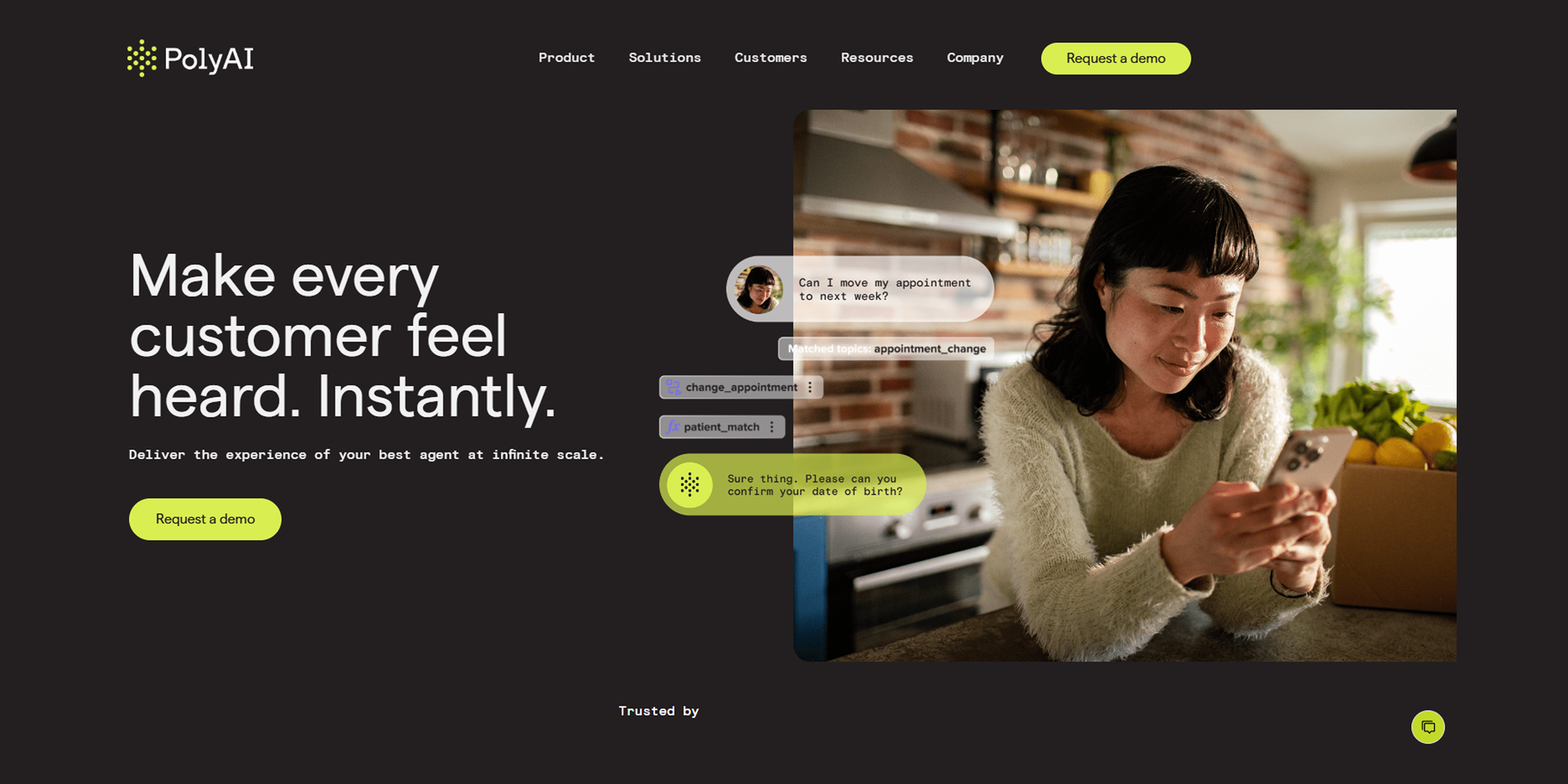
PolyAI homepage
PolyAI develops customer-facing voice assistants for various industries, including insurance, restaurants, banks, hotels, telecom, and retail. Its advanced agentic AI-based assistants help enterprises to reduce wait times, free up customer care staff, and improve overall user experience. The companies can automate inbound calls by plugging the API into existing CRMs and contact center stacks.
PolyAI’s Key Features
- Capable of understanding complex customer inputs
- Supports multilingual conversations in 12 languages
- Real-time dashboards for analytics
- Compliant with SOC 2, HIPAA, and GDPR
- Custom voice available for each assistant
PolyAI’s Pros
- Good quality voice output and interaction
- Capable of handling interruptions and topic shifts
- Improves service availability by deflecting call volume
- Deployment time to go live is faster
- 24/7 customer support
PolyAI’s Cons
- Limited analytics features
- Slow performance and lagging issues
- No free trial available
- No testing sandbox and no-code builder available
PolyAI’s Pricing
PolyAI’s official website has no pricing plans displayed publicly. Pricing is available only on a quote based on customization, volume, use case, and integration requirements.
#5 Bland AI
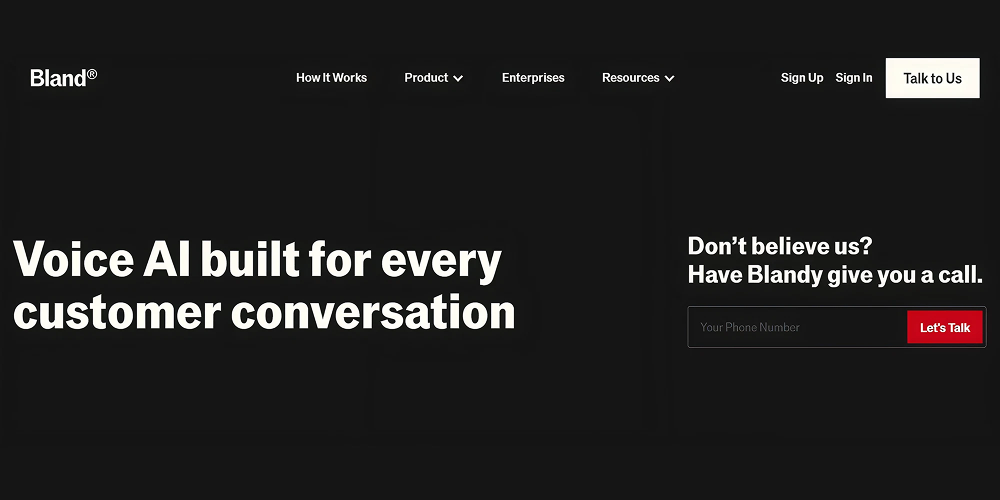
Bland AI homepage
Bland AI is a developer-focused AI voice assistant platform. It provides a do-it-yourself toolkit for your team to create voice agents. The ‘voice agent-building’ toolkit consists of webhooks, pathways, voice cloning, GPT-4 prompts, and memory stores. The platform offers high customization and control for developers to custom-build the voice agents from scratch. It comes with a basic drag-and-drop builder for creating simple call flows.
Other than that, it requires heavy reliance on engineering teams to build voice agents. Although the setup is smooth and integrations deep, users have complained (opens in a new tab) about the tool not performing well and sounding bot-like in real-world case scenarios.
Bland AI’s Key Features
- Voice API integrations for live, human-like conversations
- API-first architecture and programmable workflows
- Integration for BYOC telephony, Twilio, and Vonage
- Post-call analysis and basic reporting via API requests
- Compliant with SOC 2 and HIPAA
Bland AI’s Pros
- Handles heavy call flow of up to 1 million concurrency
- Good automation features
- High degree of control over the efficacy of agents
- Omnichannel support for calls, SMS, and chats
Bland AI’s Cons
- Not suitable when enterprises require rapid deployment and no-code environments
- Voice cloning is still in beta phase and comes as an add-on
- No multilingual support
- Lacks extensive compliance
- High latency at around 800ms
Bland AI’s Pricing
Bland AI’s official website doesn’t state its pricing plans or call per-minute charges. Pricing quotes are available on demand.
#6 Fin
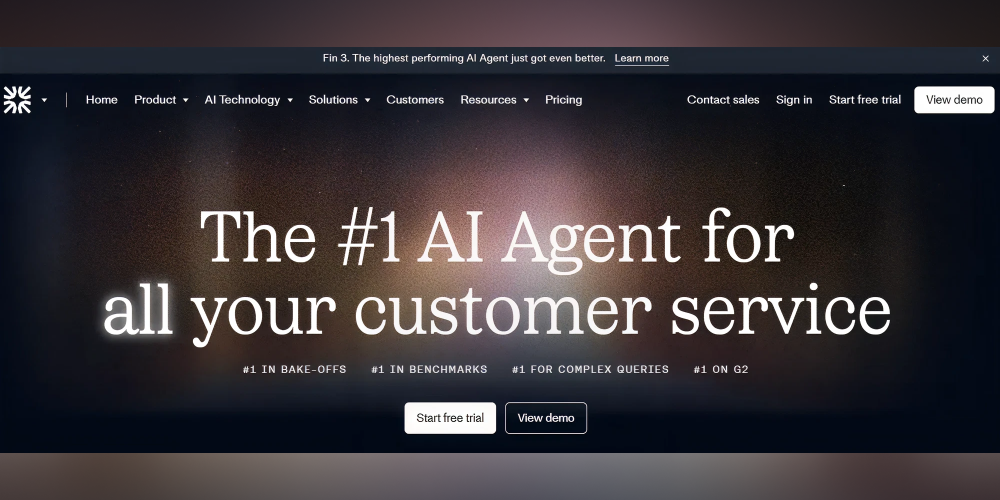
Fin homepage
Fin is a well-known AI voice and chat agent for customer service automation. It was developed by Intercom as a support agent providing natural language responses by pulling out data from the company’s knowledge base.
The platform can handle advanced workflows, but setting it up requires considerable tailoring, planning, and effort from the teams. It is more suitable for businesses interested in adopting the larger Intercom ecosystem.
Fin’s Key Features
- Resolution-based AI agents for automatic handling of customer queries
- Omnichannel support across channels
- Multilingual support with real-time translation for more than 45 languages
- Adapts responses to the company’s brand voice
- Group customer queries to analyze trends
- Bach-testing and preview of responses
Fin’s Pros
- Pulls live data from APIs for generating responses
- Easy-to-use, clean interface
- Effective for handling routine queries
- Responsive across multiple channels, including voice, chat, SMS, and email
Fin’s Cons
- Struggles with complex or multi-step questions
- Hallucinates or misinterprets occasionally
- Requires manual efforts to merge duplicate conversations across channels
- Subscription costs can increase unpredictably
- Not suitable for small businesses
Fin’s Pricing
Fin AI charges $0.99 per resolved conversation. It also has a monthly minimum monthly usage requirement in place, and charges extra for gated add-ons like Copilot, Intercom seat licenses, advanced reporting, etc.
#7 Replicant
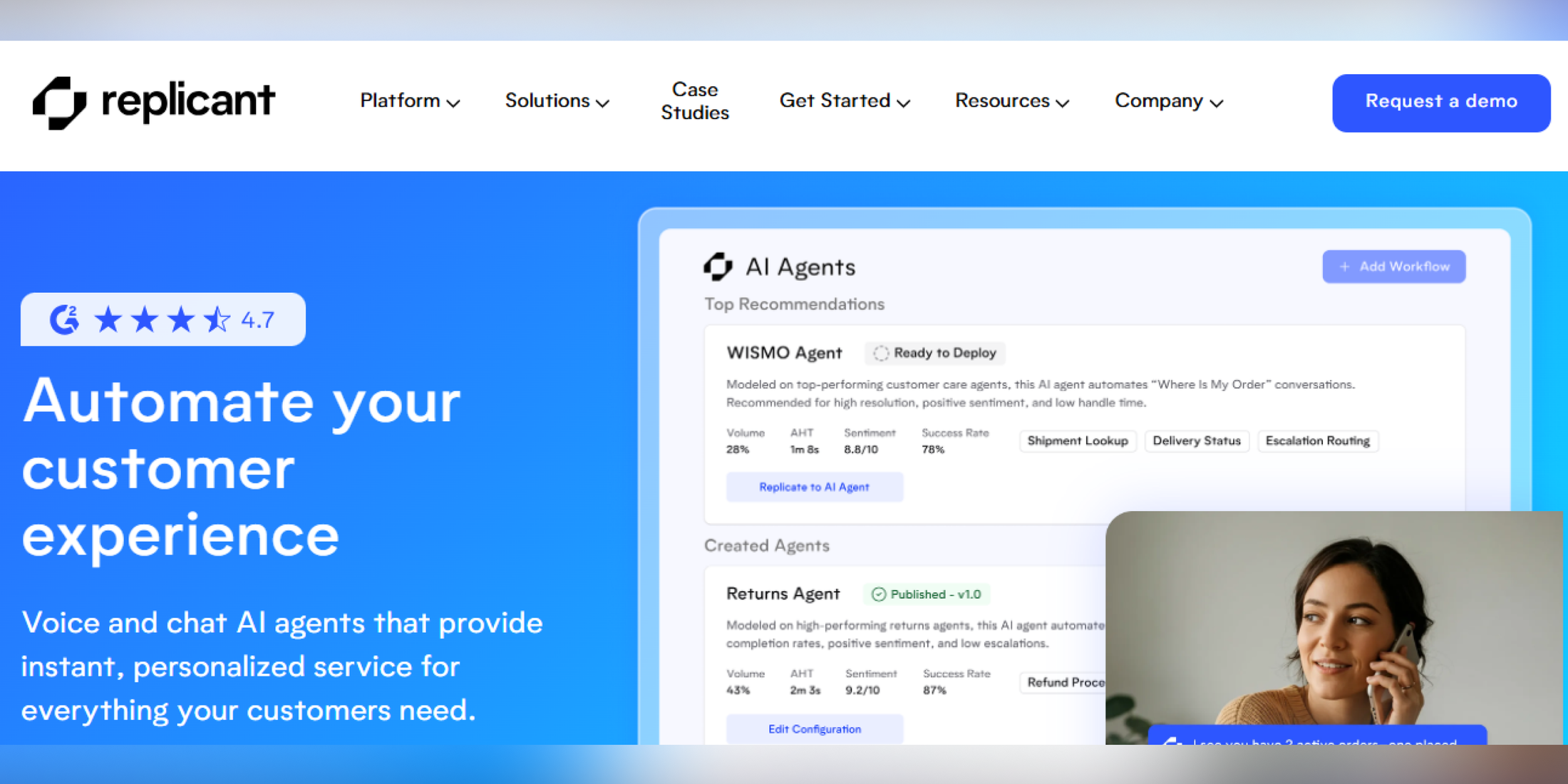
Caption: Replicant homepage
Replicant is an agentic AI-based customer service platform that automates complex conversations by replicating the top-performing human agents within the organization. The platform offers end-to-end customer issue resolution with complete visibility over how the interactions were handled.
It offers enterprise-level automation to handle repetitive calls for authentication, order status, appointment changes, etc. It is suitable for large contact centers with dedicated IT teams.
Replicant’s Key Features
- Omnichannel support across voice, SMS, and chat
- Power AI engine to understand multiple intents in a single sentence
- Offers deep analytics for call outcomes and summaries
- Delivers real-time responses
- Compliant with SOC 2 and PCI
Replicant’s Pros
- Good customer support and team response times
- Capability to handle and resolve a high volume of repetitive calls
- Good visibility via call outcomes and summaries
- Low latency and long pauses
Replicant’s Cons
- Requires considerable prepping time and effort for voice accuracy
- Not suitable for small organizations
- Deployment takes time
- No extensive multilingual support
- Expensive pricing model
Replicant’s Pricing
Replicant's official website has no publicly available information on its pricing model. It offers custom quotes to enterprises based on their requirements.
#8 Goodcall
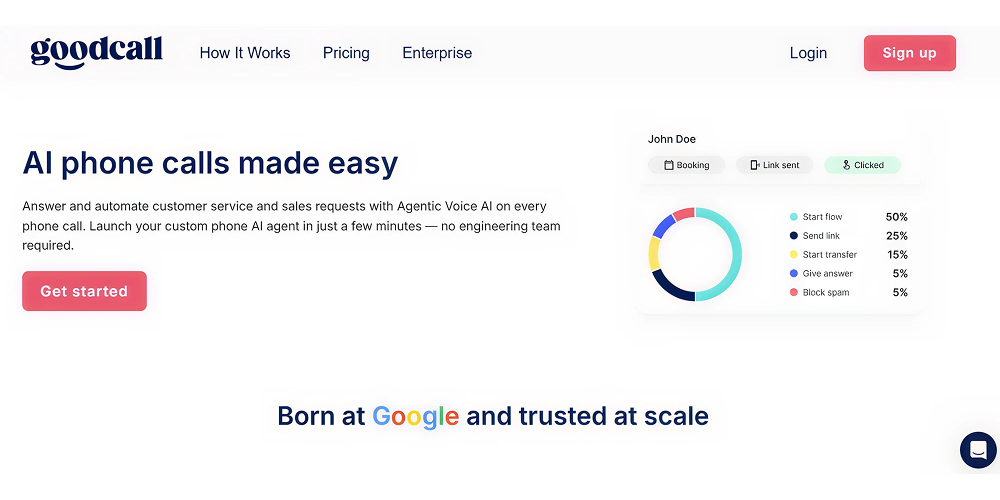
Caption: Goodcall homepage
Goodcall is a conversational AI platform catering to small businesses. It deploys phone-powered assistants for handling inbound calls, capturing leads, and booking appointments. It is not suitable for businesses that engage in sophisticated and complex customer-service processes with deep integrations.
Goodcall’s Key Features
- Inbound call automation via AI voice agents
- No-code customization for handling simple workflows
- NaScheduling, FAQs, and lead capture
- Custom AI agent for business-specific needs
- Compatible with REVIEWS.io and Zapier for other functionalities
- Compliant with ISO 27001 certification
Goodcall’s Pros
- Easy to set up and 24/7 available
- Multiple options for voice
- Analytics dashboard for basic monitoring
- Spam filter to reject robocalls
Goodcall’s Cons
- No live chat or basic support for non-enterprise plans
- Issues with user billing
- Not suitable for large-scale organizations
Goodcall’s Pricing
Goodcall has a standard tier-based pricing model. Its starter pack comes at a monthly subscription plan of $66, the Growth plan is priced at $108 monthly, and the Scale plan at $208 monthly.
#9 Yellow AI
Caption: Yellow AI Homepage
Yellow.ai is a conversational AI platform that supports voice and chat automation with a strong emphasis on multilingual coverage. It is commonly used by organizations operating across regions that need consistent customer experiences across languages and channels. The platform enables teams to deploy and test AI agents in multiple languages and regional variations, though the depth of voice-led resolution can vary depending on the workflow complexity and use case.
Yellow.ai’s Key Features
- Multilingual automation across voice and chat
- Omnichannel coverage across customer interaction channels
- Language and regional variation support to handle accents and localization needs
- Tools to test and validate AI agent consistency across regions
- Voice customization options, including voice cloning for region-specific experiences
Yellow.ai’s Pros
- Strong language support for global deployments
- Broad channel coverage for multi-region operations
- Helpful for teams prioritizing localization and regional consistency
- Voice customization options for language-specific deployments
Yellow.ai’s Cons
- Less depth in voice resolution for complex or multi-step workflows
- Enterprise feedback can be mixed depending on implementation and use case
- Performance consistency may vary by region, language, or channel
Yellow.ai’s Pricing
Yellow.ai typically uses tiered pricing based on channels enabled, languages supported, and total interaction volume.
What Features Your AI Voice Platform Must Have
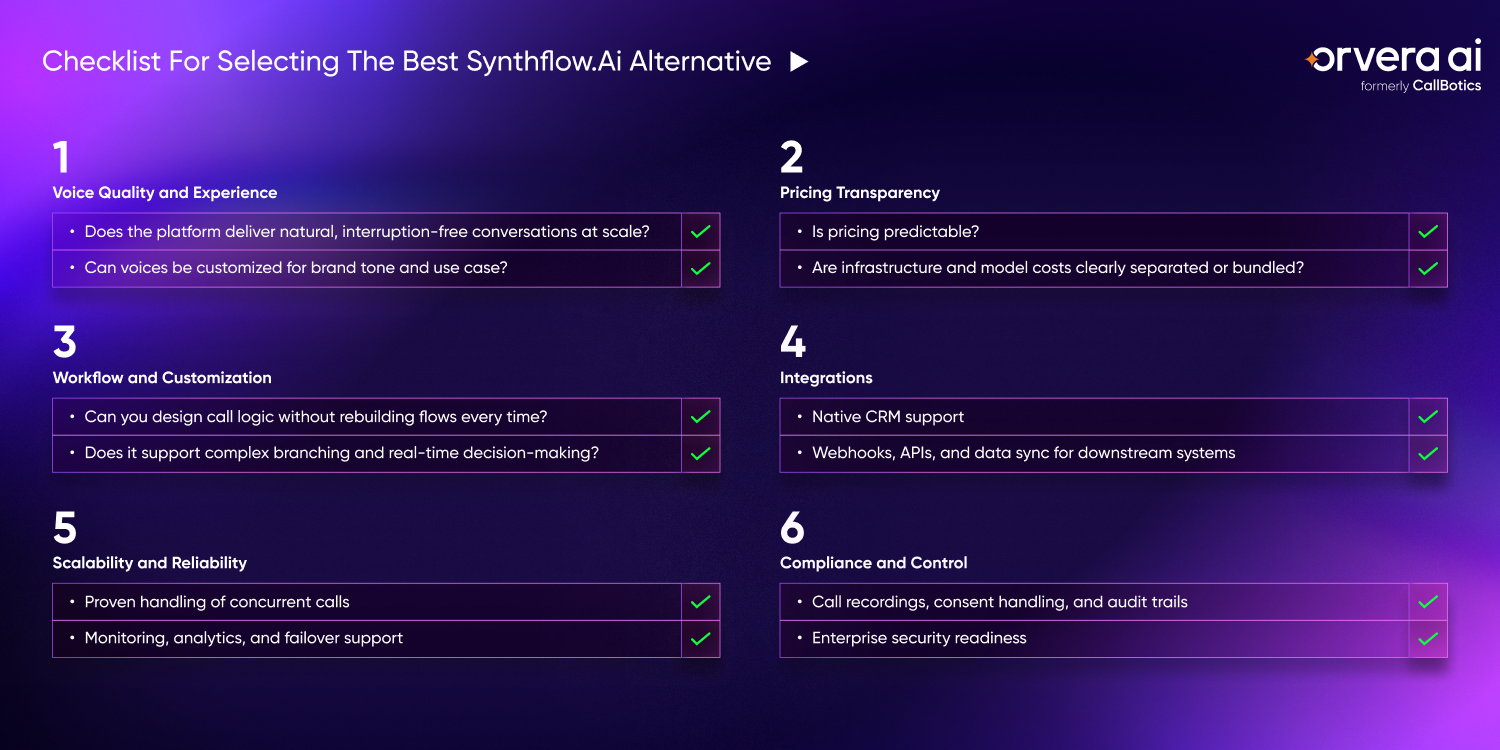
The best AI voice platform for any organization would be the one with the true operational fit. Here are a few criteria points that can come in handy during platform evaluation:
- Natural, human-like voice for better engagement, trust, and conversion during calls, and lower call drop-offs.
- No-code or low-code builder for faster iteration and for teams to adapt in real time. Low-code builders also reduce dependence on engineering teams, which slow change cycles and regular updates.
- Deep integrations with CRM and operational tools for automated logging, context-aware responses and follow-ups, and workflow triggers.
- Advanced analytics and call insights for full visibility into performance and outcomes, and subsequent optimization. Opaque systems result in blind scaling and no measurable ROI.
- Transparent pricing for budget clarity and confident scaling.
- Security and compliance for safe deployment in high-volume environments and for reduced risk of regulatory violations when handling customer conversations.
Also Read this step-by-step guide to AI Voice Agent Implementation in 2026 (opens in a new tab)
Why Orvera Is a Strong Alternative to Synthflow.ai
Orvera is built for teams that have moved beyond pilot programs and are deploying AI agents in live, revenue-critical environments. The platform emphasizes operational reliability, scalability and direct integration into real business workflows, and Orvera builds, deploys and runs it, which makes it well suited for production use at scale.
- Natural conversation handling:Natural conversation handling: Supports human-like cadence, interruptions, clarifications, and dynamic intent changes without sounding scripted, with resolution on the first contact
- High-volume, low-latency performance:Designed to sustain large call volumes with consistent response times, even during traffic spikes. First-contact resolution runs around 80 percent across Orvera customers.
- Production-grade workflow logic: Enables complex, multi-step call flows that reflect real operational processes without heavy engineering effort.
- Deep enterprise integrations: Connects natively with CRMs, scheduling systems, and operational tools to reduce manual handoffs.
- Compliance and audit readiness: Includes controls, logging, and traceability required for regulated and high-risk workflows with an in-built quality and analytics dashboard.
- White-glove implementation: run by the Orvera team.
Automate your user experience and customer service. Let Orvera manage your calls. Book a demo today or contact us (opens in a new tab) to transform your voice operations.
Frequently asked questions
Pricing varies significantly. Some platforms use pure usage-based pricing, i.e., per minute or per call. Others bundle infrastructure and AI model costs. Enterprise-focused platforms offer custom contracts. Teams moving away from Synthflow.ai often prioritize platforms with predictable monthly spend and fewer hidden infrastructure charges.
The most critical integrations are CRM systems, ticketing tools, analytics platforms, and webhook/API support for internal workflows. Without these, voice AI remains siloed. Platforms like Orvera are often chosen because they integrate directly into revenue, support, and operations workflows instead of operating as standalone call tools.
Voice quality needs to be evaluated beyond scripted demos. Enterprises should assess how well a system handles natural turn-taking without awkward interruptions, maintains low latency during real-time conversations, and delivers consistent performance across different accents and longer call durations. Running live pilot calls with real customer scenarios remains the most reliable way to determine whether a voice model is ready to handle production traffic at scale.
It depends on scale and team structure. Developer-first platforms offer deep control but increase maintenance overhead. No-code platforms accelerate deployment but may limit customization. Many enterprises prefer a hybrid approach, i.e., configurable workflows with API-level extensibility, so product teams can iterate without rebuilding logic every time.
Before switching platforms, teams should map current call flows and decision logic, audit call volumes and peak concurrency, and, finally, identify required integrations and compliance needs to avoid migration delays and immediate ROI.
Platforms that combine voice quality, workflow flexibility, analytics, and pricing transparency tend to scale best. Enterprises looking for stable, production-grade voice automation often choose solutions like Orvera, designed for operational ownership and predictability.
Written by
Urza Dey
Urza Dey (She/They) is a content/copywriter who has been working in the industry for over 5 years now. They have strategized content for multiple brands in marketing, B2B SaaS, HealthTech, EdTech, and more. They like reading, metal music, watching horror films, and talking about magical occult practices.