What Is Branded Caller ID? How Businesses Can Boost Outbound Call Trust & Answer Rates
Outbound calls have a trust problem before a rep says a word. When customers see an unknown number, they often...


Key highlights
Key takeaways
- Branded caller ID helps customers recognize a business call before they answer, which reduces the suspicion that comes with unknown numbers
- A clear caller identity can improve pickup rates for sales, support, billing, appointment, service, and customer success calls
- The setup works best when businesses verify their identity, register the right outbound numbers, and keep the displayed name consistent
- Caller reputation still matters because complaints, spam reports, aggressive dialing, and unusual call volume can hurt call performance
- AI voice agents can make outbound calls more relevant by using approved context, better timing, sentiment signals, and smart escalation
- Trusted outbound calling works when caller identity, responsible calling behavior, and AI-enhanced call management support each other
Outbound calls have a trust problem before a rep says a word. When customers see an unknown number, they often assume the call is spam, a scam, or something they can ignore. Branded caller ID helps fix that first moment by showing the business name or logo on the incoming call screen.
That recognition matters because customers are already trained to be cautious. A June 2026 research paper on robocalls notes that unsolicited automated calls caused $1.1 billion in reported losses in the US during 2025, which helps explain why people hesitate before answering unfamiliar numbers (opens in a new tab). For legitimate businesses, branded caller ID gives customers one clear signal that the call is connected to a company they know.
This does not mean every customer will answer every call. It means the call starts with less suspicion and more context. For contact centers, sales teams, healthcare teams, financial services teams, and customer support operations, that small change can make outbound calling feel less anonymous and easier for customers to trust.
What Does Branded Caller ID Mean
Branded caller ID means your outbound call shows more than a phone number. It can display your company name, verified identity, logo, or call label, depending on the carrier, device, and region. The goal is simple: help customers understand who is calling before they decide whether to answer. For outbound teams, it also makes the call feel less random and more connected to an actual customer interaction.
This matters because most people do not trust unknown numbers. A plain number can look like spam, even when the call is legitimate. Branded caller ID gives the customer a clearer signal that the call is coming from a business they may recognize. That signal is especially useful when the call is about an appointment, account update, order issue, payment reminder, or service request.
Regular caller ID vs branded caller ID
Regular caller ID usually shows the phone number calling the customer. In some cases, it may also show a basic location or a caller name pulled from carrier records. That does not always give the customer enough context to trust the call. This is why many valid business calls still get missed, even when the customer actually needs the information.
Branded caller ID adds a verified business identity to the call screen. Instead of seeing only an unfamiliar number, the customer may see the company name, logo, or a verified label. That small difference can help separate a real business call from the unknown numbers people often ignore. It gives the customer a reason to pause before declining the call.
What customers see on their phone
What a customer sees depends on their mobile carrier, device, region, and the branded caller ID setup. Some customers may see the company name. Others may see a logo, a verified checkmark, a business label, or a short call reason. The call reason can be helpful when the customer needs to know whether the call is urgent or routine.
The experience will not look the same for every customer. That is important to understand before setting expectations. Branded caller ID improves recognition, but the exact display depends on the phone network and the customer’s device. The practical goal is not a perfect display on every screen, but better recognition across more outbound calls.
How Does Branded Caller ID Work
Branded caller ID works by connecting your business identity to the phone numbers your team uses for outbound calls. The business verifies its identity, registers the right numbers, and works through carriers or call platforms that support brand display. Once the setup is active, customer devices may show your business name, logo, verified label, or other trust signals instead of showing only an unknown number. The stronger the setup behind the call, the better chance the customer has of recognizing it as a valid business call.
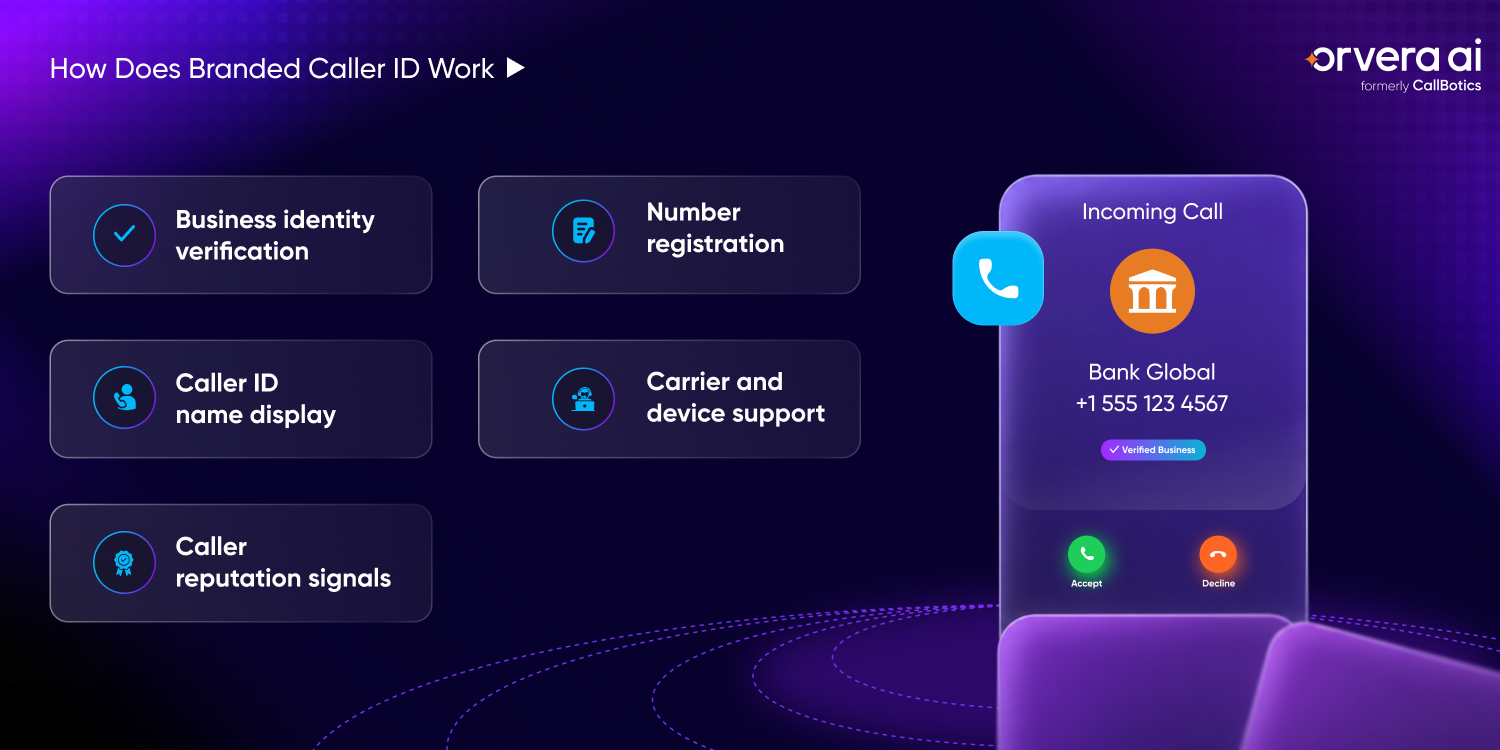
Business identity verification
Business identity verification is the first step because carriers and call platforms need to know that the company using the number is legitimate. Without this step, your business name may not display reliably, or the call may still appear as an unknown number. This step also helps protect customers from spoofed calls (opens in a new tab) that misuse real company names.
- The company may need to submit business details, legal name, domain, and contact information
- The verification process helps reduce misuse by people pretending to call from a real business
- Verified identity gives carriers a stronger reason to show the business name on supported devices
Number registration
Number registration connects your approved business identity to the phone numbers your teams use for outbound calling. This is important because sales, support, billing, reminders, and follow-up teams may use different numbers. It also helps businesses avoid confusion when multiple departments call customers from separate lines.
- Register the numbers that actually place customer calls, not only the main business line
- Keep number ownership and usage details updated when teams, vendors, or call platforms change
- Use consistent numbers for specific call types so customers can recognize them over time
Caller ID name display
Caller ID name display is what the customer sees when the registered number reaches their phone. Instead of only seeing a number, the customer may see a business name, verified label, logo, or call-related display, depending on the setup. This display becomes the customer’s first clue that the call is connected to a real business relationship.
- A clear business name helps customers understand who is calling before they answer
- The displayed name should match the brand customers already know from emails, SMS, apps, or service records
- If the name is unclear, shortened badly, or inconsistent, customers may still treat the call with suspicion
Carrier and device support
Branded caller ID does not look the same for every customer because carriers, phone models, operating systems, and regions handle call display differently. This is why businesses should treat branded caller ID as a trust improvement, not a guaranteed identical screen for every call. A rollout should include testing, monitoring, and clear expectations for what different customers may see.
- Some customers may see the full business name, while others may see only a basic caller label
- Display quality can change across iOS, Android, mobile carriers, landlines, and regions
- Testing across major carriers and devices helps teams understand what customers actually see
Caller reputation signals
Caller reputation signals affect how carriers treat your outbound calls over time. Even with branded caller ID, high complaint rates, unusual call volume, unanswered calls, or spam reports can hurt how your calls appear. Good caller reputation depends on both technical setup and responsible calling behavior.
- Keep outbound volume controlled and avoid sudden spikes that look unusual to carriers
- Make sure calls are relevant, expected, and tied to a real customer need
- Monitor answer rates, complaints, and spam labels so your team can fix issues before trust drops
Why Is Branded Caller ID Important
Branded caller ID matters because customers are careful about the calls they answer. When a number looks unknown, many people assume it could be spam, fraud, or a call that is not worth their time. That hesitation is now part of normal customer behavior, especially on mobile phones.
For businesses, that creates a problem before the conversation even starts. A recognizable caller ID helps customers connect the call to a real company, which can improve trust, answer rates, and brand recall. It gives outbound teams a better chance to start the conversation with context instead of suspicion.
Customers are less likely to answer unknown numbers
Most customers do not stop to investigate every unknown number. They usually make a quick decision based on what appears on the screen. If the call shows only a random number, the safest choice often feels like ignoring it. This is where a legitimate business call can get treated the same way as a spam call.
That missed call can create real friction for the business. Sales follow-ups get delayed, service updates go unheard, appointment reminders are missed, and support teams spend more time calling the same customer again. Over time, this adds more repeat work to teams that are already trying to move fast.
Businesses need to build trust before the call starts
Trust starts before the customer hears a voice. If the caller ID looks unclear, unfamiliar, or suspicious, the customer may reject the call even when the reason is valid. This is especially common when customers are already used to spam calls. A weak caller display can make the business look less credible than it actually is.
Branded caller ID gives the customer a clearer reason to answer. Seeing a known business name, verified label, or recognizable identity can make the call feel connected to an existing relationship instead of a random interruption. That recognition helps the customer understand that the call may be relevant to them.
Outbound teams need better connection rates
Outbound teams lose time when customers do not answer. Sales, support, billing, service, and appointment teams may all depend on live conversations to complete simple but important tasks. Low pickup rates make those workflows slower and more expensive. The issue is not always the message or the team, but whether the customer answers at all.
Branded caller ID helps teams reach more customers with less repeated effort. It does not guarantee that every call will be answered, but it can reduce the gap between a valid business call and a customer who assumes it is spam. That can make outbound work more predictable for teams that depend on timely customer contact.
Caller reputation directly affects call performance
Caller reputation can decide how your calls are treated by carriers and customers. If a number is linked to complaints, high-volume calling, poor answer rates, or spam reports, the call may be flagged or ignored more often. This means poor calling practices can damage performance even after the caller ID setup is in place.
That directly affects outbound campaign performance. Even a strong sales, support, or service message can fail if the call is marked as suspicious before the customer sees it. Branded caller ID works best when it is supported by responsible calling practices and a clean caller reputation. The brand display and the calling behavior need to support each other.
Benefits of Branded Caller ID for Businesses
Branded caller ID helps businesses make outbound calls easier to recognize and easier to trust. It supports sales, support, billing, reminders, service updates, and other customer-facing calls where missed connections can slow down the work. It also gives outbound teams a clearer starting point when the call needs quick customer action. For teams handling high call volumes, even a small lift in recognition can reduce wasted attempts.
Improves call answer rates
Customers are more likely to answer a call when they can recognize who is calling. A branded caller ID gives them that context before the call starts, which helps reduce the chance of a valid business call being ignored. This is especially useful for time-sensitive calls where a delay can create more follow-up work. It helps teams reach customers while the reason for the call is still relevant.
- Customers do not have to guess whether the number is safe or relevant
- Sales, support, and service teams get a better chance to reach customers on the first attempt
- Fewer missed calls can reduce repeated dialing and follow-up delays
Builds customer trust
A verified business identity reassures customers that the call is connected to a real company. This matters because many customers now treat unknown numbers with caution, even when the call is useful or expected. A clear caller identity helps the business earn a little trust before the conversation begins. That trust can make the customer more willing to listen instead of ending the call quickly.
- A recognizable business name makes the call feel less random
- Verified caller information helps separate legitimate calls from suspicious ones
- Customers may feel more comfortable answering when the caller identity matches a brand they know
Reduces spam suspicion
Branded caller ID can reduce the chance of customers assuming the call is unwanted. When the call screen shows a business name or verified identity, the customer has more reason to treat the call as valid. That first signal can stop a useful call from being dismissed too quickly. It also lowers the pressure on reps to prove the call is genuine in the first few seconds.
- A clear caller identity can help reduce instant declines from cautious customers
- Customers are less likely to confuse the call with unknown or nuisance numbers
- Responsible calling behavior still matters because complaints and spam reports can affect call reputation
Strengthens brand consistency
Consistent caller identity helps customers see the same brand across calls, emails, SMS, apps, and service updates. This makes the business look more organized and professional during outbound communication. It also reduces the gap between the customer’s digital experience and their phone experience. When the caller name matches the brand customers already know, the interaction feels more connected.
- The displayed business name should match the name customers already recognize
- Consistent caller identity reduces confusion when different teams call from different numbers
- A clean and reliable caller display supports a more professional customer touchpoint
Improves customer experience
A smooth outbound call starts with recognition. When customers know who is calling, they are more likely to answer with the right context instead of starting the interaction with suspicion. That makes the call feel more useful and less like an interruption. It also helps the conversation move toward the actual issue faster.
- Customers can understand the call may be connected to an appointment, order, account, payment, or support request
- Reps spend less time explaining why the call is legitimate
- The conversation can move faster because the customer is not starting from confusion or distrust
Common Use Cases of Branded Caller ID
Outbound calls work best when the customer can recognize the call before they answer. This is useful across sales, support, billing, appointment reminders, delivery updates, and customer success calls. These are the moments where a missed call can delay a sale, service request, payment conversation, or customer follow-up.
Many of these calls fail for the same reason: the customer does not know who is calling. A branded display gives them a clearer signal, so important outbound communication does not look like another unknown number. That signal helps the call feel connected to a real need instead of an unwanted interruption.
Sales and lead follow-up calls
Sales teams often call people who recently filled out a form, requested a demo, downloaded content, or spoke to the business at an event. The problem is that the prospect may not have saved the number, so the call can still look unknown. By the time the prospect misses the call, the intent that created the lead may already start cooling down.
A recognizable caller display helps connect the call to the action the prospect already took. When the business name appears on the screen, the call feels more relevant and less like a random sales attempt. That makes it easier for sales teams to continue the conversation while the prospect still remembers why they engaged.
Customer support callbacks
Support callbacks are usually expected, but customers may still miss them if the number is not familiar. This can be frustrating for both sides because the customer may have already opened a ticket, waited in a queue, or asked for help. One missed callback can push the same issue back into the queue.
A clear business name makes the follow-up easier to recognize. It also makes the callback feel more professional because the customer can see that the call is connected to the support request. That recognition helps the customer return to the issue faster without questioning who is calling.
Appointment reminders and confirmations
Appointment reminders and confirmations depend on timely customer response. When reminder calls are missed, teams may deal with no-shows, late cancellations, empty slots, and extra rescheduling work. This can affect both the customer’s schedule and the team’s daily capacity.
A known caller identity helps customers understand that the call may be tied to an upcoming appointment. That recognition can make them more likely to answer, confirm, reschedule, or call back before the appointment is missed. It gives the customer a better chance to act before the appointment window closes.
Billing and payment calls
Billing and payment calls are sensitive because customers are careful with account and financial information. If the call comes from an unknown number, the customer may avoid it or assume it could be a scam. That hesitation is reasonable, but it can slow down legitimate account conversations.
A verified business identity helps reduce that first layer of suspicion. It does not replace proper verification, but it gives the customer a clearer reason to treat the call as a legitimate account-related conversation. The call still needs a careful script, clear purpose, and proper identity checks.
Delivery and service updates
Delivery and service teams often need customers to answer quickly. A missed call can delay a delivery, technician visit, address confirmation, service window, or issue update. In many cases, the team cannot move forward until the customer responds.
A recognizable caller name helps customers see that the call is connected to an active service or delivery. That makes it easier for them to answer, respond, or call back before the operational window is missed. It can also reduce confusion when the customer is expecting an update (opens in a new tab) but does not know which number will call.
Customer success and retention calls
Customer success teams call customers for onboarding, renewals, product usage, feedback, and retention conversations. These calls can be useful, but customers may ignore them if the caller identity is unclear. That can make proactive outreach look less important than it actually is.
A consistent business identity helps customers connect the call to their existing relationship with the company. This makes the outreach feel more relevant and supports conversations that can reduce churn, improve adoption, or keep the account on track. It helps customer success teams reach people before small issues become larger account risks.
Explore how Voice AI can support branded outbound workflows without adding more manual work for your reps. (opens in a new tab)Best Practices for Using Branded Caller ID
Branded caller ID works better when the setup matches how your outbound teams actually call customers. A clear business name, registered numbers, responsible calling behavior, caller reputation tracking, and strong scripts all need to work together. If one part is weak, customers may still ignore the call or carriers may still treat it as risky.
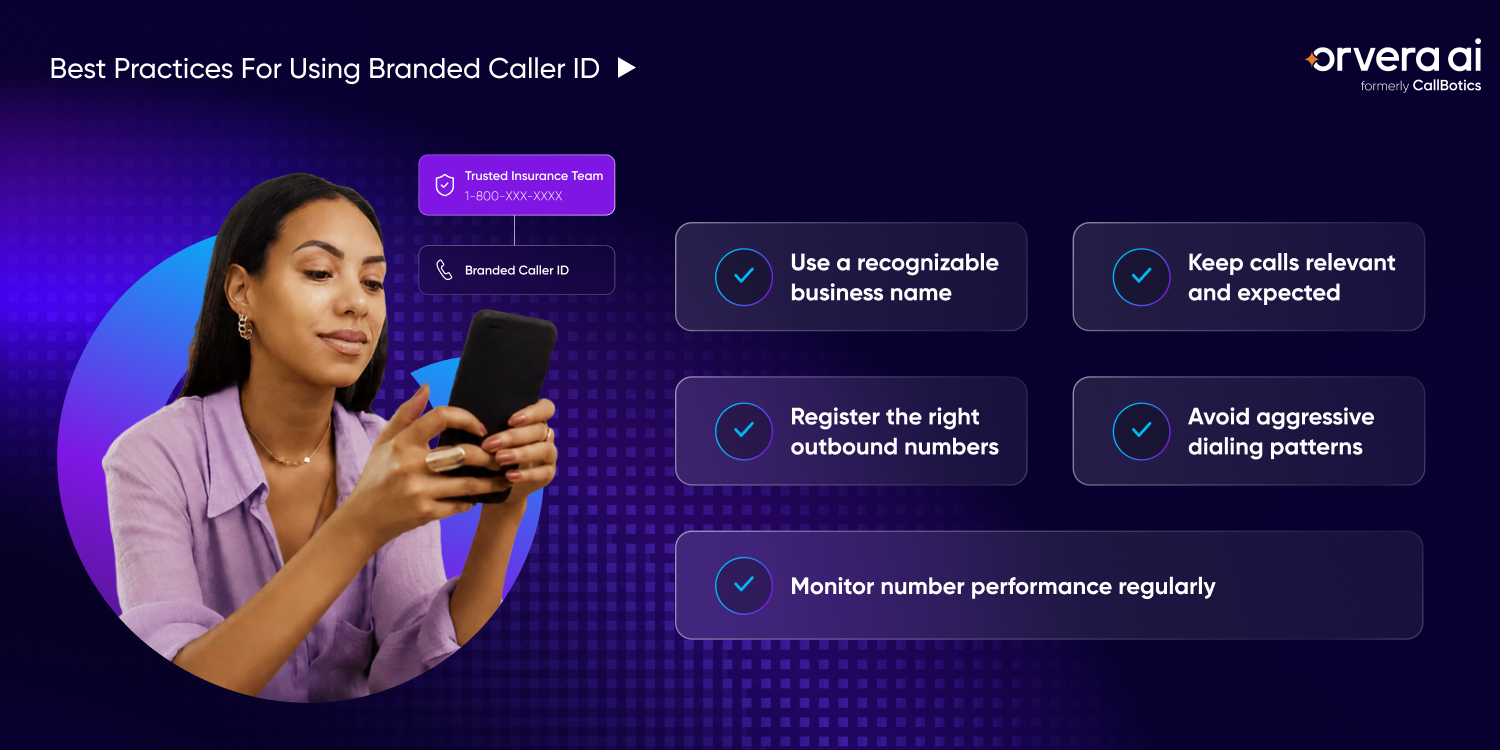
Use a recognizable business name
The displayed name should be clear enough for customers to understand who is calling at a glance. If the name is too short, unfamiliar, or different from the brand customers already know, the call may still feel suspicious. The safest choice is the name customers already associate with their account, order, appointment, or service.
- Use the business name customers see on your website, emails, SMS, app, or account portal
- Avoid unclear abbreviations, internal team names, or legal names customers may not recognize
- Keep the name consistent across sales, support, billing, and service calls
Register the right outbound numbers
Number registration should cover the phone numbers your teams actually use for customer calls. If only the main line is registered, calls from sales, support, billing, or service teams may still appear as unknown numbers. This is where many businesses lose consistency without realizing it (opens in a new tab).
- Register every active outbound number used for customer communication
- Include numbers used by internal teams, outsourced teams, call platforms, or regional offices
- Review the list regularly so old, unused, or changed numbers do not create display issues
Keep calls relevant and expected
Customers are more likely to trust a call when the timing and reason make sense. A branded display can help recognition, but the call still needs to be useful, timely, and connected to a real customer need. A trusted caller name cannot fix a call that feels unnecessary or poorly timed.
- Call customers when there is a clear reason, such as a request, appointment, update, payment, or service issue
- Avoid calling people who have not shown interest or do not have an active relationship with the business
- Match the script to the reason for the call so the customer understands the purpose quickly
Avoid aggressive dialing patterns
High call volume, repeated attempts, and poorly timed calls can damage trust. Even with a recognizable caller display, aggressive dialing can lead to complaints, ignored calls, and spam labels. Once customers start treating the number as unwanted, performance becomes harder to recover.
- Avoid calling the same customer too many times in a short period
- Space out follow-ups and respect opt-out, do-not-call, and contact preference rules
- Watch for sudden volume spikes that may look unusual to carriers or customers
Monitor number performance regularly
Caller reputation can change over time, so teams need to track how their numbers are performing. Answer rates, complaints, spam flags, and engagement trends can show whether customers and carriers are treating the calls as trustworthy. These signals help teams catch problems before a number starts hurting the whole campaign.
- Track answer rates by number, campaign, team, and call type
- Review complaints, spam labels, failed calls, and sharp drops in engagement
- Fix issues early by adjusting call volume, scripts, timing, or number usage
How AI Voice Agents Can Improve Branded Caller ID Performance
Branded caller ID helps customers recognize who is calling. AI voice agents can improve what happens after that first recognition by making outbound calls more relevant, better timed, and easier to manage. Together, they help outbound teams move from “Will the customer answer?” to “What should happen once they do?”
This matters because caller identity alone does not fix every outbound problem. If calls feel random, too frequent, or poorly timed, customers may still ignore them or mark them as unwanted. The call also needs to respect the customer’s context, timing, and reason for engagement.
Personalized outbound conversations
AI voice agents can use approved customer context to make outbound calls more relevant. The call can connect to a real reason, such as an appointment, order update, payment reminder, service request, or support follow-up. That makes the purpose of the call clear from the first few seconds (opens in a new tab).
That context helps the conversation feel less generic. Instead of starting with a broad script, the AI agent can explain why the business is calling and what the customer needs to do next. A clear next step also reduces the chance of the customer ending the call because they do not understand its value.
Smarter call timing and prioritization
Not every outbound call should be treated the same way. Some calls are urgent, some are routine, and some depend on what the customer already did in a previous interaction. Treating all of them equally can waste time and delay the calls that need faster action.
AI voice agents can help prioritize calls based on urgency, intent, and past activity. That helps teams avoid wasting effort on low-priority calls while time-sensitive customers are still waiting. It also helps outbound teams use their calling capacity where it has the most operational value.
Sentiment-aware follow-up
Customer mood matters during outbound calls. If a customer sounds frustrated, confused, or unwilling to continue, the next step should not be the same as it would be for a calm customer. A poor follow-up choice can turn a small issue into a larger service problem.
AI voice agents can detect sentiment signals during the call and adjust the follow-up path. A routine issue may continue through the AI agent, while a sensitive or complex issue can be escalated to a human rep with context. That handoff helps the rep understand what happened before they join the conversation.
Better call volume management
Caller reputation can suffer when outbound volume looks unusual. Sudden spikes, repeated attempts, and poorly spaced calls can make even legitimate business numbers look risky to carriers and customers. Once a number starts getting flagged, future calls may perform worse even when the reason for calling is valid.
AI voice agents can help manage call volume more carefully. They can support controlled outreach, avoid unnatural spikes, and help teams protect caller reputation while still reaching customers at scale. This keeps outbound activity more consistent instead of letting demand create risky calling patterns.
How Orvera AI Supports Trusted Outbound Calling
Trusted outbound calling needs more than a recognizable caller name. The call also needs the right context, timing, routing, and follow-up path once the customer answers. Without that, even a recognized call can still feel poorly timed or unhelpful. The real test is whether the call helps the customer complete something useful.
With Voice AI, branded caller ID, call context, smart routing, sentiment detection, and performance analytics working together, teams can make outbound calls easier to recognize and easier to manage. The goal is to make each call feel useful to the customer, not like another interruption. This gives teams a better way to handle outbound communication without turning every call into manual work. It also helps teams keep the calling experience consistent across higher volumes.
AI voice agents for branded outbound workflows
Outbound teams often lose time on calls that are repetitive but still important. Appointment reminders, payment follow-ups, order updates, service confirmations, and customer callbacks all need clear timing and a clear reason for calling. If these calls are not handled well, customers miss information and teams spend more time chasing responses. That creates extra workload for teams that are already trying to move fast.
Voice AI can run these outbound workflows with approved context, so the call does not feel generic. The AI agent can explain why the business is calling, confirm the next step, and keep the conversation tied to the customer’s actual need. That helps the call move toward resolution instead of stopping at basic outreach. The customer gets a clearer reason to stay on the call and take action.
Real-time intent and sentiment detection
Customers do not always respond the same way during outbound calls. Some want a quick answer, some need more detail, and some may sound frustrated, confused, or hesitant. A fixed script can miss those signals and push the conversation in the wrong direction. That can make a simple call feel harder than it needs to be.
Intent and sentiment detection help the AI agent understand what the customer is trying to do and how the customer is responding. Based on those signals, the call can continue, adjust direction, or move toward escalation. This makes the workflow more responsive to what is actually happening on the call. It also helps teams avoid treating every customer reaction the same way.
Smart human escalation
Not every outbound call should stay with an AI agent. Sensitive, complex, or emotionally charged conversations need a human rep who can use judgment and handle the situation carefully. This is where the line between routine work and human judgment needs to stay clear. The handoff should happen before the customer feels stuck or unheard.
A smart escalation path passes the call to a rep with context attached. The rep can see why the call happened, what the customer said, and what the AI agent already handled, so the customer does not have to repeat everything. That context helps the rep enter the conversation prepared instead of starting from zero. It also helps the conversation continue without losing momentum.
Call analytics and performance visibility
Outbound teams need to know what is working and what is hurting performance. Answer rates, call outcomes, customer sentiment, escalation patterns, and quality signals can show whether calls are building trust or creating friction. These signals also help leaders spot problems before they affect more customers. Without that visibility, teams may keep repeating the same calling issues.
Performance visibility turns outbound calling into a measurable process. Leaders can track outcomes, review quality, understand where customers drop off, and adjust workflows before small issues damage caller reputation. That gives teams a clearer way to improve calls instead of relying on guesswork. Over time, this helps outbound programs become more controlled, consistent, and easier to improve.
Conclusion
A recognizable caller identity helps outbound calls start with more trust and recognition. When customers see a familiar business name or verified identity, they have more context before deciding whether to answer. That matters for sales, support, billing, appointments, service updates, and customer success calls. It gives legitimate business calls a better chance of being seen as relevant instead of suspicious.
The display alone is not enough. Businesses still need responsible calling practices, registered numbers, clear scripts, controlled call volume, and regular reputation monitoring. AI voice agents can support this by making outbound calls more contextual, better timed, and easier to manage at scale. When caller identity, call behavior, and AI-enhanced workflows work together, outbound calling becomes more trusted, more consistent, and more useful for customers.
Frequently asked questions
Branded caller ID shows your business name, verified identity, logo, or call label on supported customer devices instead of only showing a phone number. It helps customers recognize the call before they decide whether to answer.
A business verifies its identity, registers outbound numbers, and works through carriers or call platforms that support branded display. When the call reaches a supported device, the customer may see the business name, logo, verified label, or call reason.
No. CNAM usually displays a caller name tied to a phone number, while branded caller ID can include richer identity signals such as a verified business name, logo, or call label depending on carrier and device support.
It can improve answer rates because customers are more likely to answer calls they recognize. Results still depend on call timing, relevance, caller reputation, and whether the customer has a reason to engage.
No. A branded display can reduce suspicion, but it cannot fully prevent spam labels if the number has poor reputation signals. High complaints, aggressive dialing, low answer rates, and unusual call volume can still affect how carriers treat the call.
Orvera helps businesses use Voice AI for outbound workflows with call context, intent detection, sentiment signals, smart escalation, and performance visibility. AI agents handle routine outbound calls, while sensitive or complex conversations can move to a human rep with context attached.

Written by
Anindita Majumder
Anindita Majumder is a communications professional with nearly four years of experience in public relations, corporate communications, and journalism. She creates content that helps brands communicate their vision, products, and expertise through press releases, thought leadership, and editorial pieces. Outside of work, she is a vocalist, which keeps her creativity flowing.