Why a 2% QA Sample Is a Liability: The Case for 100% Claims Call Auditing
A 2% QA sample fails as compliance evidence because it cannot distinguish a systemic pattern of unfair claims settlement practices from an isolated rep...

Key highlights
TL;DR - Why a 2% claims QA sample will not survive a market conduct exam
- A 2% QA sample fails as compliance evidence because it cannot distinguish a systemic pattern of unfair claims settlement practices from an isolated rep having a bad week.
- Market conduct examiners focus on three measurable outputs: complaint ratios, denial rates, and response timelines.
- A call recording captures three categories of unfair claims settlement practices that examiners treat as primary evidence: misrepresentation of policy provisions, failure to meet acknowledgment timeframes, and denial without adequate investigation.
- Auditing 100% of claims calls means every conversation is scored against an identical rubric, producing a structured compliance record before the call log closes.
- Full-coverage auditing shortens claim cycle time by catching errors at the moment they occur rather than weeks later when rework is far more expensive.
- An AI audit layer stays defensible in a regulatory exam when every score traces back to a documented rubric, a defined knowledge base, and a reproducible decision trail.
- A defensible claims compliance infrastructure requires full-population data, direct integration with the claims system of record, and a documented audit trail.
- 100% coverage is becoming the expected standard because a sample documents only what was sampled, and regulators increasingly treat unreviewed calls as unreviewed risk.
- Managed 100% claims auditing scores every conversation on voice, chat, email and messaging the moment it closes, with no sampling and no gap in the record.
Why does a 2% QA sample fail as compliance evidence?
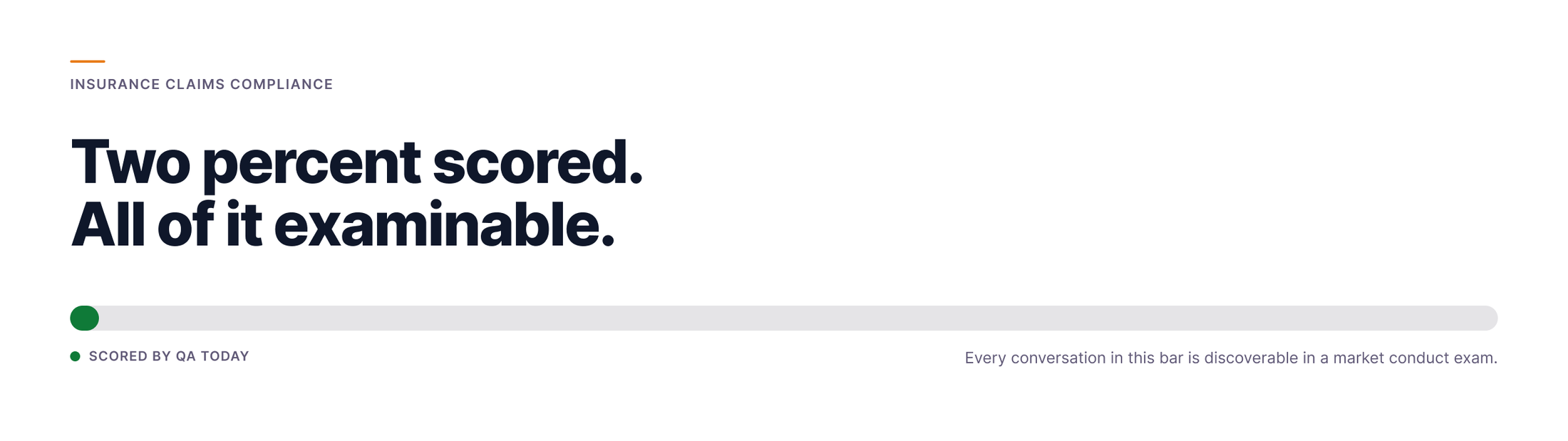
A 2% QA sample fails as compliance evidence because it cannot distinguish a systemic pattern of unfair claims settlement practices from an isolated rep having a bad week.
Your QA analysts score one to three calls per representative per month, then defend that number in calibration. The sample is rarely random. Supervisors pull calls they already heard flagged, or they pull the most recent handle, and neither approach surfaces what a market conduct examiner is looking for. What survives the selection process is a set of individual data points, not a distribution. And a distribution is exactly what a regulator needs to see.
The detection problem is structural. When a denial script drifts off-standard, when response timelines slip on a specific claim type, when a representative consistently omits a required disclosure, those patterns sit inside the 98% of calls your team never scored. A 2% pull might touch one affected call or none. The pattern reads as clean, the attestation goes out, and the next examination finds what the sample missed.
What examiners actually want is a full record. Insurance quality assurance built on sampled calls cannot produce one. The gap between what a compliance team certifies and what the floor actually ran is where regulatory exposure lives. Orvera AI audits 100% of conversations across voice, chat, email, messaging, and every other channel the claims operation runs. Every call gets scored against the same criteria, every result goes into the same record, and the pattern that took a market conduct examiner two weeks to reconstruct shows up on your dashboard before the quarter closes.
The next question is what those examiners look for when they do arrive.
What do market conduct examiners actually look at?
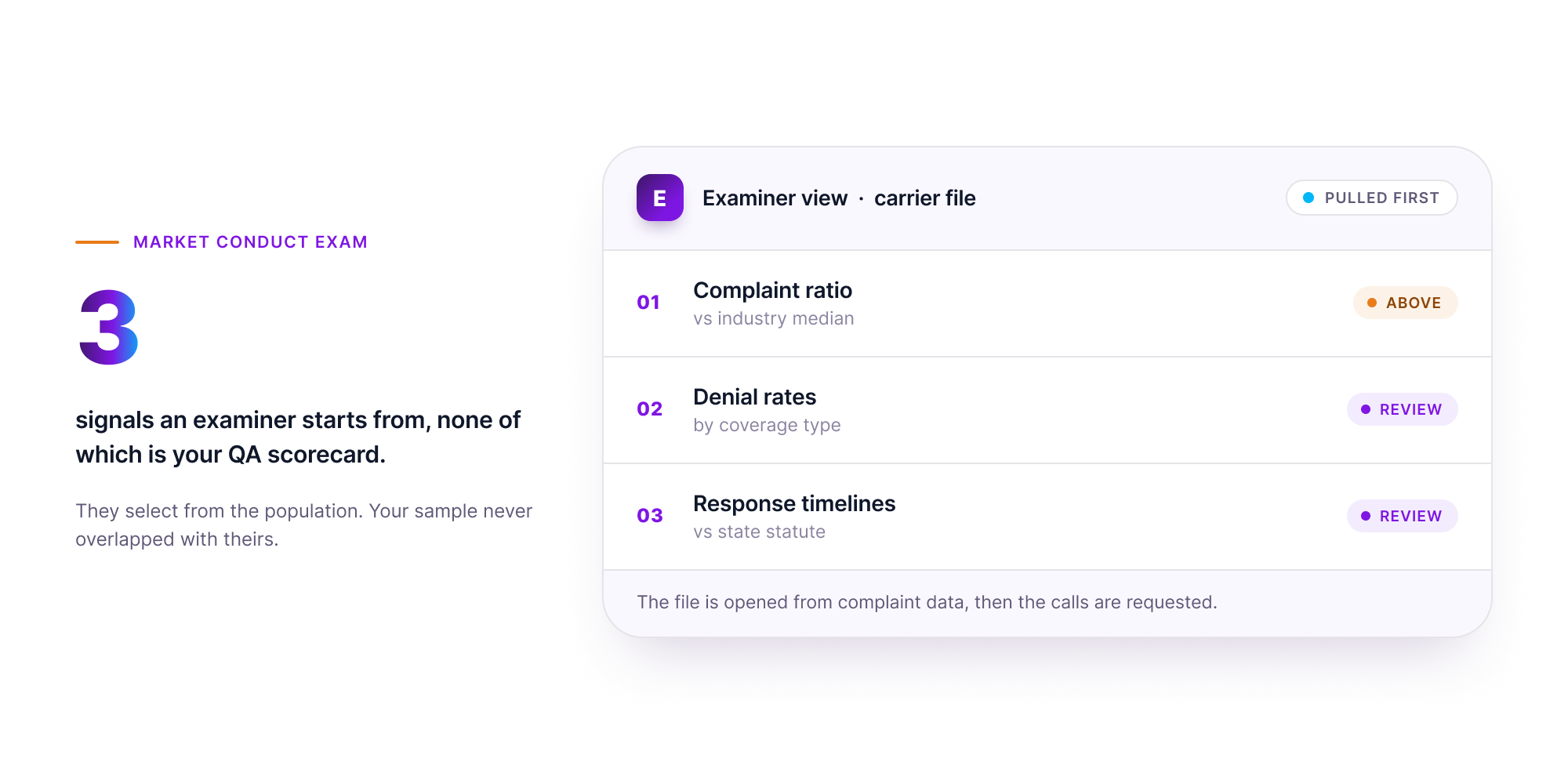
Market conduct examiners focus on three measurable outputs: complaint ratios, denial rates, and response timelines. Everything else in a market conduct examination traces back to those three numbers. An examiner does not arrive hoping to find a problem. They arrive with a methodology, and that methodology is built on patterns, not on isolated incidents.
The NAIC Market Regulation Handbook defines the analytical framework most state departments of insurance follow. Examiners begin with complaint data filed against the carrier. A complaint ratio that sits above the industry median triggers a closer review of the underlying claim files. From there, they move to denial rates by coverage type and check whether denial rates are consistent with documented investigation before the decision was made. Response timelines are measured against the applicable state statute, and acknowledgment and settlement decision windows appear across state-level unfair claims settlement practices acts modeled on NAIC guidance.
Regulatory compliance in claims processing is not a documentation exercise alone. Examiners want to see that the process described in a carrier's written procedures actually matches what happened on the call and in the file. That gap, written policy versus recorded reality, is exactly where a 2% QA sample creates exposure. A handful of reviewed calls cannot prove a systemic pattern or disprove one. What an examiner can do, and often does, is request a statistically significant sample. When your own internal audit cannot produce one, the examination record fills that vacuum.
The specific practices that appear most frequently in examination findings move beyond the aggregate numbers. They live in individual call recordings, and understanding which ones surface most often shapes how you build a defensible audit program.
Which unfair claims settlement practices show up in a call recording?
A call recording captures three categories of unfair claims settlement practices that market conduct examiners treat as primary evidence: misrepresentation of policy provisions, failure to meet acknowledgment timeframes, and denial without adequate investigation.
Each category leaves a distinct audio signature that insurance QA automation can detect far more reliably than a human reviewer working through a 2% sample.
Misrepresentation of policy provisions is the most cited violation in market conduct findings. It occurs when a rep describes coverage terms inaccurately, overstates an exclusion to discourage a claim, or quotes a benefit limit that does not match the policy language on file. In a call recording, the marker is the gap between what the rep states and what the policy document says. A 2% sample may never pull that call. Reviewing 100% of calls means the gap surfaces every time.
Acknowledgment timeframes are defined by state statute, and violations are easy to miss without systematic review. The NAIC Model Unfair Claims Settlement Practices Act establishes baseline timelines, and states have adopted versions requiring acknowledgment within a set number of working days of receiving notice of a claim. A rep who logs a call without sending confirmation, or who routes an inquiry back to a queue rather than opening a file, may be creating a recordable violation. The call recording documents the moment of contact. The absence of a confirmation record documents the failure.
Inadequate investigation before denial is harder to catch because it lives in what a rep does not say. A denial delivered on the first call, before policy documents are reviewed or medical records are requested, meets the statutory definition in many jurisdictions. The call recording shows the timeline. Insurance QA automation can flag calls where a denial outcome was recorded inside a window too short to support a reasonable investigation, and it can do that across every call in the queue, not a sampled slice of it.
The statute that ties these categories together is the NAIC Model Unfair Claims Settlement Practices Act, maintained by the National Association of Insurance Commissioners. Knowing which practices the statute names is the first step. The next question is how you actually audit for them across every call your operation takes.
How does auditing 100% of claims calls actually work?
Auditing 100% of claims calls means every conversation is scored against an identical rubric by claims audit software running in parallel with your operations, producing a structured compliance record before the call log closes.
No sampling, no selection bias, no reviewer who had a long Thursday afternoon. The scoring criteria are fixed. A call that triggers a required coverage disclosure is flagged the same way on a Monday morning as it is on a Friday at 4:45 p.m. That consistency is what a market conduct examiner expects to see, and it is what a 2% manual sample structurally cannot deliver.
How the process runs in practice. Orvera's platform coordinates best-in-class third-party models inside a governed enterprise layer that applies your documented QA criteria to every recorded conversation. The layer controls what each model scores, what threshold constitutes a flag, and how results are written to your audit trail. Orvera does not build the models underneath. It governs how they are applied so that the output is auditable, consistent, and aligned with your compliance obligations.
What each scored call captures. The audit pass runs against a consistent set of compliance markers, including:
- Required disclosures stated in the correct sequence
- Denial language that regulators flag under unfair claims settlement practices statutes
- Response commitment language and whether a follow-up timeline was named
- Sentiment and escalation signals that indicate a caller dispute in progress
The output. Each call produces a structured record, a score, the markers detected, and the verbatim segments that triggered each flag. That record is available to your QA team, your compliance officer, and, when an examiner requests a file pull, to the examination itself.
That complete, call-level record is also the input that changes how quickly errors surface and how much rework a delayed detection creates. The next section addresses that directly.
How does full-coverage auditing change claim cycle time?
Full-coverage auditing shortens claim cycle time by catching errors at the moment they occur rather than weeks later when rework is far more expensive.
The timing of error detection is the variable that drives cycle time more than almost anything else. When a QA sample surfaces a misquoted coverage limit or an omitted reservation of rights, that error already lives in a closed file. Reopening it means a supervisor call, a correction letter, a possible recontact with the claimant, and a compliance review. That sequence adds days. And when the same error pattern sits undetected across hundreds of calls because the sample never touched them, the downstream correction work compounds.
Agent Assist changes that dynamic by presenting the correct policy language, the right disclosure sequence, or the required statutory notice while the rep is still on the call. The correction happens before the file closes. There is no reopening, no recontact, and no documentation gap to defend if a market conduct examination surfaces that call later. Reducing the frequency of rework at the file level is how carriers see measurable reductions in average handle time and average cycle time together, not as separate goals.
Coaching on the full population is the structural gain that persists beyond any single call. When supervisors review only a 2% sample, they build a coaching plan on incomplete evidence. A claim that settled correctly last Tuesday but will surface a compliance error next Tuesday is invisible to them. Full-coverage auditing means the coaching queue reflects every pattern across every rep, so corrections reach the floor before the pattern becomes a market conduct examination risk rather than after an examiner has already requested the file pull.
How do you keep an AI audit layer defensible in an exam?
An AI audit layer stays defensible in a regulatory exam when every score it produces traces back to a documented rubric, a defined knowledge base, and a decision trail your compliance team can reproduce on demand.
That standard is not aspirational. State insurance departments and NAIC model regulation compliance frameworks expect carriers to demonstrate not just that calls were reviewed, but how the review criteria were set, who authorized them, and whether those criteria match the obligations written into each state's fair claims settlement statute. A system that scores calls without that audit trail is an operational tool. It is not a compliance asset.
Auditable decision trails are the first requirement. Each scored conversation should carry a record of which rubric version applied, which knowledge base snapshot grounded the score, and the timestamp of the evaluation. When an examiner pulls a sample, your team produces the call, the transcript, the score, and the reasoning. Nothing is reconstructed after the fact.
State-specific rubrics matter because fair claims handling obligations are not uniform. Prompt acknowledgment windows, written explanation requirements, and settlement timing rules vary by jurisdiction. A single generic rubric applied across a multi-state book will produce scores that look clean internally but fail the moment an examiner compares them to the controlling statute for that state. The rubric layer must reflect the actual regulatory text that governs each call.
Carrier authority over the rules is what makes the whole structure hold. The AI audit layer scores against criteria the carrier defines and approves. It does not set policy. When regulators ask who decided a particular handling step was compliant, the answer is the carrier's compliance team, supported by documented rule governance. And that clear ownership is also what connects directly to building a defensible claims compliance infrastructure, where the rules, the data distributions, and the exam-ready reporting all sit under one governed framework.
What does a defensible claims compliance infrastructure require?
A defensible claims compliance infrastructure requires full-population data, direct integration with the claims system of record, and a documented audit trail that regulators can trace from a flagged call to a corrective action.
100% quality management in insurance is not achieved by collecting more scores. It is achieved by connecting those scores to the operational record that already governs the claim. When an AI audit layer writes its output directly into the claims system of record, every conversation sits beside the corresponding claim file. A reviewer does not reconstruct what was said. The evidence is already there.
Distributions over sampled averages. A sampled QA program reports a mean compliance rate and calls it a pass. A full-coverage program produces a distribution: the center, the tails, and the specific call identifiers that populate each band. Regulators reviewing unfair claims settlement practices want to know whether a problematic behavior is isolated or systemic. A distribution answers that question. A sampled average does not.
Continuous exam readiness. The practical difference between a defensible infrastructure and a reactive one is the gap between the event and the evidence. When 100% of calls are scored in near-real time and tied to the claim record, exam readiness is a permanent state. The binder a regulator requests on a Monday already exists. There is no reconstruction period, no sampling window, and no period of exposure where undiscovered patterns could surface only after a formal inquiry begins.
A compliance infrastructure built this way does not just satisfy a current exam. It creates the baseline visibility that lets you detect a pattern before a finding names it, which is the subject the next section addresses directly.
Why is 100% coverage becoming the expected standard?
100% coverage is becoming the expected standard because a sample documents only what was sampled, and regulators examining unfair claims settlement practices increasingly treat unreviewed calls as unreviewed risk.
Sample limits. A 2% audit rate leaves 98% of conversations outside the record. That gap is not a theoretical concern. When a state insurance department requests evidence of consistent claims settlement practices, a folder of cherry-picked calls does not answer the question. The documentation that exists is the documentation that will be evaluated. What was never reviewed cannot be defended, corrected, or produced.
Pattern detection before a finding. Full-population auditing changes the compliance posture from reactive to anticipatory. A common pattern is that a coaching gap, a script deviation, or a disclosure omission repeats across hundreds of calls before anyone flags it. With 100% insurance QA automation, those patterns surface in days, not quarters. Your team can correct a systemic issue before it becomes the basis of a regulatory finding. That distinction, between a self-identified correction and an examiner-identified violation, matters in how a settlement or remediation plan is written.
Regulatory trajectory. Insurance quality assurance expectations are moving in one direction. Guidance from the National Association of Insurance Commissioners on market conduct examinations reflects an assumption that carriers can produce comprehensive documentation of claims handling practices. A sample-based approach was a reasonable operational constraint before automated auditing existed. It is harder to defend that constraint today, which is why what managed 100% claims auditing looks like in practice is the right next question.
What does managed 100% claims auditing look like in practice?
Managed 100% claims auditing means every conversation, on voice, chat, email, and messaging, is scored against your compliance framework the moment it closes, with no sampling, no manual queue, and no gap in the record.
Orvera AI builds, deploys, and runs the operation. Your team defines the scorecard, names the regulatory touchpoints specific to your claims floor, and Orvera's AI Quality Management layer applies it across the full population from day one. There is no configuration burden on your side and no separate vendor managing a siloed audio review tool. Orvera does the build and the run.
Deployment reaches a live production floor in three to six weeks. That window covers integration with your claims system of record, mapping your existing evaluation criteria into the scoring layer, and connecting every channel your representatives already work. When the first scored conversation surfaces, your QA analysts and compliance leads are reading results, not standing up infrastructure.
And the scope is every channel. Claims contacts arrive on voice, but they also arrive on chat, email, and messaging. A 2% sample drawn from voice alone leaves those channels unexamined. Orvera's AI Quality Management covers each one, so a written misrepresentation on a chat thread carries the same audit weight as a verbal one on a recorded call. The record regulators examine when they open an unfair claims settlement practices investigation reflects what your operation actually did, not what a narrow sample happened to capture.
The result is a compliance posture built on full-population data. That is the standard that defensible claims auditing requires.
Frequently asked questions
Regulators target carriers whose data tells a story before any examiner sets foot on-site, and unfair claim settlement practices are the chapter that draws the most scrutiny.
Automated claims quality assurance eliminates the sampling gap that makes manual audits unreliable as a compliance defense.
Regulators reviewing call recordings look for four verbal behaviors that map directly to unfair claim settlement practices statutes in most states: misrepresenting policy provisions, failure to respond promptly, pressure tactics on settlement offers, and closing a claim without an explanation grounded in policy language.
AI-driven QA does not replace the claim audit checklist. It populates that checklist automatically for every conversation, removing the sampling gap that makes manual audits an unreliable compliance defense.
Governed model orchestration means the AI agents operating across claims handling procedures run inside a control layer that validates outputs, enforces data protections, and produces auditable reasoning for every flagged call.
Orvera AI deploys in three to six weeks on the systems your operation already runs. Orvera does the build and runs the operation from day one, so your QA analysts shift from scoring calls to reviewing flagged exceptions and closing them.

Written by
Anindita Majumder
Anindita Majumder is a communications professional with nearly four years of experience in public relations, corporate communications, and journalism. She creates content that helps brands communicate their vision, products, and expertise through press releases, thought leadership, and editorial pieces. Outside of work, she is a vocalist, which keeps her creativity flowing.