Agentic AI for Customer Service in 2026 (What It Is and What Actually Works)
Agentic AI for customer service is real, early, and heavily oversold at the same time. In a March 2025 forecast, Gartner expects it to...

Key highlights
TL;DR —- In a Nutshell
- Agentic AI goes beyond answering questions by taking real actions across connected enterprise systems to resolve customer requests
- The key difference between real agentic AI and agent washing is the ability to plan, act, replan when needed, and complete multi-step workflows
- Successful deployments focus on bounded use cases with checkable outcomes, such as returns, refunds, order changes, and claims triage
- Resolution is a stronger measure of customer service ROI than deflection because it shows whether the customer’s problem was actually fixed
- Most agentic AI projects fail because of unclear outcomes, weak integrations, immature governance, agent washing, or deflection-first thinking
- The practical path forward is to start with one measurable workflow, establish a baseline, build permissions and escalation controls, and scale based on proven results
Agentic AI for customer service is real, early, and heavily oversold at the same time. In a March 2025 forecast, Gartner expects it to autonomously resolve 80 percent of common service issues by 2029 (opens in a new tab), cutting operational costs by 30 percent. Gartner also warned in June 2025 that more than 40 percent of agentic AI projects will be canceled by the end of 2027 (opens in a new tab). Among the thousands of vendors now selling agentic capability, only around 130 are building anything real.
Both forecasts come from the same analyst firm and both are credible. The gap between them is where most service leaders are standing in 2026. Budgets get approved against the first number while teams privately believe the second. Practitioners got there ahead of the analysts. One of the more active threads in r/customerexperience asks the question without decoration, "is agentic AI actually useful?" The replies run far more guarded than any launch announcement.
So here is the honest version. A small set of service workflows now runs end to end with no human involved. A much larger set of products carrying the agentic label still answer questions and stop short of taking action, which is what Gartner calls agent washing. Plenty of what gets sold as 2026 capability is a 2029 projection with a demo attached. The projects that get canceled tend to die on cost, unclear business value and weak risk controls. All of it runs on a conversational AI platform, and that layer decides what an agent is allowed to touch.
What Is Agentic AI for Customer Service?
Agentic AI in customer service is software that pursues a customer's goal on its own, taking real actions across connected systems until the request is resolved. Autonomy, goal orientation, context awareness, action capability and continuous learning separate it from a chatbot.
The commercial distinction is action. A system that explains your refund policy and a system that issues the refund look identical in a demo and behave nothing alike once they touch live orders. The question that separates them is what the system is permitted to write to, since anything limited to reading your knowledge base is still answering.
The five properties that define an agent
Autonomy means the system decides its own next step without a scripted branch telling it where to go. Goal orientation means it holds the customer's actual outcome as the target and keeps working until that outcome lands. Context awareness means it carries the order history, the entitlement, the prior contact and the channel into every decision. Action capability means it can write to your CRM, your order system and your billing stack, and continuous learning means each resolved case sharpens the next one.
How the perceive, reason, plan and act loop runs
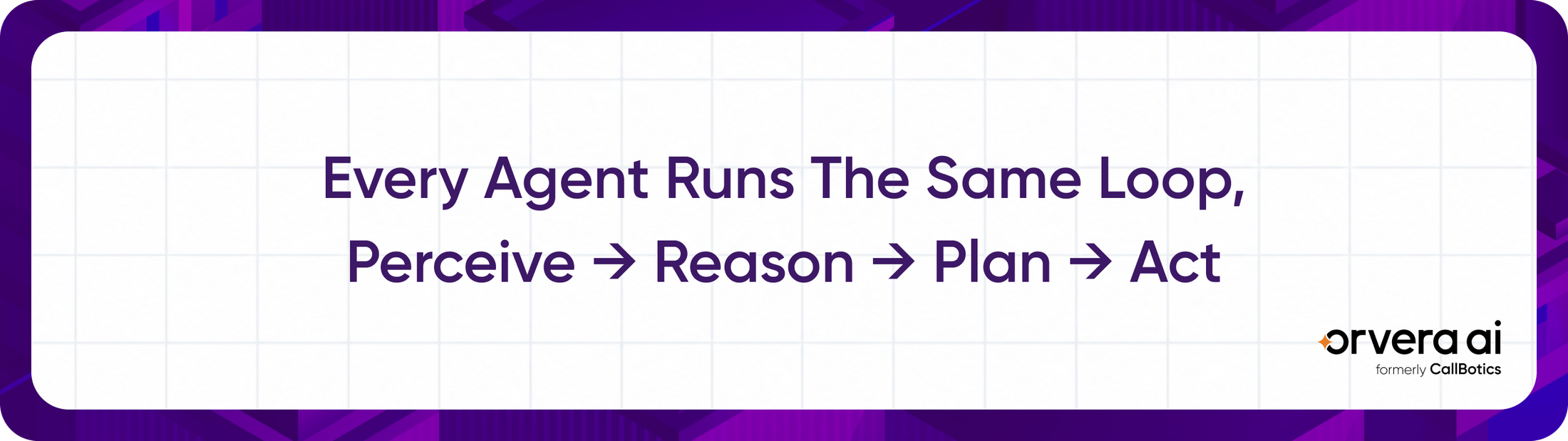
The loop starts with perception, where the agent reads the request, the customer record and the state of the order. Reasoning follows, where it works out what the customer actually needs and what the policy allows. Planning turns that into a sequence of steps with the right tool or API attached to each one. Action executes the sequence against live systems, and the result feeds back into perception for the next turn.
What agentic AI in customer service looks like on a single return
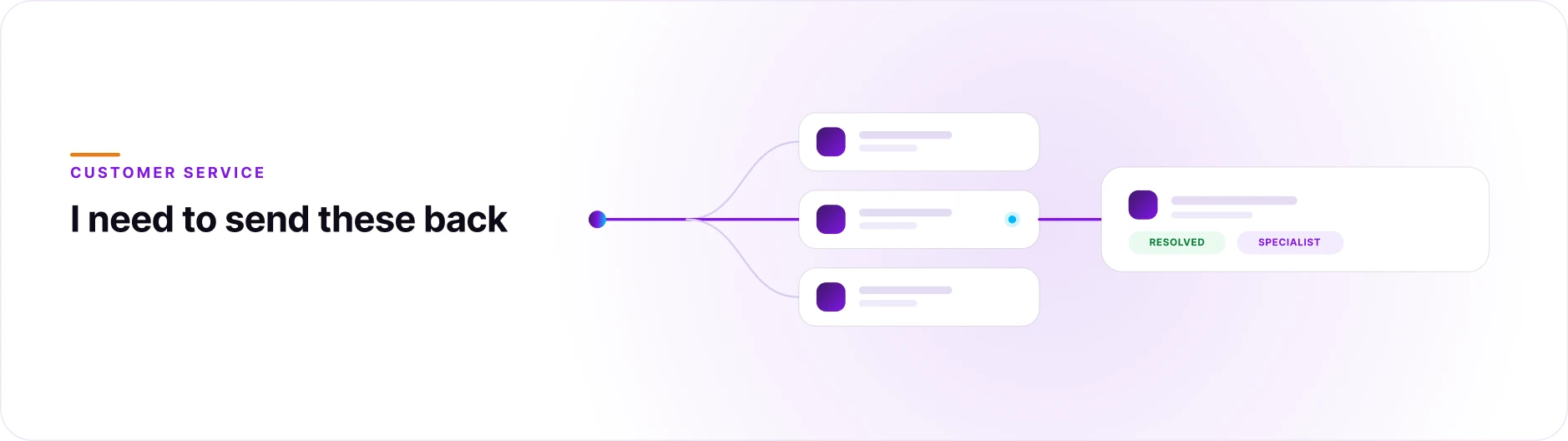
A customer messages that the shoes do not fit and asks to send them back. The agent authenticates the customer, pulls the order and checks it against your 30 day return window and the condition rules. It issues the return label, updates the order status and triggers the refund hold, all inside the order management system. It confirms the outcome to the customer in the same conversation, with no ticket, no queue and no human touch.
Agentic vs Conversational vs Chatbot vs Generative AI
Four labels get used for four different things, and only one of them acts. A chatbot matches intents to scripted replies. Conversational AI understands natural language across turns. Generative AI writes new text from a model. Agentic AI plans a sequence and executes it against your live systems, which is the only one of the four that changes the state of an order.
What each of the four can do
Run the same returns request through all four and the difference stops being academic. Each row below covers what the system handles on its own and where it stops.
| What you are comparing | Chatbot | Conversational AI | Generative AI | Agentic AI |
|---|---|---|---|---|
| Core mechanism | Intent matching against scripted flows | Natural language understanding across turns | Text generation from a trained model | Planning and execution across tools |
| The same returns request | Shows the returns policy page | Understands the request and collects the order number | Drafts a clear reply explaining the policy | Authenticates, checks the window, issues the label, updates the order |
| Writes to your systems | No | Rarely, through fixed integrations | No | Yes, through permissioned tool calls |
| Handles the unscripted | Fails to a menu | Handles phrasing, not new steps | Improvises language, not actions | Replans when a step fails |
| What it produces | A deflected contact | A qualified contact | An answer | A resolved order |
| Fails by | Dead-ending the customer | Escalating without progress | Sounding right while being wrong | Taking a wrong action at scale |
The last row is the one buyers underweight. A chatbot that fails costs you a contact, and an agent that fails costs you a refund issued against the wrong order. That asymmetry is why the conversational AI platform underneath matters more than the model, since permissions, confidence thresholds and rollback all live at that layer.
How to tell a real agent from a relabeled chatbot
Agent washing is the reason this section exists. Most products now sold as agentic are existing assistants, RPA scripts, and chatbots wearing a new label, and the market has moved faster than the capability behind it. The tell is not in the demo, because a scripted flow and a planned sequence look the same when the happy path runs. It shows up in four questions that most vendors answer badly.
Ask what the system is permitted to write to, and require the list by system name. Ask what happens when step three fails, since a real agent replans and a relabeled chatbot escalates. Ask to see a trace of a completed multi-step resolution, with each tool call and its response. Ask who holds the permission model, and follow the answer until someone names a person and a review cadence. Those four questions belong in your evaluation criteria before any pricing conversation starts, and the enterprise buyer's guide turns them into a full scoring sheet.
How Agentic AI Works in Customer Service
Six stages turn a customer message into a completed action. Intent gets read, a plan gets built, tools get called, the action lands in a system of record, the result gets verified, and the outcome feeds back into the next case. Most vendor demos show the first three stages and stop before the ones that carry the risk.
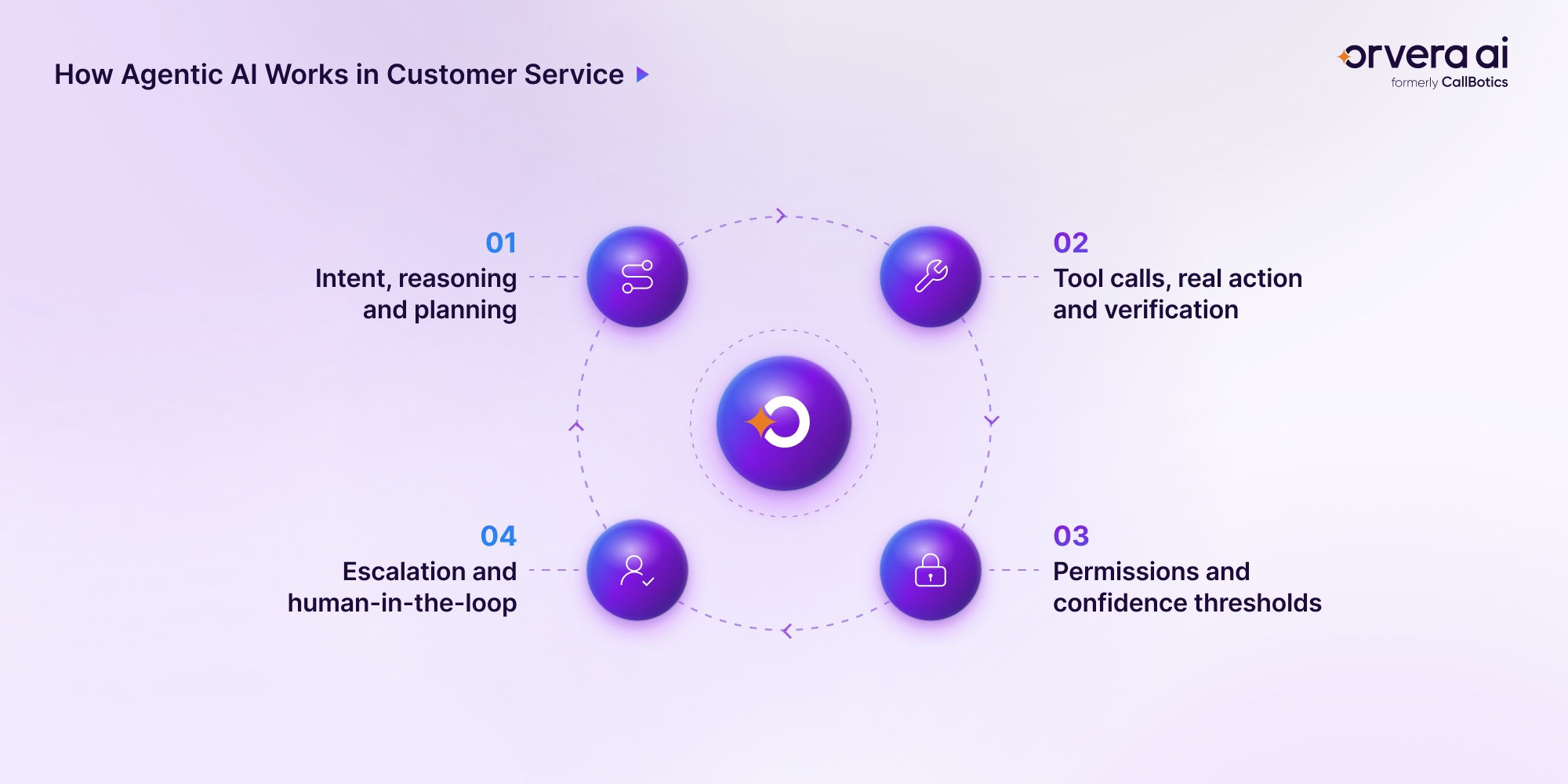
Intent, reasoning and planning
Intent capture reads what the customer wants along with the record behind them, the entitlement, the open orders, and the history of prior contacts. Reasoning turns that raw request into a working understanding of the outcome the customer is actually after, which is often broader than the sentence they typed. Planning converts that understanding into an ordered sequence, deciding which steps are needed, in what order, and what your policy permits at each one. This is the stage where a real agent and a scripted flow visibly diverge, because the plan is built at runtime for that customer rather than drawn from a branch someone mapped in advance.
Tool calls, real action and verification
Tool and API calls execute the plan against your CRM, your order system and your billing stack, with each response checked before the next call fires. Real action is the stage that defines the category, because a refund now exists, a label has been generated and a record has changed. Verification is where most implementations are thin, since the agent has to confirm that the write actually landed, that the amount matches the plan, and that no downstream system rejected it silently. Learning closes the loop by feeding the resolved case, the failure, and the correction back into how the next one gets planned.
Permissions and confidence thresholds
Permissions define the blast radius, and write access should be scoped by system, by action type, and by value. An agent that can issue a fifty-dollar refund should not be able to issue a five-thousand-dollar credit without a second pair of eyes. Model quality changes how often the agent reaches the right conclusion, and permissions change what happens on the occasions it reaches the wrong one. Confidence thresholds decide when it proceeds and when it stops, and the threshold on the plan should sit higher than the threshold on the intent, since an agent can be certain about what the customer wants and uncertain about the sequence to get there.
Escalation and human-in-the-loop
Escalation has to carry state, which means passing the intent, the steps attempted, the point of failure, and the agent's own reasoning to the person picking up. A handover that drops the customer into a queue with no context wastes the work already done and forces them to repeat themselves, which is the fastest way to lose the CSAT gain the deployment was bought for. Human-in-the-loop is a design choice with a real cost, since reviewing every action erases the economics and reviewing nothing lets one bad plan replicate across thousands of contacts. Most production deployments settle this by sampling on risk tier and auditing the remainder after the fact.
What's Actually Shipping Today
A narrow set of service workflows now runs end-to-end in production, and a much wider set is still being piloted. The honest split matters, because vendors show the pilot and price the production. The use cases below are the ones running live at scale today, followed by one deployment examined in full and a plain read on what has not crossed over yet.
The use cases that work now
Multi-step resolution is the anchor, where the agent handles a request that touches several systems and finishes it without a handoff. Refunds and returns are the most common live example, since the policy is checkable, the actions are bounded and the outcome is verifiable against the order record. Order and account changes work for the same reason, covering address updates, plan switches, cancellations, and reschedules that a chatbot could only ever route. First notice of loss and claims triage is now shipping in insurance, where the agent intakes the claim, classifies it and gathers the evidence before a human adjuster picks up. Agent copilots are the widest deployment of all, drafting the response, pulling the account context and suggesting the next action while a human keeps final control.
Klarna, examined in full
Klarna's OpenAI-powered assistant (opens in a new tab) is the most-cited deployment in the category and repays a close look because both chapters are instructive. In its first month it handled 2.3 million conversations, two-thirds of Klarna's total chat volume, doing work the company put at 700 full-time agents. Resolution time fell from 11 minutes to under 2, customer satisfaction held level with human agents, and Klarna projected a 40 million dollar profit improvement for 2024.
The caveat is the part worth studying, because by 2025 Klarna reintroduced human agents for complex cases and moved toward a model where a person is always reachable. The number that held up was reached by not hiring during growth rather than by cutting staff, and the workflows that came back were the ambiguous and regulated ones the agent could not close safely.
What is still pilot, not production
Plenty of demonstrated capability has not earned a place in the live queue yet. Open-ended troubleshooting stalls when the resolution path is not knowable in advance and the agent cannot plan a sequence it has never seen. Emotionally charged and high-value disputes stay with people, which is the specific lesson Klarna's walk-back teaches. Anything touching regulated advice sits behind human review, since the cost of a wrong autonomous action there is measured in penalties. The forward projections point the same way the working use cases do, with Cisco's research putting 68 percent of interactions between organizations and their technology vendors in the hands of agentic AI by 2028 (opens in a new tab) and McKinsey estimating generative AI could lift customer-care productivity by 30 to 45 percent of function costs (opens in a new tab). For the vendors building real agents in this category, see conversational AI companies, and for how this plays out under regulatory load, see agentic AI in financial services.
The Measurable-ROI Reality
Agentic AI platforms show measurable ROI in customer service when the metric is resolution, not deflection. A deflected contact is one that never reached an agent, and a resolved contact is one where the customer's problem is actually fixed. Those two numbers can move in opposite directions, and confusing them is how a program reports success while satisfaction falls.
Why resolution beats deflection
Deflection measures the contacts you avoided, which is a cost metric wearing a customer-experience label. A system can post a high automated-resolution rate while customer preference for the company sits far lower, and that gap is the whole problem. A customer whose issue was closed but who left the interaction unwilling to buy again was not a win, whatever the containment dashboard says. The reason the distinction matters in practice:
- Deflection counts a customer leaving the queue, even if they leave unhappy and call back tomorrow
- Resolution counts the problem being fixed, which is the outcome the customer actually came for
- A repeat contact on the same issue erases the saving the first deflection claimed
- Optimizing for deflection quietly trains the system to end conversations rather than to solve them
The KPIs that actually capture value
The metrics that hold up measure the outcome and its cost, not the volume avoided. Track a small set consistently rather than a large set occasionally, and hold the same definition before and after so the comparison is honest. The ones that matter:
- Resolution rate, the share of contacts where the customer's problem is genuinely fixed
- Cost per resolution, the fully loaded cost to actually solve one contact end to end
- Average handle time, which shows whether speed is improving without hiding unresolved cases
- First contact resolution, the share fixed on the first attempt with no repeat needed
- Customer satisfaction, measured on the automated path and compared against the human one
- Time to value, the weeks from deployment to the first measurable movement in the above
The discipline that separates ROI that holds up
The programs that prove real ROI share one habit, which is narrow scope measured precisely. Pick a single workflow, establish a baseline on it before anything changes, then measure the identical metric after the agent goes live. The discipline in three moves:
- Pick one workflow with clean, checkable outcomes, such as returns or address changes
- Set the baseline first, capturing the current resolution rate, cost and handle time before deployment
- Measure the same metric on the same workflow after go-live, with no redefinition in between
Time to value belongs in the ROI case as much as the steady-state numbers, since a program that takes a year to show movement costs more than its dashboard admits. A realistic deployment on a bounded workflow measures in weeks, typically 3 to 6, which is short enough to set a baseline, ship, and read the result inside a single planning cycle. That cadence is what lets a team expand from one proven workflow to the next on evidence rather than on faith.
Why Most Agentic AI Projects Fail
Most projects fail on the conditions around the model, not the model itself. The pattern is consistent, with programs collapsing on cost, unclear value, and weak controls rather than on the quality of the underlying AI. Those pressures show up on the ground as five recurring failure modes, each with a fix that is known before the project starts.
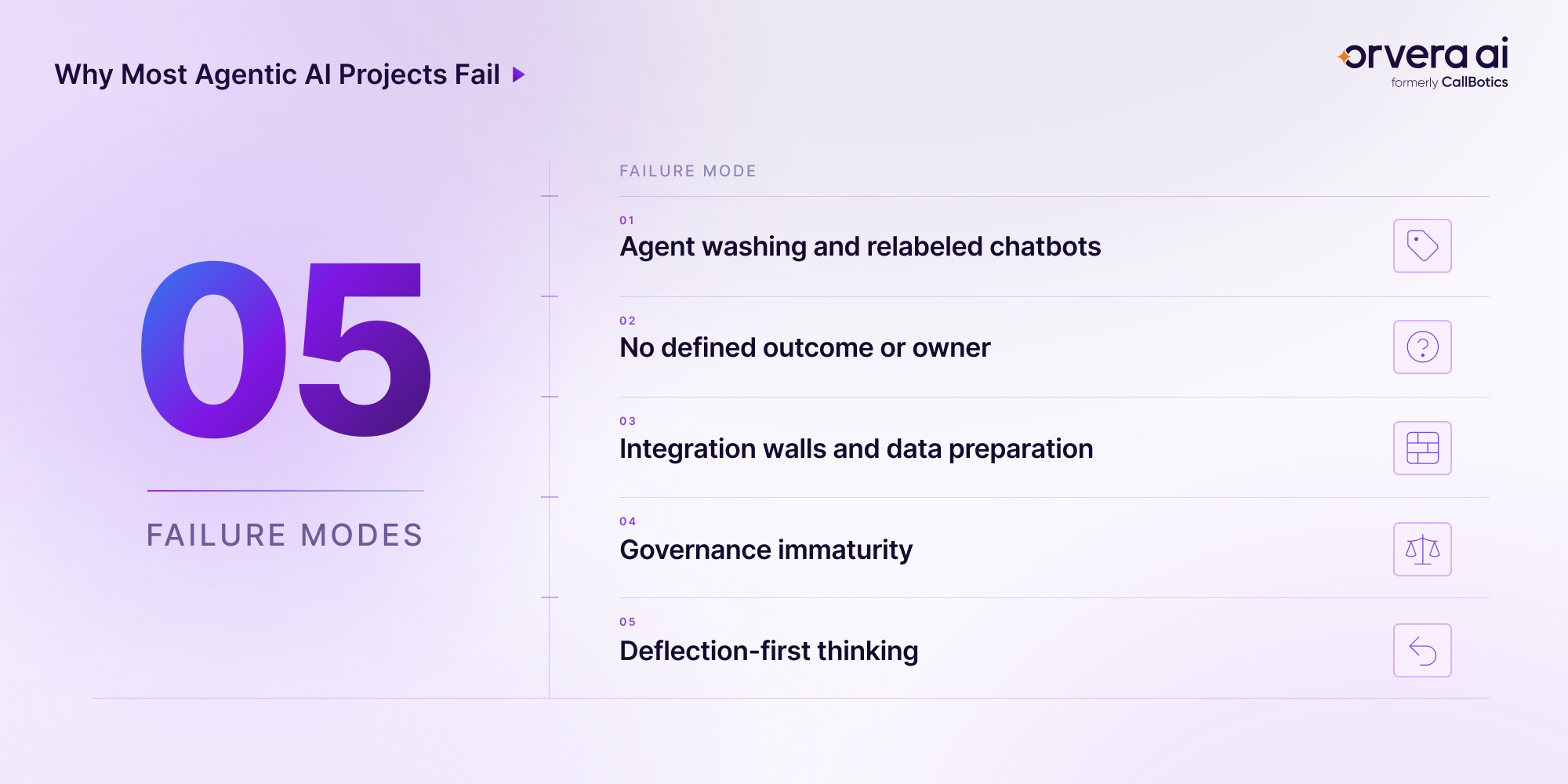
Agent washing and relabeled chatbots
The first failure is buying a system that answers when the plan required one that acts. A relabeled chatbot demos cleanly on the happy path and then stalls the moment a step needs a write to a live system. Teams tend to discover the gap in production, after the budget is committed and the timeline is public.
The fix is to test for action before signing. Require a live trace of a completed multi-step resolution with each tool call and its response shown, ask what the system writes to and make the vendor name the systems, and watch what happens when a step fails, since a real agent replans where a relabeled one escalates.
No defined outcome or owner
The second failure is launching without a single metric and a single person accountable for it. A project scoped to adopt agentic AI has no finish line, so it drifts and gets cut the moment the value question is asked. Without a clear owner, the integration decisions and the escalation rules fall to whoever is nearest, which usually means nobody.
The fix is ownership before tooling. Name one workflow, one target metric and one accountable owner before any build begins, define what success looks like in a number so the value question has an answer ready, and give that owner authority over the permission model and the escalation design rather than just the launch date.
Integration walls and data preparation
The third failure is underestimating the connective work, which is where the majority of the effort actually goes. The model is the visible part, and the integrations, the permissions and the data cleanup are the part that quietly consumes the schedule. Records that are inconsistent, stale or split across systems will stall an agent that has to act on them.
The fix is to plan for the plumbing. Budget the integration and data work as the bulk of the project because it is, audit the data the agent will act on before launch rather than after it misfires, and treat every connected system as a dependency with its own access model and failure behavior.
Governance immaturity
The fourth failure is giving an agent write access without the controls that write access demands. Permissions that are set too broad turn a single bad plan into a costly action at scale. Governance bolted on after an incident is more expensive and slower than governance designed in from the start.
The fix is rails first. Scope write access by system, action type and value before the agent goes live, set confidence thresholds on the plan and hold the action threshold above the answer threshold, and sample by risk tier while auditing the rest, so review cost stays proportional to exposure.
Deflection-first thinking
The fifth failure is optimizing for contacts avoided, which trains the system to end conversations rather than solve them. A deflection target can post strong numbers while repeat contacts climb and satisfaction slips underneath. The program looks successful right up until someone measures whether customers came back.
The fix is to measure the outcome. Set resolution as the primary metric and treat deflection as a cost input only, track repeat contacts on the same issue since they expose hollow deflection wins, and compare satisfaction on the automated path against the human one so the gap gets acted on.
Will Agentic AI Replace Customer Service Agents?
Agentic AI will not replace customer service agents, though it will change what the job is. The routine, high-volume, checkable contacts move to agents, and the people move to the work that needs judgment, empathy and authority. The honest read is a shift in the shape of the role rather than a reduction in headcount.
What moves to the agent and what stays with people
The contacts that automate well are the ones with a knowable path and a checkable outcome, such as returns, order changes and status questions. Those are also the contacts that tire agents through sheer repetition, so moving them helps the team as much as the budget. What stays with people is everything that turns on nuance, where the customer is upset, the situation is unusual, or the stakes are high enough that a careful decision matters.
The role that remains is more demanding and more valuable than the one being automated. Agents shift toward complex problem-solving, toward the emotional and relational work that people do best, and toward supervising the agents themselves through review and escalation. That supervision is genuinely new work created by the technology, since someone has to own the permission model, read the traces and handle the cases the agent passes up.
Where the line between automated and human work belongs
The boundary between automated and human work is a design decision, and the strongest deployments treat it that way. Set it too narrow and the economics thin out, set it too wide and difficult cases get closed poorly at scale, so the placement of that line deserves as much attention as the model behind it. The signal that it sits in the right place is simple, with volume flowing smoothly through the agent and hard cases arriving at a person with room to handle them well.
Real deployments have learned to keep people in the flow for the cases that need one. Several high-profile programs that began with an automation-first push have since brought human agents back for complex and emotionally charged disputes, settling into a model where a person is always reachable. The workflows that return are consistently the ambiguous, high-stakes ones, which tells you where the current boundary genuinely sits.
Human-in-the-loop is the mechanism that holds that middle. A person stays in the flow for the cases that call for one, the agent carries the volume it can resolve cleanly, and the escalation path passes full context so the person picks up with everything already in hand. That is augmentation working as intended, with the agent absorbing the repeatable load and people freed for the work that most needs them.
Conclusion
Only a narrow set of customer service workflows works end to end today. Many more are still being piloted, and a good share of what carries the agentic label answers questions when the job needs something that acts. The way through is disciplined. Pick one workflow with checkable outcomes, set a baseline before anything changes, measure resolution once the agent is live, and build the permissions, thresholds, and escalation rails before you grant any write access. That sequence separates the programs that expand on evidence from the ones that stall when the value question arrives.
Start small, prove the number on one workflow, and grow from there. If you are choosing a platform to build on, the enterprise buyer's guide turns the questions in this piece into a scoring sheet you can take into vendor calls. And if you want a read on which single workflow is the right first move for your contact center, the team at Orvera is glad to talk it through (opens in a new tab), with a deployment window of 3 to 6 weeks once the workflow and the rails are set.
Frequently asked questions
It is software that pursues a customer's goal on its own, taking real actions across your connected systems until the request is resolved. The property that sets it apart is action, meaning it can write to your systems rather than only answer questions about them.
A chatbot matches questions to scripted replies and conversational AI understands natural language, but both stop at answering. Agentic AI plans a sequence of steps and executes it against live systems, which is the only one of the three that changes the state of an order.
It runs a loop of perceive, reason, plan and act, reading the request and the customer record, building a plan, calling the right tools, then verifying the result. Permissions, confidence thresholds and escalation rules sit around that loop and decide what the agent is allowed to do.
The return shows up when the metric is resolution rather than deflection, measured as resolution rate, cost per resolution and first contact resolution against a pre-deployment baseline. Programs that scope one workflow and measure the same number before and after are the ones that prove value.
No, though it changes the role, moving routine high-volume contacts to agents while people take the complex, emotional and high-stakes cases. New work is created too, since someone has to own the permissions, read the traces and handle escalations.
Test for action rather than answers, asking for a live trace of a multi-step resolution and requiring the vendor to name the systems it writes to. The enterprise buyer's guide turns these checks into a full scoring sheet.
Yes, and the integration is where most of the real work sits, connecting your CRM, order and billing systems through permissioned access. The quality of that connective layer shapes the outcome more than the model does.

Written by
Anindita Majumder
Anindita Majumder is a communications professional with nearly four years of experience in public relations, corporate communications, and journalism. She creates content that helps brands communicate their vision, products, and expertise through press releases, thought leadership, and editorial pieces. Outside of work, she is a vocalist, which keeps her creativity flowing.