
What Conversational AI Means for Modern Ecommerce Operations
This guide explains how conversational AI strengthens ecommerce operations by improving customer interactions, conversions, and scalability without sacrificing human judgment.


Key highlights
TL;DR: How Conversational AI Improves Ecommerce Experience and Operations
- Helps ecommerce teams respond to customers instantly across browsing, checkout, and post-purchase interactions
- Transforms product discovery into guided conversations that reduce decision fatigue and improve buying confidence
- Addresses checkout hesitation in real time by clarifying delivery, availability, and return concerns
- Automates high-volume workflows such as order tracking, delivery updates, returns, and exchanges with consistency
- Keeps conversations continuous by retaining context as customer intent evolves within a single interaction
- Supports both voice and digital channels using the same conversational logic for a unified experience
- Reduces repetitive service demand while preserving human involvement for complex or sensitive cases
- Scales reliably during peak traffic periods without degrading response quality or operational control
- Makes conversational performance measurable through resolution quality, conversion influence, and customer satisfaction
Ecommerce today is shaped by speed, clarity, and continuity. Customers move quickly, expectations are high, and every interaction carries weight. Conversations that once happened across email threads or long phone queues now occur in real time, often while a shopper is actively deciding whether to buy.
In this environment, conversational AI has become a practical layer within ecommerce operations. It supports customers as they browse, purchase, and seek support, while helping teams manage volume without sacrificing experience.
Rather than acting as a standalone tool, conversational systems function best when they blend into existing ecommerce workflows and quietly keep interactions moving forward.
Understanding Conversational AI in an Ecommerce Environment
Conversational AI refers to systems that understand natural language and respond in ways that feel intuitive and relevant to the customer. In ecommerce, this capability becomes meaningful when it aligns with how shoppers actually communicate.
Conversational ai for ecommerce allows customers to ask questions in their own words and receive responses that are grounded in context, order history, product data, and current intent. These conversations may begin as simple inquiries and evolve naturally as needs change.
The goal is not to replicate human interaction, but to support it by handling common interactions efficiently and consistently.
How Ecommerce Conversations Naturally Flow
Ecommerce conversations rarely follow a single path. A shopper might begin by exploring products, then ask about delivery timing, then confirm a return policy, all within one session.
Ecommerce conversational AI is designed to recognize these shifts and respond without breaking the experience. By maintaining context and understanding intent, the system helps customers progress instead of restarting each step.
Why Ecommerce Teams Are Investing in Conversational Systems
The adoption of conversational systems is driven by operational realities rather than trends.
Customer Expectations Continue to Rise
Customers expect immediate acknowledgment and clear answers. Whether the interaction happens during business hours or late at night, delays can disrupt confidence and momentum.
Conversational systems help teams meet these expectations consistently without requiring constant human availability.
Support Volume Grows With Scale
As order volume increases, so does the number of questions related to tracking, changes, and returns. Automating these conversations allows teams to focus on complex or sensitive situations that benefit from human judgment.
Purchase Decisions Depend on Timely Guidance
Many shoppers pause before completing a purchase because they need reassurance or clarification. A well designed AI shopping assistant provides that guidance at the right moment, helping customers move forward with confidence.
How Conversational AI Operates Across the Ecommerce Journey
Conversational systems work best when they align with the rhythm of ecommerce interactions.
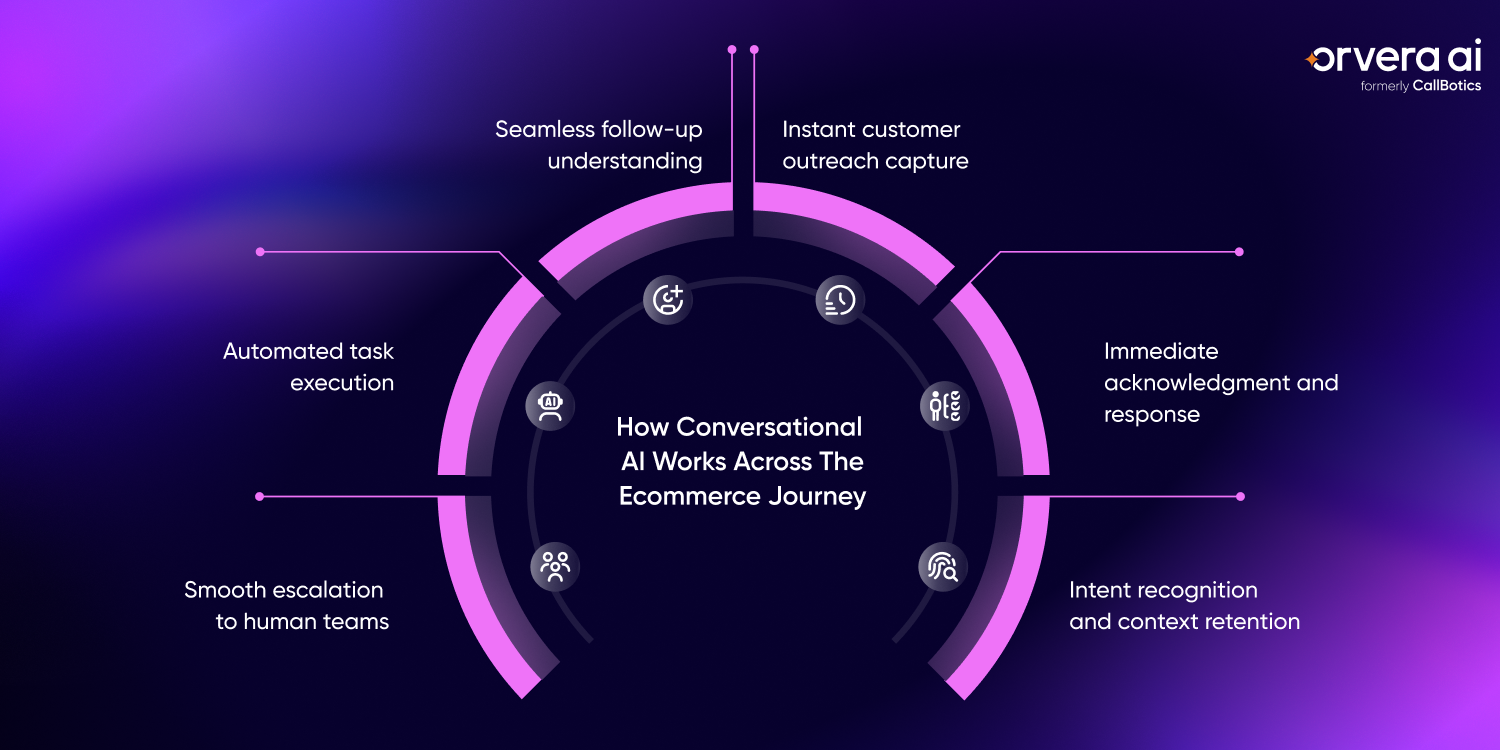
Receiving and Acknowledging Requests
Customers initiate conversations through chat or voice and receive immediate acknowledgment. This first response sets the tone and confirms that help is available.
Interpreting Intent and Context
The system identifies what the customer is trying to accomplish and keeps track of previous exchanges. This enables follow up questions to feel connected rather than repetitive.
Completing Actions
Once intent is clear, the system retrieves information or completes tasks such as checking order status, updating delivery preferences, or processing returns.
Transitioning to Human Support When Needed
Some situations benefit from human involvement. In those cases, conversations are transferred with full context so the customer does not need to repeat themselves.
The Role of Voice Conversations in Ecommerce
Voice continues to play an important role in ecommerce, especially when customers seek clarity quickly or prefer speaking over typing.
Ecommerce voice bots allow customers to receive updates, confirmations, and assistance through natural conversation. These interactions are especially valuable for delivery coordination, urgent questions, and accessibility.
When voice and digital channels share the same conversational logic, customers experience consistency regardless of how they reach out.
Operational Impact of Conversational AI in Ecommerce
| Operational Area | What Improves | Why It Matters |
|---|---|---|
| Customer Support | Faster resolution of common questions | Lower cost and better satisfaction |
| Sales Assistance | Guided product discovery | Higher conversion confidence |
| Post Purchase | Clear order and return handling | Reduced follow up volume |
| Peak Traffic | Stable performance under load | Predictable operations |
Where Conversational Systems Deliver the Most Value
Conversational AI is most effective when it supports workflows customers already use. This includes pre purchase questions, order management, and post purchase support.
By handling these interactions consistently, AI customer service ecommerce becomes a reliable extension of the service team rather than a separate experience.
What High Impact Ecommerce Use Cases Look Like in Practice
Conversational systems create the most value when they support interactions that already occur at scale. Ecommerce conversations are predictable in nature, even though individual customer journeys vary. By focusing on these high frequency moments, teams can improve both experience and efficiency without redesigning their entire operation.
This section explores where conversational AI delivers consistent, measurable impact across ecommerce workflows.
Product Discovery and Buying Guidance
Product discovery is one of the most influential moments in the ecommerce journey. Customers often know what outcome they want but struggle to translate that into filters, keywords, or comparisons.
Conversational systems support this stage by turning browsing into dialogue. Instead of navigating multiple pages, customers can describe their needs and receive guided recommendations that adapt as preferences become clearer.
This approach reduces decision fatigue and helps shoppers feel confident about their choices.
Cart Recovery and Checkout Assistance
Cart abandonment is rarely about price alone. Many customers pause because of uncertainty around shipping timelines, return policies, or product fit.
Conversational AI supports checkout by identifying hesitation signals and offering timely assistance. This may include clarifying delivery expectations, confirming availability, or addressing common concerns before the customer exits.
When done thoughtfully, checkout conversations feel supportive rather than an interruption.
Order Tracking and Delivery Updates
Order tracking remains one of the highest volume customer service interactions in ecommerce. Customers want fast, accurate updates without waiting or navigating multiple systems.
Conversational systems automate this process by pulling real time data from order management platforms and presenting it clearly. Customers can ask follow up questions such as delivery changes or timing adjustments within the same conversation.
This reduces inbound tickets while improving transparency.
Returns and Exchanges Management
Returns are a natural part of ecommerce and often define how customers remember the brand. Slow or confusing return processes create friction long after the purchase.
Conversational AI simplifies this experience by guiding customers through eligibility checks, return initiation, and exchange options. Clear explanations help set expectations while automation ensures consistency.
Well designed return conversations also reduce unnecessary follow ups and manual intervention.
Post Purchase Support and Follow Ups
The customer journey does not end at checkout. Post purchase questions around product usage, warranties, or delivery adjustments are common.
Conversational systems handle these interactions continuously, ensuring customers receive timely responses even outside business hours. This consistency builds trust and reduces pressure on service teams.
Over time, these interactions contribute to higher repeat purchase rates.
Comparing Conversational Support to Traditional Workflows
| Interaction Type | Traditional Handling | Conversational Handling |
|---|---|---|
| Product questions | Static FAQs or email | Guided dialogue |
| Cart hesitation | Exit without feedback | Real time assistance |
| Order tracking | Support ticket | Instant response |
| Returns | Forms and waiting | Step by step guidance |
| Post purchase | Delayed replies | Continuous availability |
Designing Conversations That Scale
Effective conversational systems are designed around intent, not scripts. This means anticipating how conversations evolve and allowing flexibility within defined boundaries.
Key design principles include:
- Starting with clear intent recognition
- Allowing natural follow up questions
- Keeping responses concise and actionable
- Ensuring smooth transitions to human teams when appropriate
This approach supports scalability without compromising experience.
Measuring What Matters in Conversational Ecommerce
Success should be evaluated using metrics that reflect business outcomes rather than surface engagement.
Key indicators include:
- Resolution rate without escalation
- Conversion rate influenced by conversations
- Reduction in repetitive service volume
- Customer satisfaction after automated interactions
Tracking these metrics helps teams continuously refine conversational flows.
What Enterprise Ready Conversational AI Looks Like in Ecommerce
As ecommerce operations scale, the demands placed on conversational systems become more complex. High call volumes, unpredictable traffic spikes, shifting customer intent, and the need for reliable escalation are everyday realities rather than edge cases.
An effective conversational platform must operate consistently under these conditions while preserving clarity for customers and control for teams.
This is where operational design matters more than feature lists.
How Orvera Supports Ecommerce Conversations at Scale
Orvera was designed around real contact center conditions. Its role within ecommerce operations aligns closely with the workflows and use cases explored throughout this guide.
Below is how Orvera supports ecommerce teams in practice.
Designed for End to End Conversation Resolution
- Handles structured ecommerce conversations such as order tracking, delivery coordination, returns, and confirmations from greeting to resolution
- Maintains conversational context across multiple turns so customers can ask follow up questions naturally
- Reduces unnecessary transfers by resolving complete interactions where possible
Ready for Fast Deployment Without Operational Disruption
- Deploys in 3 to 6 weeks using pre built conversation logic aligned to common ecommerce workflows
- Integrates with existing systems such as order management and CRM platforms without requiring extensive reconfiguration
- Allows teams to go live quickly while retaining the ability to refine flows over time
Adapts Conversations Using Real Time Awareness
- Uses real time sentiment analysis to adjust tone and response paths during live conversations
- Identifies moments where escalation improves outcomes, using the context of the conversation
- Supports smoother transitions between automated handling and human involvement
Uses One Conversation Logic Across Inbound and Outbound Calls
- Applies the same intent understanding and response logic to inbound support calls and outbound notifications
- Supports outbound use cases such as delivery confirmations, appointment reminders, and follow ups
- Ensures consistency regardless of who initiates the conversation
Maintains Performance During High Volume Periods
- Scales across concurrent calls without degradation in response quality
- Supports peak traffic events such as sales campaigns and seasonal surges
- Delivers predictable performance that operations teams can plan around
Makes Performance Visible and Actionable
- Provides built in real time analytics that show resolution rates, escalation patterns, and conversation outcomes
- Enables teams to monitor performance continuously rather than relying on retrospective reports
- Supports operational decisions using live insight rather than assumptions
How Orvera Fits the Ecommerce Use Cases Discussed
- Product and purchase related calls are handled with clear intent capture and contextual follow ups
- Checkout related questions receive immediate clarification, reducing abandonment during decision moments
- Order tracking and delivery updates are resolved quickly with accurate system level data
- Returns and post purchase conversations follow consistent logic that sets expectations clearly
- Escalations occur only when judgment or coordination improves the outcome
This alignment allows ecommerce teams to improve experience and efficiency simultaneously.
Why This Matters for Ecommerce Teams
For customers, conversational clarity means fewer transfers, shorter wait times, and faster resolution. For teams, it means stable operations, faster deployment, and lower complexity.
Orvera strengthens ecommerce operations by removing friction from routine interactions while preserving human judgment where it matters most.
The result is a conversational layer that supports growth without adding unpredictability.
Frequently asked questions
It supports revenue by guiding product discovery, reducing checkout hesitation, and improving post purchase engagement.
High volume workflows such as order tracking, delivery updates, and returns provide the fastest operational impact.
Intent recognition and context retention allow conversations to adapt naturally as customer needs evolve.
Escalation is most effective when emotional nuance, complex coordination, or exceptions are involved.
Resolution quality, conversion influence, reduced repeat contacts, and customer satisfaction provide meaningful insight.