AI Agents for Shopify and Gorgias: What They Read, Write and Hand to Your Team
A practical guide for CX leaders at online brands: the Shopify and Gorgias records an AI agent needs for order status, returns and exchanges, what it writes back, how handoffs work, and what to prepare before deployment.

Key highlights
Key takeaways: AI Agents for Shopify and Gorgias: What They Read, Write and Hand to Your Team
- Gorgias is where your team works, so it holds the conversation history and receives the handoff.
- Take a size swap: running shoes bought in a 9, needed in a 9.5.
- A handoff works when the person who picks it up can act right away.
- A polished demo on sample data tells you little.
An AI agent for Shopify and Gorgias customer service reads the order, fulfillment, tracking and return records in Shopify and the customer's ticket history in Gorgias, then finishes the request inside the conversation. It tells the shopper where the order is, checks a return or exchange against your policy, takes the approved actions set up for your workflows, and writes the outcome back to your system of record. Requests that need judgment, such as a policy exception or a large refund, go to a person on your team with a full summary and the conversation history attached.
Orvera AI runs AI agents for customer experience teams across voice, chat and email, and both Shopify and Gorgias are in the Orvera AI integration directory (opens in a new tab). This guide covers what the agent reads and writes in each system, where your team stays in charge, and what to prepare.
What does an AI agent need to read from Shopify to answer "where is my order"?
A typical case starts in chat. A shopper writes that her order was due Saturday and the tracking page hasn't moved since Thursday. The agent needs four things from Shopify: the order, its fulfillments, the tracking information on each fulfillment, and the customer record.
Shopify's Order object holds the shipments, the fulfillment and financial status, line items, shipping address, notes and tags. Each fulfillment carries the carrier name, tracking number and tracking URL. Shopify's documentation also notes that building a tracking URL doesn't mean Shopify automatically updates the shipment status. Shopify updates shipment status automatically only for a listed set of carriers. For the rest, the agent needs the carrier's latest scan too, or it can read back a status that is days old.
So the agent checks both sources before it answers. As our guide to WISMO calls (opens in a new tab) explains, the agent reads the order record and the carrier scan together and explains the gap. AI voice agents for order tracking (opens in a new tab) covers the same work on the phone.
Where does Gorgias fit into the conversation?
Gorgias is where your team works, so it holds the conversation history and receives the handoff. With a Shopify store connected, Gorgias shows order history, lifetime spend, tags, fulfillment status and order notes beside each ticket. A ticket can have one assigned agent and one assigned team.
Macros deserve attention during setup. They record how your team already answers, and a macro can add tags, set a status, assign an agent, send an internal note or run Shopify actions such as canceling an order. Gorgias Voice logs each call as a ticket event, with any recording, transcript or voicemail attached.
What can the agent write back for a return or an exchange?
Take a size swap: running shoes bought in a 9, needed in a 9.5. Shopify supports the sequence. Merchants set return rules for which items qualify and for how long, and a return can include an exchange for a different variant, a return label and a full or partial refund. Through the API, an approved return moves from requested to open, then to closed once all items are processed.
The agent reads the purchase date, return window, final-sale flag and stock for the 9.5. Our post on return authorization and labels (opens in a new tab) walks through the same policy check.
Orvera AI agents answer from your approved policies and documents, and they write the outcome back to your system of record. On voice, the agent can be set to match order numbers exactly, so it never settles for the nearest match on a customer's record.
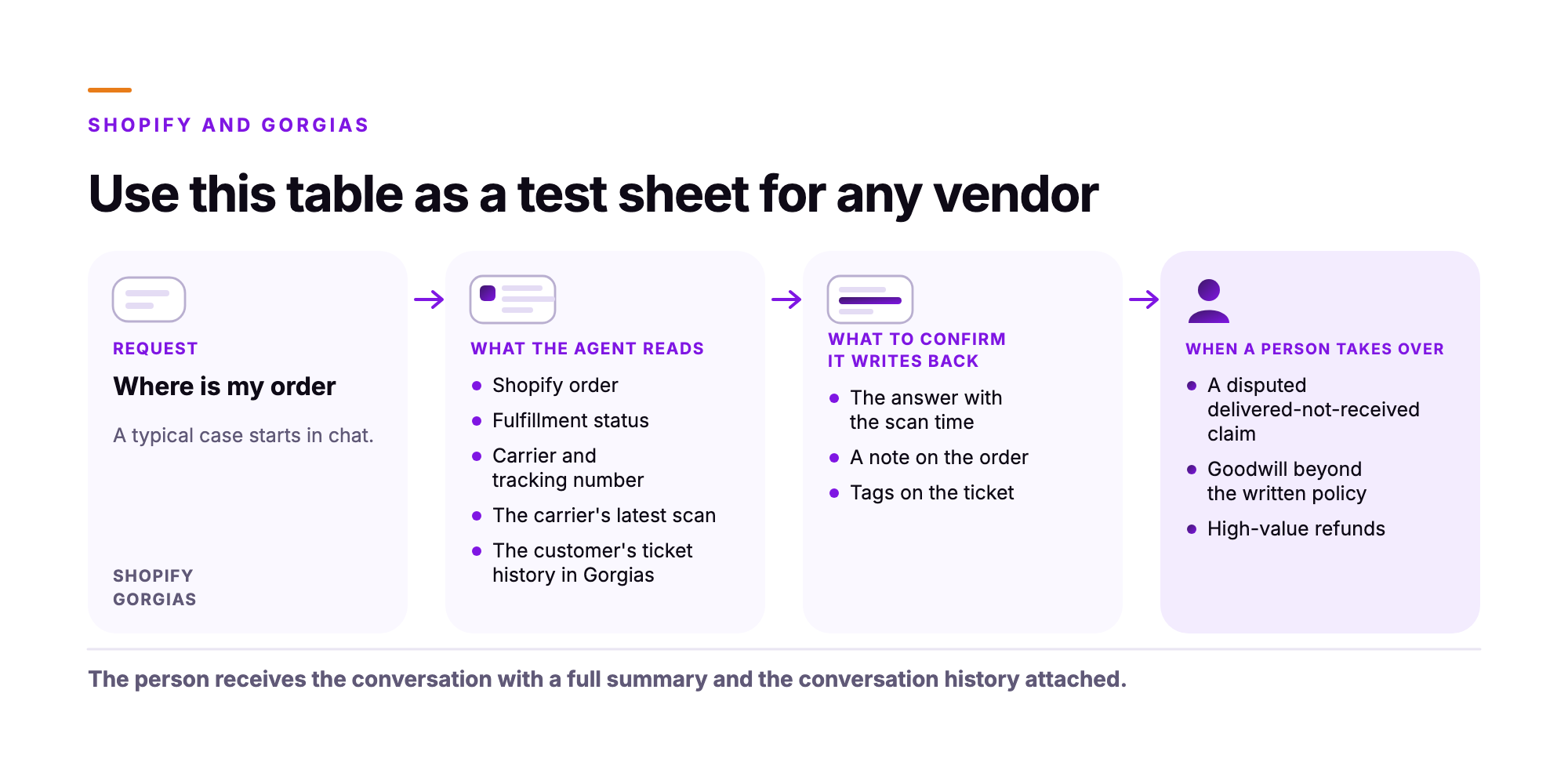
Use this table as a test sheet for any vendor.
| Request | What the agent reads | What to confirm it writes back in testing | When a person takes over |
|---|---|---|---|
| Where is my order | Shopify order, fulfillment status, carrier and tracking number, plus the carrier's latest scan | The answer with the scan time, a trace or replacement when policy allows, a note on the order, tags on the ticket | A disputed delivered-not-received claim, or goodwill beyond the written policy |
| Return | Purchase date, return window, final-sale flag, item condition, the customer's order history | An opened return, a return label, the refund timing stated to the shopper, a ticket note | A damage dispute, a request outside policy, a high-value order |
| Exchange | Return eligibility plus stock for the requested variant | A return with the exchange item, a label, a note on the order | The new item costs more, or several items change at once |
| Cancel or change before shipping | Fulfillment status, shipping address, line items | A cancellation or address change in Shopify, with a check that your warehouse or 3PL received it | The order has already gone to the warehouse |
| Refund status | Refunds on the order and the return status | The refund amount and date, a ticket note | A refund that never posted, or a payment dispute |
Sources: Shopify Order object, https://shopify.dev/docs/api/admin-graphql/latest/objects/Order (read November 6, 2026) · Shopify FulfillmentTrackingInfo, https://shopify.dev/docs/api/admin-graphql/latest/objects/FulfillmentTrackingInfo (November 6, 2026) · Shopify returns and exchanges, https://help.shopify.com/en/manual/fulfillment/managing-orders/returns (November 6, 2026) · Shopify returns apps, https://shopify.dev/docs/apps/build/orders-fulfillment/returns-apps (November 6, 2026) · Gorgias, Connect a store: Shopify, https://docs.gorgias.com/en-US/connect-shopify-to-gorgias-81814 (November 6, 2026) · Gorgias, Tickets, https://helpcenter.gorgias.com/en-US/articles/tickets-18372 (November 6, 2026) · Gorgias, Macro actions, https://helpcenter.gorgias.com/en-US/macros-actions-81913 (November 6, 2026) · Gorgias, Handle Gorgias Voice tickets, https://helpcenter.gorgias.com/en-US/handle-gorgias-voice-tickets-296977 (November 6, 2026).
When does a person take over, and what do they receive?
A handoff works when the person who picks it up can act right away. With Orvera AI, the agent hands the conversation to a person with a full summary and the conversation history attached. On voice, the transfer can be set to warm. The shopper tells the story once.
On your side, decide which Gorgias team receives each type of handoff, and confirm in testing that the summary and conversation history arrive with it. Orvera AI Agent Assist can support that person live with approved knowledge, a suggested next step and a summary at the end.
Which requests should stay with your team?
That line is yours to draw. Start with these groups:
- Policy exceptions. A return two days late from a customer with twelve prior orders is a judgment call. Write the rule, or route it to a person.
- Fraud signals. Repeated delivered-not-received claims on one account go to someone trained to read them.
- High-value refunds. Set a dollar amount above which a person approves. The agent gathers the facts first.
Orvera AI configures permissions, guardrails and escalation rules per channel and per use case, so these rules live in the deployment. Orvera AI Quality Management then scores AI-handled and human-handled conversations against your own scorecards, which shows where a rule needs adjusting.
Can a vendor handle your own messy orders?
A polished demo on sample data tells you little. Ask the vendor to run three of your real requests from last month, picked by you:
- A stalled shipment where Shopify and the carrier disagree.
- A return that falls just outside your window.
- An order canceled after it went to the warehouse.
Watch what the agent reads, what it writes back and how the handoff lands in Gorgias. The third case tests candor. Ask every vendor what happens at your warehouse when its agent cancels an order.
Then ask about results and timing. First-contact resolution runs about 80%, and average handle time falls 8 to 15% in the first 90 days, averages across Orvera AI customer engagements. Measure against your own baseline.
Is your team ready for deployment day?
Start with access. The deployment team needs access to Shopify and Gorgias, plus your carrier tracking, returns and 3PL tools. Shopify gives apps the last 60 days of orders by default, and older orders require a request for full order access, so ask for it early if your return window runs longer.
Next, write your return, exchange, cancellation and refund rules as decisions with clear limits.
Then gather knowledge: macros, help center articles, shipping policy and size guides. Macros show how your best agents already answer.
Turning on a system listed in the Orvera AI directory happens inside the deployment, and deployment takes 3 to 6 weeks on average across Orvera AI customer engagements. See how this works for online brands on the retail and e-commerce page (opens in a new tab).
Pre-launch checklist
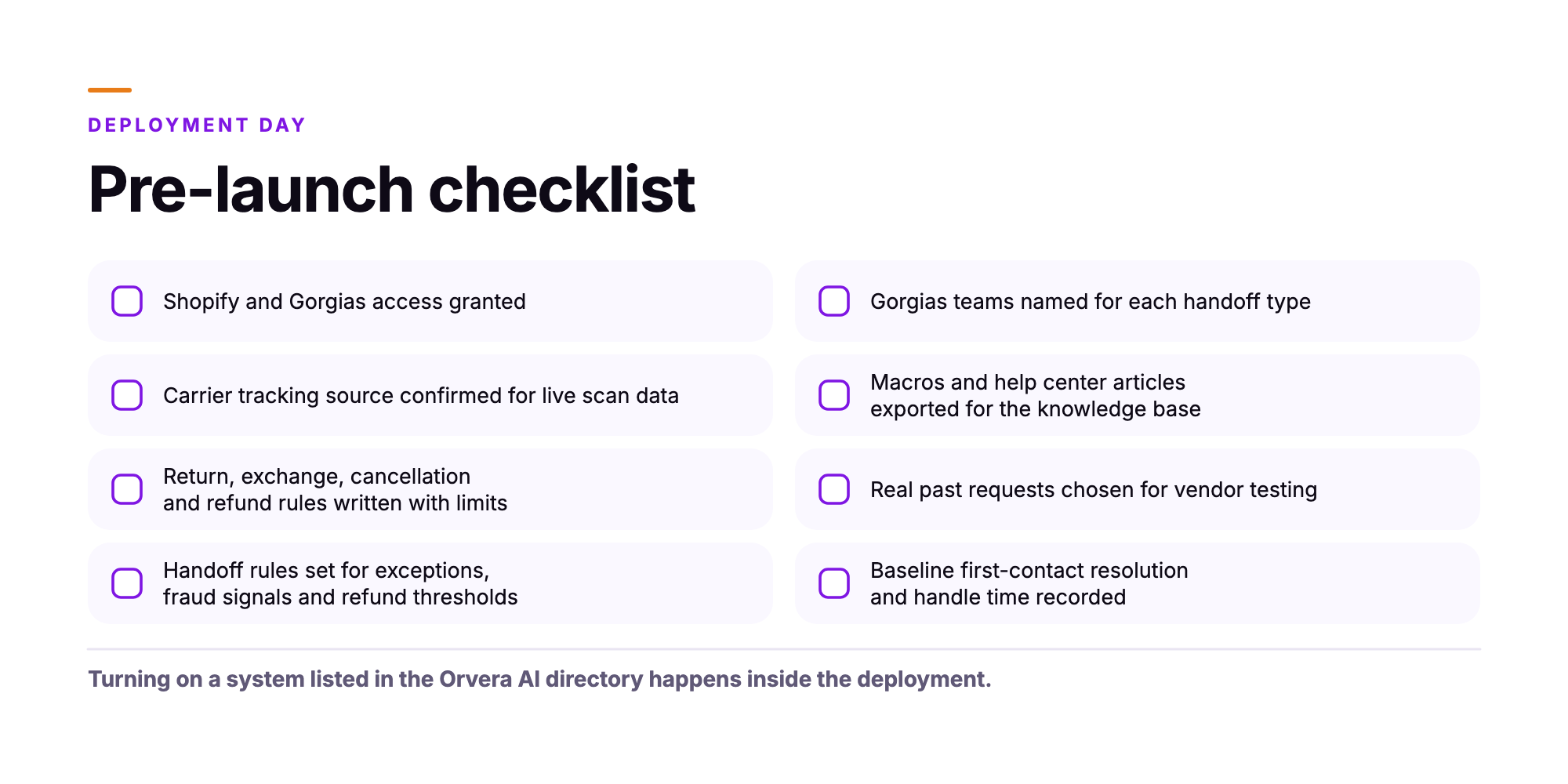
- Shopify and Gorgias access granted, including access to orders older than 60 days if needed
- Carrier tracking source confirmed for live scan data
- Return, exchange, cancellation and refund rules written with limits
- Handoff rules set for exceptions, fraud signals and refund thresholds
- Gorgias teams named for each handoff type
- Macros and help center articles exported for the knowledge base
- Three real past requests chosen for vendor testing
- Baseline first-contact resolution and handle time recorded
Frequently asked questions
Yes. Both Shopify and Gorgias are listed in the Orvera AI integration directory. Turning on a listed system is a configuration step inside the deployment.
Yes, when the request fits your written policy. Shopify supports return requests, approvals, exchanges, return labels and refunds. Orvera AI agents answer from your approved policies and write the outcome back to your system of record. Requests outside policy, damage disputes and high-value orders go to a person on your team.
The person receives the conversation with a full summary and the conversation history attached. On voice, the transfer can be set to warm. The shopper explains the issue once.
Deployment takes 3 to 6 weeks on average across Orvera AI customer engagements. Having access, written policies and your knowledge sources ready at the start keeps it on schedule.
Orvera AI agents work in more than 80 languages across voice, chat and email, so a shopper can get an order answer or ask about a return in their own language.

Written by
Anindita Majumder
Anindita Majumder is a communications professional with nearly four years of experience in public relations, corporate communications, and journalism. She creates content that helps brands communicate their vision, products, and expertise through press releases, thought leadership, and editorial pieces. Outside of work, she is a vocalist, which keeps her creativity flowing.