Why Enterprise Retailers Are Moving Beyond Simple IVR for WISMO Resolution
WISMO holds the top contact driver position because self-service tracking pages answer the easy questions, and every call that reaches your queue is...

Key highlights
Key takeaways
- WISMO holds the top contact driver position because self-service tracking pages answer the easy questions, and every call that reaches your queue is the question those pages could not resolve.
- On a standard WISMO call, a rep opens three systems in sequence, reconciles two conflicting status records, and reads the customer a tracking narrative the customer has already read.
- Reading a tracking status tells the caller where the order is. Resolving the call finishes the caller's problem so they have no reason to call again.
- An AI agent must read live order management system state and live carrier scan state simultaneously, then reconcile the two records before it can give a caller a reliable answer.
- A split shipment or a delivery exception does not need a different sentence from the AI agent. It needs a different action, triggered by the specific exception type the system reads in real time.
- When WISMO calls resolve at first contact, three operational metrics shift immediately: contacts per order, containment rate on your number one call driver, and repeat contacts on the same order number.
- A WISMO call goes to a human the moment resolution requires a judgment call that falls outside defined policy, most commonly a goodwill compensation decision or a disputed claim that needs account-level authority.
- Peak season is where the gap between IVR containment and actual resolution becomes a staffing crisis, and agentic AI voice agents change the math by removing headcount as the primary capacity lever.
- Agentic AI voice agents resolve WISMO contacts by reconciling live order and carrier state at the moment of the call. Reading a tracking number back to a caller is not resolution, and your repeat contact rate will prove the difference.
Why is WISMO still the number one contact driver in retail?
WISMO holds the top contact driver position because self-service tracking pages answer the easy questions, and every call that reaches your queue is the question those pages could not resolve.
The customer already opened the carrier portal. They read the same "in transit" status three times. They checked back the next morning and it still had not moved. By the time they dial in, they are not asking for information. They are asking for an explanation, an exception, or a commitment, and your representative has to reconstruct the same dead-end tracking narrative before they can give any of those things.
Contacts per order is the metric that makes the cost visible. It measures how many inbound contacts a single order generates across its lifecycle, and in peak season it climbs. When one in ten shipments generates a call, your self-service layer is not finishing the job. Multiply that against holiday order volume and you have a staffing problem that cannot be hired out of on a six-week runway.
That is precisely where AI voice agents for order status have moved from an experiment to an operational requirement. The alternative is adding seats to answer questions that carry no decision authority, and then adding more seats in November.
What does a rep actually do on a where is my order call today?
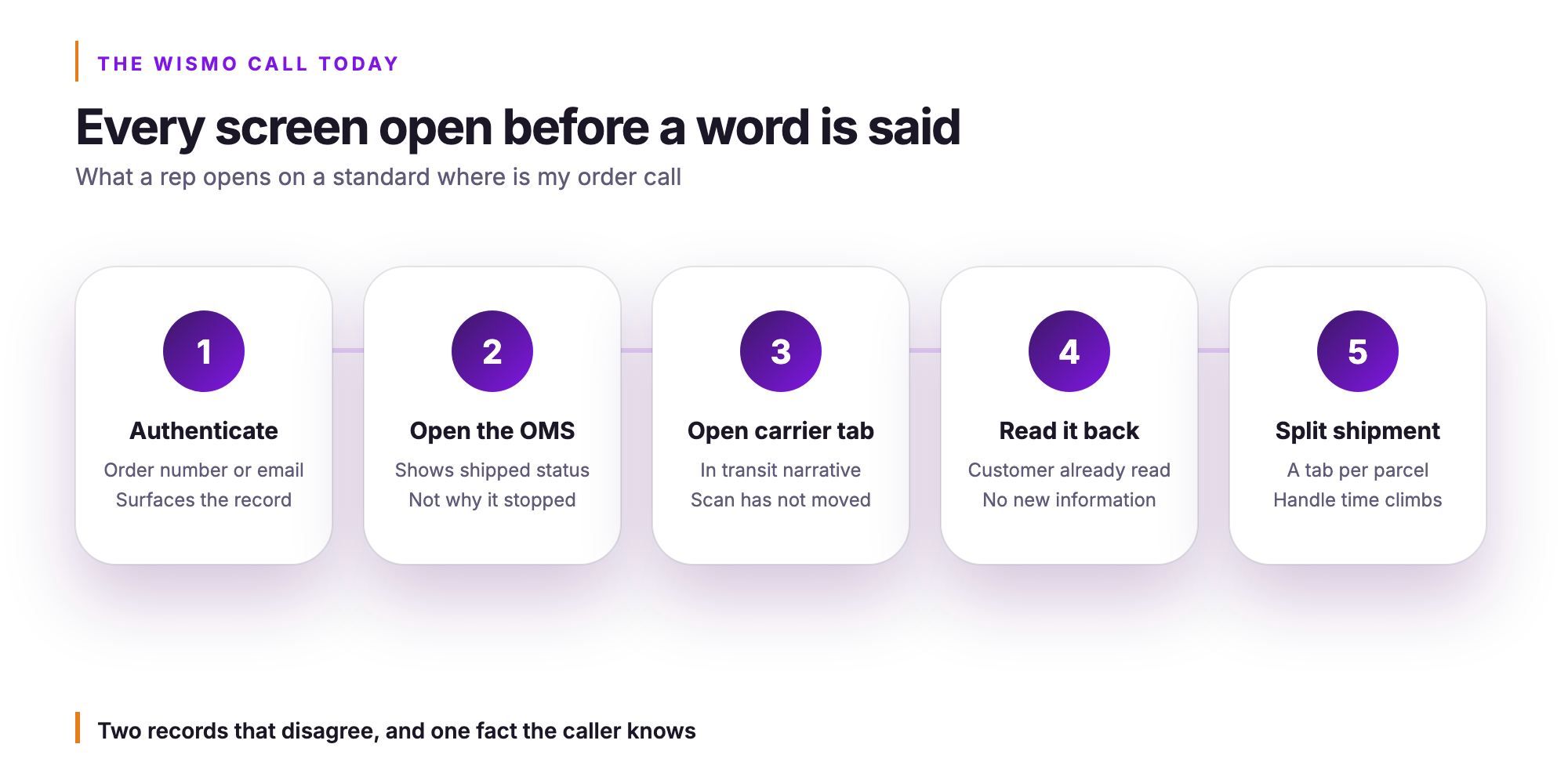
On a standard WISMO call, a rep opens three systems in sequence, reconciles two conflicting status records, and reads the customer a tracking narrative the customer has already read.
The sequence is consistent enough that WISMO automation in retail contact centers targets it directly. The rep authenticates the caller first, pulling an order number or email address to surface the record. The order management system opens next. That screen shows a shipped status, a carrier name, and a tracking number. It does not show why a package stopped moving.
So the rep opens a second tab. The carrier tracking page loads a narrative. "Departed facility. In transit. Arriving by end of day." The carrier scan has not changed in three days. The rep now holds two screens that disagree with each other in tone while agreeing on the one fact the customer already knows. The package has not arrived. The rep reads the tracking narrative back. The customer already read it. The call has produced no new information for either party.
Split shipments make that sequence worse. A single order confirmation becomes two or three tracking numbers across two or three carriers. The rep opens a separate carrier tab for each shipment, checks each scan history independently, and tries to explain which items are in which box and why one has moved while another has not. Handle time climbs. The resolution stays the same. What happens on that call after the rep reads the status is the question the next section addresses directly.
What is the difference between reading a tracking status and resolving the call?
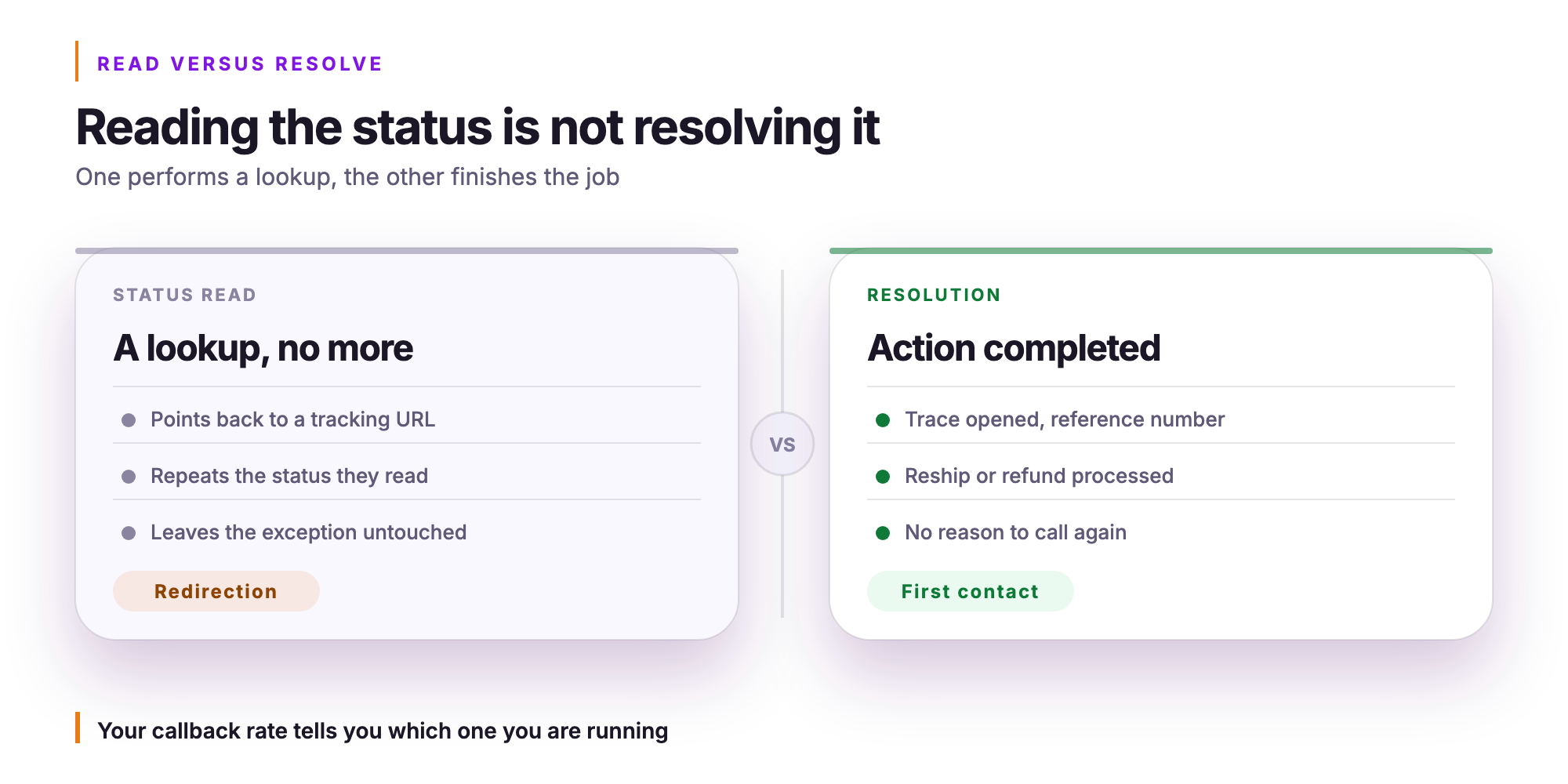
Reading a tracking status tells the caller where the order is. Resolving the call finishes the caller's problem so they have no reason to call again.
The distinction matters more than most IVR redesign projects acknowledge. A system that reads a carrier status back to a caller has performed a lookup. It has not resolved anything. The caller already read that same status on the tracking page before dialing in. Returning them to that page is not resolution. It is redirection, and it produces a callback.
Resolution means the call ends with an action completed. For a stalled shipment, that action is a carrier trace opened with a reference number. For a lost package confirmed by the carrier, it is a reship or a refund processed before the caller disconnects.
The callback rate tells you which of those two things your current system is doing. A caller who hears "your order is in transit" for the third time does not need more status information. They need a decision made on their behalf. That decision requires a system that reads live order management state and carrier scan data together, then executes the next step through an integration. Enterprise conversational AI for order tracking closes that loop. The next section examines exactly what data an AI agent must read to make that determination correctly.
What does an AI agent need to read to answer a WISMO call correctly?
An AI agent must read live order management system state and live carrier scan state simultaneously, then reconcile the two records before it can give a caller a reliable answer.
A cached OMS feed is the most common source of wrong answers in ecommerce voice AI deployments. The OMS record may show "shipped" while the carrier has not produced a scan in 72 hours. Reading the OMS record alone means the agent tells the caller something accurate as of yesterday and wrong as of now.
Live carrier scan state is where the actual signal lives. A stalled scan, meaning no new carrier event for longer than the expected transit window, is the condition that determines whether a package is on schedule or in trouble. The agent cannot classify the call correctly without knowing that gap. And it cannot recommend a next action, whether that is waiting one more day or opening a trace claim, without reading the gap against your carrier's SLA for that shipment lane.
Reconciliation is the step that turns two data reads into one resolution. The agent compares OMS ship date, carrier first-scan timestamp, and carrier last-scan timestamp. A mismatch between those three points is what defines the exception type. The agent reads all three to answer correctly.
The minimum data set for a correct WISMO answer includes:
- Live OMS record: order status, ship date, carrier assignment, and tracking number
- Live carrier scan feed: first scan, last scan, current scan event, and expected delivery date
- Calculated scan age: hours since the last carrier event against the carrier SLA for that lane
- Shipment count: one parcel or multiple, to flag split-shipment cases before they generate a second call
Each of those data points is read at call time, not pre-fetched. That distinction matters more than any other architectural choice in a WISMO resolution build.
What happens on a split shipment or a delivery exception?
A split shipment or a delivery exception does not need a different sentence from the AI agent. It needs a different action, triggered by the specific exception type the system reads in real time.
A single WISMO call can mask four distinct problems, and customer service voice AI that cannot distinguish between them will resolve none of them. Each exception type maps to a specific next action, not a rephrased version of the same tracking narrative.
1. Stalled scan. The carrier last touched the parcel 72-plus hours ago and no new scan has registered. The correct action is to open a carrier trace, not to read the last known location back to the caller. The AI agent initiates the trace and gives the caller a case reference number.
2. Carrier exception. The carrier has flagged the shipment with a coded exception, such as an address problem or a missed delivery window. The correct action is to surface the exception code, explain what it requires from the caller, and offer to connect to the carrier's redelivery workflow.
3. Lost package. No carrier scan activity exists past a defined threshold. The correct action is to initiate a replacement or refund according to your policy, not to advise the caller to wait.
4. Delivered-not-received claim. The carrier marked the parcel delivered, but the caller did not receive it. The correct action is to collect a claim, validate it against address confirmation, and route to your claims team with that record attached.
In the split-shipment case, two parcel IDs sit under one order number. One parcel arrived. One did not. The AI agent must identify both records, confirm which items belong to each, and apply the correct exception logic to the open shipment while acknowledging the delivered one. Reading a single order status produces the wrong answer for both the caller and your operations team. The section that follows shows which metrics shift when this level of resolution replaces a status read.
Which metrics move when WISMO calls actually resolve?
When WISMO calls resolve at first contact, three operational metrics shift immediately: contacts per order, containment rate on your number one call driver, and repeat contacts on the same order number.
A customer who received a genuine answer does not call back the next morning to ask the same question with a different representative. Contacts per order is the number to baseline before deployment and re-read after. Enterprises evaluating SOC 2 Type II certified AI voice agents for high-volume WISMO queues should set that baseline first, because it is the one metric that separates a resolved contact from a repeated one.
Containment rate on the WISMO driver matters because WISMO is not one call type among many. It is routinely the single largest share of inbound volume at peak. First-contact resolution averages around 80% across Orvera AI deployments, and lifting that on your number one driver alone restructures the queue. And the downstream effect lands on repeat contacts on the same order, which fall because the exception logic described in the prior section, split shipments and carrier holds, gets diagnosed in the first conversation rather than escalated for a human to re-diagnose on a second call.
Average handle time is the wrong headline metric here. A call that ends in 90 seconds because the customer gave up is not a win. A call that ends in three minutes with a confirmed reroute and a revised delivery date is. The metric that matters is whether the order question closed.
The capacity this returns is real. At peak season, every WISMO contact that closes on the first call is a call minute returned to billing disputes, returns authorization, and loyalty recovery. Those are the contacts where a human rep changes a customer's decision to stay. That is where the recovered capacity earns its value. The question of which calls should still reach a human is worth examining directly.
When should a WISMO call go to a human?
A WISMO call goes to a human the moment resolution requires a judgment call that falls outside defined policy, most commonly a goodwill compensation decision or a disputed claim that needs account-level authority.
The boundary is plain. The AI agent resolves every contact it can confirm against the order management system and carrier data. When the exception is diagnosable but the remedy exceeds policy parameters, the call moves. That is not a failure of containment. It is the system working as designed.
What changes in that escalation is what the human rep receives. The order number, the carrier exception type, the shipment status, and the full interaction history transfer with the call. The rep picks up mid-resolution, not at the beginning. Authentication is already complete. The problem is already named.
And the rep does not work that call without support. Agent Assist surfaces the relevant policy, the compensation guardrails, and any prior contact history in real time, directly inside the rep's workspace. The rep makes the judgment call. The system gives them the context to make it confidently and quickly, which keeps average handle time from spiking on escalated contacts.
That full path, from greeting to AI-driven resolution to a supported human decision, is what separates a contained contact from a call that simply moved queues. The same architecture that keeps standard WISMO contacts away from your reps also makes your reps more effective on the contacts that legitimately need them. How that architecture performs when order volume doubles is a different question, and one that peak season answers quickly.
What does this change during peak season?
Peak season is where the gap between IVR containment and actual resolution becomes a staffing crisis, and agentic AI voice agents change the math by removing headcount as the primary capacity lever.
WISMO volume does not scale linearly with order volume during peak. A carrier network under stress produces more exceptions, more delayed scans, and more split shipments arriving out of sequence. Each of those conditions generates a repeat contact. Your WISMO queue at peak is not just bigger, it is harder, and it arrives at precisely the moment when seasonal hiring quality is lowest. A new rep authenticating on an order number, reconciling a stalled carrier scan against an order management system record, and deciding whether a three-day gap warrants a goodwill offer is a judgment chain that takes weeks to learn. Seasonal hires rarely have those weeks.
Capacity, under an agentic AI model, is not a headcount equation. The AI agent handles the authentication, pulls live order and carrier state together, and delivers a real answer. When volume doubles on Cyber Monday, the platform absorbs that load without an additional hire, an expedited training cycle, or an overtime authorization. The human reps you do have are reserved for the escalations that actually require a judgment call, which is where their time produces measurable CSAT value.
The deployment window matters here. A full enterprise deployment runs three to six weeks, which means a retailer who starts the process in early fall has a fully configured, tested platform available before the peak period begins. That window includes knowledge-base setup, integration with your order management system and carrier feeds, and rep training on escalation handoff. There is no reason to enter peak season treating containment as a headcount problem when the alternative is available on your existing stack before the volume arrives.
What should a care leader take away from this?
Agentic AI voice agents resolve WISMO contacts by reconciling live order and carrier state at the moment of the call. Reading a tracking number back to a caller is not resolution, and your repeat contact rate will prove the difference.
- Resolution ends the repeat contact. A caller who hears the same shipped status they already read in the app calls back tomorrow. An AI agent that detects a stall, identifies the cause, and either corrects it or sets a firm expectation closes the contact. That distinction shows up in your FCR number, not in your IVR containment report.
- Live order and carrier state reconciled together is what makes a real answer possible. Your order management system and your carrier's tracking feed disagree more often than your current reporting captures. An agentic AI voice agent queries both at the moment of the call and surfaces the authoritative state, not whichever record loaded first.
- The goodwill boundary is a design decision. Where the AI agent hands to a human representative is a policy your team sets, not a failure built into the technology. Define the exception types, set the threshold, and the escalation runs consistently across every contact.
- Peak volume amplifies every gap in your current approach. The contacts that overwhelmed your queue last peak season were not anomalies. They were the ceiling your IVR was always going to hit. Book time with the Orvera team to walk through what that math looks like on your call volume.
Frequently asked questions
A single WISMO call touches three separate screens because the order management system and the carrier tracking page hold different versions of the same shipment state, and a representative has to reconcile them manually before saying a word.
A voice AI agent resolves the most common "where is my order" scenarios completely on the call, without routing the caller to a human rep.
Reading live order and carrier state means placing the order management system record next to the carrier scan record in the same moment, then describing the gap between them, which is precisely what the customer called to understand.
A voice AI agent reads the order management system record and the carrier scan record together, identifies the specific exception type, and takes the next action on the call without transferring.
Containing order status calls moves contacts per order first, because every repeat call on the same shipment is a failure the first interaction did not resolve.
Agentic AI for retail contact centers resolves the lookup, the reconciliation, and the first available remedy, then escalates when the resolution requires a goodwill judgment no policy document can pre-authorize.

Written by
Anindita Majumder
Anindita Majumder is a communications professional with nearly four years of experience in public relations, corporate communications, and journalism. She creates content that helps brands communicate their vision, products, and expertise through press releases, thought leadership, and editorial pieces. Outside of work, she is a vocalist, which keeps her creativity flowing.