AI Agents vs Chatbots: What’s the Difference and Which Should You Choose?
Chatbots respond, AI agents resolve. Where each works best, what each costs to run, and how to choose by complexity, integrations and outcomes.

Key highlights
TL;DR — Differences at a Glance
- AI agents and chatbots both automate conversations, but they solve very different levels of problems.
- Chatbots are designed for guided interactions. They answer common questions, collect information, and route requests using predefined flows, menus, or limited AI.
- AI agents are built for task completion. They can understand goals, plan steps, use external tools, and resolve requests end-to-end with minimal human intervention.
- The core difference is capability: chatbots primarily respond, while AI agents can take actions across systems such as CRM, scheduling platforms, billing tools, or support software.
- Chatbots work best for high-volume, predictable scenarios like FAQs, status checks, identity verification, and intake forms where the correct response is known in advance.
- AI agents are suited for complex workflows that require decisions, context retention, and multi-step execution, such as processing changes, resolving issues, coordinating services, or managing follow-ups.
- Because AI agents interact with business systems, they require stronger governance, monitoring, and compliance controls than chatbots.
- Implementation complexity also differs. Chatbots can often be deployed quickly with limited integrations, while AI agents typically need workflow design, tool connections, testing, and operational guardrails.
- Cost structures reflect value delivered. Chatbots offer lower upfront cost and predictable scope, while AI agents deliver higher resolution rates and operational efficiency for complex interactions.
- Many organizations deploy both, using chatbots for simple deflection and AI agents for high-impact customer support journeys that require true resolution.
- As customer expectations rise, the strategic question is not which technology is newer, but which one can solve the actual problems your teams face.
Businesses exploring automation often encounter two terms used almost interchangeably: chatbots and AI agents. At first glance, both appear to perform the same function. They interact with customers through conversation, answer questions, and reduce workload on human teams.
But the similarity is superficial.
The difference between a chatbot and an AI agent directly impacts real business outcomes, including resolution rates, customer satisfaction, operational costs, and scalability. Deploying the wrong type of system can lead to stalled conversations, high escalation rates, and frustrated users. Choosing the right one can transform how work gets done.
In simple terms, chatbots are designed to respond. AI agents are designed to resolve.
As organizations are increasingly moving beyond basic automation, customer expectations are rising. According to Markets and Markets, the AI agents market is valued at around $7.8 billion in 2025, projected to reach $52.6 billion by 2030 with a 46.3% CAGR. (opens in a new tab) In contrast, as per Grand View Research, the chatbot market stands at about $7.8 billion in 2024, expected to grow to $27.3 billion by 2030 at a 23.3% CAGR. (opens in a new tab) Agents' higher growth rate reflects demand for advanced, proactive systems over reactive chat interfaces.
This shift is especially visible in industries where phone conversations remain mission-critical, such as healthcare, financial services, insurance, logistics, and retail. In these sectors, automation is not just about answering questions. It must support identity verification, compliance, scheduling, payments, case management, and real-time decision making.
Teams evaluating automation, therefore, face a strategic choice: deploy a chatbot to reduce inbound volume, or deploy AI agents capable of handling entire workflows from start to finish.
What Is a Chatbot?
A chatbot is a software system designed to simulate conversation with users through text or voice. Its primary purpose is to provide information, guide users, or collect details.
Most chatbots operate within predefined boundaries. They work best when questions match known patterns and when the response can be delivered without complex reasoning or system actions.
Chatbots typically rely on one or more of the following:
- Decision trees or scripted flows
- Keyword matching
- FAQ databases
- Basic natural language understanding
- Menu-based navigation
- Retrieval of stored information
For example, a website chatbot might answer questions about business hours, return policies, or product details. In customer support, it may collect order numbers or route users to the correct department.
Chatbots are effective when the problem is well-defined and repeatable.
Common characteristics of chatbots:
- Guided conversations
- Limited context retention
- Minimal autonomy
- No long-term planning
- Often escalates complex issues to humans
Many organizations deploy chatbots as a first line of interaction to reduce inbound volume. According to industry surveys, chatbot adoption continues to grow because of their relatively low cost and fast deployment time.
What Is an AI Agent?
An AI agent is a system designed to achieve goals rather than simply conduct conversations. Instead of only responding to inputs, it can interpret intent, plan actions, use tools, and complete tasks end-to-end.
AI agents combine capabilities from multiple AI disciplines, including natural language processing, reasoning, decision-making, and workflow orchestration.
Unlike chatbots, agents can interact with external systems such as:
- CRM platforms
- Scheduling tools
- Payment systems
- Order databases
- Knowledge bases
- Authentication services
- Operational workflows
For example, if a customer says, “I need to reschedule my appointment,” an AI agent can:
- Verify identity
- Check availability
- Apply business rules
- Update the system
- Confirm the change
- Send notifications
All without human intervention.
Key characteristics of AI agents:
- Goal-driven behavior
- Multi-step reasoning
- Persistent context
- Tool and API usage
- Decision-making capability
- Ability to execute real actions
This makes AI agents particularly valuable in environments where requests are complex, varied, or time-sensitive.
AI Agents vs Chatbots: The Core Differences
At the highest level, the difference can be summarized as:
Chatbots reply. AI agents do.
This distinction affects everything from what problems they can solve to how much value they deliver.
Task Handling
Chatbots primarily provide information or collect inputs. They may guide users through processes, but typically do not execute actions themselves.
AI agents can perform tasks directly, such as:
- Updating account details
- Processing cancellations
- Booking appointments
- Handling transactions
- Triggering workflows
- Escalating with full context
Because they can act, agents reduce the need for human intervention and shorten resolution time.
Context and Memory
Chatbots usually operate within a narrow conversational window. If the interaction deviates from expected paths, they may lose context or restart.
AI agents maintain a broader context across multiple steps. They can track progress, remember prior inputs, and adapt when the conversation changes direction.
This capability is crucial for real-world scenarios, where customers rarely communicate in perfectly structured ways.
Tool Use and Integrations
Chatbots often rely on static knowledge bases or simple integrations to retrieve information.
AI agents actively interact with systems. They can read and write data, trigger processes, and coordinate across multiple tools.
For organizations already operating complex digital ecosystems, this ability determines whether automation actually reduces workload or merely redirects it.
Flexibility with Messy Questions
Customers do not always ask clean, predictable questions. They interrupt themselves, change topics, or combine multiple requests.
Chatbots perform best when queries match known patterns. AI agents handle ambiguity more effectively because they interpret intent and plan accordingly.
This leads to fewer “dead-end bot” experiences.
Governance and Risk
Because AI agents can take real actions, they introduce additional governance requirements.
Organizations must consider:
- Authorization rules
- Audit logging
- Compliance requirements
- Error handling
- Escalation safeguards
- Approval workflows
Chatbots pose lower operational risk because they typically do not modify systems.
Comparison Table: Chatbot vs AI Agent
| Dimension | Chatbot | AI Agent |
|---|---|---|
| Primary purpose | Provide answers | Achieve outcomes |
| Task execution | Limited | Extensive |
| Autonomy | Low | High |
| Planning | None | Multi-step |
| Context handling | Narrow | Persistent |
| Tool usage | Minimal | Deep integrations |
| Best for | FAQs, routing | Complex workflows |
| Implementation complexity | Lower | Higher |
| Value per interaction | Lower | Higher |
Use Cases Where Chatbots Work Best
Chatbots remain highly useful when applied to the right problems. Here are some ideal use cases for chatbots:
1. FAQs and Basic Support
Common questions with consistent answers are ideal for chatbot automation:
- Business hours
- Shipping policies
- Account instructions
- Product details
- Troubleshooting basics
Because responses rarely change, chatbots can deliver reliable information quickly.
2. ID&V and Simple Verification
Chatbots can collect identifying information before handing users over to human agents.
Examples:
- Name and account number
- Date of birth
- Verification codes
- Issue category
This reduces handling time for live support teams.
3. Intake and Form-Style Data Capture
Chatbots excel at structured data collection.
Typical uses include:
- Support ticket intake
- Appointment requests
- Lead qualification forms
- Survey responses
- Service requests
By gathering required information upfront, organizations can route inquiries more efficiently.
Use Cases Where AI Agents Work Best
AI agents shine when tasks involve multiple steps, decisions, or interactions with systems. Here are some use cases where AI agents are a better choice:
1. Customer Service Agent for Resolution
Instead of merely answering questions, AI agents can resolve issues end-to-end.
Examples:
- Checking order status and initiating refunds
- Updating subscriptions
- Handling billing disputes
- Managing account changes
- Coordinating service requests
2. Agent Copilot for Live Support
AI agents can assist human representatives in real time by providing:
- Conversation summaries
- Suggested responses
- Next-best actions
- Knowledge retrieval
- Compliance prompts
This improves productivity and consistency while reducing training requirements.
For a detailed breakdown of how this works in practice, see the guide on the benefits of AI agent assist (opens in a new tab), which explains how real-time suggestions, summaries, and workflow automation improve productivity without sacrificing service quality.
3. Outbound Agent for Follow-Ups
AI agents can proactively engage customers to complete tasks such as:
- Appointment confirmations
- Payment reminders
- Lead qualification
- Post-service surveys
- Renewal outreach
Because they can handle complex interactions, outbound agents enable scalable engagement without proportional increases in staffing.
Industry Examples Where AI Agents Deliver the Most Value
AI agents tend to deliver the highest ROI in environments with complex, regulated, or time-sensitive interactions.
For example:
Healthcare and patient access
- Appointment scheduling and rescheduling
- Insurance verification
- Prescription refill coordination
- Symptom triage routing
- After-hours support
These healthcare-related workflows (opens in a new tab) require accuracy, privacy compliance, and context continuity — capabilities that most chatbots lack.
Financial services and insurance
- Account inquiries and updates
- Fraud alerts and verification
- Policy changes
- Claims intake
- Payment processing
Strict regulatory requirements make auditability and governance essential.
E-commerce and retail
- Order modifications
- Delivery issues
- Returns and refunds
- Loyalty program support
- Upsell opportunities
AI agents can handle these scenarios end-to-end, reducing abandonment and improving conversion in the e-commerce industry (opens in a new tab).
Field services and home services
- Emergency routing
- Technician scheduling
- Service updates
- Quote follow-ups
- Lead qualification
For a deeper look at how AI is transforming operational workflows across sectors, explore the relevant industry solutions pages on the Orvera (opens in a new tab) site.
Why AI Agents Handle More Complex Issues
Complex requests require more than scripted responses. They involve uncertainty, dependencies, and decision-making.
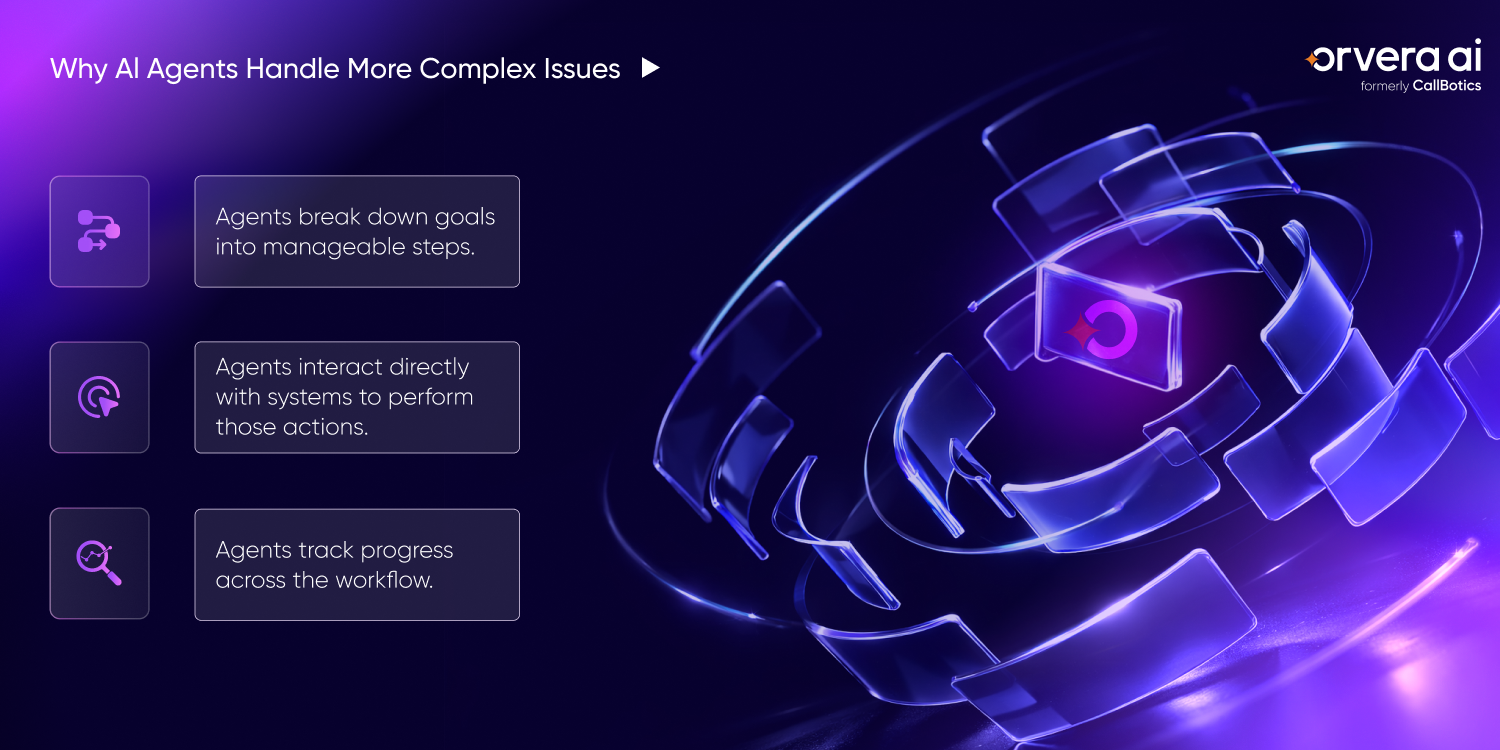
AI agents address this complexity through three capabilities:
- Planning: Agents break goals into manageable steps and determine which actions are needed to achieve the desired outcome.
- Tool execution: They interact directly with systems to perform those actions.
- Context preservation: They track progress across the workflow, ensuring continuity even when conversations shift.
These capabilities reduce handoffs, shorten resolution time, and minimize frustration.
Another reason AI agents outperform chatbots in complex environments is their ability to generate actionable insights from conversations, not just complete tasks.
Because agents interact directly with systems and customers, they produce rich operational data that can be analyzed to improve processes over time.
For example, conversation analytics can reveal:
- Recurring failure points in workflows
- Emerging customer concerns
- Product issues
- Policy confusion
- Training gaps
- Churn risk signals
These insights help organizations shift from reactive support to proactive improvement.
To understand how conversational data can be transformed into operational intelligence, see this detailed guide on AI call analysis (opens in a new tab), which explains how speech analytics uncovers patterns across thousands of interactions:
When combined with automation, analytics enables a powerful feedback loop: detect issues → resolve them → prevent recurrence.
Implementation: Chatbot vs AI Agent
Implementation is where the practical differences between chatbots and AI agents become most visible. While both can automate conversations, the depth of integration, operational impact, and governance requirements vary significantly. Chatbots are typically lighter to deploy and manage, focused on information delivery and basic routing. AI agents, by contrast, operate inside live systems, execute workflows, and influence customer outcomes. As a result, implementation planning must account not only for speed to launch, but also for architecture, security, oversight, and long-term operational ownership.
Time to Launch
Chatbots generally go live faster because they require fewer integrations and less testing.
AI agents often require:
- Workflow design
- System integrations
- Security controls
- Testing scenarios
- Guardrails
- Monitoring frameworks
However, modern platforms increasingly offer production-ready templates that accelerate deployment.
What You Need to Manage
Chatbot maintenance typically involves updating content and monitoring performance.
AI agent management includes:
- Workflow optimization
- Policy updates
- Exception handling
- Continuous improvement
- Performance monitoring
- Compliance oversight
While more demanding, these activities also produce greater operational impact.
Large organizations must also consider governance, security, and operational readiness before deploying AI agents.
Key implementation factors include:
- Access controls and authorization rules
- Compliance requirements (HIPAA, GDPR, SOC 2, etc.)
- Audit logging and traceability
- Failure handling procedures
- Escalation policies
- Monitoring and quality assurance
- Human oversight mechanisms
Unlike chatbots, which pose limited operational risk, AI agents can modify systems and customer records. This makes production readiness essential.
Successful deployments typically involve cross-functional collaboration between IT, operations, legal, compliance, and customer experience teams.
Cost Differences You Should Expect
Cost depends more on complexity and volume than on whether the system is labeled a chatbot or agent.
Chatbot Cost Pattern
Chatbots usually have:
- Lower setup costs
- Predictable scope
- Minimal integration requirements
- Lower risk of unintended actions
They deliver value primarily through deflection.
AI Agent Cost Pattern
AI agents involve:
- Higher upfront effort
- Integration investment
- Governance requirements
- Ongoing monitoring
However, they also deliver higher value per interaction.
Orvera's customers average a 65 to 90 percent reduction in per-interaction cost after automating labor-intensive processes.
While AI agents require greater upfront planning, they often produce stronger long-term economic benefits by reducing dependence on human labor.
Traditional support models scale linearly with headcount. Agentic automation introduces non-linear scaling, allowing organizations to handle significantly higher volumes without proportional increases in staffing.
Additional cost advantages may include:
- Reduced training costs
- Lower turnover impact
- Faster response times
- Improved first-contact resolution
- Reduced escalation rates
- 24/7 availability without shift premiums
In environments with high call volumes, these benefits compound rapidly.
How to Choose: Chatbot or AI Agent?
When evaluating chatbot vs AI agent solutions, organizations should assess three dimensions:
1. Interaction complexity
Are requests simple questions or multi-step problems?
2. Required actions
Does the system need to update records, process transactions, or trigger workflows?
3. Business impact of failure
What happens if the system cannot resolve the issue?
If failure leads to lost revenue, compliance risk, or safety concerns, agent-level capabilities are typically required.
When to Choose a Chatbot
- Questions are repetitive and predictable
- Answers rarely change
- Minimal system actions are required
- Your primary goal is deflection
- The budget or timeline is limited
When to Choose an AI Voice Agent
- Requests involve multiple steps
- Tasks require system updates or transactions
- Context matters across interactions
- You want real resolution, not just responses
- Manual workload is high
- Customer journeys are complex
Start Small and Scale
Many organizations begin with chatbot-style automation for simple interactions, then upgrade critical journeys to agent workflows as confidence grows.
This phased approach balances risk and value while enabling continuous improvement.
How Orvera Helps You Move Beyond Basic Chatbots
Organizations transitioning from basic chatbots to operational AI often seek platforms designed for production environments rather than experimental deployments.
Orvera runs AI agents across voice, chat and digital channels that handle real customer interactions across complex workflows, with automation, analytics, and governance in a single system.
Key differentiators include:
- End-to-end task handling and deep, branching workflows
- Seamless integrations with your existing tech stack
- Real-time summaries and insight generation
- Intelligent routing based on intent
- Continuous performance monitoring
- Support for high-volume environments
- Built-in quality and analytics
- white-glove implementation and support
Because analytics is embedded directly into live operations, teams gain immediate visibility into resolution outcomes rather than relying on post-hoc analysis.
Organizations operating in regulated or high-stakes industries often prioritize this production-ready approach to minimize operational risk while maximizing automation benefits.
Frequently asked questions
No. While they may share conversational interfaces, AI agents can plan actions, use tools, and complete tasks. Chatbots primarily respond.
Chatbots can often be deployed quickly. AI agents typically require integrations, workflow design, and testing, though modern platforms can reduce deployment time significantly.
Yes. Integration with CRM, helpdesk, scheduling, and operational systems is a core capability that enables agents to perform real tasks.
Chatbots generally have lower upfront costs but limited impact. AI agents involve more investment but deliver higher value per interaction and can significantly reduce operational expenses.
They typically require stronger governance and monitoring, but many platforms provide managed deployment and support to simplify ongoing operations.
Written by
Bryan Miller
Bryan is a B2B SaaS writer with a technical background who shifted into writing about technology and AI four years ago. With hands-on tech experience, he brings depth, clarity, and practical context to complex AI and SaaS topics. He’s a firm believer in an AI-driven future and focuses on content that explains not just how technology works, but why it matters. Outside of writing, Bryan enjoys watching films, listening to tech podcasts, and nurturing an unusual rookie-level interest in marine biology.