AI Voice Agent CRM Integration: How It Works & Why Your Team Needs It
How AI voice agents write call outcomes, entities and follow-ups straight into the CRM, the four integration paths (native connectors, APIs, middleware, webhooks) and what to check before you pick a platform.

Key highlights
TL;DR — Key Highlights
- AI voice agents can automatically capture structured data from customer conversations and write it directly into CRM systems.
- CRM integration eliminates manual call logging and improves data accuracy across sales and support workflows.
- Real-time CRM updates accelerate follow-ups, pipeline movement, and customer response times.
- Integrated voice automation prevents fragmented customer data between telephony systems and CRM tools.
- AI voice platforms typically connect to CRM systems using native connectors, APIs, middleware, or webhooks.
- Organizations should evaluate integration reliability, data security, latency, and workflow automation capabilities when selecting a voice AI platform.
Customer conversations generate valuable information. Sales signals, support requests, account updates, and follow-up opportunities all appear during live interactions. However, in many organizations, this information never reaches the system of record immediately. Agents must manually log calls, summarize outcomes, and update CRM records later.
This delay introduces friction into operational workflows. Leads wait for follow-ups. Customer records remain incomplete. Managers struggle to see accurate pipeline data in real time.
AI voice agents are changing how organizations handle these conversations. These systems can answer calls, conduct natural discussions, capture structured information, and trigger workflows automatically. The real operational impact appears when voice automation connects directly with CRM systems.
AI voice agent CRM integration transforms spoken conversations into structured operational data. Customer records update automatically, follow-ups trigger instantly, and organizations gain real-time visibility into customer interactions.
This guide explains how AI voice agent CRM integration works, why it improves operational efficiency, and what organizations should evaluate when selecting a voice automation platform.
What Are AI Voice Agents and AI Voice Agent Platforms
AI voice agents are software systems that conduct spoken conversations with customers. They can answer calls, understand spoken language, respond naturally, and complete tasks during the interaction.
These systems use advanced speech technologies and language models to process conversations in real time. Unlike traditional IVR systems, voice agents can understand natural language rather than forcing callers through rigid menu structures.
AI voice agent platforms provide the infrastructure required to deploy these systems in production environments. They combine telephony connectivity, AI models, workflow orchestration, monitoring tools, and enterprise integrations into a unified environment.
Organizations use these platforms to automate repetitive interactions, capture structured information from calls, and integrate conversation data with internal systems such as CRM platforms.
Core technologies behind AI voice agents
AI voice agents rely on several foundational technologies to conduct natural conversations.
Automatic speech recognition (ASR) converts spoken audio into text so the system can process customer intent.
Natural language understanding (NLU) interprets the meaning of the text, identifying intent, entities, and contextual information within the conversation.
Text-to-speech (TTS) converts system responses into natural spoken audio so the agent can reply to the caller.
These technologies work together to enable real-time conversational interaction between customers and automated systems.
What an AI voice agent platform includes
Production-grade voice automation platforms include multiple system layers that support enterprise deployments.
Typical components include:
- Telephony infrastructure for call routing and connectivity
- AI models for speech recognition and conversational reasoning
- Workflow orchestration systems that manage conversation flows
- Integration layers that connect external systems such as CRMs
- Monitoring tools that track call performance and system reliability
Together, these components enable organizations to deploy voice automation at scale across sales, support, and operational workflows.
Why Voice AI CRM Integration Matters
Voice conversations often contain the most valuable customer signals. A caller may request pricing, confirm an appointment, update an account, or report a service issue.
If this information remains inside call recordings or agent notes, it cannot influence operational workflows quickly enough.
CRM integration ensures that every interaction becomes structured operational data within the organization’s system of record.
Eliminating manual call documentation
Manual call logging consumes a significant portion of agent time in many organizations.
After completing a conversation, agents often need to write summaries, update account records, log call outcomes, and schedule follow-up tasks.
AI voice agents can automate this process. The system can generate structured call summaries, capture relevant entities, and automatically update CRM records at the end of the interaction.
This removes repetitive documentation work and ensures consistent data capture.
Faster follow-ups and pipeline movement
Speed often determines whether a sales opportunity progresses or disappears.
When CRM records update in real time, follow-up actions can trigger automatically. Leads can be assigned instantly, tasks can appear in the pipeline, and teams can act immediately.
Automated CRM updates significantly reduce the delay between a conversation and the next operational step.
Preventing fragmented customer data
Many organizations operate separate tools for telephony, CRM systems, ticketing systems, and analytics.
Without integration, conversation data remains isolated inside call logs or voice platforms.
AI voice agent CRM integration eliminates these silos by ensuring that every interaction becomes part of the unified customer record.
This creates a consistent view of customer history across teams.
Many organizations exploring automation are also evaluating broader call reduction strategies for contact centers (opens in a new tab), where voice AI and workflow automation play a critical role in reducing repetitive inbound interactions.
Explore how Orvera's AI agents integrate with CRM systems to automate data capture and follow-ups across customer conversations. (opens in a new tab)Key Benefits of AI Voice Agent CRM Integration
When voice AI platforms integrate directly with CRM systems, organizations gain operational improvements across multiple functions.
Automated lead capture from calls
Inbound calls often represent potential sales opportunities.
AI voice agents can automatically capture caller information, extract relevant details, and create new lead records inside the CRM.
Missed calls or voicemail interactions can also trigger automated lead creation, ensuring that potential opportunities do not disappear.
Higher CRM data accuracy
Manual data entry introduces errors and inconsistencies.
Voice AI systems can extract structured entities such as names, account numbers, addresses, or product inquiries directly from the conversation.
This structured extraction improves CRM data accuracy and consistency.
Faster workflow automation
CRM integrations enable automated workflows.
For example:
- Sales calls can trigger follow-up reminders
- Support requests can create service tickets
- Appointment requests can schedule meetings
- Payment inquiries can initiate billing workflows
Automation reduces the manual coordination required across teams.
Improved analytics and coaching insights
Voice AI platforms generate transcripts and interaction data for every conversation. When this information flows into CRM and analytics systems, managers gain deeper insights into customer interactions and can identify first-call-resolution improvement strategies (opens in a new tab) that reduce repeat contacts and improve service efficiency.
When this information flows into CRM and analytics systems, managers gain deeper insights into customer interactions.
Organizations can analyze sentiment trends, common inquiries, and conversion signals to improve operational performance.
Reduced operational workload
Automation removes repetitive administrative tasks from agents.
Instead of logging calls and updating CRM records manually, agents can focus on complex conversations and customer relationships.
This improves productivity while maintaining accurate records.
How AI Voice Agents Integrate With CRM Systems
Voice automation platforms typically integrate with CRM (opens in a new tab) systems through several architectural approaches.
Native CRM connectors
Many voice AI platforms provide built-in integrations with widely used CRM systems such as Salesforce, HubSpot, or Microsoft Dynamics.
Native connectors allow organizations to synchronize call data, customer records, and workflow triggers without extensive custom development.
Bidirectional CRM APIs
API integrations allow voice agents to both retrieve and update CRM data.
For example, before answering a call, the system can retrieve customer records to personalize the conversation. During the interaction, it can update fields, log activities, or create follow-up tasks.
Bidirectional APIs enable real-time synchronization between conversations and CRM systems.
Middleware and integration platforms
Some organizations use middleware platforms or integration layers to connect systems that do not have native connectors.
These tools act as intermediaries between voice AI platforms and internal software environments.
Middleware can transform data formats, enforce security policies, and coordinate communication between systems.
Webhooks and workflow triggers
Webhooks allow voice platforms to send real-time notifications when specific conversation events occur.
For example:
- A call outcome can trigger a CRM update
- A lead qualification result can assign a salesperson
- A support issue can create a ticket automatically
Webhooks enable event-driven automation across multiple operational systems.
Technical Components of a Voice Agent CRM Integration Stack
Reliable production deployments require multiple system layers working together.
Speech processing layer
The speech layer converts audio into structured data.
Real-time speech recognition processes the caller’s voice, while text-to-speech systems generate spoken responses.
This layer enables natural conversational interaction.
Conversation engine and context tracking
The conversation engine manages dialogue flow and intent detection.
It tracks context throughout the interaction, ensuring the system understands multi-turn conversations and complex requests.
Integration and orchestration layer
The integration layer connects the voice platform with CRM systems and other operational tools.
APIs, data mapping rules, and workflow orchestration ensure that conversation events update CRM records correctly.
Monitoring and observability systems
Production systems must continuously monitor performance and reliability.
Monitoring tools track call quality, response latency, integration failures, and workflow outcomes.
This visibility helps teams maintain consistent service quality.
Discover how CRM-connected voice automation with Orvera can turn every customer call into structured operational data. (opens in a new tab)Measuring ROI From AI Voice Agent CRM Integration
Organizations evaluating automation should also understand AI voice agent pricing models, including platform licensing, usage-based interaction costs, and integration complexity.
Cost per interaction
Voice automation reduces the cost of handling routine interactions.
When AI voice agents resolve simple requests automatically, organizations can lower the cost per interaction while maintaining service availability.
Time to next action
CRM automation shortens the time between customer interaction and operational response.
Leads move through the pipeline faster, and support teams respond more quickly to customer requests.
CRM data completeness
Automated data capture improves the completeness and accuracy of CRM records.
More reliable data leads to better reporting, forecasting, and decision-making.
Total cost of ownership
Organizations must also evaluate implementation costs, integration complexity, and long-term maintenance requirements.
Platforms that provide mature CRM integrations often reduce deployment effort and operational overhead.
Evaluating AI Voice Agent Platforms for CRM Integration
Organizations selecting a voice automation platform should evaluate several technical and operational factors.
CRM connector maturity
Platforms with mature native CRM connectors simplify deployment and reduce integration complexity.
Latency and reliability
Real-time conversations require low latency and reliable system performance.
Integration failures or delays can disrupt customer interactions and operational workflows.
Data security and compliance
Customer conversations often involve sensitive information.
Enterprise deployments require encryption, audit logging, and compliance controls to protect customer data.
Conversation intelligence capabilities
Accurate transcripts, entity extraction, and sentiment detection improve operational insights.
These capabilities enable better coaching, quality monitoring, and performance optimization.
Customization and workflow orchestration
Organizations should evaluate how easily the platform supports custom workflows, data mapping rules, and automation triggers.
Flexibility is critical for adapting voice automation to real operational processes.
Best Way to Start With AI Voice Agent CRM Integration
Organizations should approach CRM integration gradually rather than attempting to automate every workflow immediately.
Start with a high-frequency workflow
The best starting point is a repetitive, high-volume interaction such as:
- Lead capture
- Appointment scheduling
- Account verification
- Basic information requests
These workflows provide quick operational value.
Define measurable success metrics
Clear metrics help organizations evaluate the effectiveness of automation.
Typical metrics include response time, lead conversion rates, and interaction resolution speed.
Limit initial integration complexity
Focused pilots allow teams to deploy quickly and learn from real interactions before expanding automation across additional workflows.
Checklist for Integrating AI Voice Agents With Your CRM
Organizations preparing for CRM integration should review several technical and operational considerations.
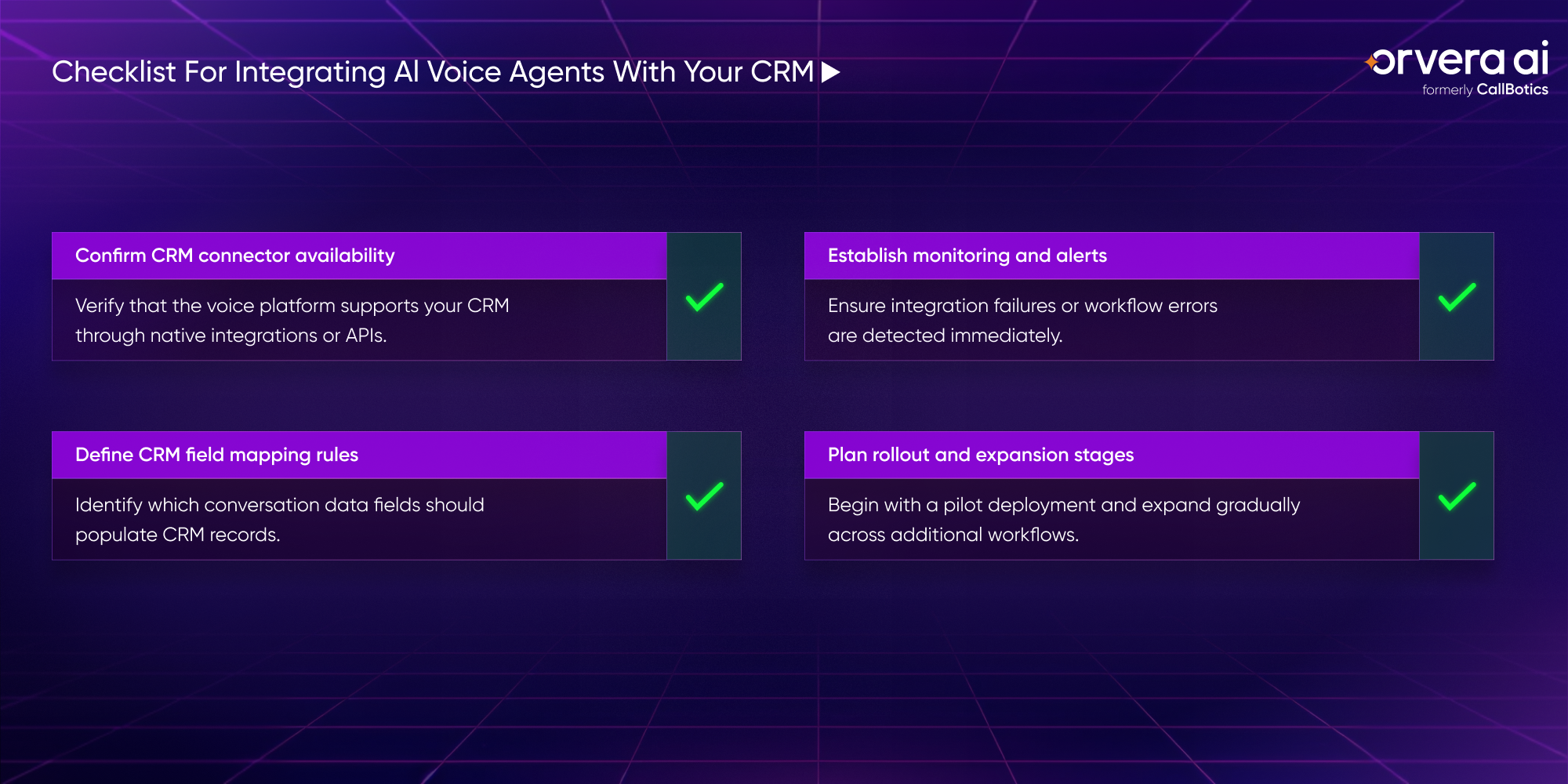
Confirm CRM connector availability
Verify that the voice platform supports your CRM through native integrations or APIs.
Define CRM field mapping rules
Identify which conversation data fields should populate CRM records.
Establish monitoring and alerts
Ensure integration failures or workflow errors are detected immediately.
Plan rollout and expansion stages
Begin with a pilot deployment and expand gradually across additional workflows.
How Orvera Enables AI Voice Agent CRM Integration
This operational experience allows Orvera (opens in a new tab) to integrate voice automation directly with CRM systems in ways that reflect how customer interactions actually flow inside contact centers.
Built by contact center operators
The platform reflects real operational workflows, including lead capture, account verification, and multi-step support interactions.
Real-time CRM updates during conversations
Call outcomes, transcripts, and structured data can be written directly into CRM records automatically.
Voice agents that retrieve CRM context before conversations
Voice agents can access customer history, account status, and previous interactions before speaking, enabling personalized conversations.
Automated follow-ups and workflow triggers
Voice interactions can trigger CRM workflows such as task assignment, lead creation, or appointment scheduling.
Designed for complex real-world conversations
The system supports verification steps, branching conversation paths, and multi-turn interactions while maintaining accurate CRM updates.
Operational visibility and analytics built in
Call transcripts, outcomes, and sentiment signals feed analytics dashboards that help teams monitor and improve performance.
Conclusion
AI voice agents are becoming a central component of modern customer interaction systems. However, the real operational value of voice automation appears when these systems connect directly with CRM platforms.
CRM integration transforms conversations into structured operational data. Customer records are automatically updated, follow-ups occur faster, and organizations gain real-time visibility into interactions across sales and support workflows.
As voice automation adoption grows, organizations that integrate voice agents with their CRM systems will gain significant operational advantages in responsiveness, data accuracy, and workflow efficiency.
Frequently asked questions
AI voice agent CRM integration connects voice automation platforms with CRM systems, enabling conversation data to automatically update customer records and trigger operational workflows.
Voice agents capture conversation data, including call outcomes, transcripts, and extracted entities. This information is sent to CRM systems through APIs, native connectors, or webhooks.
Many platforms support integrations with widely used CRMs such as Salesforce, HubSpot, Zoho CRM, and Microsoft Dynamics.
Key benefits include automated data capture, faster follow-ups, improved CRM data accuracy, reduced manual work, and better operational analytics.
Orvera connects with CRM platforms using APIs and integration layers that allow voice agents to retrieve customer data, update records in real time, and trigger automated workflows after conversations.
Written by
Urza Dey
Urza Dey (She/They) is a content/copywriter who has been working in the industry for over 5 years now. They have strategized content for multiple brands in marketing, B2B SaaS, HealthTech, EdTech, and more. They like reading, metal music, watching horror films, and talking about magical occult practices.