Why a 3% Call Sample is a Compliance Liability for Medicare Advantage Plans
Your QA team scores one to three calls per representative each month, and the 97% of conversations they never hear is where your CMS audit exposure actually...

Key highlights
TL;DR - Why a 3% sample cannot establish your CMS failure rate
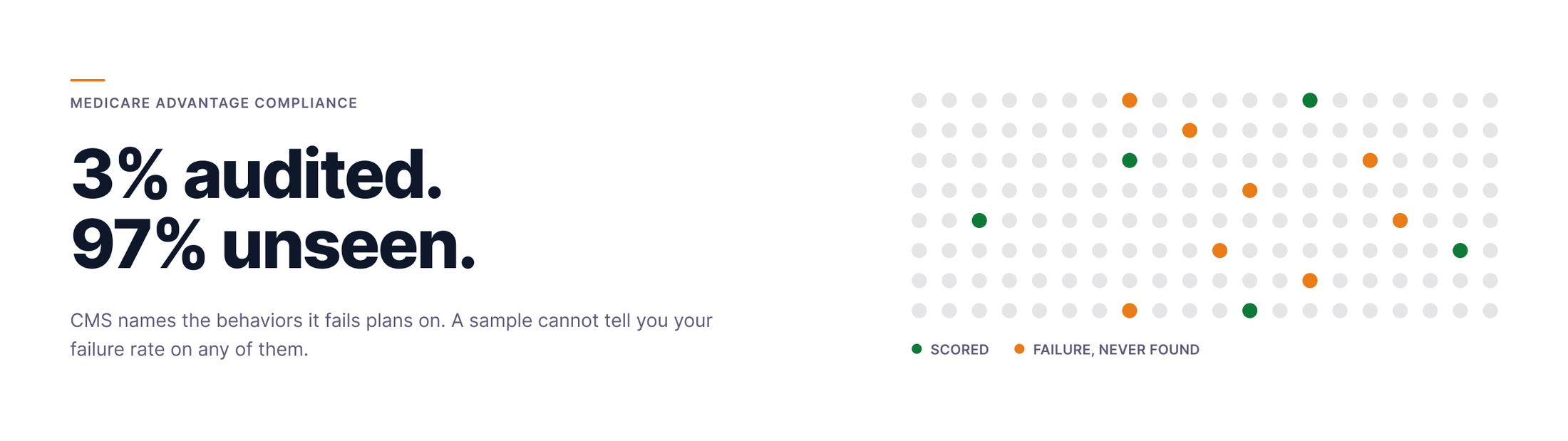
- Your QA team scores one to three calls per representative each month, and the 97% of conversations they never hear is where your CMS audit exposure actually lives.
- CMS call center requirements have grown from a short list of access standards into a layered framework that tracks every interaction from greeting to resolution, and a 3% sample cannot cover that surface.
- A grievance buried in the 97% of calls your QA team never reviews does not stay buried. It accumulates, surfaces in CMS data, and pulls your Star Rating down before your compliance team knows there is a problem.
- Basic transcription records what was said. Agentic AI understands what was meant, and that distinction is what separates a compliance record from a compliance program.
- Automated 100% quality management closes the gap that a sampled review program structurally cannot, and it does so on every call your center handles, not a selected fraction.
- Medicare Advantage plans facing CMS call center monitoring requirements need a partner who has run the floor, not a vendor who has only built software to describe it.
- Ungrounded AI in healthcare is a compliance event waiting to happen.
- Automated call center quality monitoring costs a fraction of what manual QA scaling requires, and it eliminates the compliance exposure that a sampled program cannot close.
- A 3% call sample is not a compliance program. It is a documentation gap that a CMS auditor can walk through without breaking stride.
- A 3% sample is a reactive posture, and CMS auditors are not impressed by it.
The Statistical Blind Spot in Medicare Call Center Compliance
Your QA team scores one to three calls per representative each month, and the 97% of conversations they never hear is where your CMS audit exposure actually lives.
The math is straightforward. A Medicare Advantage plan running 50,000 member calls a month and sampling 3% reviews 1,500 of them. The remaining 48,500 conversations, each carrying its own disclosure language, transfer timing, and enrollment confirmation sequence, go unexamined. CMS timeliness studies measure adherence across the full volume, not the slice your analysts pulled. When a systemic error runs through the unmonitored 97%, it compounds across thousands of contacts before anyone surfaces it.
The compliance gap is the distance between what your QA sample confirms and what CMS can see in an audit. Manual review catches individual errors. It does not catch a pattern that affects 12% of your queue on days when a particular script variant runs. Automated Medicare call center compliance monitoring closes that gap by auditing every conversation, not a representative subset. The difference is not efficiency. It is whether a repeating disclosure failure stays invisible until a CMS timeliness study flags it, or whether your team finds it on day two.
CMS's monitoring expectations have grown more specific, and the mismatch with manual QA has widened alongside them. The requirements your floor runs against today are not the same ones a 3% sample was designed to satisfy.
How CMS call center compliance behaviors have evolved
CMS call center requirements have grown from a short list of access standards into a layered framework that tracks every interaction from greeting to resolution, and a 3% sample cannot cover that surface.
The regulatory expectations that govern Medicare Advantage call centers today are materially more demanding than they were a decade ago. CMS now evaluates hold times, disclosure language, enrollment accuracy, grievance identification, TTY/TDD accessibility, and multi-language support as separate, auditable behaviors. Each one carries its own documentation standard. Missing any single element on a monitored call is a deficiency. Missing it on an unmonitored call is invisible until a beneficiary complaint or an audit surfaces it.
Tracking compliance from greeting to resolution manually is difficult because the compliance-relevant moments are not evenly distributed across a call. A required disclosure might surface two minutes in. An unreported grievance might surface eight minutes in. TTY/TDD readiness must be confirmed at the point of access, not assumed. A rep handling a Spanish-language caller must demonstrate language access in the moment, not just note it in the after-call wrap. Manual reviewers sampling one to three calls per rep per month will statistically miss the majority of these moments.
The requirements that create the most consistent gaps in a sampled review include:
- TTY/TDD access confirmation. Reps must actively direct callers to the TTY line, not assume the IVR covered it.
- Multi-language support disclosure. Language assistance must be offered proactively, documented, and consistently applied.
- Timeliness study thresholds. CMS measures average speed to answer and hold-time compliance across a statistically valid volume of calls, not a handful.
- Grievance identification. Any expression of dissatisfaction with a plan, a provider, or a service must be flagged and routed, regardless of whether the caller uses the word grievance.
Timeliness studies represent a particular compliance vulnerability. CMS requires plans to demonstrate that hold-time and answer-speed standards are met across a representative sample large enough to be statistically valid. A 3% QA pull does not satisfy that threshold. 100% call monitoring for CMS compliance is the only methodology that produces a defensible data set when a timeliness study is requested. The cost of that gap becomes clear when a grievance goes undetected, a subject the next section addresses directly.
The high cost of undetected grievances
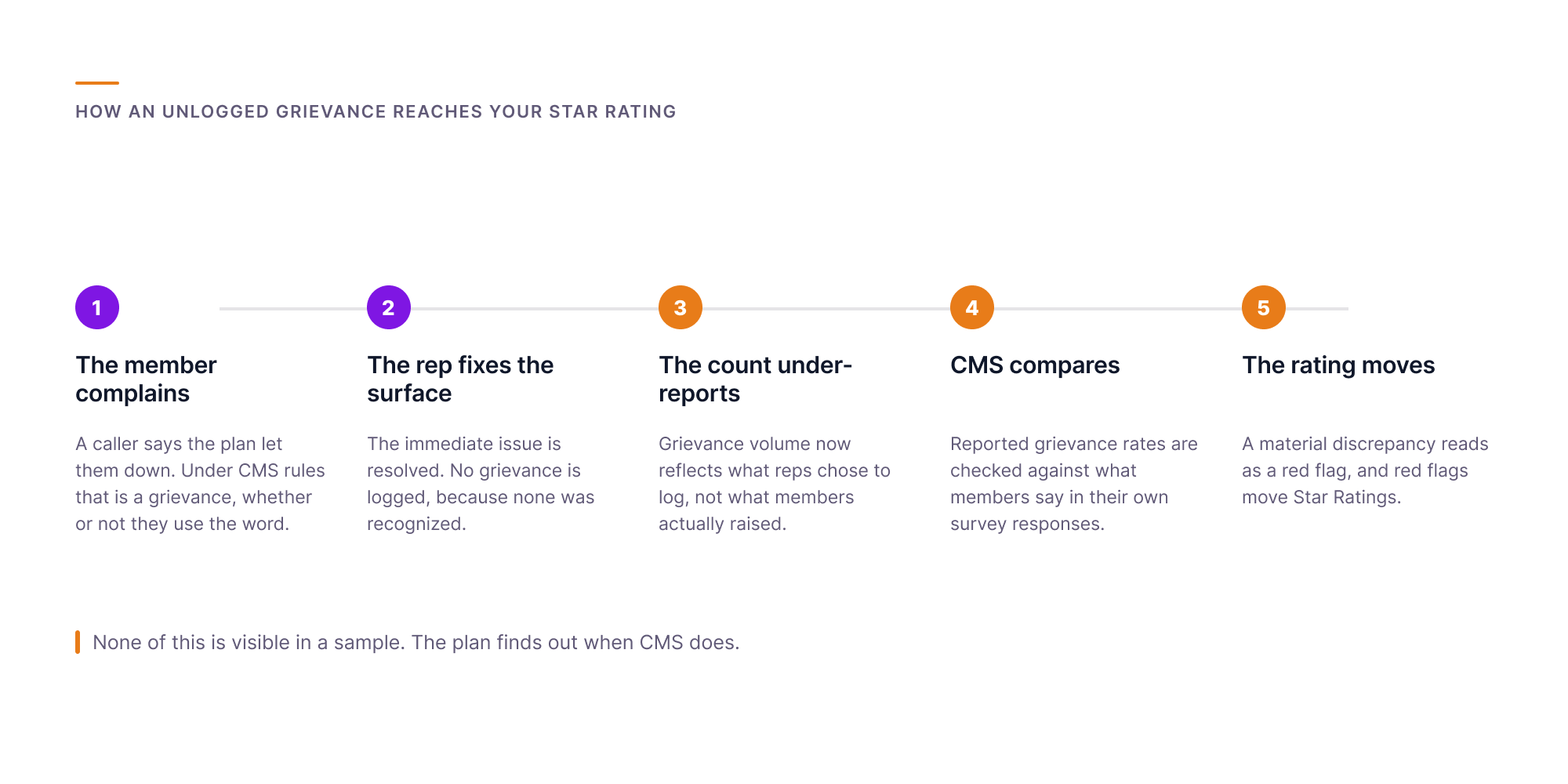
A grievance buried in the 97% of calls your QA team never reviews does not stay buried. It accumulates, surfaces in CMS data, and pulls your Star Rating down before your compliance team knows there is a problem.
The connection between unmonitored calls and Star Rating erosion is direct. CMS scores Medicare Advantage plans on member experience measures that draw heavily from call center interactions, including complaint resolution timeliness and member satisfaction. When a caller expresses dissatisfaction with a coverage decision, a denied prior authorization, or a billing dispute, that interaction meets the regulatory definition of a grievance, regardless of whether your rep logged it as one. A rep who does not recognize the signal, or who resolves the surface issue without documenting the underlying complaint, creates a gap in your grievance volume reporting. CMS compares reported grievance rates against member survey responses. A material discrepancy is a red flag, and red flags move Star Ratings.
Financial consequences follow quickly. A one-star drop for a Medicare Advantage plan can eliminate hundreds of millions of dollars in quality bonus payments, and CMS enforcement actions compound that exposure. Sanctions, civil monetary penalties, and enrollment freezes are all available remedies for plans with sustained compliance failures. An enrollment freeze alone can halt growth during the annual enrollment period, a damage that no recovery plan fully offsets. The financial model for Medicare Advantage depends on maintaining four stars or above, and that threshold is harder to defend when your call center compliance monitoring covers only a fraction of actual volume.
AI-driven detection changes the detection window. AI-driven CMS call center compliance monitoring reviews every conversation, applying consistent criteria to identify grievance language that reps may not flag, including indirect expressions of dissatisfaction, appeals language buried in longer calls, and escalation signals that appear after the rep believes the call is resolved. In practice, plans that move from sampled review to 100% call monitoring find a measurable increase in documented grievances, not because complaints increased, but because previously hidden ones are now visible. That visibility is the starting point for understanding what complete call monitoring actually requires from the underlying technology, a question the next section addresses directly.
Moving beyond transcription: the role of agentic AI
Basic transcription records what was said. Agentic AI understands what was meant, and that distinction is what separates a compliance record from a compliance program.
Speech-to-text tools convert audio to text. They do not determine whether a rep completed a required privacy verification, missed a mandated disclosure, or failed to document a grievance. Against CMS call center requirements, that gap is consequential. A transcript is evidence. An agentic system is an auditor.
Managed platform vs. API tools. Orvera AI is not a developer API that your engineering team configures and maintains. It is a managed Agentic AI platform, deployed and governed by operators who have run contact center floors. The platform coordinates best-in-class third-party models through an enterprise application layer that Orvera controls, meaning no single model failure breaks your compliance posture. In practice, that distinction matters most when a model update changes behavior overnight. A raw API leaves your team to catch it. A managed platform catches it first.
Governed model coordination is the mechanism that makes 100% call monitoring reliable in a regulated environment. Every model inference passes through a governance layer that enforces your plan's specific disclosure rules, escalation paths, and audit logging requirements. The output is not a confidence score on a dashboard. It is a structured, auditable record of whether each interaction met its compliance criteria.
That record is the foundation for what full-coverage quality management can deliver, which the next section addresses directly.
Achieving 100% quality management in a regulated environment
Automated 100% quality management closes the gap that a sampled review program structurally cannot, and it does so on every call your center handles, not a selected fraction.
Medicare call recording requirements establish a baseline: capture the audio, retain it, produce it on demand. What those requirements cannot enforce on their own is the review of what is inside the recording. That gap is where compliance risk accumulates. Automated QM addresses the gap by running a structured evaluation on each conversation immediately after it closes.
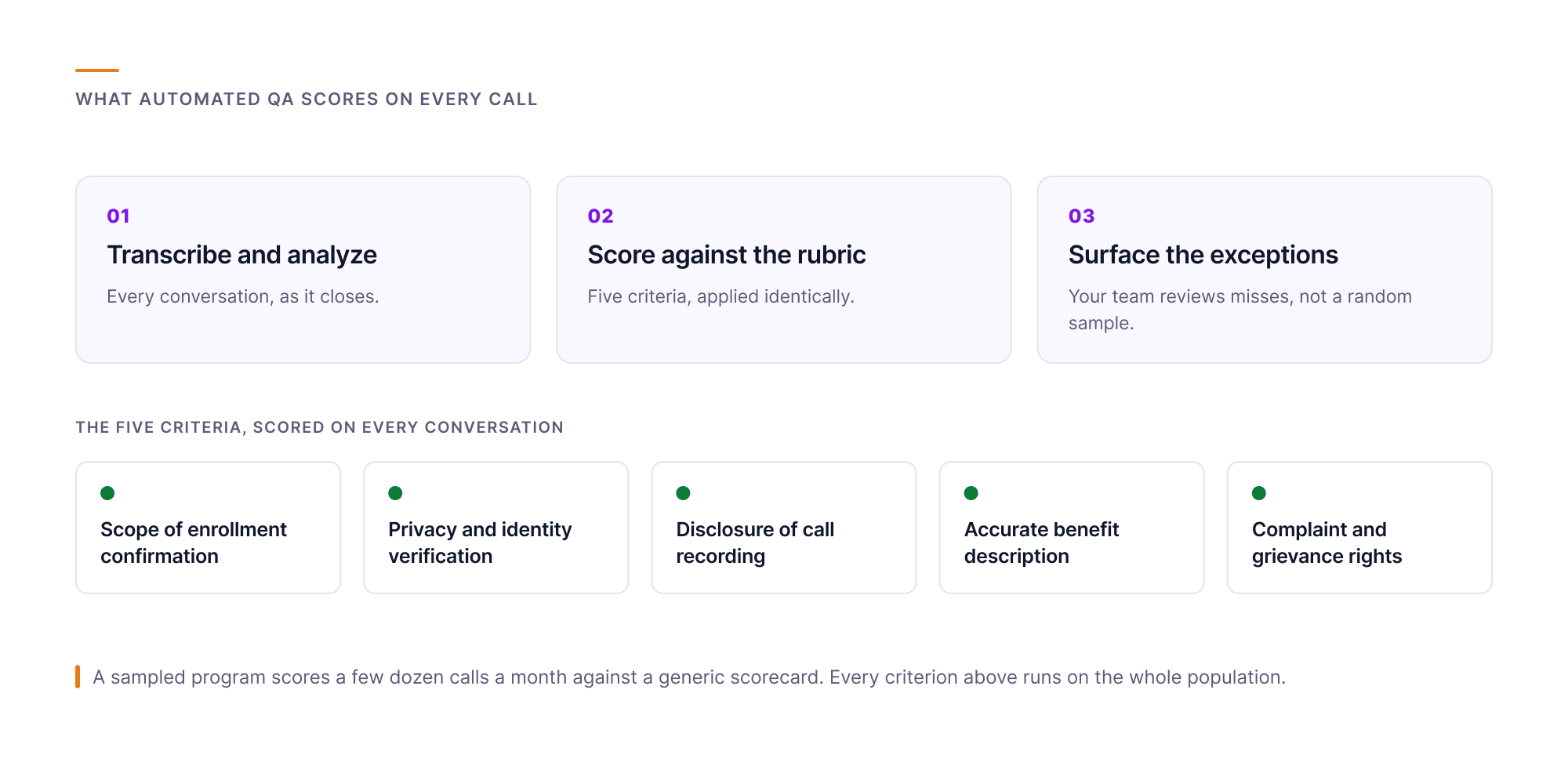
The workflow moves in three stages. First, the platform transcribes and analyzes the full conversation. Second, a scored evaluation runs against a defined rubric, flagging behaviors that CMS monitors directly:
- Scope of enrollment confirmation. Did the rep establish that the call concerned a Medicare Advantage or Part D product before any plan detail was discussed?
- Privacy and identity verification. Was the caller's identity confirmed using the required data points before protected health information was exchanged?
- Disclosure of call recording. Was the required disclosure delivered at the opening of the call, before the substantive conversation began?
- Accurate benefit description. Were plan benefits stated within the boundaries of approved marketing materials?
- Complaint and grievance rights. Where a grievance arose, was the caller informed of their filing rights?
Third, scored results feed a compliance dashboard, surfacing every call that missed a flagged behavior, so your quality team reviews exceptions rather than working through a random sample.
But automation does not replace judgment in high-stakes moments. A call where a member disputes a denial or describes a care coordination breakdown carries consequences that a scored rubric alone cannot fully adjudicate. Human reviewers stay in the loop for those escalations, working from the AI-generated transcript and score rather than starting from a blank audio file. The result is faster, more consistent review. And it is review applied to 100% of the record, not the 3% a manual program can realistically sustain.
The question of who builds and runs that workflow inside a regulated contact center is one the next section takes up directly.
Operational heritage vs. tool-only vendors
Medicare Advantage plans facing CMS call center monitoring requirements need a partner who has run the floor, not a vendor who has only built software to describe it.
The distinction matters more than it sounds. An API toolkit hands your team a set of components and a configuration guide. What it does not hand you is 18 years of knowing which edge cases break a compliance workflow at 2 a.m. on a Saturday, or which silence patterns in a post-enrollment call signal a member who did not actually understand their coverage. That operational knowledge does not ship in a developer package.
Build and run vs. plug and play. A managed deployment means the platform arrives fully configured, with knowledge bases loaded, escalation logic tested, and your human reps trained before the first live call. A plug-and-play API approach transfers that configuration burden to your internal team, which in a regulated Medicare environment means your CCO is now accountable for decisions that a specialized operator would otherwise own. The risk does not disappear when you buy software. It relocates.
Ungrounded AI in healthcare is a compliance event waiting to happen. When an AI agent cites a benefit the member's plan does not cover, or misroutes a grievance, the CMS record reflects that interaction regardless of who caused the error. A managed service provider governs the models, audits every conversation, and owns the remediation loop. A tool-only vendor closes the ticket.
The difference between those two postures shows up directly in the numbers that compliance officers and finance teams review together.
The ROI of total compliance coverage
Automated call center quality monitoring costs a fraction of what manual QA scaling requires, and it eliminates the compliance exposure that a sampled program cannot close.
Manual QA costs. A program reviewing 3% of calls means supervisors are spending time on a fraction of interactions while the other 97% remain unreviewed. Scaling that program to even 10% coverage requires additional headcount, training, and coordination that compounds quickly. Automated 100% monitoring, by contrast, runs across every conversation without adding labor. Across a high-volume Medicare Advantage operation, that difference translates directly to cost-per-contact reduction, not as an estimate but as a measurable outcome across engagements Orvera AI runs today.
Containment value. AI agents that resolve member inquiries from greeting to resolution reduce the volume of calls that reach human reps in the first place. Fewer calls requiring rep involvement means the compliance surface shrinks proportionally. The 65% to 90% cost-to-serve efficiency Orvera AI delivers on managed engagements reflects that containment, not deflection, not routing, but actual resolution that prevents the follow-up call tomorrow.
Member satisfaction returns. When an AI agent is personalized to the caller's history, members receive accurate, relevant responses on the first contact. For Medicare Advantage members, who are often managing complex benefits questions, that accuracy directly influences CSAT and, ultimately, Star Ratings. Resolution that reflects a member's prior contacts and current plan details is not a feature. It is the mechanism by which compliance coverage and member satisfaction move together, not in opposition.
The economics are clear. The compliance path ahead will make them unavoidable.
Summary: the path to audit-ready operations
A 3% call sample is not a compliance program. It is a documentation gap that a CMS auditor can walk through without breaking stride.
The sections above have traced that gap from its origin in manual QA economics to its consequences in Star Ratings, disenrollment patterns, and enforcement exposure. The conclusion is consistent across every dimension: Medicare Advantage plans cannot meet current CMS call center monitoring requirements by sampling. The regulation does not grade on a curve, and the audit does not average out.
The shift to 100% monitoring is not a stretch goal reserved for large plans with outsized QA budgets. Automated call center quality monitoring, deployed through a managed Agentic AI platform, converts a cost-prohibitive manual process into a continuous, governed operation. Orvera AI audits every conversation, scores it against CMS-aligned criteria, and surfaces the compliance signal that a 3% sample statistically cannot reach.
Star Ratings are the financial mechanism that makes this operational. The 97% of calls a plan is not currently reviewing contain the enrollment-period disclosures, the formulary explanations, and the complaint interactions that CMS weights directly in its measurement methodology. Those calls are not neutral. They are either building your rating or eroding it, and right now most plans do not know which.
Managed governance closes that gap with a structure that satisfies both the operational and the regulatory requirement. The platform maintains an auditable record from greeting to resolution, gives your compliance team defensible documentation, and gives your reps real-time support that improves the interaction before it becomes a finding.
The difference between a plan that survives a CMS audit and one that absorbs a corrective action is rarely a policy. It is whether the monitoring infrastructure covers the full call population. That is the conversation the next section addresses directly.
Securing your compliance future
A 3% sample is a reactive posture, and CMS auditors are not impressed by it. The sections above trace the same arc: a sampled program documents what went right on the calls you happened to pull, and leaves everything else unexamined until an audit, a grievance, or a member complaint forces the question. Moving to 100% call center quality monitoring closes that gap before the regulator arrives, not after.
That shift is not a tool decision. It is an operational decision. Orvera AI builds, deploys, and runs the full quality management layer on the stack you already have, live in three to six weeks. Your QA analysts stop pulling samples and start acting on findings. Your compliance team gets a defensible record across every conversation, every channel, every day.
Medicare Advantage is not a segment where close-enough survives. CMS call center requirements carry real enforcement weight, and the plans that meet them are the ones that can show their work on demand. A 100% coverage program is that proof. What you score today on 1% to 3% of calls tells you very little about what a CMS reviewer will find when they ask for everything. And they will ask.
Talk to the team about what 100% automated monitoring looks like running on your operation.
Frequently asked questions
By regulation, Medicare Advantage call center monitoring requirements are set through the Medicare Communications and Marketing Guidelines (MCMG), which bind every MA plan to documented oversight of both inbound and outbound member calls.
100% call QA coverage for healthcare compliance closes the gap that manual sampling leaves open, and that gap is nearly the entire record.
Medicare Advantage plans must retain call recordings and all associated metadata for a minimum of 10 years, as required under 42 C.F.R. 422.504(d).
AI-driven grievance identification for CMS audits meets the regulatory standard when the detection layer is governed, auditable, and resolves to a documented workflow.
Agent Assist delivers real-time compliance prompts directly to your reps during live calls, reducing the error rate that drives CMS audit findings.
A CMS-compliant AI monitoring platform signs a Business Associate Agreement, covers 100% of recorded conversations under its quality management layer, and stores audio in line with CMS call recording retention guidelines.

Written by
Anindita Majumder
Anindita Majumder is a communications professional with nearly four years of experience in public relations, corporate communications, and journalism. She creates content that helps brands communicate their vision, products, and expertise through press releases, thought leadership, and editorial pieces. Outside of work, she is a vocalist, which keeps her creativity flowing.