How AI Voice Agents Improve CSAT Scores in Contact Centers
Seven ways AI voice agents lift CSAT (instant answers, intent routing, end-to-end resolution, context-rich handoffs), the use cases that move the score fastest, what hurts it, and the KPIs to track alongside it.


Key highlights
TL;DR — Ways AI Voice Agents Lift CSAT
- CSAT drops when customers wait too long, get transferred too often, repeat themselves, or do not get a clear resolution
- AI voice agents improve CSAT by answering instantly, reducing queue time, and helping customers get useful answers faster
- The biggest drivers of CSAT are speed, first call resolution, low effort, and clear next steps
- The best use cases for quick CSAT improvement include appointment scheduling, order status, billing support, and call intake or triage
- AI can hurt CSAT if it gives wrong answers, asks too many questions, transfers calls badly, or makes it hard to reach a human
- To improve CSAT with AI, teams should track wait time, abandonment rate, first call resolution, repeat contacts, transfer rate, and handoff quality
Customer satisfaction usually drops when getting help feels harder than it should. Long hold times, repeat transfers, inconsistent answers, and unresolved issues make callers feel like their time does not matter. That frustration adds up quickly. Recent research shows that 74% of customers find it frustrating to repeat their story (opens in a new tab) to different agents, and 88% expect faster response times than they did just a year ago.
AI voice agents help reduce that friction by answering instantly, handling routine requests consistently, and passing the right context to human agents when a call needs a person. The result is a smoother customer experience and less pressure on contact center teams.
What CSAT Means in a Contact Center (And Why It Drops)
CSAT stands for customer satisfaction. In a contact center, it shows how people feel after a support interaction. Usually, customers answer a simple question after the call, such as, “How satisfied were you with your experience?”
So, in simple terms, CSAT tells you whether the customer felt the interaction was helpful, clear, and worth their time.
A strong CSAT score usually means the customer got support quickly and left with a clear outcome. A low score usually points to friction in the experience, not just the attitude of the agent, but the full journey from the moment the call starts to the moment it ends.
Some of the most common reasons CSAT drops are:
- Long wait times: Customers get annoyed when help takes too long to reach them.
- Too many transfers: Being moved from one person to another makes the experience feel disorganized.
- Repeating the same issue: Customers lose patience when they have to explain the problem again.
- Inconsistent answers: Confidence drops when different agents give different information.
- Unresolved issues: A friendly interaction still results in a poor score if the problem is not resolved.
- Unclear communication: Customers want answers that are easy to understand and relevant to their situation.
- Too much effort for simple tasks: Basic requests should not feel like long, complicated processes.
The Biggest Drivers of CSAT (What Customers Actually Care About)
When contact center teams (opens in a new tab) try to improve CSAT, it is easy to focus on too many things at once. But most callers are not judging the experience on a long checklist. They usually care about a few simple things.
They want help quickly. They want the answer to be useful. They want their issue solved without being passed around. And they want to leave the call knowing exactly what happens next.
That means better CSAT does not usually come from sounding more polished alone. It comes from making the experience easier, faster, and more reliable.
The biggest drivers of CSAT usually come down to these four areas:
- How fast the customer gets real help
- Whether the issue is solved on the first call
- Whether the customer has to repeat information
- Whether the next steps are clear
Wait time and speed to a useful answer
Long hold times are one of the fastest ways to hurt customer satisfaction. By the time a caller finally reaches someone, they may already be annoyed. If they then spend even more time explaining the issue, waiting for answers, or being placed on another hold, the experience feels even worse.
What matters here is not just speed in picking up the call. It is the speed to a useful answer.
Customers do not feel helped just because someone answered quickly. They feel helped when they get to the right answer without wasting time. A short wait followed by confusion can still lead to a poor rating. A fast, clear resolution is what actually improves CSAT.
Teams should focus on questions like:
- How quickly does the caller reach the right path?
- How long does it take before they get a useful answer?
- Are simple issues being handled quickly and clearly?
Getting the issue solved on the first call
For most customers, the best support experience is the one that ends the problem right away. They do not want a case number, a transfer, or a promise that someone will call back later unless it is truly necessary.
This is why first call resolution has such a strong impact on CSAT. When the issue is solved during the first interaction, the customer feels that the company was prepared, organized, and respectful of their time.
A polite script can help the tone of the conversation, but it does not replace real resolution. A friendly agent who cannot solve the problem will usually leave the customer less satisfied than an efficient interaction that actually gets the job done.
Customers remember outcomes more than wording. They ask themselves one simple question after the call: Did this solve my problem?
If the answer is yes, satisfaction usually goes up.
Not repeating yourself
Few things frustrate callers faster than having to repeat the same information multiple times. It makes the experience feel disconnected and inefficient. It also makes customers feel like no one is really listening.
This usually happens when:
- A caller is transferred without context
- Notes are missing or incomplete
- Systems do not share information properly
- The next agent has to start from the beginning
From the customer’s point of view, repeating an issue feels like extra work. They already made the effort to call. They should not have to rebuild the conversation every time it moves to someone else.
Reducing repetition does more than save time. It makes the support experience feel smoother and more personal. Even when a transfer is necessary, carrying the full context forward can protect CSAT and reduce frustration.
Clear next steps
Not every issue can be solved immediately. Sometimes a follow-up is needed. Sometimes another team has to step in. Sometimes a document, approval, or callback is part of the process.
In those moments, clarity matters a lot.
Customers are more likely to feel satisfied when they know:
- What has already been done
- What happens next
- Who is responsible
- How long will it take
- Whether they need to do anything else
Unclear endings create doubt. The caller leaves wondering whether the issue is actually moving forward or whether they will have to call again and start over.
Clear next steps build confidence. Even if the final resolution takes time, customers feel better when the path forward is simple, specific, and easy to understand.
In many cases, satisfaction comes down to this: people can accept a process, but they do not like uncertainty.
Explore how Orvera improves first call resolution across high-volume support flows. (opens in a new tab)How AI Voice Agents Improve CSAT (7 Practical Ways)
AI voice agents improve CSAT when they remove friction from the customer experience. Customers do not care that the system is advanced. They care that it helps them quickly, clearly, and without making the process harder.
When used well, AI voice agents improve the parts of support that matter most to callers. They reduce waiting, lower effort, improve consistency, and help customers reach a resolution faster.
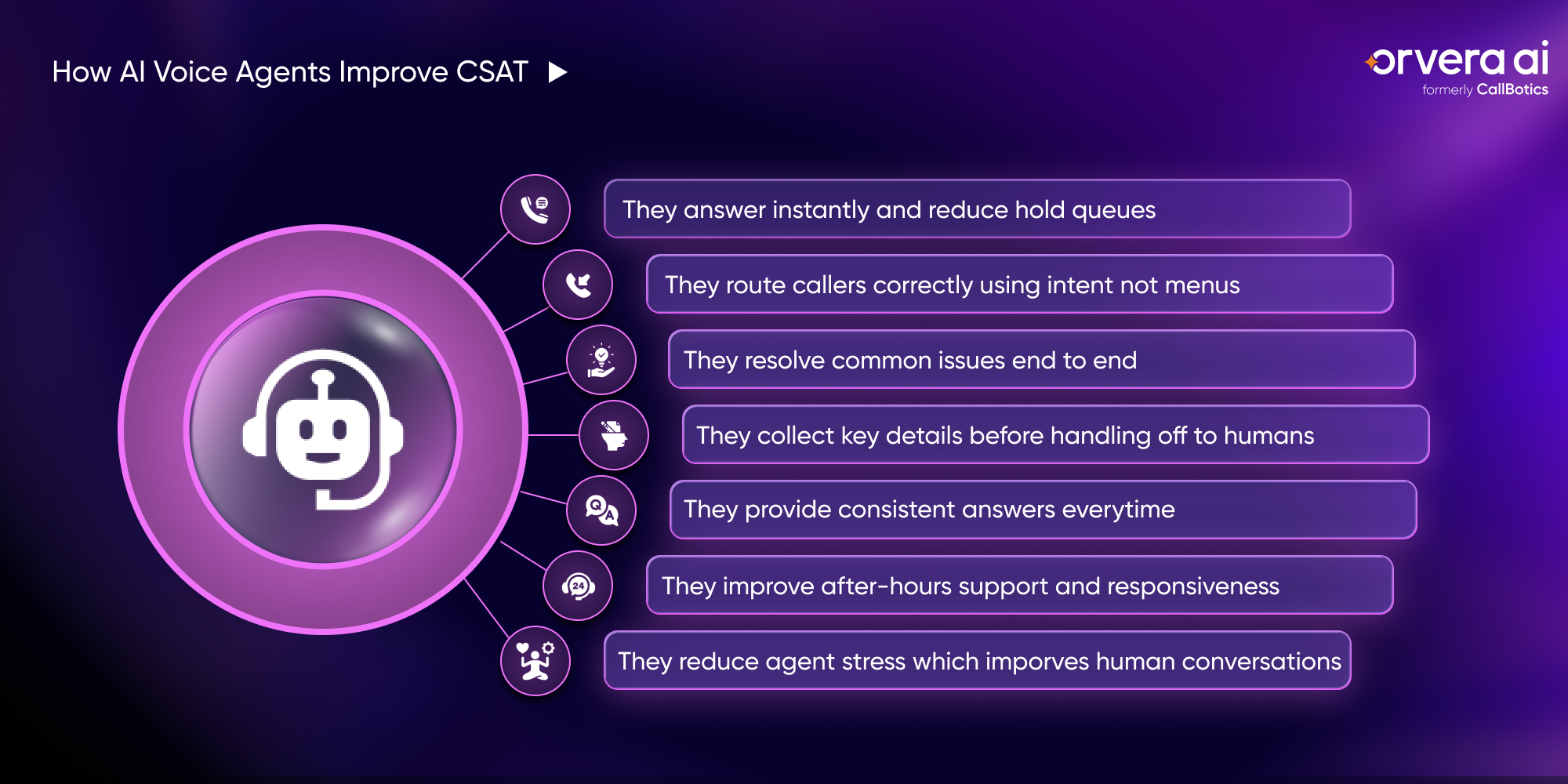
1) They answer instantly and reduce hold queues
Long hold times create frustration before the real conversation even begins. When customers have to wait in a queue just to explain a simple issue, the experience already starts on a negative note.
AI voice agents help by answering right away. That fast response improves the first impression, reduces queue pressure, and lowers the chance that callers hang up before getting help.
2) They route callers correctly using intent, not menus
Traditional phone menus often slow people down. Customers may press the wrong option, get stuck in the wrong path, or end up with a team that cannot help them.
AI voice agents can understand what the caller is trying to do and route them based on intent. This reduces wrong transfers, shortens the path to help, and makes the experience feel more natural.
3) They resolve common issues end-to-end
A large share of contact center volume comes from common requests (opens in a new tab) like appointment scheduling, order status, claim updates, balance checks, or simple FAQs. These are often repetitive but still important to the customer.
AI voice agents can handle many of these requests from start to finish without involving a live agent. That improves CSAT because the customer gets a quick answer or completes the task in one interaction.
4) They collect key details before handing off to humans
Some calls still need a person, but the handoff matters a lot. If the next agent has no context, the customer has to start again, which quickly becomes frustrating.
AI voice agents can collect the reason for the call, account details, and other useful information before the transfer happens. This helps the human agent pick up the conversation with context instead of asking the same basic questions again.
5) They provide consistent answers every time
One of the fastest ways to lose trust is to give different answers to the same question. When customers hear one thing from one agent and something else from another, confidence drops.
AI voice agents help reduce this problem by using the same approved information every time. That creates a more reliable experience and helps customers feel that the answer does not depend on who picked up the call.
6) They improve after-hours support and responsiveness
Customers do not only call during business hours. They also reach out early in the morning, late in the evening, or on weekends when live coverage may be limited.
AI voice agents help teams stay responsive outside standard hours. Even if every issue cannot be fully resolved after hours, customers can still get help, share details, and move the issue forward instead of hearing silence.
7) They reduce agent stress, which improves human conversations
When agents spend most of their day on repetitive calls, their energy drops. That affects the quality of the conversations that actually need patience, judgment, and empathy.
AI voice agents take routine work off their plate (opens in a new tab), which gives human agents more space to focus on complex cases. That often leads to calmer, clearer, and more helpful conversations, which directly supports better CSAT.
Best Contact Center Use Cases That Improve CSAT Fast
Not every AI voice use case needs to be complex to create value. The fastest wins usually come from high-volume interactions that are simple, repetitive, and easy to standardize. These use cases improve satisfaction quickly because they reduce waiting, remove confusion, and make it easier for customers to get what they need.
Appointment scheduling and confirmations
Scheduling is one of the easiest places to improve CSAT because customers usually want one simple outcome: book, change, or confirm an appointment without delay. AI voice works well here because the process is structured, repeatable, and time-sensitive.
- Books new appointments quickly without making the caller wait for an agent
- Handles rescheduling and cancellations in a clear, step-by-step way
- Gives instant confirmations and reminders so customers know exactly what is booked
Order status and delivery issues
Order status calls are common, but they do not need to take up live agent time. Customers usually just want a fast and accurate update. When they can get that immediately, satisfaction improves and frustration drops.
- Shares order status, shipping progress, or delivery updates right away
- Reduces WISMO call volume and long hold times for simple questions
- Gives consistent updates without forcing customers through multiple transfers
Billing questions and routing
Billing calls can become frustrating when the customer reaches the wrong team or has to explain the issue more than once. AI voice helps by collecting the right context first and sending the call to the right place faster.
- Captures the billing issue clearly before the handoff happens
- Routes the caller to the correct billing or support team based on intent
- Helps live agents start with context instead of restarting the conversation
Intake and triage for support calls
Support calls often slow down because teams spend too much time figuring out what the issue is before real help begins. AI voice improves this by identifying intent early and collecting the details needed to move the call forward.
- Understands the reason for the call and directs it to the right path
- Collects basic details before the customer reaches a live agent
- Reduces back-and-forth at the start of the interaction and speeds up resolution
What Can Hurt CSAT When Using AI Voice Agents
AI voice agents can improve customer satisfaction, but only when the experience feels fast, clear, and reliable. If the setup is clunky or confusing, customers notice it immediately, and CSAT can drop instead of improve.
That is why good deployment matters as much as the technology itself. The goal is not just to automate calls. The goal is to make the interaction easier for the customer.
Long robotic intros and too many questions
Customers do not want to sit through a long introduction before getting help. If the AI starts with a scripted speech or asks too many questions upfront, the call begins to feel slow and unnatural.
Short, clear prompts work better. They help the caller get to the point quickly, reduce irritation early in the call, and lower the chance of hang-ups before the issue is even understood.
AI guessing or giving wrong answers
Nothing hurts trust faster than a confident but incorrect answer. If the AI makes assumptions, gives unclear information, or tries to handle something it does not understand, the customer leaves with less confidence than before.
That is why clear fallback rules matter. In many cases, it is better for the AI to say it does not have enough information and transfer the call properly than to guess and get it wrong. Good escalation protects CSAT because it keeps the experience honest and useful.
Bad transfers with no context
A transfer is not always a problem. The real problem is when the customer gets transferred and has to explain everything again from the beginning.
Good handoffs should carry context forward. A short summary of the issue, the caller’s details, and what has already been discussed helps the next agent pick up the conversation smoothly (opens in a new tab) instead of restarting it.
No option to reach a human
Some issues are too sensitive, too complex, or too specific for automation alone. If the customer cannot reach a person when needed, the experience can start to feel trapped and frustrating.
A clear path to a human builds trust, even if most callers do not use it. Customers feel more comfortable when they know that help is available if the AI cannot solve the issue properly.
KPIs to Track When Your Goal Is Higher CSAT
If the goal is better CSAT, teams need to look beyond overall call volume or automation rate (opens in a new tab). The most useful KPIs are the ones that show whether the customer experience is becoming faster, smoother, and easier. That is what helps connect AI performance to actual satisfaction.
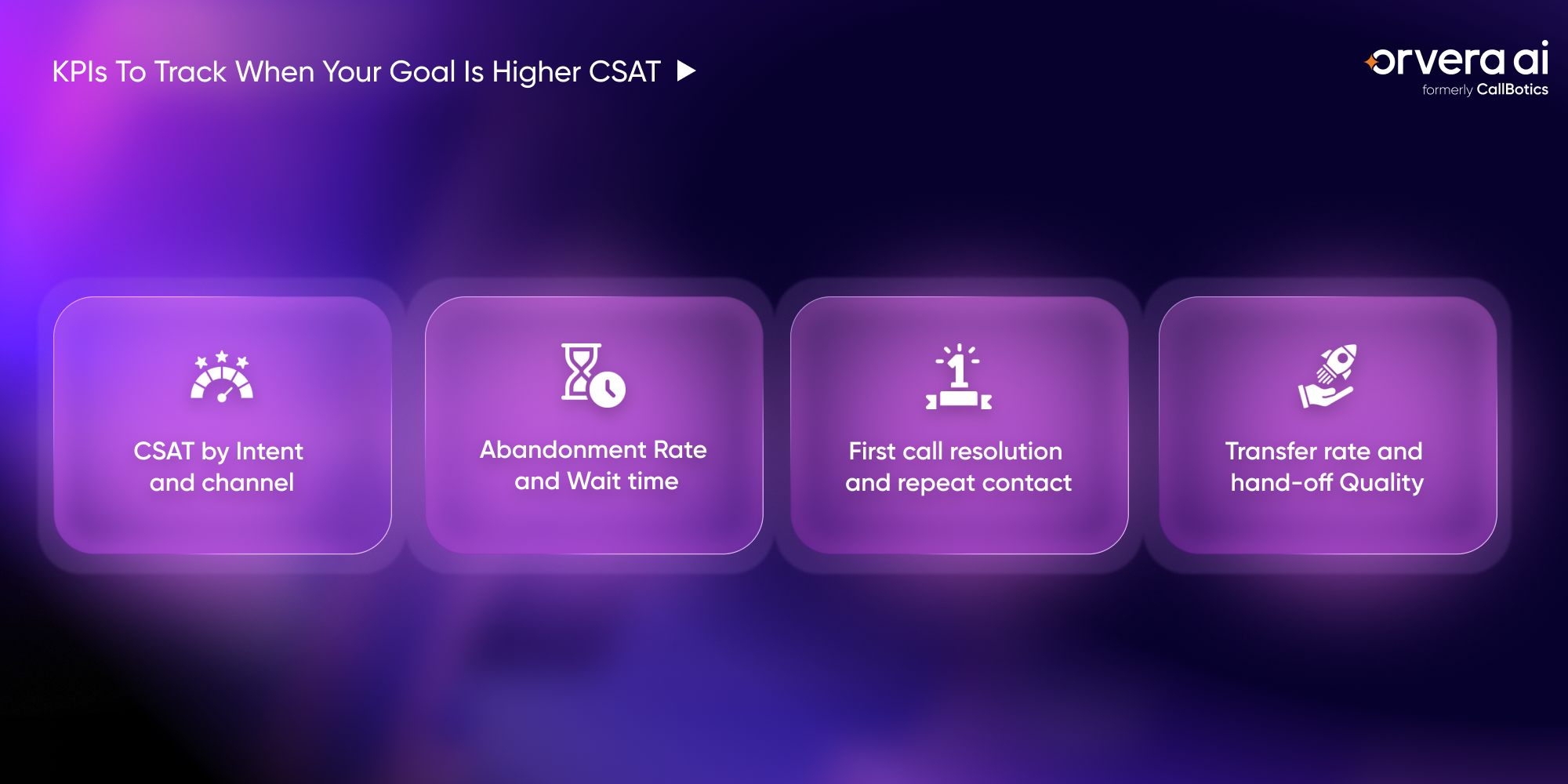
CSAT by intent and channel
A single CSAT score does not tell the full story. Breaking it down by call type and channel helps teams see where the experience is working well and where it still needs attention.
- Track CSAT separately for intents like billing, scheduling, status checks, and support
- Compare CSAT across voice, chat, and human-assisted flows to find gaps
- Use segmented scores to identify which journeys are improving and which ones are hurting satisfaction
Abandonment rate and wait time
Customers often rate the experience before the real conversation even begins. If wait times are long or too many people hang up before getting help, CSAT usually suffers.
- Measure the average wait time before the caller reaches useful help
- Track abandonment rate to see how often customers leave before resolution starts
- Watch whether lower queue times are followed by stronger CSAT scores over time
First call resolution and repeat-contact rate
Customers are usually more satisfied when their issue gets solved in one interaction. If they have to call back again for the same problem, satisfaction tends to drop quickly.
- Track how often the issue is fully resolved on the first call
- Measure repeat-contact rate for the same intent within a set time period
- Review which flows solve the issue in one step and which ones create extra follow-up
Transfer rate and handoff quality
Too many transfers make support feel disorganized. Even when a transfer is necessary, the quality of the handoff has a big impact on how the customer feels about the experience.
- Track how often calls are transferred before resolution
- Measure whether the next agent receives enough context to continue smoothly
- Review handoff summaries to make sure customers are not being forced to repeat themselves
How Orvera Helps Contact Centers Improve CSAT
Improving CSAT usually comes down to fixing a few common problems in the customer experience. Customers want fast answers, clear direction, and a smooth path to resolution. They do not want long hold times (opens in a new tab), repeated transfers, or conversations that start over every time.
That is where Orvera fits in. The platform is built on 18+ years of contact center experience, reaches first-contact resolution of roughly 80% as a customer average, and stands up new call flows in 3 to 6 weeks. In practice, that helps contact centers answer instantly, route by intent, resolve common requests, and hand off with context, so teams can improve CSAT without increasing headcount at the same pace as volume.
With Orvera, contact centers can improve CSAT by:
- Answering calls instantly so customers do not start the experience with long hold times
- Routing callers by intent instead of forcing them through long menu trees
- Resolving requests end-to-end, such as scheduling, status checks, FAQs, and support tasks
- Collecting key details before transfer so human agents have context before the conversation begins
- Providing consistent answers based on approved business knowledge and workflows
- Supporting after-hours coverage so customers can still get help outside normal business hours
- Reducing repetitive call volume for live agents so teams can focus on more complex and sensitive conversations
- Improving handoff quality with summaries so customers do not have to repeat the same issue again
- Helping operations scale support more efficiently without increasing headcount at the same pace as call volume
Conclusion
AI voice agents improve CSAT when they make support feel easier for the customer. That usually means less waiting, fewer transfers, faster answers, and a better chance of solving the issue in one interaction. When common requests are handled quickly and human agents receive the right context, the overall experience becomes smoother from start to finish.
The key is to use AI in a practical way. It should reduce effort, improve resolution, and support human teams, not block customers or create confusion. When escalation is simple and the handoff is clear, AI voice agents can help contact centers improve satisfaction without making the experience feel less human.
Frequently asked questions
Yes, AI voice agents can improve CSAT when they reduce wait time, resolve common issues quickly, route calls correctly, and make escalation to a human easy when needed.
The fastest way to improve CSAT is to reduce customer effort by cutting hold times, improving first call resolution, and removing unnecessary transfers.
The use cases that usually improve CSAT the fastest are appointment scheduling, confirmations, order status, delivery updates, billing intake, and support triage.
Alongside CSAT, teams should track wait time, abandonment rate, first call resolution, repeat-contact rate, transfer rate, and handoff quality by intent and channel.
Yes, AI voice agents can reduce hold time and abandonment rate by answering instantly, handling routine requests quickly, and lowering queue pressure on live agents.

Written by
Anindita Majumder
Anindita Majumder is a communications professional with nearly four years of experience in public relations, corporate communications, and journalism. She creates content that helps brands communicate their vision, products, and expertise through press releases, thought leadership, and editorial pieces. Outside of work, she is a vocalist, which keeps her creativity flowing.