How an AI Agent Platform Builds the Service-Quality Reporting Pack for Utilities
A utility's service-quality filing is hard to assemble because the numbers in it live in different systems that were never built to agree with each other. An agentic AI platform that keeps the full record of every conversation it runs lets the pack be counted from that one record, so each...

Key highlights
- A utility's service-quality filing is hard to assemble because the numbers in it live in different systems that were never built to agree with each other.
- An AI agent platform assembles the pack by counting every reported figure directly from one complete interaction record, captured as each conversation happens.
- A storm month's pack carries a spike in outage calls on top of normal billing volume, and the commission's questions about that spike come months later.
- The utility owns every judgment in the filing, and the platform owns the record and the counting.
- A utility gets the platform built and run for it because its contact center rarely has spare engineering capacity between rate cases to build and maintain one itself.
- Four operational measures tell a VP whether the reporting pack has moved from assembled to defensible, and all four measure the reporting process itself.
- A VP presenting this to the executive team needs four statements that hold up without the deck behind them.
- Once the platform runs, evidence is created as the work happens and is already in the record when the filing is due.
What makes a utility's service-quality filing hard to assemble from the contact center?
A utility's service-quality filing is hard to assemble because the numbers in it live in different systems that were never built to agree with each other. An agentic AI platform that keeps the full record of every conversation it runs lets the pack be counted from that one record, so each interaction-based figure opens to the calls behind it, while the utility's regulatory team keeps the standards, the definitions, and the filing.
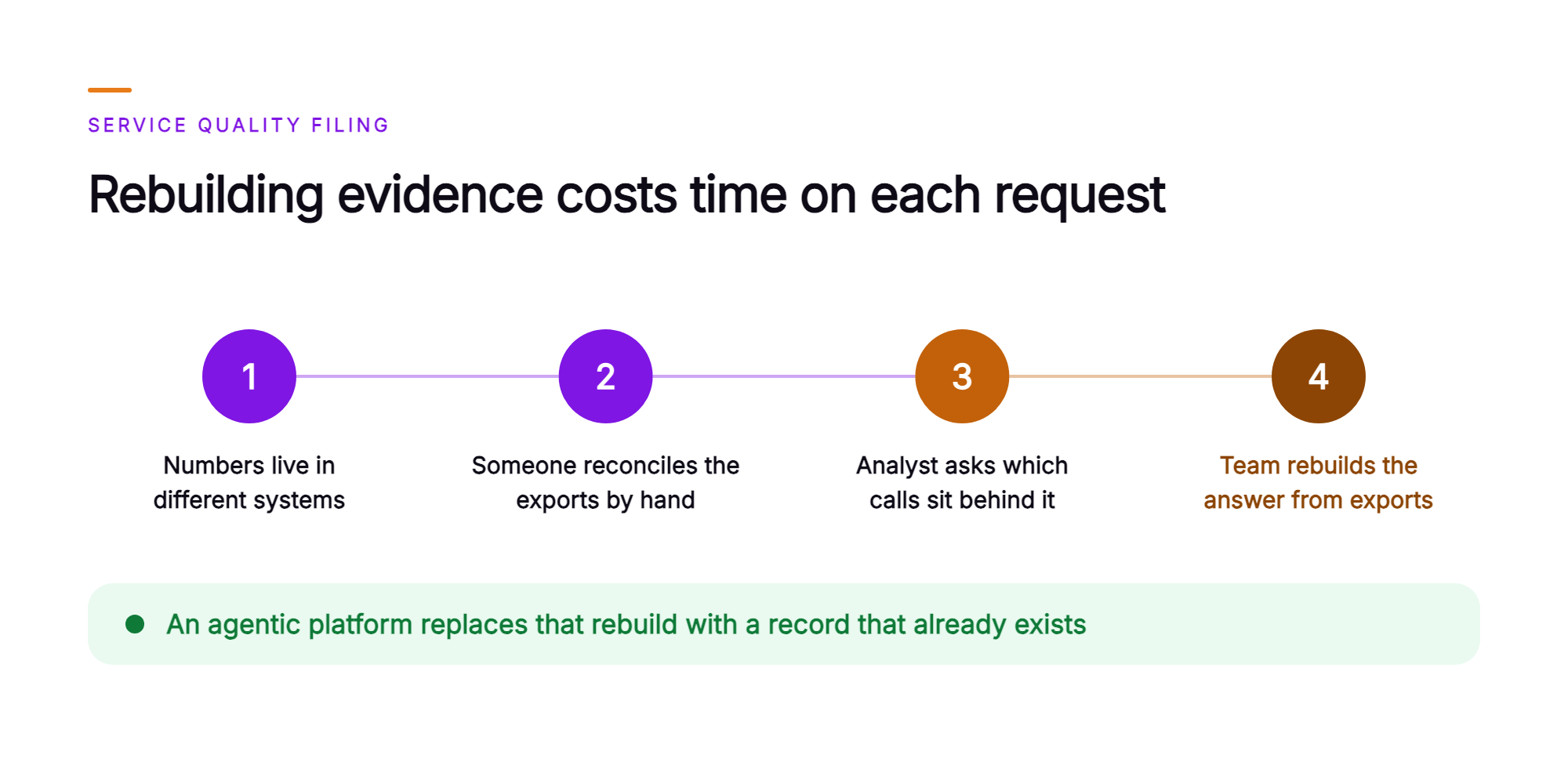
The work usually runs like this. Call counts and average speed of answer come out of the phone system. Account-level context comes out of the customer information system. Complaint categories, escalations, and payment-arrangement outcomes come out of a helpdesk queue or a spreadsheet a supervisor maintains. Someone on the operations team reconciles the exports by hand, resolves the gaps between them, and hands a clean set of figures to regulatory affairs for review.
Then comes the moment that costs everyone the most time. A commission staff analyst asks which calls sit behind a reported figure. The team has no single place to look, so they rebuild the answer from the same separate exports, matching timestamps and account numbers until the count comes back out the same way it did the first time.
Underneath all of it sits a sampling problem. Quality reviews done by hand reach a small slice of calls each month. The people preparing the filing are counting interactions they have no conversation-level evidence for.
What is a regulatory service-quality reporting pack?
A regulatory service-quality reporting pack is the set of contact-center counts and measures a utility reports to its state commission under its own service-quality standards, together with the interaction-level evidence that supports each one.
The contents vary by jurisdiction and by the utility's approved standards. Most packs carry some combination of call volume, average speed of answer, abandonment, first-contact resolution, complaint counts by category, and customer satisfaction results, reported monthly, quarterly, or annually depending on the commission's schedule.
What matters operationally is who owns what. The service-quality standards, the metric definitions, and the decision about what gets reported belong to the utility and its regulatory affairs team. The platform supplies the record the figures are counted from.
Two people live with the pack every cycle. The VP of Customer Operations runs the floor the numbers come from and answers for average speed of answer, resolution, and the quality program behind them. The Director of Regulatory Affairs reviews the pack, decides how each figure is presented, and signs the filing. When commission staff follow up, that signature is the one attached to the answer. Both need to work from the same underlying evidence.
How does an AI platform assemble the reporting pack from the interaction record?
An AI agent platform assembles the pack by counting every reported figure directly from one complete interaction record, captured as each conversation happens.
Orvera AI is an agentic AI platform for enterprise customer experience, and it keeps a full transcript, a summary, and a report log for every interaction it runs. That holds whether one of Orvera's AI agents resolved the conversation from greeting to resolution or a human rep took it over, and it holds across voice, chat, email, and every other channel in service. AI Quality Management scores every conversation, human-handled and AI-handled, against the scorecards the utility's evaluators already use, so the quality evidence behind the filing covers every one of them.
The pack is then built from that record. The utility supplies the metric definitions. The platform applies them to the interactions it holds and produces the counts, with each one tied to the set of conversations it was counted from.
What does one month's pack look like when a storm drives outage calls?
A storm month's pack carries a spike in outage calls on top of normal billing volume, and the commission's questions about that spike come months later.
Consider an illustrative reporting month at an investor-owned electric utility. A severe weather event pushes outage reports into the contact center across three days. Billing questions, high-bill disputes, and payment-arrangement requests keep arriving at their normal rate the entire time, because storm conditions do not pause the billing cycle.
Orvera's AI agents take outage reports around the clock, verify the service address against the customer information system, log the report, and give the caller a restoration status. Calls that need judgment, such as a medical-necessity account, a damage claim, or a hardship payment arrangement, are handed to a human rep with the full conversation history and a summary attached, so the rep starts from what the caller already said. AI Agent Assist surfaces the approved next step while the conversation is live. Each interaction is logged with its transcript and its summary, storm hours included.
When the pack is assembled, the regulatory team decides how the storm period is treated: whether exclusion criteria in the approved standards apply, and how the period is presented. If a figure looks wrong, they open the conversations behind it and read them. Then they sign.
Which parts of the reporting pack does the utility own, and what does the platform do?
The utility owns every judgment in the filing, and the platform owns the record and the counting. Set the line between them in writing before deployment, so it is already settled when a data request arrives.
The utility owns:
- The service-quality standards it reports against, as approved by its commission.
- The metric definitions, including how average speed of answer, abandonment, and first-contact resolution are calculated for its jurisdiction.
- The decision on what gets reported, including how exclusion periods and storm conditions are treated.
- The filing itself and the signature on it.
The platform does:
- Keeps a full transcript, a summary, and a report log for every interaction, human-handled and AI-handled, across voice, chat, email, and every other channel it runs.
- Counts each reported interaction from that record, applying the metric definitions the utility set.
- Links each interaction-based figure to the specific conversations behind it, so any number in the pack opens to its evidence.
- Audits every conversation against the utility's own scorecards, so the quality measures in the pack rest on the full population.
The pack arrives with its evidence attached, and the regulatory team decides what goes to the regulator.
Why would a utility want the platform built and run for it?
A utility gets the platform built and run for it because its contact center rarely has spare engineering capacity between rate cases to build and maintain one itself.
Orvera builds, deploys, and runs the platform for the utility as a managed service. The build connects it to the systems already in place: the CCaaS platform, the customer information system, the outage management feed, the CRM, and the helpdesk. Orvera draws on 500+ integrations, so the deployment runs on the utility's current stack and each of those systems stays in service.
A full Orvera AI deployment goes live in three to six weeks. Orvera's team carries out the integration, onboarding, training, and change management. The team behind it brings 18+ years of contact-center experience.
Governance is the part a compliance officer should check first. The platform audits every conversation, human-handled and AI-handled. Responses are grounded in approved knowledge. Orvera is SOC 2 Type II certified, HIPAA compliant, and GDPR compliant, and Orvera custom-trains its own contextualization models on de-identified data.
Which numbers tell a VP of Customer Operations the pack is working?
Four operational measures tell a VP whether the reporting pack has moved from assembled to defensible, and all four measure the reporting process itself.
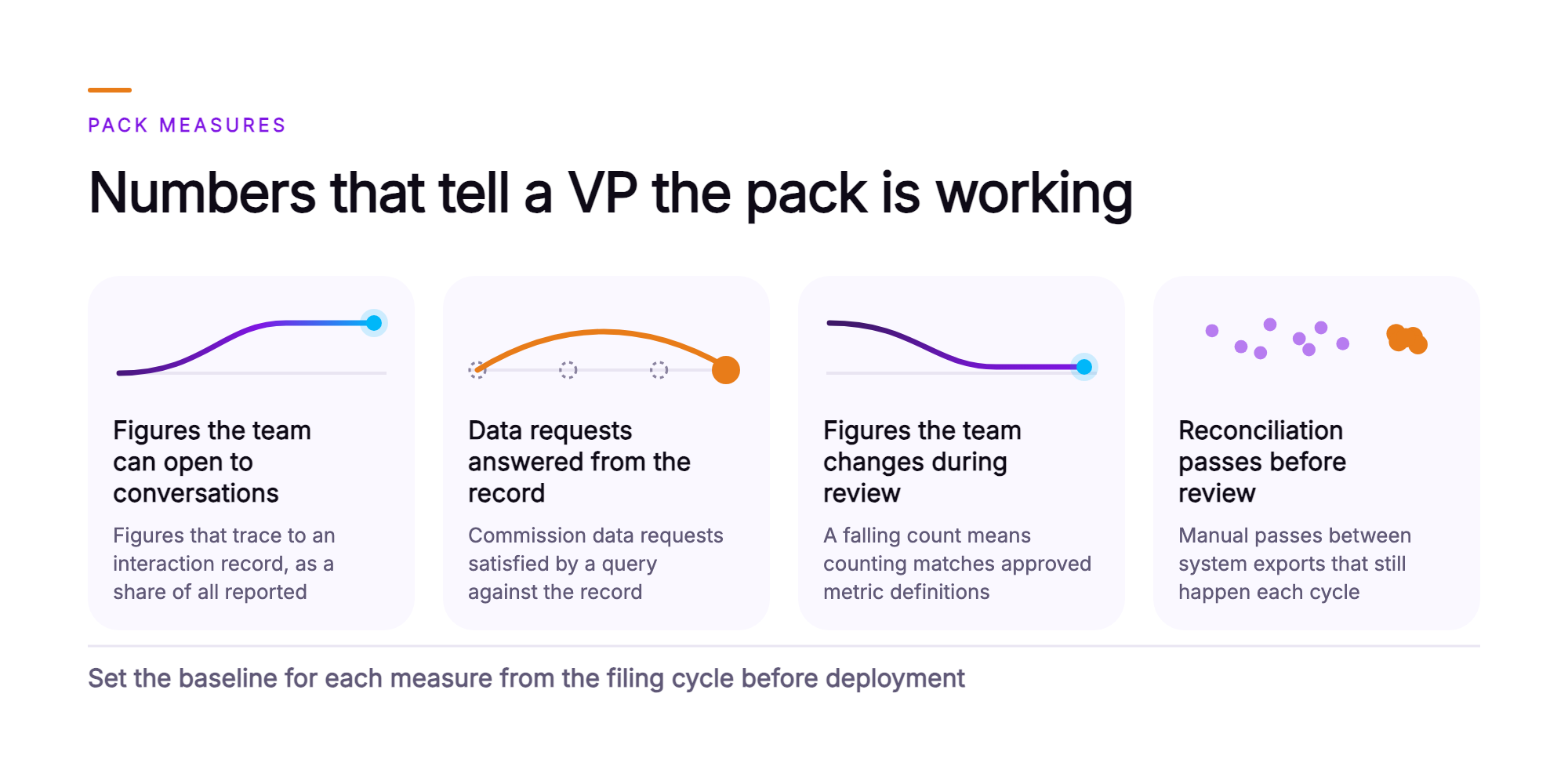
- Reported figures the regulatory team can open to the conversations behind them. Count the figures in the pack that trace to an interaction record, as a share of all figures reported. The target is every one of them.
- Data requests answered from the record. Count how many commission data requests were satisfied by a query against the existing interaction record, with the answer taken straight from conversations already counted.
- Figures the regulatory team changes during its review. Track how many numbers move between the draft pack and the signed filing. A falling count means the underlying counting matches the approved metric definitions.
- Hand reconciliation passes the team runs before review. Count the manual passes between system exports that still happen each cycle. This is the labor line that compliance costs sit on.
Set the baseline for each measure from the filing cycle immediately before deployment, using that cycle's actual figures, reconciliation passes, and request history. Progress then shows up as each measure moves against that baseline.
What should the leader take to the executive team?
A VP presenting this to the executive team needs four statements that hold up without the deck behind them.
- The interaction record holds a full transcript and summary for every interaction the platform runs, human-handled and AI-handled, across voice, chat, email, and every other channel in service. Quality coverage is the full population of conversations, every month.
- Every interaction-based figure in the service-quality reporting pack traces back to the specific conversations it was counted from, so a reported number and its evidence are the same object.
- A commission data request can be answered from the record of conversations already counted, the same record the pack was built from.
- Regulatory affairs keeps full ownership of the service-quality standards, the metric definitions, what is filed, and the signature on the filing. The platform supplies the evidence and the counting. The regulatory judgment stays with regulatory affairs.
The strategic case for executives is narrower than the technology case. Rebuilding evidence after the fact costs the regulatory team time on each data request. An agentic platform replaces that rebuild with a record that already exists when the question is asked.
What does the reporting cycle look like once the platform runs?
Once the platform runs, evidence is created as the work happens and is already in the record when the filing is due.
Conversations arrive and get resolved. Orvera's AI agents handle outage reports, billing questions, payment arrangements, and service moves from greeting to resolution, and hand off to human reps with the context attached when the case calls for judgment. Each interaction lands in the record with its transcript, its summary, and its quality score from AI Quality Management. Voice of Customer turns the same conversations into themes and drivers the operations team can act on before the next cycle.
At period close, the pack is assembled from that record using the utility's own metric definitions. Regulatory affairs reviews it, opens the conversations behind any figure it questions, decides how each measure is presented, and signs.
When a data request arrives three months later, it starts from the record of the conversations already counted.
If you are preparing the next service-quality filing and want to see how utility customer service reporting works when every figure opens to its evidence, talk to the team (opens in a new tab).
Frequently asked questions
A utility contact center reporting pack holds the counts and measures you report under your state's service-quality standards, with the transcript, summary, and report log of every interaction counted sitting behind each figure. The pack is only as defensible as the record underneath it. Your team sets the metrics under your commission's standards and chooses how interactions are grouped. One option is to group by contact reason: outage reports, billing questions, payment arrangements, service starts and stops, and high-bill complaints. Answer speed, abandonment, and resolution can then be counted for each group and for the center as a whole, in the breakdown your approved standards call for. Orvera AI builds the pack from the metric definitions your regulatory affairs team sets.
Each interaction-based figure is counted from the record Orvera keeps for each conversation: the transcript, the summary, and the report log. Each count runs across every conversation in that record for the period. Counting follows the metric definitions your team sets. If your approved standards define an outage contact a particular way, that definition governs which conversations land in the count. The result is that any figure in the pack opens back out into the conversations behind it, one by one. That traceability is what makes a figure in the pack evidence: a counted number with its conversations attached.
Your regulatory affairs team decides what is filed, and your team signs and certifies it. Orvera AI's platform provides the pack and the complete record behind it. Your team reviews the figures, checks them against the definitions in your tariff, commission rules, or commission order, and determines what goes into the filing. Where a figure needs an explanatory note, a restatement, or exclusion under a storm provision, that judgment belongs to the people who answer to the commission. This division matters most during a rate proceeding, when every figure in the filing has to hold up under questioning. The platform keeps the interaction record. The utility remains the filer of record.
Your team pulls the transcripts and summaries behind a reported figure directly from the record that already holds them. A data request asking how a specific outage-week number was derived is answered by producing the conversations that produced it. A request scoped to a reporting period or a contact reason works the same way, because each figure was counted under those definitions. What leaves the building is your decision. Your regulatory team reviews the extract, applies whatever redaction your privacy counsel requires, and determines the response. Orvera supplies the underlying record and the chain back to each figure in the pack.
Yes. Orvera keeps a full transcript, summary, and report log for every interaction, whether one of Orvera's AI agents or a human representative handled it. A conversation that starts with an AI agent and transfers to a human rep reaches the rep with a full summary attached, and both parts are logged in the record. AI Quality Management audits every conversation, human-handled and AI-handled, across every channel Orvera runs: voice, chat, email, and the rest. Scoring uses the scorecards your evaluators already use. For measures tied to a commission standard, that coverage puts human-handled and AI-handled calls in one record, scored the same way and counted together.
Orvera AI integrates into the systems you already operate, including your contact-center phone platform and your customer information system, and it draws on 500+ integrations. Outage management and billing systems connect the same way. If your system is in Orvera's integration directory, turning it on is a configuration step. If it is not, Orvera builds the connection inside the deployment timeline. A full deployment goes live in three to six weeks, with Orvera's team doing the integration work. Orvera AI is SOC 2 Type II certified, HIPAA compliant, and GDPR compliant. To see how your reporting pack would be counted from the interaction record, talk to the team.

Written by
Anindita Majumder
Anindita Majumder is a communications professional with nearly four years of experience in public relations, corporate communications, and journalism. She creates content that helps brands communicate their vision, products, and expertise through press releases, thought leadership, and editorial pieces. Outside of work, she is a vocalist, which keeps her creativity flowing.