Integrating AI Voice Agents with Salesforce: A Practical Guide
How AI voice agents turn Salesforce into an execution layer: CTI and API integration, object mapping, real-time updates during the call, escalation with context, and how to evaluate a platform before you buy.

Key highlights
TL;DR — How AI Voice Agents Transform Salesforce into an Execution Engine
- AI voice agent Salesforce solutions integrate directly with CRM to automate inbound and outbound calls while updating data in real time
- Salesforce voice automation ensures every interaction is logged, structured, and actionable, eliminating manual data entry and fragmented workflows
- AI calling Salesforce integration enables conversations to trigger workflows, create cases, update opportunities, and assign tasks instantly
- AI leverages Salesforce context (contacts, cases, opportunities, history) to deliver personalized, continuous conversations without repetition
- Voice AI for Salesforce CRM turns static data into real-time execution by connecting conversations directly to business workflows
- AI voice agents support end-to-end use cases, including lead qualification, customer support, appointment scheduling, and re-engagement campaigns
- Structured data extracted from conversations improves reporting, forecasting, and pipeline visibility inside Salesforce
- Salesforce conversational AI enables consistent, scalable interactions across inbound and outbound channels without increasing headcount
- AI operates 24/7 with intelligent escalation, enabling hybrid human + AI models while preserving full conversation context
- Enterprise-grade AI agents for Salesforce include security, compliance, and governance controls for large-scale deployments
- Salesforce call automation transforms Salesforce from a system of record into a real-time execution engine that drives outcomes, not just data storage
Salesforce has long been the operational backbone for customer data across sales, service, and support teams. It captures interactions, tracks opportunities, and structures workflows across the customer lifecycle.
But in most organizations, execution still happens outside the system.
Calls are handled through separate telephony tools. Notes are added manually after conversations. Follow-ups depend on individual discipline. And critical context often gets lost between touchpoints.
This creates a fundamental gap:
Salesforce stores customer intelligence, but it does not always act on it in real time.
At the same time, customer expectations have shifted toward immediacy, continuity, and contextual engagement across every interaction.
This is where AI voice agents come in.
An AI voice agent integrated with Salesforce transforms the platform from a system of record into a real-time execution layer. It enables organizations to automate conversations, trigger workflows during interactions, and continuously sync outcomes back into Salesforce without manual intervention.
Instead of treating calls as isolated events, every conversation becomes part of a structured, data-driven workflow that updates the CRM, drives actions, and moves customer journeys forward.
This guide explains how AI voice agents integrate with Salesforce, how they automate calling and CRM workflows, and how enterprises use them to scale sales and support operations.
What Are AI Voice Agents and How They Work
AI voice agents are conversational systems designed to handle real-time voice interactions while executing tasks directly within business systems like Salesforce.
They combine multiple technologies into a single operational layer:
- Speech recognition to convert voice into structured input
- Natural language processing to understand intent
- Dialogue management to guide conversations dynamically
- Workflow execution to take action based on outcomes
Unlike traditional telephony systems, AI voice agents are not limited to routing or basic automation.
They are capable of:
- Holding multi-turn, context-aware conversations
- Asking follow-up questions based on responses
- Completing tasks such as updating records or creating cases
- Triggering workflows in real time
Core Components of AI Voice Systems
Speech-to-Text and Text-to-Speech
The system converts spoken language into machine-readable input and generates natural voice responses. Modern systems are designed to handle accents, interruptions, and conversational variability.
Intent Detection
AI identifies the purpose behind a conversation, not just keywords. This allows it to understand whether a user wants to resolve an issue, schedule a meeting, or check an order status.
Dialogue Orchestration
Instead of following rigid scripts, the AI dynamically adjusts conversations based on user input, context, and CRM data.
Workflow Execution
This is where AI voice agents fundamentally differ from legacy systems. They don’t just understand conversations; they act on them by updating Salesforce records, triggering automations, and completing tasks.
From IVR Systems to Conversational Execution Engines
Traditional Salesforce telephony integrations often rely on:
- IVR systems with predefined menus
- Dialers that require manual handling
- Post-call CRM updates
These systems operate outside Salesforce and require human intervention to complete workflows.
AI voice agents operate differently.
They function inside the Salesforce ecosystem as an execution layer where:
- Conversations directly trigger CRM updates
- Actions happen during the interaction, not after
- Context is continuously maintained across touchpoints
The result is a shift from fragmented communication systems to a unified, intelligent interaction model.
Why Integrate AI Voice Agents with Salesforce in 2026
As Salesforce adoption has scaled across enterprises, a consistent pattern has emerged.
The platform excels at managing structured customer data, but execution still depends heavily on manual processes.
This gap becomes more visible as organizations grow.
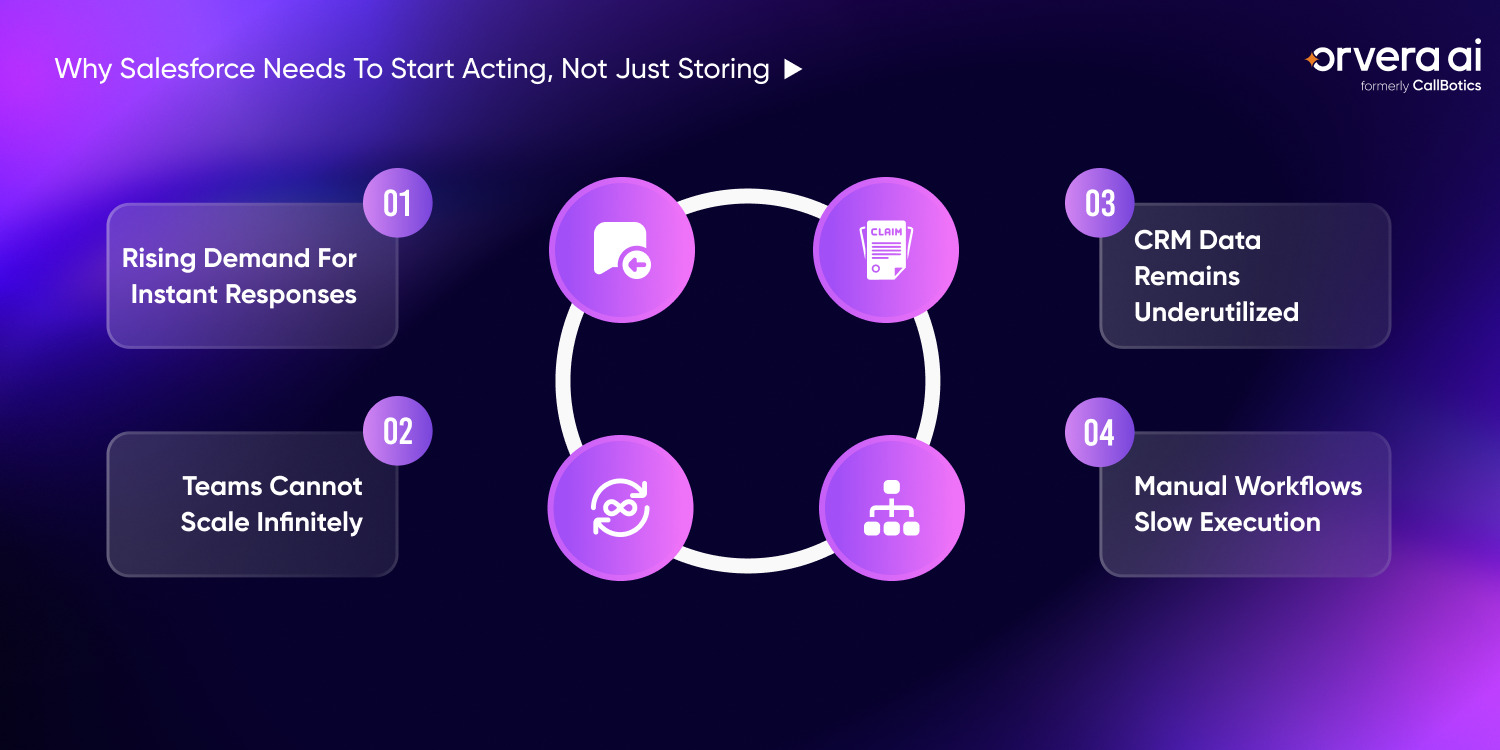
Rising Customer Expectations
Customers now expect:
- Immediate responses
- Context-aware interactions
- Seamless transitions across channels
Delays or repetitive questioning reduce engagement and impact conversion rates.
Operational Constraints in Contact Centers
Sales and support teams face structural limitations:
- Limited availability tied to working hours
- High cost of scaling human agents
- Variability in performance across individuals
Even high-performing teams cannot scale infinitely.
Fragmented Communication Systems
In many Salesforce environments:
- Telephony systems operate separately
- CRM updates happen post-call
- Data is inconsistent or incomplete
This fragmentation reduces Salesforce’s effectiveness as a decision-making system.
Manual Workflows Create Inefficiencies
Common operational challenges include:
- Missed follow-ups
- Incomplete activity logging
- Delayed updates to opportunities or cases
- Inconsistent pipeline visibility
These issues directly impact revenue and customer experience.
The Shift Toward Automation-Driven Execution
Organizations are moving toward systems where:
- Actions are triggered automatically
- Data is updated in real time
- Workflows execute without manual intervention
AI voice agents enable this shift by connecting conversations directly to Salesforce workflows.
Instead of relying on human effort to bridge the gap between interaction and execution, AI closes that loop instantly.
Salesforce + AI Voice Agents: A Closed-Loop System
When integrated effectively, Salesforce and AI voice agents create a system where:
- Conversations initiate actions
- Actions update CRM data
- CRM data informs future interactions
This creates a continuous feedback loop where:
- No interaction is lost
- No data remains unutilized
- No follow-up depends on memory or manual effort
Salesforce evolves from a static system of record into a dynamic system that actively drives customer engagement and business outcomes.
Key Benefits of AI Voice Agent Integration with Salesforce
Context-Aware Customer Conversations
AI voice agents access Salesforce data in real time, including:
- Contact details and history
- Open opportunities
- Past interactions and cases
This enables conversations that are:
- Personalized to each customer
- Aligned with their lifecycle stage
- Free from repetitive questioning
Instead of restarting every interaction, the AI continues from where the last one ended.
Automated Activity Logging
One of the biggest operational inefficiencies in Salesforce environments is manual data entry.
AI voice agents eliminate this entirely.
They automatically:
- Log calls with timestamps and outcomes
- Attach transcripts to records
- Generate summaries for quick review
This ensures that Salesforce remains:
- Accurate
- Up to date
- Consistent across teams
Workflow Automation and Action Triggering
AI voice agents can execute actions during or immediately after conversations.
These include:
- Creating cases for support issues
- Updating opportunity stages
- Assigning tasks to team members
- Triggering follow-up emails or messages
This creates a closed-loop system where:
- Conversations lead directly to execution
- No step is delayed or missed
Enhanced Customer Profiles
Voice interactions generate valuable insights that often remain unstructured in traditional systems.
AI voice agents extract and structure this data, including:
- Customer intent
- Urgency and timelines
- Key objections or requirements
This data is stored directly in Salesforce, enabling:
- Better segmentation
- Improved lead scoring
- More accurate forecasting
Consistency at Scale
Unlike human-led processes, AI voice agents ensure:
- Consistent communication quality
- Standardized data capture
- Reliable workflow execution
This allows organizations to scale operations without compromising performance or accuracy.
How AI Voice Agents Integrate with Salesforce
AI voice agents integrate with Salesforce (opens in a new tab) by acting as a real-time bridge between voice interactions and CRM data.
Instead of treating calls as external activities that are logged later, the integration ensures that:
- Conversations happen with Salesforce context
- Actions occur inside Salesforce workflows
- Data is updated during the interaction
This creates a tightly coupled system where voice is not a channel layered on top of Salesforce, but an operational layer embedded within it.
Authentication and Access Control
Integration begins with secure access to Salesforce data.
AI voice platforms typically connect using:
- OAuth-based authentication for secure, delegated access
- Salesforce APIs (REST / Streaming APIs) for real-time communication
- Role-based access control to ensure data visibility is restricted appropriately
This ensures that the AI agent:
- Accesses only relevant records
- Operates within defined permissions
- Maintains compliance with enterprise governance standards
Security is not an afterthought here. It is foundational to enabling real-time execution.
Mapping Voice Data to Salesforce Objects
For AI voice agents to operate effectively, conversations must translate into structured CRM data.
This requires mapping voice interaction outputs to Salesforce objects:
- Calls → Activities or Tasks
- Customer issues → Cases
- Sales conversations → Opportunities
- Follow-ups → Tasks or Events
During a call, the AI continuously:
- Captures key data points
- Structures them into predefined fields
- Updates the corresponding Salesforce objects in real time
This ensures that every conversation becomes a fully documented, actionable record.
Telephony and CTI Integration
Salesforce environments typically rely on CTI (Computer Telephony Integration) frameworks to manage voice interactions.
AI voice agents integrate through:
- SIP trunking for call handling
- CTI adapters (such as Salesforce Open CTI)
- Telephony APIs for call control and event streaming
This enables:
- Automatic caller identification using CRM data
- Screen pops with relevant customer context
- Real-time syncing of call events (start, end, outcomes)
Unlike traditional dialers, AI voice agents do not just connect calls; they also engage callers. They actively participate in and manage the interaction.
Real-Time Data Sync During Conversations
One of the defining characteristics of AI voice agents is their ability to update Salesforce during a conversation.
For example:
- A customer confirms a requirement → AI updates opportunity fields instantly
- A support issue is identified → AI creates a case during the call
- A meeting is scheduled → Calendar and CRM are updated in real time
This eliminates:
- Post-call processing delays
- Data inconsistencies
- Dependency on manual updates
Salesforce becomes a live system, not a retrospective one.
Escalation and Webhook Handling
Not all interactions can or should be fully automated.
AI voice agents are designed to escalate intelligently when needed.
This includes:
- Creating tasks for human agents
- Triggering alerts via Slack or email
- Assigning ownership within Salesforce
Webhooks and event triggers ensure that:
- Escalations happen instantly
- Context is preserved
- Workflow continuity is maintained
When a human takes over, they receive:
- Conversation summaries
- Key data points
- Suggested next steps
This removes friction from handoffs and improves resolution speed.
Building and Configuring AI Voice Agents for Salesforce
Successful deployment is not just about integration. It requires careful design of workflows, data structures, and conversation logic.
Designing Use Cases and Intents
The most effective implementations start with clearly defined use cases.
Focus areas typically include:
- High-volume interactions
- Repetitive workflows
- Time-sensitive engagements
Examples:
- Lead qualification
- Customer support queries
- Follow-up calls
Each use case requires:
- Defined intents (what the user wants)
- Structured conversation paths
- Clear success outcomes
The goal is not to automate everything, but to automate the right things.
Data Security and Compliance
Salesforce deployments often operate in regulated environments, making compliance critical.
AI voice systems must support:
- Encryption of call recordings and transcripts
- Masking of sensitive data (PII, financial information)
- Consent capture for recording and processing
Additionally:
- Audit logs must be maintained
- Access must be controlled and traceable
This ensures alignment with regulations such as GDPR and industry-specific compliance standards.
Development and Testing
AI voice agents must be tested in real-world conditions, not just controlled scenarios.
Key steps include:
- Integrating with Salesforce APIs for real-time updates
- Simulating real call flows with interruptions and edge cases
- Validating intent detection accuracy
- Ensuring CRM updates occur correctly and consistently
Testing should cover:
- Noisy environments
- Partial or ambiguous inputs
- Multi-step conversations
Because production environments are unpredictable, and the system must handle variability gracefully.
AI Voice Agent Use Cases in Salesforce
AI voice agents unlock multiple use cases across sales, support, and operations.
Customer Support Automation
AI agents can:
- Handle incoming support calls
- Create and update cases automatically
- Provide status updates
- Resolve common issues without human intervention
This reduces:
- Agent workload
- Resolution time
- Operational costs
Sales Qualification and Outreach
For sales teams, AI voice agents enable:
- Automated lead qualification calls
- Real-time opportunity updates
- Follow-ups based on engagement signals
Instead of relying on SDR availability, outreach becomes:
- Immediate
- Consistent
- Scalable
Appointment Scheduling
AI voice agents can:
- Book meetings during calls
- Reschedule appointments
- Sync with calendars and Salesforce events
This removes the back-and-forth typically required for scheduling.
Callback and Queue Management
AI helps optimize inbound operations by:
- Managing callback requests
- Reducing hold times
- Prioritizing high-value interactions
This improves:
- First-contact resolution
- Customer satisfaction
- Operational efficiency
Re-Engagement and Lifecycle Campaigns
AI voice agents can also activate dormant Salesforce data by:
- Calling inactive leads
- Running re-engagement campaigns
- Following up on stalled opportunities
This ensures that:
- Existing data continues to generate value
- Pipeline leakage is reduced
Monitoring, Reporting, and Performance Tracking
AI voice agents bring full visibility into Salesforce-driven operations by turning every conversation into structured, analyzable data.
Instead of relying on sampled QA or incomplete reporting, organizations can monitor 100% of interactions in real time. This includes operational metrics such as containment rate, average handling time, and escalation frequency, as well as deeper insights like intent accuracy, objection patterns, and conversion signals.
Because all interaction data is written directly into Salesforce, reporting becomes both operational and strategic. Teams can track how conversations influence pipeline movement, case resolution speed, and customer experience outcomes.
Over time, this creates a continuous feedback loop where:
- Conversations improve workflows
- Workflows improve performance
- Performance insights refine future interactions
The result is a system that not only executes but also learns and optimizes continuously.
Learn more about how to automate inbound calls in 2026 with AI Voice Agents. (opens in a new tab)
Best Practices for Deployment and Adoption
Design Clear Handoff Mechanisms
AI voice agents should handle scale, while human agents handle complexity. Seamless escalation with full context ensures smooth transitions and that customers do not have to repeat information.
Train Teams on AI Interaction Models
Adoption improves when teams understand how AI-driven updates appear in Salesforce and how to collaborate with automated workflows. This reduces friction and increases operational efficiency.
Continuously Improve AI Performance
AI systems improve through iteration. Regularly analyzing transcripts, refining intents, and optimizing workflows ensures higher accuracy and better outcomes over time.
Maintain Transparency with Customers
Clear communication about AI usage builds trust. Customers should be informed and always have the option to escalate to a human agent when needed.
Operational Considerations: Scale, Governance, and Cost
Scaling AI voice automation within Salesforce requires alignment across infrastructure, workflows, and ownership.
Organizations must plan for:
- Call concurrency and peak volumes
- Salesforce API limits and data throughput
- Cross-functional ownership between IT, operations, and CRM teams
Pricing should not be evaluated in isolation. While usage-based costs are visible, the real impact comes from reduced manual effort, improved data accuracy, faster response times, and increased pipeline velocity.
The focus should be on total operational value, not just cost per interaction.
AI Voice Agents vs Traditional Salesforce Telephony
| Feature | AI Voice Agents | Traditional CTI / Dialer |
|---|---|---|
| Automation | End-to-end workflow execution | Limited |
| Data capture | Automatic and structured | Manual |
| Personalization | CRM-driven and dynamic | Agent-dependent |
| Scalability | High concurrency | Limited by team size |
| Availability | 24/7 | Business hours |
How to Evaluate an AI Voice Agent for Salesforce
Choosing the right AI voice agent requires evaluating how well it performs within real Salesforce workflows, not just in isolated demonstrations.
A strong solution must provide deep CRM integration that enables it to read and write Salesforce data dynamically during conversations. Basic integrations that only log activities are not sufficient for enterprise use.
Real-time performance is equally critical. Conversations must feel natural, with low latency and the ability to handle interruptions, pauses, and multi-step interactions without breaking flow.
Workflow flexibility determines long-term scalability. The system should support conditional logic, multi-step automation, and complex decision-making aligned with Salesforce processes.
Finally, compliance and security are essential. Enterprise deployments require encryption, consent management, audit logging, and role-based access controls to ensure data governance and regulatory compliance.
Learn more about how to integrate AI voice agents with your CRM. (opens in a new tab)
Why Enterprises Choose Orvera for Salesforce Voice Automation
Enterprises choose Orvera because it is designed for production-scale execution inside Salesforce: thousands of simultaneous interactions, workflows that span multiple Salesforce objects, and CRM data that stays accurate in real time.
Orvera is built for real-world conditions where workflows are complex, volumes are high, and data accuracy is critical.
Orvera (opens in a new tab) is built specifically to operate in these environments.
It is designed for scenarios where:
- Thousands of interactions occur simultaneously
- Workflows span multiple Salesforce objects and lifecycle stages
- CRM data must remain accurate in real time
- Performance must be consistent across all interactions
Architecture Built for Scale
Orvera (opens in a new tab) is engineered to handle high-volume inbound and outbound interactions without compromising conversational quality or system performance. It supports parallel execution at scale, enabling consistent engagement across large datasets.
Deep Salesforce Integration with Real-Time Execution
AI voice agents operate directly within Salesforce, accessing and updating data across contacts, leads, cases, and opportunities in real time.
Every interaction:
- Reads CRM context before and during the call
- Updates records instantly
- Triggers workflows based on outcomes
This ensures that Salesforce remains continuously accurate and actionable.
End-to-End Workflow Execution
Orvera focuses on completing the task during the conversation. (opens in a new tab)
During interactions, the system can:
- Qualify leads
- Book meetings
- Resolve support queries
- Trigger follow-ups and lifecycle updates
Each conversation results in a clear, measurable outcome.
Built-in Quality and Analytics for Full Visibility
All interactions are captured, structured, and analyzed, providing complete visibility across voice operations.
Teams gain:
- Insights into performance and conversion
- Visibility into customer intent and objections
- Data to continuously optimize workflows
This eliminates reliance on partial QA and enables data-driven decision-making.
Enterprise-Grade Compliance and Rapid Deployment
Orvera (opens in a new tab) supports enterprise requirements, including secure data handling, consent tracking, audit logs, and role-based access control.
At the same time, its deployment model takes teams from initial setup to production in 3 to 6 weeks, with Orvera doing the build, the deployment and the integration.
Conclusion
Salesforce is a powerful system for managing customer data, but it does not execute workflows automatically.
AI voice agents bridge this gap by connecting conversations directly to actions. They enable organizations to automate interactions, update CRM data in real time, and trigger workflows without manual effort.
This transforms Salesforce from a passive system of record into an active execution engine.
As AI adoption continues to grow, voice automation is becoming a core operational layer within Salesforce ecosystems, driving efficiency, consistency, and improved customer experience at scale.
Frequently asked questions
They integrate through APIs and CTI frameworks, enabling real-time conversations, CRM updates, and workflow execution within Salesforce.
Yes, they can create cases, update opportunity stages, assign tasks, and trigger workflows based on conversation outcomes.
Enterprise platforms support encryption, consent tracking, and audit logs to ensure compliance with regulations such as GDPR and DNC.
They enable automation, real-time CRM updates, improved personalization, and scalable customer engagement while reducing manual workload.
Most implementations go live in 3 to 6 weeks, with the exact timeline set by integration depth and workflow complexity.
Written by
Urza Dey
Urza Dey (She/They) is a content/copywriter who has been working in the industry for over 5 years now. They have strategized content for multiple brands in marketing, B2B SaaS, HealthTech, EdTech, and more. They like reading, metal music, watching horror films, and talking about magical occult practices.