AI Voice Analytics: How It Works & Key Features
What AI voice analytics is, the five-step pipeline behind it, what it tells you about customers, deals, complaints and compliance, and the features that separate a useful platform from a dashboard.


Key highlights
TL;DR — AI Voice Analytics at a Glance
- AI voice analytics transforms phone calls into structured data, extracting intent, sentiment, topics, and outcomes that traditional call metrics cannot capture.
- The technology works through a pipeline of audio capture, transcription, language analysis, signal detection, and reporting, turning unstructured conversations into searchable insights.
- Organizations use AI voice analytics to uncover why customers call, what blocks sales, where service breaks down, and how agents perform in real interactions.
- Real-time analysis enables faster intervention, allowing teams to detect churn risk, compliance issues, or escalation signals while conversations are still happening.
- Modern voice analytics software can process 100% of interactions, compared with traditional QA methods that review only a small sample of calls.
- Key capabilities include transcription, summaries, topic tracking, sentiment analysis, coaching insights, and integrations with CRM and support systems.
- Sales teams use AI call insights to improve discovery, handle objections, and increase conversion rates, while support teams use it to reduce repeat contacts and resolution time.
- Compliance and risk teams rely on conversation analytics to identify missing disclosures, risky language, or policy violations across large call volumes.
- The most effective deployments combine automated insights with human review to account for context, accents, noise, and complex conversational nuances.
- As voice remains a primary customer channel, AI voice analytics is becoming foundational for organizations seeking measurable improvements in experience, efficiency, and operational visibility.
Every business phone call contains valuable signals. Sales intent. Customer frustration. Compliance risk. Product feedback. Competitive intelligence. Yet historically, most of that insight disappeared the moment a call ended, locked inside recordings that few teams had time to review.
In 2026, that is changing fast.
AI voice analytics turns conversations into structured data that teams can search, analyze, and act on. Instead of reviewing a small sample of recordings, organizations can now understand patterns across thousands or millions of interactions. This enables faster decisions, better coaching, improved customer experience, and measurable performance gains across revenue, retention, and efficiency.
The shift is also driven by scale and complexity. Customer expectations have risen while staffing costs continue to climb. Organizations must resolve issues faster, personalize interactions, and maintain compliance simultaneously. Voice analytics helps bridge this gap by surfacing what actually happens in conversations, not just operational metrics.
Calls are no longer just operational events. They are a primary source of business intelligence that can inform strategy across departments.
This guide explains how AI voice analytics works, what insights it can deliver, and the key features to evaluate when choosing a solution.
What Is AI Voice Analytics?
AI voice analytics uses artificial intelligence to analyze phone conversations and extract meaningful insights at scale. It combines speech recognition, natural language processing, and machine learning to understand not just what was said, but what it means for the business.
Unlike traditional call metrics that focus on duration, queue time, or volume, modern analytics examines the actual substance of conversations. This includes customer intent, objections, satisfaction signals, purchasing interest, churn indicators, and compliance risks.
At its core, voice analytics turns unstructured audio into structured data that can be searched, filtered, aggregated, and connected to business outcomes.
Common outputs include:
- Transcripts and summaries
- Conversation analytics dashboards
- Trends across thousands of calls
- Agent performance insights
- Customer sentiment patterns
- Risk alerts and compliance flags
- Opportunity identification for sales or retention
Organizations use voice analytics software across sales, support, operations, product teams, and leadership to better understand customers and improve outcomes. In many enterprises, it is becoming part of a broader analytics ecosystem that includes digital behavior data, CRM activity, and operational metrics.
If you need live visibility, Orvera enables real-time call analytics with instant transcription, sentiment tracking, automated QA, and supervisor alerts so teams can intervene during conversations, not after they end.
How AI Voice Analytics Works (Step by Step)
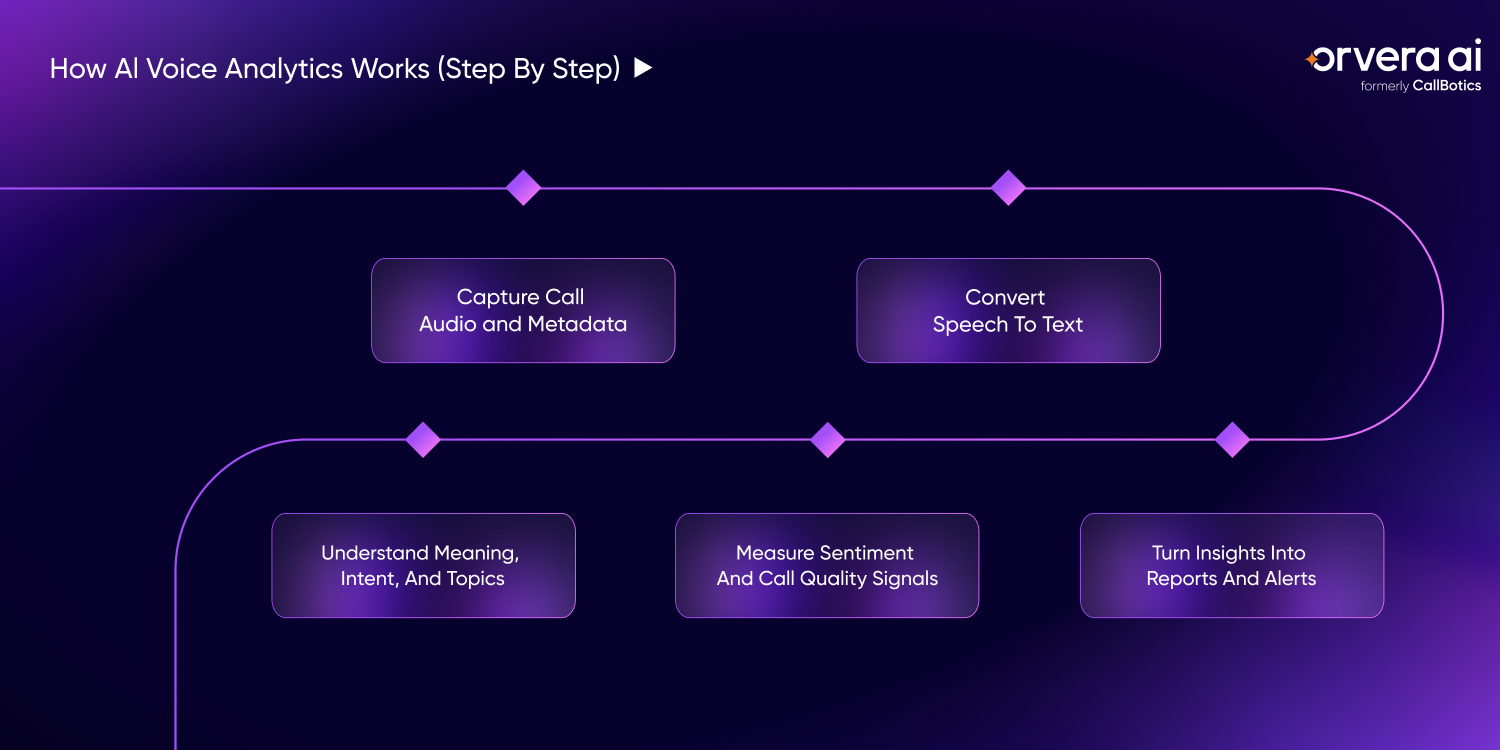
Understanding the workflow helps demystify what happens behind the scenes. While implementations vary, most systems follow the same pipeline.
Capture Call Audio and Metadata
The process begins with recording or streaming the conversation.
In addition to audio, systems collect metadata such as:
- Agent identity
- Customer identifiers
- Call time and duration
- Queue or department
- Outcome tags
- Channel information
This contextual data is essential. Without it, insights cannot be tied to specific teams, workflows, or customer segments.
Cloud contact centers and AI platforms often capture this data automatically at the point of interaction.
Convert Speech To Text
Next, automatic speech recognition converts audio into text.
Accurate transcription depends on factors like:
- Audio quality
- Background noise
- Speaker clarity
- Accent handling
- Language support
Modern models can achieve very high accuracy under good conditions, especially when trained on domain-specific vocabulary.
Clean transcripts are foundational. Every downstream analysis relies on this step.
Understand Meaning, Intent, And Topics
Once transcribed, natural language processing analyzes the conversation.
The system identifies themes such as:
- Pricing discussions
- Cancellation risk
- Product questions
- Technical issues
- Renewal conversations
- Competitive mentions
This is often referred to as conversation analytics. Instead of manually tagging calls, AI automatically groups them by content and intent.
Over time, patterns emerge that reveal what customers actually care about.
Orvera can analyze caller intent in real time and use it to optimize call routing, ensuring customers reach the right team or workflow on the first attempt.
Measure Sentiment And Call Quality Signals
Voice analytics also examines emotional and behavioral cues.
Sentiment analysis looks for indicators of:
- Frustration or anger
- Satisfaction or relief
- Confusion
- Urgency
- Escalation risk
Advanced systems combine textual signals with acoustic features such as tone, pace, and interruptions.
These insights help teams identify at-risk customers, difficult interactions, and opportunities for intervention.
Turn Insights Into Reports And Alerts
Finally, the system converts analysis into usable outputs.
These may include:
- Dashboards showing trends over time
- Automated summaries and action items
- Real-time alerts for high-risk calls
- Performance scorecards
- Searchable call libraries
Instead of digging through recordings, teams can instantly find relevant interactions and respond quickly.
What AI Voice Analytics Can Tell You
When applied across large volumes of conversations, analytics reveals patterns that are impossible to detect manually. These insights often challenge assumptions about customer behavior and operational effectiveness.
Why Customers Are Calling
Topic clustering shows the primary drivers of contact.
Examples include:
- Billing questions
- Account issues
- Technical support
- Renewals and upgrades
- Order inquiries
- Policy clarification requests
This insight helps organizations reduce call volume by addressing root causes through product improvements, self-service resources, or process changes.
In many cases, companies discover that a small number of issues generate a large percentage of contacts.
For strategies on reducing unnecessary contacts, read 8 Effective Call Reduction Strategies For Contact Centers in 2026 (opens in a new tab).
What Blocks Deals From Closing
Sales teams gain visibility into objections and friction points that stall or kill deals.
Common blockers include:
- Pricing concerns
- Competitive comparisons
- Missing features
- Timing issues
- Budget constraints
- Implementation fears
Analyzing lost deals at scale enables more effective messaging, pricing strategies, and sales enablement. It also highlights gaps between marketing promises and real product capabilities.
What Customers Complain About Most
Recurring issues surface quickly when thousands of conversations are analyzed together.
These insights can inform:
- Product improvements
- Policy adjustments
- Service redesign
- Training priorities
- Knowledge base updates
Voice data often reveals problems long before surveys or formal feedback channels do, because customers tend to speak more candidly during real interactions.
Many retail and e-commerce (opens in a new tab) customer support teams use voice analytics to identify return drivers, delivery issues, and product confusion directly from real customer conversations.
Which Agents Need Coaching And Why
Analytics highlights performance patterns such as:
- Long handle times
- Incomplete discovery
- Weak objection handling
- Missed upsell opportunities
- Escalation frequency
- Inconsistent messaging
Instead of relying on subjective impressions, managers can coach based on concrete evidence from actual conversations.
This also supports fairer performance evaluations, since insights are derived from comprehensive data rather than small samples.
To understand how these coaching signals connect to measurable outcomes such as conversion rates, productivity, and efficiency, see Outbound Call Center Performance Metrics You Must Track (opens in a new tab).
Where Compliance Risk Shows Up
Certain industries must follow strict scripts or disclosures.
AI can detect:
- Missing required statements
- Risky language
- Unauthorized commitments
- Policy violations
- Regulatory triggers
This enables targeted review rather than auditing random samples, reducing risk while lowering manual workload.
In regulated sectors such as healthcare (opens in a new tab), analytics helps verify that required disclosures are delivered correctly while maintaining detailed interaction records.
Key Features to Look for in AI Voice Analytics Software
Not all solutions provide the same depth, reliability, or usability. Choosing the right platform requires understanding which capabilities actually drive outcomes.
Accurate Transcription And Speaker Labels
Everything starts with clean transcripts.
Look for systems that:
- Distinguish between speakers
- Handle domain-specific vocabulary
- Support multiple languages
- Maintain high accuracy at scale
- Adapt to accents and noise conditions
Without this foundation, downstream insights become unreliable.
Call Summaries And Action Items
Automated summaries save significant time.
Useful summaries should:
- Capture key decisions and next steps
- Highlight important issues
- Enable quick follow-up
- Reduce manual note-taking
Many organizations deploy call transcription and summaries as their first analytics capability.
Topic And Keyword Tracking
Keyword detection helps monitor specific concerns.
Common examples include:
- “Cancel”
- “Refund”
- “Pricing”
- Competitor names
- Compliance phrases
Topic tracking reveals trends across conversations, not just individual calls.
Sentiment And Emotion Signals
Sentiment analysis is valuable but should be interpreted carefully.
It works best as an indicator rather than a definitive judgment. Context, sarcasm, and cultural differences can affect accuracy.
Used appropriately, it helps prioritize interactions that need attention.
Coaching And Scorecards
Performance tools enable structured improvement.
Effective platforms allow managers to:
- Review flagged call segments
- Provide targeted feedback
- Track progress over time
- Standardize evaluation criteria
Some systems automatically score interactions against predefined standards.
Search, Filters, And Call Library
Teams must be able to quickly find relevant conversations.
Powerful search capabilities allow filtering by:
- Agent
- Topic
- Date range
- Outcome
- Sentiment
- Customer segment
This turns call archives into a usable knowledge base.
Integrations With CRM And Helpdesk
Insights should flow into existing workflows.
Integration enables:
- Automatic logging of summaries
- Triggering follow-up tasks
- Enriching customer records
- Cross-team visibility
Disconnected analytics tools often fail to drive action.
For a broader context on AI-driven operations, explore how Orvera (opens in a new tab) powers end-to-end voice automation and analytics across customer interactions.
Security, Access Control, And Data Retention
Voice data can contain sensitive information.
Enterprise-grade solutions should provide:
- Role-based access controls
- Encryption
- Retention policies
- Compliance support
- Audit logs
This is especially important in regulated industries.
Common Use Cases of AI Voice Analytics
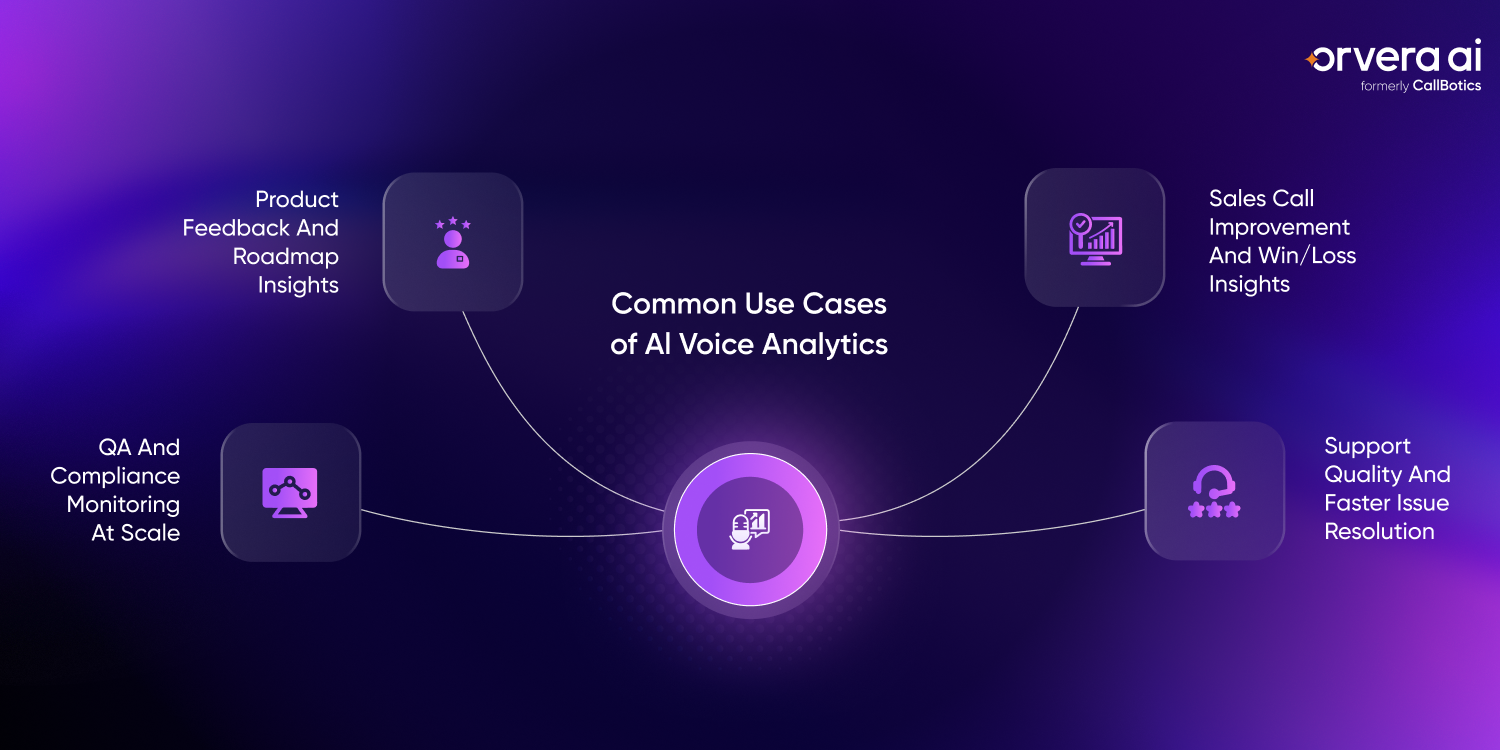
Different teams adopt analytics for different goals.
Sales Call Improvement And Win/Loss Insights
Sales organizations use insights to refine:
- Discovery questions
- Messaging
- Objection handling
- Closing techniques
Patterns across successful calls can be replicated across teams.
Support Quality And Faster Issue Resolution
Support teams identify recurring problems and resolution gaps.
Analytics helps reduce repeat contacts by addressing root causes rather than symptoms.
QA And Compliance Monitoring At Scale
Manual quality assurance reviews only a small fraction of calls. AI enables evaluation of every interaction, flagging those that need human review.
This capability is especially valuable in large BPO contact center (opens in a new tab) operations, where thousands of calls must be monitored consistently without relying on manual sampling.
Product Feedback And Roadmap Insights
Customers often share candid feedback during conversations.
Aggregating this data reveals unmet needs, feature requests, and usability issues that surveys may miss.
Challenges and Limits to Know
AI voice analytics is powerful but not infallible.
Common limitations include:
- Background noise affecting transcription
- Strong accents or dialect variations
- Overlapping speech
- Contextual misunderstandings
- Sarcasm or ambiguous language
- Incomplete metadata
Additionally, sentiment detection may misinterpret tone without broader context. A raised voice may indicate urgency rather than anger, for example.
Human oversight remains important, especially for high-stakes decisions such as compliance enforcement or performance evaluation.
Organizations typically achieve the best results by combining automated analysis with targeted manual review.
How Orvera Supports AI Voice Analytics
Orvera embeds analytics directly into live AI operations across voice, chat and digital channels. Insights are generated as workflows execute, giving teams immediate visibility into resolution rates, adherence to compliance, intent shifts, and escalation triggers inside the same platform. Because analytics is built into production AI, organizations monitor performance continuously.
This tight coupling between automation and intelligence connects analytics directly to outcomes. Teams can see not only what happened in conversations, but whether issues were resolved, escalated, or converted. Across Orvera customers, first-contact resolution averages roughly 80 percent and cost per call falls 65 to 90 percent as workflows are tuned on these real-time insights.
Key capabilities include:
- 100 Percent Automated QA: Every interaction, human-handled and AI-handled, is evaluated automatically for correctness, compliance, and policy adherence across live operations.
- Sentiment Analysis: Detects emotional tone, escalation triggers, and conversational shifts as they occur, enabling adaptive responses during the interaction.
- Custom Dashboards And Reports: Track operational KPIs, including resolution rates, conversion outcomes, containment, and handling patterns, in real time.
- Churn Intelligence: Identifies at-risk customers based on behavioral and sentiment signals and can trigger retention workflows immediately.
- Live Monitoring: Supervisors can listen in, whisper guidance, or intervene during active calls when risk or opportunity is detected.
- Latency Tracking: Measures delays across the interaction pipeline, including speech recognition and response time, to uncover performance bottlenecks that affect customer experience.
- Multi-Tenancy Architecture: Supports large enterprises managing multiple teams, business units, or clients with isolated data and reporting.
Together, these capabilities transform conversations into operational intelligence that drives faster resolution, stronger compliance, lower costs, and measurable business outcomes.
For a deeper look at call analytics by AI agents, see How to Use AI Agents to Analyze Phone Calls and Unlock Insights (opens in a new tab).
Frequently asked questions
AI voice analytics uses artificial intelligence to analyze phone conversations and extract insights such as intent, sentiment, topics, and performance patterns.
Not exactly. Speech analytics focuses primarily on transcribing and analyzing spoken words. AI voice analytics typically includes additional capabilities such as sentiment detection, behavioral analysis, and predictive insights.
Accuracy depends on audio quality, language support, and speaker clarity. Modern systems can achieve high accuracy, especially in controlled environments, but errors can still occur.
Industries with high call volumes see the greatest impact, including contact centers, financial services, healthcare, telecommunications, retail, and insurance.
Yes. Most enterprise solutions integrate with CRM and helpdesk platforms to automatically log summaries, insights, and action items, ensuring information is accessible across teams.

Written by
Urza Dey
Urza Dey (She/They) is a content/copywriter who has been working in the industry for over 5 years now. They have strategized content for multiple brands in marketing, B2B SaaS, HealthTech, EdTech, and more. They like reading, metal music, watching horror films, and talking about magical occult practices.