How to Automate IVR with Voice AI Agents
Learn how voice AI agents automate IVR by detecting caller intent, resolving routine requests, and routing complex issues with context.

Key highlights
TL;DR: How To Automate IVR With Voice AI Agents
- Traditional IVR systems route calls through menu trees, which often create friction and increase abandonment.
- When you automate IVR with voice AI agents, callers speak naturally instead of pressing buttons.
- Voice AI detects intent, gathers required details, and resolves simple requests end-to-end.
- Complex issues are escalated with full context, reducing repetition and transfer time.
- This shift improves containment rates, routing accuracy, and first-call resolution.
- AI-powered IVR generates transcripts, intent tags, and outcome data for continuous optimization.
- High-impact workflows to automate first include FAQs, appointment booking, order tracking, billing inquiries, and lead qualification.
- Successful deployment requires clear intent mapping, CRM and system integrations, escalation rules, and compliance guardrails.
- The goal is not to replace menus with voice prompts but to redesign call flows around resolution.
Traditional IVR systems were built for routing. They helped businesses move callers from one department to another using menu trees like “Press 1 for billing, Press 2 for support.” At the time, that was automation.
Today, those same menus often create friction. Long option trees increase abandonment. Wrong routing increases transfers. Customers repeat themselves after finally reaching an agent. The experience feels mechanical.
Modern contact centers are shifting from menu-based routing to conversational automation. Automate IVR with voice AI agents, and you move from rigid button selection to natural intent recognition. Instead of navigating menus, callers simply say what they need. The system understands intent, collects details, resolves simple requests, and routes complex cases with full context.
The result is fewer transfers, higher resolution, and less frustration.
Want to see how conversational AI can replace rigid IVR menus in real contact center environments?
Explore how Orvera's AI agents automate inbound calls, resolve requests, and integrate directly with CRM and telephony systems.
The IVR market itself reflects this shift. It is valued at approximately USD 11.85 billion in 2025 and projected to reach USD 26.94 billion by 2035 at an 8.56 percent CAGR, driven heavily by AI integration. (opens in a new tab)In parallel, organizations adopting AI-powered IVR report meaningful improvements in call containment, routing accuracy, and customer satisfaction when conversational automation replaces rigid menu trees.
This guide explains exactly how to modernize your IVR using voice AI agents, step by step.
What Does It Mean to Automate IVR with Voice AI Agents?
To automate IVR with voice AI agents means replacing or upgrading menu-only routing with conversational handling.
Instead of:
“Press 1 for billing.”
You get:
“Hi, how can I help you today?”
The caller says:
“I need to check my order status.”
The AI detects intent, retrieves order details, confirms identity, and provides the update. If needed, it escalates with context.
You are not removing structure. You are upgrading it. Traditional IVR routes calls. Voice AI agents understand meaning and complete tasks.
If you want a detailed comparison of how routing differs from resolution, see IVR vs AI Voice Agents (opens in a new tab).
Traditional IVR vs Voice AI Agents Before You Automate
What Traditional IVR Does Well
- Simple department routing
- Office hours announcements
- Basic account number collection
- After-hours voicemail handling
- Structured and predictable call distribution
IVR remains useful for fixed processes with clear categories.
Where Traditional IVR Fails
- Menu fatigue from long option trees
- Misrouting when callers choose the wrong option
- High abandonment rates
- Limited ability to resolve multi-step issues
- No understanding of natural language
Legacy systems are designed for routing, not resolution.
What Voice AI Agents Add
- Natural conversation
- Intent detection
- Context awareness
- Data capture
- End-to-end task completion
- Intelligent escalation
Instead of directing traffic, the system completes the transaction.
Why Businesses Automate IVR with Voice AI Agents
Reduce Caller Frustration and Drop-Offs
More companies now use voice AI for support interactions, and customers expect conversational handling instead of numbered trees.
Conversational automation reduces cognitive load. Instead of translating their issue into menu categories, callers describe it naturally.
Resolve More Calls Without Human Agents
Voice AI agents achieve containment rates beyond what traditional IVR menus typically achieve.
That shift dramatically reduces human workload.
Improve Routing Accuracy with Intent-Based Handling
Menu systems route based on button selection.
AI routes based on meaning.
This reduces misdirected calls and improves first-call resolution.
Capture Better Call Data and Insights
Traditional IVR tracks call duration and queue metrics.
Voice AI generates:
- Transcripts
- Intent tags
- Conversation summaries
- Sentiment indicators
- Resolution outcomes
This data supports continuous improvement and operational visibility.
How IVR Automation with Voice AI Agents Works Step by Step
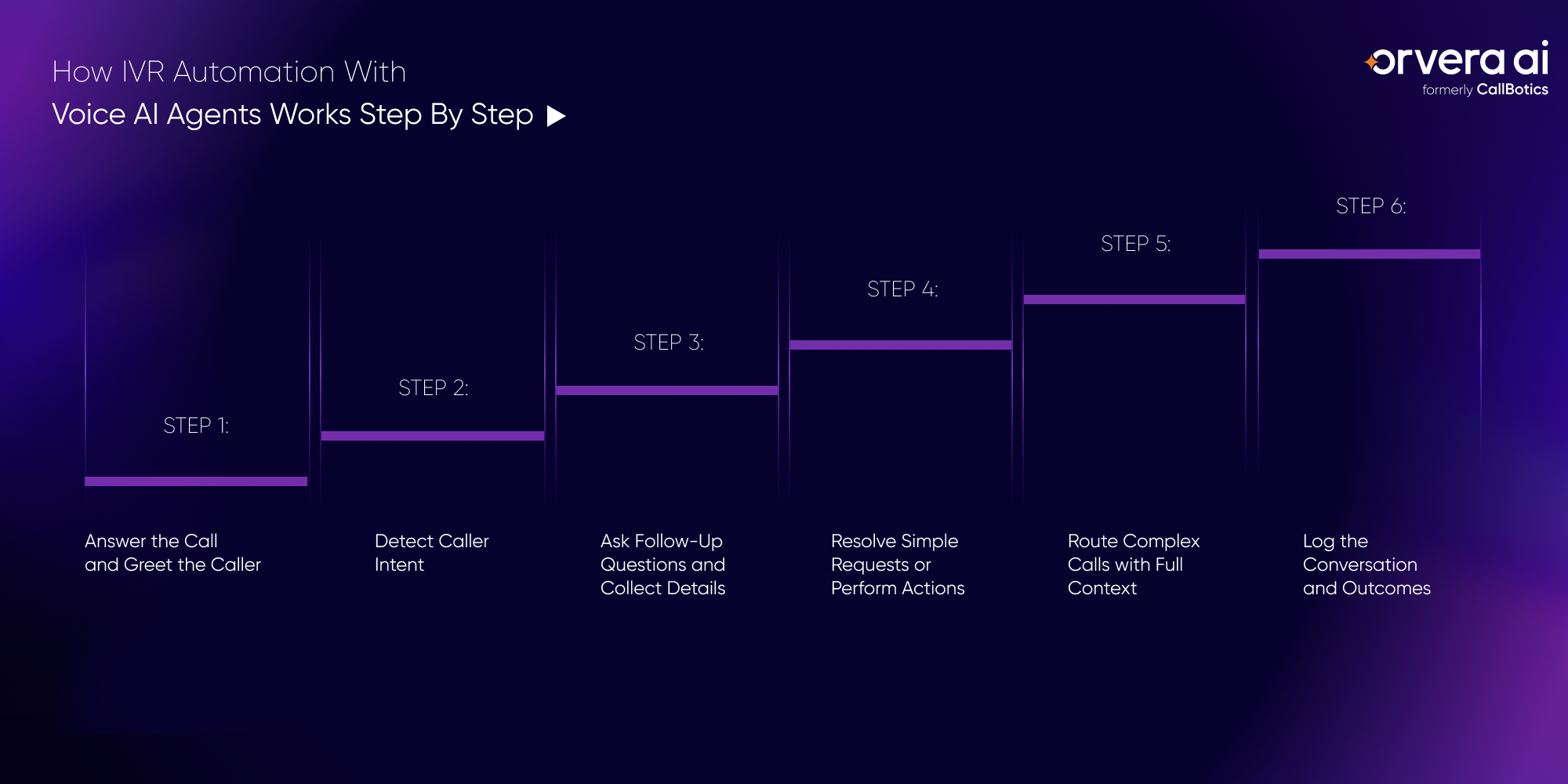
Automating IVR with voice AI agents is not about replacing menu prompts with a voice recording. It is about restructuring the call flow so that intent, context, and resolution sit at the center of the experience.
Here is what a modern automated IVR flow looks like in practice.
Step 1: Answer the Call and Greet the Caller
The AI answers the call with a natural, open-ended greeting:
“Hi, how can I help you today?”
This simple shift eliminates menu trees and invites callers to speak freely.
Behind the scenes, the system activates:
- Speech recognition tuned for phone-quality audio
- Barge-in capability so callers can interrupt naturally
- Context detection to handle background noise or partial responses
Instead of forcing callers into predefined categories, the system listens first. This reduces friction immediately and sets the tone for a conversational interaction.
Step 2: Detect Caller Intent
Using automatic speech recognition and natural language understanding, the AI identifies what the caller actually wants.
For example:
- “I need help with my bill” → Billing intent
- “Where is my order?” → Order status intent
- “I want to reschedule” → Appointment management intent
- “My service isn’t working.” → Technical support intent
- “I’m calling about a quote” → Sales inquiry intent
Unlike traditional IVR, which routes based on button presses, AI routes based on meaning.
This significantly improves routing accuracy and reduces misdirected calls.
Step 3: Ask Follow-Up Questions and Collect Details
After detecting intent, the AI gathers the information required to complete the task.
Depending on the use case, this may include:
- Account number
- Date of birth
- Policy ID
- Order number
- Service location
- Preferred appointment time
The AI dynamically asks only what is necessary. It does not follow a rigid script. If the caller already provided part of the information, it adjusts.
For critical actions such as payments or account changes, the AI confirms key details before proceeding. This reduces errors and improves compliance.
This stage is where automation becomes intelligent. Instead of routing immediately, the system prepares to resolve.
Step 4: Resolve Simple Requests or Perform Actions
Once the required data is collected, the AI performs actions through system integrations.
Connected to CRM, billing, scheduling, or ticketing systems via APIs, it can:
- Retrieve order status
- Confirm delivery timelines
- Book or reschedule appointments
- Process simple payments
- Update contact information
- Provide policy details
- Answer knowledge base questions
This is the core difference between routing and resolution.
When implemented correctly, this stage reduces average handle time by resolving common issues before escalation and improves first-call resolution compared to menu-only routing in many deployments.
Calls that previously required human intervention are now completed end-to-end.
Step 5: Route Complex Calls with Full Context
Not every interaction should be automated. Escalation is part of good design.
When a request is complex, sensitive, or outside predefined workflows, the AI transfers the call intelligently.
Instead of a blind transfer, the system passes:
- Intent classification
- Collected account details
- Conversation summary
- Actions already taken
This eliminates repetition and reduces frustration.
Agents begin the call informed, not guessing. This improves efficiency and shortens resolution time.
Step 6: Log the Conversation and Outcomes
After the interaction, the system automatically logs structured data.
This includes:
- Full transcript
- Intent tags
- Resolution status
- Escalation reason
- Sentiment markers
- Duration and handling metrics
Unlike traditional IVR, which tracks routing metrics only, AI-powered IVR generates insight-rich data.
These logs support:
- Performance reporting
- Intent optimization
- Compliance audits
- Continuous improvement
Automation does not end when the call ends. It feeds the next iteration.
High-Impact IVR Flows to Automate First
When you automate IVR with voice AI agents, start where volume is high and complexity is manageable. Early wins build confidence and justify expansion.
FAQs and Repetitive Support Questions
High-volume, low-variation questions are ideal for automation.
Examples:
- “What are your business hours?”
- “How do I reset my password?”
- “What documents do I need?”
These calls consume agent time but rarely require judgment.
Automating them delivers immediate containment gains and reduces queue congestion.
Appointment Booking and Confirmations
Scheduling is one of the most automation-friendly workflows.
Voice AI can:
- Check availability
- Offer alternate slots
- Confirm appointments
- Send reminders
- Process cancellations
Healthcare, automotive service, home services, and professional services benefit significantly.
Because scheduling follows structured logic, it scales cleanly.
Order Status and Delivery Updates
E-commerce and logistics environments receive large volumes of tracking calls.
Voice AI can:
- Pull tracking data in real time
- Explain delivery timelines
- Notify about delays
- Offer resolution options
These interactions are data-driven and rarely require human negotiation, making them ideal automation candidates.
Lead Qualification and Callback Intake
Inbound sales calls often require structured qualification.
Voice AI can:
- Ask discovery questions
- Capture contact information
- Determine urgency
- Route qualified prospects
This improves both marketing efficiency and sales productivity.
Many organizations start with high-volume workflows such as appointment scheduling, lead intake, and order tracking. For additional examples of how AI voice agents support customer service operations, see How AI Voice Agents Improve First Call Resolution (opens in a new tab).
Payment, Billing, and Account Routing
Billing inquiries are high volume and high friction.
AI can:
- Collect account context
- Confirm balances
- Guide payment steps
- Route to specialized billing teams with full context
Even if the final payment requires a human agent, pre-collection of details reduces handle time and improves resolution speed.
What You Need Before You Automate IVR
Successful automation depends on preparation.
Clear Call Intents and Routing Logic
Before deploying voice AI, analyze call logs to identify:
- Top 10 intents
- Percentage of total volume
- Transfer frequency
- Average handle time
Start there.
Knowledge Base and Approved Answers
Automation is only as good as its content.
Ensure:
- FAQs are up to date
- Policies are clearly defined
- Responses are standardized
- Sensitive answers are pre-approved
Inconsistent knowledge creates inconsistent automation.
CRM, Helpdesk, and Phone System Integrations
Voice AI must connect to systems of record.
This typically includes:
- CRM
- Ticketing systems
- Billing platforms
- Scheduling tools
- Telephony infrastructure
Without integration, AI can only talk. With integration, it can act.
Escalation Rules and Human Handoff Paths
Define clear rules for immediate transfer, such as:
- Fraud-related concerns
- Legal escalation
- Payment disputes
- Emotional distress signals
Automation should reduce risk, not introduce it.
QA and Compliance Guardrails
Implement:
- Transcript review processes
- Random call audits
- Escalation tracking
- Data redaction policies
- Consent confirmation where required
Governance ensures automation remains aligned with operational standards.
Best Practices to Automate IVR with Voice AI Agents
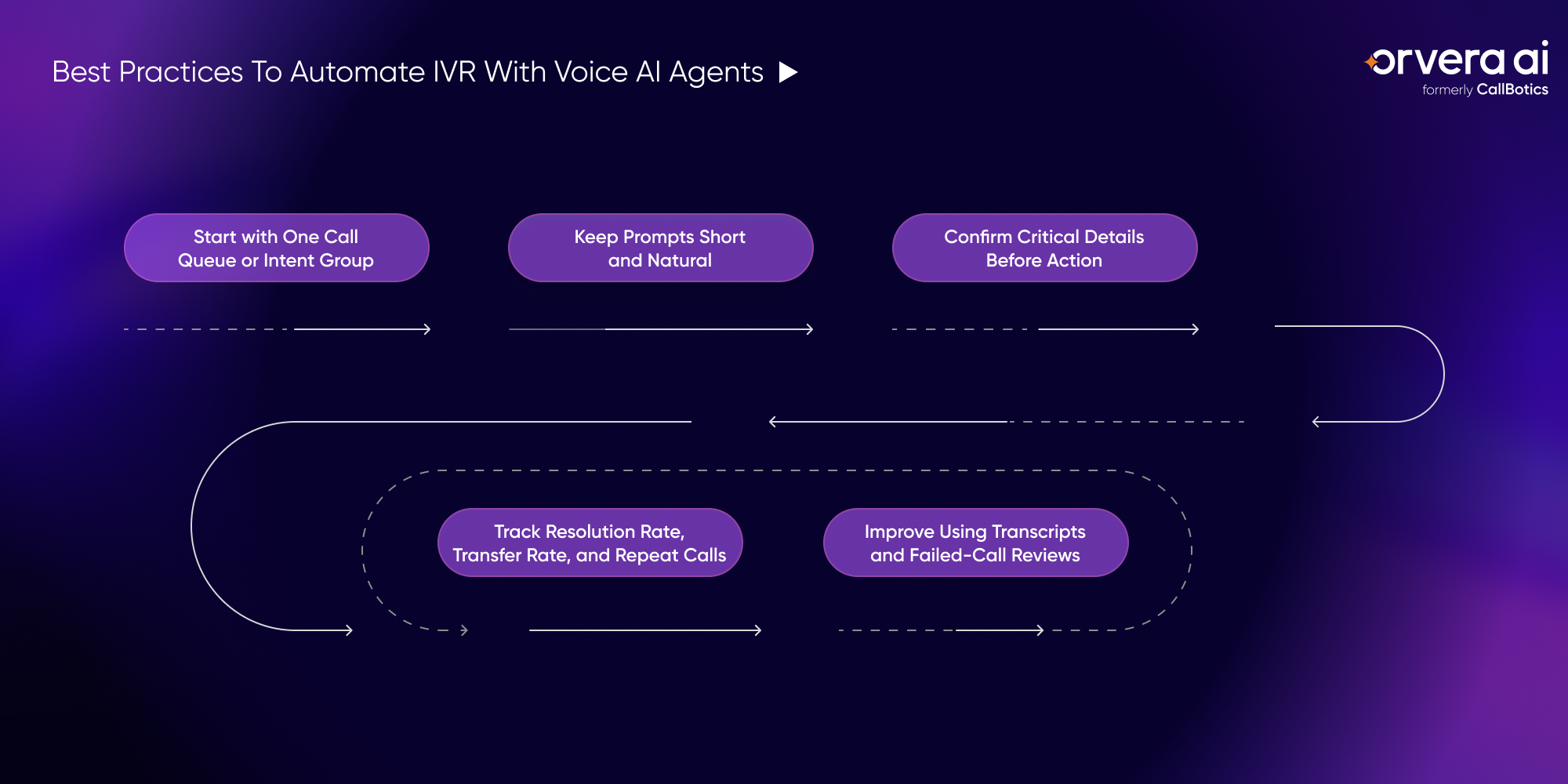
Start with One Call Queue or Intent Group
Resist the urge to automate everything at once.
Pilot one queue, such as:
- Billing FAQs
- Appointment scheduling
- Order tracking
Measure results before expanding.
Keep Prompts Short and Natural
Long scripted prompts recreate the IVR problem.
Use concise, conversational language.
Example:
Instead of “Please state in a clear voice the nature of your inquiry,” say “How can I help?”
Confirm Critical Details Before Action
Before booking, canceling, or processing payment, repeat:
- Name
- Date
- Amount
- Account number
Confirmation reduces disputes and errors.
Track Resolution Rate, Transfer Rate, and Repeat Calls
The most important metrics include:
- Containment rate
- First-call resolution
- Transfer reduction
- Repeat call rate
- CSAT
Do not focus only on the call volume handled.
Improve Using Transcripts and Failed-Call Reviews
Review:
- Misclassified intents
- Escalation patterns
- Abandoned calls
- Confusion points
Continuous tuning improves automation quality over time.
Common Mistakes to Avoid When Replacing IVR Menus
- Automating too much, too fast, without a staged rollout
- Weak escalation logic that traps callers
- Missing CRM or backend integrations
- Poor intent mapping due to insufficient call analysis
- Ignoring QA and compliance review
- Measuring vanity metrics instead of resolution outcomes
Successful IVR automation is not about replacing menus with a voice. It is about redesigning the call flow around understanding, action, and measurable improvement.
How Orvera Helps You Automate IVR with Voice AI Agents
Modernizing IVR is not just about replacing menu prompts with conversational scripts. It requires production-ready automation that integrates cleanly into existing telephony stacks, CRM systems, compliance workflows, and operational reporting frameworks.
Many organizations attempt to layer conversational AI onto legacy IVR without redesigning resolution workflows. The result is partial automation that still depends heavily on human agents. True IVR automation means shifting from routing logic to outcome logic.
Orvera (opens in a new tab) helps enterprises automate IVR with voice AI agents that are purpose-built for call-heavy environments. The platform is designed to handle structured, high-volume workflows across industries, including healthcare (opens in a new tab), insurance (opens in a new tab), retail (opens in a new tab) and legal (opens in a new tab).
Orvera is engineered for operational reliability and measurable performance in production environments.
Orvera delivers:
- Higher autonomous resolution driven by workflows built from real contact center experience
- Production-ready AI voice agents live in 3 to 6 weeks for defined use cases
- White-glove implementation, including workflow mapping, intent tuning, integration setup, testing, and early optimization
- Built-in quality and analytics with transcripts, intent tracking, escalation monitoring, and outcome reporting tied directly to live KPIs
- Governance-first architecture, with structured guardrails, escalation logic, and compliance-ready design
- Optional no-code builder, enabling operations teams to refine flows without engineering bottlenecks
- One agentic platform across voice, SMS, chat, and email, with consistent workflow logic across channels
Because analytics are embedded at the execution layer, teams gain visibility into containment rates, transfer reduction, first-call resolution impact, and cost-per-interaction changes without deploying separate QA systems.
This approach allows organizations to modernize IVR in controlled phases. Start with high-volume workflows such as appointment confirmations or billing inquiries. Validate containment and resolution improvements. Then scale responsibly across additional queues.
Orvera focuses on delivering measurable improvements in resolution rates, reduced transfers, lower handle time, and improved customer satisfaction in real operating conditions, starting from the first workflow.
IVR automation only creates value when it improves outcomes. Orvera is built to ensure that it does.
To Sum Up
IVR was built for routing. Customers today expect resolution.
When you automate IVR with voice AI agents, you shift from menu navigation to intelligent conversation. That shift reduces frustration, increases containment, shortens queues, and improves first-call resolution.
The market is already moving in this direction. IVR adoption continues to grow, but AI integration is the force driving real performance gains.
The businesses that modernize thoughtfully, starting with high-impact workflows and strong governance, will see measurable improvements in cost, efficiency, and customer experience.
Automation is no longer about pressing 1. It is about solving the problem before the transfer happens.
Frequently asked questions
Yes, in some environments. Voice AI agents can handle routing and resolution. Many enterprises use a hybrid model during transition, keeping IVR for authentication or compliance prompts while AI manages conversations and task completion.
Start with high-volume, structured workflows such as FAQs, appointment scheduling, order status, billing inquiries, and lead qualification. These deliver fast ROI because they follow predictable logic and reduce repetitive agent workload.
For defined workflows with clear integrations, a full enterprise deployment lands in 3 to 6 weeks. Broader rollouts may need additional time for compliance validation, system integrations, and QA testing.
Connect CRM, billing systems, scheduling tools, helpdesk platforms, authentication services, and telephony infrastructure. Integration depth determines whether AI only routes calls or fully resolves them.
Measure containment rate, first-call resolution, transfer reduction, handle time, repeat calls, CSAT, and cost per interaction. Focus on outcome efficiency, not just call volume handled.

Written by
Bryan Miller
Bryan is a B2B SaaS writer with a technical background who shifted into writing about technology and AI four years ago. With hands-on tech experience, he brings depth, clarity, and practical context to complex AI and SaaS topics. He’s a firm believer in an AI-driven future and focuses on content that explains not just how technology works, but why it matters. Outside of writing, Bryan enjoys watching films, listening to tech podcasts, and nurturing an unusual rookie-level interest in marine biology.