How an AI Agent States the Total Price and Books Direct on a Hotel's Website
Guests leave at the total-price question because a chat that cannot state what the stay costs with every fee included gives them a reason to check the same room on a third-party site. On the hotel's own website chat, Orvera's AI agent answers that question with the total price the hotel's...

Key highlights
- Guests leave at the total-price question because a chat that cannot state what the stay costs with every fee included gives them a reason to check the same room on a third-party site.
- Direct-booking assist chat is an AI agent embedded in the hotel's own website chat window that reads live rate, availability, cancellation, and deposit data from the hotel's systems and completes the reservation when the guest is ready.
- A single web chat for hotel bookings can move a guest from an opening rate question to a confirmed reservation in one continuous conversation on the hotel's own website.
- The hotel and its revenue team control every pricing and policy decision.
- A hotel group that has its direct-booking AI agent built and run as a managed service removes the integration, deployment, and ongoing operations burden from its own technology and reservations teams.
- Four measures, read from the reservation system and the Orvera interaction record, tell a distribution leader whether the chat agent is converting rate questions into confirmed direct bookings.
- A VP of Distribution can bring four operational facts to the leadership team that cover what the agent does, who controls pricing, how it is deployed, and how the results are measured.
- Across a multi-property hotel group, direct-booking assist chat in steady state means a guest on any property's website, at any hour, reads the total price the hotel's own reservation system returned and books in the same conversation.
Why do guests leave a hotel's website at the moment they ask for the total price?
Guests leave at the total-price question because a chat that cannot state what the stay costs with every fee included gives them a reason to check the same room on a third-party site. On the hotel's own website chat, Orvera's AI agent answers that question with the total price the hotel's systems return, mandatory fees included, explains the hotel's own cancellation and deposit terms, and completes the booking in the hotel's reservation system when the guest asks it to, while rates, fees, and exceptions stay set by the hotel and its revenue team.
The scenario repeats across every property type. A guest lands on the hotel's own booking page, sees a nightly rate displayed, and opens the chat to ask what the stay actually comes to after resort fees, parking, and taxes. That is a specific, high-intent question. It is also a question a chat window can answer only when it reads live rate and fee data from the hotel's reservation systems.
The gap between a displayed rate and a confirmed total is where direct revenue leaks. When the chat window returns a vague response or redirects the guest to "check the booking page," the guest can open a third-party booking site, find the all-in price, and complete the transaction there. The hotel's direct channel loses the booking, and the OTA collects the commission.
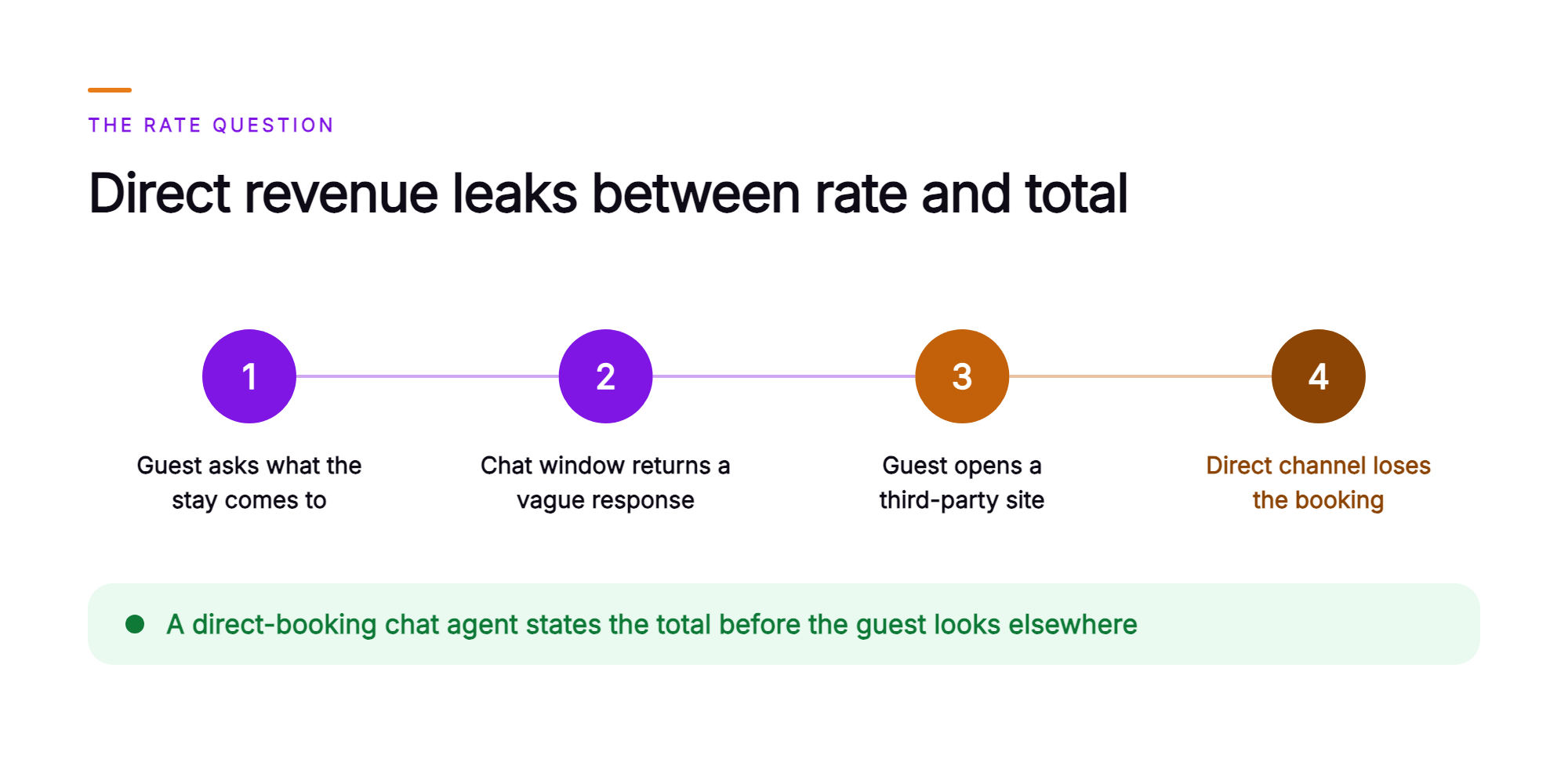
The data already exists. The nightly rate, mandatory fees, and total cost for the requested dates all sit inside the hotel's central reservation system and rate management layer. A direct-booking assist chat agent that reads those systems can state the total in the same message that answers the guest's question, before the guest considers looking elsewhere.
What is direct-booking assist chat on a hotel's own website?
Direct-booking assist chat is an AI agent embedded in the hotel's own website chat window that reads live rate, availability, cancellation, and deposit data from the hotel's systems and completes the reservation when the guest is ready.
The AI agent queries the central reservation system and rate inventory the revenue team publishes, pulls the live total for the guest's dates and room type, and writes a confirmed booking back to that same system when the guest commits. The hotel's reservation system stays the authoritative record of every booking the agent completes.
Distribution leaders read this on the OTA commission line. The AI agent handles the full path from greeting to reservation confirmation, inside the hotel's own channel.
Orvera AI's platform runs web chat agents on the same architecture as voice and email. One shared customer profile and one continuous memory span every channel, so a guest who called last week and opens a chat window today finds that call's details already in the conversation.
How does the AI agent answer the rate question and complete the booking in the website chat?
An AI agent for hotel website chat answers the total-price question by taking the guest's dates, room type, and party size, reading the rate and fees for that stay from the hotel's reservation and rate systems, then returning the complete cost those systems hold, with every mandatory fee included in that number.
This process occurs in a single conversation. The agent collects the stay details, queries the hotel's central reservation system for the applicable rate and fee schedule, and states the total the hotel's reservation system returns for that stay, with every mandatory fee inside that figure. Before the guest books, the agent also states the final amount due, taxes included, as the hotel's system calculates it.
After stating the total, the agent reads back the cancellation and deposit terms attached to that specific rate. If the guest selects a non-refundable rate, the agent confirms those terms before moving to reservation completion. When the guest is ready to book, the agent completes the reservation inside the hotel's system of record and writes the confirmed booking back to that system. The guest receives confirmation, and the reservations team has a full record of the conversation and the rate the guest accepted.
Orvera AI's platform runs this full path, from greeting to reservation confirmation, on one architecture that spans web chat, voice, and every other channel on the platform.
What does one direct-booking chat look like from the first question to a confirmed reservation?
A single web chat for hotel bookings can move a guest from an opening rate question to a confirmed reservation in one continuous conversation on the hotel's own website.
In practice, the scenario runs like this. A guest opens the chat window on a resort property's booking page and asks what two weekend nights for two adults will cost in total. The AI agent takes the requested dates, room type, and party size, reads the rate and fees for that stay from the hotel's central reservation system, returns the complete cost with every mandatory fee included, and reads back the cancellation and deposit terms tied to that specific rate. The guest then asks whether the property can do better on the rate. The agent recognizes that request as a rate exception, outside the values the revenue team has set, and passes the full conversation to the reservations team with a structured summary attached.
The guest decides to book the published rate in the same chat window. The agent completes the reservation directly in the hotel's system of record and sends the guest a confirmation.
For the exception request, the reservations team received the full conversation transcript and a structured summary, so the team can respond with the guest's dates, rate plan, and request already in front of them.
Which decisions stay with the hotel and which steps does the AI agent carry out?
The hotel and its revenue team control every pricing and policy decision. The AI agent reads those decisions from the hotel's systems and carries out the steps that turn them into a confirmed booking.
The revenue team authors the rates and terms, and the agent executes them.
Here is how each responsibility falls:
- Hotel revenue team. Sets room rates, mandatory fees, and the total price held in the central reservation system. Defines cancellation terms, deposit requirements, and booking rules. Designates which requests require a human decision.
- AI agent. Reads those values live from the hotel's systems. States the full total, including every fee, to the guest. Explains the cancellation and deposit terms the revenue team has set for that rate. Completes the reservation on request and writes the confirmed booking back to the system of record.
- AI agent, on exception. Recognizes a guest request that falls outside the configured rules, passes that request to the reservations team with the full conversation and a structured summary attached, and keeps working with the guest on the rest of the booking.
This boundary lets a hotel group run a direct-booking agent that states totals and explains terms from the values the revenue team controls.
Why would a hotel group want the chat agent built and run for it?
A hotel group that has its direct-booking AI agent built and run as a managed service removes the integration, deployment, and ongoing operations burden from its own technology and reservations teams.
Building and operating a chat agent that connects to live rate and reservation systems requires contact-center operations knowledge, integration depth, and a governance layer that stays current as systems and policies change. Orvera AI delivers the full scope as a managed service: build, integration, deployment, and day-to-day operations, with full deployment in three to six weeks.
The platform connects to the reservation and rate systems the property already runs through 500+ integrations, and a system missing from the directory is built inside the deployment. Orvera AI is SOC 2 Type II certified, HIPAA compliant, and GDPR compliant, and the documentation goes to the hotel's procurement team on request.
What the reservations leader gets in return is visibility. Orvera AI audits every conversation, AI-handled and human-handled, and scores each one against the criteria the operations team sets. That means a distribution director can read exactly how the agent answered the rate question in any chat, on any day.
Which numbers tell a distribution leader the chat agent is working?
Four measures, read from the reservation system and the Orvera interaction record, tell a distribution leader whether the chat agent is converting rate questions into confirmed direct bookings.
Each measure is a count, a rate, or a trend, and each one comes straight out of those two records.
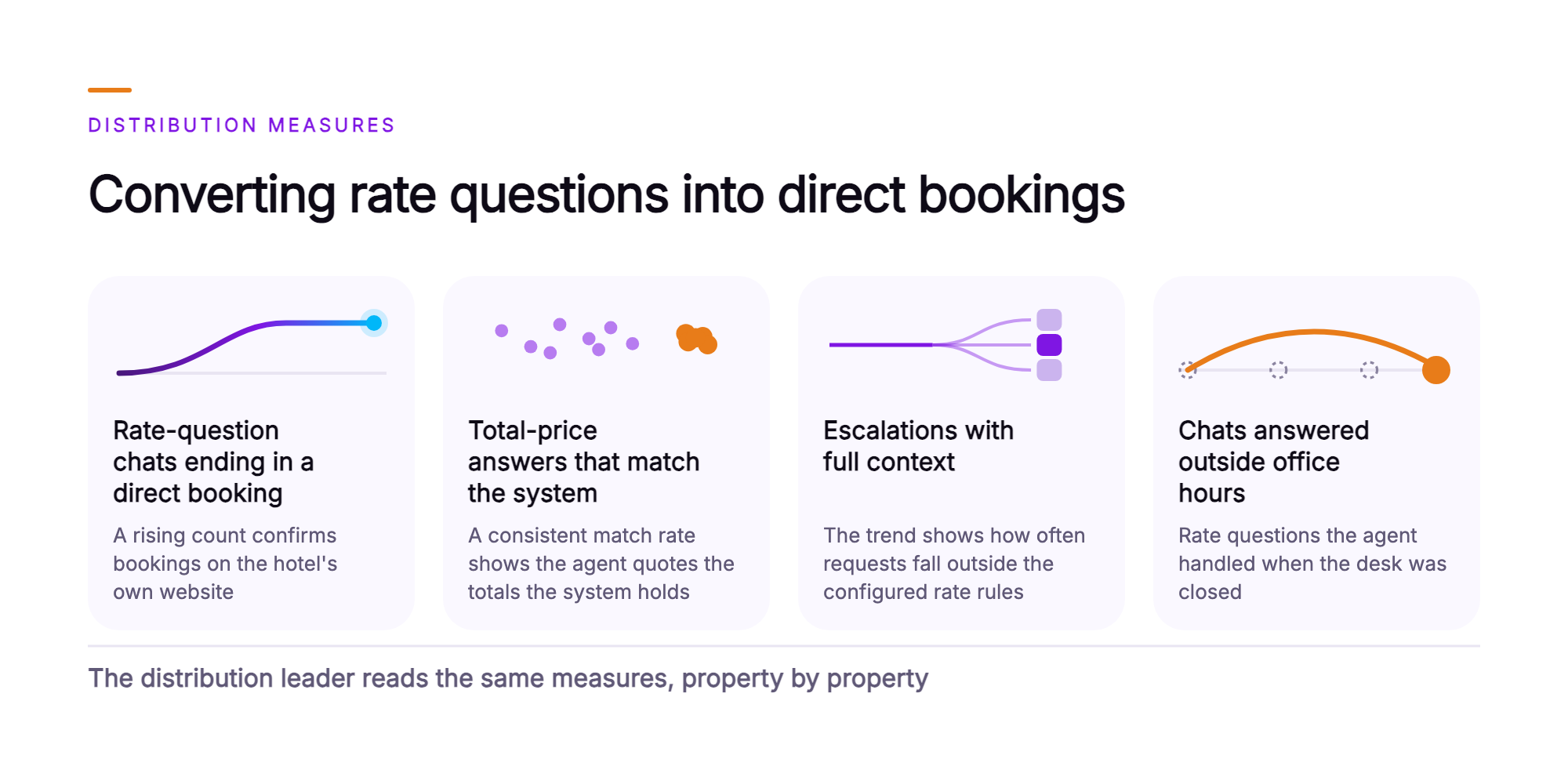
- Rate-question chats that end in a direct booking. This is the conversion count: the number of web chat sessions that opened with a rate or availability question and closed with a reservation recorded in the hotel's system of record. A rising count confirms the agent is completing bookings on the hotel's own website.
- Total-price answers that match the reservation system. AI Quality Management scores each chat on the reservations team's own scorecard and links every score to the transcript evidence, so the team can check each stated total against the reservation system. A consistent match rate shows the agent is quoting the totals the reservation system holds.
- Escalations with full context. This is the count of exception requests passed to the reservations team, each with the full conversation attached. The trend in this count shows the reservations team how often guest requests fall outside the configured rate rules.
- Chats answered outside reservations-office hours. Read from the Orvera interaction record, this count shows the volume of rate questions the agent handled when the reservations desk was closed. Read it next to the first measure to see how many of those after-hours chats ended in a confirmed direct booking.
What should a VP of Distribution take to the leadership team?
A VP of Distribution can bring four operational facts to the leadership team that cover what the agent does, who controls pricing, how it is deployed, and how the results are measured.
Each point below can go straight into a leadership update.
- The agent states the total the hotel's systems return and completes the booking on the hotel's own website. When a guest asks for the full price in chat, the agent reads the rate, taxes, and fees from the property's own reservation system and states the total and the final amount in the same message. The guest confirms in the chat and the booking is written to the system of record.
- Rates, fees, and exceptions stay with the revenue team. The AI agent reads and applies the values the revenue team configures. Requests outside the configured rules pass to the reservations team with a full conversation summary attached.
- Orvera AI builds, integrates, and runs the agent and has it live in three to six weeks. Orvera's team carries out the integration, onboarding, and ongoing operations.
- The two lead measures are rate-question chats that end in a confirmed direct booking and total-price answers that match the reservation system. Orvera AI audits every conversation and scores each one, so a distribution leader can verify accuracy on any chat, on any day, straight from the audit record.
What does direct-booking chat look like once it runs across the portfolio?
Across a multi-property hotel group, direct-booking assist chat in steady state means a guest on any property's website, at any hour, reads the total price the hotel's own reservation system returned and books in the same conversation.
The guest asks what the stay costs and what the deposit terms are. The AI agent reads those values directly from the property's system of record and states the total price, mandatory fees included, in the same message as the deposit terms. The guest reads the cancellation policy the revenue team configured and confirms the reservation before closing the chat window. The whole booking, from the first question to the confirmation, happens in that one chat on the hotel's own website.
The distribution leader reads the same four measures, property by property, from the reservation system and the interaction record.
To see how Orvera AI runs this across your portfolio, talk to the team (opens in a new tab).
Frequently asked questions
The guest sees the total price for the dates and room type they asked about, returned from the hotel's reservation and rate systems, with mandatory fees already inside that total. Before booking, the agent also states the final amount due, taxes included, as the hotel's system calculates it. The answer names the room, the dates, and the rate plan the total belongs to, so the guest knows exactly what they are looking at. A guest who gets the all-in number in the chat window has what they need to book right there, on the hotel's own website.
They come from the hotel's own reservation and rate systems at the moment the guest asks. These are the same values the revenue team publishes to the booking page, and the chat reads them live. The division of labor is simple. Orvera's AI agent reads the values. The hotel's revenue management team sets them. In the chat, the agent states the total price the hotel's systems return, and the rate and fee structure stay as the revenue team set them. When the revenue team changes a rate plan in its own systems, the chat answers from the changed plan, because the agent reads the hotel's systems when the guest asks.
Yes. When the guest asks to book, Orvera's AI agents complete the reservation in the hotel's reservation system, and the booking sits there exactly like any other direct booking. The answer and the transaction happen in the same chat window. The outcome is recorded in the system of record, and the full transcript is logged for the reservations team. A reservations supervisor can review the entire interaction, including the guest's question, the quoted rate, and the confirmation, in one record. The booking is auditable in the same place every other booking is auditable.
The AI agent explains the rate and the terms the hotel set, then escalates the request to the reservations team with the full conversation and a written summary attached. The reservations team makes that decision. This is the boundary of the chat agent. Pricing authority stays with your people. What the agent removes is the reconstruction work: the reservations specialist opens the escalation with the guest's dates, rate plan, and exact ask already in front of them. The agent tells the guest that the reservations team has the request.
The AI agent states the cancellation and deposit terms attached to the specific rate the guest chose, as the hotel's systems hold them. For a question about changing dates, the agent reads the hotel's terms for that rate back to the guest. Anything outside those terms, such as a waiver on a non-refundable booking, goes to the reservations team with the conversation attached. Precision in this part of the chat gives a guest weighing a prepaid rate the exact terms before they commit.
Orvera AI establishes the connection to the hotel's existing reservation and rate systems, drawing on 500+ integrations across CCaaS, CRM, travel, and the other categories an enterprise contact center depends on. A full deployment goes live in three to six weeks. Orvera's team carries out the integration, onboarding, and training. If your property management system or booking engine is not in the directory, Orvera AI builds the connector within the same deployment window. Post-deployment, Orvera operates the AI agent and audits it: AI Quality Management reviews every conversation, human-handled and AI-handled, so every booking chat is evaluated against your reservations team's existing standards. To see how this works against your booking engine and rate structure, talk to the team.
Written by
Anindita Majumder
Anindita Majumder is a communications professional with nearly four years of experience in public relations, corporate communications, and journalism. She creates content that helps brands communicate their vision, products, and expertise through press releases, thought leadership, and editorial pieces. Outside of work, she is a vocalist, which keeps her creativity flowing.