Best AI Answering Service for Businesses in 2026
If your phone channel drives revenue, retention, or risk management, the expectations around calls have changed.

Key highlights
TL;DR: A Practical Buyer’s Guide to AI Answering Services in 2026
- AI answering services in 2026 are evaluated on outcomes, not novelty, with resolution quality, escalation accuracy, and performance visibility taking priority
- The strongest platforms stabilize voice operations under peak load rather than simply routing or deflecting calls
- Effective AI answering systems complete structured conversations end to end, including verification, task execution, and contextual escalation
- Analytics, auto QA, and sentiment awareness are essential to move voice from a black box to a manageable operational channel
- Different platforms suit different maturity levels, from experimentation to enterprise scale, but production readiness is the key differentiator
- Orvera stands out for organizations that need predictable performance, rapid deployment, and measurable outcomes in real contact center conditions
If your phone channel drives revenue, retention, or risk management, the expectations around calls have changed. Customers expect immediate pickup, clear answers, and a smooth path to resolution. Teams still need control, compliance, and predictable performance when call volume spikes.
That is the reason the category has matured quickly in 2026. Buyers are no longer evaluating voice AI for novelty. They are evaluating it for outcomes like fewer transfers, higher first call resolution, better visibility into quality, and lower operational friction.
This guide is built for that reality. It explains what to look for in the best AI answering service option, how to evaluate platforms under real contact center conditions, and how to select a solution that can move from pilot to production without dragging your team into endless configuration.
What Is an AI Answering Service
An AI answering service is a voice system that can answer calls, understand intent, respond conversationally, and complete structured tasks without requiring a live agent on every interaction.
A strong AI virtual answering service does more than greet and route. It can do work that normally requires an agent's time, such as:
- verifying a caller and capturing the reason for the call
- answering routine questions with the right policy language
- completing requests like scheduling, status checks, simple changes, and confirmations
- deciding when a call needs escalation and transferring with context
The key idea is resolution. Many deployments fail because they stop at routing. In a real operation, routing alone does not remove load. Resolution removes load.
Why this matters in 2026: Voice is still the highest cost channel in most service operations. When the voice gets busy, customer experience degrades quickly through wait time, repeat calls, and transfers. AI answering works when it stabilizes that channel and keeps outcomes consistent under load.
Why AI Answering Services Are Important for Businesses
A modern automated answering service improves the business when it changes the shape of demand, not when it merely deflects it. It gives teams a way to manage rising call volume without letting service quality break under pressure. For operators, the value is not just availability. It is the ability to control response quality, maintain service continuity, and keep resolution moving even when demand spikes. For executives, it matters because it ties voice operations more directly to cost control, customer experience, and scalability.
Here are the benefits that typically matter most to operators and executives:
Consistent coverage without coverage anxiety
Zero hold time is valuable, but the bigger value is stability. It keeps peak periods from becoming quality failures. This matters most when businesses face uneven call patterns across hours, days, or seasons and cannot afford service gaps. Instead of relying only on staffing buffers, teams get a more dependable layer of support that keeps coverage consistent even when demand becomes unpredictable.
Lower cost per resolved interaction
Cost improvement comes from reducing repetitive agent work and shortening the path to resolution. The best results show up when the system handles multi-step calls end-to-end. That is what separates surface-level automation from real operational efficiency. When more calls are actually resolved without adding manual effort, cost savings become more durable and easier to measure over time.
Better caller experience under load
For customers, the biggest friction points are waiting, repeating themselves, and getting bounced between teams. AI answering improves the experience when it reduces those moments. Under high-volume conditions, that improvement becomes even more important because service quality usually drops first at the exact moment demand rises. A strong system protects the customer experience by keeping interactions faster, clearer, and more consistent.
Higher throughput without linear headcount growth
When voice volume rises, staffing does not scale fast enough. AI helps absorb predictable categories of calls so your team can stay focused on high judgment work. That gives operations more room to grow without treating every increase in demand as a hiring problem. It also helps leadership protect service levels while using human capacity where it creates the most value.
Measurable improvement over time
The real shift in 2026 is that voice automation is becoming measurable. Teams want dashboards that show what the system resolved, what it escalated, and where call flows break. That visibility makes optimization much more practical because teams can improve call handling based on actual performance data, not assumptions. Over time, this turns answering services from a support layer into a system that can be managed, refined, and held accountable for outcomes.
Key Features to Look for in an AI Answering Service
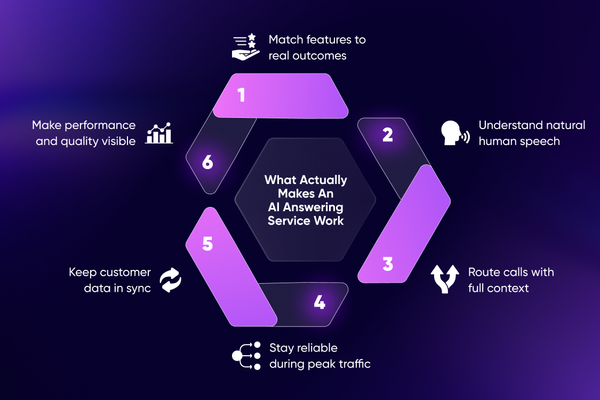
A useful way to evaluate features is to map them to real outcomes. That keeps the evaluation grounded in business impact instead of feature lists that look good in demos but do not change operations. The right platform should help you reduce friction, improve resolution quality, protect service consistency, and give teams more control as volume grows. In practice, that means judging every capability by what it changes in the live environment, how it supports agents and supervisors, and whether it holds up under production pressure:
- If the goal is fewer transfers, focus on call flow design, escalation logic, and context preservation
- If the goal is a better customer experience, focus on latency, natural dialogue, and interruption handling
- If the goal is risk reduction, focus on QA visibility, compliance controls, and audit readiness
- If the goal is scale, focus on concurrency, stability during spikes, and operational tooling
Natural language understanding
NLU is the foundation of caller trust. It must handle real speech patterns, such as partial sentences, corrections, pauses, and emotional shifts. In production, the hidden test is how the system handles ambiguity. Callers often describe the same issue in multiple ways.
Strong NLU reduces friction because the caller does not need to adapt their language to the system. It also improves first-pass understanding, which helps the conversation move forward without unnecessary clarification loops or broken intent capture.
Call routing and smart transfers
Routing is necessary, but routing quality decides whether automation reduces work or creates more work. Look for routing that uses intent and context, not just menu choices. When escalation happens, the transfer should carry a clear summary (opens in a new tab) of what the caller needs and what has already been collected.
That prevents repeat questions and reduces handle time on the human side. Strong routing also improves workforce efficiency because agents receive calls that are better matched to their role, queue, or skill level.
24/7 Availability and auto response
Availability is not just about after hours. It is about resilience. The operational test is whether the system maintains response quality during spikes. Many platforms perform well at low volume and degrade under load. Your evaluation should include peak scenarios. A reliable platform should keep response speed, conversation quality, and workflow execution stable even when demand rises unexpectedly.
CRM integration
CRM integration is where the platform becomes actionable. When the system can read context, update records, and trigger follow-ups, it reduces manual work and improves continuity. It also reduces errors that happen when information is collected on calls but never lands in the system of record. Good integration also makes the customer experience smoother because agents and automated systems work from the same context instead of fragmented information.
Analytics and reporting
Analytics turns voice from a black box into an operational surface.
At minimum, you want visibility into:
- resolution and escalation outcomes
- top intents and failure points
- sentiment signals and risk patterns
- call containment trends by workflow
- QA indicators and compliance flags if relevant
Without reporting, teams rely on anecdotes. With reporting, teams tune like an operator. Strong reporting also makes it easier to identify what is working, what is failing, and where workflow changes will have the biggest impact.
Custom scripting and workflows
This is the difference between demos and production. Your call workflows include edge cases, verification steps, handoffs, and compliance language. A platform must support branching logic and structured steps without turning the build process into an engineering project.
If your workflows change frequently, flexibility matters. If your workflows are stable, reliability and governance matter more. The best platforms support both, so teams can adapt quickly when needed without losing control over quality, consistency, or compliance.
See how contact center teams track resolution, escalation, and sentiment in real time with Orvera→ (opens in a new tab)Top AI Answering Services for Businesses in 2026
AI answering services vary widely in how they behave once calls move beyond demos and into daily operations. Some platforms perform well for early testing but introduce friction as volume grows. Others are built to stabilize call handling under pressure, where consistency and visibility matter more than flexibility.
The following analysis explains what businesses should expect from each platform in practice, focusing on deployment effort, scalability, operational control, and long-term ownership.
Orvera
Orvera is most relevant for teams that treat voice as a core operational channel rather than an experimental one. In real deployments, its strength shows up when call volume is high, conversations are structured, and escalation quality matters.
What businesses typically notice after deployment:
- Faster path from requirements to live calls: Orvera workflows are configured using existing SOPs, scripts, and escalation rules. This reduces the time teams spend translating operational reality into flow logic.
- End-to-end resolution: Calls are designed to complete verification, intent handling, and task execution in a single flow. Routing is used only when a human decision is required.
- Consistent behavior during peak traffic: The platform is built to maintain response quality as concurrency increases. This matters during billing cycles, seasonal demand, or outage events.
- Real-time sentiment awareness inside conversations: Emotional shifts influence how conversations proceed, including when and how escalation occurs. This improves handoff quality and reduces repeated explanations.
- Built-in quality visibility without external tools: Every call is evaluated automatically, allowing teams to track resolution rates, escalation patterns, and conversation breakdowns without separate QA systems.
- Operational predictability at scale: the platform holds response quality as concurrency rises, so operations teams plan staffing around resolution.
For leaders evaluating platforms for contact centers, the key takeaway is that Orvera runs the build, the deployment and the integration, and keeps running the system it deploys.
Synthflow AI
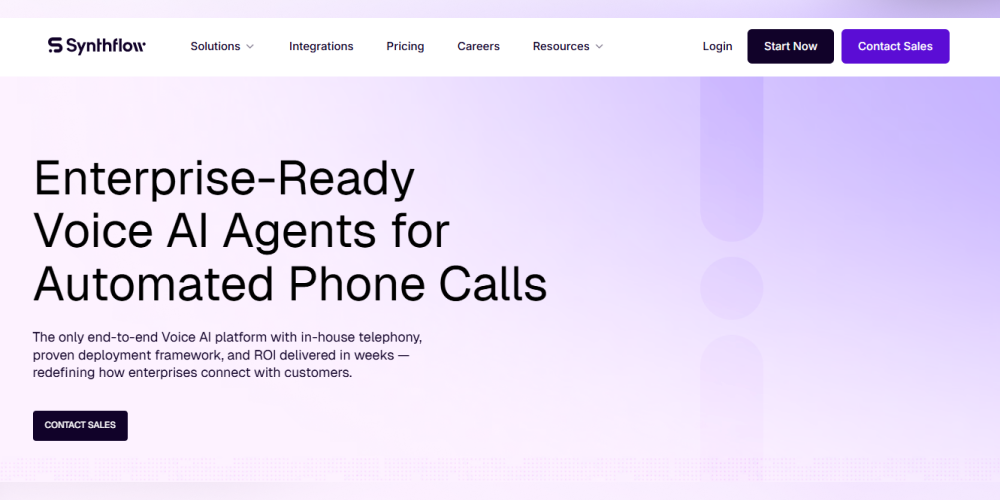
Synthflow AI is often chosen when teams want to build and test voice workflows quickly, especially when internal technical resources are limited. Its design favors accessibility and iteration over long-term operational rigor.
What businesses typically experience in practice:
- Quick setup for simple call flows: Teams can create basic voice workflows without engineering support, making it useful for appointment booking, simple triage, or lead capture.
- High flexibility during experimentation: The visual builder allows frequent changes, which is helpful when teams are still learning how callers behave.
- Broad integration coverage for common tools: CRM and scheduling integrations are straightforward, enabling quick proof-of-concept deployments.
- Usage-based cost behavior: Costs scale with call volume and concurrency. This is manageable at low volume but requires close monitoring as usage grows.
- Operational tuning responsibility remains internal: As workflows become more complex, teams must manage flow logic, exception handling, and ongoing optimization themselves.
Synthflow works best when automation is narrow in scope and call volume is predictable. For businesses planning large-scale or mission-critical deployments, additional operational planning is usually required.
Retell AI
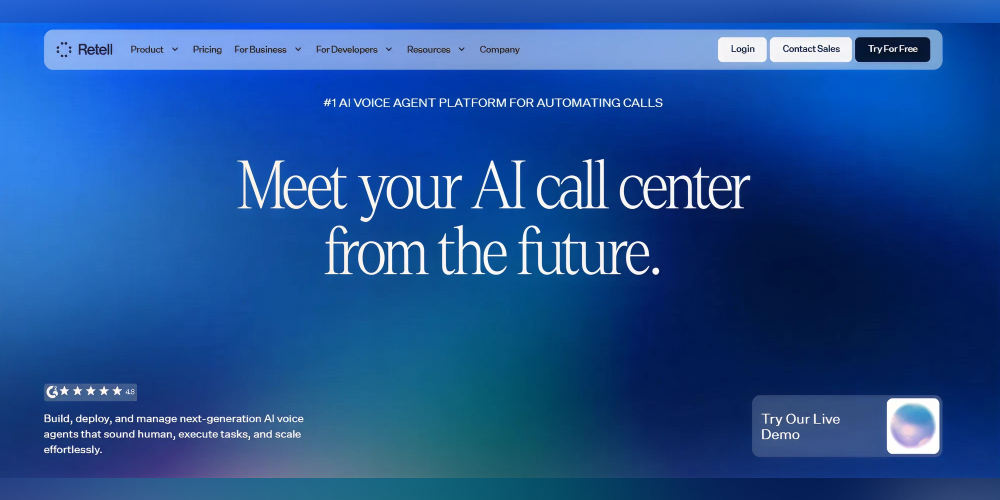
Retell AI (opens in a new tab) appeals to organizations that prefer to own conversation logic and continuously refine it. It supports structured flow design and low-latency interactions, which can produce very natural conversations when properly configured.
What businesses typically observe:
- Strong control over conversation structure: Modular flow components allow reuse of verification, booking, and escalation logic across multiple call types.
- Responsive conversational pacing: Low latency improves natural turn-taking, which matters for customer satisfaction.
- Flexible telephony and integration options: Teams can customize routing, concurrency, and backend connections to match internal systems.
- Usage-based pricing with variable outcomes: Cost depends on model selection, call length, and concurrency. Forecasting becomes more complex as volume increases.
- Ongoing ownership requirement: Teams are responsible for maintaining and optimizing flows as policies, products, or customer behavior change.
Retell is a strong fit when engineering ownership is available, and voice automation is treated as a living system rather than a fixed deployment.
Bland AI
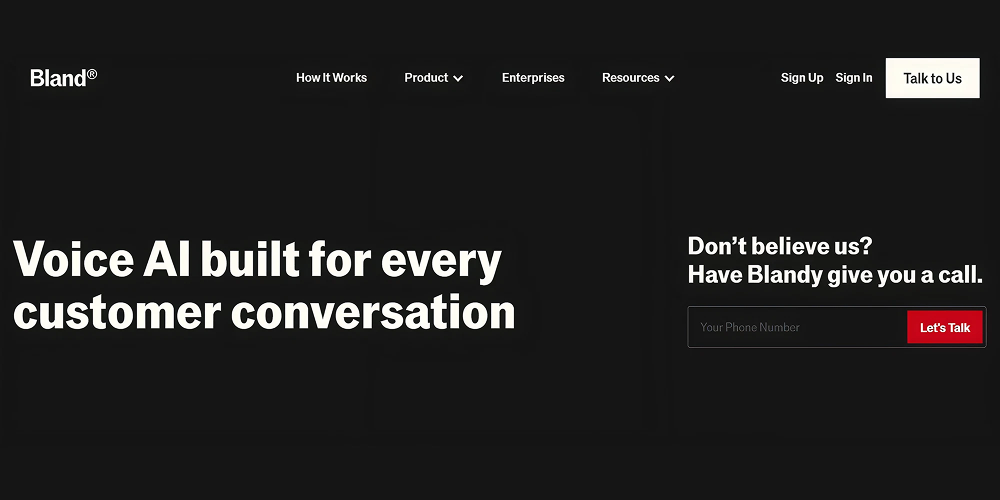
Bland AI operates at a different level of complexity. It is typically evaluated by organizations with regulatory, geographic, or data sovereignty constraints that require dedicated infrastructure.
What businesses should expect:
- Dedicated deployment environments: Infrastructure is isolated, which supports strict compliance and internal governance requirements.
- Custom trained conversational models: Voice behavior, tone, and vocabulary can be tightly controlled and aligned with brand standards.
- Support for very high concurrency: The platform is capable of handling extreme call volumes, making it suitable for large national or global operations.
- Longer implementation cycles: Customization and coordination with internal teams take time, but the result is a highly tailored system.
- Higher cost and operational complexity: This approach makes sense only when scale, control, and compliance outweigh simplicity and speed.
Bland is best considered when voice automation is part of a broader enterprise infrastructure strategy rather than a standalone efficiency initiative.
How to Choose the Right AI Answering Service for Your Business
Selecting an AI answering service in 2026 requires more than comparing features. Voice automation directly affects customer trust, operational efficiency, and risk exposure. The right choice depends on how closely a platform aligns with real call patterns, escalation needs, and performance accountability.
A strong evaluation framework starts with three questions:
- Which call types represent the highest volume or operational cost
- Where resolution breaks down today, and why
- How performance will be monitored, tuned, and governed after launch
When these questions are answered clearly, the differences between platforms become easier to assess.
Decision Framework by Business Size and Operational Complexity
Evaluation priorities do not stay the same as an organization grows. What works for a small business can become a limitation in a mid-size environment, and what looks sufficient for a mid-size team often breaks at enterprise scale. The right buying criteria depend on how much call volume you manage, how varied your workflows are, and how much operational risk comes from failure. That is why teams should evaluate AI answering services against their current operating complexity, not just their feature list.
The table below outlines how evaluation priorities typically shift as organizations scale.
| Business Context | Primary Goal | Key Evaluation Criteria | Common Risks if Misaligned |
|---|---|---|---|
| Small businesses | Never miss calls and complete basic tasks | Fast pickup, simple workflows, appointment booking, basic reporting | Overengineering, unclear ownership, rising usage costs |
| Mid-size businesses | Reduce agent load while maintaining quality | CRM integration, escalation logic, predictable pricing, analytics | Pilots that fail under volume, cost volatility |
| Enterprise teams | Stabilize voice operations at scale | Concurrency, escalation quality, compliance, QA visibility | Fragmented tooling, inconsistent outcomes, long deployment cycles |
What to Prioritize Based on Your Operating Model
What matters most in an AI answering service changes with the shape of your operation. A small business usually needs reliability and simplicity, while larger environments need stronger workflow control, integrations, and governance. The mistake is evaluating every platform with the same checklist regardless of volume, complexity, or internal support capacity. A better approach is to align priorities with how your team actually handles calls, where breakdowns occur, and the level of operational control you need.
Small business environments
Small teams typically benefit from systems that require minimal ongoing management. The objective is consistent call handling without introducing complexity.
Priority areas include:
- Immediate call answering with natural responses
- Scheduling, intake, and basic information capture
- Clear summaries of what was handled and what needs follow up
Mid-size business environments
Mid-size organizations often experience variability across call types, products, or locations. At this stage, voice automation must reduce friction without creating a new operational burden.
Priority areas include:
- Intent recognition across multiple workflows
- CRM and ticketing integration so actions complete during the call
- Escalation paths that preserve context
- Cost structures that remain stable as concurrency increases
Enterprise environments
Enterprise voice operations demand reliability, auditability, and consistency across regions and teams. AI answering must behave as an operational system, not an experimental layer.
Priority areas include:
- Stable performance during traffic spikes
- Escalation with complete context to protect handle time
- Built-in QA and performance reporting
- Clear governance and ownership models
Why Orvera Performs Well in Real Contact Center Conditions
Orvera is particularly effective when voice automation is expected to perform under real contact center conditions. Built on 18+ years of contact center operational experience, its design reflects how calls behave in production. It is built for environments where call volume fluctuates, workflows are structured but not always linear, and operational teams need visibility into what the system resolved, escalated, or failed to complete. That makes it a stronger fit for teams that care about resolution quality, service stability, and measurable performance.
- Resolution-driven conversation design: Call workflows are built to complete structured interactions end to end, reducing unnecessary transfers and repeat calls.
- Live in 3 to 6 weeks: Existing scripts, SOPs, and escalation rules are converted into working voice workflows, with Orvera doing the build.
- Real-time sentiment awareness: Emotional signals during calls influence tone, pacing, and escalation decisions, improving outcomes in sensitive interactions.
- Unified inbound and outbound logic: The same conversational framework supports inbound service calls and outbound follow-ups, maintaining consistency.
- High concurrency without degradation: Performance remains stable as call volume increases, supporting peak demand without added tuning.
- Built-in quality and analytics: Every call is automatically evaluated, giving teams visibility into resolution rates, escalation trends, and workflow effectiveness.
- One accountable owner: Orvera builds, deploys and runs the deployment, so the team's job is reviewing results.
Final Thoughts
Choosing an AI answering service is really a decision about how you want your voice operation to perform when demand becomes harder to manage. The strongest platforms do not just help you answer more calls. They help you protect service quality, reduce avoidable workload, and create a more stable operating environment as volume, complexity, or customer expectations increase. That is why the evaluation should stay tied to practical questions around workflow fit, escalation quality, reporting visibility, and operational control.
As this category matures, the gap between platforms is becoming easier to see in live conditions. Some tools are useful for experimentation, while others are better suited for businesses that need reliability, accountability, and cleaner execution at scale. The best choice is the one that fits your current operating model, supports the way your team actually works, and gives you a clear path from initial rollout to long-term optimization.
Frequently asked questions
It is a system that answers calls, understands intent, completes structured tasks, and escalates to humans when judgment is required.
They combine speech recognition, intent modeling, workflow logic, and system integrations to resolve calls conversationally.
Resolution capability, escalation quality, system integration, analytics, and predictable performance under load.
Security depends on deployment model, data handling practices, and governance controls, which should be validated during evaluation.
Resolution rate, transfer reduction, escalation quality, and consistency during peak volume provide the clearest indicators.

Written by
Alex Penn
Alex Penn is a B2B SaaS writer with 3 years of experience turning complex AI topics into clear, practical content for modern businesses. She specializes in AI, automation, and emerging tech, with a knack for making technical ideas accessible without watering them down. Outside of work, Alex bakes cookies for friends and unwinds with a steady diet of indie music.