Retell AI Review 2026: Features, Pricing, Pros & Cons
Retell positions itself as a platform for building, testing, deploying, and monitoring AI voice agents that handle...


Key highlights
TL;DR: Retell AI at a Glance
- If you want a fast, natural-sounding AI voice agent without building everything from scratch, Retell AI is a strong place to start.
- It offers a visual builder with conversation flows, plus production basics like concurrent calling.
- Pricing has two modes: Pay-as-you-go and Enterprise. Costs vary based on the LLM, voice engine, and telephony you choose.
- Strong points: low latency, flexible integrations, and multilingual voice options for real-world calling.
- Watch-outs: costs can be harder to forecast at scale, and some teams may hit a learning curve while setting up agent workflows.
- Orvera is the stronger Retell AI alternative for contact centers that want a fast go-live (3 to 6 weeks), a commercial model scoped to the deployment, and built-in QA and analytics.
If you’re evaluating conversational voice AI for a contact center, you’ve probably noticed a pattern. Many AI agents seem great in demos but struggle on real calls, or they’re powerful but require engineering effort to keep things running at scale. This Retell AI review breaks down where it fits on that spectrum.
Retell positions itself as a platform for building, testing, deploying, and monitoring AI voice agents that handle calls in production. In this blog, we’ll take a look at what it does well and where teams typically struggle. We’ll cover Retell AI's features, pricing, and how it compares to Orvera (opens in a new tab).
What Is Retell AI?
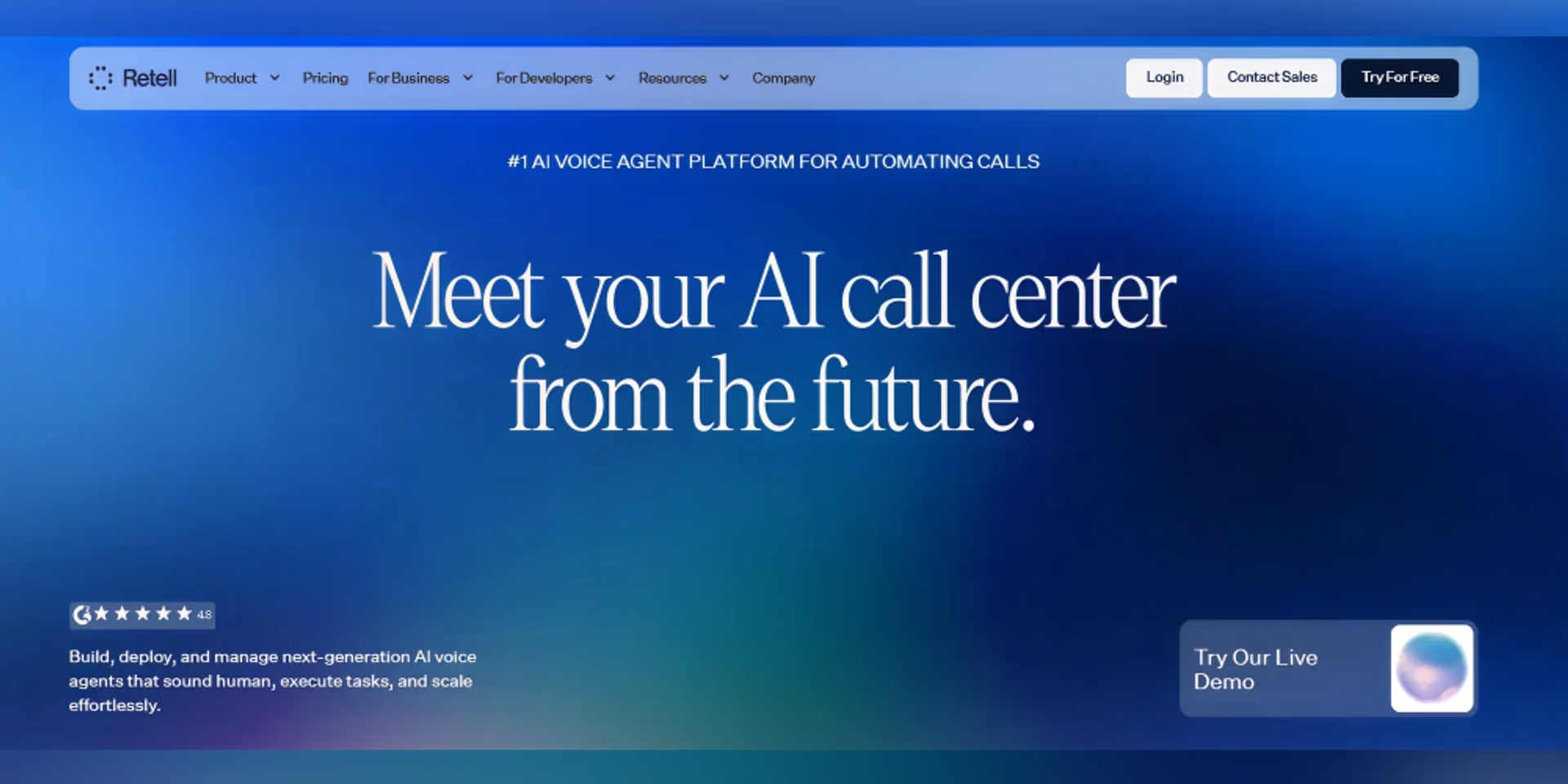
Caption: Retell AI helps you build, deploy, and manage AI voice agents
Retell AI is a voice agent platform designed to help businesses create AI agents that can handle phone calls (inbound and outbound), automate routine conversations, and perform tasks. This means the agents can handle scheduling, routing, FAQs, and basic workflows.
Retell’s documentation describes it as a complete solution for creating conversational agents that handle phone calls naturally, with built-in telephony integrations and monitoring.
Who it’s best suited for
- Teams that want flexibility in how agents are designed and connected to existing systems.
- Organizations that have engineering resources available during setup and optimization.
- Companies that want usage-based pricing and the ability to scale or tune capabilities over time.
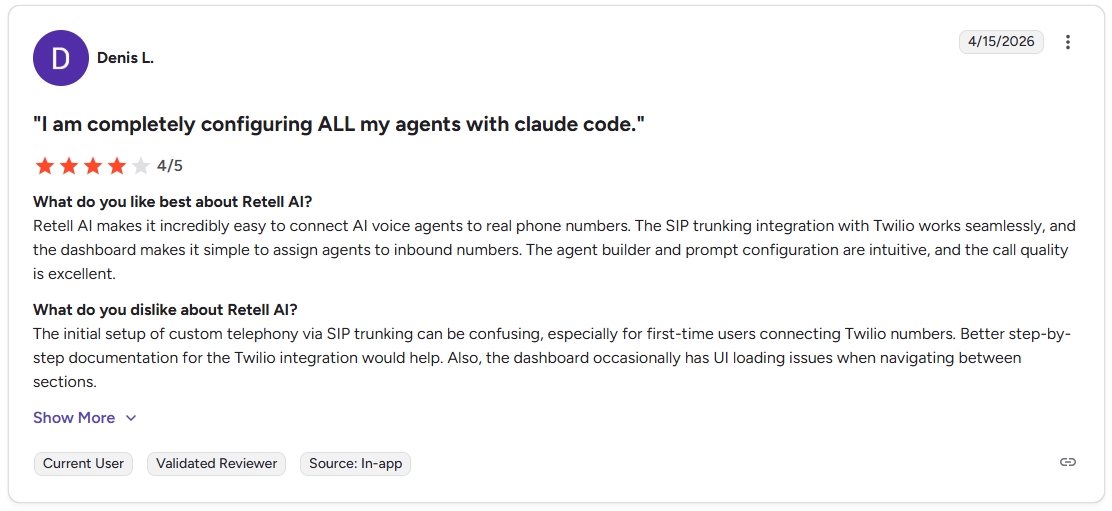
Source: G2 (opens in a new tab)
Business problems it helps solve
- Reducing repetitive call load (status checks, appointment booking, simple triage)
- Handling high volumes with concurrency controls
- Connecting phone conversations to tools like CRMs and automation platforms via integrations
Retell AI Overview: Our Honest Ratings
| Metric | Rating out of 5 | Why |
|---|---|---|
| Overall | 3.9/5 | Strong product for configurable voice AI, but not the easiest fit for operations-led contact center teams. |
| Ease of Setup | 3.7/5 | The visual builder and structured UI help, but there is still a learning curve once flows become multi-step and edge cases increase. |
| Pricing Clarity | 3.5/5 | Entry pricing is clear, but total cost is harder to forecast because spend varies by LLM, voice engine, telephony, and add-ons. |
| Call Quality | 4.3/5 | The blog positions Retell strongly on low-latency performance, sub-second benchmark results, multiple voice engines, and denoising options. |
| Support | 3.6/5 | The documentation seems strong, but the basic plan relies on Discord and email, while higher-touch support is pushed to enterprise tiers. |
| Implementation | 3.8/5 | Good for teams with technical ownership and configuration control, but less frictionless for teams that want a more guided, operations-led rollout. |
Retell rating: 3.9/5
Best for teams that value voice AI flexibility and speed, but are willing to trade some pricing clarity and setup simplicity for that control.
How Does Retell AI Work?
At a practical level, Retell AI works like a configurable voice agent stack. You define how an agent should behave, connect it to data and tools, deploy it through telephony, and monitor performance after launch.
Design the agent behavior
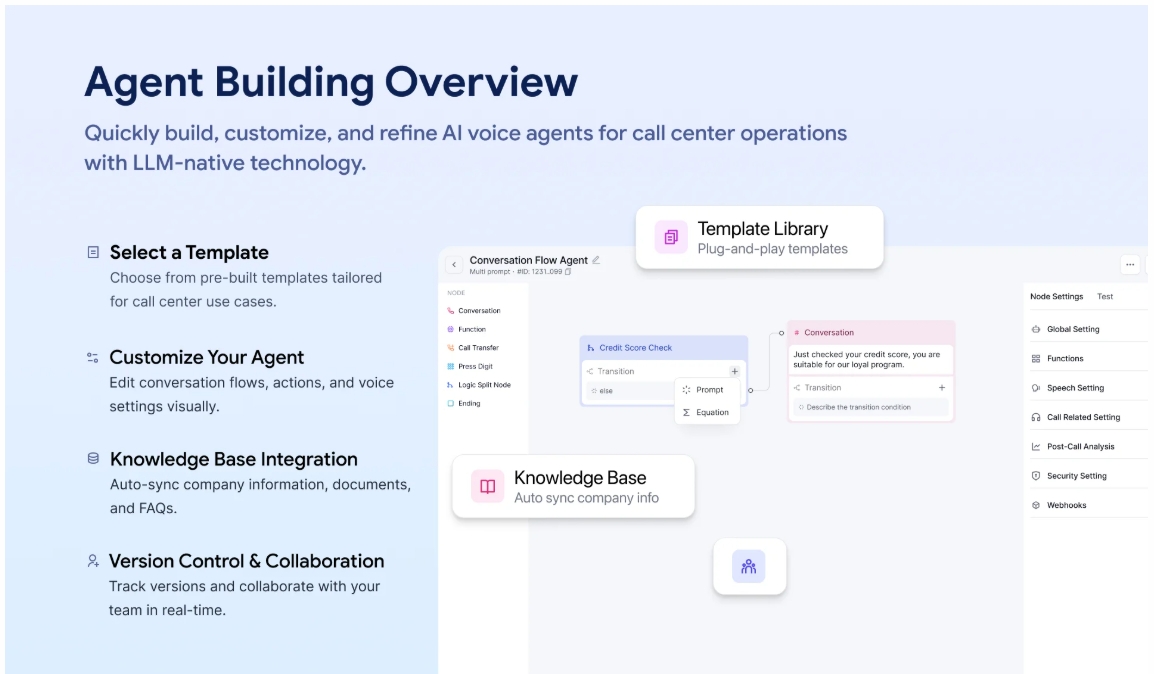
You can build structured conversation flows using nodes and transitions (Retell calls these Conversation Flow Agents), which offer fine-grained control for structured conversations. For more flexible, less structured use cases, you can use single- or multi-prompt agents.
Source: G2 (opens in a new tab)
Connect tools and data
Add integrations (CRM, scheduling, automation tools) so the agent can take actions during a call. For instance, the agent can create a lead, schedule an appointment, send a message, or update a record.
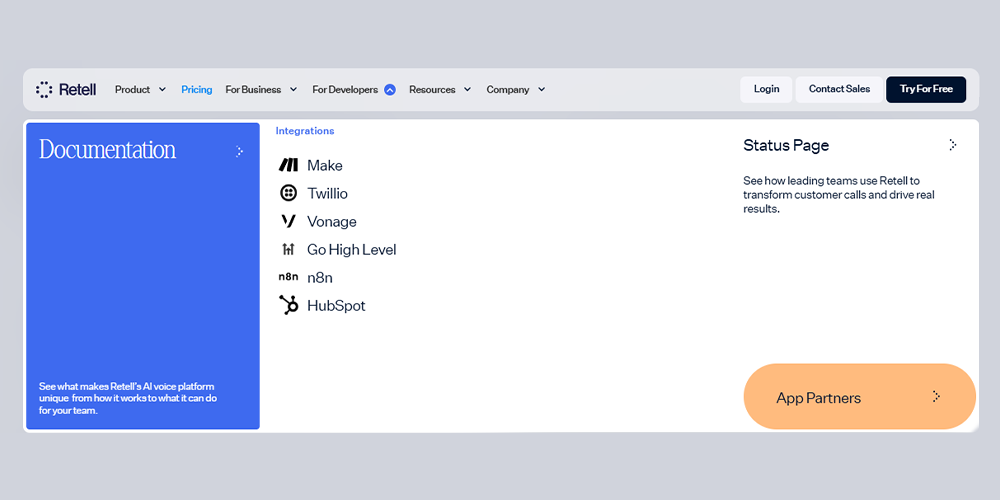
Retell’s integrations directory includes categories such as CRM, telephony, automation platforms, CX platforms, e-commerce, and more. Some integrations are unofficial connectors or partner-supported, so implementation effort can vary.
Deploy via telephony
Retell supports working with telephony providers and configurations. You can also manage concurrency (the number of live calls your setup can handle simultaneously).
Test, monitor, iterate
Retell’s platform and docs emphasize the loop of building, testing, deploying, and monitoring. You can monitor results through the Retell dashboard.
Retell AI Features
Retell gives teams a structured way to design and run voice agents while still leaving room for customization through integrations, tooling, and configuration. That balance can be valuable in production, especially when you need predictable conversation paths. Below are a few key Retell AI features.
No-Code Visual Builder
Retell’s product leans heavily into structured conversation flows. You can build with nodes, transitions, and reusable components rather than relying on a single prompt to handle everything.
- Conversation Flow Agents support multiple nodes for different scenarios, making outcomes more predictable for complex call paths.
- Components let you package a portion of a flow and reuse it across different agents. This is useful when you have repeated sequences, such as identity verification, appointment capture, or escalation logic.
- You can configure global settings from a canvas/settings workflow in the flow builder experience.
Architecture optimized for speed
Retell is built for low-latency voice conversations. In benchmarks Retell published, its performance is shown to be in the sub-second range, and a benchmark comparison cites 780ms for Retell in one example.
Integrations
Retell can connect to CRMs, telephony, automation platforms, CX tools, e-commerce, calendars, and communication platforms. It can also connect to tools such as Twilio, Vonage, Make, and n8n.
White-glove support
Retell offers an enterprise plan with optional white-glove support and custom deployment assistance. This is relevant for organizations that want more hands-on help with building and scaling agents, especially when they do not want to own the full implementation process internally.
Retell AI Pricing
Pricing is often a critical deciding factor because pricing models influence scalability and predictability. Retell’s pricing is designed to be usage-based (opens in a new tab), which can work well for pilots and variable volumes. Contact center teams should also consider how pricing behaves once call minutes and concurrency grow.
Retell’s pricing page states there are no platform fees and lists $0.07+/minute for AI Voice Agents, along with $10 free credits and 20 free concurrent calls on the pay-as-you-go tier.
Retell also includes a pricing calculator on its pricing page that lets you estimate monthly spend based on the specific configuration you choose.
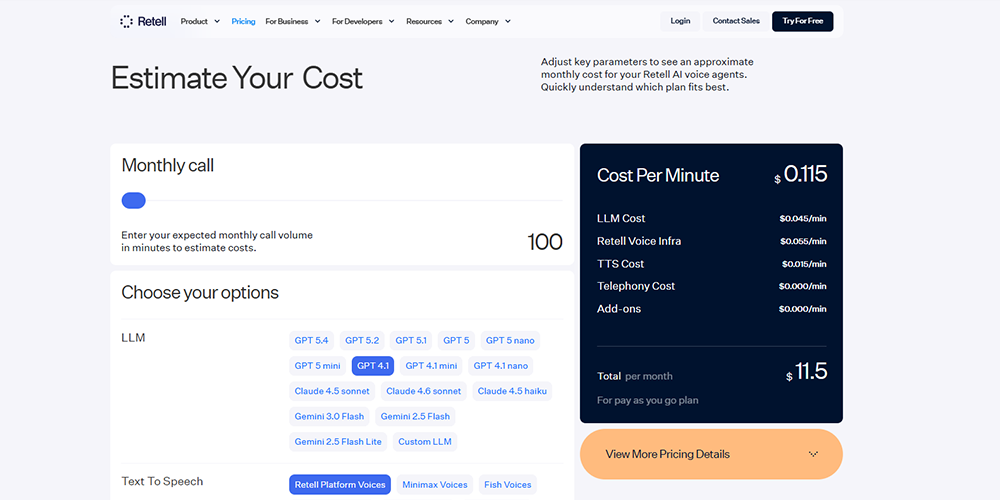
- The calculator shows how costs change based on your selected LLM agent, such as ChatGPT, Claude, Gemini, or a custom LLM.
- It also lets you choose a voice engine, including ElevenLabs/Cartesia Voices (and other voice options listed on the page).
- You can also configure telephony, such as Custom Telephony or Retell’s options like Twilio/Telynx, and see how that affects the estimate.
Plan Structure
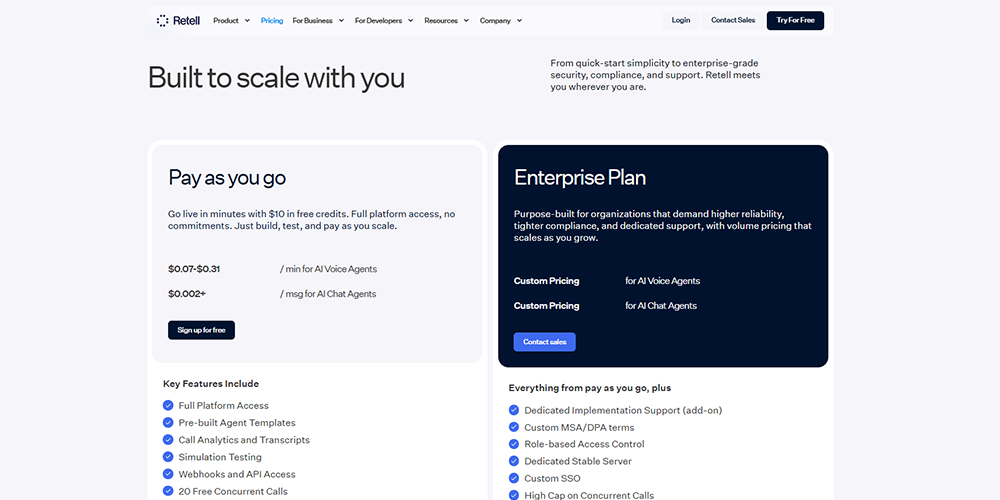
Retell’s pricing has two tracks:
- Pay-as-you-go (self-serve, start instantly)
- Enterprise plan (custom deployment, higher concurrency, optional white-glove service, premium support channel)
| Plan | How much it cost | What’s included |
|---|---|---|
| Pay as you go | - $0-0.07+/minute for AI Voice Agents - $0.002+/msg for AI Chat Agents | Pre-built Functions - Simulation Testing - Analytics - $10 free credits - 20 free concurrent calls - 10 free Knowledge Bases - Discord + Email support |
| Enterprise plan | Contact sales | Everything in Pay as you go - Custom deployment and support - Optional white-glove service - Higher concurrency and limits (based on volume) - Premium support channel (dedicated teams) |
Caption: Retell AI’s two pricing models compared
Usage & Add-On Costs
Retell’s pay-as-you-go model can include add-ons depending on what you enable. For instance, Retell lists Branded Caller ID as an add-on for $0.10/min on its feature page.
What to watch for when budgeting:
- Usage-based pricing can be attractive early, but contact centers should model the total cost based on past and projected call volumes.
- Small per-minute differences compound quickly when call minutes rise.
- Add-ons may be reasonable individually, but their cost can increase significantly if several are required for production.
Usability & Performance
For contact centers, the real questions are: how quickly can your team get this live, how reliable it is during real calls, and how much effort does it take to maintain quality as scenarios expand? Usability and performance answer these questions.
Interface & Setup Experience
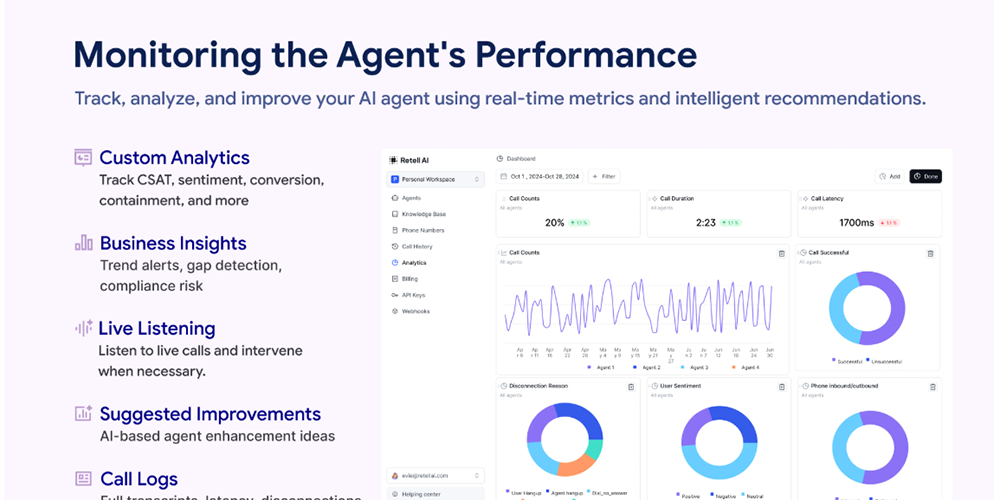
Retell’s dashboard is designed to build and manage voice agents in one place.
Setup typically starts with creating an agent, configuring how it should respond, and then connecting the tools or integrations it needs. The UI encourages a structured approach, which can help keep call flows clean as you add more scenarios over time.
Source: G2 (opens in a new tab)
Call Quality & Reliability
Once agents are live, quality and reliability come down to two things: how natural the conversation feels and how consistently the system handles real calls.
Retell supports multiple voice engines, including ElevenLabs/Cartesia and OpenAI. Retell lists an Advanced Denoising add-on for improving clarity in noisy conditions.
Security & Customer Support
Contact centers handle sensitive customer conversations, and even minor reliability issues can quickly escalate into incidents. A strong voice AI platform should provide a clear security posture and practical support channels for resolving issues quickly.
Security & Compliance
Retell’s compliance page states that it is HIPAA- and GDPR-compliant and SOC 2 Type 1 & Type 2 certified.
For teams in regulated environments, this is a baseline check. You should still validate what specific controls apply to your use case, including data retention, access controls, audit trails, and how recordings and transcripts are handled.
Customer Support & Documentation
Retell’s support lists the following support channels:
- A Discord support channel for instant support and community
- Email support via support@retellai.com
- Premium private Slack channel support with dedicated support teams for Enterprise plan customers.
On the documentation front, Retell does a comprehensive job of capturing everything you need to get started with different workflows. There are also troubleshooting sections on how to debug incorrect responses, fix agent behaviors, etc.
Retell AI Pros and Cons
Source: G2 Retell AI Review (opens in a new tab)
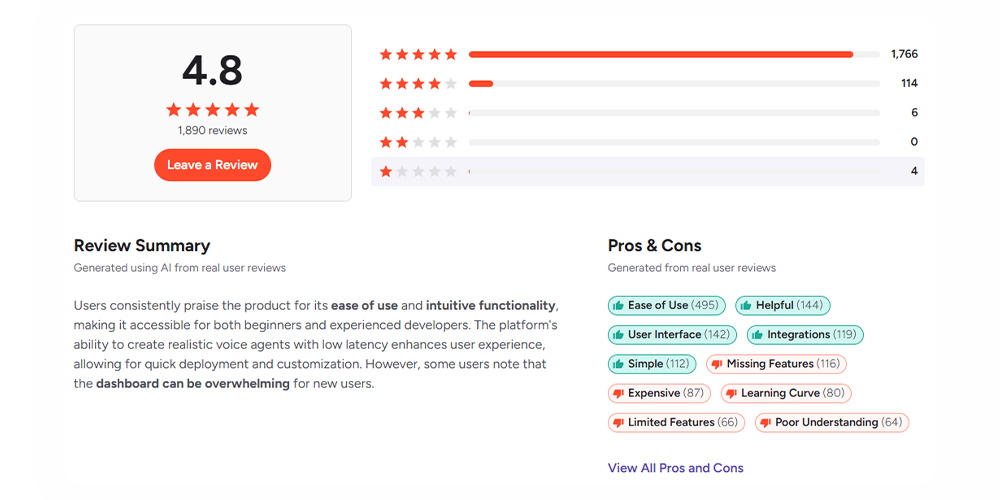
Retell is easy to use, has an intuitive UI, and supports most of the integrations companies need. However, there are also missing features, a learning curve to get started, and pricing that feels expensive (opens in a new tab) for some teams. Here are Retell’s pros and cons:
Pros
- Clear entry pricing and fast self-serve start: Retell’s pricing page clearly lists $0.07+/minute for AI voice agents, $10 free credits, and 20 free concurrent calls on pay-as-you-go. That makes it easy to trial real calls without committing to a long onboarding cycle.
- Ease of use and UI: Retell has a visual flow builder that helps teams set up simple flows with nodes and transitions.
- Low-latency positioning: Retell emphasizes fast responsiveness, and benchmarks indicate it is under a second.
- Integration flexibility: Retell maintains an extensive integration directory with categories such as CRM, telephony, automation platforms, CX platforms, communication tools, e-commerce, and calendars.
Cons
- Pricing can be hard to forecast: Retell’s pricing calculator shows costs shifting based on the LLM agent, voice engine, and telephony choice. That flexibility is powerful, but it makes cost forecasting more complex once volumes rise.
- Learning curve: Non-technical teams can still face a learning curve when they move beyond basic scripts. The tricky parts usually show up when you need to handle multi-step call flows, handle interruptions and topic changes, configure fallbacks, connect integrations reliably, and test edge cases before rollout.
- Support requirements: Retell offers support only via Discord and email for the basic plan. Smaller teams might struggle with bugs, complex workflow setup, and other challenges.
Retell AI vs Orvera
Retell AI Vs. Orvera (opens in a new tab) comes down to the difference between flexibility and operational readiness. Retell is often chosen by teams that want configuration control and developer-led setup, while Orvera is built for contact centers that need faster rollout, more predictable operations, and built-in quality visibility. As you move through the comparison below, the differences become clearer across workflow design, pricing structure, support model, and how each platform fits real production environments.
Feature Comparison
Both platforms support voice agents, integrations, and call workflows. The difference lies in how they approach day-to-day contact center needs, such as workflow resolution, QA, and operational tooling.
| Area of Comparison | Retell AI | Orvera |
|---|---|---|
| Primary product focus | Configurable voice agent platform | Agentic AI platform for enterprise customer experience, built, deployed and run by Orvera |
| Workflow approach | Flexible agent configuration and tooling | End-to-end call resolution with structured workflows |
| Post-call insights | Post-call analysis and call outcomes | QA + built-in analytics dashboards for operational visibility |
| Integrations | Integrations directory plus API/webhooks | Integrations + implementation support to connect contact center systems |
Pricing & Scalability
Pricing is one of the biggest practical differences. Retell is usage-based and configuration-dependent, which can be great for pilots and variable volumes. Orvera scopes its commercial model to the deployment and shares the specifics on a scoped call, so the conversation starts from the workflows and the volume they carry.
| Area of Comparison | Retell AI | Orvera |
|---|---|---|
| Pricing model | Pay-as-you-go per minute | Scoped to the engagement |
| Entry pricing signal | $0.07+/minute for AI voice agents | Shared on a scoped call |
| Included credits | $10 free credits | Discussed on a scoped call |
| Concurrency at entry | 20 free concurrent calls | No throttling at scale |
| Cost variability drivers | LLM agent + voice engine + telephony choices | Orvera builds, deploys and runs the operation |
Deployment & Support
For contact centers, time-to-live and support quality matter as much as features. Retell provides strong documentation and community-style support. Orvera emphasizes white-glove onboarding and faster production rollout.
| Area of Comparison | Retell AI | Orvera |
|---|---|---|
| Typical rollout style | Self-serve build and deploy | White-glove onboarding and implementation support |
| Speed to production | Depends on complexity and internal setup | Often positioned as live in 3 to 6 weeks |
| Support channels | Discord + email; enterprise support options | Dedicated support and implementation-led rollout |
| Fit for contact center ops teams | Best when there is a technical owner | Designed for operations-led deployment |
How Orvera Improves Voice AI for Customer Service
Orvera is an enterprise-ready conversational AI platform (opens in a new tab) designed to help teams move from pilot to production with more predictable operations, drawing on 18+ years of experience in real customer support environments to shape how workflows, escalation paths, quality controls, and operational visibility are built into the platform. While Retell AI is often used for more modular, configuration-driven deployments, Orvera is positioned for teams that want faster implementation, stronger operational consistency, and a voice AI model that aligns more closely with how customer service operates in day-to-day production environments.
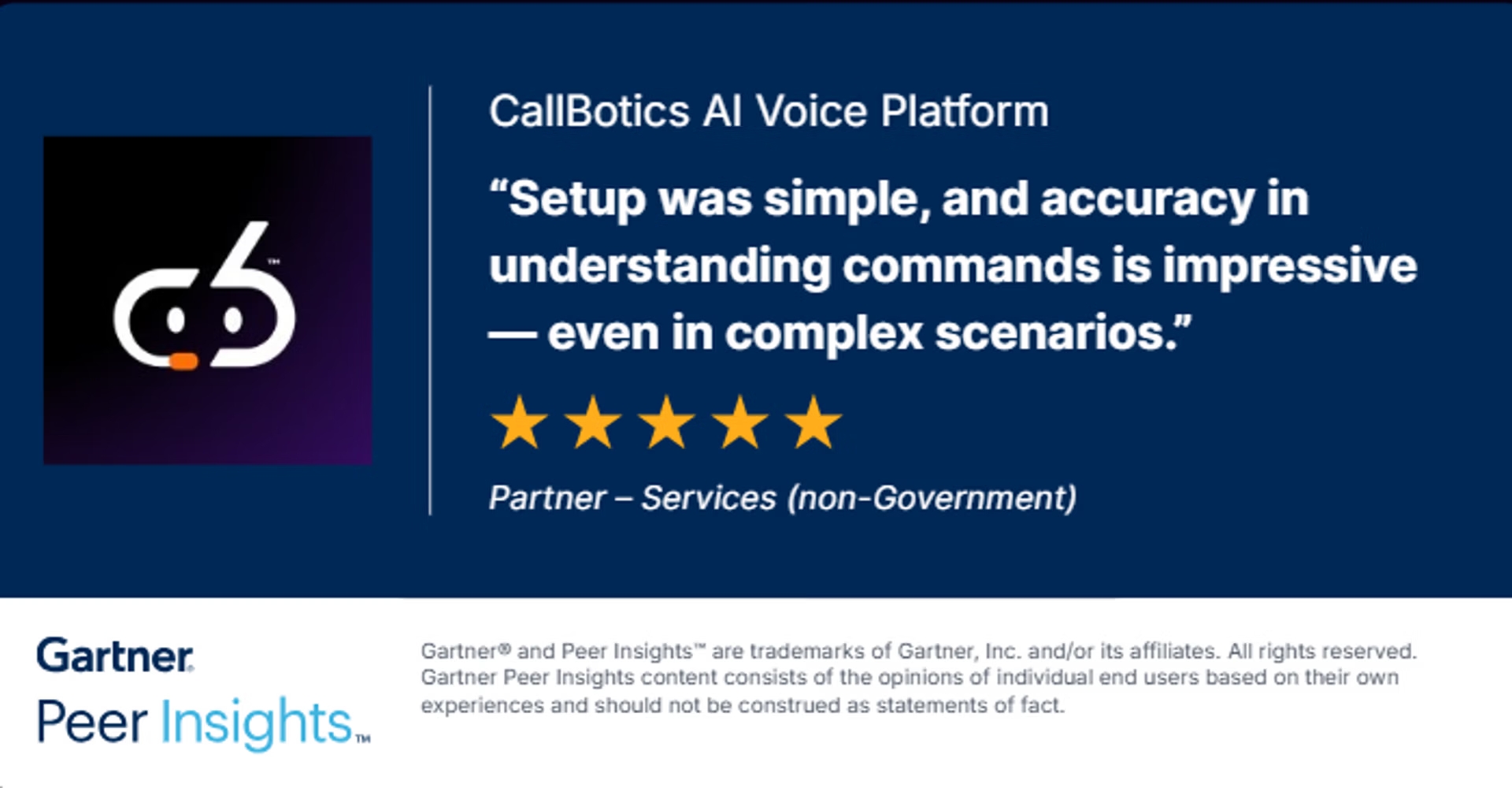
Caption: Client testimonial from Gartner Peer Insights
Orvera differentiators at a glance:
- High resolution rate: First-contact resolution runs around 80 percent across Orvera customers, reducing agent workload while maintaining service quality.
- White-glove implementation: Hands-on deployment led by contact center practitioners, enabling non-technical teams to launch advanced workflows without ongoing developer dependency.
- Commercial model scoped to the deployment: shared on a scoped call, so budgeting starts from the workflows and the volume they carry.
- Rapid deployment: Production-ready voice workflows go live in 3 to 6 weeks using templates and guided setup.
- Built for contact center scale: Engineered to perform reliably in high-volume, real-world contact center environments. Integrates with 500+ industry-specific systems.
- Built-in QA and analytics: Orvera includes integrated quality assurance and analytics (opens in a new tab) dashboards, allowing teams to review call outcomes, track automation performance, and continuously optimize workflows without relying on external reporting tools.
Retell vs. Other Alternatives: A Side-by-Side Comparison
Retell AI sits in a competitive set alongside Bland AI, Vapi, and Synthflow (opens in a new tab). All four platforms support AI voice agents, but they differ in how they price usage, how they position latency, how much setup work they expect from the team, and how naturally they fit structured contact center environments. The table below gives a practical side-by-side view.
| Platform | Pricing | Latency | Setup effort | Contact center fit |
|---|---|---|---|---|
| Retell AI | $0.07 to $0.31/minute for AI voice agents on pay-as-you-go, with enterprise pricing available for larger deployments. | Retell says its platform can achieve around 600ms latency and positions itself around low-latency voice conversations. | Moderate. Easier to get started than fully raw infrastructure, but teams still need to configure flows, telephony, and workflow logic. | Good fit for teams that want configurable voice agents and production controls, especially when there is technical ownership. |
| Bland AI | Bland’s official materials indicate $0.09/minute connected-call pricing, with plan-based rates for self-serve customers. | Bland strongly emphasizes speed and describes its stack as optimized for real-time conversation, but it does not present a simple public benchmark number on the main docs pages surfaced here. | Moderate to high. Powerful and flexible, but better suited to teams comfortable owning architecture, testing, and deployment decisions. | Strong fit for enterprise voice operations, especially where control, infrastructure flexibility, and deeper technical ownership matter. |
| Vapi | Public pricing starts at $0.05/minute for calls, with volume-based discounts and separate provider costs depending on configuration. | Vapi says it typically achieves around 800ms end-to-end latency, while also positioning parts of its platform around sub-500ms latency. | Moderate. Developer-friendly and fast to build on, but setup depth depends heavily on how custom the use case becomes. | Moderate fit for contact centers. Strong for teams building custom voice experiences, but more platform-oriented than contact-center-opinionated. |
| Synthflow | Pricing is estimator-based and enterprise-led, with public plan comparison pages centered on usage tiers and contact-sales motion rather than a simple headline per-minute rate. | Synthflow claims sub-100ms latency for its in-house telephony, though that appears tied specifically to its telephony layer rather than a simple full end-to-end conversation benchmark. | Low to moderate. It is positioned as easier to deploy than more developer-heavy stacks, though actual effort still depends on integrations and workflow complexity. | Moderate to strong fit for teams that want faster deployment and enterprise voice capabilities without building everything from scratch. |
Final Verdict: Retell AI vs Orvera
Retell AI is a strong choice when flexibility is the priority. Its usage-based model, multiple configuration options, and pricing calculator make it easy to start small and tailor the system to your needs as you learn. For teams that want control over setup options such as models, voices, and telephony, Retell can be a compelling option.
Orvera is the better fit when the priority is to move into production quickly and run voice automation reliably at a contact center scale. With white-glove onboarding, fast go-live (3 to 6 weeks), and built-in QA and analytics, Orvera is designed to deliver clearer operational ownership and stronger long-term value for contact centers.
Frequently asked questions
Retell AI can be used with a visual builder and conversation flows, but advanced setups often involve configuration and integrations. This is where teams feel the learning curve.
Yes, most contact centers evaluate Retell AI on how cleanly it can escalate or transfer when the agent cannot complete a request. Ask about warm transfer, context handoff, and failure handling.
A practical approach is to run scripted test calls across edge cases (interruptions, incorrect inputs, silence, noisy audio), then refine prompts, flows, and tool calls before scaling volume.
Beyond the base per-minute cost, model how Retell AI pricing changes based on your LLM choice, voice engine, telephony setup, and any add-ons you may need in production.
Most buyers start with CRM/helpdesk logging, appointment scheduling, and workflow automation. Make sure the integration path fits your stack and doesn’t require heavy workarounds.
Compare how each handles workflow completion, escalation quality, reporting/QA visibility, and how predictable costs are at your expected call volume.

Written by
Alex Penn
Alex Penn is a B2B SaaS writer with 3 years of experience turning complex AI topics into clear, practical content for modern businesses. She specializes in AI, automation, and emerging tech, with a knack for making technical ideas accessible without watering them down. Outside of work, Alex bakes cookies for friends and unwinds with a steady diet of indie music.