How to Reduce Call Drops and Build More Reliable Voice Operations
Learn how to strengthen voice reliability to protect resolution and trust.

Key highlights
TL;DR How Leaders Reduce Call Drops at Scale
- Call drops occur when live voice interactions disconnect before resolution, creating repeat calls and operational drag.
- Drops are rarely caused by one issue. They emerge from the interaction of network instability, system configuration, device reliability, traffic surges, and software behavior.
- Voice reliability degrades fastest during peak demand, long multi-step conversations, and transitions between automation and human agents.
- Measuring drop rate trends, reviewing failure logs, and analyzing customer feedback reveal patterns that isolated incidents do not.
- Preventing drops requires designing for peak conditions, not averages, and treating visibility as a core operational capability.
- AI-driven voice environments raise stability expectations and require systems built for long conversations, concurrency, and clean escalation.
- Reliable voice operations reduce customer effort, protect revenue, and restore predictability to contact center performance.
Voice remains the most expensive and most visible channel in the contact center. When a live interaction disconnects unexpectedly, the impact extends well beyond a technical inconvenience. A call drop interrupts resolution, forces repetition, and creates friction that customers remember.
For contact center leaders, dropped calls represent a compounding operational risk. They increase inbound volume through repeat attempts, stretch agent capacity, and erode confidence in the experience your organization delivers. At scale, even a small percentage of instability translates into measurable cost and reputational impact.
Reducing dropped calls requires more than infrastructure upgrades. It requires understanding how voice systems behave under real operating conditions and aligning technology, workflows, and monitoring around reliability.
According to Gartner, by 2028 30% of Fortune 500 (opens in a new tab) companies will offer customer service through a single AI-enabled channel that supports text, image, and voice, highlighting the shift toward intelligent, automated voice interactions
This guide explains what causes call drops in modern contact centers, how they affect business performance, and what practical steps leaders can take to reduce them.
What Is a Call Drop
A call drop refers to an unplanned termination of an active voice interaction before the conversation naturally concludes. The call ends without intent from either party, forcing the interaction to restart or escalate.
This differs from general call quality issues such as brief audio distortion or latency. Quality degradation affects how a conversation feels. A dropped call ends the conversation entirely and breaks continuity.
In contact centers, drops often occur during high-value moments such as authentication, data capture, escalation, or resolution. When these moments are interrupted, both customer effort and operational cost increase.
Common Causes of Call Drops
Dropped calls rarely originate from a single point of failure. They emerge from how networks, platforms, devices, and workflows interact under real demand.
Network Connectivity Issues
Voice depends on consistent signal and bandwidth. Weak cellular coverage, unstable internet connections, or packet loss can terminate sessions without warning. Movement between networks or towers adds complexity, particularly in distributed agent environments.
These call drop causes become more pronounced during peak demand and high concurrency scenarios.
VoIP System Problems
Voice platforms rely on precise coordination between signaling, routing, and session control. Configuration gaps, overloaded servers, or incomplete failover paths can disrupt calls even when underlying connectivity appears stable.
At scale, small configuration issues often surface as intermittent drops that are difficult to trace without deep visibility.
Hardware and Device Failures
Endpoints still influence call stability. Aging headsets, unstable routers, or malfunctioning phones introduce failure points during live interactions. Battery instability and thermal issues can also interrupt longer calls.
Because these issues appear inconsistent, they are often underestimated despite their cumulative impact.
High Call Traffic and Overload
When inbound or outbound volume exceeds system capacity, voice sessions compete for limited resources. Without sufficient concurrency handling, calls may disconnect mid-conversation.
In these conditions, dropped calls often increase without triggering full system outages, making the issue harder to detect.
Software Bugs and Updates
Operating systems, firmware, and call applications evolve continuously. Incompatibilities or partial updates can interrupt live calls. Even mature environments face risk during rollout windows if testing and sequencing are not tightly controlled.
Effects of Call Drops on Businesses
Dropped calls introduce friction across customer journeys and internal workflows. Over time, the impact compounds across cost, performance, and perception.
Poor Customer Experience
Unexpected disconnections force customers to repeat information and reestablish context. This increases frustration and reduces confidence, especially during complex or sensitive interactions.
Lost Sales and Revenue
Interrupted conversations break momentum. Prospects disengage and transactions stall. Each unresolved interruption increases the likelihood that a call failure results in lost opportunity.
Lower Agent Productivity
Agents spend additional time reconstructing conversations, documenting partial interactions, and handling follow-up calls. This inflates handle time and reduces effective capacity.
Damage to Brand Reputation
Repeated disconnections signal instability. Customers often associate unreliable voice experiences with broader service quality concerns, regardless of the root cause.
Gartner predicts that customer service organizations using technologies like connected rep strategies and AI assistance can improve contact center efficiency by up to 30% by 2026, underscoring (opens in a new tab)measurable operational benefits from better tooling.
How to Measure and Track Call Drops
Improvement begins with visibility. Measurement allows leaders to distinguish isolated incidents from systemic patterns.
Call Drop Rate
Call drop rate measures the percentage of calls that disconnect before completion. Tracking this metric across queues, call types, and time windows reveals where instability concentrates.
Call Failure Logs
System logs capture signaling events, session timeouts, and disconnect reasons. Reviewing these logs helps teams isolate whether failures originate from network behavior, platform configuration, or endpoint instability.
Customer Complaints and Feedback
Customer feedback surfaces gaps that metrics alone may miss. Patterns in complaints often point to specific workflows or time periods where reliability degrades.
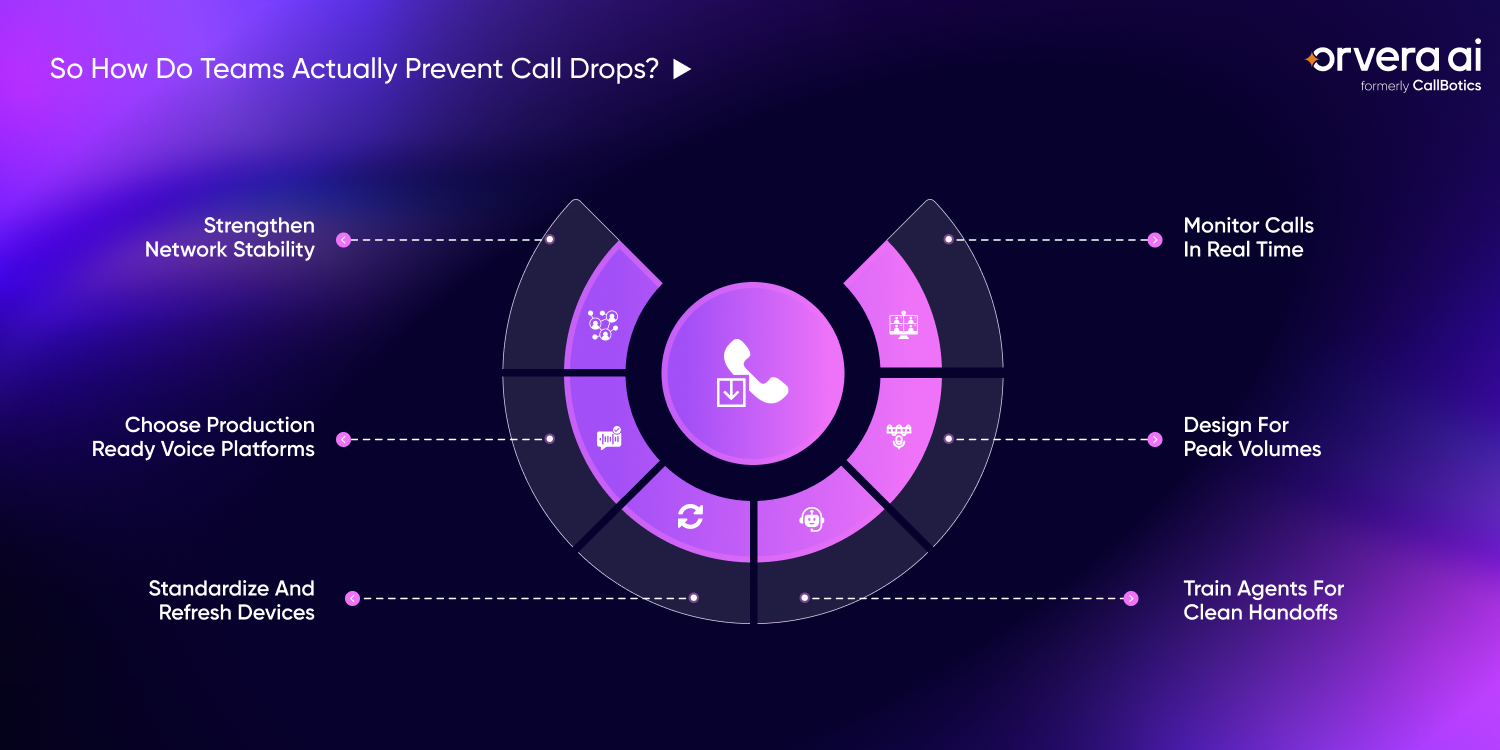
How to Prevent Call Drops
Prevention focuses on strengthening the entire voice ecosystem rather than addressing symptoms in isolation.
Improve Network and Internet Quality
Reliable bandwidth, redundancy, and quality controls reduce packet loss and session instability, especially during peak demand.
Use Reliable VoIP and Call Systems
Platforms built for high concurrency and complex contact center workflows handle real-world variability more effectively.
Maintain and Update Hardware Regularly
Standardized devices, proactive replacement cycles, and endpoint health monitoring reduce unexpected interruptions.
Monitor Call Performance in Real Time
Live visibility into call behavior enables faster detection and response before issues escalate across volumes.
Train Agents on Call Handling Best Practices
Clear escalation paths, disciplined transfer behavior, and consistent call flow management reduce avoidable disconnects and improve recovery when issues occur.
Call Drops in AI and Automated Calling Systems
As contact centers introduce automation into voice workflows, stability expectations increase. Automated systems handle volume efficiently, but they also introduce new failure modes if they are not designed for real operating conditions.
In AI-driven environments, a dropped call is not only a technical interruption. It disrupts workflow execution, data capture, and escalation logic. This makes reliability a design requirement rather than an optimization step.
Challenges With AI Call Stability
AI voice agents (opens in a new tab) operate continuously and at scale. This changes how instability shows up.
- Concurrency pressure: Automated systems often handle hundreds or thousands of simultaneous calls. If concurrency limits are not engineered properly, performance degrades under load.
- Long, multi-step conversations: Many AI implementations perform well for short routing tasks but struggle with longer interactions that include authentication, branching logic, or verification steps.
- Context sensitivity: Automated calls must maintain state across interruptions, pauses, and transfers. When systems fail to preserve context, calls disconnect or escalate unnecessarily.
- Escalation timing: Poorly designed handoffs between automation and human agents increase the likelihood of disconnection during critical transitions.
Importance of Smart Call Routing
Routing logic plays a central role in call stability. Smart routing reduces unnecessary transfers and minimizes exposure to failure points.
Effective routing systems:
- Match intent accurately early in the interaction
- Reduce mid-call transfers that increase disconnect risk
- Preserve context during escalation
- Adapt dynamically based on call conditions and system load
When routing is static or overly rigid, automated calls are more likely to terminate before resolution.
How Call Stability Breaks Down Across the Voice Stack
The table below outlines where instability typically occurs and what operational leaders should evaluate at each layer.
| Layer | Where Breakdowns Occur | What to Evaluate |
|---|---|---|
| Network | Bandwidth fluctuation, packet loss, tower handoffs | Redundancy, quality controls, peak load behavior |
| Platform | Session limits, routing logic, failover gaps | Concurrency handling, configuration discipline |
| Automation | Long flows, escalation logic, state management | Conversation design, fallback behavior |
| Endpoints | Device inconsistency, headset quality | Standardization, monitoring |
| Operations | Spikes, staffing imbalance, poor visibility | Forecasting, real-time dashboards |
This layered view helps leaders address root causes instead of treating symptoms in isolation.
Building More Reliable Voice Operations
Reducing disconnections requires coordinated action across technology and operations. Leaders who achieve measurable improvement focus on the following areas.
Design for Peak Conditions
Systems must be evaluated under worst-case scenarios, not average load. Peak billing cycles, outage events, and seasonal surges reveal weaknesses that remain hidden during normal operations.
Treat Visibility as a Core Capability
Real-time insight into call behavior enables faster intervention. Without visibility, teams rely on customer complaints or lagging metrics.
Reduce Complexity at Handoff Points
Every transfer introduces risk. Simplifying call flows and reducing unnecessary transitions lowers the chance of instability.
Align Automation With Human Workflows
Automation should support how agents actually work. When AI logic mirrors real contact center patterns, transitions become smoother and more reliable.
Preparing for the Next Stage of Voice Automation
As automation expands, reliability becomes a differentiator. Leaders evaluating AI voice systems should look beyond demo performance and ask:
- How does this system behave under sustained load?
- How does it handle long, branching conversations?
- How does it escalate without breaking context?
- How quickly can issues be detected and corrected?
These questions separate experimentation from production readiness.
How Orvera Helps Reduce Call Drops
Contact center leaders reduce instability by designing voice operations for real conditions, not ideal ones. Orvera strengthens call reliability by aligning automation with how contact centers actually operate under load, during peaks, and across complex workflows.
How Orvera improves voice stability in production environments:
- Designed around real contact center conditions: Orvera is built for high volume, shifting intent, and long multi-step conversations. It assumes interruptions, escalations, and concurrency from day one, which reduces breakdowns during live operations.
- Production-ready deployment in 3 to 6 weeks: Faster go-live reduces prolonged pilot phases where instability often persists. Teams move quickly into monitored, optimized production states where issues are identified and corrected early.
- End-to-end resolution for structured conversations: Orvera resolves complete workflows within the call. Fewer transfers reduce exposure to disconnect risk during mid-call handoffs.
- Real-time sentiment awareness: Built-in sentiment analysis adjusts tone and escalation paths dynamically. This helps maintain conversational continuity during emotionally charged or complex interactions.
- Unified logic for inbound and outbound calls: Using the same conversation logic across call types reduces configuration sprawl and inconsistency, which often introduce reliability gaps.
- High concurrency handling without degradation: Orvera is designed to scale across concurrent calls while maintaining consistent performance, even during demand spikes.
- Built-in quality and analytics visibility: Every call becomes measurable. Real-time dashboards and QA visibility help teams identify emerging instability before it impacts large volumes.
- Clear escalation paths that preserve context: When automation hands off to human agents, Orvera passes full context. This reduces repeat explanations and minimizes disconnect risk during transitions.
For deeper operational insight, teams often reference Orvera resources such as the AI-First Contact Center Operating Model, production deployment case studies, and blogs on voice automation reliability and QA visibility.
For example, a national record retrieval enterprise reduced costs by 64% while achieving a 76% success rate using (opens in a new tab)Orvera (opens in a new tab)’s AI voice agents. (opens in a new tab)
Next Steps Forward
Voice reliability is not a background technical concern. It is a visible measure of operational maturity.
Organizations that reduce dropped interactions consistently do three things well. They design for peak conditions, maintain real-time visibility, and align automation with human workflows. When these elements work together, voice operations become predictable, scalable, and easier to manage.
As contact centers adopt automation at greater scale, stability becomes the foundation that supports resolution, efficiency, and customer trust. The right systems and practices turn voice from a source of risk into a controlled, measurable advantage.
Frequently asked questions
Call drops typically occur due to a combination of network instability, platform configuration gaps, hardware limitations, traffic spikes, and software behavior. The risk increases during peak demand and complex workflows.
Teams calculate call drop rate by tracking the percentage of calls that disconnect before completion. Reviewing this metric across call types, queues, and time windows helps isolate patterns.
Yes. Unexpected disconnections increase customer effort, reduce confidence, and often lead to repeat calls. Over time, this negatively impacts satisfaction and loyalty.
Prevention requires coordinated improvements across network quality, call platforms, device standards, real-time monitoring, and agent workflows. Addressing only one area rarely delivers sustained results.
Orvera improves reliability by resolving complete workflows end to end, scaling across concurrent calls, preserving context during escalation, and making call performance visible in real time. This operational focus reduces instability across automated and human-assisted interactions.