Beyond Deflection: Why Resolution is the New Standard for AI Claim Status Inquiries
Claim status is the highest repeat-contact driver in claims because the answer your rep reads on screen is never the answer the caller actually needs...

Key highlights
TL;DR - Why resolution beats deflection on claim status calls
- Claim status is the highest repeat-contact driver in claims because the answer your rep reads on screen is never the answer the caller actually needs.
- Deflecting a status call moves the caller somewhere else. Resolving it closes the caller's question on the call they already made, with a specific next step and a specific date.
- A rep with the claim open cannot give a date because the date does not live in the claim record. It lives across four or five separate systems, none of which feed the claims system of record in real time.
- Conversational AI for claims processing stays inside regulatory boundaries when every response is grounded in approved knowledge, audited at 100%, and governed under a documented compliance posture.
- A carrier that needs claim status resolved at first contact should buy a platform that is built, integrated, and run on its behalf, with the conversation flows, integration layer and quality management maintained by the vendor.
- When claim status calls resolve at first contact, repeat contacts per claim fall, containment on status inquiries rises, and status communication obligations inside the 45-day cycle improve.
- The AI agent transfers a claimant to a human rep the moment the inquiry crosses into a decision that requires licensed judgment or policy authority.
- Coverage disputes, denial questions, and supplement disagreements go to a licensed human rep every time, without exception.
- A resolution-first status line stops the repeat-contact loop that a deflection-only approach never touches, and full deployment lands in three to six weeks.
Why is claim status the highest repeat-contact driver in claims?
Claim status is the highest repeat-contact driver in claims because the answer your rep reads on screen is never the answer the caller actually needs.
The rep pulls the claim, checks the last file note, scans the payment ledger, confirms the estimate status. That takes two to three minutes of handle time. And then they cannot give a date, because the date sits with a field adjuster who has not updated the system or a vendor whose estimated time of arrival has not been entered. The call ends with a promise to call back, which is not a resolution. It is a scheduled repeat contact.
That callback becomes an inbound call the next morning. And if the adjuster still has not moved the file, it becomes a third. Across a high-volume claims floor, that compounding is where your cost-per-contact bleeds out.
A traditional Interactive Voice Response (IVR) reads a status code back, and the member calls again. The caller hears "your claim is in review" and presses zero, because that phrase answers nothing. The contact is now counted twice, the rep still cannot give a date, and your IVR containment metric looks fine while your repeat-contact rate stays exactly where it was.
This is why the conversation around AI voice agents for insurance claims has moved away from how to deflect a status call and toward how to actually finish one.
What is the difference between deflecting a status call and resolving it?
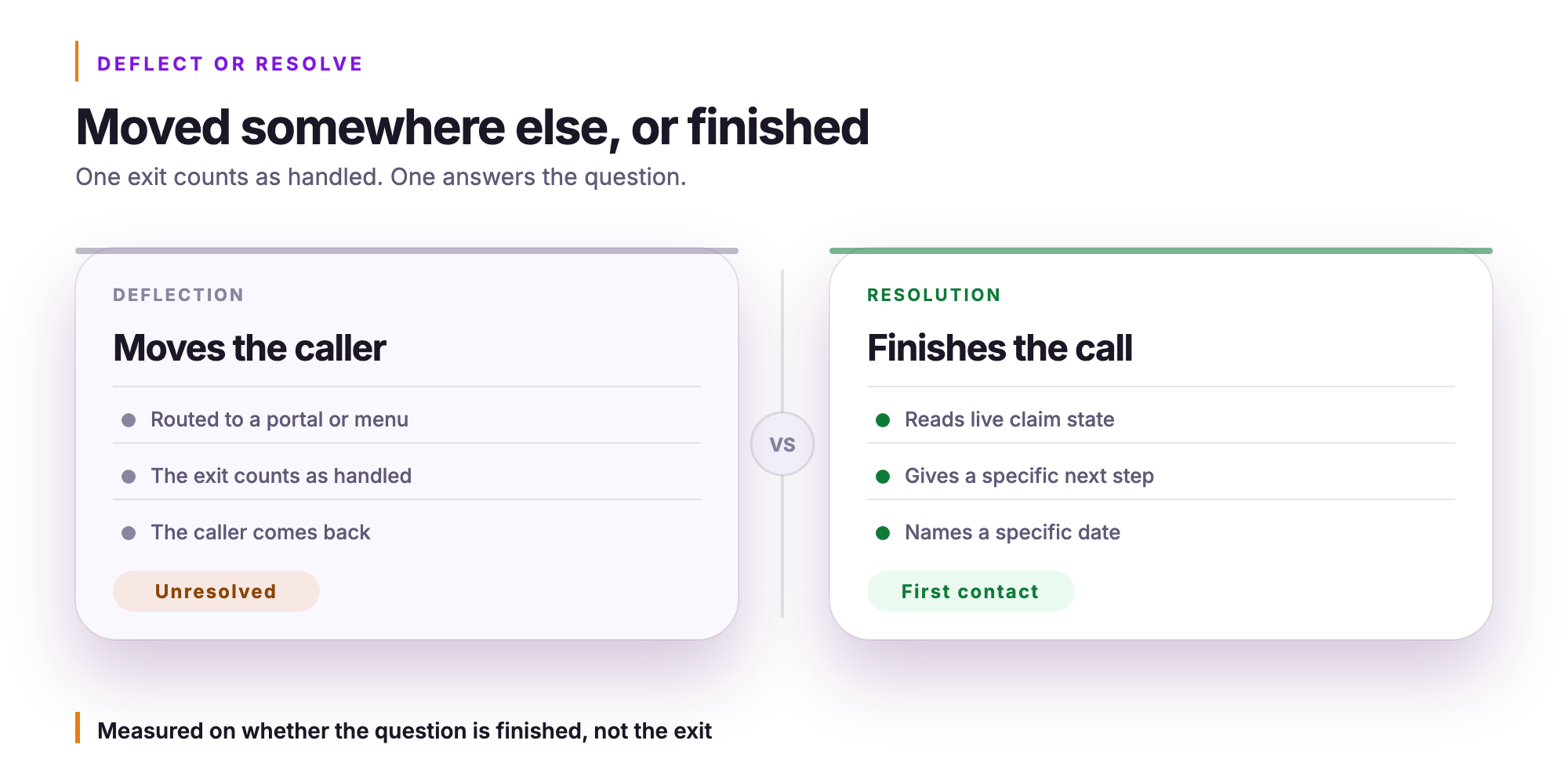
Deflecting a status call moves the caller somewhere else. Resolving it closes the caller's question on the call they already made, with a specific next step and a specific date, before they hang up.
Deflection is the practice of routing a claimant to a self-service portal or a scripted menu and counting that exit as a handled contact. In practice, the claimant who cannot find their answer in the portal presses zero, reaches a human rep, and the contact center logs two touches for one unresolved question. The first touch inflates containment metrics. The second touch inflates cost per contact. Neither touch resolved anything.
Resolution is a different standard entirely. Automated claim status inquiry solutions built around resolution read live claim state, not a cached file note, and return the specific answer the caller is asking for: the payment amount, the next inspection date, the vendor assigned. A scripted voicebot reads a status code. A resolution-focused AI agent reads the actual claim state and translates it into a next step the claimant can act on.
That single shift in measurement changes every design decision downstream, from which systems the platform connects to, to what the AI agent says when the answer is not yet available.
Why can a rep with the claim open still not give the claimant a date?
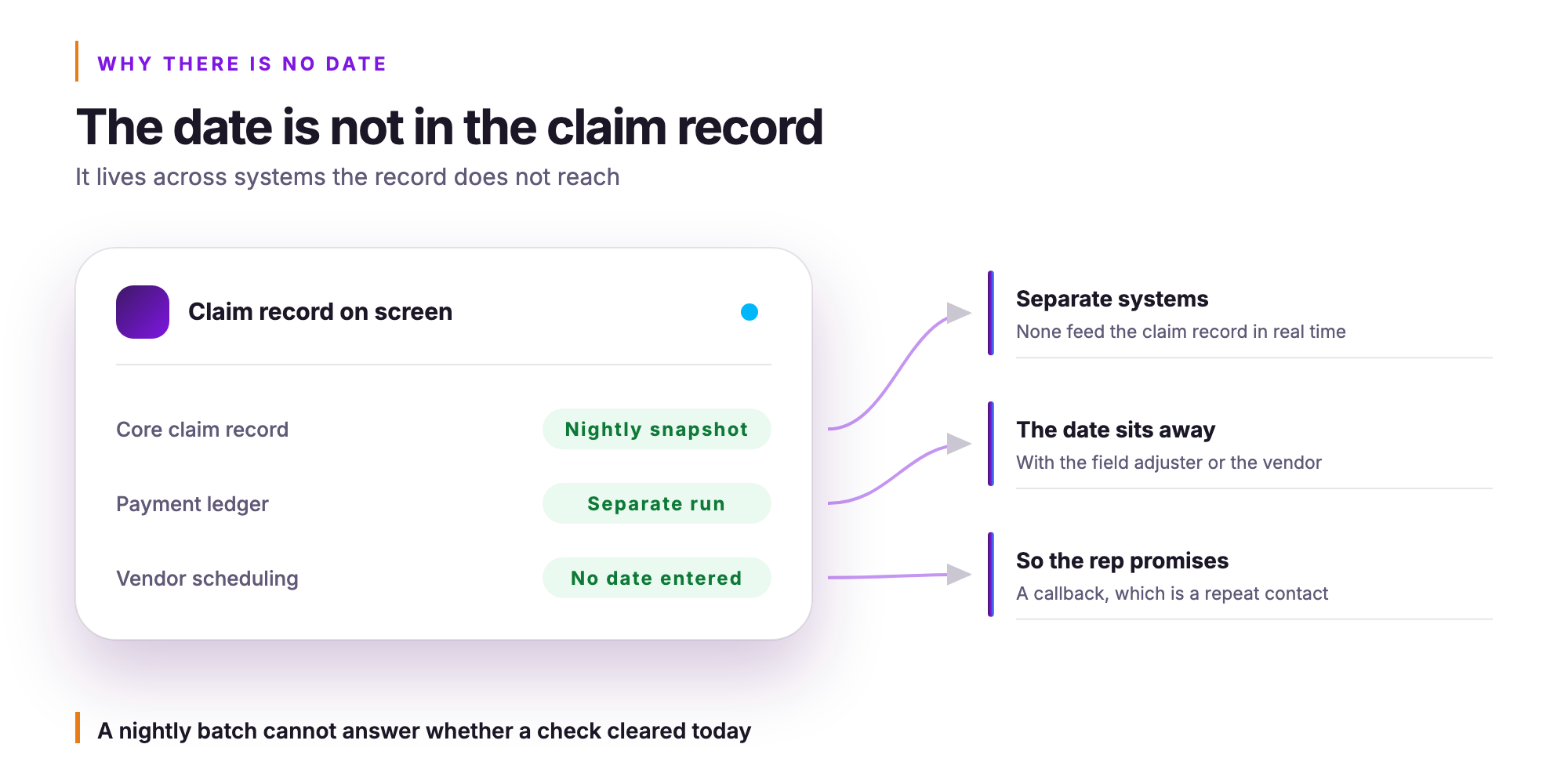
A rep with the claim open cannot give a date because the date does not live in the claim record. It lives across four or five separate systems, none of which feed the claims system of record in real time.
Fragmented data is the structural problem. The claim status your rep reads in Guidewire ClaimCenter or Duck Creek Claims reflects a nightly snapshot of the core claim record. The payment ledger runs on a separate schedule. The repair estimate sits in a third system. Vendor scheduling, where the field adjuster or body shop holds the appointment, is a fourth. A nightly batch is not enough when a caller wants to know whether a check cleared this morning or whether the reinspection is confirmed for this week.
The gap between data and voice is where "your claim is in process" is born. Your rep reads the last file note, checks the payment status, and finds no confirmed date because the vendor has not yet pushed an appointment back into the claim record. The honest answer is a callback promise, which creates the repeat contact you are already measuring. In practice, managed model coordination for regulated contact centers addresses this by connecting an AI agent to live data feeds across all four systems, so the answer the caller hears reflects current state, not last night's batch.
The practical outcome is a conversation that ends with a specific next step. Not "we are working on your claim" but "your reinspection is scheduled for Thursday and payment processes within three business days of that inspection closing." That is the standard a well-configured AI voice agent can meet when it is grounded in live data.
How do you keep an automated claim conversation inside the rules?
Conversational AI for claims processing stays inside regulatory boundaries when every response is grounded in approved knowledge, audited at 100%, and governed under a documented compliance posture.
The failure mode most carriers discover after deployment is not a hostile caller. It is an AI agent that improvises. When the knowledge base has a gap, an ungrounded system fills it with a plausible-sounding answer. In a regulated claims environment, a plausible-sounding answer about a settlement timeline or a coverage determination is a liability. The agent must be constrained to respond only from approved, version-controlled content tied to the specific claim record and the carrier's policy language. No improvisation, no inference beyond the data returned.
The compliance framework supporting a carrier's regulatory obligations includes four requirements:
- Grounded responses only. Every answer the AI agent returns traces to an approved knowledge source or a live system-of-record lookup. The agent does not generate a response when no approved answer exists. It escalates to a human rep instead.
- SOC 2 Type II certified and HIPAA compliant.The platform is SOC 2 Type II certified, HIPAA compliant, and GDPR compliant, covering both voice and digital channels.
- 100% conversation auditing. Quality management runs on every conversation, AI-handled and human-handled alike. A sampled audit cannot surface a systemic compliance gap. Full auditing can.
- Documented escalation rules. Any conversation that reaches a boundary the agent cannot resolve within approved parameters transfers to a human rep, with the full conversation context intact.
That audit coverage matters beyond compliance. It produces the data set a carrier needs to improve containment over time.
Should a carrier build this on an API or buy a platform that is run for them?
A carrier that needs claim status updates resolved at first contact should buy a platform that is built, integrated, and run on its behalf, with the conversation flows, integration layer and quality management maintained by the vendor.
The build path looks attractive on a slide. In practice, it transfers the operational burden. A self-built voice AI requires an internal team to write and version the conversation flows, retune the natural-language models when claims system fields change, maintain the integration layer every time a claims platform is patched, and monitor containment daily. That team does not exist in most claims contact centers, and the skills are not adjacent to adjudication. What begins as a six-month project routinely becomes a standing engineering commitment with no clear owner.
The alternative is a platform that is run for the carrier after go-live. Orvera AI is built on the carrier's existing stack, integrated with the claims system of record, and run as a managed operation from greeting to resolution. The voice AI, Agent Assist, and 100% automated quality management run together, on the integrations the carrier already owns, without requiring the carrier to staff a separate AI operations function.
The distinction between software and a run operation matters most in regulated claims environments. 18+ years of contact-center experience is the reason a vendor can govern the conversation, hold containment, and keep every interaction audited.
Which metrics actually move when claim status calls get resolved?
When claim status calls resolve at first contact, three numbers shift immediately: repeat contacts per claim fall, containment on status inquiries rises, and the percentage of status communication obligations met inside the 45-day cycle improves.
The instinct is to measure average handle time.
Repeat contacts per claim is the metric that exposes that pattern. A platform that resolves the inquiry once, pulling live data from the claim file and the payment ledger, produces a lower repeat-contact rate than a short call that leaves the claimant with a promise.
Calls contained on status without transfer is the second number that moves. In practice, containment on status inquiries rises when the AI agent has verified access to the adjuster notes and vendor status records, which is where the operational shift becomes visible.
The third shift is quieter but consequential. Status communication obligations inside the 45-day cycle can be met through outbound proactive contacts rather than waiting for the claimant to call in, which changes the obligation from reactive to systematic.
And that last point connects directly to licensed adjuster capacity. When status inquiries no longer consume adjuster time, that capacity returns to coverage analysis and complex adjudication.
When should the agent hand the claimant to a human?
The AI agent transfers a claimant to a human rep the moment the inquiry crosses into a decision that requires licensed judgment or policy authority.
Claim status is a data retrieval task. Coverage disputes, denial questions, and supplement disagreements are not. Those three categories go to a licensed human rep every time, without exception. The boundary is not a configuration setting your team argues over at launch. It is a fixed rule, defined in advance, and enforced consistently across every call.
The escalation path runs in a defined order. The AI agent recognizes the trigger, states the transfer to the claimant, and moves the conversation to the queue. The full transcript, the claim number, the file context pulled during the call, and any payment or estimate data already surfaced travel with the transfer. The claimant does not repeat their name, their claim number, or the question they already asked. The human rep picks up a call that is already in context.
And the human rep is not working alone. Agent Assist runs behind the rep from the moment they pick up, surfacing approved knowledge, flagging next-best actions, and identifying escalation cues in real time. A denial explanation that requires policy language gets the relevant passage surfaced to the screen before the rep reaches for it. That reduces handle time on the calls that genuinely require human judgment, which is the population where handle time most affects CSAT.
What does a resolution-first status line change for a claims operation?
A resolution-first status line stops the repeat-contact loop that a deflection-only approach never touches, and that single shift changes the economics of the entire claims contact center.
The most immediate change is structural. When the AI agent reads live claim state from the system of record and commits to a specific date rather than a file note summary, the claimant has no reason to call back tomorrow. The status queue stops generating its own follow-up volume. That is not a marginal improvement. In practice, repeat contacts on status inquiries account for a disproportionate share of total inbound volume, and every one of those calls carries full handle time and full staffing cost.
Capacity returns to your human reps. When status volume contains at first contact, the reps who were absorbing the second and third call on the same claim are freed to work the inquiries that genuinely require licensed judgment, negotiation, or policy authority. That is where experienced reps generate the most value, and a resolution-first status line is what gives them the space to do it.
Deployment timeline for a full enterprise configuration, including system-of-record integration, knowledge-base setup, escalation routing, and quality management, runs three to six weeks. That window covers a managed deployment with the integration, knowledge base and quality management in place.
What should a claims leader take away from this?
A claims operation that measures resolution stops the repeat-contact loop driving the highest volume in your queue.
- Resolution is the metric that matters. A contact counted as contained but unresolved returns to the queue tomorrow. First-contact resolution, measured against the system of record, is the only figure that tells you whether the inquiry is actually finished.
- Live claim state is what makes a specific date possible. An AI voice agent reading a static data extract gives a claimant the same non-answer a rep does. Reading directly from the claims management system, at the moment of the call, is what converts a status inquiry into a date the claimant can hold.
- The escalation boundary is a design decision. When a claim crosses into licensed judgment or policy authority, the AI agent transfers with a full conversation summary and no cold handoff. That boundary is defined before deployment, not discovered mid-call. It is a deliberate operating parameter, not a failure state.
- Orvera AI builds, deploys, and runs the operation. Full deployment lands in three to six weeks on the stack your claims contact center already runs. Your representatives handle the contacts that require judgment. Orvera resolves the rest, from greeting to resolution, on voice, chat, email, messaging, and every other channel.
Frequently asked questions
An AI voice agent running automated insurance claims status calls reads directly from your system of record through a live API connection, so the caller hears the current file state, not last night's batch.
Voice AI for insurance claims processing routes coverage and denial questions to a licensed human rep every time, without exception. A coverage dispute, a denial question, or a supplement disagreement falls outside the boundary immediately.
Voice AI for automated insurance claims resolves the call. Containment means the caller never reached a human rep. Resolution means the caller's question is finished, the next step is named, and the date is specific.
Every AI-handled status call is logged as a pertinent communication in the claim file, complete with a full transcript and a structured summary tied to the claim number.
Voice AI for automated insurance claims scales to meet surge volume without hold-time collapse, because capacity is not a headcount equation. Adjuster capacity stays on the complex work.
Orvera AI deploys a claim status automation operation in three to six weeks, and the carrier builds nothing. Orvera handles the build, configuration, and operation on the stack already in place.

Written by
Anindita Majumder
Anindita Majumder is a communications professional with nearly four years of experience in public relations, corporate communications, and journalism. She creates content that helps brands communicate their vision, products, and expertise through press releases, thought leadership, and editorial pieces. Outside of work, she is a vocalist, which keeps her creativity flowing.