
How an AI Agent Builds Competitive Offer Intelligence from Live Calls for ISPs
The retention floor hears every competitor offer first, and the task is to retain what it hears, organized by market and week.

Key highlights
- The retention floor hears every competitor offer first, and the task is to retain what it hears, organized by market and week.
- Competitive offer intelligence from live calls is the structured record of every competitor comparison a subscriber speaks aloud, captured from the conversation itself, across every audited call your floor handles.
- When a subscriber names a competitor on a live call, the platform captures the comparison, tags the market and week, surfaces the approved retention offer to the human rep, and logs the transcript and summary before the call wraps.
- A single disconnect call, handled correctly, becomes a structured data point that reaches your offer team before any research cycle reports the promotion.
- How to handle competitor mentions on live calls comes down to four operator-defined rules, each paired with a specific platform action that runs automatically from the moment the subscriber names a rival.
- Orvera AI builds, deploys, integrates, and runs the platform on the operator's behalf as a managed service, with full enterprise deployment landing in three to six weeks.
- Four metrics tell a retention leader whether competitive offer intelligence is producing a result, and each one connects to a specific step in the sequence from live call to market decision.
- Comparisons captured with every field filled
Why do competitor offers quoted on live calls take weeks to reach the leaders who set retention offers?
The retention floor hears every competitor offer first, and the task is to retain what it hears, organized by market and week.
A subscriber on a disconnect call tells your representative exactly what a rival is offering: a faster fiber tier, a lower monthly rate, a promotional term that ends in a few months. Your representative has seconds to answer. That detail is live, specific, and actionable, but what happens to it next determines whether it ever reaches anyone who can act on it.
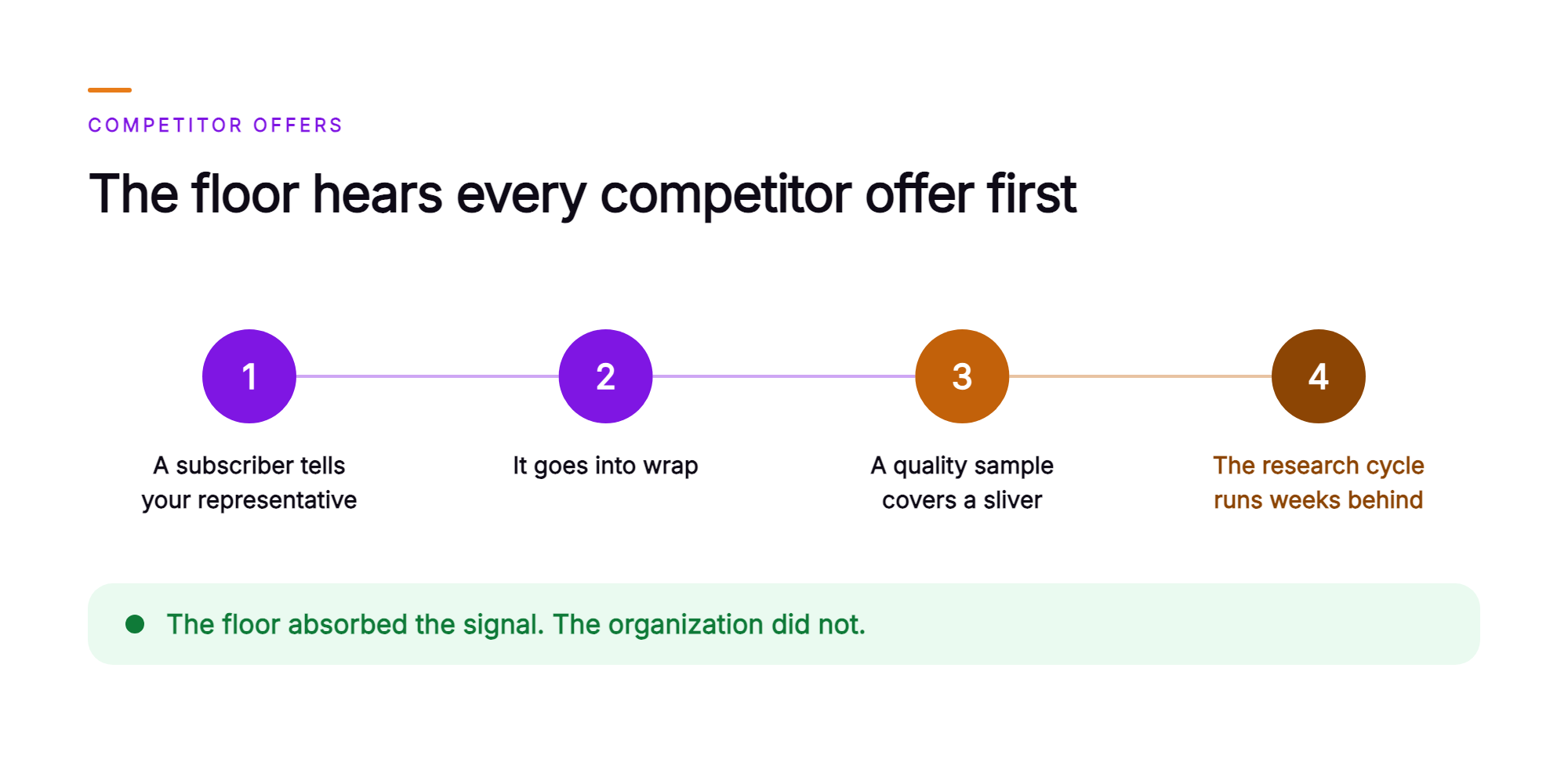
Currently, it goes into wrap. A drop-down code that reads competitor offer. A typed note if the representative had a spare moment after closing the conversation. And then a quality sample that covers a sliver of the week's calls, scored for tone and process, not for what the subscriber said the market was offering.
The teams who set retention offers are not reading those notes. They are waiting on the market-research cycle, which runs weeks behind the floor. By the time a new promotion surfaces in a report, your representatives have already heard about it from hundreds of subscribers. The floor absorbed the signal. The organization did not.
Competitive offer intelligence AI closes that gap. It works in parallel with the research cycle, capturing what your representatives already hear on every call, the competitor named, the offer type, the rate comparison, the promotional term, and tagging it to a market and a week before it disappears into wrap. The following section defines what that record looks like and how it is built from the conversation.
What is competitive offer intelligence from live calls?
Competitive offer intelligence from live calls is the structured record of every competitor comparison a subscriber speaks aloud, captured from the conversation itself, across every audited call your floor handles.
The record carries specific fields: the competitor named, the offer type, the speed tier quoted, the monthly rate the subscriber mentioned, the promotional term attached to that rate, the subscriber's market, and the week the conversation took place. Those fields are lifted from the spoken exchange while the call is still running. The market tag pulls directly from the account record the operator already holds, so attribution is automatic. The representative stays with the subscriber, and the platform does the logging.
That precision is what makes the record usable by the people who set the offers. The retention leader who reviews it on Monday morning sees competitor mentions by market and by week, sourced from the actual call population, counted in full. And because the record is built on every audited conversation the floor handles, the coverage is complete. Common in real-time objection handling for ISP sales is the challenge of capturing that comparison before the call closes and the context disappears. Agent Assist captures the transcript and metadata (opens in a new tab) at the moment of the interaction, so the field is written before wrap ends.
The following section explains what the platform does when a subscriber names a competitor on a live call.
What does the AI platform do when a subscriber quotes a competitor on a live call?
When a subscriber names a competitor on a live call, the platform captures the comparison, tags the market and week, surfaces the approved retention offer to the human rep, and logs the transcript and summary before the call wraps.
The platform audits every conversation, whether a human rep handled it or an AI agent resolved it. That coverage matters. Automated competitive intelligence from customer interactions only holds when the record draws from the full call population, audited call by call. The platform reads each conversation for a competitor comparison spoken in plain language. The subscriber may name a specific tier and rate. They may only say the other company offered them more for less. Both statements produce the same result: a structured record with fields written before wrap ends.
Those fields carry the competitor named, the offer type, the speed tier referenced, the rate comparison, and the promotional term. Each record is tagged to the market and the week. The automated conversation summary carries the same detail, so the record is readable in the weekly market view from that summary alone.
And on the live call itself, the picture changes for the human rep. Agent Assist surfaces the approved retention offer for that market from the knowledge base, recommends the next-best action, and flags the escalation cue when the call belongs with a save specialist. What that looks like in practice on a save desk is described in how real-time guidance works during a save call (opens in a new tab). The next section walks one disconnect call through that sequence, from the subscriber quoting a rival to the comparison landing in the weekly market view.
How does one save call become a line in the weekly market view?
A single disconnect call, handled correctly, becomes a structured data point that reaches your offer team before any research cycle reports the promotion.
The sequence begins when a subscriber on a disconnect call informs your human rep that a rival offers a faster speed tier on a promotional term and requests a match. Agent Assist reads the conversation in real time, surfaces the approved retention offer for that market from the knowledge base, and recommends the next-best action. The human rep presents the offer. The call closes with a structured summary already written: competitor name, offer type, speed tier, rate, promotional term, market, and week, all attached before wrap ends. Every field comes from the subscriber's own words.
That same rival promotion surfaces through other human reps working the same market across the week. Each call adds another row. By Friday, the weekly market view shows that market's competitor-mention count climbing while neighboring markets stay flat. The pattern is visible in the roll-up itself. Agent Assist captures the summary and metadata at the moment of interaction (opens in a new tab), so the count reflects every call the floor handled in that market.
The retention leader reviews the market and week roll-up and sends it to the offer and marketing teams. This is where agentic AI for telecom contact centers changes the timing. The promotion your floor heard on Monday reaches the people who set counter-offers by the following week, ahead of the report that will confirm it. The next section covers exactly which rules the operator sets to make that sequence repeatable.
Which rules does the operator set, and what does the platform do under each one?
How to handle competitor mentions on live calls comes down to four operator-defined rules, each paired with a specific platform action that runs automatically from the moment the subscriber names a rival.
The rules are simple. They are decisions your team makes once, written into the platform configuration, and the platform executes them consistently across every call the floor handles. Each rule below states what the operator sets and what Agent Assist does under it.
- Weekly cadence for the offer team. The operator sets a fixed day for the market and week roll-up to reach offer and marketing leaders. The platform holds the structured report log, the call-level summaries, and the aggregated competitor counts ready for that delivery, so the offer team receives a complete picture on schedule, assembled automatically.
- Approved offer only. The operator sets the rule that only the retention offer approved for the subscriber's market may be presented on a live call. Agent Assist surfaces exactly that offer from the approved knowledge base during the conversation, putting the rate approved for that market in front of the rep who answers the subscriber.
- Structured capture on every comparison. The operator sets which fields must be written for every competitor quote: competitor name, offer type, speed, rate, promotional term, market, and week. The platform writes those fields from the conversation itself before wrap ends.
- Save specialist escalation. The operator defines which disconnect calls carrying a competitor quote belong with a save specialist. Agent Assist flags the escalation cue live and generates the call summary the specialist reads before picking up, so the comparison and the market are already in front of them. That same live escalation and summary capability (opens in a new tab) is working alongside a newer rep the first time they take a high-stakes save call.
The rules your team sets today determine what the weekly market view contains next Monday. The question that follows is who builds, deploys, and runs the platform that executes those rules reliably across every call your floor handles.
Why does a cable or ISP operator want the platform built, deployed and run for it?
Orvera AI builds, deploys, integrates, and runs the platform on the operator's behalf as a managed service, with full enterprise deployment landing in three to six weeks.
Your team defines the rules. Running them reliably across every save call, every market, every week is the work a managed service takes on. Orvera AI operates the floor's tooling for the operator, drawing on 18+ years of contact center operating heritage. That history is why the real time call analytics the platform delivers carry the precision of a team that has staffed a live retention queue.
The platform audits every conversation, whether a human rep handled it or an AI agent resolved it. Full report logs, summaries, and transcripts are kept for every interaction. A retention leader reviewing a market roll-up the following Monday is reading from the complete record of that week's calls.
Deployment connects to the systems the operator already runs through 500+ integrations across CCaaS, CRM, helpdesk, ITSM, and every other category an enterprise contact center depends on. Enablement spans onboarding, knowledge-base setup, rep training, and change management. The platform is SOC 2 Type II certified, HIPAA compliant, and GDPR compliant, so the conversation data that feeds the weekly market view is handled under the compliance posture regulated operators require before AI touches a customer conversation.
The question that follows is which numbers tell a retention leader that the intelligence is actually working.
Which numbers tell a retention leader the intelligence is working?
Four metrics tell a retention leader whether competitive offer intelligence is producing a result, and each one connects to a specific step in the sequence from live call to market decision.
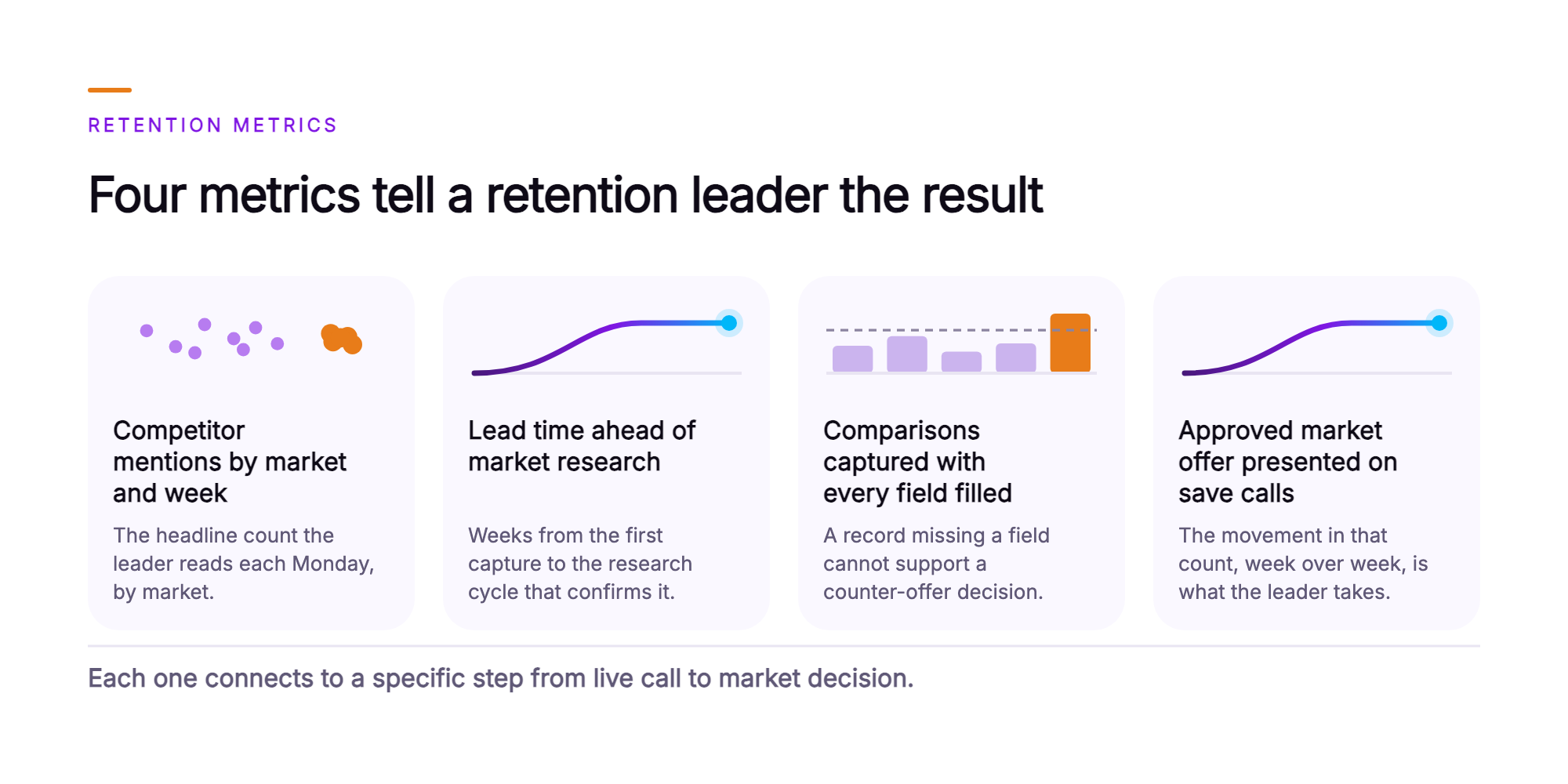
Lead time ahead of market research is the number of weeks between the platform's first capture of a new competitor offer in a given market and the formal research cycle that later confirms the same offer. That gap is what makes the intelligence actionable while the promotion is still running.
Comparisons captured with every field filled counts records that carry competitor name, offer type, speed tier, rate, promotional term, market, and week. A record missing one of those fields cannot support a counter-offer decision, so this metric is the direct measure of whether the captured data is ready to use.
Save calls where the approved market offer was presented counts calls on which Agent Assist (opens in a new tab) surfaced the approved counter-offer and the human rep presented it, connecting the intelligence cycle back to the floor outcome that justifies the investment. The movement in that count, week over week, is the number a retention leader takes to the leadership team. The next section assembles those four numbers into the case the leader makes in that room.
What does the retention leader take to the leadership team?
The case a retention leader makes in that room is stronger when every number on the slide comes from the floor itself, captured on the calls the operator handled that week.
The four points below hold today. Each one describes what the platform produces, stated precisely enough that you can read any of them aloud to a skeptical CFO or a chief revenue officer without needing the article around it for context.
- Competitor comparisons are captured from every audited conversation. The competitor named, the offer type, the speed tier, and the rate the subscriber quoted are extracted automatically and tagged to market and week, so the count reflects what every caller actually said.
- The intelligence reaches the offer team ahead of the market-research cycle. Promotions your floor hears on Monday are available in the weekly market view before the research report that will confirm them arrives.
- Every conversation is audited, human-handled and AI-handled alike. The count covers the whole floor, so the leadership team is working from the full call population when it sets the counter-offer.
- Orvera AI builds, deploys, and runs the platform on the systems the operator already runs, with full deployment in three to six weeks. The operator sets the markets, the approved offers, and the weekly cadence. Orvera runs the rest.
What the retention desk looks like once that intelligence runs every week is the next question.
What does the retention desk look like once the intelligence runs every week?
The retention desk that runs competitive offer intelligence from live calls moves first and sets the counter-offer before the research report confirms what the floor already heard.
The weekly market view is delivered on Monday. The offer team reads which competitors were named in each market, which promotional rates came up, and which terms subscribers cited as reasons to disconnect. Adjustments to approved counter-offers go into the system before the week's save calls begin. Your human reps present that offer on a live call with the comparison already logged, the context already structured, and the platform carrying what a subscriber said Friday straight into what the offer team decided over the weekend.
The desk reaches that position ahead of the research cycle. The data came from the calls the floor handled, captured at the moment of the interaction, tagged by market and week, and assembled into the view the offer team reads. The intelligence is continuous. A promotional window your team hears about on Tuesday is in that week's competitor-mention count.
Orvera AI builds the platform, deploys it on the systems your operation already runs, and manages it from there. The leader's part is to name the markets, define the approved offers, and set the weekly cadence. Orvera runs the rest.
To see what that looks like on your floor, talk to the team (opens in a new tab).
Frequently asked questions
Agentic AI competitive intelligence for telecom captures the competitor named, the offer type, the speed tier, the monthly rate quoted, the promotional term, the subscriber's market, the week, written into structured fields, and the automated conversation summary on every call. The platform reads the comparison as the subscriber speaks it in plain language. A caller who says only that the other company offered more for less is captured alongside one who names the exact tier and rate. Both comparisons land in the same fields. That capture runs on every conversation, whether a human representative or an AI agent handled it. The transcript, the summary, and the structured fields are logged and available for review after the call closes. How each mention is then attributed to a market and a week is where the value compounds for retention leaders reading movement across their footprint.
Automated competitor offer extraction from live calls assigns each mention to a market and a week using data the operator already holds, and the platform does that tagging itself from go-live onward. The market comes from the subscriber's account record. The platform reads the service address and applies the operator's own market definition, whether that is a footprint, a region, or a node. That definition is configured once during deployment and applied to every mention that follows. The week is the week when the comparison was spoken. The roll-up counts mentions by market and week, so a retention leader reads each market's movement from one period to the next in that same view. In practice, the result is a structured view of competitive pressure by geography and time. How the approved offer then reaches the rep during that same conversation is where attribution turns into action.
Real-time competitive insights for ISP contact centers reach the retention leader and the teams who set approved offers through the reporting and observability layer, with the full report log, conversation summary, and transcript behind every count. The record is written at the moment the conversation is audited, and that audit covers every conversation the operator handles. The current week's count is readable while that week is still open. Agent Assist surfaces the approved offer to the human rep during the same conversation where the comparison was spoken. The floor acts on what the platform captured before the call closes. That same audit record, covering every channel Orvera AI runs, is what the next section addresses.
The platform audits every conversation across every channel, including voice, chat, email, and messaging, whether a human rep or an AI agent handled it, and the competitor comparison sits as a structured field on that same record. Retention leaders who want to know how to track competitor pricing mentions in live calls read them from the quality audit that runs on every call. The audit record already holds the full report log, the conversation summary, and the transcript. The competitive comparison field is part of that same record, and one automated audit writes all of it. That consistency matters for quality review. The scorecard and the competitive capture come from one source, so a leader reading the week's mentions is reading the same record that scored the call. A coach reviewing a call sees the competitor comparison alongside the score. What connects that audit record to the systems your team already runs is addressed in how Agent Assist generates summaries and how those records flow downstream. The integration layer behind that connection is where the next section begins.
An enterprise agentic AI platform for telecom customer retention connects to the CCaaS, CRM, and helpdesk systems the operator already runs, with Orvera managing the integration as part of deployment. Orvera connects across 500 plus enterprise systems. One integration program spans every channel and data source. The market tag on every competitor mention arrives from the account record the operator already holds, so the comparison is attributed to a geography while human reps stay on the conversation. The governed model layer is model-agnostic. When a stronger foundation model becomes available, the operator adopts it inside the stack already running. That same principle applies to how the platform supports newer reps during live conversations, surfacing approved knowledge inside the tools they already use. What deployment looks like in practice, including the timeline and what the Orvera team configures on the operator's behalf, is what the next section covers.
Can AI agents identify competitor retention offers from live calls? Yes, Orvera builds, deploys, integrates, and runs the full platform on the operator's behalf, with deployment landing in three to six weeks. Enablement spans onboarding, knowledge-base setup loaded with the approved retention offers by market, representative training, and change management. The operator's team reads results. Orvera's team configures the stack. The platform is SOC 2 Type II certified, HIPAA compliant, and GDPR compliant, with documentation available to procurement on request. Eighteen-plus years of contact center operating experience sits behind the team doing the work.

Written by
Anindita Majumder
Anindita Majumder is a communications professional with nearly four years of experience in public relations, corporate communications, and journalism. She creates content that helps brands communicate their vision, products, and expertise through press releases, thought leadership, and editorial pieces. Outside of work, she is a vocalist, which keeps her creativity flowing.


