Nesting Compression: How Live Agent Assist Gets New BPO Agents to Contracted Numbers Sooner
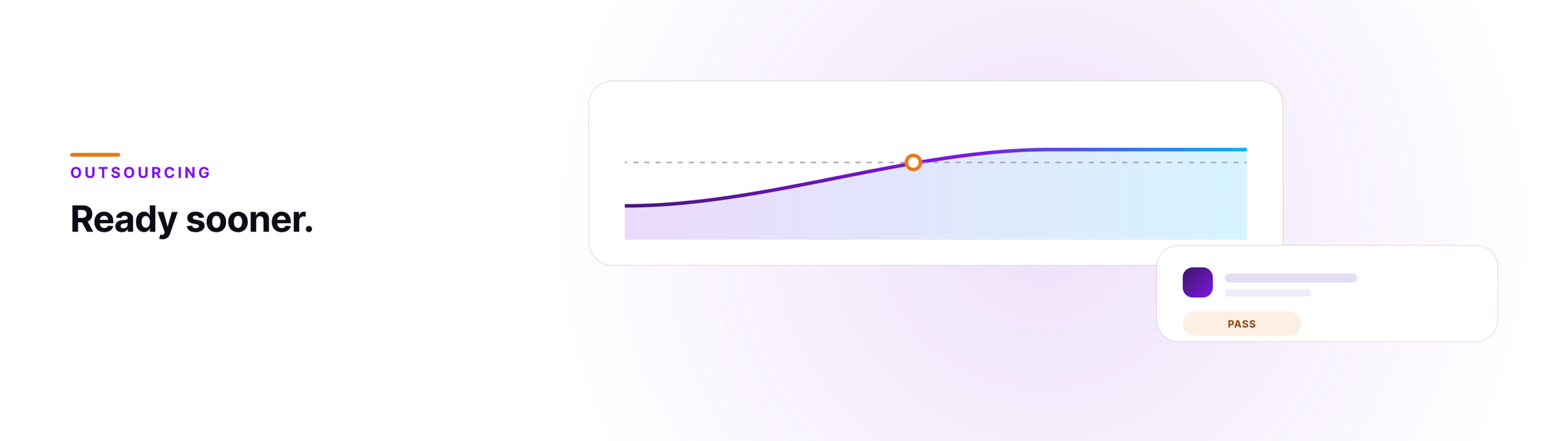
Nesting is cost the contract does not pay for. Live assist moves approved knowledge into the conversation, so a new agent performs closer to a tenured one sooner.

Key highlights
Nesting Compression: How Live Agent Assist Gets New BPO Agents to Contracted Numbers Sooner
- Classroom completion and floor competence are different things, and the gap between them is where ramp time goes.
- Nesting is cost the contract does not pay for, which makes ramp time a margin question and not only a training one.
- Nesting compression means a new agent reaches the contracted numbers sooner, not that training is cut shorter.
- Agent Assist surfaces approved knowledge, recommends next-best actions, flags escalation cues and generates automated summaries during the call.
- Across Orvera AI’s customer engagements, average handle time falls 8% to 15% within the first 90 days of the engagement, largely through Agent Assist.
- That figure is an average across those engagements, not a per-account guarantee.
- Whether the guidance is landing is answerable only if every conversation is scored, not a sample of them.
- Orvera AI is multi-tenant and purpose-built for channel partners and BPOs, with AI agents operating in more than 80 languages.
Why does a nesting agent take so long to hit contracted AHT and quality?
A nesting agent takes longer to meet contracted AHT and quality targets because classroom learning and floor competence are different things, creating a gap where progress toward proficiency stalls.
Enterprise program complexity. An enterprise program carries more product detail, policy variation, and exception handling than a new agent can hold during a live call. Training ends. The work starts. And what fills that space between knowing the material and executing it on a contact is searching: searching the knowledge base, searching memory, searching for the right path while a caller waits. Handle time extends not because the agent is unprepared, but because retrieval under pressure is a skill built through repetition.
A commercial problem, not only a training one. That gap is also a financial one. Nesting time carries a real cost for the outsourcer: supervisors on the floor, time carved out of production, program overhead running before the account reaches its contracted numbers. Most of it is unbillable. This transforms a predictable performance curve into a commercial risk. Understanding what live call support actually changes (opens in a new tab) during this period is where the conversation about nesting compression begins.
What is nesting compression, and what actually causes it?
Nesting compression means a new agent reaches contracted AHT and quality numbers sooner, not that training is cut shorter or that nesting itself is eliminated.
The distinction between compressing nesting and cutting it matters, because nesting costs arise from the gap between an agent joining the floor and consistently performing to contract. Closing that gap faster is the outcome. The mechanism behind it is a shift in where knowledge lives during a call. In a conventional nesting period, the agent carries the knowledge internally and retrieves it under pressure. That retrieval slows the call and introduces variance. Real-time assist (opens in a new tab) moves approved answers, next-best actions, and escalation cues into the conversation itself, so the agent is reading the right response rather than searching for it.
That shift changes the shape of nesting in three concrete ways.
- Knowledge location moves. The agent stops being the sole repository of procedure and policy during a live call. The right answer surfaces in the moment it is needed.
- Variance narrows earlier. New agents follow the same path a tenured agent would take, because the assist layer recommends it, not because they have memorized it yet.
- After-call work shrinks. Automated summary generation means the time between contacts is not consumed by documentation, which pulls handle time down without adding floor pressure.
In practice, this pattern on exchange calls (opens in a new tab) shows how assist compresses the path to independent competency.
How does live assist change what a new agent has to carry in their head?
Agent Assist reduces the cognitive load a new agent carries by moving approved knowledge, recommended actions, escalation cues, and call summaries off the agent's memory and onto the screen in real time.
The hardest thing to teach a new agent is what to do simultaneously: listen, locate the right answer, decide the next step, and watch the clock. A tenured rep has internalized enough of that sequence that it runs in the background. A nesting agent has not, and the gap shows in every handle time report.
“The agent's role shifts from finding the answer to confirming its accuracy. That shift is where nesting compression actually happens.”
Knowledge surfacing removes the hunt. When Agent Assist surfaces the approved response as the caller is still speaking, the agent reads rather than searches, which keeps the conversation moving. Next-best action guidance keeps the call on the path a tenured rep would take, without requiring the new agent to have earned that judgment through months on the floor. Escalation flagging means the call that should leave the agent's hands actually does, rather than running long while the agent decides. And automated after-call summaries stop post-call wrap from competing with the next contact in the queue.
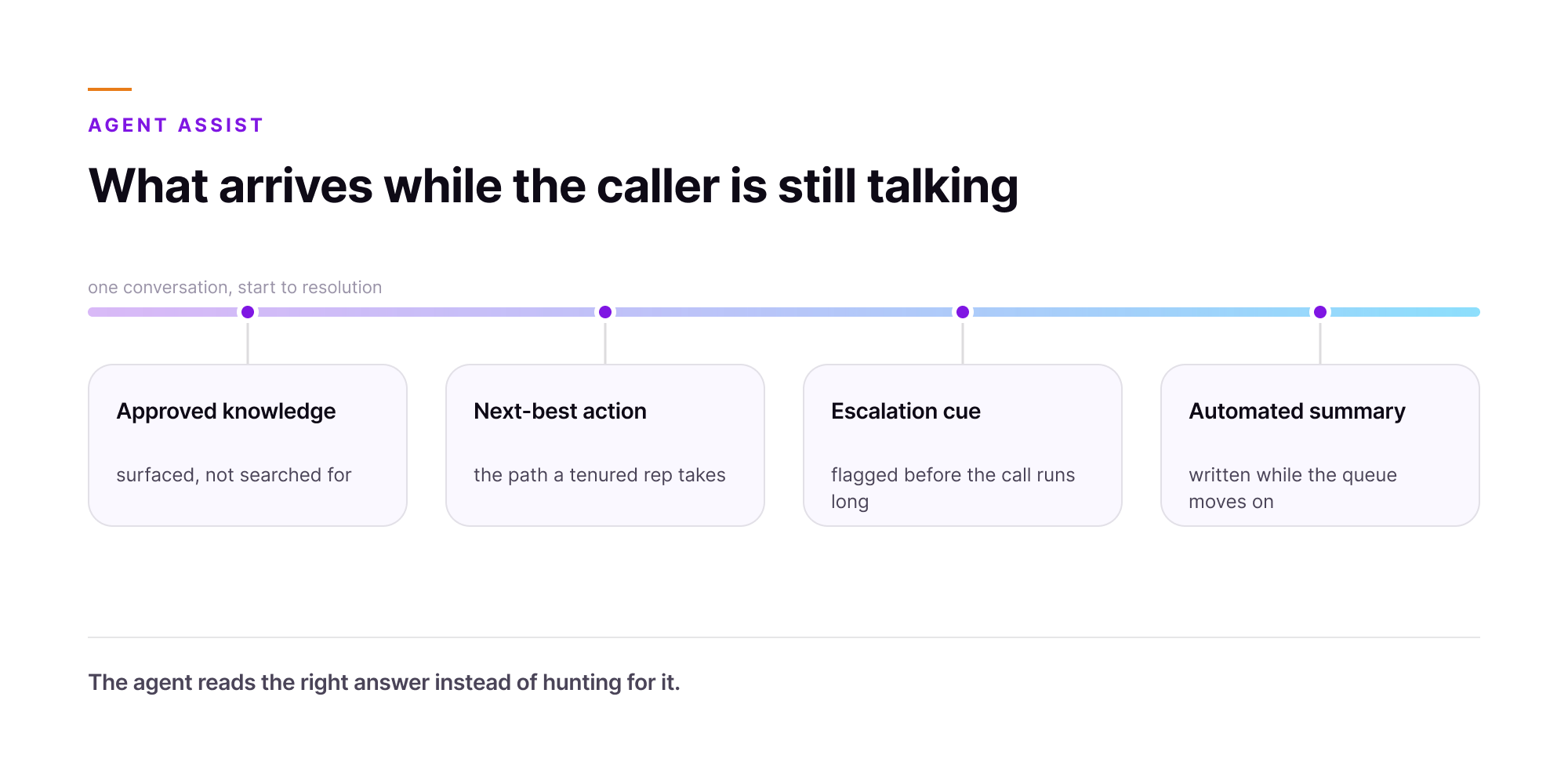
The result is a reduced gap between a new agent's current capabilities and contract requirements. The AHT mechanics behind that gap (opens in a new tab) are worth examining alongside whichever metrics your program manager watches most closely, because live assist does not move every number the same way.
Which contracted metrics does live assist actually move?
Agent Assist moves average handle time, which is the one contracted metric Orvera AI attaches a figure to, and Auto QA scores every conversation so a program manager can see whether quality is holding.
AHT is the metric program managers watch most closely, and it is the one Orvera AI attaches a figure to. Across Orvera AI's customer engagements, average handle time falls 8% to 15% within the first 90 days of the engagement, largely through Agent Assist. That figure is an average across Orvera AI's engagements, not a per-account guarantee. What produces it is the same mechanism described in the previous section: the new rep stops searching and starts acting, because the approved answer is already on screen.
Quality consistency is the second metric that moves, and the mechanism is different. An agent guided toward the same approved handling on every call produces fewer variance spikes than one relying on recall. The guidance does not change between Monday morning and Friday afternoon. The handling does not drift.
What a program manager can watch to confirm the guidance is landing:
- AHT trend by cohort. A new-hire cohort moving toward contracted AHT within the first ninety days signals the assist layer is surfacing the right content at the right moment.
- Quality score variance. Narrowing variance across a cohort, not just a rising average, shows that guidance is producing repeatable handling rather than isolated strong performances.
- 100% conversation coverage. Orvera AI Auto QA audits every conversation, human-handled and AI-handled, across every channel. A sampled review misses the calls where guidance failed. Full coverage does not.
AHT trend by cohort, quality score variance and full conversation coverage together tell a program manager whether the assist layer is compressing nesting or simply running in the background.
What does live assist change about an agent's first ninety days?
Live assist changes the first ninety days by replacing the experience of struggling through live calls alone with the experience of being carried through them by the system.
A rep who can answer the caller in front of them has a different early experience from one who cannot. That difference is not abstract. It shows up in contact center productivity within the first weeks. An agent without support in the moment has to choose between putting the caller on hold, escalating unnecessarily, or committing to an answer they are not confident in. Each of those choices compounds the difficulty of the call and extends the time it takes to close it.
Support during the call is the mechanism that changes this. Agent Assist surfaces approved knowledge, recommends the next-best action, and flags escalation cues in the moment the rep needs them, on a call or in a chat. The agent is not searching a knowledge base after the fact or waiting for a supervisor to become available. The decision is available to them when the caller is still on the line.
For a program leader, the practical result is a new rep who builds pattern recognition through guided repetition rather than through unguided error. And an agent who handles calls well early stays longer. That retention effect is the mechanism, not a figure Orvera AI publishes, but a pattern any floor operator will recognize from their own programs.
Why does a managed platform matter more than a tool for an outsourcer?
A managed platform matters because an outsourcer's engineering capacity is already committed to the programs it runs, not to maintaining the infrastructure underneath them.
A tool the BPO has to configure, host, and maintain becomes another operational burden. It competes for the same engineering time that should be going toward client programs, quality initiatives, and reducing time to proficiency for nesting agents. That is the wrong trade.
Orvera AI is built for the way an outsourcer actually operates. It coordinates best-in-class third-party models inside its own governed enterprise layer, and it custom-trains its own contextualization models on de-identified data. The outsourcer receives a running operation.
What a managed platform looks like in practice:
- Multi-tenant by design. Each client program runs inside one multi-tenant platform built for channel partners and BPOs, without a separate deployment per account.
- Language coverage. AI agents operate in more than 80 languages, which matters when BPO programs serve diverse caller populations across accounts.
- Built, deployed, and run by Orvera AI. A working agent goes live in weeks, and your teams run the platform under your brand after go-live, with Orvera AI supporting them.
- 500+ integrations. The platform connects to the systems your programs already use without requiring the BPO to build connectors, and the connector directory is illustrative rather than a limit.
The distinction is straightforward. A managed platform does the work, so the outsourcer can put its attention on what the contract actually measures.
What belongs in the internal case for live assist during nesting?
The internal case rests on three facts: nesting is margin the contract does not recover, knowledge delivered in the moment of a live call lands differently than knowledge delivered in a classroom, and guidance cannot be declared effective unless every conversation is scored.
Ramp time is a cost line that sits outside the contract. The hours a nesting agent spends on live calls with extra support are largely unbillable, which means the outsourcer carries them. Compressing that window is not a training objective. It is a margin objective.
Knowledge delivered during a live call reaches an agent differently than knowledge delivered in a classroom. An agent copilot surfaces approved answers and next-best actions at the exact moment a caller raises the issue. That is a different mechanism than recall from a session completed weeks earlier. The gap between trained knowledge and applied knowledge closes when the delivery and the decision occur at the same time.
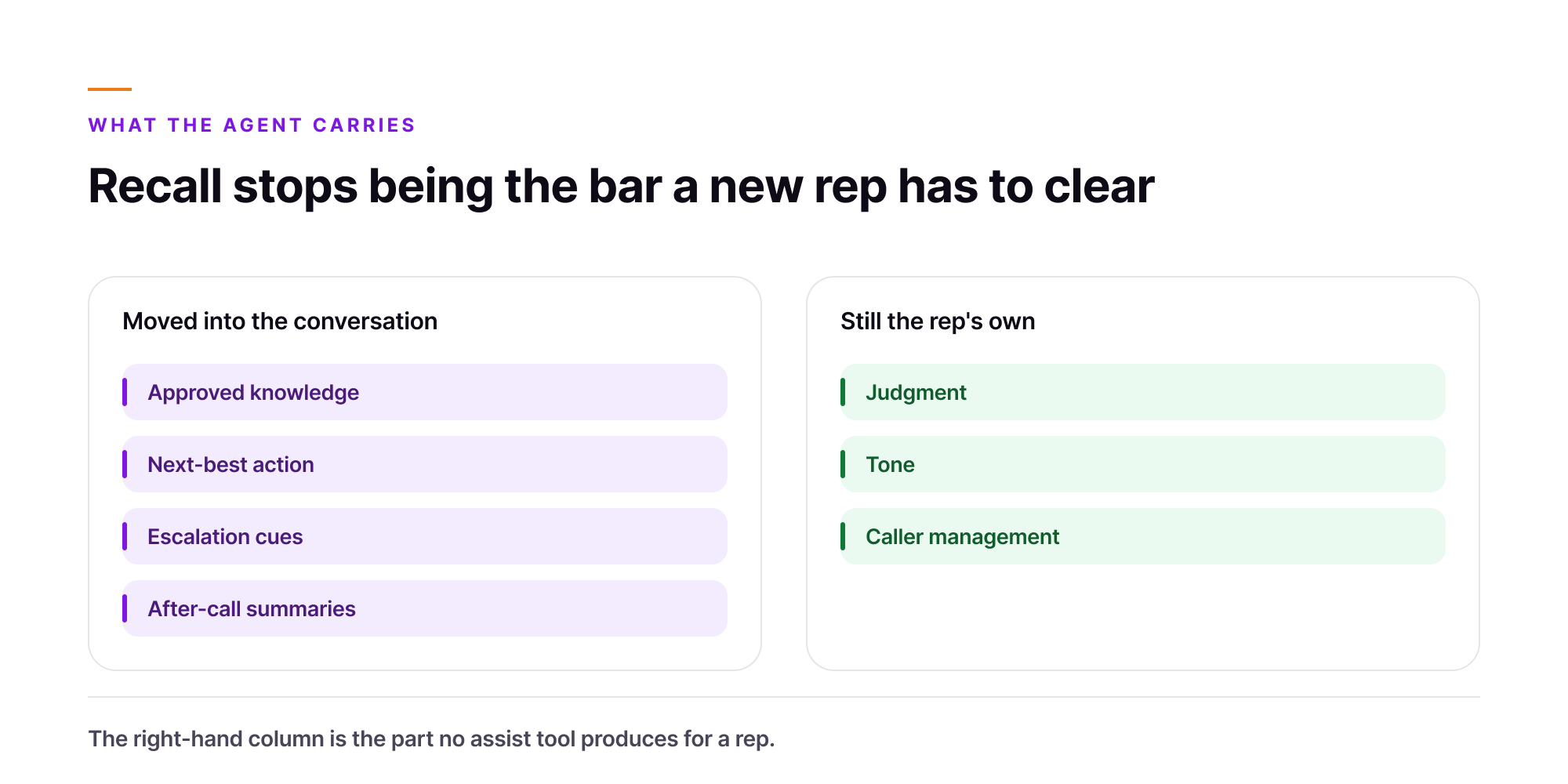
Measurement is the third piece. Whether any of this is working is not answerable from a sample. Orvera AI Auto QA audits 100% of conversations across every channel, both human-handled and AI-handled, which means every nesting call is scored, not a representative slice of them.
The bullets below translate those three facts into the language a financial or operations review requires:
- Margin recovery. Every week of nesting is cost without revenue recovery. Compressing the path to contracted numbers improves program margin directly.
- Point-of-need delivery. Guidance surfaced during the call reaches the agent when the decision is live, which is the moment it changes the outcome.
- Complete conversation audit. A sample quality program cannot tell you whether the guidance is working. Scoring 100% of calls can.
How does a BPO put live assist in front of nesting agents without disrupting the program?
A BPO contact center adds live assist without disrupting the program by deploying Orvera AI on the stack already in production, with no rip-and-replace and a working agent live in weeks.
Orvera AI runs onboarding, knowledge-base setup, agent training, and change management. Your QA analysts and program leads are not standing up infrastructure. They are reading results.
The practical starting point is the line of business carrying the most policy detail. That is where the distance between a new agent and a tenured one is widest, where handle time variance shows up first in your client reporting, and where Agent Assist returns the clearest signal. One program, one knowledge domain, one clean set of QA criteria. Orvera AI audits 100% of conversations, human-handled and AI-handled, across voice, chat, email, messaging, and every other channel the program runs, so the performance picture is complete once the program is live rather than built from a thin sample.
If your operation is at the point where nesting margin, early attrition, and contracted AHT are all converging into the same problem, talk to the team (opens in a new tab) about where to start.
Frequently asked questions
Live assist shortens ramp time because approved knowledge arrives during the call, so a new agent reads the right answer instead of searching for it or guessing.
Live assist changes what classroom training has to achieve, not simply how many hours it runs.
Live assist is a margin question before it is a training question, because nesting is cost the contract does not pay for.
Live assist changes how the knowledge base reaches the rep: the approved answer surfaces inside the conversation at the moment the caller raises the issue.
The guidance an agent sees during a live conversation is surfaced from the knowledge base your program team approved, which is what a program leader is actually relying on.
Orvera AI is multi-tenant and purpose-built for channel partners and BPOs, so several client programs run on one platform, each with its own configuration.

Written by
Anindita Majumder
Anindita Majumder is a communications professional with nearly four years of experience in public relations, corporate communications, and journalism. She creates content that helps brands communicate their vision, products, and expertise through press releases, thought leadership, and editorial pieces. Outside of work, she is a vocalist, which keeps her creativity flowing.