
How an AI Agent Completes Self-Service Flight Rebooking in Chat and In-App
When a weather or crew event cancels a bank of flights, thousands of travelers open the app inside the same ten-minute window, and most of them hit the same wall.

Key highlights
- When a weather or crew event cancels a bank of flights, thousands of travelers open the app inside the same ten-minute window, and most of them hit the same wall.
- A self-service flight rebooking AI earns its place by acting on the traveler's preference and executing a complete ticket reissue inside the same chat session where the traveler stated it.
- Agentic AI for travel contact centers earns its place in a moment like this: a two-leg itinerary through a hub, the first leg canceled for weather at 6 a.m., and the traveler already standing at the gate.
- The AI agent does not interpret the airline's policy. It applies the policy as written, and the airline's policy team owns every rule on the list.
- Same-cabin reprotection within a set window.
- Corporate or group booking requiring a named approver.
- The airline's customer care team needs a chat agent that can rebook a canceled flight while its engineers stay on their existing roadmap, and that is the delivery model Orvera AI operates.
- Four measures, read together, tell the customer care leader how much of the disruption the chat agent resolved and how much of it reached another channel.
Why does a disrupted traveler end up on the phone after starting in the app?
When a weather or crew event cancels a bank of flights, thousands of travelers open the app inside the same ten-minute window, and most of them hit the same wall.
The app shows the cancellation. It surfaces alternatives. And then a fare rule applies, or the next available flight runs on a partner carrier, or the itinerary has three legs, and the chat session ends with a phone number. That number rings into the one queue that was already full before the event started.
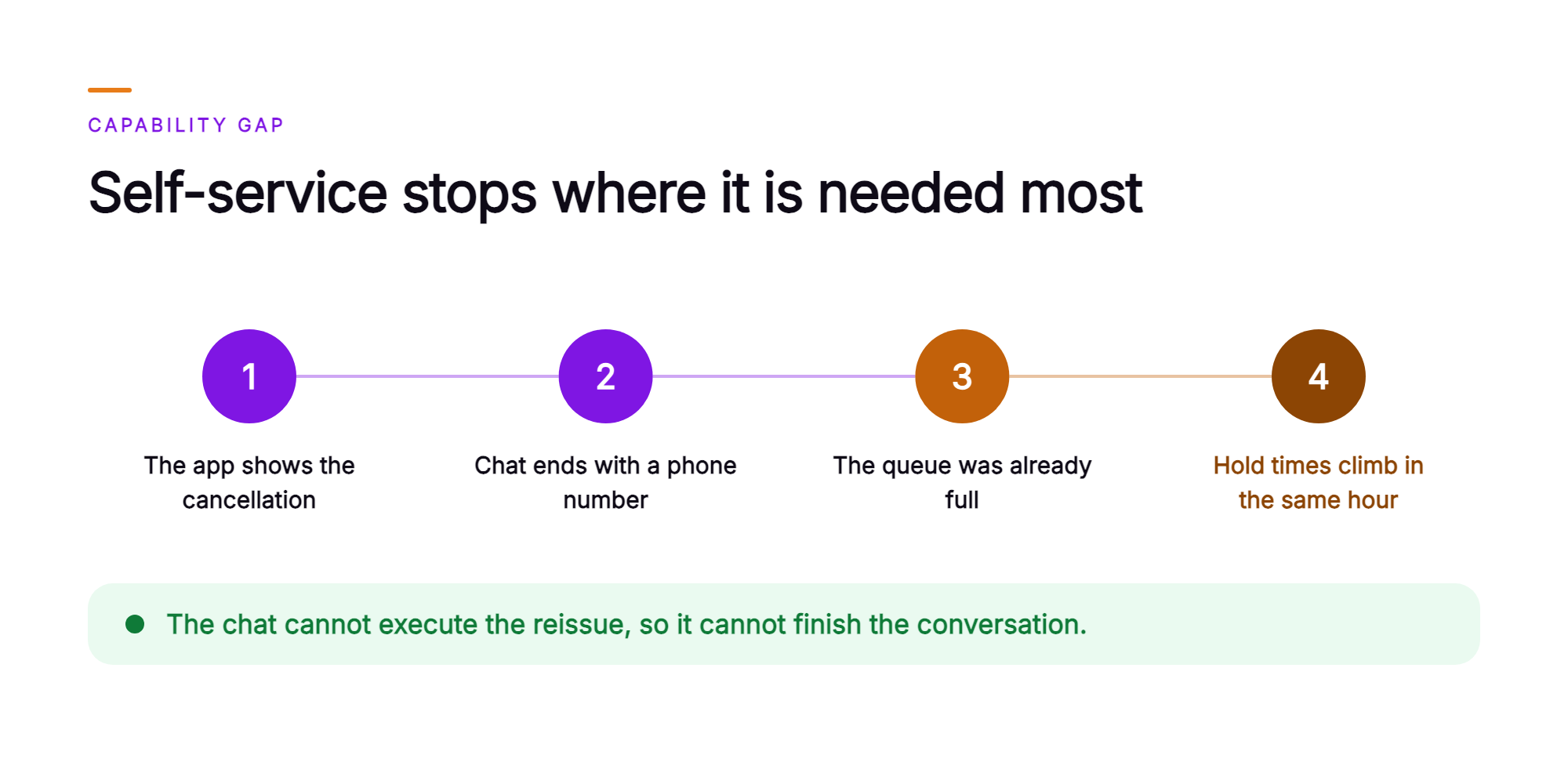
The success of a disruption chat session is measured one way. It is whether the disrupted traveler closes the session holding a reissued ticket and an updated confirmation. An AI agent platform for airline rebooking earns its place on that one standard. The next section details the platform requirements for resolution.
What is in-app and web disruption self-service rebooking?
Automated travel disruption management, in its complete form, means a traveler opens the airline app or website after a cancellation and closes it holding a reissued ticket, an updated confirmation, and reassigned seats and bags, the whole transaction completed in chat.
These events are specifically named in airline operations: irregular operations, involuntary schedule changes, missed connections, and reprotection onto the next available flight. That last category includes partner-operated segments where the airline's reprotection policy permits it. The scope follows what the airline's contract of carriage and reprotection policy authorize.
That boundary matters. The fare rules, reprotection policy, and contract of carriage are the governing documents. The platform applies those rules as written. When a rule blocks an option, the traveler is told which rule applies and what it means for their itinerary, and the chat moves straight to the alternatives that remain.
The chat agent carries the same authority to reissue and applies the same policy logic as the voice agent, because both run on one architecture for understanding, planning, execution, and governance. The next section outlines the practical consequences of this single-architecture design.
What does the agentic AI agent actually do with a disruption chat?
A self-service flight rebooking AI earns its place by acting on the traveler's preference and executing a complete ticket reissue inside the same chat session where the traveler stated it.
The sequence begins the moment the traveler opens the chat. The AI agent reads the passenger name record, checks live inventory across available routings, and identifies every disrupted segment on the itinerary. It then evaluates each alternative against the airline's fare rules and reprotection policy, and presents only the options that policy allows. When a rule blocks a routing, the agent names the rule. The traveler stays in the session and sees the reason in plain language.
Every answer the agent surfaces during the conversation is grounded in approved policy content and the live record. That grounding is what makes agentic AI for travel contact centers accountable for the options it presents and the reissue it writes. The options in front of the traveler come from their own itinerary and the fare they actually bought.
Watching those steps execute against a real itinerary, in order, makes the capability concrete, and that is what the next section covers.
How does one traveler's rebooking play out end to end?
Agentic AI for travel contact centers earns its place in a moment like this: a two-leg itinerary through a hub, the first leg canceled for weather at 6 a.m., and the traveler already standing at the gate.
The traveler opens the app. The AI agent reads the passenger record, confirms identity against the booking reference and the loyalty profile, and surfaces the disrupted connection straight from that record. That step alone removes the rekeying work a phone call begins with.
Option presentation follows immediately. The agent finds two reprotection options the fare rule permits. The first is an earlier routing through the same hub with seats available in the original cabin. The second is a later nonstop. A third routing exists on a partner carrier, but the fare class restricts partner reprotection, so the agent names that rule in plain language, shows that routing as blocked, and explains the airline's approval path.
The traveler picks the earlier routing. The ticket reissues, the assigned seat moves with it, and the checked bag record updates. The confirmation appears in the app and arrives by email. The traveler completes the process before boarding opens for the replacement flight.
And the record is complete. The transcript, the policy clause applied, and the reissue reference number sit in a single audit record the airline can open at any point. What that record contains against each specific fare rule is what the next section covers.
What does the agent do at each of the airline's rebooking rules?
The AI agent does not interpret the airline's policy. It applies the policy as written, and the airline's policy team owns every rule on the list.
That distinction matters when the airline is reducing contact center volume during travel disruptions by moving rebooking into the app. The agent carries no authority to soften a restriction or substitute a judgment call. When a rule blocks an option, the agent names the rule in plain language and presents what the policy does permit. The list below pairs each common rule with the action that follows.
- Same-cabin reprotection within a set window. The agent surfaces all available seats in the same cabin within the airline's published reprotection window. It limits the options presented to that window and states the constraint.
- Partner-segment restriction. When the disrupted leg is operated by a partner carrier, the agent confirms which carriers are eligible under the reprotection agreement and limits the options presented to that list.
- Fare that permits a date change only. The agent offers alternative dates in the same market. A cabin upgrade or routing change is not presented because the fare rule does not permit it, and the agent says so.
- Voucher already issued to the traveler. The agent reads the voucher from the passenger record, applies it to the reissue where policy allows, and states any remaining balance or restriction on the voucher's use.
- Corporate or group booking requiring a named approver. The agent identifies the approval requirement, presents the options that are pending approval, and routes the authorization request to the named approver, who holds the decision on the reissue.
In each case, the traveler receives a direct answer grounded in the actual rule, inside the session they already have open. That consistency is what makes the agent reliable enough to carry the airline's policy into a live disruption queue. How the airline gets that agent built and running, with Orvera doing that work, is what the next section covers.
Why does an airline want the chat agent built, deployed and run for it?
The airline's customer care team needs a chat agent that can rebook a canceled flight while its engineers stay on their existing roadmap, and that is the delivery model Orvera AI operates.
Orvera builds, deploys, and runs the agent on the airline's behalf. Full enterprise deployment takes three to six weeks. The build, the integration work, and the ongoing operation all sit with Orvera.
The team behind that delivery has run contact centers for 18 years. That operating history is what makes it practical to hand Orvera a live disruption desk. The people configuring the agent have staffed queues themselves. They know what a contact looks like from the floor.
Governance is built into every conversation the agent handles. Auto QA audits every conversation, human-handled and AI-handled, across every channel. Each conversation produces a transcript, a summary, and a report log the airline can open at any point.
And the agent connects to the systems the airline already runs. The passenger service system, GDS, loyalty platform, and notification infrastructure are all reachable through 500+ integrations. Orvera does the integration work itself. The airline's stack stays as it is.
The question that follows is which numbers the customer care leader watches to confirm the agent is performing inside a live disruption event.
Which numbers tell the customer care leader the chat agent is working?
Four measures, read together, tell the customer care leader how much of the disruption the chat agent resolved and how much of it reached another channel.
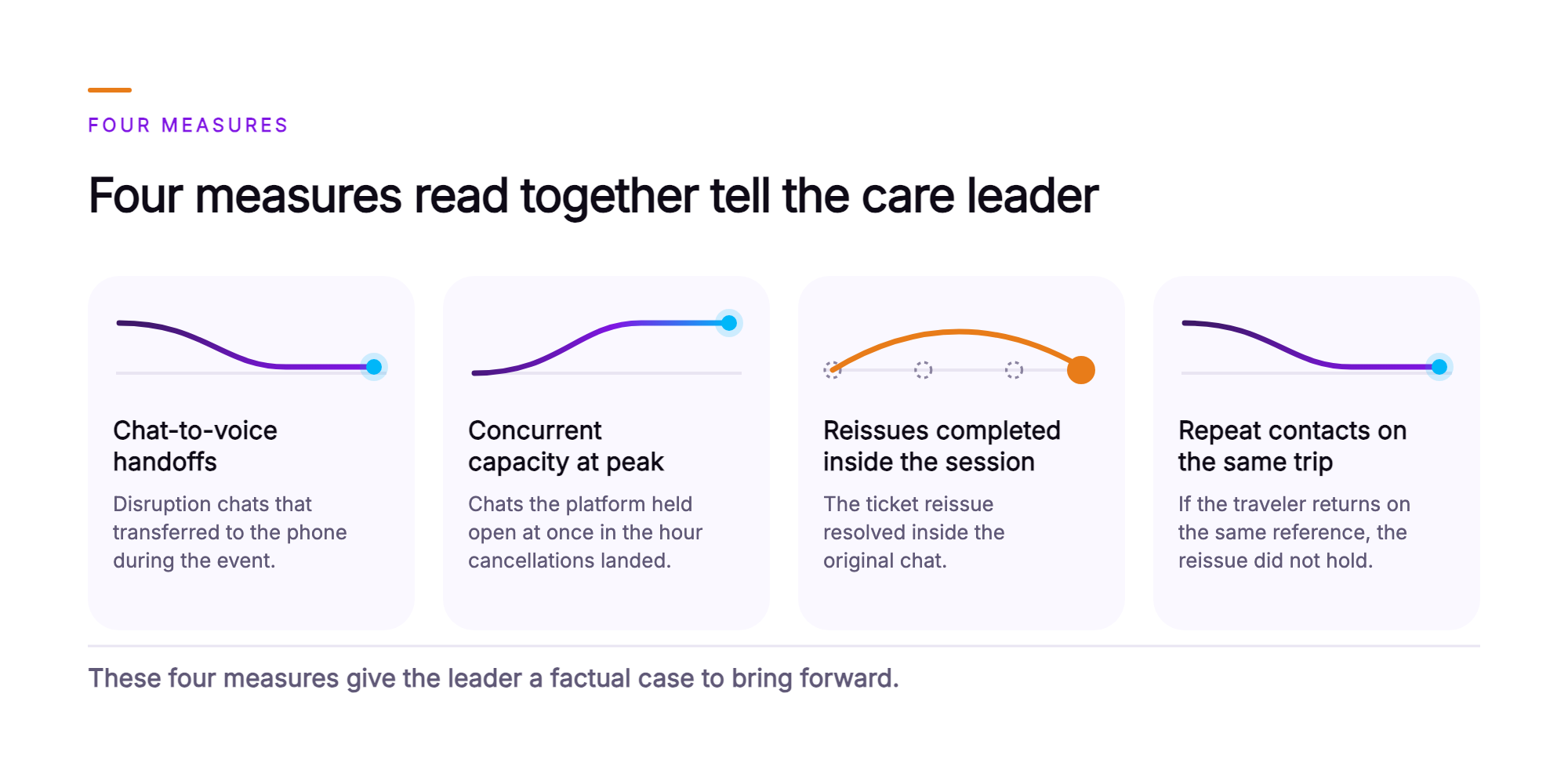
Chat-to-voice handoffs are the primary measure. The count of disruption chats that transferred to the phone during the event, read alongside the reason code logged on each handoff, tells the leader exactly where the agent reached the boundary of its authority. A low handoff count with reasons concentrated in genuine policy exceptions is the signal the agent is working. A high count with reasons spread across general inquiry or a catch-all code is the signal something in the configuration needs attention.
Concurrent capacity at peak tracks how many disruption chats the platform held open at once in the hour a bank of cancellations landed, measured against the number of travelers affected. That ratio is what confirms the agent scaled with the event and held capacity level with demand.
Reissues completed inside the session records whether the ticket reissue resolved inside the original chat, with a new ticket number returned to the traveler before the conversation closed. A completed reissue means the passenger service system now holds the rewritten ticket. It is a transaction confirmed.
Repeat contacts on the same trip within a day closes the loop. If the traveler returns on the same booking reference the following morning, the reissue did not hold. That figure, read against the reissue count, is the clearest test of actual resolution. Together, these four measures give the customer care leader a factual case to bring forward. What that case looks like when it travels up to the leadership team is what the next section covers.
What does the customer care leader take to the leadership team?
The customer care leader who carries this case upward needs four statements that hold under scrutiny when an executive audience presses on them.
Each of the following is a full sentence built from what the agent actually does, and each can move directly onto a slide as written.
- The chat agent reissues the ticket itself, under the airline's own fare rules, with the same authority as the voice agent, so the traveler closes the session holding a confirmed itinerary and a new ticket number.
- Peak capacity scales with the disruption event, every conversation is audited and recorded automatically, and the platform Orvera AI builds, deploys, and runs for the airline is live in three to six weeks.
- The voice floor works the three cases that reach it, a decision the airline's policy reserves for a person, a traveler who asks for one, and an itinerary the agent cannot match to live inventory, each with the transcript and the evaluated options attached.
- The leader measures the result in two numbers: chat-to-voice handoffs during the event and concurrent capacity held at the peak hour, because both figures appear in the audit record the morning after.
Those four statements answer the questions a CFO, a COO, or a Chief Experience Officer will ask. Reissue authority, handoff routing, audit coverage, deployment timeline, and the two measures the leader reports are each addressed by one of the bullets above. The leadership team receives a performance record. What that record looks like on the day a bank of cancellations actually lands is what the next section shows.
What does disruption day look like once the chat agent runs?
When a bank of cancellations lands, the app carries the volume, travelers rebook in the chat session, and the voice floor works the exceptions the agent was right to escalate.
That is the after state. Thousands of disruption chats open inside the first forty minutes. The agent reads each booking reference, applies the fare rule, confirms the reissued ticket, and closes the session. The voice queue holds the contacts that require judgment: a missed connection with a separate interline partner, a loyalty tier exception that sits outside the waiver window, a traveler using TTY relay who requests a human representative directly. Those contacts reach a representative with a full summary already written. The transfer is warm, and the identity check from the chat session still stands.
The next morning, the customer care leader opens the audit record. Every chat the agent handled produced a transcript, a policy clause reference, and a reissue confirmation or a documented handoff reason. Capacity during peak hour appears in the same report alongside the chat-to-voice handoff count and the repeat contact rate on the same booking reference within twenty-four hours. The case to the leadership team is already built.
Orvera AI brings over 18 years of contact center experience to that record. Orvera builds the agent, deploys it onto the airline's stack, and runs it. The airline's customer care team reads results. To see what that looks like on your operation, talk to the team (opens in a new tab).
Frequently asked questions
When a flight is disrupted, the AI agent reads the airline's reprotection policy and fare rules, presents qualifying alternative itineraries, reissues the ticket the traveler selects, moves the seat assignment and bag allowance with it, and sends the confirmation, all as one automated transaction. The airline's limits define the boundaries. Where a carrier policy permits same-day rebooking within a defined fare class, the agent applies that permission as written. Where it does not, the agent stops at that boundary. Airline disruption management software has to stay inside the carrier's policy on every reissue, and the AI agent holds that line at peak disruption volume. The voice agent and the chat agent run the same policy logic on one governed layer. A traveler who switches from chat to a phone call mid-disruption meets the same decision authority and the same options. When the fare rules reserve an exception for human judgment, the next section covers what happens there.
When the fare rules close a door, the AI agent names the specific rule in plain language and presents what the airline's policy does permit, whether that is a different date, a different routing, or a carrier-issued voucher. The agent does not improvise. The airline's own fare rules and contract of carriage decide every reissue, and the agent applies them as written. That boundary is the compliance discipline that lets agentic AI for travel disruption management run automated reissue safely across high-volume operations. Where the airline's policy reserves an exception for human judgment, the agent routes the record to a human rep. That person picks up with the full transcript, the passenger name record, and the options already evaluated in front of them. The following section details what triggers the handoff and what the rep receives.
The AI agent transfers a traveler to a human rep when the airline's policy reserves the decision for a person, when the traveler explicitly requests one, or when the agent cannot reconcile the requested itinerary with live inventory. Understanding where automation stops is as important as knowing how to automate airline passenger re-accommodation across a disruption event. The boundary is written into the carrier's policy, and the agent applies it consistently. When a handoff occurs, the human rep receives the full conversation transcript, the passenger name record, the options already evaluated, and the specific rule that stopped the AI agent. The rep starts with that context in hand. They decide. Each handoff carries a reason code. Those codes are counted and available in the reports your team reviews, giving you a clear view of where policy limits fall and where reprotection logic may warrant review. The following section explains how every decision is captured in a reviewable audit record.
Every automated and human-handled rebooking produces a complete audit record: the full conversation transcript, a structured summary, the specific policy clause the AI agent applied, and the reissue reference number written back to the ticketing system. The platform produces that same record on whichever channel the rebooking runs. Auto QA reviews every conversation across a disruption event, AI-resolved and human rep-handled alike. The quality team sees a consistent scoring view across the entire volume, with the same criteria applied to each contact. That consistency matters when a single weather event generates thousands of rebooking interactions inside a few hours. Report logs are available to both the airline's operations team and its compliance team for every interaction. Teams commonly ask how to integrate AI rebooking with existing GDS and ticketing systems so that reissue references reconcile automatically. The following section explains how those connections are built and maintained.
Automated flight rebooking solutions for enterprises require live, write-access connections to the systems that hold the record of travel, and Orvera AI builds and runs those connections as part of the managed service. The platform connects to the passenger service system, the GDS, loyalty programs, and the notification channels the airline already operates. Orvera AI does the integration work itself during deployment, then maintains those connections afterward. The middleware sits with Orvera. The platform is model-agnostic and runs on your existing stack. When a better underlying model becomes available, you adopt it and the integrations already in place keep running. The reissue reference writes back to your ticketing system automatically, keeping records reconciled from the first interaction through resolution. The following section outlines the full deployment timeline and what Orvera AI handles during the build.
Full enterprise deployment lands in three to six weeks, with Orvera AI building the connections, configuring the policy content, and running the managed service from day one. Orvera does the build and the integration. Orvera also sets up the middleware and manages the rollout. Enablement spans onboarding, knowledge-base setup loaded with your carrier's reprotection and fare-rule content, and change management for the customer care floor so your representatives know exactly what the AI agent handles and what routes to them. Security teams asking for SOC 2 compliant AI agents for travel get documentation on request. The platform is SOC 2 Type II certified and GDPR compliant. Procurement reviews the posture before the first interaction goes live.

Written by
Anindita Majumder
Anindita Majumder is a communications professional with nearly four years of experience in public relations, corporate communications, and journalism. She creates content that helps brands communicate their vision, products, and expertise through press releases, thought leadership, and editorial pieces. Outside of work, she is a vocalist, which keeps her creativity flowing.


