How an AI Agent Handles DOI Complaint and Executive Escalation Intake for Carriers
A Department of Insurance complaint starts the response clock the moment it arrives, and the file that wins or loses that response is assembled by hand, one system at a time.

Key highlights
- A Department of Insurance complaint starts the response clock the moment it arrives, and the file that wins or loses that response is assembled by hand, one system at a time.
- DOI complaint and executive escalation intake is the work that turns an arriving regulatory letter or an executive-office complaint into a complete, routed file before the compliance team writes a single word of the response.
- When a DOI complaint reaches the carrier, the AI agent's role is immediate and specific: identify the regulatory trigger, assemble the evidence pack, and route a complete file before the compliance owner opens the case.
- A single call from a policyholder about a delayed auto claim payment shows exactly how an AI agent for insurance moves from greeting to a complete, routed evidence pack on its own.
- The AI agent applies specific logic to each DOI complaint. It applies the carrier's own rules, and each rule produces a specific, traceable action.
- A carrier managing department of insurance complaint intake needs the intake logic built, deployed, and running, with a team behind it that already knows where complaint files go missing between systems.
- A Head of Consumer Affairs needs four numbers to confirm that insurance grievance intake is running correctly. Each one is measurable, and each one moves as the agent takes over assembly and routing.
- Same-day routing of executive escalations.
Why does a DOI complaint file take days to assemble at a carrier?
A Department of Insurance complaint starts the response clock the moment it arrives, and the file that wins or loses that response is assembled by hand, one system at a time.
The consumer affairs analyst opens the letter and immediately needs the full interaction history: the call recordings tied to the claim, the chat and email threads, the claim notes, the policy record, and every prior escalation the policyholder ever filed. Each of those lives in a different platform. The contact center platform holds the recordings. The CRM holds the escalation history. The claims system holds the adjuster notes. None of them talk to each other without someone in the middle pulling the thread.
That pull takes days in a standard insurance contact center workflow. Recordings get requested one at a time and transcribed manually. Files land with the compliance owner missing a thread or a call. Responses go out late, or they go out thin, because the analyst could not surface the complete history before the regulator's window closed. A response built on an incomplete file exposes the carrier to follow-up requests, and sometimes to findings that a fuller record would have answered on the first submission.
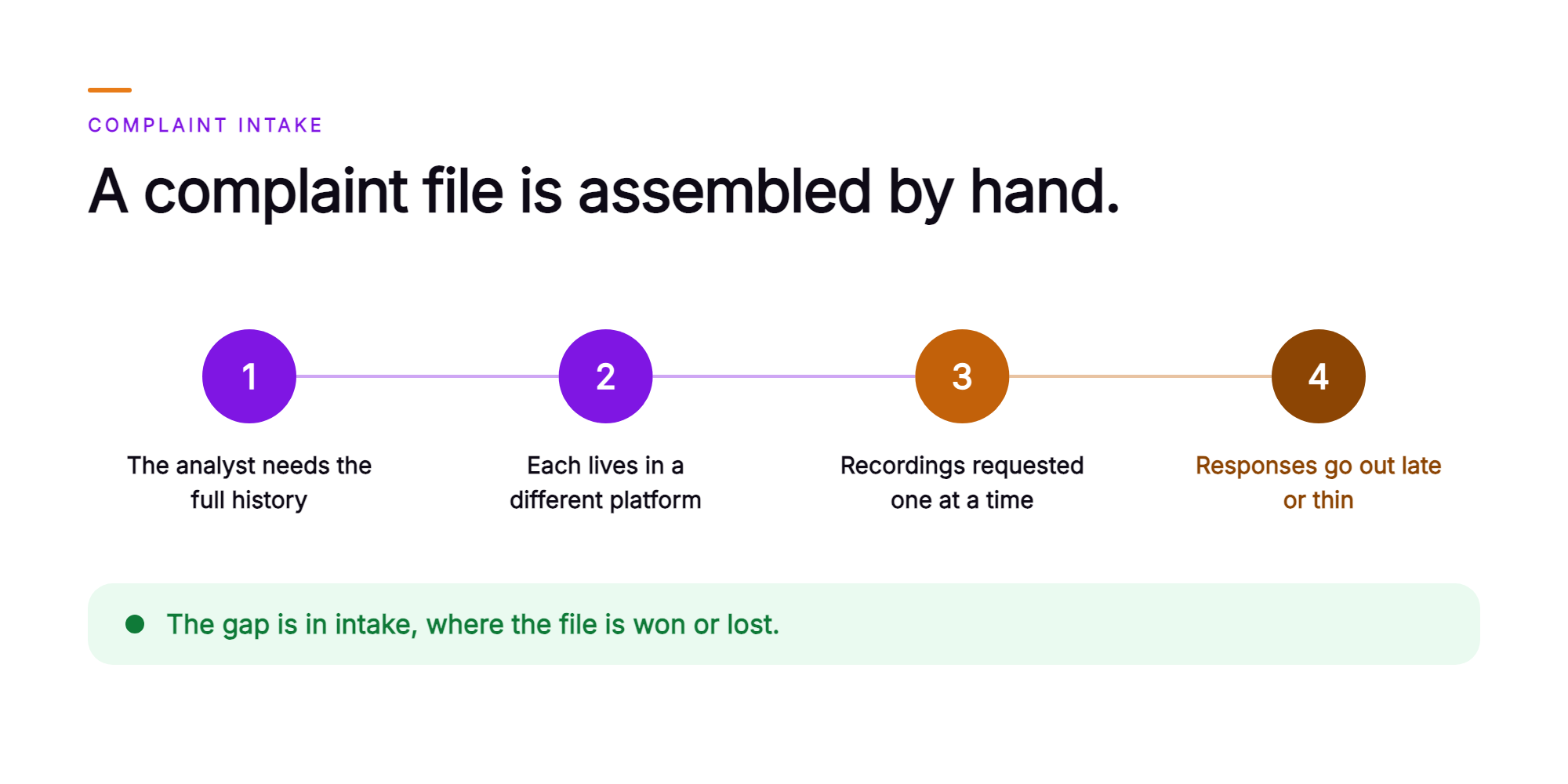
The delay is not due to complexity. The interaction history the regulator will ask about already exists inside the systems the carrier runs. The gap is in intake: the work between the complaint arriving and a complete, routed file reaching the compliance owner who will write the response. That is where the file is won or lost.
What is DOI complaint and executive escalation intake?
DOI complaint and executive escalation intake is the work that turns an arriving regulatory letter or an executive-office complaint into a complete, routed file before the compliance team writes a single word of the response.
A DOI complaint is a formal statement of dissatisfaction a policyholder files with the state Department of Insurance. The regulator forwards it to the carrier with a written response deadline. That deadline is not a suggestion. The carrier's consumer affairs or compliance owner is the person who decides the position, drafts the response, and sends it to the regulator. Every step before that decision belongs to intake.
Intake, then, is the identification, history assembly, transcript set, and routing step. It is not the response. The carrier's compliance team owns the response entirely. Intake is everything that makes an accurate response possible, and it is the step where most of the delay actually lives.
What does the AI agent do when a DOI complaint arrives?
When a DOI complaint reaches the carrier, the AI agent's role is immediate and specific: identify the regulatory trigger, assemble the evidence pack, and route a complete file before the compliance owner opens the case.
Identification begins at the channel level. Whether the policyholder calls to say she has filed with her state Department of Insurance, sends a chat message referencing her complaint, or the carrier's intake team logs an arriving DOI letter against a policy number, the AI agent recognizes the regulatory signal across every channel the carrier runs. The same applies to executive escalations addressed to a named officer or the executive office. The trigger type determines the priority routing path, and that determination happens at intake, ahead of the first human review of the queue.
Assembly follows identification in the same motion. The agent pulls the policyholder's full interaction history from the systems the carrier already runs, attaching the transcript of each call, each chat session, and each email thread to the case record. Claim references, policy records, and prior correspondence are drawn from the same integrated sources. Because every conversation is scored and retained across channels, the transcript set the agent surfaces is complete, spanning every system that holds part of the history.
Routing closes the intake step. The agent opens the case in the complaint management system insurance teams already use, attaches the assembled evidence pack, and assigns it to the named consumer affairs or compliance owner. The policyholder's own words arrive intact in the file. One boundary holds throughout: the agent assembles and routes the evidence pack, and the carrier's compliance team decides and drafts the response to the regulator.
That complete, routed file is the input the compliance owner needs to write an accurate response. The next section details one case from the opening call to the evidence pack landing on the analyst's desk.
How does one DOI complaint move from a phone call to a routed evidence pack?
A single call from a policyholder about a delayed auto claim payment shows exactly how an AI agent for insurance moves from greeting to a complete, routed evidence pack on its own.
The policyholder calls to report that her auto claim payment is three weeks overdue. During that call, she states she has filed a complaint with her state Department of Insurance. The AI agent verifies her identity against the policy record, flags the DOI trigger in her statement, and begins assembling the evidence pack immediately. It pulls six prior calls, two chat sessions, and the adjuster's email thread. The transcript of each interaction attaches to the case file as the pull completes.
The routed result arrives with the consumer affairs analyst the same day. The complaint management system holds the full evidence pack: the assembled transcripts, the claim timeline, the policy record, and the policyholder's own words from the triggering call. Each piece of evidence keeps its original form. What reaches the analyst is finished work, assembled at intake.
And that same-day arrival matters for the response window. The analyst reads the pack, determines the carrier's position on the delayed payment, and writes the response to the Department of Insurance. The claims record and the adjuster thread arrived with the routed case. The intake step delivered everything the response requires.
What determines which analyst receives that file, and how urgency is assigned inside the complaint management system, comes down to the carrier's own rules. The following section maps those rules directly to the actions the agent takes.
How do the carrier's rules shape what the agent does with each complaint?
The AI agent applies specific logic to each DOI complaint. It applies the carrier's own rules, and each rule produces a specific, traceable action.
Carriers define their complaint workflow in their complaint management system and in the policy documents that govern it. The agent interprets those rules and acts on them. Four rule types drive the behavior:
- Sources rule. The carrier's configuration names which systems hold the interaction history for each complaint type. The agent pulls from exactly those systems and no others, so the evidence pack reflects the same scope the compliance team would have gathered by hand.
- Routing rule. The carrier's rule names the owner by complaint type and state. The agent routes the assembled pack to that named owner. On executive escalations, it copies the executive office as the rule requires.
- Priority rule. The carrier sets which complaints reach the front of the queue, whether by regulatory deadline, complaint type, or line of business. The agent flags the case so the owner sees it first.
- Boundary rule. The carrier's rule reserves the regulator response for the compliance team. The agent stops at handoff and records what it assembled and where it sent it.
That audit record matters. Every action the agent takes is logged against the case, so the compliance owner can see exactly what was assembled and when. A carrier that applies this discipline across every complaint call carries a consistent, verifiable intake record into any regulatory review. The platform that runs this logic also needs to be built and maintained to the compliance standard regulated insurers require. The next section covers what it means for a carrier to have that platform built and run on its behalf.
Why would a carrier want the platform built and run for it?
A carrier managing department of insurance complaint intake needs the intake logic built, deployed, and running, with a team behind it that already knows where complaint files go missing between systems.
Orvera AI builds, deploys, and runs the agent on the carrier's behalf. Full enterprise deployment lands in three to six weeks. That timeline spans configuration, integration, and going live. It reflects 18 plus years of running contact centers, which is exactly how the team knows which handoff points between claim notes, policy records, and complaint management system entries are where files stall.
Auto QA audits every conversation the platform touches, human-handled and AI-handled alike. Every call that carries a DOI complaint trigger produces a transcript and a quality record, so the compliance team relies on the full set. The compliance owner receives the evidence pack, and the quality record arrives with it.
Governance matches what regulated carriers require. The platform grounds every agent response in approved knowledge, logs every routing decision with a traceable record, and integrates with 500 plus systems the carrier already runs. SOC 2 Type II certified, HIPAA compliant, and GDPR compliant. The auditability covers what was assembled, what was attached, and where the file was sent.
The question that follows naturally is how a Head of Consumer Affairs confirms the model is working once it runs. The next section identifies the specific numbers that answer that question.
Which numbers tell the Head of Consumer Affairs it is working?
A Head of Consumer Affairs needs four numbers to confirm that insurance grievance intake is running correctly. Each one is measurable, and each one moves as the agent takes over assembly and routing.
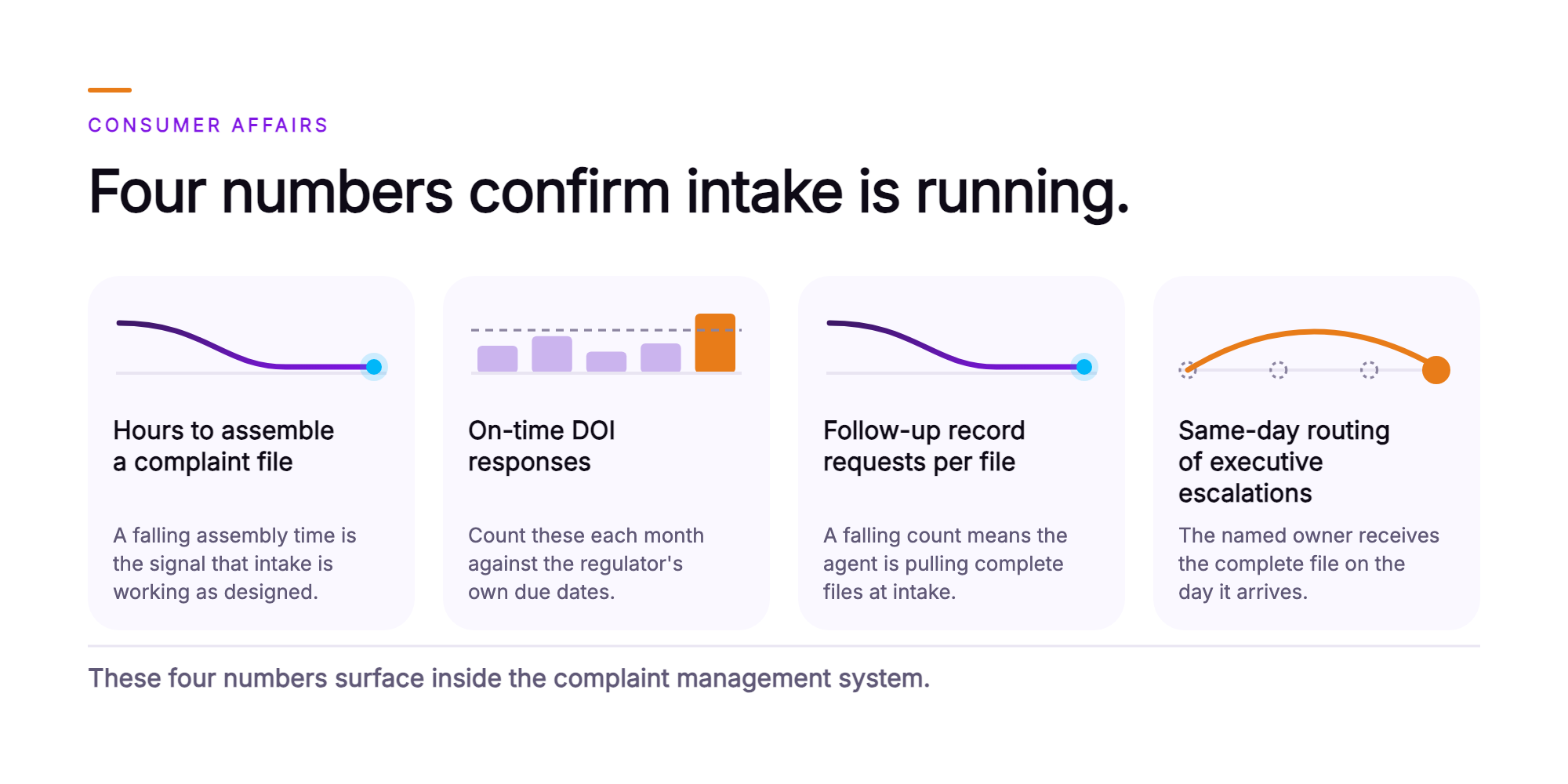
Hours to assemble a complaint file. This is the first metric to watch. When the evidence pack lands with the compliance owner the same day the complaint arrives, the analyst's calendar opens. Time that was spent chasing recordings and adjuster notes becomes time spent on the response itself. A falling assembly time is the signal that intake is working as designed.
On-time DOI responses. Count these each month against the regulator's own due dates. The date is within reach when the file is already complete. What makes the due date is a ready, routed evidence pack sitting with the analyst before the response window narrows.
Follow-up record requests per file. This is the count of times a compliance analyst goes back into a claim for a missing recording, transcript, or case note. A falling count means the agent is pulling complete files at intake, with everything the analyst needs in the first pass.
Same-day routing of executive escalations. The executive office watches this number because a delayed escalation file is a delayed decision. When the named owner receives the complete file on the day it arrives, the response timeline starts from arrival, and the decision time stays whole.
These four numbers surface inside the complaint management system the carrier already runs. That gives the Head of Consumer Affairs hard numbers to put in front of the leadership team.
What does the Head of Consumer Affairs take to the leadership team?
The Head of Consumer Affairs takes four concrete results to leadership: files assembled faster, complete intake records, a full audit trail behind every regulator response, and a compliance posture the carrier can defend.
Evidence packs in full. The interaction history and transcripts behind a complaint already exist inside the systems the carrier runs. The AI agent pulls them into one evidence pack at intake, so the compliance owner opens a case that contains the conversation record. That is the result leadership needs to hear: the carrier routes complete files, with the assembly work done by the agent.
Compliance team ownership. For executive escalation insurance cases and DOI complaints alike, the carrier's compliance team keeps full ownership of the position and the wording of every regulator response. The agent delivers a complete file. The team decides what to say and writes it. That boundary is clear, and leadership can communicate it to the regulator with confidence.
A quality record behind every response. Every complaint conversation is recorded, transcribed, and audited, so the file behind each regulator response carries a verifiable quality record. The compliance owner can open any conversation in that file exactly as it was captured.
Deployment and compliance posture. Orvera AI builds, deploys, and runs the agent. Full enterprise deployment lands in three to six weeks, and the platform holds the SOC 2 Type II, HIPAA, and GDPR posture regulated carriers require. The next section shows what the operation looks like once the agent is running.
What does complaint intake look like once the agent is running?
When a regulatory complaint insurance file arrives, the compliance owner opens a case that already holds the policy record, the claim history, and every relevant call transcript, assembled and routed before the analyst's morning starts.
The analyst's workflow changes in a specific way. Time goes to reading the file and forming the carrier's position, because the agent pulls the records from every named system and attaches the transcript of the original call at intake. The regulator's response window is still open. The evidence pack is already in hand. The agent runs that sequence, arriving complaint to complete routed file, the same way each time.
Intake and response stay separate. The agent assembles the file and routes it to the correct compliance owner according to the carrier's own rules. The compliance team answers the regulator. That boundary does not move. What the agent changes is the condition the compliance team works from: a complete file at the start of the case.
The four metrics covered earlier, hours to assemble a complaint file, on-time DOI responses, follow-up record requests per file, and same-day routing of executive escalations, confirm the model is running correctly. The complaint management system the carrier already runs surfaces each number.
If you want to see what this looks like on your own floor, talk to the team (opens in a new tab).
Frequently asked questions
AI agent DOI complaint handling begins the moment identification is confirmed, whether a policyholder states on a call that they filed with the state or a DOI letter is logged against the policy record. The agent pulls the policyholder's interaction history across every channel the carrier runs, voice, chat, email, and messaging, along with each conversation transcript, claim references, the policy record, and prior correspondence. Those records arrive intact, with the policyholder's own words preserved. The agent then opens the case in the complaint management system and attaches the full evidence pack. How AI supports compliance in DOI responses is settled at intake by the authority the carrier grants the agent. The agent is grounded in the carrier's approved knowledge and runs under the explicit controls the compliance team defines. Every action the agent takes is captured in the full conversation audit that runs across voice, chat, and every other channel the carrier operates.
Governed AI coordination for department of insurance complaints stops at the handoff point. The carrier's compliance team decides the carrier's position, writes the response, and sends it to the Department of Insurance. The AI agent's work ends when the evidence pack reaches the named owner. It assembled the file, recorded what it gathered, and logged where the file went. Nothing in that sequence crosses into regulatory drafting or legal judgment. Those decisions belong to your people. Agentic AI for insurance compliance operates strictly within the carrier's approved knowledge and explicit controls. What the agent says to a policyholder during intake stays inside the rules the carrier set. No interpretation outside those boundaries reaches the file, and no response goes to a regulator without a compliance officer behind it.
Automated executive escalation intake insurance processes route the completed evidence pack based on complaint type and state, so the named consumer affairs or compliance owner receives the case, and the executive office receives a copy when the escalation originated at that level. The routed object is a case record in the complaint management system. It holds the interaction history, the transcript set, and the claim and policy records, flagged so the assigned owner sees it first. Automated triage for executive level insurance complaints categorizes the case at intake, before a human reads a single line. The routing record captures who received the pack and the exact time it arrived. That record is what the compliance lead checks against the regulator's due date. How that record was built, and what every conversation in the file contains, is where the audit layer becomes the next critical question.
An AI agent platform for high-stakes insurance escalations must carry a full quality record alongside every transcript, documenting how each complaint conversation was handled. The platform retains the complete conversation log, the summary, and the full transcript for every interaction across every channel the carrier supports. Those records are the source material for the transcript set that lands in the evidence pack. That set holds every one of them, carried forward as they were captured. AI Auto QA audits every conversation, whether a human rep or an AI agent handled it. Each complaint call carries a scored quality record attached to its transcript. The compliance lead can open any entry in the file and read exactly what was said, by whom, and on which channel.
Regulatory complaint automation for insurers only holds up when the AI agent reads live system data straight from the systems of record. The platform connects to the complaint management system, claims administration, policy administration, and the CRM through 500+ enterprise integrations. The agent pulls current records at the moment a policyholder is identified. Your compliance and consumer affairs teams keep working in the systems they already know. Orvera AI does the build, the deployment, and the integration work. The carrier receives a configured platform with live connections into those systems. The architecture is model-agnostic. When a stronger underlying model becomes available, the carrier can adopt it while the integrations already in place stay as they are. That stability matters when you consider what deployment itself involves, which the next section covers directly.
Orvera AI builds, deploys, and runs the agent on the carrier's behalf, with full enterprise deployment landing in three to six weeks. Carriers asking how to automate DOI complaint intake with AI receive the intake logic configured to their own complaint categories and escalation owners. Orvera does the build: onboarding, knowledge-base setup, agent training, and change management for the consumer affairs and compliance teams. Your representatives keep working in the systems they already know. The posture behind the build is SOC 2 Type II certified, HIPAA compliant, and GDPR compliant. The team doing the work carries 18+ years of contact center operating experience. That is what an operator running the floor brings to a carrier's complaint desk.

Written by
Anindita Majumder
Anindita Majumder is a communications professional with nearly four years of experience in public relations, corporate communications, and journalism. She creates content that helps brands communicate their vision, products, and expertise through press releases, thought leadership, and editorial pieces. Outside of work, she is a vocalist, which keeps her creativity flowing.