Orvera vs. Bland AI: Which AI Platform Is Better in 2026?
This guide compares Orvera AI and Bland AI on pricing, deployment, workflow control, telephony, integrations, analytics, scalability and security, using Bland's own website as of October 5, 2026, so you can choose the right fit.

Key highlights
Comparison at a Glance
- Choose Orvera AI if you want omnichannel AI agents across voice, chat, email and messaging, with Agent Assist and Auto QA for human agents on the same platform and clear operational reporting.
- Choose Bland AI if you want telephony-first automation, usage-based call economics, and more direct API and webhook control over call behavior.
- Orvera fits teams that prioritize structured business outcomes, queue reduction, and one platform for AI agents and human agents.
- Bland AI is usually the better fit for teams prioritizing phone automation infrastructure, developer-led workflows, and granular telephony control.
- If your team runs customer conversations across voice, chat, email and messaging and wants AI agents, Agent Assist and Auto QA on one platform, Orvera is built for that operation.
Orvera AI, an AI agent company for customer experience teams, and Bland AI both help teams automate customer interactions with AI, but the better choice depends on what matters most in the real rollout. Some buyers care most about channel mix, workflow depth, rollout speed, and cost predictability. Others care more about telephony control, API-led customization, and large-scale call infrastructure. Orvera AI runs omnichannel AI agents across voice, chat, email and messaging, with Agent Assist and Auto QA for human agents on the same platform. Bland AI is more commonly evaluated as a telephony-first AI platform for inbound and outbound calling, with strong emphasis on phone automation, APIs, webhooks, SIP, and production-grade calling workflows.
Orvera AI publishes this comparison. Competitor details come from each vendor's own website as of October 5, 2026, and are linked where they appear.
Both platforms can automate conversations. The question is which one matches your operating model. This guide focuses on the factors that usually shape the decision in practice: pricing style, setup effort, workflow control, telephony, integrations, analytics, governance, and how many channels your team needs to run together.
Quick Snapshot (Orvera vs Bland AI)
Orvera AI is an agentic customer experience platform: omnichannel AI agents across voice, chat, email and messaging, plus Agent Assist and Auto QA for human agents, with 500+ integrations and more than 80 languages. Orvera brings 18+ years of contact-center experience. Across Orvera customer engagements, full deployment averages 3 to 6 weeks and first-contact resolution averages about 80 percent.
Bland AI is best known for AI phone automation. As of October 5, 2026, its public materials emphasize inbound and outbound calling, open APIs, SIP support, webhooks, batch calls, telephony-heavy workflows (opens in a new tab), and enterprise calling infrastructure. Its docs and API references make it especially visible to technical teams that want direct control over how phone workflows behave in production.
So the quick summary is this: Orvera fits CX teams that want omnichannel AI agents across voice, chat, email and messaging with Agent Assist and Auto QA on one platform, while Bland AI fits teams that want a more telephony-centric platform with explicit API and call-control flexibility.
What Orvera Is Best For
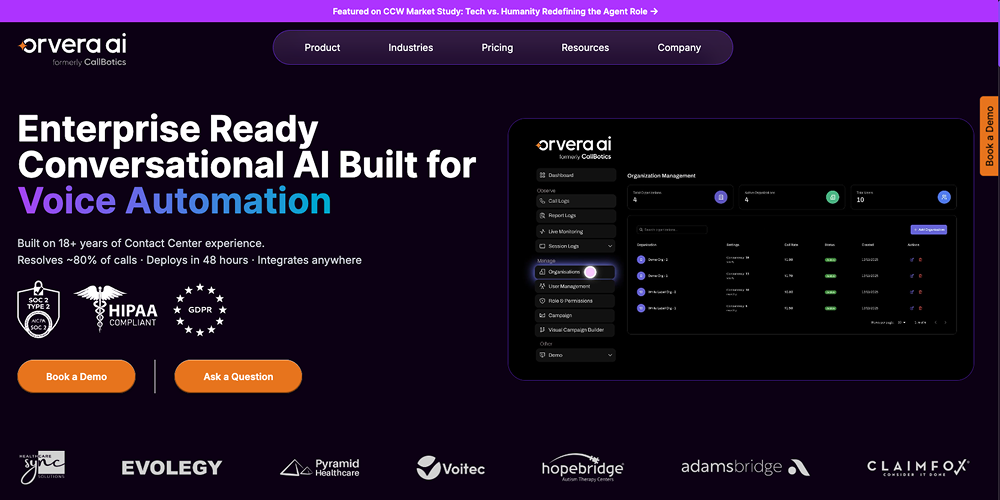
Orvera is best for CX teams that want to automate customer interactions across channels (opens in a new tab), with AI agents and human agents on one platform. It is built around structured workflows, measurable outcomes, summaries, analytics, and operational visibility, making it especially relevant for contact centers, BPOs, scheduling programs, triage workflows, and voice-heavy service environments.
Because it is built around operational fit, Orvera suits teams that care about handoff continuity, queue reduction, and a guided rollout across real business workflows. Voice, chat, email and messaging run on the same platform as Agent Assist and Auto QA, so each channel connects to the rest of the customer journey.
See how Orvera runs AI agents across voice, chat, email and messaging, with conversation summaries and operational reporting in one place. (opens in a new tab)What Bland AI Is Best For
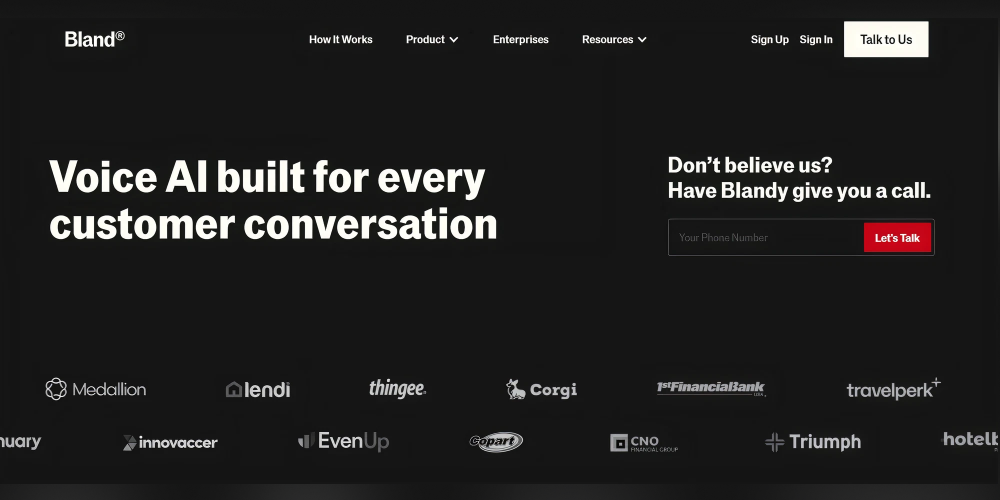
Bland AI is best for teams that want to automate inbound and outbound phone calls with direct control over telephony behavior, API-triggered actions, and developer-accessible workflow logic. Its public product story is centered on calls first, including sending calls, receiving inbound calls, using webhooks during live calls, SIP routing, batch outbound calling, and custom API-driven workflows.
That makes Bland AI especially relevant for telephony-heavy operations, API-led engineering teams, and organizations that want to treat voice automation as a programmable call infrastructure layer. As of October 5, 2026, Bland's homepage also sells a single agent across voice, SMS, iMessage, and web chat (opens in a new tab), and its clearest public strength remains AI phone calls.
How They Work (Simple Setup Flow)
In practice, both platforms follow a similar rollout pattern. Teams choose a workflow, design the interaction logic, connect business systems, test edge cases, go live, and then review outcomes weekly to improve the flow. That is true whether the workflow is appointment scheduling, inbound support, collections, lead qualification, or outbound reminders.
The real difference is how each platform expects teams to operate during that rollout. Orvera builds, deploys and runs the workflow for the customer and reports on measurable workflow outcomes. Bland frames it more around voice-agent definition, telephony behavior, API and webhook actions, test scenarios, and gap detection inside phone workflows. As of October 5, 2026, Bland's homepage says its forward-deployed engineers build a customer's first agent end to end (opens in a new tab), and its self-serve plans let technical teams build their own. So the difference comes down to channel scope and how much telephony control your team wants to keep.
What are the key differences between Orvera AI and Bland AI?
The main differences show up in the areas that affect time-to-value, operating fit, and total cost over time. For most buyers, those areas are pricing style, setup effort, workflow control, telephony depth, integrations, analytics, scalability, governance, and omnichannel readiness.
Pricing style and total cost
Bland AI is commonly evaluated through a usage-based model. As of October 5, 2026, Bland's pricing page lists $0.14 per minute (opens in a new tab) on its Start plan and $0.12 per minute plus a $299 monthly platform fee on its Build plan, with transfers billed at $0.05 and $0.04 per transfer minute, telephony billed separately, and custom contracts on Enterprise. Buyers should still confirm the current billing model, transfer charges, telephony charges, and what is bundled at their expected scale.
Orvera discusses cost with each account on a consultative call, once there is a named use case. The real comparison is the total cost against outcomes, support, integrations, and workflow success.
Deployment speed and setup effort
Time-to-launch depends on workflow clarity, integrations, telephony setup, testing, QA, approvals, and how much implementation the buyer needs to own. Across Orvera customer engagements, full deployment averages 3 to 6 weeks, with Orvera's team running the implementation. As of October 5, 2026, Bland promotes enterprise deployments live in production in 30 days (opens in a new tab), and its pricing page says most self-serve teams deploy a first agent within a day (opens in a new tab). Both timelines depend on how much custom call logic, integration work, and operational tuning the workflow needs before scaling.
In practical terms, Orvera suits teams that want Orvera's team to run the rollout into production, while Bland's self-serve plans suit teams comfortable taking on technical implementation work in exchange for deeper call-control flexibility.
Workflow building and control
Both platforms can support complex workflows, but they frame control differently. Bland's ecosystem is built around Conversational Pathways, APIs, webhooks, live actions during calls, and test scenarios, per its documentation as of October 5, 2026 (opens in a new tab). That makes it attractive for teams that want granular control over voice-agent behavior and are comfortable treating the call flow as a more technical system.
Orvera also supports deep workflow execution, with positioning that is outcome-led. It suits teams that care most about getting structured business workflows into production and measuring business outcomes clearly, with telephony behavior configured for them.
Telephony and calling options
Telephony flexibility is one of Bland's clearest strengths. As of October 5, 2026, its public site references SIP (opens in a new tab), number porting, telephony provider compatibility, batch calls, inbound support, outbound calls, and API-based call dispatch. This makes telephony depth a real evaluation point in the comparison.
Orvera also runs specialized Voice AI for inbound and outbound calling, and its public story emphasizes the workflow and outcome layers across voice, chat, email and messaging. Buyers who want telephony-first control may find Bland easier to evaluate on that axis, while buyers who care more about what the system achieves operationally may find Orvera more naturally aligned.
Integrations and tool actions
Both platforms support strong business-tool connectivity, but they communicate that strength differently. Bland emphasizes open REST APIs, webhooks, and business system integration, which is especially appealing to technical teams building on internal systems or custom architectures.
Orvera combines broad integration coverage with 500+ integrations (opens in a new tab) across CCaaS, CRM, helpdesk, scheduling and other business systems. It suits buyers who want Orvera's team to connect the system to their CRM, scheduling, support, and business tools.
Analytics and call insights
Bland's analytics story is closely tied to its broader testing and optimization loop. As of October 5, 2026, its documentation and pricing page describe test scenarios, Knowledge Base Gaps detection (opens in a new tab), and platform-level tooling for improving call flows over time. That is valuable for teams that want a more technical optimization workflow around voice automation.
Orvera puts its emphasis on transcripts, summaries, call outcomes, QA-style visibility, and Voice of Customer themes and drivers (opens in a new tab) that map directly to contact center and operations use cases. For teams that want reporting to help service managers, QA teams, and operations leaders make weekly decisions, Orvera adds Agent Assist and Auto QA across AI-handled and human-handled conversations on the same platform.
Explore Orvera if you want AI agents, conversation summaries, reporting, and cross-channel workflow visibility built for real customer operations. (opens in a new tab)Scalability and concurrency
As of October 5, 2026, Bland's homepage describes AI call centers where agents answer thousands of concurrent calls (opens in a new tab), and its pricing page lists 10 concurrent calls on Start and 50 on Build (opens in a new tab). Buyers should still validate what that means under their own peak-load conditions, transfer logic, and real production traffic.
Orvera fits CX operations where queue pressure, handoff quality, and outcome visibility matter. It suits teams whose real scaling problem is high-volume service delivery under operational constraints.
Security and governance
As of October 5, 2026, Bland's homepage lists SOC 2 Type II, HIPAA and PCI DSS certifications and offers self-hosted and on-premises deployments (opens in a new tab), which is meaningful for regulated or risk-sensitive environments. Buyers should still confirm how that maps to their own procurement, hosting, and access-control requirements.
Orvera also positions itself on governed execution, and the distinction is mostly one of emphasis. Bland's story is more infrastructure and privacy-led. Orvera runs governance in the same architecture as workflow execution, which is useful for teams that need controls built into workflow execution (opens in a new tab). Both need live validation, and Orvera fits CX leaders who want governance in an execution-oriented package.
How do Orvera AI and Bland AI compare side by side?
Table entries summarize each vendor's own pages as of October 5, 2026.
| Category | Orvera | Bland AI |
|---|---|---|
| Best for | Omnichannel AI agents plus Agent Assist and Auto QA on one platform | Voice-centric automation and telephony-heavy workflows |
| Pricing approach | Discussed with Orvera's team on a consultative call | Usage-based per-minute plans, telephony billed separately |
| Setup effort | Implementation run by Orvera's team, full deployment averages 3 to 6 weeks across Orvera customer engagements | Self-serve first agent in a day, enterprise deployments in 30 days |
| Workflow control | Strong workflow execution with business-outcome focus | Granular phone workflow control with APIs and webhooks |
| Telephony depth | Specialized Voice AI for inbound and outbound calling | Stronger explicit telephony and SIP focus |
| Integrations | 500+ integrations with solution-led workflow fit | Strong API and webhook integration flexibility |
| Analytics and QA | Conversation summaries, reporting, Agent Assist and Auto QA | Test scenarios and call-flow testing tooling |
| Scalability | Built for high-volume customer operations | Thousands of concurrent calls, per its homepage |
| Security and governance controls | Governed and SOC 2 Type II certified, with execution-oriented fit | Strong privacy and self-hosting posture |
| Omnichannel readiness | AI agents across voice, chat, email and messaging | Voice-led, with one agent across voice, SMS, iMessage, and web chat |
Best Use Cases For Orvera
Orvera fits best where CX teams want AI agents across voice, chat, email and messaging, with Agent Assist and Auto QA supporting their human agents.
Contact center automation and queue reduction
Orvera is a strong fit for high-volume inbound environments where the goal is to answer quickly, reduce hold time, automate repeatable call types, and route exceptions cleanly while preserving operational visibility.
Appointment scheduling and confirmations
Structured workflows with clear success outcomes, such as booked, rescheduled, confirmed, or canceled, are a natural fit because Orvera is positioned around execution and measurable outcome reporting.
Omnichannel customer engagement
Orvera is also a strong fit for teams that want voice, chat, email and messaging coordinated as part of one customer interaction workflow, with voice automation connected to the other channels.
Best Use Cases For Bland AI
Bland AI is strongest where teams are primarily focused on phone automation, telephony-heavy workflows, and technical control over call behavior.
Inbound and outbound phone automation
Bland is a strong fit for reminders, confirmations, collections, support calls, and other phone-heavy workflows where AI calls are the main delivery channel.
Telephony-driven workflows with API control
Bland is especially relevant when the team wants to trigger actions mid-call, connect directly to APIs and webhooks, and keep deeper technical control over how the conversation behaves.
Variable-volume calling programs
Bland's per-minute plans suit pilots, variable outbound campaigns, and teams that want a direct usage model. Total cost still needs validating against retries, transfers, telephony charges, and real call duration.
What are the strengths and considerations of each platform?
This decision comes down to channel fit, workflow design preference, and how your team wants to own deployment.
Orvera Strengths and Considerations
Pros
- Omnichannel AI agents across voice, chat, email and messaging on one platform
- Implementation run by Orvera's team
- Built by teams with 18+ years of contact center experience
- 500+ integrations across CCaaS, CRM, helpdesk and scheduling systems
- Agent Assist and Auto QA for human agents on the same platform
- Suited to teams that want guided execution and measurable outcomes
What to validate in a pilot
- Cross-channel orchestration depth for your exact workflow mix
- Handoff quality and task confirmation
- Reporting fit for your QA and compliance model
- Rollout fit for your target use cases
Bland AI Strengths and Considerations
Pros
- Strong telephony-first product story
- Strong API and webhook flexibility
- Stronger explicit SIP and calling infrastructure posture
- Published per-minute plan pricing
- Strong testing story for call-flow improvement
What to validate in a pilot
- Real deployment effort in your environment
- Total cost at production call volume
- Transfer behavior and transfer-minute charges
- How its SMS, iMessage, and web chat channels fit your wider channel orchestration
- Reporting usefulness for non-technical service teams
Which One Should You Choose? (Simple Decision Guide)
The fastest way to choose is to start from your operating model.
Choose Orvera if…
Choose Orvera if you need omnichannel AI agents across voice, chat, email and messaging, measurable outcomes, and governance across multiple customer touchpoints. It fits teams that want Orvera's team to run the rollout, clear reporting, and Agent Assist and Auto QA on the same platform as the AI agents.
Choose Bland AI if…
Choose Bland AI if your first priority is AI phone automation (opens in a new tab), usage-based voice economics, API-level control, or telephony-heavy workflows where your team wants to shape call behavior in more technical detail.
If you're unsure, run a 2-workflow pilot
Test one simpler workflow and one medium-complexity workflow, then compare:
- Containment
- Task completion
- Transfer quality
- Call duration
- Cost per successful outcome
- QA visibility
- Ease of weekly optimization
This will usually tell you whether your team needs broader workflow execution across channels or deeper telephony-first control. This is a practical recommendation based on the platform differences above.
How Orvera Helps Teams Upgrade AI Automation
Orvera helps teams upgrade AI automation by running omnichannel AI agents across voice, chat, email and messaging, with Agent Assist and Auto QA for human agents on the same platform. Orvera brings 18+ years of contact-center experience, so the team understands queue pressure, handoff quality, workflow execution, and how to keep improving customer interactions after launch.
What makes Orvera different:
- Omnichannel AI agents plus Agent Assist and Auto QA on one platform
- A deployment the Orvera team runs for you
- Strong workflow execution tied to real outcomes
- 500+ integrations across business systems
- Strong summaries, analytics, and operational visibility
- Built for teams that measure success by resolved conversations and completed workflows
Conclusion
Both platforms are credible, but they solve slightly different buying problems. Bland AI is a strong fit for telephony-first automation and teams that want granular API and webhook control over voice behavior. Orvera fits CX teams that want omnichannel AI agents across voice, chat, email and messaging, a rollout run by Orvera's team, broad workflow execution, and Auto QA and operational reporting on the same platform.
The best choice depends on your channel mix, workflow complexity, rollout model, governance requirements, and budget. If your team wants one platform that runs customer interactions across voice, chat, email and messaging, with AI agents and human agents supported together, Orvera is built for that operation.
Frequently asked questions
As of October 5, 2026, Bland's pricing page lists per-minute rates of $0.14 on Start and $0.12 plus a $299 monthly platform fee on Build, with transfer minutes and telephony billed separately and custom Enterprise contracts. Buyers should verify transfer charges, telephony costs, and enterprise terms.
It depends on who builds it. As of October 5, 2026, Bland says most self-serve teams deploy a first agent within a day and enterprise deployments go live in 30 days. Orvera's team runs the implementation, and full deployment averages 3 to 6 weeks across Orvera customer engagements.
No. As of October 5, 2026, Bland's homepage sells one agent across voice, SMS, iMessage, and web chat, and its product center of gravity is AI phone automation.
Orvera AI runs AI agents across voice, chat, email and messaging, with Agent Assist and Auto QA on one platform, so it fits teams that need those channels orchestrated together.
You should test containment, task completion, transfer quality, cost per successful outcome, reporting usefulness, and how easy it is to improve the workflow after launch.
Written by
Anindita Majumder
Anindita Majumder is a communications professional with nearly four years of experience in public relations, corporate communications, and journalism. She creates content that helps brands communicate their vision, products, and expertise through press releases, thought leadership, and editorial pieces. Outside of work, she is a vocalist, which keeps her creativity flowing.