Orvera vs Decagon: Which AI Platform Is Better in 2026?
This guide compares Orvera AI and Decagon on channels, deployment, workflow building, integrations, analytics, governance and pricing style, with Decagon details from its own website as of October 5, 2026, so you can choose the right fit.

Key highlights
Comparison in a Nutshell
- Choose Orvera AI if you want omnichannel AI agents across voice, chat, email and messaging, with Agent Assist and Auto QA on one platform and deep Voice AI specialization.
- Choose Decagon if you want to build and tune AI agents across chat, email, SMS and voice with in-house testing and experimentation tooling.
- Orvera is best suited to teams that want the platform built, deployed and run for them by an operator with 18+ years of contact-center experience.
- Decagon is best suited to teams that want to build and tune their own AI agents with in-house testing and experimentation tooling.
- Across Orvera customer engagements, full deployment averages 3 to 6 weeks.
Both Orvera AI and Decagon are built to help businesses automate customer interactions with AI, but the better choice depends on what you need most. Some teams care most about rollout speed and workflow execution. Others care most about in-house tooling to build and tune their own agents. Decagon positions itself as an AI customer experience platform with omnichannel support, optimization tooling and controls. Orvera is an AI agent company for customer experience teams, with omnichannel AI agents across voice, chat, email and messaging, Agent Assist and Auto QA on one platform, and deep specialization in Voice AI.
Orvera AI publishes this comparison. Competitor details come from each vendor's own website as of October 5, 2026, and are linked where they appear.
This is why the comparison comes down to operating fit. The real decision usually comes down to channel mix, workflow complexity, integrations, reporting depth, governance needs, pricing style, and how quickly your team wants to move from first use case to live automation. This guide focuses on those buying criteria.
Quick Snapshot (Orvera vs Decagon)
Orvera is an AI agent company for customer experience teams. It runs omnichannel AI agents across voice, chat, email and messaging, inbound and outbound, with Agent Assist and Auto QA for human agents on the same platform and deep specialization in Voice AI. The platform is backed by 18+ years of contact-center experience.
As of October 5, 2026, Decagon runs AI agents across chat, email, voice and SMS (opens in a new tab). Its public materials emphasize building, optimizing and scaling AI agents, with Agent Operating Procedures (AOPs) for natural-language workflows (opens in a new tab), testing, experiments, and insights and reporting as core parts of the platform story.
In practice, both support omnichannel automation, and they are often shortlisted for different reasons. Orvera is best suited to teams that want one platform for AI agents and human-agent support, built, deployed and run for them. Decagon is best suited to teams that want to own the agent lifecycle in-house, with testing and optimization tooling.
What Orvera Is Best For
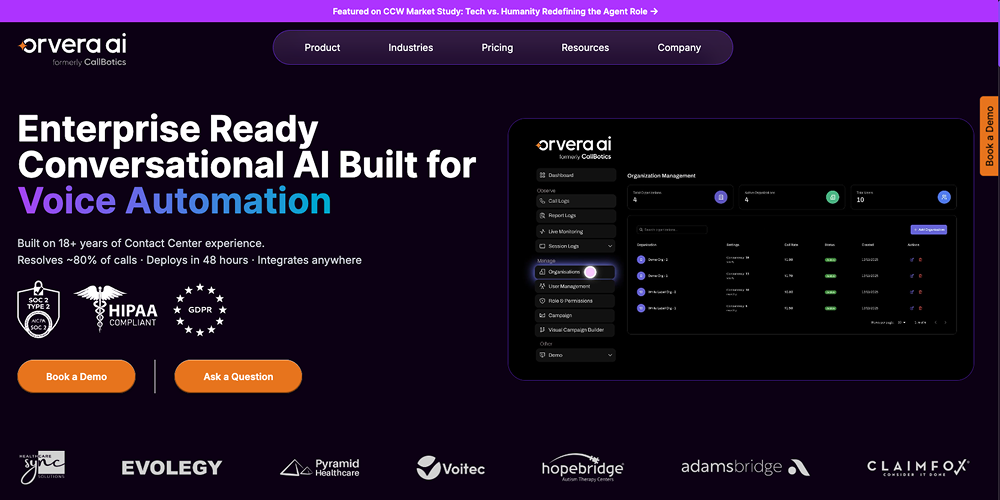
Orvera is best for CX teams that want AI automation (opens in a new tab) with deep specialization in Voice AI and customer interaction execution. Its AI agents work across voice, chat, email and messaging, inbound and outbound, with intent-driven handling, summaries, analytics and structured workflow completion. Agent Assist and Auto QA support the human agents on the same platform.
That makes Orvera especially relevant for contact centers, BPOs, scheduling workflows, lead qualification, support triage and other structured service operations where handoff quality and measurable workflow outcomes matter. It suits buyers who want to optimize around real performance metrics.
What Decagon Is Best For
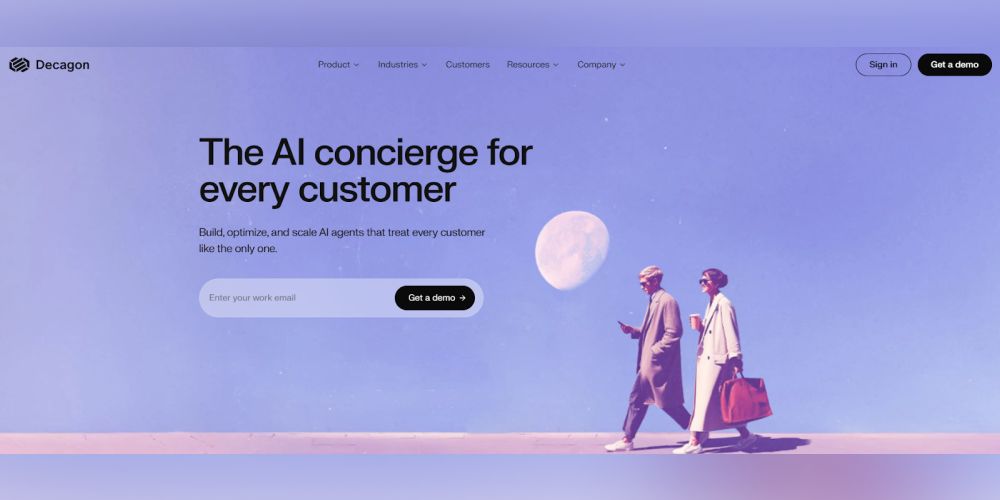
Decagon is best for teams that want an AI customer experience (opens in a new tab) platform across channels. Its public positioning centers on AI agents that can build, optimize, and scale across chat, email, voice and SMS, while also supporting memory, testing, experimentation, and action-taking within support workflows.
That makes Decagon relevant for organizations that want a customer experience layer across digital and voice channels, using a single agent framework their own team tunes.
How They Work (Simple Setup Flow)
In practice, both platforms follow a similar setup path. Teams start with one or two high-value interaction types, define the workflow, connect the required systems, test edge cases, launch a pilot, measure outcomes, and then improve the workflow over time. That core rollout logic is similar regardless of the initial use case: appointment scheduling, support triage, FAQs, or outbound follow-up.
The difference is in how each platform frames the process. Orvera builds, deploys and runs the solution for the customer, with a focus on workflow execution and contact center performance. Decagon leans toward build, optimize and scale, with public emphasis on natural-language workflows, testing, experiments and continuous optimization. Both can launch agents, so the real comparison is the amount of implementation effort the team wants to own and the speed at which they need to see value from the first workflow.
What are the key differences between Orvera AI and Decagon?
The most important differences are the ones that affect time-to-value, operational fit, and cost behavior over time. For most buyers, that means pricing style, setup effort, workflow depth, channel support, integrations, reporting, scalability, and governance. Both platforms handle complex CX workloads, but they are built around slightly different center-of-gravity assumptions.
Pricing approach
Pricing shapes budgeting and forecasting as automation grows. Decagon's website shows no public pricing page as of October 5, 2026. (opens in a new tab) Ask Decagon for its billing unit at your expected volume.
For Orvera, pricing is discussed on a consultative call about your use cases.
Deployment speed and setup effort
Time-to-launch matters. Across Orvera customer engagements, full deployment averages 3 to 6 weeks. Decagon emphasizes natural-language workflow building, tool connectors and optimization tooling. For either platform, setup effort depends on workflow complexity, approvals, integrations and internal change management.
In practice, Orvera is best suited to teams that want their first workflows built, deployed and run for them. Decagon is best suited to teams that want to run a platform rollout in-house, with testing and optimization infrastructure around the agent lifecycle.
Workflow building and control
Workflow depth matters because production AI fails quickly when the logic around fallbacks, validation, interruptions and tool actions is weak. Decagon's public materials emphasize Agent Operating Procedures that define agent workflows in natural language as of October 5, 2026 (opens in a new tab), plus tool connectors for taking actions in connected systems. That gives it a platform-led story around workflow governance and AI agent design.
Orvera also supports deep workflow execution, with positioning that is outcome-led and operationally grounded. It suits teams that judge a workflow by whether it resolves conversations, routes correctly and performs under real contact center conditions. Orvera frames workflow depth through execution, and Decagon frames it through platform building and optimization.
Voice and channel support
Both platforms support omnichannel automation. Orvera runs omnichannel AI agents with deep specialization in Voice AI (opens in a new tab), with Agent Assist and Auto QA for human agents on the same platform. Decagon is positioned around customer experience automation across channels and publicly highlights chat, email, voice and SMS, plus Decagon Assist for human representatives, as of October 5, 2026 (opens in a new tab). Orvera's AI agents work across voice, chat, email and messaging, inbound and outbound.
That means:
- Orvera is best suited to teams that want AI agents and human-agent support on one platform, with deep Voice AI specialization
- Decagon is best suited to organizations that want to build and tune a cross-channel AI support platform in-house from the start
- Both are omnichannel. The difference is where each puts its depth: Orvera in Voice AI and the human-agent layer, Decagon in in-house agent building and optimization tooling
Integrations and tool actions
Integrations matter because AI agents create the most value when they can take real actions. Decagon publicly highlights integrations through tool connectors as of October 5, 2026 (opens in a new tab), which matters for teams building support workflows across systems.
Orvera also has a strong integration story (opens in a new tab), with 500+ integrations across CCaaS, CRM, helpdesk, ITSM, payments and other business systems. That suits teams that want AI agents taking actions inside the systems they already run.
Analytics and call insights
Analytics are essential because AI platforms improve through iteration after launch. Decagon emphasizes testing and QA, simulations, live A/B experiments and its Watchtower always-on QA as of October 5, 2026 (opens in a new tab). That makes it attractive for teams that want optimization tooling around agent behavior and support workflows.
Orvera pairs its AI agents with Agent Assist, Auto QA across AI-handled and human-handled conversations, and conversation summaries, transcripts and reporting. For teams that care most about conversation insights, queue outcomes, transfer quality and measurable automation performance, that keeps reporting tied to day-to-day service operations.
Explore Orvera if you want agentic AI agents plus Agent Assist and Auto QA, with call summaries, Voice of Customer themes and drivers, and operational visibility built for real contact center teams. (opens in a new tab)Scalability under peak demand
Scalability matters most during peak demand, overflow conditions and large support events. Decagon positions itself for large-scale support across channels. For either platform, validate peak-load behavior, escalation rules and consistency under pilot conditions.
Orvera is best suited to buyers whose main concern is conversation volume, queue pressure and structured workflow performance under peak conditions.
Security and governance
Decagon publishes detailed security controls as of October 5, 2026 (opens in a new tab), including AES-256 encryption for storage, TLS 1.2+ in transit, zero-data retention with LLM providers, PII redaction and audit logs. Buyers should validate the specifics against their own requirements.
Orvera is SOC 2 Type II certified, HIPAA compliant and GDPR compliant, and it builds, deploys and runs the operation for the customer across channels. Compare both against your own security review.
Best Use Cases for Orvera
Orvera tends to fit best where teams want AI agents and human-agent support on one platform, and measurable results from structured workflows.
Contact center automation and queue reduction
Orvera is a strong fit for high-volume inbound environments where the goal is to answer quickly, reduce hold time, automate common call types, and route exceptions cleanly. Orvera's focus on containment and genuine resolution, with Agent Assist for the calls that reach a human, fits this use case well.
Appointment scheduling and confirmations
Structured workflows with clear end states, such as booked, confirmed, canceled, or rescheduled, are another natural fit. These workflows are easy to measure and align closely with Orvera's Voice AI specialization.
Lead qualification and outbound follow-ups
Orvera is also well-suited to workflows where agents need to collect details, qualify intent, and pass a clean summary back to downstream systems or human teams. That makes it useful for sales, intake, and structured outbound engagement.
Best Use Cases for Decagon
Decagon is best suited to businesses that want a customer experience automation layer across channels that their own team builds and tunes.
Omnichannel support automation
Decagon's public positioning makes it a fit for businesses that want one AI agent platform across chat, email, voice and SMS, especially when support teams are trying to unify customer interactions across multiple surfaces.
Voice agents with handoffs and outbound engagement
Decagon also highlights voice agents with outbound calling and handoff summaries as of October 5, 2026 (opens in a new tab), making it a credible option for organizations that want voice automation as part of a broader omnichannel support strategy.
Teams that want strong integrations and operational tooling
Because Decagon leans heavily into testing, QA, integrations, and optimization, it may appeal most to teams that want strong platform tooling around agent improvement, debugging, and cross-channel support operations over time.
What are the strengths and considerations of each platform?
The right choice is the platform that matches your deployment model, workflow mix, and reporting needs.
See how Orvera runs omnichannel AI agents, Agent Assist and Auto QA on one platform for customer experience teams. (opens in a new tab)Orvera: Strengths and Considerations
Pros
- A deployment the Orvera team runs for you
- Deep Voice AI specialization inside an omnichannel platform
- Built on 18+ years of contact-center experience
- 500+ integrations for workflow execution inside your existing stack
- Agent Assist and Auto QA across AI-handled and human-handled conversations
- Best suited to contact center and BPO-style operations
What to validate in a pilot
- Handoff quality in your exact workflow
- Intent accuracy under edge cases
- Tool action confirmation in production
- Reporting depth for your QA and compliance model
Decagon: Strengths and Considerations
Pros
- Strong omnichannel platform story across support channels
- Strong public emphasis on AOPs, testing, QA, and optimization
- Tool connectors for action-taking across connected systems
- Published security controls, including encryption, zero-data retention with LLM providers and audit logs
What to validate in a pilot
- Billing unit at your expected volume
- Setup timeline for the first workflow
- Workflow reliability under edge cases
- Whether the broader platform scope matches your actual near-term needs
- Peak-load behavior for the channels you care about most
Which One Should You Choose? (Simple Decision Guide)
The fastest way to decide is to start from real constraints.
Choose Orvera if…
Choose Orvera AI if you want omnichannel AI agents across voice, chat, email and messaging, Agent Assist and Auto QA on one platform, deep Voice AI specialization, and a platform shaped by 18+ years of contact-center experience that is built, deployed and run for you.
Choose Decagon if…
Choose Decagon if you want to build and tune AI agents in-house (opens in a new tab), with platform-led optimization tooling and a customer support strategy designed from the beginning around AI agents across multiple surfaces.
If you're unsure, run a 2-workflow pilot
A practical way to decide is to test one simpler workflow and one more complex workflow. Compare resolution quality, handoff quality, reporting visibility, escalation behavior, and cost per successful outcome. That will usually tell you which operating model fits your team. This is a practical recommendation based on the public positioning of both platforms.
How Orvera Runs Automation For CX Teams
Orvera combines omnichannel AI agents, Agent Assist and Auto QA on one platform, with workflow execution and operator-informed design. It draws on 18+ years of contact center (opens in a new tab) experience, and it is built by people who understand queue pressure, routing quality, handoff complexity, and how to improve voice workflows week by week after launch.
What makes Orvera different:
- Omnichannel AI agents across voice, chat, email and messaging, with deep Voice AI specialization
- Agent Assist and Auto QA for human agents on the same platform
- Strong workflow execution tied to routing, summaries, and task completion
- 500+ integrations across CRM, CCaaS and helpdesk systems
- Strong outcome-focused reporting and operational visibility
- Best suited to teams that want the platform built, deployed and run for them
Conclusion
Both platforms are credible AI options for CX teams, and they solve slightly different buying problems. Decagon is best suited to teams that want an omnichannel AI customer experience platform they build and tune in-house, with an emphasis on testing and optimization. Orvera is best suited to teams that want omnichannel AI agents, Agent Assist and Auto QA on one platform, with deep Voice AI specialization, built, deployed and run for them.
The best choice comes down to workflow complexity, channel strategy, integration needs, governance requirements and budget model. Run the two-workflow pilot above and compare cost per successful outcome before you commit.
Frequently asked questions
Decagon's website shows no public pricing page as of October 5, 2026, so ask Decagon for pricing during a vendor evaluation.
Yes. Decagon is positioned as an omnichannel AI customer experience platform. Orvera is omnichannel too, with deep Voice AI specialization.
Decagon publishes detailed governance and security controls as of October 5, 2026. Orvera is SOC 2 Type II certified, HIPAA compliant and GDPR compliant, and it pairs AI agents with Auto QA across AI-handled and human-handled conversations and workflow reporting.
Yes. Orvera offers 500+ integrations, and as of October 5, 2026, Decagon highlights integrations through tool connectors.
You should test setup speed, workflow completion, handoff quality, reporting usefulness, escalation behavior, and cost per successful outcome under realistic conditions.
Written by
Anindita Majumder
Anindita Majumder is a communications professional with nearly four years of experience in public relations, corporate communications, and journalism. She creates content that helps brands communicate their vision, products, and expertise through press releases, thought leadership, and editorial pieces. Outside of work, she is a vocalist, which keeps her creativity flowing.