SynthFlow Vs. Retell AI: Honest Comparison & How Orvera Fits In
Teams choosing a voice AI platform often compare Synthflow and Retell AI on how each handles conversations, integrations and live calls. This comparison covers both products and shows where Orvera AI fits as a platform built for contact centers.

Key highlights
Key takeaways
- Synthflow AI is great for small teams or pilot projects, offering a visual, no-code workflow builder that makes setup quick and simple.
- Retell AI works well for technical teams that want flexible, pay-as-you-go pricing with API-level control and high concurrency.
- Synthflow now sells enterprise contracts from $30,000 a year, while Retell requires ongoing technical effort to manage complex workflows.
- Orvera builds, deploys and runs the operation for CX teams, with advanced multi-step workflows, built-in analytics and high concurrency for teams moving beyond pilots.
- Teams that want the build, the deployment and the daily operation handled for them are better served by a platform that runs the operation end to end.
- As call volumes grow and workflows become more complex, platforms built for contact center operations reduce friction during scale-up.
Voice AI now sits at the center of how modern contact centers handle revenue, service, and customer trust. In search for the one you need, you likely wanted to compare Synthflow and Retell AI, with a clear view of how each handles conversations, integrations, and live calls. Both products appeal to teams building structured voice automation with clear control over agent behavior.
Alongside them, Orvera shows how a contact-center-built platform approaches scale, quality, and speed to production. Once live, these platforms express distinct approaches to how voice AI supports real customer conversations.
This guide helps teams match each solution to call volume patterns, workflow depth, and the level of operational ambition driving their contact center decisions.
Short answer: As of October 2, 2026, Synthflow's pricing page lists enterprise contracts starting at $30,000 a year, scoped to call volume, concurrency and integrations, with implementation and launch support. Retell AI lists pay-as-you-go pricing from $0.07 to $0.31 per minute plus enterprise plans, and suits teams with the technical capacity to configure telephony and workflows themselves.
Synthflow vs Retell AI and How They Compare to Orvera AI
Synthflow and Retell AI take different approaches to pricing and setup, and Orvera does the build, the deployment and the integration and then runs the operation. The table below sets out these differences side by side.
| Property | Synthflow | Retell AI | Orvera AI |
|---|---|---|---|
| Pricing Model | Enterprise contracts, scoped to volume, concurrency, telephony and integrations | Pay-as-you-go per minute with modular charges | Scoped to the deployment, shared on a scoped call |
| Annual Price Overview (per user/per month) | From $30,000 a year (as of October 2, 2026) | Usage only, $0.07 to $0.31 per minute for voice (as of October 2, 2026) | Shared on a scoped call |
| Free Trial/ Starter Credits | Not listed on the pricing page | $10 starting credit | Demo by request |
| Integrations | Native CRM & telephony integrations (Salesforce, HubSpot, Twilio, Genesys, etc.) | Webhooks and API integrations. SIP trunking for custom telephony | Native CRM/helpdesk integrations and API for custom systems |
| Open API/ Developer Tools | API available, but no deep low‑code tooling | Full API plus low‑code and webhook support | Full API access and workflow automation |
| Workflow Builder | No‑code visual drag‑and‑drop flow builder | Low‑code/technical workflow control via API/webhooks | No‑code builder with multi-step workflow depth |
| Concurrent Calls | Scoped in the contract | 20 included, scalable with add-ons | High concurrency, sized on the scoped call |
| Voice Quality | High using integrated TTS (ElevenLabs, GPT‑4o voices) | Flexible voice engines with custom LLM choices | Human‑trained conversational AI with production-grade accuracy |
| Latency | Generally <500ms | Approx 700 to 800ms | Low latency, optimized for live calls |
| Multilingual Support | 50+ languages (native) | 30+ languages (add‑on setups) | Multilingual support in 80+ languages |
| Call Recording | Yes (with transcription) | Yes, with post‑call analysis available | Yes, plus sentiment and QA analytics |
| Batch Outbound Campaigns | Supported with plan upgrades | Supported with modular charges (batch dialing) | Supported with automated outbound workflows |
| Branded Caller ID | Limited or add‑on, depending on plan | Available as an add-on | Available through integrated telephony connectors |
| Post‑Call Analysis & Insights | Basic call logs and transcripts | Built‑in summaries, key insights, sentiment context | Built‑in quality and analytics module (sentiment, KPIs) |
| Security & Compliance | SOC2, HIPAA, GDPR optional in Enterprise | SOC2 Type I & II, HIPAA, GDPR included | SOC 2 Type II certified, HIPAA compliant, GDPR compliant |
| Ease of Setup | Very easy for basic use | Technical setup is typically required | Fast with white-glove onboarding, live in 3 to 6 weeks |
| Support Options | Email/ticketing. Premium tiers get dedicated support | Email and community support. Premium enterprise support available | Dedicated solution architects and real‑time support |
Side‑by‑side comparison of Synthflow AI, Retell AI, and Orvera features, pricing, and performance
For smaller teams or light workflows, Synthflow or Retell AI may be enough. For teams requiring high concurrency and advanced automation, Orvera is a better alternative.
Platform Overview: A Simple Look at All Three Tools
Gartner predicts that by 2026, conversational AI will cut contact center labor costs by $80 billion (opens in a new tab). Those savings only happen when voice platforms perform reliably with real customer calls.
Teams comparing Synthflow, Retell AI, and Orvera need to know which solution can scale live operations and produce dependable results. This review breaks down all three platforms so the projected savings become real improvements for your contact center.
Synthflow overview
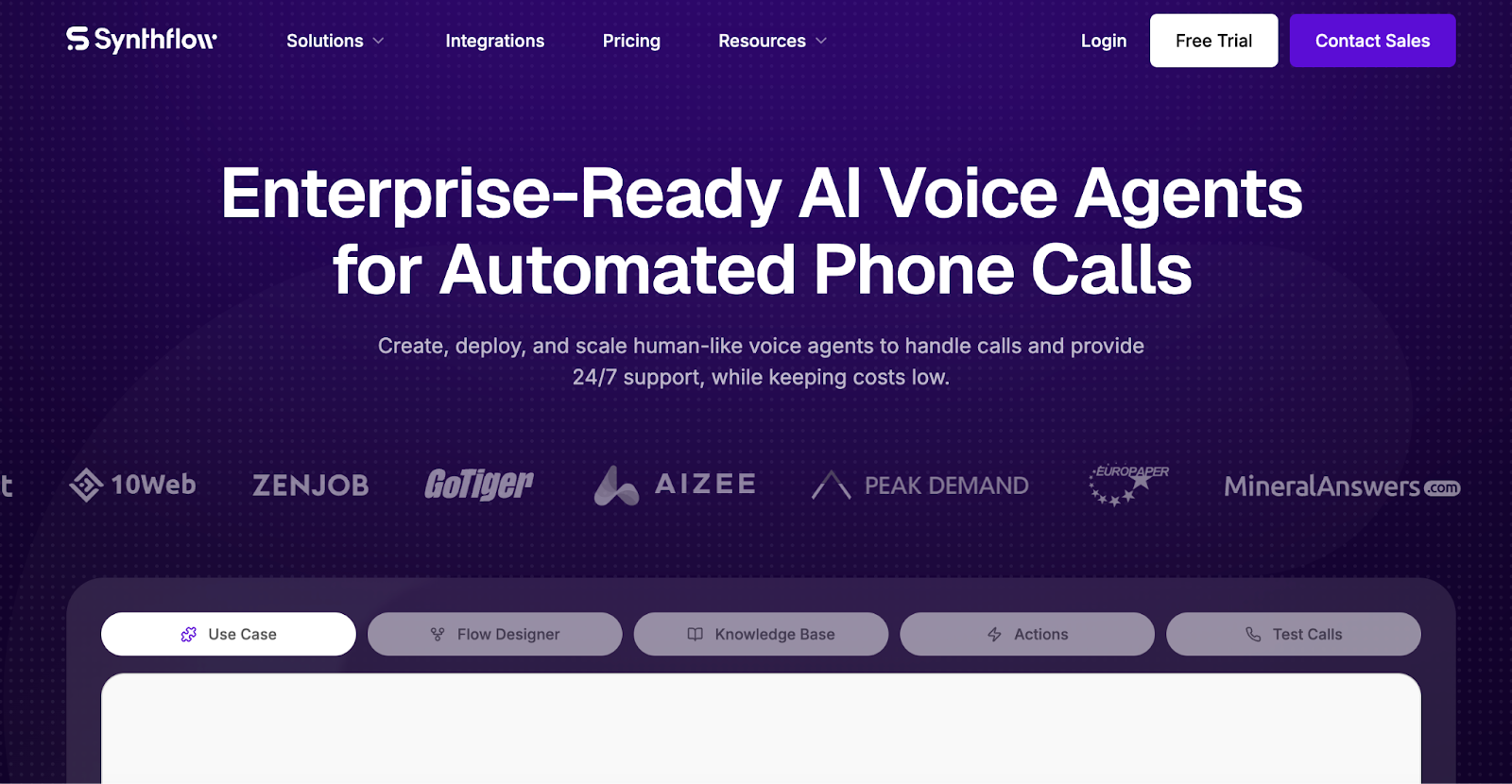
Caption: Deploy Voice AI for automated calls
Synthflow AI is a no-code tool that helps teams automate phone calls without advanced technical skills. Its drag‑and‑drop flow builder equips business teams to create call flows for inbound FAQs, appointment scheduling, and basic outbound campaigns.
Most early adopters choose Synthflow for:
- Low‑complexity automation
- Fast setup with visual tools
- Simple call routing and basic logic
It is user-friendly and provides a visual workflow design. Pricing can be a consideration for teams evaluating broader or higher-volume use cases.
Retell AI overview
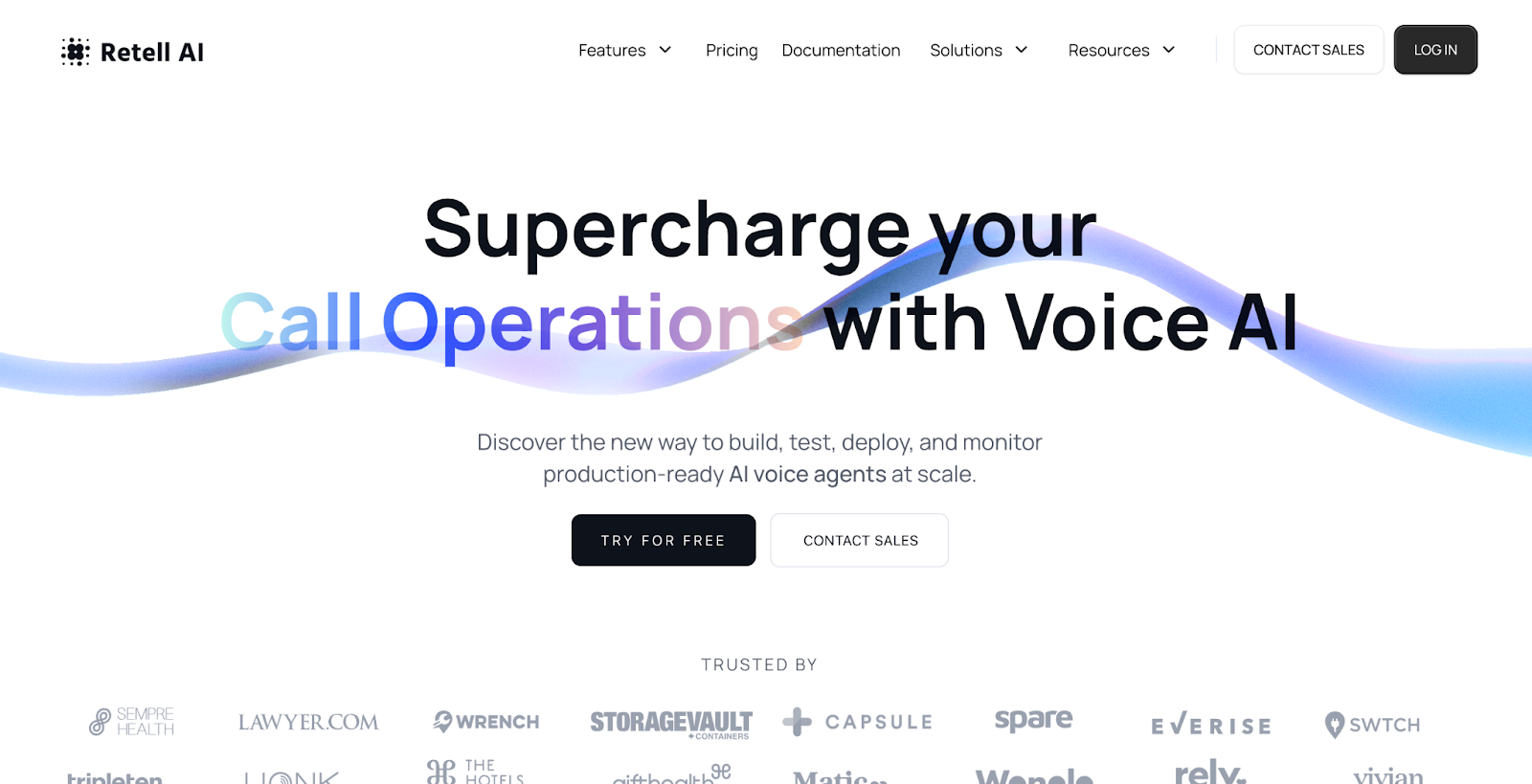
Caption: Build and deploy production-ready AI voice agents at scale
Retell AI takes a flexible, usage‑based approach. It follows a pay-as-you-go model that charges per minute across voice, telephony, and AI components.
Retell customers often highlight:
- Pay-as-you-go pricing from $0.07 to $0.31 per minute as of October 2, 2026
- High concurrency and flexible telephony control
- Branded caller ID to boost answer rates
- Post‑call analysis and knowledge base integration
This makes Retell a good choice for mid‑sized teams or technical users who want more control over costs and call handling specifics.
Orvera overview
Orvera is an AI agent company for customer experience teams that Orvera builds, deploys and runs, with deep workflow intelligence. Compared to Synthflow and Retell AI, it is designed for contact center operations, with high concurrency and built-in quality and analytics.
Orvera suits teams that need:
- High‑volume automation with stable performance
- Built‑in quality & analytics modules
- Compliance standards (SOC 2, HIPAA, GDPR)
- Rapid deployment without heavy engineering dependence
Orvera fits teams that handle high call volumes and need consistent performance across complex workflows.
📌Also read: AI Contact Centers vs Traditional Contact Centers: Which Model Wins on ROI? (opens in a new tab)
Feature Comparison: Synthflow vs Retell AI vs Orvera AI
Each platform takes a different approach to core contact center features. This section outlines how they compare.
Automation & workflow tools
Before we go in-depth, here’s how each platform compares against automation and workflow tools.
| Platform | Workflow Logic | Customization | Developer Control |
|---|---|---|---|
| Synthflow | Basic branching | No‑code only | Limited |
| Retell AI | Moderate multi‑step | Low‑code options | API/webhook support |
| Orvera AI | Advanced multistep and nested workflows | High automation control | High automation control |
Automation and workflow tooling across Synthflow, Retell AI, and Orvera AI
Now, let’s take a detailed look at each tool.
Synthflow AI
Synthflow AI delivers a visual workflow builder that appeals to teams without technical expertise. You create branches, prompts, and outcomes via drag‑and‑drop blocks. For common tasks such as routing calls, FAQ handling, and simple outbound prompts, this structure works well.
However, Synthflow’s workflows can feel linear when interactions become complex. Many real-world call flows require loops, fallbacks, exception handling, and data lookups mid‑conversation. Real call flows often need loops, fallbacks, and data checks during a call. In these situations, non-technical users may struggle to model complex logic reliably, because Synthflow is designed for simple, fast call setup rather than advanced flow control.
Retell AI
Retell AI offers more flexibility through a pay-as-you-go, developer-friendly setup. Teams can build conversational logic using APIs and custom integrations, without relying only on visual flows. This supports workflows that pull data, run advanced queries, or trigger actions during a live call.
These capabilities add technical overhead. Effective use of these features depends on access to engineering or scripting capability.
Orvera AI
Orvera combines ease of use with operational control. The platform includes a no-code workflow builder that supports more advanced logic than entry-level tools, like parallel paths, conditional retries, exception handling, and context retention across multiple steps. Teams get the simplicity of no-code while supporting real production voice automation.
Orvera workflows are designed around contact center operations, not basic bot scripts. Escalation paths, sentiment-based routing, transfer logic, and dynamic context branching are supported natively within the platform, without relying on external modules.
Voice quality & AI accuracy
Voice quality and conversational accuracy are central to user experience and resolution rates. Poorly designed voice agents frustrate callers and lead to transfers or abandoned calls.
| Platform | Voice Naturalness | Context Handling | Interrupt Handling |
|---|---|---|---|
| Synthflow | Good for simple tasks | Basic memory | Limited |
| Retell AI | More natural | Moderate | Better than basic |
| Orvera | Human-like voices | Strong context memory | Excellent in complex scenarios |
Voice quality & AI accuracy across Synthflow, Retell AI, and Orvera AI
Here’s what each tool offers:
Synthflow AI
Synthflow delivers solid baseline quality through integrated AI services. Its voices can sound natural, and if call interactions stay simple, audio responses feel smooth.
But when conversations lengthen or handle unexpected inputs, the agent may repeat questions in a way that feels mechanical.
Retell AI
Retell AI offers flexibility in voice quality through multiple voice engine options. Teams can select higher-quality voices, including ElevenLabs voices, which Retell's pricing page lists at $0.04 to $0.10 per minute on top of its platform rate as of October 8, 2026. The platform also includes post-call analysis, branded caller ID, and knowledge base support, which help deliver more context-aware conversations.
Because Retell AI integrates knowledge bases into its conversational context, agents can sustain longer, more meaningful dialogues instead of reverting to generic responses. They also support features such as warm transfers and caller identity, which reduce spam flags and improve answer rates.
Orvera
Orvera trains AI voice agents specifically on contact center patterns and professional dialogue flows. This focus results in human-like responses with strong accuracy, emotional tone, and interruption handling. Agents maintain context across multiple question turns and handle interruptions more naturally than basic scripted bots.
Many teams find that this results in higher first-call resolution rates, fewer escalations and shorter overall call durations, all of which translate into 65 to 90 percent cost reduction across Orvera customers and improvements in customer satisfaction.
Reporting & analytics
Data matters for improvement. A platform that extracts call insights, sentiment trends, failure points, and workflow performance offers teams the tools to iterate and optimize.
| Platform | Basic Metrics | Sentiment/QA | Insights Depth |
|---|---|---|---|
| Synthflow | Yes | No | Limited |
| Retell AI comparison | Yes | Moderate | Post‑call summaries |
| Orvera | Yes | Advanced | Deep insights & QA dashboards |
Analytics and quality feature comparison across voice AI platforms
Here are the reporting and analytics features each tool provides:
Synthflow AI
Synthflow has basic dashboards that show call counts, durations, and transcripts.
These tools are sufficient for small deployments, but deeper insight often requires exporting data and building custom reports.
Retell AI
Retell AI includes real‑time post‑call analysis that automatically captures action items, summaries, and sentiment outcomes. This makes it easier to understand how calls are performed using external dashboards. Teams that adopt Retell often see higher visibility into call outcomes right from the start.
However, much of Retell’s reporting is technical data. This means raw logs, transcripts, and sentiment outputs must be interpreted and connected to their analytics systems.
Orvera
Orvera embeds analytics and quality modules directly into the platform. Supervisors can monitor call volumes and durations, including workflow bottlenecks, sentiment trends, resolution rates, and agent health metrics without external tools.
This built‑in reporting reduces dependency on BI teams and speeds up optimization cycles. It also means teams can tie insights directly to operational KPIs, instead of scrambling to integrate logs from multiple systems.
Pricing Comparison: Which One Fits Your Budget Best?
Different teams have different needs, with some prioritizing predictable costs, others seeking flexibility, and others seeking capacity for high call volumes.
Before we dive deeper, here’s a side-by-side comparison of each platform’s pricing and plans.
| Property | Synthflow | Retell AI | Orvera |
|---|---|---|---|
| Pricing Model | Enterprise contracts only | Pay-as-you-go consumption-based, optional enterprise support | Scoped to the deployment, shared on a scoped call |
| Entry/ Base Plan | No self-serve plan listed | Self-serve: $0.07 to $0.31 per minute for voice, from $0.002 per message for chat, $10 starting credit | Shared on a scoped call |
| Mid Plan | No mid-tier plan listed | Enterprise: custom pricing, optional white-glove setup | Shared on a scoped call |
| Top/Enterprise Plan | Enterprise: from $30,000 a year, scoped to volume, concurrency, telephony, integrations, security and launch support | Enterprise: Volume-based custom pricing with optional white-glove support | Shared on a scoped call |
| Concurrent Calls | Scoped in the contract | 20 included, scalable with paid add-ons | Sized to the deployment on the scoped call |
| Workflows/ Features | Scoped in the contract | Pay-as-you-go: pre-built functions, analytics, simulation testing. Enterprise adds concurrency, higher knowledge base limits, private Slack | No-code builder, advanced analytics, multi-step workflows and full automation, sized to the deployment on the scoped call |
| Overages/ Add-ons | Set by the contract scope | None for pay-as-you-go, Enterprise scales with volume | Shared on the scoped call |
| Best For | Teams ready for an annual enterprise contract | Startups or teams needing flexible, usage-based pricing | CX teams running high-volume customer-experience operations |
Pricing and features comparison of Synthflow, Retell AI, and Orvera for different team needs
Here’s a detailed look at how Synthflow, Retell AI, and Orvera structure their pricing, so you can see which platform aligns with your budget and call volume expectations.
Synthflow Pricing
As of October 2, 2026, Synthflow's pricing page (opens in a new tab) lists enterprise contracts only, starting at $30,000 a year. Each contract is scoped around call volume, concurrency, telephony setup, integrations, security needs and launch support, and the page lists no self-serve plan.
Enterprise contract, from $30,000 a year
- Covers: SLA terms, telephony options, custom routing and escalation logic, CRM and integration support, security documentation, and implementation and training
With contracts starting at $30,000 a year as of October 2026, Synthflow now fits teams ready for an annual enterprise commitment more than small experiments.
Retell AI pricing
Retell AI uses a flexible, consumption-based model, where you only pay for what you use. This is perfect for startups or teams looking for a low upfront commitment.
Optional white-glove enterprise support is available for high-volume teams.
Pay-as-you-go (Self-serve)
- Price: $0.07 to $0.31 per minute for AI voice agents and from $0.002 per message for AI chat agents, as of October 2, 2026
- Starting credit: $10
- Concurrent calls: 20 on pay-as-you-go, with more at $8 per concurrent call per month
- Support: Discord and email
- Features: Pre-built functions, simulation testing, analytics
Enterprise plan
- Price: custom, quoted by Retell's sales team
- Features: Everything from pay-as-you-go plus optional white-glove setup, additional concurrency, early beta access, higher knowledge base limits, and private Slack support
- Positioning: Companies with large call volumes that want a fully managed AI agent deployment
Retell AI is best for teams who want flexibility and pay-for-usage pricing with optional enterprise support for scaling.
How Orvera delivers
Orvera builds, deploys and runs the operation for high-volume teams that need compliance, reliability and fast deployment.
What Orvera AI includes
- Handles routine to complex workflows (inbound/outbound)
- Appointment booking
- Commercial terms shared on a scoped call
- Deployment in 3 to 6 weeks, white-glove onboarding
- Smooth integrations, no-code builder
- Advanced analytics dashboard
- Higher concurrency
- Multi-step, customizable workflows
- Industry-grade routing
- Sentiment analytics and real-time booking
- Deployment in 3 to 6 weeks
- Full AI automation with custom voices
- Unlimited workflows across multiple business units
- Industry compliance (SOC 2 Type 2, HIPAA, GDPR)
- Hundreds of concurrent AI calls
- Custom integrations, 24/7 support, white-label options
Orvera is ideal for high-volume, compliance-heavy CX teams that need reliable performance and a platform Orvera builds, deploys and runs.
Pricing takeaway
As of October 2026, Synthflow sells annual enterprise contracts from $30,000, so it suits teams ready for that commitment. Retell AI suits flexible, usage-driven budgets, and its costs rise with call volume.
Orvera is best for scaling CX teams that need advanced workflows and high concurrency, built, deployed and run by Orvera.
Pro tip: If you expect higher call volume or complex workflows, a platform that is built, deployed and run for you with production-ready features (Orvera) is usually the safest choice.
📌Interesting Read: AI Voice Agent Cost & Pricing Guide: What to Budget for in 2026 (opens in a new tab)
Ease of Use, Support & Setup: Which One Feels Easiest?
When adopting an AI voice platform, user experience, onboarding speed, and support quality are often as important as feature depth. Teams want tools that reduce friction and let workflows start delivering value quickly.
Synthflow experience
Synthflow’s visual workflow builder is intuitive, making it appealing for non-technical users. Drag-and-drop elements allow teams to create call flows without coding. Simple routing, greetings, and FAQ handling are straightforward to implement.
Getting started with Synthflow is relatively quick. A small team can deploy a pilot within a few days. However, scaling workflows to handle more complex interactions may require guidance from support or consulting resources.
Retell AI experience
Retell AI is flexible but has a steeper learning curve. While it includes a visual builder, the platform assumes familiarity with AI workflows and API usage for more complex tasks. Teams with engineering support can quickly use advanced automation.
Basic voice workflows can be launched within a day, but more advanced setups involving database integrations, multiple voice engines, or LLMs require planning and testing.
Orvera experience
Orvera offers a no-code workflow builder that supports both simple and complex automation. Teams can design workflows without working directly with APIs. The platform stays accessible for business users while meeting technical requirements.
It provides dedicated onboarding and support run by the Orvera team, with workflow templates that let teams start without long ramp-up periods.
How Orvera Compares to Synthflow and Retell AI
Orvera positions itself as an AI agent company for customer experience teams with deep specialization in AI voice automation, offering a modern alternative to Synthflow and Retell AI through production-grade automation, predictable operations, and ease of adoption.
While Synthflow and Retell AI serve more specific or developer-leaning use cases, Orvera is built for contact centers that need complex workflows, faster go-live, and clarity at scale. It removes the friction of heavy technical setup, simplifies pricing, and pairs automation with hands-on support so teams can move from experimentation to live operations without operational risk.
Orvera differentiators at a glance:
- Workflow flexibility: Native support for multi-step workflows with conditional branching, parallel paths, context retention, and exception handling, enabling complex production use cases without heavy technical intervention.
- High resolution rate: First-contact resolution runs around 80 percent across Orvera customers, reducing agent workload while maintaining service quality.
- Resolution on the first contact: Resolves customer requests within a single automated interaction, with clear escalation paths when human judgment is required.
- White-glove implementation: Hands-on deployment led by contact center practitioners, enabling non-technical teams to launch advanced voice workflows without ongoing developer dependency.
- Commercial model scoped to the deployment: shared on a scoped call, so budgeting starts from the workflows and the volume they carry.
- Rapid deployment: Production-ready voice workflows go live in 3 to 6 weeks using prebuilt templates and guided setup.
- Hands-on onboarding and support: Structured onboarding, proactive guidance, and 24/7 support ensure teams move smoothly from pilot to production.
- Built for contact center scale: Engineered to perform reliably in high-volume, real-world contact center environments rather than limited or experimental automation scenarios.
📌Suggested Read: Discover the ROI of AI in Your Contact Center (opens in a new tab)
How to Choose the Right AI Voice Platform for Your Team
Selecting the right AI voice platform depends on workflow complexity, technical capacity, budget, and team size. Here’s a summary based on our comparison:
When Synthflow is a good choice
Choose Synthflow if you are a small team experimenting with AI voice agents and need a quick setup with a highly visual workflow builder.
It works well for simple inbound support, appointment scheduling, or low‑volume campaigns.
When Retell AI is a good choice
If your team wants a flexible cost model where you pay only for what you use and has some technical capacity to configure telephony and workflows, Retell AI offers a compelling, modular approach.
Its per‑minute pricing and API support help teams scale smartly.
When Orvera might be the better choice
For high-volume contact center operations that need production-ready workflows and advanced analytics, Orvera is designed for complex, mission-critical voice automation.
Its rapid deployment process and built-in QA and analytics help teams reduce operational costs while improving customer experience. From hundreds of concurrent calls to multi-step automated processes, Orvera gives your team the control, insights, and speed to deliver outstanding customer experiences.
Get started today and see how Orvera can transform your contact center operations.
Frequently asked questions
Orvera offers the smoothest onboarding experience, followed by Synthflow. Retell AI requires technical skills for more complex workflows.
Orvera builds, deploys and runs the operation for CX teams, starting from the workflows and the volume they carry.
Orvera scales well because concurrency is matched to the deployment. Retell AI scales flexibly if you monitor usage costs carefully. Synthflow scopes concurrency in its annual enterprise contract, so capacity for higher volume is set when the contract is agreed.
Yes. Orvera combines ease of use with advanced workflow capability, positioning it as a viable alternative for businesses that might otherwise choose Synthflow for simplicity or Retell AI for flexibility.
Orvera is designed to manage complex, multi-branch voice workflows with context retention, exception handling, and real-time analytics. Retell AI can also handle complexity, but may require technical setup. Synthflow is limited to simpler scenarios.

Written by
Anindita Majumder
Anindita Majumder is a communications professional with nearly four years of experience in public relations, corporate communications, and journalism. She creates content that helps brands communicate their vision, products, and expertise through press releases, thought leadership, and editorial pieces. Outside of work, she is a vocalist, which keeps her creativity flowing.