How AI Agent Assist Helps Representatives Explain Patient Billing Statements
A patient billing call takes so long because the answer to one statement question lives in as many as six separate places, and the representative has to assemble it while the patient waits on the line.

Key highlights
- A patient billing call takes so long because the answer to one statement question lives in as many as six separate places, and the representative has to assemble it while the patient waits on the line.
- While the representative is on the call, the agent assist assembles the account picture, writes a plain-language explanation of the statement, and points to the next action the health system's own policies support.
- One billing call with the agent assist running looks like a single question asked and answered in plain language by a representative who has the whole account in front of them.
- The health system and its representatives own the account and every decision made on it, and the agent assist handles preparation, explanation, and documentation.
- Four operational measures tell a patient financial services leader whether the assist is working, and all four come from data the contact center already reports.
- A Director of Patient Financial Services takes four statements to revenue cycle leadership, each one clear on its own and each one defensible under review.
- Once the agent assist runs, a billing call opens with the account already assembled and the explanation already written, so the representative spends the call talking to the patient.
Why does a patient billing call take so long to answer?
A patient billing call takes so long because the answer to one statement question lives in as many as six separate places, and the representative has to assemble it while the patient waits on the line.
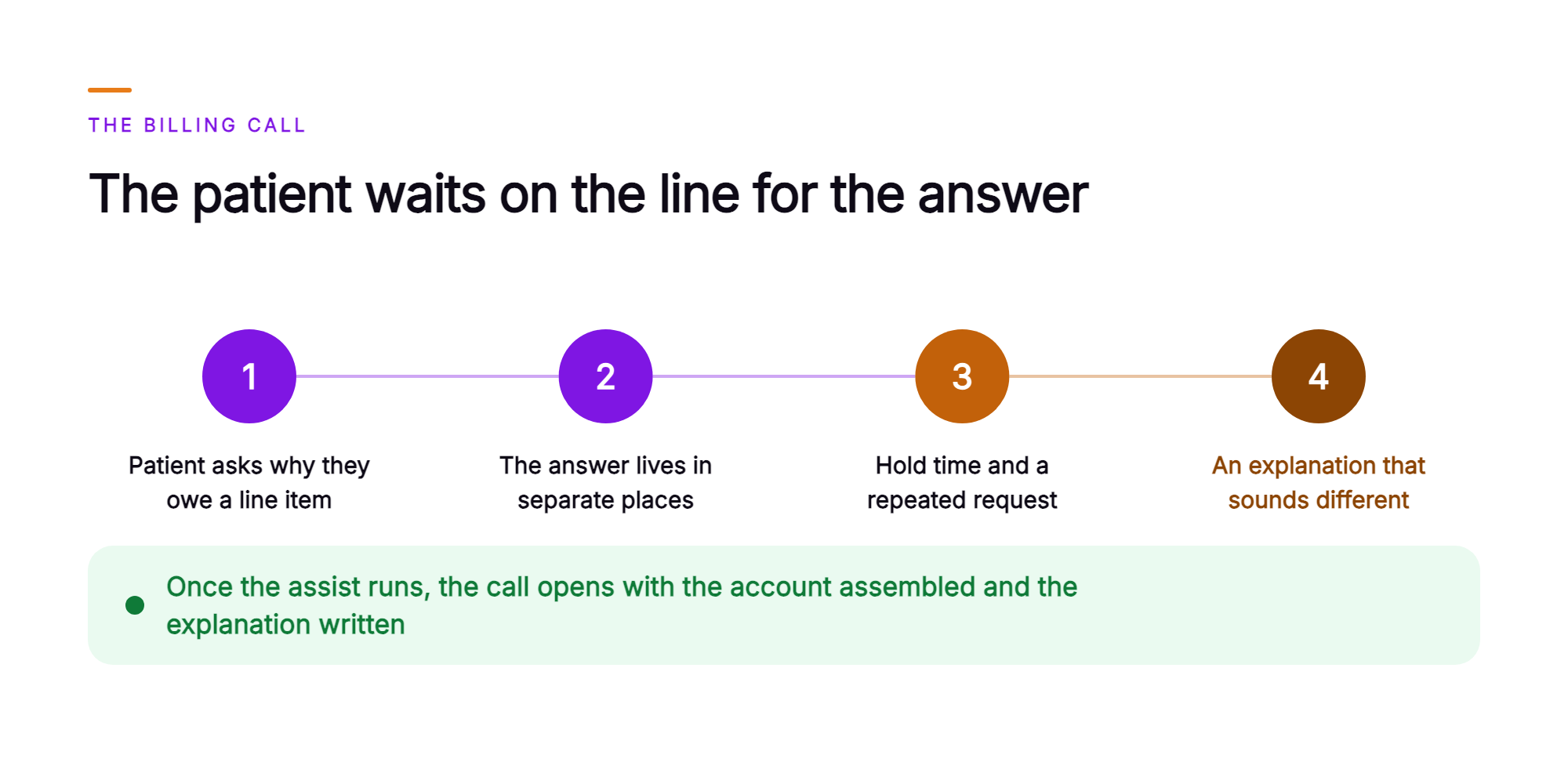
The moment is familiar to anyone who has run a billing queue. A patient calls holding a statement, points at a line item, and asks what it means and why they owe it. The representative knows the answer exists. Finding it is the problem.
The account sits in the patient accounting system. The statement document sits somewhere else. The insurance adjudication, with the deductible applied, the allowed amount, and the patient responsibility, sits in a claims or remittance screen. The financial assistance policy sits in a policy document. The payment plan options sit in a separate workflow. Prior contact notes sit in a sixth place.
What the patient hears during that assembly is hold time, a repeated request for a date of birth and account number, and an explanation that sounds different depending on which representative picked up. Two patients with identical accounts can hang up with two different understandings of what they owe. That inconsistency starts as a data problem, and it is the problem that healthcare call center agent assist is built to solve.
What is live billing explanation assist?
Live billing explanation assist is a real-time agent assist that works beside the human representative during an inbound, patient-initiated billing call, pulling the account into one view and writing the explanation of the statement in clear language as the conversation happens.
It runs alongside the call in the representative's existing workspace and reads what the health system already stores.
The one-view account picture brings together:
- The current statement and the charges on it
- The insurance adjudication on the account, including how the payer applied the deductible, the copay, the coinsurance, and the contractual adjustment
- Prior contact history on the account, so the representative knows what the patient was told last time
- The health system's financial assistance policy and the eligibility criteria it sets
- The payment options the health system offers, including plan terms and any discount programs
That account summary in one view is assembled from the health system's own systems of record. The account, the statement, the adjudication, and every policy belong to the health system and its billing systems. The assist reads them where they already live, and the health system stays the source of truth for every figure the representative repeats to the patient.
What does the agent assist do while the representative is on the call?
While the representative is on the call, the agent assist assembles the account picture, writes a plain-language explanation of the statement, and points to the next action the health system's own policies support.
The work begins as the call connects. As the patient is verified, the assist pulls the account, the statement, the adjudication, and the contact history into a single pane. The representative works from that pane, and the picture is already there when the first question lands.
From that picture, the assist produces the explanation in words a patient can follow. It turns claim codes and adjustment reason abbreviations into a sentence that says what the payer covered, what it applied to the deductible, and what remains. The representative reads it, adjusts the wording to the patient in front of them, and speaks.
Two more things happen quietly. The assist flags escalation cues in the conversation, such as a dispute, a legal mention like bankruptcy, or a hardship signal the representative can route to financial counseling. And it drafts the call summary and disposition as the call proceeds, so after-call work shrinks to a review and a save.
What does one billing call look like with the agent assist running?
One billing call with the agent assist running looks like a single question asked and answered in plain language by a representative who has the whole account in front of them.
A patient calls about a hospital visit from the prior quarter. They received a statement, insurance has already processed the claim, and they want to know what one line means and why a balance remains after coverage.
The assist places the statement and the insurance adjudication side by side on the representative's screen. It shows which charges the payer allowed, which portion the payer paid, how much was applied to the patient's remaining deductible, and how much was written off under the contracted rate. Then it writes the sentence: the payer covered the visit, a share of the allowed amount went to the deductible the patient had not yet met for the year, and that share is the balance on the statement.
The representative says it in their own voice. The patient follows it, because the explanation is a plain-language billing statement summary that translates the adjustment codes behind the balance.
The assist then surfaces the next action the health system's policy points to. The payment plan terms already available on the account appear, along with the health system's financial assistance application path and the screening criteria its policy sets. The representative chooses what to offer, sets up the arrangement, and ends the call with the patient understanding what they owe and why.
Which steps does the health system own, and which does the agent assist handle?
The health system and its representatives own the account and every decision made on it, and the agent assist handles preparation, explanation, and documentation.
The health system and the representative own:
- The account, its balance, and its status
- The statement and all charges on it
- The insurance adjudication and any claim rework
- Financial assistance eligibility and approval decisions, under the health system's own policy
- Payment arrangements, plan terms, and discounts
- Every word spoken to the patient
The agent assist handles:
- Assembling the account picture in one view as the call opens
- Writing the plain-language explanation of the statement and adjudication
- Pointing to the next action the health system's policy supports
- Flagging escalation cues such as disputes, hardship, and legal mentions
- Drafting the call summary and disposition for review
The representative decides every action on the account. The assist proposes, surfaces, and documents. Posting an adjustment, approving an application, and committing the health system to terms stay with the representative. That separation keeps the audit trail clean and keeps accountability where revenue cycle leadership expects it.
Why do health systems want the agent assist built and run for them?
Health systems want the agent assist built and run for them because integrating the billing systems behind a statement, and keeping a policy-grounded knowledge layer current on top of them, is engineering work that sits outside patient financial services.
Orvera AI is an agentic AI platform for enterprise customer experience, and Orvera builds, deploys, and runs it for the health system. AI Agent Assist connects to the patient accounting system, the CRM, the helpdesk, and the contact center platform the health system already runs, through 500+ integrations. Every one of those systems stays in place.
Agent Assist reaches floor-wide rollout in two to four weeks on the stack the health system already runs, and the delivery model draws on 18+ years of contact-center experience. Orvera's team carries out the integration, representative onboarding, and the change management a floor rollout requires.
AI Quality Management audits every conversation, human-handled and AI-handled, so patient financial services leaders see the quality of every billing explanation on the floor.
The platform is SOC 2 Type II certified, HIPAA compliant, and GDPR compliant. The assist grounds its explanations in knowledge the health system wrote and approved.
Which numbers tell a patient financial services leader the assist is working?
Four operational measures tell a patient financial services leader whether the assist is working, and all four come from data the contact center already reports.
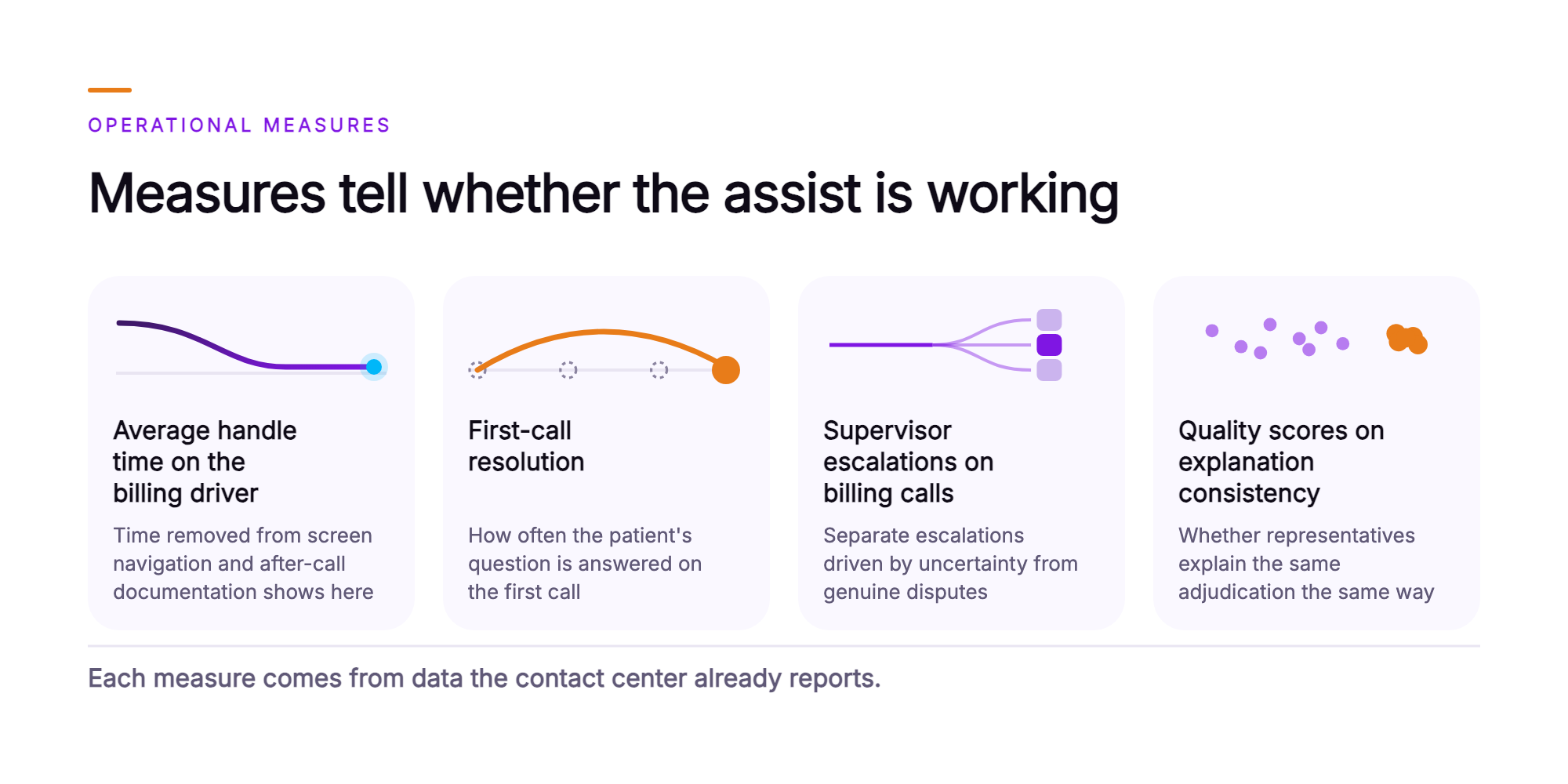
- Average handle time on the billing driver. Measure how long statement and balance questions take from greeting to wrap-up, isolated to that call reason. Time removed from screen navigation and after-call documentation shows up here first.
- First-call resolution on statement explanation. Track how often the patient's question is answered on the first call, with no callback, no transfer to a second department, and no repeat contact on the same account within the follow-up window.
- Supervisor escalations on billing calls. Watch how often a representative has to pull a supervisor into a statement question. Separate escalations driven by uncertainty from those driven by genuine disputes, because uncertainty is the share a ready explanation on the screen is built to address.
- Quality scores on explanation consistency. Score whether two representatives explain the same adjudication the same way. Conversation audits across the full volume make that visible.
Read the four together. Handle time dropping while first-call resolution holds flat means calls got shorter without getting better.
What does the director take to the revenue cycle leadership team?
A Director of Patient Financial Services takes four statements to revenue cycle leadership, each one clear on its own and each one defensible under review.
- On an inbound, patient-initiated billing call, the representative sees the patient's account, statement, insurance adjudication, and contact history in one view, with a plain-language explanation of the statement already written and ready to read.
- The next action the representative sees follows the health system's own policies, including financial assistance criteria and the payment plan terms the health system has approved.
- The representative decides what happens on the account. The assist prepares and documents. Posting adjustments, approving applications, and committing the health system to terms stay with the representative.
- The platform is SOC 2 Type II certified, HIPAA compliant, and GDPR compliant, and Orvera audits every conversation, human-handled and AI-handled, so quality on billing explanations is measured across the full call volume.
Those four points answer what compliance, IT security, and the CFO each ask in their own language. The explanation is grounded, the decision is human, the systems of record stay with the health system, and the quality is measured.
What changes on a billing call once the agent assist is live?
Once the agent assist runs, a billing call opens with the account already assembled and the explanation already written, so the representative spends the call talking to the patient.
The representative greets the patient and verifies them, and the statement, the adjudication, the prior notes, and the available payment options are already on one screen. The plain-language explanation of what the payer covered and what remains is sitting there, ready to say out loud. The representative adapts it to the person on the line, answers the follow-up question, and sets up whatever the patient needs.
The boundary holds throughout. AI Agent Assist prepares the explanation, points to the next action under the health system's policy, and drafts the summary. The representative speaks with the patient and owns every decision made on the account.
To see how AI Agent Assist fits the billing systems your teams already run, talk to the team (opens in a new tab).
Frequently asked questions
The human representative sees one view of the patient's account, assembled as the call opens and the patient is verified, with the explanation already written beside it. AI Agent Assist retrieves the statement and its line items, how the payer processed the claim on that account, prior contact history across channels, the health system's financial assistance policy and the eligibility criteria it sets for patients, and the payment options available to them. Next to that picture sits a plain-language explanation of the statement, written so the representative can say it out loud in their own words. The suggested next action appears with it, drawn from the policy that applies. This is what healthcare agent assist looks like on a live billing call: the account, the adjudication detail, and the explanation on one screen while the patient is on the line.
The account picture comes from the health system's own billing and patient accounting systems, read through Orvera AI's 500+ integrations with CCaaS, CRM, and enterprise systems of record. The account stays where it lives. The statement, the adjudication detail, the contact history, and the financial assistance policy remain under the health system's control, in the systems the health system already runs. Orvera accesses them at the moment of the call and composes the view the representative sees.
The agent assist converts the statement line items and the payer's processing of the claim into short sentences the representative can say to the patient directly. A deductible applied, a service denied as not covered, a coordination of benefits delay, an adjustment posted after the statement printed: each becomes a sentence in everyday words that the patient can follow. Each explanation is based on the health system's approved knowledge. That matters on billing calls, because two representatives giving two different answers about the same balance is how a billing dispute starts. Approved-knowledge grounding keeps the explanation consistent across the floor, across shifts, and across new hires still learning the statement format.
The human representative decides, under the health system's own policies. Posting an adjustment, approving financial assistance, and setting up a plan stay with the representative. The assist surfaces the next action the applicable policy points to. When the patient describes financial hardship, the assist shows the health system's financial assistance policy and the documentation that policy requires. When the patient asks about paying over time, the payment plan terms the policy permits appear. The representative talks to the patient, weighs what they hear, and chooses what to offer. The decision and the accountability stay with your people.
The agent assist covers inbound, patient-initiated calls about a statement. These are the questions a patient billing call center hears every day: what a line item means, why the balance changed, how insurance processed a claim, whether financial assistance applies, and what payment options exist. The assist collaborates with patient financial services and patient access representatives on the health system's own floor, inside the existing queue and the existing phone system. Agent assist for billing here works beside the person on the call, and that person speaks with the patient. When the assist flags an escalation cue, such as a billing dispute, a hardship signal, or a legal mention, the representative routes the call to the team responsible for it, with the full call context attached. A better patient financial experience starts with the first call being answered correctly.
Orvera AI's AI Quality Management audits every conversation, human-handled and AI-handled, against the scorecards your evaluators already use. Coaching can draw on every call each representative handles. Each explanation the assist supplied is logged and reviewable, so a quality lead or a compliance reviewer can trace what the representative was shown and what they said. The platform is SOC 2 Type II certified, HIPAA compliant, and GDPR compliant, with full auditability of every interaction. Voice of Customer analyzes the scored calls to identify themes and drivers, highlighting the statement language that generates the most confusion. To see how Orvera AI supports patient billing representatives on every call, talk to the team.

Written by
Anindita Majumder
Anindita Majumder is a communications professional with nearly four years of experience in public relations, corporate communications, and journalism. She creates content that helps brands communicate their vision, products, and expertise through press releases, thought leadership, and editorial pieces. Outside of work, she is a vocalist, which keeps her creativity flowing.