How an AI Agent Keeps a Retrievable Audit Trail for a BPO's Regulated Programs
Building an agentic AI audit trail for regulated industries starts with understanding why the record does not already exist when the request arrives.

Key highlights
- Building an agentic AI audit trail for regulated industries starts with understanding why the record does not already exist when the request arrives.
- The record is built contact by contact, from greeting to resolution, with each material moment timestamped in the transcript as it occurs.
- When the record is built contact by contact and stored in a retrievable structure, a compliance request becomes a retrieval task the operations lead completes in three steps.
- A finished platform, configured per regulated program and running under the BPO's own brand, means the audit trail is owned by the operation that answers for it.
- The four measures that tell you the audit trail is performing are all counts the BPO already tracks. The operation reads all four in the reports it runs today. They change when the record exists before the request arrives.
- Time to produce an audit response, measured from request to delivery.
- Interactions with disclosure and consent moments marked, counted per program per month.
- Findings returned by the client's compliance team per audit response, counted per request.
Why does an audit request take days to answer in a regulated BPO program?
Building an agentic AI audit trail for regulated industries starts with understanding why the record does not already exist when the request arrives.
The moment a client's compliance team sends the request, an operations lead starts reconstructing evidence that was never assembled in one place. Recordings live in the telephony platform. Transcripts, if they exist, sit in a separate tool. Agent notes are in the CRM. QA scorecards, for the interactions that got one, are in a spreadsheet. The disclosure moment your program required, the one that had to happen at a specific point in the conversation, is somewhere inside a recording that a person has to listen through to locate.
This mechanism makes every request slow. The record has to be assembled after the fact, per request, by a person pulling from four systems that were not designed to answer a compliance question together. And because QA reviewed only a sampled slice of interactions, most contacts in that request carry no review at all. The operations lead is not retrieving evidence. They are building it.
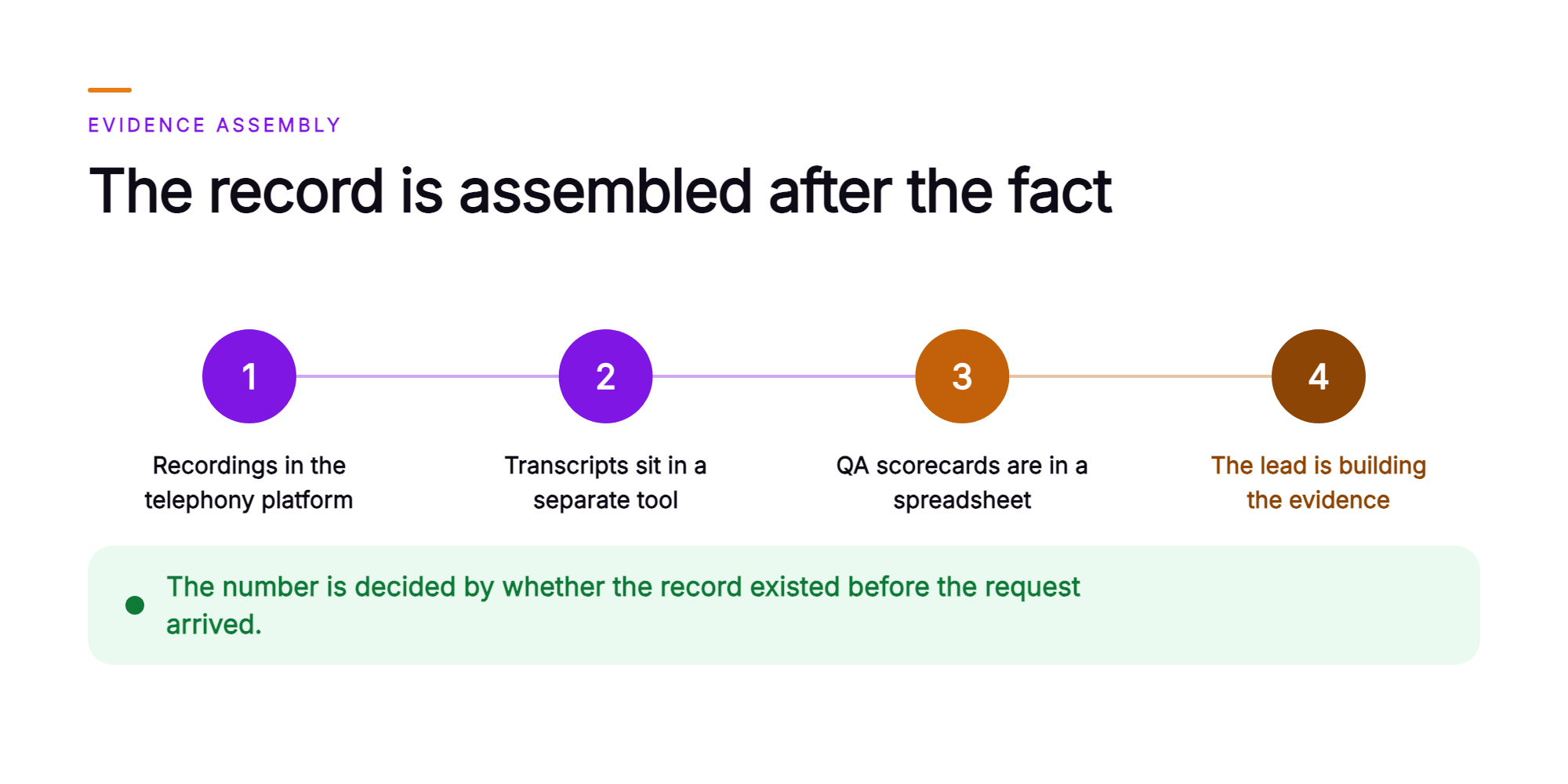
The buyer measures one number: time to produce an audit response. That number is decided entirely by whether the record existed before the request arrived.
What is a regulatory audit trail for a BPO's own regulated programs?
A regulatory audit trail is a complete, retrievable record of each interaction: the transcript, the automated summary, every action executed in the systems of record, and the disclosure and consent moments marked at the exact point in the conversation where they occurred.
That definition carries a practical consequence. The record is one unified object, and each system event is stored with the conversation that produced it. The timestamp on a consent moment sits in the same record as the transcript line that captured the customer's response. The case note written to the CRM at close belongs to the same record as the interaction it describes. Audit logs for contact center compliance are only useful when that structure holds, because a regulator or client auditor does not want to cross-reference three exports to reassemble what happened.
The scope here is the BPO's own regulated programs, the ones its teams run and answer for, across voice, chat, email, and every channel the BPO operates. And the record covers human-handled and AI-handled interactions in the same shape. One request returns one form of evidence, regardless of whether a rep or an AI agent handled the contact. That uniformity is what makes the automated summary and transcript structure on human-handled interactions as auditable as anything the AI agent produces on its own.
What does the agentic AI agent record during a regulated interaction?
The record is built contact by contact, from greeting to resolution, with each material moment timestamped in the transcript as it occurs.
Disclosure and consent. The AI agent reads the required disclosure from approved knowledge configured for the program. When the customer responds, the agent captures that response. The transcript marks both moments at the exact point in the conversation where they occurred. The later audit work starts from a record that is already complete. The evidence exists at close.
Executed actions. The agent runs the identity check, writes the case note, and deposits the automated summary to the case at close. Each action is written to the same record as the conversation it belongs to. When a reviewer opens the record, the interaction and its system activity are one document. That is what makes automated evidence retrieval for BPO audits a single pull that returns the whole interaction.
Governed orchestration. Approved-knowledge grounding, explicit execution controls, and full auditability sit above the models. What the agent says is grounded in approved knowledge. What it executes sits inside explicit controls. Both are auditable in the record. Compliance accountability lives in the layer above the models, and it stays there as the underlying models change.
Human-handled interactions. Agent Assist writes the same shape of record when a rep handles the contact. Surfaced knowledge, next-best actions, escalation cues, and the automated summary at close are all captured. One request returns evidence from both populations in the same form.
How does one audit request get answered when the record already exists?
When the record is built contact by contact and stored in a retrievable structure, a compliance request becomes a retrieval task the operations lead completes in three steps.
Consider a common pattern in contact center compliance work. A BPO running a regulated financial services program receives a request from the client's compliance team: produce evidence for 47 named accounts over a 90-day window, confirming the required disclosure was delivered and consent was captured on each contact. In the old model, that request starts a days-long rebuild. When the record already exists, the operations lead filters, reviews, and sends.
Filter. The operations lead applies three parameters: program name, account list, and date range. The system returns every matching interaction, both voice and chat, human-handled and AI-handled in the same queue.
Review. Each interaction opens with the transcript, the disclosure and consent moments marked at their timestamps, and the Auto QA score already attached. The operations lead reads for completeness. The record is written as the contact happens. The review confirms what the record already shows.
Send. The set is exported as one package per interaction, uniform in shape regardless of whether a rep or an AI agent handled the contact. The operations lead reviews the full package and sends it.
Three steps carry the request from arrival to a delivered audit response. The next question is how the record demonstrates, rule by rule, that the program's requirements were met for each of those contacts.
How does the record show each program rule was followed?
The AI agent audit trail works because each compliance step a program requires in the conversation maps to a discrete, timestamped event in the record, and the record holds the evidence of each event in the customer's own words or in a system-confirmed result.
The rules are set by the BPO and its client programs. The AI agent executes them as configured. The list below pairs each common program rule with what the record holds when that moment passes.
- Required disclosure. The AI agent reads the approved disclosure text before any substantive exchange begins. The record holds the timestamp of delivery and the exact text read, drawn from configured knowledge.
- Consent capture. The agent waits for the customer's affirmative response before any recorded action proceeds. The record holds the customer's response word for word at the moment consent was given.
- Identity verification. The agent runs the identity check against the configured verification logic before any account data is accessed. The record holds the verification result and the point at which account access was granted or denied.
- Handoff to a human rep. When the customer asks to speak with a person, or when the topic sits outside program scope, the agent steps aside. The record holds the handoff point, the reason, and the Auto QA review note attached to that moment.
- Case summary at close. The automated summary writes to the case record on completion. The record holds the full summary tied to the interaction.
And when an audit request arrives, the reviewer reads this sequence back in the order it happened. Each event is already fixed in the record, retrievable by interaction ID. The question the next section addresses is who actually builds and runs the platform that holds it.
Why does a BPO want a finished platform its teams run under their own brand?
A finished platform, configured per regulated program and running under the BPO's own brand, means the audit trail is owned by the operation that answers for it.
The delivery model is straightforward. Orvera AI is a multi-tenant platform purpose-built for BPOs running many client programs on one system. Each program is configured independently. The BPO's teams run it under their own brand, and the record each program produces is discrete, retrievable by program, and uniform in shape across every channel the operation runs.
Full enterprise deployment lands in three to six weeks. Enablement consists of onboarding, knowledge-base setup, rep training, and change management, so the floor is operating the platform from the first live program.
The design reflects 18+ years of contact center operations. The record is shaped by people who have run a live floor and answered its audit requests firsthand. That experience shows in what gets captured and how it is structured. Timestamps, disclosure confirmations, handoff points, and case summaries are designed in from the start. They are the record's architecture.
Auto QA audits every conversation, human-handled and AI-handled, across every channel, so the quality review is already attached when a compliance request arrives. The compliance posture is SOC 2 Type II certified, HIPAA compliant, and GDPR compliant. The question that follows is which numbers tell a BPO leader the audit trail is actually performing.
Which numbers tell a BPO leader the audit trail is working?
The four measures that tell you the audit trail is performing are all counts the BPO already tracks. The operation reads all four in the reports it runs today. They change when the record exists before the request arrives.
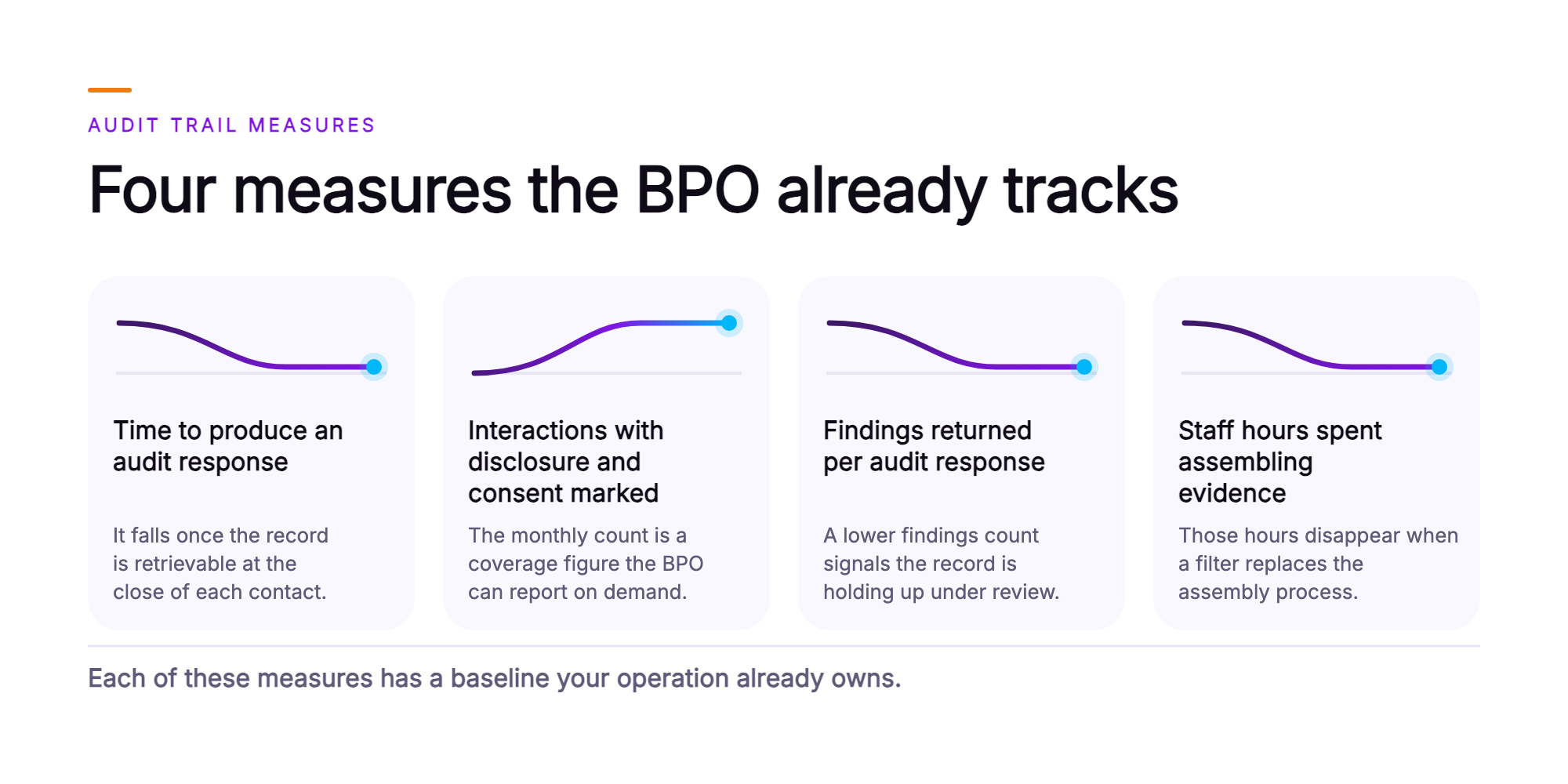
Time to produce an audit response, measured from request to delivery. This is the number the client's compliance team watches, and it falls directly once the record is already structured and retrievable at the close of each contact.
Interactions with disclosure and consent moments marked, counted per program per month. The record marks each moment at the point it happens during the contact, so the monthly count is a coverage figure the BPO can report on demand.
Findings returned by the client's compliance team per audit response, counted per request. A complete record answers the reviewer's question in the first pass. Incomplete evidence invites follow-up requests, and each follow-up extends the cycle. A lower findings count is a signal that the record is holding up under review.
Staff hours spent assembling evidence per request. This is the cost the operations leader feels most directly. Reconstruction work, pulling transcripts, chasing recordings, writing summaries after the fact, converts to hours that disappear when a filter replaces the assembly process.
Each of these measures has a baseline your operation already owns. The question for the next section is how a BPO leader frames all four for the leadership team that sets the program's standards.
What does the operations leader take to the leadership team?
The leadership conversation is a report on four operational facts, each measurable, each tied to a commitment the BPO has already made to its clients.
The four points an operations leader can place in front of a leadership team are direct.
- Every interaction in a regulated program has a complete, retrievable record. Disclosure and consent moments are marked at the point they occurred in the transcript, and that structure holds whether a human rep or an AI agent handled the contact.
- An audit response is produced by filtering that record down to the interactions the request names. The measure is time to produce the response, and it drops to what a search of the existing record takes.
- Auto QA reviews every conversation, across every channel the BPO runs, so each record already carries its quality review when a compliance request arrives.
- The platform is delivered in three to six weeks as a finished system the BPO's teams run under their own brand, built on 18+ years of contact center operations heritage.
Each bullet resolves a question the leadership team will ask. How complete is the record? How fast is the response? Is quality review attached? How long does deployment take? Each answer is an operational fact the record produces on its own, stated in the same terms the BPO already uses to report its work. The next section shows what a regulated program looks like once every interaction carries that record from the first day it runs.
What does a regulated program look like once every interaction has a record?
A regulated program in steady state looks like this: the audit request arrives, the operations lead filters by program, account, and date range, reviews the assembled package, and sends it as one set.
Everything the response needs is already in the record. Transcripts, summaries, and the marked disclosure and consent moments are held per interaction. The record was built contact by contact from the first day the program ran, so the response time is the time the retrieval takes.
The compliance conversation with the client changes in character. Both sides work from the same record. Disclosure moments, consent confirmations, and handoff points sit in the transcript at the exact second they happened. The client reviews what the record shows. The BPO answers from the same document.
And the record carries as the BPO adds programs. Each new client is configured on the same multi-tenant platform. Its record holds the same shape, the same timestamped event structure, the same attached quality review, as every program already running. The audit trail exists before the engagement does. The engagement inherits it.
That is what an agentic AI audit trail for regulated industries produces on a floor that runs it from day one. If your operation is still assembling evidence after the request arrives, talk to the team (opens in a new tab).
Frequently asked questions
Every interaction on the platform produces a complete, retrievable audit record holding the full transcript, the automated summary, every system action taken, each disclosure and consent moment marked with a timestamp, and the Auto QA review. The record has the same shape whether a human rep or an AI agent handled the contact, and whether it arrived on voice, chat, email, messaging, or any other channel the BPO runs. That consistency is what an AI governance platform requires when a client or regulator pulls a sample across programs. Each record is retrievable by program, account, date range, channel, and handler, with the automated QA score attached. A request becomes a retrieval from evidence captured at the time of the contact.
The time to produce an audit response is the time to filter the record, review the package, and send it. That is possible because the audit logs for AI agents and human reps are assembled at the moment of each interaction. When a request arrives, the record already exists. What remains is a three-step cycle familiar to any BPO operations leader: - Filter. Narrow by program, account, date range, and channel. - Review. Confirm the agent audit trail includes the transcript, automated summary, and Auto QA score. - Send. Deliver the complete package to the requesting party. Those three steps run in one system, on one record per interaction. The next question most BPO leaders ask is how disclosure and consent moments are captured inside that record.
The required disclosure is read from approved knowledge configured for the program, and the compliance audit trail marks the exact point in the transcript where it was delivered. The customer's consent response is captured in the customer's own words, with a timestamp attached, before the AI agent proceeds to the recorded action. That sequence matters in regulated industries because the moment of consent must be auditable, readable in the transcript at the point it was given. Governed model coordination for regulated industries requires that the same rule applies to both populations. On human-handled contacts, the transcript and the Auto QA review mark the identical disclosure and consent moments, so the check reaches every program segment. A client or regulator examining a mixed sample therefore sees one record structure for every contact it contains. The next question is how that check is applied across every conversation the BPO runs.
AI Auto QA reviews every conversation the BPO runs, whether a human rep or an AI agent handled it, across voice, chat, email, messaging, and every other channel, and the review attaches to the record for that interaction. In a regulated program, the review checks four specific conditions: - Disclosure. Was the required disclosure delivered from approved knowledge? - Consent. Was the customer's response captured before the action proceeded? - Identity. Was the caller verified before account access was granted? - Handoff. Where the program rule calls for a transfer to a human rep, did it happen? That automated check is the foundation of compliance evidence management. Because the review is already part of the record when an audit request arrives, the evidence package is complete and ready to send. The check runs the same way across every program the BPO operates, which raises a practical question about how programs with different rules and client requirements are managed on one platform.
Each client program runs in its own configuration, with its own rules, approved knowledge, and disclosure set, all on one platform and all producing a compliance audit trail with the same structure. That consistent shape is what makes multi-program operations manageable. The operations team answers an audit request from a financial services client the same way it answers one from a healthcare client. The record format holds its shape. The retrieval steps stay fixed. What changes is the program filter applied at the start. The platform folds into the systems the BPO already runs. With 500+ integrations across CCaaS, CRM, helpdesk, and the other categories a contact center depends on, the operations team maintains a single stack. That foundation is what makes deployment the practical next question.
Full enterprise deployment lands in three to six weeks, delivered as a finished platform your teams run under your own brand, with the AI audit trail active from the first contact. Enablement spans onboarding, knowledge-base setup, representative training, and change management. That scope reflects 18 plus years of contact center operations, so the configuration matches what the floor actually runs, down to the program rules and disclosure scripts each client requires. The compliance posture: SOC 2 Type II certified, HIPAA compliant, and GDPR compliant. Talk to the team to walk through what deployment looks like for your program mix.

Written by
Anindita Majumder
Anindita Majumder is a communications professional with nearly four years of experience in public relations, corporate communications, and journalism. She creates content that helps brands communicate their vision, products, and expertise through press releases, thought leadership, and editorial pieces. Outside of work, she is a vocalist, which keeps her creativity flowing.